Auditory Arts
Elements
What is music?
Music- is composed of tones and silences
organized in such a manner to convey the
emotions and ideas conceived by the composer
Music, art concerned with combining vocal or
instrumental sounds for beauty of form or
emotional expression, usually according to
cultural standards of rhythm, melody, and, in most
Western music, harmony.
Music is an art that, in one guise or another,
permeates every human society.
What is music?
Throughout history, music has been an important
adjunct to ritual and drama and has been credited
with the capacity to reflect and influence human
emotion. Popular culture has consistently
exploited these possibilities, most conspicuously
today by means of radio, film, television, musical
theatre, and the Internet.
Music as auditory art
Music moves through time, thus it is
called temporal.
Music appreciation is the acquired ability
to listen to music intelligently.
3 components of music:
-ability to appreciate music is not inborn
-acquired by anyone who makes up his
mind to do so
-conscious effort
Functions of Music
1. An attempt to imitate the natural sound
2. Release of one’s emotions or feelings (therapeutic)
3. As signals in wars
4. Means of worship and vehicles of rituals
5. Used to accompany dance
6. A form of entertainment in community celebrations
7. Symbols of life’s cycles
Sound (Tones): The Physical Material
Property of Music
Vibration is what produced a sound
Regular vibrations produce tones or
musical sounds
Irregular sounds yield noise
Four general qualities in sound:
1. Timbre
This refers to the quality which enables us to
distinguish one sound from another
A sound may not be audible unless it is amplified by
something.
Resonator- any object which amplifies the
vibrations.
Four general qualities in sound:
2. Pitch
This refers to the relative highness or lowness
or a tone
This is the result of the frequency of
vibrations
The higher the frequency the higher the pitch
Four general qualities in sound:
Scale- series of different tones which are
arranged at definite fixed distances or intervals
from one another.
Octave- western music uses a scale consisting of
12 pitches in 7 different tones designated as: A, B,
C, D, E, F, G or la, ti, do, re, mi fa sol.
Sharps- mean a tone is to be raised
Flats- tone to be lowered
Four general qualities in sound:
3. Intensity
This refers to the loudness or softness of a
sound
This results from the pressure or force which
is used to cause the vibrations that produce a
sound
Dynamics- the degree of loudness or
softness in music
Four general qualities in sound:
Dynamics Indicators:
A. Forte- loudly
B. Fortissimo- very loudly
C. Piano - softly
D. Pianissimo- very softly
Four general qualities in sound:
Dynamics Indicators:
E. Mezzo Forte - medium loud
F. Mezzo Piano - medium soft
G. Crescendo- gradually louder
H.Decrescendo or diminuendo-
gradually softer
Four general qualities in sound:
4. Duration
It refers to the length of time which a
sound occupies.
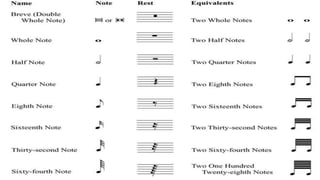
Notes- relative time values indicated in
musical notation by symbols
Types of Notes
Elements of Music
A. RHYTHM
The tones and silences of varying durations
moving through time
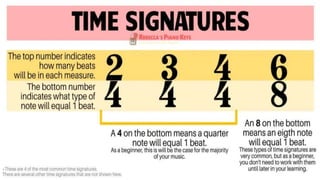
Time signatures:
1. 2/4
2. 3/4
3. 4/4
4. 6/8
B. MELODY
Melody is the pitch added to the rhythm
other synonymous terms: Tune, air,
theme, motif and melodic line.
Characteristics of Melody:
A. Dimension
a. Length - an amount of time or how long or
short a note, phrase, section, or composition
lasts.
b. Range -distance between the highest and
lowest notes.
Characteristics of Melody:
B. Progression
The motion of upward or downward, the
distance between one tone and the next as
the melody moves forward.
Characteristics of Melody:
C. Direction
Considers the distance between
individual, successive tones - Relate to
the climax of the repertoire.
D. Register
Considers the pitch of most notes Are they
mostly high.
3. HARMONY
The simultaneous sounding of tones .
Melody is the horizontal aspect while harmony the vertical
side.
Tonality - or key feeling results when a single key is used
thus providing a tonal center.
Chord -3 or more tones of different pitches sounded
together .
Consonance- quality when the combination of sounds or
tones is satisfying or pleasant. If unpleasant - dissonance
or discord (producing tension)
4. TONE COLOR
This is the result of tempo, dynamics and the timbre
or the medium or mediums.
Tempo - speed indicated into:
a. presto – very fast
b. Allegro -fast
c. Moderato - moderate speed
d. andante- moderate slow
4. TONE COLOR
e. Adagio -slow
f . Largo -very slow
g. Ritardando -the gradual slowing down
h. Accelerando -gradual increase
i. Tempo rubato -music to be played with
irregularity.
5. TEXTURE
This is the characteristic disposition and
relationship between melody and harmony.
Types of Textures:
1. Monophonic - one melody is sung or played with
no accompaniment
2. Homophonic - song sung to the chordal
accompaniment of a guitar or piano or any
instrument or two people sing one soprano and the
other alto, homophonic music is produced.
5. TEXTURE
3. Polyphonic - Polyphonic results when two or
more melodies are played together
4.Heterophony- is a texture created by the
simultaneously varying a single melody. It is usually
associated with non-folk or non-Western music.
6. FORM
The overall design or plan is called a musical
structure or musical form.
Sectional forms:
Binary Form
Ternary Form

Auditory Arts Elements MID LESSONSS.pptx

  • 1.
  • 2.
    What is music? Music-is composed of tones and silences organized in such a manner to convey the emotions and ideas conceived by the composer Music, art concerned with combining vocal or instrumental sounds for beauty of form or emotional expression, usually according to cultural standards of rhythm, melody, and, in most Western music, harmony. Music is an art that, in one guise or another, permeates every human society.
  • 3.
    What is music? Throughouthistory, music has been an important adjunct to ritual and drama and has been credited with the capacity to reflect and influence human emotion. Popular culture has consistently exploited these possibilities, most conspicuously today by means of radio, film, television, musical theatre, and the Internet.
  • 4.
    Music as auditoryart Music moves through time, thus it is called temporal. Music appreciation is the acquired ability to listen to music intelligently.
  • 5.
    3 components ofmusic: -ability to appreciate music is not inborn -acquired by anyone who makes up his mind to do so -conscious effort
  • 6.
    Functions of Music 1.An attempt to imitate the natural sound 2. Release of one’s emotions or feelings (therapeutic) 3. As signals in wars 4. Means of worship and vehicles of rituals 5. Used to accompany dance 6. A form of entertainment in community celebrations 7. Symbols of life’s cycles
  • 7.
    Sound (Tones): ThePhysical Material Property of Music Vibration is what produced a sound Regular vibrations produce tones or musical sounds Irregular sounds yield noise
  • 8.
    Four general qualitiesin sound: 1. Timbre This refers to the quality which enables us to distinguish one sound from another A sound may not be audible unless it is amplified by something. Resonator- any object which amplifies the vibrations.
  • 9.
    Four general qualitiesin sound: 2. Pitch This refers to the relative highness or lowness or a tone This is the result of the frequency of vibrations The higher the frequency the higher the pitch
  • 10.
    Four general qualitiesin sound: Scale- series of different tones which are arranged at definite fixed distances or intervals from one another. Octave- western music uses a scale consisting of 12 pitches in 7 different tones designated as: A, B, C, D, E, F, G or la, ti, do, re, mi fa sol. Sharps- mean a tone is to be raised Flats- tone to be lowered
  • 11.
    Four general qualitiesin sound: 3. Intensity This refers to the loudness or softness of a sound This results from the pressure or force which is used to cause the vibrations that produce a sound Dynamics- the degree of loudness or softness in music
  • 12.
    Four general qualitiesin sound: Dynamics Indicators: A. Forte- loudly B. Fortissimo- very loudly C. Piano - softly D. Pianissimo- very softly
  • 13.
    Four general qualitiesin sound: Dynamics Indicators: E. Mezzo Forte - medium loud F. Mezzo Piano - medium soft G. Crescendo- gradually louder H.Decrescendo or diminuendo- gradually softer
  • 14.
    Four general qualitiesin sound: 4. Duration It refers to the length of time which a sound occupies. Notes- relative time values indicated in musical notation by symbols
  • 15.
  • 17.
  • 18.
    A. RHYTHM The tonesand silences of varying durations moving through time Time signatures: 1. 2/4 2. 3/4 3. 4/4 4. 6/8
  • 20.
    B. MELODY Melody isthe pitch added to the rhythm other synonymous terms: Tune, air, theme, motif and melodic line.
  • 21.
    Characteristics of Melody: A.Dimension a. Length - an amount of time or how long or short a note, phrase, section, or composition lasts. b. Range -distance between the highest and lowest notes.
  • 22.
    Characteristics of Melody: B.Progression The motion of upward or downward, the distance between one tone and the next as the melody moves forward.
  • 23.
    Characteristics of Melody: C.Direction Considers the distance between individual, successive tones - Relate to the climax of the repertoire. D. Register Considers the pitch of most notes Are they mostly high.
  • 24.
    3. HARMONY The simultaneoussounding of tones . Melody is the horizontal aspect while harmony the vertical side. Tonality - or key feeling results when a single key is used thus providing a tonal center. Chord -3 or more tones of different pitches sounded together . Consonance- quality when the combination of sounds or tones is satisfying or pleasant. If unpleasant - dissonance or discord (producing tension)
  • 25.
    4. TONE COLOR Thisis the result of tempo, dynamics and the timbre or the medium or mediums. Tempo - speed indicated into: a. presto – very fast b. Allegro -fast c. Moderato - moderate speed d. andante- moderate slow
  • 26.
    4. TONE COLOR e.Adagio -slow f . Largo -very slow g. Ritardando -the gradual slowing down h. Accelerando -gradual increase i. Tempo rubato -music to be played with irregularity.
  • 27.
    5. TEXTURE This isthe characteristic disposition and relationship between melody and harmony. Types of Textures: 1. Monophonic - one melody is sung or played with no accompaniment 2. Homophonic - song sung to the chordal accompaniment of a guitar or piano or any instrument or two people sing one soprano and the other alto, homophonic music is produced.
  • 28.
    5. TEXTURE 3. Polyphonic- Polyphonic results when two or more melodies are played together 4.Heterophony- is a texture created by the simultaneously varying a single melody. It is usually associated with non-folk or non-Western music.
  • 29.
    6. FORM The overalldesign or plan is called a musical structure or musical form. Sectional forms: Binary Form Ternary Form