Music
● Recognize the origin and importance of Music.
● Appreciate the role of music in our lives.
● Discuss the essentials in songwriting.
● Demonstrate understanding of the different music genres.
● Demonstrate understanding of the classification of musical instruments.
● Display an ability to do song composition
Music gives life and mood. It is one of the greatest ways to effectively express one’s
emotion and the fastest way to let people relate and connect.
The same with music, may you easily relate to the lesson and set you in a good mood as
you explore this new topic.
Most Filipino people feel they are outstanding musicians. We Filipinos cannot dispute that music is
one of our stress relievers. You can see that music is never missing on every occasion. Music brings us
together with people. We shall explain how crucial and how everything started in this subject. So let's take
the proper lesson.
History and Importance of Music
Music is a kind of art in which sound is used. The name 'music' comes as a reference to the Greek
word mousike, meaning 'Art of the Muses.' It can create a coherent and continuous composition through
coordinated sequencing of tones. Music is an essential element in the lives of many individuals from different
civilizations. It is an art genre that includes plausibly combining sounds.
Musical instruments, such as drums, pianos, and guidelines can generate and launch musical
vibrations into the air. These numerous musical instruments are the composer's mediums of expression; they
are how he communicates with the listener.
The notes represent the pitches and duration of the music. The symbols show that the higher or
lower the pitch, the higher the note on the staff. The more notice is—moreover, the lower the notes, the lower
the pitch of the tone.
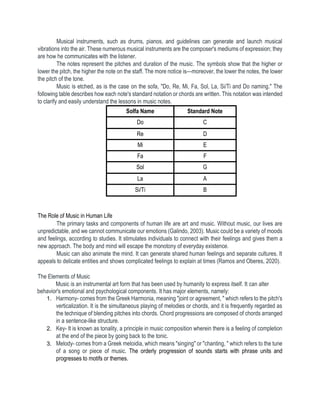
Music is etched, as is the case on the sofa, "Do, Re, Mi, Fa, Sol, La, Si/Ti and Do naming." The
following table describes how each note's standard notation or chords are written. This notation was intended
to clarify and easily understand the lessons in music notes.
Solfa Name Standard Note
Do C
Re D
Mi E
Fa F
Sol G
La A
Si/Ti B
The Role of Music in Human Life
The primary tasks and components of human life are art and music. Without music, our lives are
unpredictable, and we cannot communicate our emotions (Galindo, 2003). Music could be a variety of moods
and feelings, according to studies. It stimulates individuals to connect with their feelings and gives them a
new approach. The body and mind will escape the monotony of everyday existence.
Music can also animate the mind. It can generate shared human feelings and separate cultures. It
appeals to delicate entities and shows complicated feelings to explain at times (Ramos and Oberes, 2020).
The Elements of Music
Music is an instrumental art form that has been used by humanity to express itself. It can alter
behavior's emotional and psychological components. It has major elements, namely:
1. Harmony- comes from the Greek Harmonia, meaning "joint or agreement, " which refers to the pitch's
verticalization. It is the simultaneous playing of melodies or chords, and it is frequently regarded as
the technique of blending pitches into chords. Chord progressions are composed of chords arranged
in a sentence-like structure.
2. Key- It is known as tonality, a principle in music composition wherein there is a feeling of completion
at the end of the piece by going back to the tonic.
3. Melody- comes from a Greek meloidia, which means "singing" or "chanting, " which refers to the tune
of a song or piece of music. The orderly progression of sounds starts with phrase units and
progresses to motifs or themes.
4. Pitch- refers to the perceptual property that allows the ordering of sounds on a Frequency. It refers
to a low or high tone on a musical scale.
5. Rhythm- comes from the Greek word rhythmos, which means "any regular recurring motion." It refers
to the swing, sway, beat, rocking, dance action, and the pattern of sound in time and beats in music.
6. Tempo- This is an Italian word that means time. It regards the speed (slow or fast) of a given piece
of music.
7. Texture- refers to how the harmonic materials are combined in a composition. It relates to the quality
of tones heard and generated, whether thin or thick, and produced by many or few instruments. It
could be monophonic (single melodic line), polyphonic (two or more melodic lines), Or homophonic
(the main melody accompanied by chords).
8. Timbre- This is the unique quality of sound created by other instruments. The sound (tone) quality
separates one voice or instrument from another.
The Essentials in Songwriting
A song is a singing composition of the vocals. Songs can be accompanied by musical instruments
or not, as in Cappella songs. It might be like choral plays for a solo, a duet, a trio, or a large group. What
should be done to succeed is the techniques for songwriting. These are the fundamental songwriting criteria
(Kamien, 1997).
1. Arrangement- it is a reconceptualization of a previously composed work. It includes the order in which
the music sections are placed (such as intro-verse-chorus-verse-chorus) and instrumentation,
vocals, and other musical elements that make up a song.
2. Beat and Rhythm. The beat is the speed (tempo) of the song that drives the audience to feel either
fast or slow. On the other hand, the rhythm is the beat that the various instruments such as bass,
drum, and guitar have produced.
3. Chords (Chord Progression)- refer to any harmonic set of pitches accompanying the song's melody.
It is produced when multiple pitches (notes on a musical instrument) are placed on staff (a music
sheet). It comes in different varieties, including augmented chords, major chords, minor chords,
diminished chords, seventh chords (three-note chord or triad), and Neapolitan chords (major chord).
4. Concept (Story)- All songs have a storyline. The title of any song will convey the essence of that
story idea, and the words (lyric) will expound upon that idea.
5. Genre and Style- The song genre, such as pop, hip-hop, punk rock, country, and alternative type of
music, is established by the beat and rhythm of the song.
6. Length- The length of a song is always considered, depending on its use. It can be shorter or longer,
but this is the typical length of today's musical arrangement.
7. Lyrics- This term derives from the Greek word lyrikos, which means "singing to the lyre." It describes
an idea of a theme, which rhymes in the music sections.
8. Melody- it is the harmony of the basis of the
song. It is the main line of music and the basis of the song.
9. Song Sections- Songs are divided into sections or components: intro, verse, chorus, bridge, lead
breaks, etc.
Music Genres
The music is distinct in every piece. Everything rests on the musician or composer's organization
and expression of its song. There are diverse types of music, and it can sometimes be a wonderful experience
to work with different musicians. It also brings new fans to the music created by an artist. Varying genres of
music can contribute to calming a distressed soul, improving concentration, and encouraging us to be happy.
There are certain types of music:
1. Classical Music- This music is a sophisticated form of composition, as it requires skills like learning
the ability to coordinate with other musicians.
2. Folk Music- is people's, race's, or nation's spontaneous, traditional music, and it reflects the emotions
of an ordinary group. Folk music is divided into two sub-genres: cultural and popular music.
3. Funk- This music became popular in the late 1960s. Funk made rhythm the essential element while
de-emphasizing melody.
4. Hip-hop Music- always includes using an instrument such as bass, drums, guitar, piano, violin, and
fiddle. In this music, the primary tool is the bass. This type of music can be used in different intensities
to emote anger or pride.
5. Jazz- It's an exhilarating type of music in which melody and rhythm are in perfect harmony. It is
sophisticated and has a strong beat feature of this kind of music. The main instruments used for this
style of music are the cornet, trumpet, and violin.
6. Meta Music- This type of music wherein the melody is influenced by the structure of the songs (known
as "information music").
7. Opera Music- It's one of the most captivating kinds of musical entertainment. This genre features a
remarkable blend of dramatic art and musical inventiveness, and it is performed in front of large
audiences.
8. Rock Music- This music genre needs vocals complemented by bass, drums, and guitar.
Occasionally, piano, synthesizer, saxophone, flute, mandolin, and sitar are also in this genre for a
more profound impact. This type of music has several subgenres, such as hard rock, metal rock, and
progressive rock.
9. Techno Music- This genre is also known as a fusion type of music. It is a form of electronic dance
music based on African-American music styles like electro-jazz and funk.
10. Trance Music- Clubhouses are where this style of music is performed. This music has a fast tempo
and repetitive beats.
Classification of Musical Instruments
Musical instruments are melodic-sounding instruments that have been modified or produced. They're
mostly made to sound like natural sounds for ritual purposes. Their vocal range is frequently categorized in
comparison to other instruments, such as:
1. Alto Instruments- Alto is an Italian word that refers to a high vocal range. In four-part music, it is the
second-highest part.
a. Alto Saxophone- Adolphe Sax, a Belgian instrument designer, invented the saxophone family
of woodwind instruments in 1841. It's a type of device that's typically found in classical music.
b. French Horn- is a brass instrument with a flared bell created from 12-13 feet of tubing twisted
into a coil.
c. English Horn (also identified as cor Anglais)- The oboe is a double-reed woodwind instrument
with two reeds.
d. Viola- is the violin family's middle voice, situated between the violin and the cello. It's a stringed
instrument with a bow.
2. Bass Instruments- It is the most profound sound or instrument. The bass is the lowest form of sound
in a male's voice.
a. The double Bass- is the largest and lowest-pitched bowed string instrument in the modern
symphony orchestra.
b. Bass Guitar- is a stringed instrument with four to eight strings with a larger neck and scale
length. Picking, plucking, slapping, popping, tapping, or thumping are the most common ways
to play it.
c. Bass Saxophone- It is one of the most important low-range saxophone family members, and
it is normally played with the help of a stand.
d. Tuba- It is the largest and deepest-pitched brass instrument available. Vibrating the lips into
a large cup-shaped mouthpiece produces the sound.
3. Baritone Instruments- The baritone is a male voice with a medium range. These brass instruments
with a low pitch belong to the saxhorn family. The saxhorn family consists of brass piston-valve
instruments with conical bores and deep cup-shaped mouthpieces. The saxhorn's sound has a
mellow tone quality, and it combines well with other brass instruments.
a. Bassoon- It belongs to the double reed family of woodwind instruments. The instrument is
sounded by squeezing the reed between the lips and blowing.
b. The baritone Saxophone- is one of the most significant saxophone family members and is the
lowest-pitched saxophone.
c. Bass Clarinet- is frequently heard in symphony orchestras, wind ensembles, marching bands,
and solo performances in modern music.
d. Cello (Violoncello)- is a string instrument that can be plucked or bowed. It has a hardwood
body that is hollow and has two sound holes and four strings going down the body and neck.
e. Baritone Horn- It's a wind instrument made comprised of a brass tube (often of varying length)
that's blown through a cup- or pipe-shaped mouthpiece.
4. Soprano Instruments- It is the most advanced form of a single instrument. If you're singing, it's the
highest part of your voice.
a. A flute- is a wind instrument that makes sound by blowing air through a hole with a complex
series of keys.
b. Violin- is a small string instrument, usually with four strings tuned in perfect fifths.
c. The soprano Saxophone- is a woodwind instrument used in classical music as a solo and
chamber instrument and in concert bands and orchestras.
d. The trumpet- is a buzzing musical instrument usually played by blowing air through closed lips.
e. Clarinet- is a woodwind instrument featuring a single-reed mouthpiece, a straight cylindrical
tube, and a flared bell.
f. Oboe- is a double-reed woodwind instrument with a narrow tubular body with holes stopped
by keys.
g. Piccolo- is the high-pitched woodwind instrument used in orchestras and military bands.
5. Tenor Instruments- In terms of range, it is the highest tone for a male singer.
a. Trombone- When the player's vibrating lips cause the air column inside the device to vibrate,
the result is a musical instrument.
b. Tenor Saxophone- is a medium-sized woodwind instrument popular in jazz bands and one of
the principal voices in a concert or marching band.
Guitar- is a six- or twelve-stringed musical instrument with a fretted fingerboard and often incurved sides
played by plucking or strumming.

Chapter-8-Music.docx

  • 1.
    Music ● Recognize theorigin and importance of Music. ● Appreciate the role of music in our lives. ● Discuss the essentials in songwriting. ● Demonstrate understanding of the different music genres. ● Demonstrate understanding of the classification of musical instruments. ● Display an ability to do song composition Music gives life and mood. It is one of the greatest ways to effectively express one’s emotion and the fastest way to let people relate and connect. The same with music, may you easily relate to the lesson and set you in a good mood as you explore this new topic. Most Filipino people feel they are outstanding musicians. We Filipinos cannot dispute that music is one of our stress relievers. You can see that music is never missing on every occasion. Music brings us together with people. We shall explain how crucial and how everything started in this subject. So let's take the proper lesson. History and Importance of Music Music is a kind of art in which sound is used. The name 'music' comes as a reference to the Greek word mousike, meaning 'Art of the Muses.' It can create a coherent and continuous composition through coordinated sequencing of tones. Music is an essential element in the lives of many individuals from different civilizations. It is an art genre that includes plausibly combining sounds.
  • 2.
    Musical instruments, suchas drums, pianos, and guidelines can generate and launch musical vibrations into the air. These numerous musical instruments are the composer's mediums of expression; they are how he communicates with the listener. The notes represent the pitches and duration of the music. The symbols show that the higher or lower the pitch, the higher the note on the staff. The more notice is—moreover, the lower the notes, the lower the pitch of the tone. Music is etched, as is the case on the sofa, "Do, Re, Mi, Fa, Sol, La, Si/Ti and Do naming." The following table describes how each note's standard notation or chords are written. This notation was intended to clarify and easily understand the lessons in music notes. Solfa Name Standard Note Do C Re D Mi E Fa F Sol G La A Si/Ti B The Role of Music in Human Life The primary tasks and components of human life are art and music. Without music, our lives are unpredictable, and we cannot communicate our emotions (Galindo, 2003). Music could be a variety of moods and feelings, according to studies. It stimulates individuals to connect with their feelings and gives them a new approach. The body and mind will escape the monotony of everyday existence. Music can also animate the mind. It can generate shared human feelings and separate cultures. It appeals to delicate entities and shows complicated feelings to explain at times (Ramos and Oberes, 2020). The Elements of Music Music is an instrumental art form that has been used by humanity to express itself. It can alter behavior's emotional and psychological components. It has major elements, namely: 1. Harmony- comes from the Greek Harmonia, meaning "joint or agreement, " which refers to the pitch's verticalization. It is the simultaneous playing of melodies or chords, and it is frequently regarded as the technique of blending pitches into chords. Chord progressions are composed of chords arranged in a sentence-like structure. 2. Key- It is known as tonality, a principle in music composition wherein there is a feeling of completion at the end of the piece by going back to the tonic. 3. Melody- comes from a Greek meloidia, which means "singing" or "chanting, " which refers to the tune of a song or piece of music. The orderly progression of sounds starts with phrase units and progresses to motifs or themes.
  • 3.
    4. Pitch- refersto the perceptual property that allows the ordering of sounds on a Frequency. It refers to a low or high tone on a musical scale. 5. Rhythm- comes from the Greek word rhythmos, which means "any regular recurring motion." It refers to the swing, sway, beat, rocking, dance action, and the pattern of sound in time and beats in music. 6. Tempo- This is an Italian word that means time. It regards the speed (slow or fast) of a given piece of music. 7. Texture- refers to how the harmonic materials are combined in a composition. It relates to the quality of tones heard and generated, whether thin or thick, and produced by many or few instruments. It could be monophonic (single melodic line), polyphonic (two or more melodic lines), Or homophonic (the main melody accompanied by chords). 8. Timbre- This is the unique quality of sound created by other instruments. The sound (tone) quality separates one voice or instrument from another. The Essentials in Songwriting A song is a singing composition of the vocals. Songs can be accompanied by musical instruments or not, as in Cappella songs. It might be like choral plays for a solo, a duet, a trio, or a large group. What should be done to succeed is the techniques for songwriting. These are the fundamental songwriting criteria (Kamien, 1997). 1. Arrangement- it is a reconceptualization of a previously composed work. It includes the order in which the music sections are placed (such as intro-verse-chorus-verse-chorus) and instrumentation, vocals, and other musical elements that make up a song. 2. Beat and Rhythm. The beat is the speed (tempo) of the song that drives the audience to feel either fast or slow. On the other hand, the rhythm is the beat that the various instruments such as bass, drum, and guitar have produced. 3. Chords (Chord Progression)- refer to any harmonic set of pitches accompanying the song's melody. It is produced when multiple pitches (notes on a musical instrument) are placed on staff (a music sheet). It comes in different varieties, including augmented chords, major chords, minor chords, diminished chords, seventh chords (three-note chord or triad), and Neapolitan chords (major chord). 4. Concept (Story)- All songs have a storyline. The title of any song will convey the essence of that story idea, and the words (lyric) will expound upon that idea. 5. Genre and Style- The song genre, such as pop, hip-hop, punk rock, country, and alternative type of music, is established by the beat and rhythm of the song. 6. Length- The length of a song is always considered, depending on its use. It can be shorter or longer, but this is the typical length of today's musical arrangement. 7. Lyrics- This term derives from the Greek word lyrikos, which means "singing to the lyre." It describes an idea of a theme, which rhymes in the music sections. 8. Melody- it is the harmony of the basis of the song. It is the main line of music and the basis of the song. 9. Song Sections- Songs are divided into sections or components: intro, verse, chorus, bridge, lead breaks, etc. Music Genres The music is distinct in every piece. Everything rests on the musician or composer's organization and expression of its song. There are diverse types of music, and it can sometimes be a wonderful experience
  • 4.
    to work withdifferent musicians. It also brings new fans to the music created by an artist. Varying genres of music can contribute to calming a distressed soul, improving concentration, and encouraging us to be happy. There are certain types of music: 1. Classical Music- This music is a sophisticated form of composition, as it requires skills like learning the ability to coordinate with other musicians. 2. Folk Music- is people's, race's, or nation's spontaneous, traditional music, and it reflects the emotions of an ordinary group. Folk music is divided into two sub-genres: cultural and popular music. 3. Funk- This music became popular in the late 1960s. Funk made rhythm the essential element while de-emphasizing melody. 4. Hip-hop Music- always includes using an instrument such as bass, drums, guitar, piano, violin, and fiddle. In this music, the primary tool is the bass. This type of music can be used in different intensities to emote anger or pride. 5. Jazz- It's an exhilarating type of music in which melody and rhythm are in perfect harmony. It is sophisticated and has a strong beat feature of this kind of music. The main instruments used for this style of music are the cornet, trumpet, and violin. 6. Meta Music- This type of music wherein the melody is influenced by the structure of the songs (known as "information music"). 7. Opera Music- It's one of the most captivating kinds of musical entertainment. This genre features a remarkable blend of dramatic art and musical inventiveness, and it is performed in front of large audiences. 8. Rock Music- This music genre needs vocals complemented by bass, drums, and guitar. Occasionally, piano, synthesizer, saxophone, flute, mandolin, and sitar are also in this genre for a more profound impact. This type of music has several subgenres, such as hard rock, metal rock, and progressive rock. 9. Techno Music- This genre is also known as a fusion type of music. It is a form of electronic dance music based on African-American music styles like electro-jazz and funk. 10. Trance Music- Clubhouses are where this style of music is performed. This music has a fast tempo and repetitive beats. Classification of Musical Instruments Musical instruments are melodic-sounding instruments that have been modified or produced. They're mostly made to sound like natural sounds for ritual purposes. Their vocal range is frequently categorized in comparison to other instruments, such as: 1. Alto Instruments- Alto is an Italian word that refers to a high vocal range. In four-part music, it is the second-highest part. a. Alto Saxophone- Adolphe Sax, a Belgian instrument designer, invented the saxophone family of woodwind instruments in 1841. It's a type of device that's typically found in classical music. b. French Horn- is a brass instrument with a flared bell created from 12-13 feet of tubing twisted into a coil. c. English Horn (also identified as cor Anglais)- The oboe is a double-reed woodwind instrument with two reeds. d. Viola- is the violin family's middle voice, situated between the violin and the cello. It's a stringed instrument with a bow.
  • 5.
    2. Bass Instruments-It is the most profound sound or instrument. The bass is the lowest form of sound in a male's voice. a. The double Bass- is the largest and lowest-pitched bowed string instrument in the modern symphony orchestra. b. Bass Guitar- is a stringed instrument with four to eight strings with a larger neck and scale length. Picking, plucking, slapping, popping, tapping, or thumping are the most common ways to play it. c. Bass Saxophone- It is one of the most important low-range saxophone family members, and it is normally played with the help of a stand. d. Tuba- It is the largest and deepest-pitched brass instrument available. Vibrating the lips into a large cup-shaped mouthpiece produces the sound. 3. Baritone Instruments- The baritone is a male voice with a medium range. These brass instruments with a low pitch belong to the saxhorn family. The saxhorn family consists of brass piston-valve instruments with conical bores and deep cup-shaped mouthpieces. The saxhorn's sound has a mellow tone quality, and it combines well with other brass instruments. a. Bassoon- It belongs to the double reed family of woodwind instruments. The instrument is sounded by squeezing the reed between the lips and blowing. b. The baritone Saxophone- is one of the most significant saxophone family members and is the lowest-pitched saxophone. c. Bass Clarinet- is frequently heard in symphony orchestras, wind ensembles, marching bands, and solo performances in modern music. d. Cello (Violoncello)- is a string instrument that can be plucked or bowed. It has a hardwood body that is hollow and has two sound holes and four strings going down the body and neck. e. Baritone Horn- It's a wind instrument made comprised of a brass tube (often of varying length) that's blown through a cup- or pipe-shaped mouthpiece. 4. Soprano Instruments- It is the most advanced form of a single instrument. If you're singing, it's the highest part of your voice. a. A flute- is a wind instrument that makes sound by blowing air through a hole with a complex series of keys. b. Violin- is a small string instrument, usually with four strings tuned in perfect fifths. c. The soprano Saxophone- is a woodwind instrument used in classical music as a solo and chamber instrument and in concert bands and orchestras. d. The trumpet- is a buzzing musical instrument usually played by blowing air through closed lips. e. Clarinet- is a woodwind instrument featuring a single-reed mouthpiece, a straight cylindrical tube, and a flared bell. f. Oboe- is a double-reed woodwind instrument with a narrow tubular body with holes stopped by keys. g. Piccolo- is the high-pitched woodwind instrument used in orchestras and military bands. 5. Tenor Instruments- In terms of range, it is the highest tone for a male singer. a. Trombone- When the player's vibrating lips cause the air column inside the device to vibrate, the result is a musical instrument.
  • 6.
    b. Tenor Saxophone-is a medium-sized woodwind instrument popular in jazz bands and one of the principal voices in a concert or marching band. Guitar- is a six- or twelve-stringed musical instrument with a fretted fingerboard and often incurved sides played by plucking or strumming.