MUSIC
WHAT IS MUSIC Music  is an  art  form whose  medium  is  sound  organized in  time . Common elements of music are  pitch  (which governs  melody  and  harmony ),  rhythm  (and its associated concepts  tempo ,  meter , and  articulation ),  dynamics , and the sonic qualities of  timbre  and  texture   It vary according to culture and social context.
HISTORY
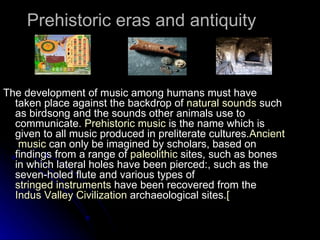
Prehistoric eras and antiquity  The development of music among humans must have taken place against the backdrop of  natural sounds  such as birdsong and the sounds other animals use to communicate.  Prehistoric music  is the name which is given to all music produced in preliterate cultures. Ancient  music  can only be imagined by scholars, based on findings from a range of  paleolithic  sites, such as bones in which lateral holes have been pierced:, such as the seven-holed flute and various types of  stringed instruments  have been recovered from the  Indus Valley Civilization  archaeological sites. [
ELEMENT OF MUSIC
Melody  Pitch  Scales and modes  Rhythm  Harmony  Consonance and dissonance  Dynamics  Texture  Form or structure
Melody  A melody is a series of notes sounding in succession. The notes of a melody are typically created with respect to pitch systems such as  scales  or  modes . Melody is typically divided into phrases within a larger overarching structure. The elements of a melody are  pitch , duration,  dynamics , and  timbre . In the context of theory, a piece of music may be melodically based. In this instance, a composer will first take a melody, and use that to create his work. A harmonically based piece, on the contrary, will focus on a chord progression, with the melody as a secondary or incidental factor of composition
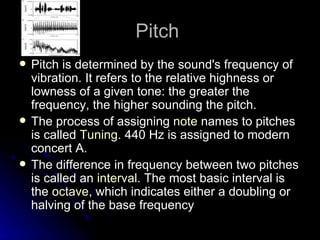
Pitch  Pitch is determined by the sound's frequency of vibration. It refers to the relative highness or lowness of a given tone: the greater the frequency, the higher sounding the pitch. The process of assigning  note  names to pitches is called  Tuning . 440 Hz is assigned to modern concert A. The difference in frequency between two pitches is called an  interval . The most basic interval is the  octave , which indicates either a doubling or halving of the base frequency
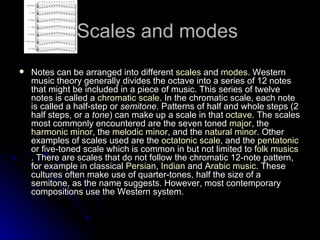
Scales and modes  Notes can be arranged into different  scales  and  modes . Western music theory generally divides the octave into a series of 12 notes that might be included in a piece of music. This series of twelve notes is called a  chromatic scale . In the chromatic scale, each note is called a half-step or  semitone . Patterns of half and whole steps (2 half steps, or a  tone ) can make up a scale in that  octave . The scales most commonly encountered are the seven toned  major , the  harmonic minor , the  melodic minor , and the  natural minor . Other examples of scales used are the  octatonic  scale , and the  pentatonic  or five-toned scale which is common in but not limited to  folk  musics . There are scales that do not follow the chromatic 12-note pattern, for example in classical  Persian ,  Indian  and  Arabic music . These cultures often make use of quarter-tones, half the size of a semitone, as the name suggests. However, most contemporary compositions use the Western system.
Rhythm  Rhythm  is the arrangement of sounds in  time .  Meter  animates time in regular pulse groupings, called  measures or bars . The  time signature  or meter signature specifies how many  beats  are in a measure, and which value of written note is counted and felt as a single beat.. In recent years, rhythm and meter have become an important area of research among music scholars.  Rhythm is one of the most central features of many styles of music, especially  jazz  and  hip-hop . Both of these styles of music involve an underlying repeated rhythm or beat into which more complex patterns are interwoven
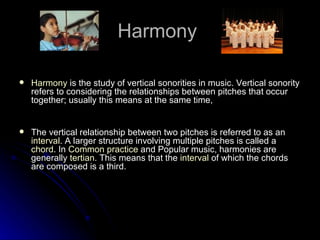
Harmony  Harmony  is the study of vertical sonorities in music. Vertical sonority refers to considering the relationships between pitches that occur together; usually this means at the same time, The vertical relationship between two pitches is referred to as an  interval . A larger structure involving multiple pitches is called a  chord . In  Common practice  and Popular music, harmonies are generally  tertian . This means that the  interval  of which the chords are composed is a third.
Consonance and dissonance  Consonance  can be roughly defined as harmonies whose tones complement and increase each others' resonance, and dissonance as those which create more complex acoustical interactions (called 'beats'). A simplistic example is that of "pleasant" sounds versus "unpleasant" ones. Another manner of thinking about the relationship regards stability; dissonant harmonies are sometimes considered to be unstable and to "want to move" or "resolve" toward consonance. However, this is not to say that dissonance is undesirable. A composition made entirely of consonant harmonies may be pleasing to the ear and yet boring because there are no instabilities to be resolved. Melody is often organized so as to interact with changing harmonies (sometimes called a  chord progression ) that accompany it, setting up consonance and dissonance. The art of melody writing depends heavily upon the choices of tones for their nonharmonic or harmonic character. "Harmony" as used by music theorists can refer to any kind of simultaneity without a value judgement, in contrast with a more common usage of "in harmony" or "harmonious", which in technical language might be described as  consonance
Dynamics  In music, dynamics normally refers to the softness or loudness of a sound or note, e.g. pianissimo or fortissimo. Until recently, most of these dynamics and signs were written in Italian, but recently are becoming written or translated into English. However, to every aspect of the execution of a given piece, either stylistic (staccato, legato etc.) or functional (velocity) are also known as dynamics. The term is also applied to the written or printed musical notation used to indicate dynamics
Texture  Musical texture  is the overall sound of a piece of music commonly described according to the number of and relationship between parts or lines of music:  monophony ,  heterophony ,  polyphony ,  homophony , or  monody . The perceived texture of a piece may also be affected by the timbre of the instruments, the number of instruments used, and the interval between each musical line, among other things. Monophony is the texture of a melody heard only by itself. If a melody is accompanied by chords, the texture is homophony. In homophony, the melody is usually but not always voiced in the highest notes. A third texture, called polyphony, consists of several simultaneous melodies of equal importance.
Form or structure  Form  is a facet of music theory that explores the concept of musical syntax, on a local and global level. The syntax is often explained in terms of phrases and periods (for the local level) or sections or genre (for the global scale). Examples of common forms of Western music include the  fugue , the  invention ,  sonata-allegro ,  canon ,  strophic ,  theme and variations , and  rondo . Popular Music often makes use of  strophic form  often in conjunction with  Twelve bar blues .
PRODUCTION
Composition  Notation  Improvisation
Composition  "Composition" is often classed as the creation and recording of music via a medium by which others can interpret it (i.e. paper or sound). Many cultures use at least part of the concept of preconceiving musical material, or composition, as held in western  classical music . Even when music is notated precisely, there are still many decisions that a performer has to make. The process of a performer deciding how to perform music that has been previously composed and notated is termed interpretation. Different performers' interpretations of the same music can vary widely. Composers and song writers who present their own music are interpreting, just as much as those who perform the music of others or folk music.
Notation  Notation is the written expression of music notes and rhythms on paper using symbols. When music is written down, the pitches and rhythm of the music is notated, along with instructions on how to perform the music. The study of how to read notation involves music theory, harmony, the study of performance practice, and in some cases an understanding of historical performance methods. Written notation varies with style and period of music. In Western Art music, the most common types of written notation are scores, which include all the music parts of an ensemble piece, and parts, which are the music notation for the individual performers or singers. In popular music, jazz, and blues, the standard musical notation is the lead sheet, which notates the melody, chords,  lyrics  (if it is a vocal piece), and structure of the music. Scores and parts are also used in popular music and jazz, particularly in large ensembles such as jazz "big bands." In popular music,  guitarists  and electric  bass  players often read music notated in tablature (often abbreviated as "tab"), which indicates the location of the notes to be played on the instrument using a diagram of the guitar or bass fingerboard. Tabulature was also used in the Baroque era to notate music for the  lute , a stringed, fretted instrument. Notated music is produced as  sheet music .
Improvisation  Musical improvisation  is the creation of  spontaneous music . Improvisation is often considered an act of instantaneous composition by performers, where compositional techniques are employed with or without preparation. Improvisation is a major part of some types of music, such as  blues ,  jazz , and  jazz fusion , in which instrumental performers improvise solos and melody lines. In the Western art music tradition, improvisation was an important skill during the Baroque era and during the Classical era; solo performers and singers would improvise virtuoso cadenzas during concerts. However, in the 20th and 21st century, improvisation played a smaller role in
INSTUMENTS
 
PICTURES OF FAMOUS PERSONALITY IN MUSIC


REALITIES SHOWS
DETAILS TMU 3 YEAR B.A MUSIC 2 YEAR DIPLOMA IN MUSIC DURATION FEE COURSE
SPECIALISATION 6 MONTH DIPLOMA IN FOLK MUSIC & MUSICAL INSTRUMENT DURATION FEE COURSE
OWNERS
OWNERS 3 MONTH BASIC COURE IN VIDEO EDITING & SOUND RECORDING DURATION FEE COURSE
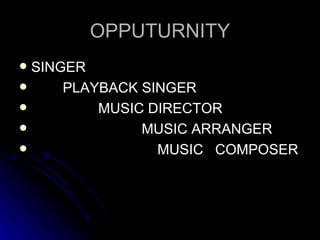
OPPUTURNITY SINGER PLAYBACK SINGER MUSIC DIRECTOR MUSIC ARRANGER MUSIC  COMPOSER
ADMISSION ELIGIBILITY:-10+2 SELECTION PROCEDURE:- APPTITUDE TEST INTERVIEW
QUESTIONS

Music

  • 1.
  • 2.
    WHAT IS MUSICMusic is an art form whose medium is sound organized in time . Common elements of music are pitch (which governs melody and harmony ), rhythm (and its associated concepts tempo , meter , and articulation ), dynamics , and the sonic qualities of timbre and texture It vary according to culture and social context.
  • 3.
  • 4.
    Prehistoric eras andantiquity The development of music among humans must have taken place against the backdrop of natural sounds such as birdsong and the sounds other animals use to communicate. Prehistoric music is the name which is given to all music produced in preliterate cultures. Ancient music can only be imagined by scholars, based on findings from a range of paleolithic sites, such as bones in which lateral holes have been pierced:, such as the seven-holed flute and various types of stringed instruments have been recovered from the Indus Valley Civilization archaeological sites. [
  • 5.
  • 6.
    Melody Pitch Scales and modes Rhythm Harmony Consonance and dissonance Dynamics Texture Form or structure
  • 7.
    Melody Amelody is a series of notes sounding in succession. The notes of a melody are typically created with respect to pitch systems such as scales or modes . Melody is typically divided into phrases within a larger overarching structure. The elements of a melody are pitch , duration, dynamics , and timbre . In the context of theory, a piece of music may be melodically based. In this instance, a composer will first take a melody, and use that to create his work. A harmonically based piece, on the contrary, will focus on a chord progression, with the melody as a secondary or incidental factor of composition
  • 8.
    Pitch Pitchis determined by the sound's frequency of vibration. It refers to the relative highness or lowness of a given tone: the greater the frequency, the higher sounding the pitch. The process of assigning note names to pitches is called Tuning . 440 Hz is assigned to modern concert A. The difference in frequency between two pitches is called an interval . The most basic interval is the octave , which indicates either a doubling or halving of the base frequency
  • 9.
    Scales and modes Notes can be arranged into different scales and modes . Western music theory generally divides the octave into a series of 12 notes that might be included in a piece of music. This series of twelve notes is called a chromatic scale . In the chromatic scale, each note is called a half-step or semitone . Patterns of half and whole steps (2 half steps, or a tone ) can make up a scale in that octave . The scales most commonly encountered are the seven toned major , the harmonic minor , the melodic minor , and the natural minor . Other examples of scales used are the octatonic scale , and the pentatonic or five-toned scale which is common in but not limited to folk musics . There are scales that do not follow the chromatic 12-note pattern, for example in classical Persian , Indian and Arabic music . These cultures often make use of quarter-tones, half the size of a semitone, as the name suggests. However, most contemporary compositions use the Western system.

  • 10.
    Rhythm Rhythm is the arrangement of sounds in time . Meter animates time in regular pulse groupings, called measures or bars . The time signature or meter signature specifies how many beats are in a measure, and which value of written note is counted and felt as a single beat.. In recent years, rhythm and meter have become an important area of research among music scholars. Rhythm is one of the most central features of many styles of music, especially jazz and hip-hop . Both of these styles of music involve an underlying repeated rhythm or beat into which more complex patterns are interwoven
  • 11.
    Harmony Harmony is the study of vertical sonorities in music. Vertical sonority refers to considering the relationships between pitches that occur together; usually this means at the same time, The vertical relationship between two pitches is referred to as an interval . A larger structure involving multiple pitches is called a chord . In Common practice and Popular music, harmonies are generally tertian . This means that the interval of which the chords are composed is a third.
  • 12.
    Consonance and dissonance Consonance can be roughly defined as harmonies whose tones complement and increase each others' resonance, and dissonance as those which create more complex acoustical interactions (called 'beats'). A simplistic example is that of "pleasant" sounds versus "unpleasant" ones. Another manner of thinking about the relationship regards stability; dissonant harmonies are sometimes considered to be unstable and to "want to move" or "resolve" toward consonance. However, this is not to say that dissonance is undesirable. A composition made entirely of consonant harmonies may be pleasing to the ear and yet boring because there are no instabilities to be resolved. Melody is often organized so as to interact with changing harmonies (sometimes called a chord progression ) that accompany it, setting up consonance and dissonance. The art of melody writing depends heavily upon the choices of tones for their nonharmonic or harmonic character. "Harmony" as used by music theorists can refer to any kind of simultaneity without a value judgement, in contrast with a more common usage of "in harmony" or "harmonious", which in technical language might be described as consonance
  • 13.
    Dynamics Inmusic, dynamics normally refers to the softness or loudness of a sound or note, e.g. pianissimo or fortissimo. Until recently, most of these dynamics and signs were written in Italian, but recently are becoming written or translated into English. However, to every aspect of the execution of a given piece, either stylistic (staccato, legato etc.) or functional (velocity) are also known as dynamics. The term is also applied to the written or printed musical notation used to indicate dynamics
  • 14.
    Texture Musicaltexture is the overall sound of a piece of music commonly described according to the number of and relationship between parts or lines of music: monophony , heterophony , polyphony , homophony , or monody . The perceived texture of a piece may also be affected by the timbre of the instruments, the number of instruments used, and the interval between each musical line, among other things. Monophony is the texture of a melody heard only by itself. If a melody is accompanied by chords, the texture is homophony. In homophony, the melody is usually but not always voiced in the highest notes. A third texture, called polyphony, consists of several simultaneous melodies of equal importance.
  • 15.
    Form or structure Form is a facet of music theory that explores the concept of musical syntax, on a local and global level. The syntax is often explained in terms of phrases and periods (for the local level) or sections or genre (for the global scale). Examples of common forms of Western music include the fugue , the invention , sonata-allegro , canon , strophic , theme and variations , and rondo . Popular Music often makes use of strophic form often in conjunction with Twelve bar blues .
  • 16.
  • 17.
    Composition Notation Improvisation
  • 18.
    Composition "Composition"is often classed as the creation and recording of music via a medium by which others can interpret it (i.e. paper or sound). Many cultures use at least part of the concept of preconceiving musical material, or composition, as held in western classical music . Even when music is notated precisely, there are still many decisions that a performer has to make. The process of a performer deciding how to perform music that has been previously composed and notated is termed interpretation. Different performers' interpretations of the same music can vary widely. Composers and song writers who present their own music are interpreting, just as much as those who perform the music of others or folk music.
  • 19.
    Notation Notationis the written expression of music notes and rhythms on paper using symbols. When music is written down, the pitches and rhythm of the music is notated, along with instructions on how to perform the music. The study of how to read notation involves music theory, harmony, the study of performance practice, and in some cases an understanding of historical performance methods. Written notation varies with style and period of music. In Western Art music, the most common types of written notation are scores, which include all the music parts of an ensemble piece, and parts, which are the music notation for the individual performers or singers. In popular music, jazz, and blues, the standard musical notation is the lead sheet, which notates the melody, chords, lyrics (if it is a vocal piece), and structure of the music. Scores and parts are also used in popular music and jazz, particularly in large ensembles such as jazz "big bands." In popular music, guitarists and electric bass players often read music notated in tablature (often abbreviated as "tab"), which indicates the location of the notes to be played on the instrument using a diagram of the guitar or bass fingerboard. Tabulature was also used in the Baroque era to notate music for the lute , a stringed, fretted instrument. Notated music is produced as sheet music .
  • 20.
    Improvisation Musicalimprovisation is the creation of spontaneous music . Improvisation is often considered an act of instantaneous composition by performers, where compositional techniques are employed with or without preparation. Improvisation is a major part of some types of music, such as blues , jazz , and jazz fusion , in which instrumental performers improvise solos and melody lines. In the Western art music tradition, improvisation was an important skill during the Baroque era and during the Classical era; solo performers and singers would improvise virtuoso cadenzas during concerts. However, in the 20th and 21st century, improvisation played a smaller role in
  • 21.
  • 22.
  • 23.
    PICTURES OF FAMOUSPERSONALITY IN MUSIC
  • 24.
  • 25.
  • 26.
  • 27.
  • 28.
  • 29.
  • 30.
    DETAILS TMU 3YEAR B.A MUSIC 2 YEAR DIPLOMA IN MUSIC DURATION FEE COURSE
  • 31.
    SPECIALISATION 6 MONTHDIPLOMA IN FOLK MUSIC & MUSICAL INSTRUMENT DURATION FEE COURSE
  • 32.
  • 33.
    OWNERS 3 MONTHBASIC COURE IN VIDEO EDITING & SOUND RECORDING DURATION FEE COURSE
  • 34.
    OPPUTURNITY SINGER PLAYBACKSINGER MUSIC DIRECTOR MUSIC ARRANGER MUSIC COMPOSER
  • 35.
    ADMISSION ELIGIBILITY:-10+2 SELECTIONPROCEDURE:- APPTITUDE TEST INTERVIEW
  • 36.