12/21/2018 1
The Earliest Known Musical Instrument
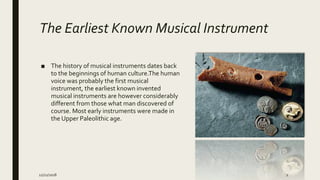
■ The history of musical instruments dates back
to the beginnings of human culture.The human
voice was probably the first musical
instrument, the earliest known invented
musical instruments are however considerably
different from those what man discovered of
course. Most early instruments were made in
the Upper Paleolithic age.
12/21/2018 2
Families of Musical Instruments
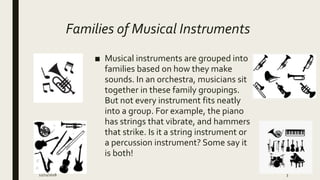
■ Musical instruments are grouped into
families based on how they make
sounds. In an orchestra, musicians sit
together in these family groupings.
But not every instrument fits neatly
into a group. For example, the piano
has strings that vibrate, and hammers
that strike. Is it a string instrument or
a percussion instrument? Some say it
is both!
12/21/2018 3
Brass Instruments
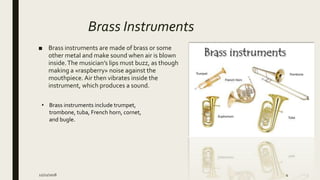
■ Brass instruments are made of brass or some
other metal and make sound when air is blown
inside.The musician’s lips must buzz, as though
making a «raspberry» noise against the
mouthpiece. Air then vibrates inside the
instrument, which produces a sound.
• Brass instruments include trumpet,
trombone, tuba, French horn, cornet,
and bugle.
12/21/2018 4
Brass Instruments
■ Modern brass instruments produce sound through a metal mouthpiece.The
mouthpiece is similar on most brass instruments, usually varying only in size. Sound is
produced by placing the lips on the mouthpiece and blowing while vibrating the lips.
The larger the mouthpiece, the lower the sound of the instrument.
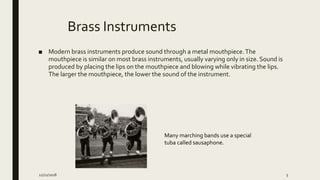
Many marching bands use a special
tuba called sausaphone.
12/21/2018 5
Percussion Instruments
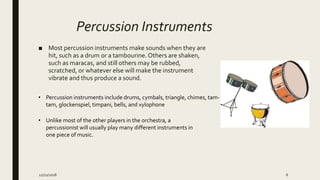
■ Most percussion instruments make sounds when they are
hit, such as a drum or a tambourine. Others are shaken,
such as maracas, and still others may be rubbed,
scratched, or whatever else will make the instrument
vibrate and thus produce a sound.
• Percussion instruments include drums, cymbals, triangle, chimes, tam-
tam, glockenspiel, timpani, bells, and xylophone
• Unlike most of the other players in the orchestra, a
percussionist will usually play many different instruments in
one piece of music.
12/21/2018 6
Percussion instruments
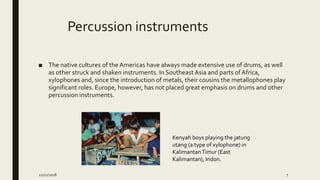
■ The native cultures of the Americas have always made extensive use of drums, as well
as other struck and shaken instruments. In Southeast Asia and parts of Africa,
xylophones and, since the introduction of metals, their cousins the metallophones play
significant roles. Europe, however, has not placed great emphasis on drums and other
percussion instruments.
Kenyah boys playing the jatung
utang (a type of xylophone) in
KalimantanTimur (East
Kalimantan), Indon.
12/21/2018 7
String Instruments
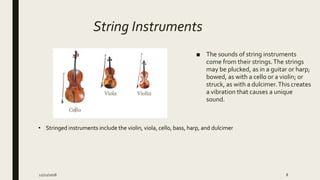
■ The sounds of string instruments
come from their strings.The strings
may be plucked, as in a guitar or harp;
bowed, as with a cello or a violin; or
struck, as with a dulcimer.This creates
a vibration that causes a unique
sound.
• Stringed instruments include the violin, viola, cello, bass, harp, and dulcimer
12/21/2018 8
String Instruments
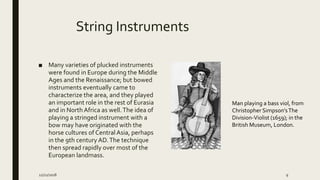
■ Many varieties of plucked instruments
were found in Europe during the Middle
Ages and the Renaissance; but bowed
instruments eventually came to
characterize the area, and they played
an important role in the rest of Eurasia
and in NorthAfrica as well.The idea of
playing a stringed instrument with a
bow may have originated with the
horse cultures of Central Asia, perhaps
in the 9th century AD.The technique
then spread rapidly over most of the
European landmass.
Man playing a bass viol, from
Christopher Simpson’sThe
Division-Violist (1659); in the
British Museum, London.
12/21/2018 9
Woodwind Instruments
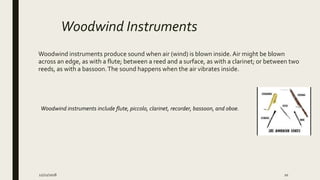
Woodwind instruments produce sound when air (wind) is blown inside.Air might be blown
across an edge, as with a flute; between a reed and a surface, as with a clarinet; or between two
reeds, as with a bassoon.The sound happens when the air vibrates inside.
Woodwind instruments include flute, piccolo, clarinet, recorder, bassoon, and oboe.
12/21/2018 10
Woodwind Instruments
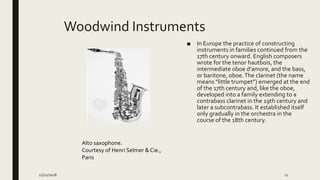
■ In Europe the practice of constructing
instruments in families continued from the
17th century onward. English composers
wrote for the tenor hautbois, the
intermediate oboe d’amore, and the bass,
or baritone, oboe.The clarinet (the name
means “little trumpet”) emerged at the end
of the 17th century and, like the oboe,
developed into a family extending to a
contrabass clarinet in the 19th century and
later a subcontrabass. It established itself
only gradually in the orchestra in the
course of the 18th century.
Alto saxophone.
Courtesy of Henri Selmer & Cie.,
Paris
12/21/2018 11
Instrumental Demonstration
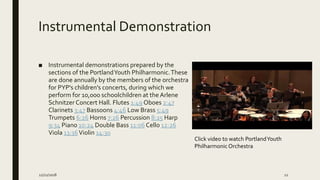
■ Instrumental demonstrations prepared by the
sections of the PortlandYouth Philharmonic.These
are done annually by the members of the orchestra
for PYP's children's concerts, during which we
perform for 10,000 schoolchildren at the Arlene
Schnitzer Concert Hall. Flutes 1:49 Oboes 2:47
Clarinets 3:47 Bassoons 4:46 Low Brass 5:49
Trumpets 6:26 Horns 7:26 Percussion 8:25 Harp
9:34 Piano 10:24 Double Bass 11:06 Cello 12:26
Viola 13:36Violin 14:30
12/21/2018 12
Click video to watch PortlandYouth
Philharmonic Orchestra
Classification of Musical Instruments
12/21/2018 13
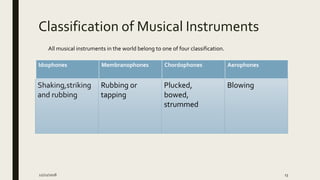
All musical instruments in the world belong to one of four classification.
Idıophones Membranophones Chordophones Aerophones
Shaking,striking
and rubbing
Rubbing or
tapping
Plucked,
bowed,
strummed
Blowing

Musical instruments

  • 1.
  • 2.
    The Earliest KnownMusical Instrument ■ The history of musical instruments dates back to the beginnings of human culture.The human voice was probably the first musical instrument, the earliest known invented musical instruments are however considerably different from those what man discovered of course. Most early instruments were made in the Upper Paleolithic age. 12/21/2018 2
  • 3.
    Families of MusicalInstruments ■ Musical instruments are grouped into families based on how they make sounds. In an orchestra, musicians sit together in these family groupings. But not every instrument fits neatly into a group. For example, the piano has strings that vibrate, and hammers that strike. Is it a string instrument or a percussion instrument? Some say it is both! 12/21/2018 3
  • 4.
    Brass Instruments ■ Brassinstruments are made of brass or some other metal and make sound when air is blown inside.The musician’s lips must buzz, as though making a «raspberry» noise against the mouthpiece. Air then vibrates inside the instrument, which produces a sound. • Brass instruments include trumpet, trombone, tuba, French horn, cornet, and bugle. 12/21/2018 4
  • 5.
    Brass Instruments ■ Modernbrass instruments produce sound through a metal mouthpiece.The mouthpiece is similar on most brass instruments, usually varying only in size. Sound is produced by placing the lips on the mouthpiece and blowing while vibrating the lips. The larger the mouthpiece, the lower the sound of the instrument. Many marching bands use a special tuba called sausaphone. 12/21/2018 5
  • 6.
    Percussion Instruments ■ Mostpercussion instruments make sounds when they are hit, such as a drum or a tambourine. Others are shaken, such as maracas, and still others may be rubbed, scratched, or whatever else will make the instrument vibrate and thus produce a sound. • Percussion instruments include drums, cymbals, triangle, chimes, tam- tam, glockenspiel, timpani, bells, and xylophone • Unlike most of the other players in the orchestra, a percussionist will usually play many different instruments in one piece of music. 12/21/2018 6
  • 7.
    Percussion instruments ■ Thenative cultures of the Americas have always made extensive use of drums, as well as other struck and shaken instruments. In Southeast Asia and parts of Africa, xylophones and, since the introduction of metals, their cousins the metallophones play significant roles. Europe, however, has not placed great emphasis on drums and other percussion instruments. Kenyah boys playing the jatung utang (a type of xylophone) in KalimantanTimur (East Kalimantan), Indon. 12/21/2018 7
  • 8.
    String Instruments ■ Thesounds of string instruments come from their strings.The strings may be plucked, as in a guitar or harp; bowed, as with a cello or a violin; or struck, as with a dulcimer.This creates a vibration that causes a unique sound. • Stringed instruments include the violin, viola, cello, bass, harp, and dulcimer 12/21/2018 8
  • 9.
    String Instruments ■ Manyvarieties of plucked instruments were found in Europe during the Middle Ages and the Renaissance; but bowed instruments eventually came to characterize the area, and they played an important role in the rest of Eurasia and in NorthAfrica as well.The idea of playing a stringed instrument with a bow may have originated with the horse cultures of Central Asia, perhaps in the 9th century AD.The technique then spread rapidly over most of the European landmass. Man playing a bass viol, from Christopher Simpson’sThe Division-Violist (1659); in the British Museum, London. 12/21/2018 9
  • 10.
    Woodwind Instruments Woodwind instrumentsproduce sound when air (wind) is blown inside.Air might be blown across an edge, as with a flute; between a reed and a surface, as with a clarinet; or between two reeds, as with a bassoon.The sound happens when the air vibrates inside. Woodwind instruments include flute, piccolo, clarinet, recorder, bassoon, and oboe. 12/21/2018 10
  • 11.
    Woodwind Instruments ■ InEurope the practice of constructing instruments in families continued from the 17th century onward. English composers wrote for the tenor hautbois, the intermediate oboe d’amore, and the bass, or baritone, oboe.The clarinet (the name means “little trumpet”) emerged at the end of the 17th century and, like the oboe, developed into a family extending to a contrabass clarinet in the 19th century and later a subcontrabass. It established itself only gradually in the orchestra in the course of the 18th century. Alto saxophone. Courtesy of Henri Selmer & Cie., Paris 12/21/2018 11
  • 12.
    Instrumental Demonstration ■ Instrumentaldemonstrations prepared by the sections of the PortlandYouth Philharmonic.These are done annually by the members of the orchestra for PYP's children's concerts, during which we perform for 10,000 schoolchildren at the Arlene Schnitzer Concert Hall. Flutes 1:49 Oboes 2:47 Clarinets 3:47 Bassoons 4:46 Low Brass 5:49 Trumpets 6:26 Horns 7:26 Percussion 8:25 Harp 9:34 Piano 10:24 Double Bass 11:06 Cello 12:26 Viola 13:36Violin 14:30 12/21/2018 12 Click video to watch PortlandYouth Philharmonic Orchestra
  • 13.
    Classification of MusicalInstruments 12/21/2018 13 All musical instruments in the world belong to one of four classification. Idıophones Membranophones Chordophones Aerophones Shaking,striking and rubbing Rubbing or tapping Plucked, bowed, strummed Blowing