Elements of Music
Let's start with an acronym:SHMRF (pronounced like Sh-murf)  		SoundHarmonyMelodyRhythmForm
SoundSound can be described as three elements: TEXTURE timbreDynamicsTexture  =  the combination of melodiesTimbre  =  the sound of an instrument or voiceDynamics = the volume of music
Monophonic or monophony - one unaccompanied melody Texture
Homophonic or homophony - melody and harmonyTexture
Polyphonic or polyphony– two or more melodies togethertexture
TimbreDescribes how something sounds:BrightTinnyReedyDarkBrassyOr the way a particular instrument sounds (even two of the same instruments)
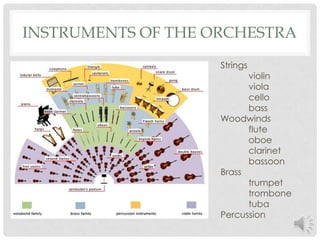
Instruments of the OrchestraStringsviolinviolacellobassWoodwindsflute	oboeclarinetbassoonBrasstrumpettrombonetubaPercussion
Benjamin Britten’s Young Person’s Guide to the OrchestraExample of different orchestral Groups
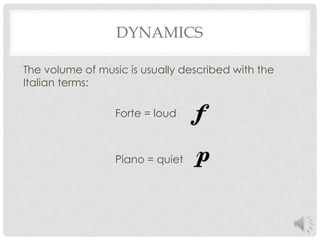
DynamicsThe volume of music is usually described with the Italian terms:			Forte = loud			Piano = quiet
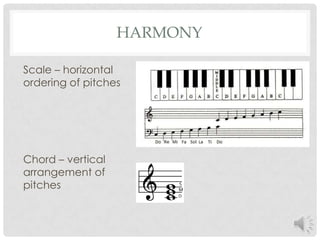
HarmonyScale – horizontal ordering of pitchesChord – vertical arrangement of pitches
Harmony - MajorMoods: happy, heroic, joyous, etc. (For more read this lesson on Major Keys and Scales)The Sea Hawk (1940)Note change in music at 0:56 to Major when we see the ship
Harmony - MinorMoods:sad, melancholic, introspective, etc. (For more read this lesson on Minor Keys and Scales)Bambi (1942): Bambi’s mom dies (watch from 0:40-3:02 – at 3:03 there is an abrupt segue to major)
Harmony – DissonanceDissonance harmonic clash of sounds outside of Major and Minor keysPlanet of the Apes (1968)The score for this movie is dissonant all the way through.
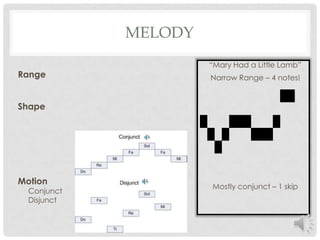
MelodyRangeShape MotionConjunctDisjunct“Mary Had a Little Lamb”Narrow Range – 4 notes!Mostly conjunct – 1 skip
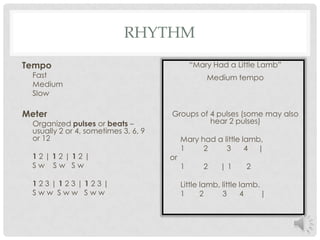
RhythmTempoFastMediumSlowMeterOrganized pulses or beats – usually 2 or 4, sometimes 3, 6, 9 or 121 2 | 1 2 | 1 2 |S w    S w   S w1 2 3 | 1 2 3 | 1 2 3 |S w w  S w w   S w w“Mary Had a Little Lamb”Medium tempoGroups of 4 pulses (some may also hear 2 pulses)     Mary had a little lamb,     1         2         3      4     |or     1         2      | 1       2     Little lamb, little lamb.    1       2         3      4        |
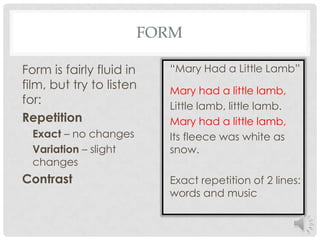
FormForm is fairly fluid in film, but try to listen for:Repetition Exact – no changesVariation – slight changesContrast“Mary Had a Little Lamb”Mary had a little lamb,Little lamb, little lamb.Mary had a little lamb,Its fleece was white as snow.Exact repetition of 2 lines: words and music
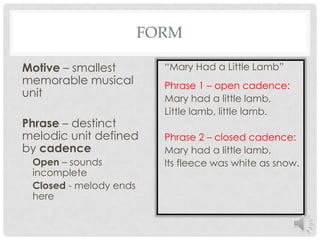
FormMotive – smallest memorable musical unitPhrase – destinct melodic unit defined by cadenceOpen – sounds incompleteClosed - melody ends here“Mary Had a Little Lamb”Phrase 1 – open cadence:Mary had a little lamb,Little lamb, little lamb.Phrase 2 – closed cadence:Mary had a little lamb,Its fleece was white as snow.
Your turnGo to the discussion forum called “Elements of Music” and describe what you hear in the music excerpts given there.

Elements of music

  • 1.
  • 2.
    Let's start withan acronym:SHMRF (pronounced like Sh-murf)  SoundHarmonyMelodyRhythmForm
  • 3.
    SoundSound can bedescribed as three elements: TEXTURE timbreDynamicsTexture = the combination of melodiesTimbre = the sound of an instrument or voiceDynamics = the volume of music
  • 4.
    Monophonic or monophony- one unaccompanied melody Texture
  • 5.
    Homophonic or homophony- melody and harmonyTexture
  • 6.
    Polyphonic or polyphony–two or more melodies togethertexture
  • 7.
    TimbreDescribes how somethingsounds:BrightTinnyReedyDarkBrassyOr the way a particular instrument sounds (even two of the same instruments)
  • 8.
    Instruments of theOrchestraStringsviolinviolacellobassWoodwindsflute oboeclarinetbassoonBrasstrumpettrombonetubaPercussion
  • 9.
    Benjamin Britten’s YoungPerson’s Guide to the OrchestraExample of different orchestral Groups
  • 10.
    DynamicsThe volume ofmusic is usually described with the Italian terms: Forte = loud Piano = quiet
  • 11.
    HarmonyScale – horizontalordering of pitchesChord – vertical arrangement of pitches
  • 12.
    Harmony - MajorMoods:happy, heroic, joyous, etc. (For more read this lesson on Major Keys and Scales)The Sea Hawk (1940)Note change in music at 0:56 to Major when we see the ship
  • 13.
    Harmony - MinorMoods:sad,melancholic, introspective, etc. (For more read this lesson on Minor Keys and Scales)Bambi (1942): Bambi’s mom dies (watch from 0:40-3:02 – at 3:03 there is an abrupt segue to major)
  • 14.
    Harmony – DissonanceDissonanceharmonic clash of sounds outside of Major and Minor keysPlanet of the Apes (1968)The score for this movie is dissonant all the way through.
  • 15.
    MelodyRangeShape MotionConjunctDisjunct“Mary Hada Little Lamb”Narrow Range – 4 notes!Mostly conjunct – 1 skip
  • 16.
    RhythmTempoFastMediumSlowMeterOrganized pulses orbeats – usually 2 or 4, sometimes 3, 6, 9 or 121 2 | 1 2 | 1 2 |S w S w S w1 2 3 | 1 2 3 | 1 2 3 |S w w S w w S w w“Mary Had a Little Lamb”Medium tempoGroups of 4 pulses (some may also hear 2 pulses) Mary had a little lamb, 1 2 3 4 |or 1 2 | 1 2 Little lamb, little lamb. 1 2 3 4 |
  • 17.
    FormForm is fairlyfluid in film, but try to listen for:Repetition Exact – no changesVariation – slight changesContrast“Mary Had a Little Lamb”Mary had a little lamb,Little lamb, little lamb.Mary had a little lamb,Its fleece was white as snow.Exact repetition of 2 lines: words and music
  • 18.
    FormMotive – smallestmemorable musical unitPhrase – destinct melodic unit defined by cadenceOpen – sounds incompleteClosed - melody ends here“Mary Had a Little Lamb”Phrase 1 – open cadence:Mary had a little lamb,Little lamb, little lamb.Phrase 2 – closed cadence:Mary had a little lamb,Its fleece was white as snow.
  • 19.
    Your turnGo tothe discussion forum called “Elements of Music” and describe what you hear in the music excerpts given there.

Editor's Notes

  • #3 It is impossible to encapsulate everything you could possibly learn about music in a short lesson. So, I'll give you a short overview of what are the most important things to understand in order to discuss the role of music in film.These are the important elements of music. Now let's break down what each word actually means.
  • #5 Unlike texture in art or physical objects, this doesn't mean how something "feels" or in this case "sounds" (bright, dark, rough, smooth, etc.), instead texture means how melodies work together. Western-European History gave us three different textures: monophonic or monophony, homophonic or homophony, and polyphonic or polyphony.
  • #8 Now this IS the word we use to describe how something sounds.
  • #12 As your text states, harmony occurs when two simultaneous pitches are sounded at the same time. But harmony also governs the way that pitches work together. In Western music, harmony has lead to the creation of scales and chords.