History Of Music
                Elements of Music
                       Elements of Music:
     Sounds may be perceived as pleasant or unpleasant.
    What are these sounds that we hear? What is "sound"?
            What causes it, and how do we hear it?
-Sound begins with the vibration of an object, such as a table
          that is pounded or a string that is plucked.
   -The vibrations are transmitted to our ears by a medium,
     which is usually air -As a result of the vibrations, our
  eardrums start vibrating too, and impulses, or signals, are
  transmitted to the brain. There the impulses are selected,
                   organized, and interpreted.
   -Music is part of this world of sound, an art based on the
                 organization of sounds in time
Properties of musical sounds
• -We distinguish music from other sounds by
  recognizing the four main properties of musical
  sounds: pitch, dynamics (loudness or softness),
  tone color, and duration.
• Duration: the length of time a musical sound lasts
• Pitch is the relative highness or lowness that we
  hear in a sound
• -The pitch of a sound is determined by the
  frequency of its vibrations.
• -The faster the vibrations, the higher the pitch;
  the slower the vibrations, the lower the pitch.
• -Vibration frequency is measured in cycles per
  second.
Dynamics:
• Degrees of loudness or softness in music are called dynamics our
  second property of sound.
• -Loudness is related to the amplitude of the vibration that produces
  the sound. The harder a guitar string is plucked (the farther it moves
  from the fingerboard), the louder its sound. When instruments are
  played more loudly or more softly, or
• when there is a change in how many instruments are heard, a
  dynamic change results; such a change may be made either suddenly
  or gradually.
• Crescendo: A gradual increase in loudness. It often creates
  excitement, particularly when the pitch rises too.
• Decrescendo: a gradual decrease in loudness. It can be used to
  convey a sense of calm.
• When notating music, composers have traditionally used Italian
  words, and their abbreviations, to indicate dynamics. The most
  common terms are:
• For extremes of softness and loudness, composers use ppp or pppp
  and fff or ffff. The following notations indicate gradual changes in
  dynamics:
ELEMENTS OF MUSIC:
• Rhythm is the flow of music through time.
• Rhythm has several interrelated aspects: beat,
  meter, accent and syncopation, and tempo.
• Beat: is a regular, recurrent pulsation that divides
  music into equal units of time. When you clap
  your hands or tap your foot to music, you are
  responding to its beat.
• A note may last a fraction of a beat, an entire beat,
  or more than a beat. More specifically, rhythm can
  be defined as the particular arrangement of note
  lengths in a piece of music. The rhythm of a
  melody is an essential feature of its personality.
Meter:
• Meter: In music we find a repeated pattern of a strong beat
  plus one or more weaker beats. The organization of beats
  into regular groups is called meter.
• A group containing a fixed number of beats is called a
  measure. There are several types of meter, which are based
  on the number of beats in a measure.
• When a measure has 2 beats, it is in duple meter; we count
  12, 12,
• The first, or stressed, beat of the measure is known as the
  downbeat.
• A pattern of 3 beats to the measure is known as triple
  meter. All waltzes are in triple meter, we count 123, 123,
  etc.
• Another basic metrical pattern is quadruple meter, which
  has 4 beats to the measure. As usual, the downbeat is
  strongest; but there is another stress on the third beat,
  which is stronger than the second and fourth beats and
  weaker than the first: 1234, 1234.
Meter:
• Upbeat: It is an unaccented pulse preceding the downbeat.
• Sextuple meter contains six rather quick beats to the measure. The
  downbeat is strongest, and the fourth beat also receives a stress:
  123456.
• Quintuple meter, with 5 beats to the measure, and septuple meter,
  with 7 beats to the measure, occur frequently in twentieth-century
  music and are found occasionally in earlier music. Each of these
  meters combines duple and triple meter. In quintuple meter, for
  example, the measure is subdivided into groups of 2 and 3 beats:
  123/45 or 12/345.
• Accent and Syncopation: An important aspect of rhythm is the way
  individual notes are stressedhow they get special emphasis. A note is
  emphasized most obviously by being played louder than the notes
  around it, that is, by receiving a dynamic accent.
• When an accented note comes where we normally would not expect
  one, the effect is known as syncopation.
• A syncopation also occurs when a weak beat is accented, as in 1234 or
  1234
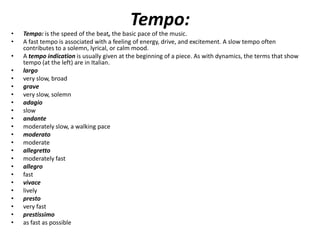
Tempo:
•   Tempo: is the speed of the beat, the basic pace of the music.
•   A fast tempo is associated with a feeling of energy, drive, and excitement. A slow tempo often
    contributes to a solemn, lyrical, or calm mood.
•   A tempo indication is usually given at the beginning of a piece. As with dynamics, the terms that show
    tempo (at the left) are in Italian.
•   largo
•   very slow, broad
•   grave
•   very slow, solemn
•   adagio
•   slow
•   andante
•   moderately slow, a walking pace
•   moderato
•   moderate
•   allegretto
•   moderately fast
•   allegro
•   fast
•   vivace
•   lively
•   presto
•   very fast
•   prestissimo
•   as fast as possible
Tempo:
• Qualifying words are sometimes added to tempo
  indications to make them more specific. The two most
  commonly used are molto (much) and non troppo (not too
  much). We thus get phrases like allegro molto (very fast)
  and allegro non troppo (not too fast).
• A gradual quickening of tempo may be indicated by writing
  accelerando (becoming faster), and a gradual slowing down
  of tempo by ritardando (becoming slower).
• An accelerando, especially when combined with a rise in
  pitch and volume, increases excitement, and a ritardando is
  associated with less tension and a feeling of conclusion.
• Metronome, an apparatus which produces ticking sounds
  or flashes of light at any desired musical speed. The
  metronome setting indicates the exact number of beats per
  minute
Melody:
• Melody: After hearing a piece of music, we usually
  remember its melody best. melody is a series of single
  tones which add up to a recognizable whole. A melody
  begins, moves, and ends; it has direction, shape, and
  continuity. The up-and-down movement of its pitches
  conveys tension and release, expectation and arrival. This is
  the melodic curve, or line.
• -A melody moves by small intervals called steps or by larger
  ones called leaps. A step is the interval between two
  adjacent tones in the do-re-mi scale (from do to re, re to mi,
  etc.). Any interval larger than a step is a leap (do to mi, for
  example). Besides moving up or down by step or leap, a
  melody may simply repeat the same note.
• -A melodys range is the distance between its lowest and
  highest tones. Range may be wide or narrow.
Harmony:
• Harmony: refers to the way chords are constructed and how they
  follow each other.
• -A chord is a combination of three or more tones sounded at once.
• Essentially, a chord is a group of simultaneous tones, and a melody is a
  series of individual tones heard one after another.
• Consonance and Dissonance
• Some chords have been considered stable and restful, others unstable
  and tense.
• -A tone combination that is stable is called a consonance.
  Consonances are points of arrival, rest, and resolution.
• -A tone combination that is unstable is called a dissonance.
• -A dissonance has its resolution when it moves to a consonance.
  When this resolution is delayed or accomplished in unexpected ways,
  a feeling of drama, suspense, or surprise is created. In this way a
  composer plays with the listeners sense of expectation.
• -Dissonant chords are active and move music forward. Traditionally
  they have been considered harsh and have been used in music that
  expresses pain, grief, and conflict.

Presentation1

  • 1.
    History Of Music Elements of Music Elements of Music: Sounds may be perceived as pleasant or unpleasant. What are these sounds that we hear? What is "sound"? What causes it, and how do we hear it? -Sound begins with the vibration of an object, such as a table that is pounded or a string that is plucked. -The vibrations are transmitted to our ears by a medium, which is usually air -As a result of the vibrations, our eardrums start vibrating too, and impulses, or signals, are transmitted to the brain. There the impulses are selected, organized, and interpreted. -Music is part of this world of sound, an art based on the organization of sounds in time
  • 2.
    Properties of musicalsounds • -We distinguish music from other sounds by recognizing the four main properties of musical sounds: pitch, dynamics (loudness or softness), tone color, and duration. • Duration: the length of time a musical sound lasts • Pitch is the relative highness or lowness that we hear in a sound • -The pitch of a sound is determined by the frequency of its vibrations. • -The faster the vibrations, the higher the pitch; the slower the vibrations, the lower the pitch. • -Vibration frequency is measured in cycles per second.
  • 3.
    Dynamics: • Degrees ofloudness or softness in music are called dynamics our second property of sound. • -Loudness is related to the amplitude of the vibration that produces the sound. The harder a guitar string is plucked (the farther it moves from the fingerboard), the louder its sound. When instruments are played more loudly or more softly, or • when there is a change in how many instruments are heard, a dynamic change results; such a change may be made either suddenly or gradually. • Crescendo: A gradual increase in loudness. It often creates excitement, particularly when the pitch rises too. • Decrescendo: a gradual decrease in loudness. It can be used to convey a sense of calm. • When notating music, composers have traditionally used Italian words, and their abbreviations, to indicate dynamics. The most common terms are: • For extremes of softness and loudness, composers use ppp or pppp and fff or ffff. The following notations indicate gradual changes in dynamics:
  • 4.
    ELEMENTS OF MUSIC: •Rhythm is the flow of music through time. • Rhythm has several interrelated aspects: beat, meter, accent and syncopation, and tempo. • Beat: is a regular, recurrent pulsation that divides music into equal units of time. When you clap your hands or tap your foot to music, you are responding to its beat. • A note may last a fraction of a beat, an entire beat, or more than a beat. More specifically, rhythm can be defined as the particular arrangement of note lengths in a piece of music. The rhythm of a melody is an essential feature of its personality.
  • 5.
    Meter: • Meter: Inmusic we find a repeated pattern of a strong beat plus one or more weaker beats. The organization of beats into regular groups is called meter. • A group containing a fixed number of beats is called a measure. There are several types of meter, which are based on the number of beats in a measure. • When a measure has 2 beats, it is in duple meter; we count 12, 12, • The first, or stressed, beat of the measure is known as the downbeat. • A pattern of 3 beats to the measure is known as triple meter. All waltzes are in triple meter, we count 123, 123, etc. • Another basic metrical pattern is quadruple meter, which has 4 beats to the measure. As usual, the downbeat is strongest; but there is another stress on the third beat, which is stronger than the second and fourth beats and weaker than the first: 1234, 1234.
  • 6.
    Meter: • Upbeat: Itis an unaccented pulse preceding the downbeat. • Sextuple meter contains six rather quick beats to the measure. The downbeat is strongest, and the fourth beat also receives a stress: 123456. • Quintuple meter, with 5 beats to the measure, and septuple meter, with 7 beats to the measure, occur frequently in twentieth-century music and are found occasionally in earlier music. Each of these meters combines duple and triple meter. In quintuple meter, for example, the measure is subdivided into groups of 2 and 3 beats: 123/45 or 12/345. • Accent and Syncopation: An important aspect of rhythm is the way individual notes are stressedhow they get special emphasis. A note is emphasized most obviously by being played louder than the notes around it, that is, by receiving a dynamic accent. • When an accented note comes where we normally would not expect one, the effect is known as syncopation. • A syncopation also occurs when a weak beat is accented, as in 1234 or 1234
  • 7.
    Tempo: • Tempo: is the speed of the beat, the basic pace of the music. • A fast tempo is associated with a feeling of energy, drive, and excitement. A slow tempo often contributes to a solemn, lyrical, or calm mood. • A tempo indication is usually given at the beginning of a piece. As with dynamics, the terms that show tempo (at the left) are in Italian. • largo • very slow, broad • grave • very slow, solemn • adagio • slow • andante • moderately slow, a walking pace • moderato • moderate • allegretto • moderately fast • allegro • fast • vivace • lively • presto • very fast • prestissimo • as fast as possible
  • 8.
    Tempo: • Qualifying wordsare sometimes added to tempo indications to make them more specific. The two most commonly used are molto (much) and non troppo (not too much). We thus get phrases like allegro molto (very fast) and allegro non troppo (not too fast). • A gradual quickening of tempo may be indicated by writing accelerando (becoming faster), and a gradual slowing down of tempo by ritardando (becoming slower). • An accelerando, especially when combined with a rise in pitch and volume, increases excitement, and a ritardando is associated with less tension and a feeling of conclusion. • Metronome, an apparatus which produces ticking sounds or flashes of light at any desired musical speed. The metronome setting indicates the exact number of beats per minute
  • 9.
    Melody: • Melody: Afterhearing a piece of music, we usually remember its melody best. melody is a series of single tones which add up to a recognizable whole. A melody begins, moves, and ends; it has direction, shape, and continuity. The up-and-down movement of its pitches conveys tension and release, expectation and arrival. This is the melodic curve, or line. • -A melody moves by small intervals called steps or by larger ones called leaps. A step is the interval between two adjacent tones in the do-re-mi scale (from do to re, re to mi, etc.). Any interval larger than a step is a leap (do to mi, for example). Besides moving up or down by step or leap, a melody may simply repeat the same note. • -A melodys range is the distance between its lowest and highest tones. Range may be wide or narrow.
  • 10.
    Harmony: • Harmony: refersto the way chords are constructed and how they follow each other. • -A chord is a combination of three or more tones sounded at once. • Essentially, a chord is a group of simultaneous tones, and a melody is a series of individual tones heard one after another. • Consonance and Dissonance • Some chords have been considered stable and restful, others unstable and tense. • -A tone combination that is stable is called a consonance. Consonances are points of arrival, rest, and resolution. • -A tone combination that is unstable is called a dissonance. • -A dissonance has its resolution when it moves to a consonance. When this resolution is delayed or accomplished in unexpected ways, a feeling of drama, suspense, or surprise is created. In this way a composer plays with the listeners sense of expectation. • -Dissonant chords are active and move music forward. Traditionally they have been considered harsh and have been used in music that expresses pain, grief, and conflict.