A Q UI C K V I S UA L A N A L O G Y
FORM
PRINCIPLES OF FORM
• Repetition
• The return of the familiar
• Contrast
• The arrival of something different
• Variation
• The return of the familiar with some changes
VISUAL REPRESENTATION
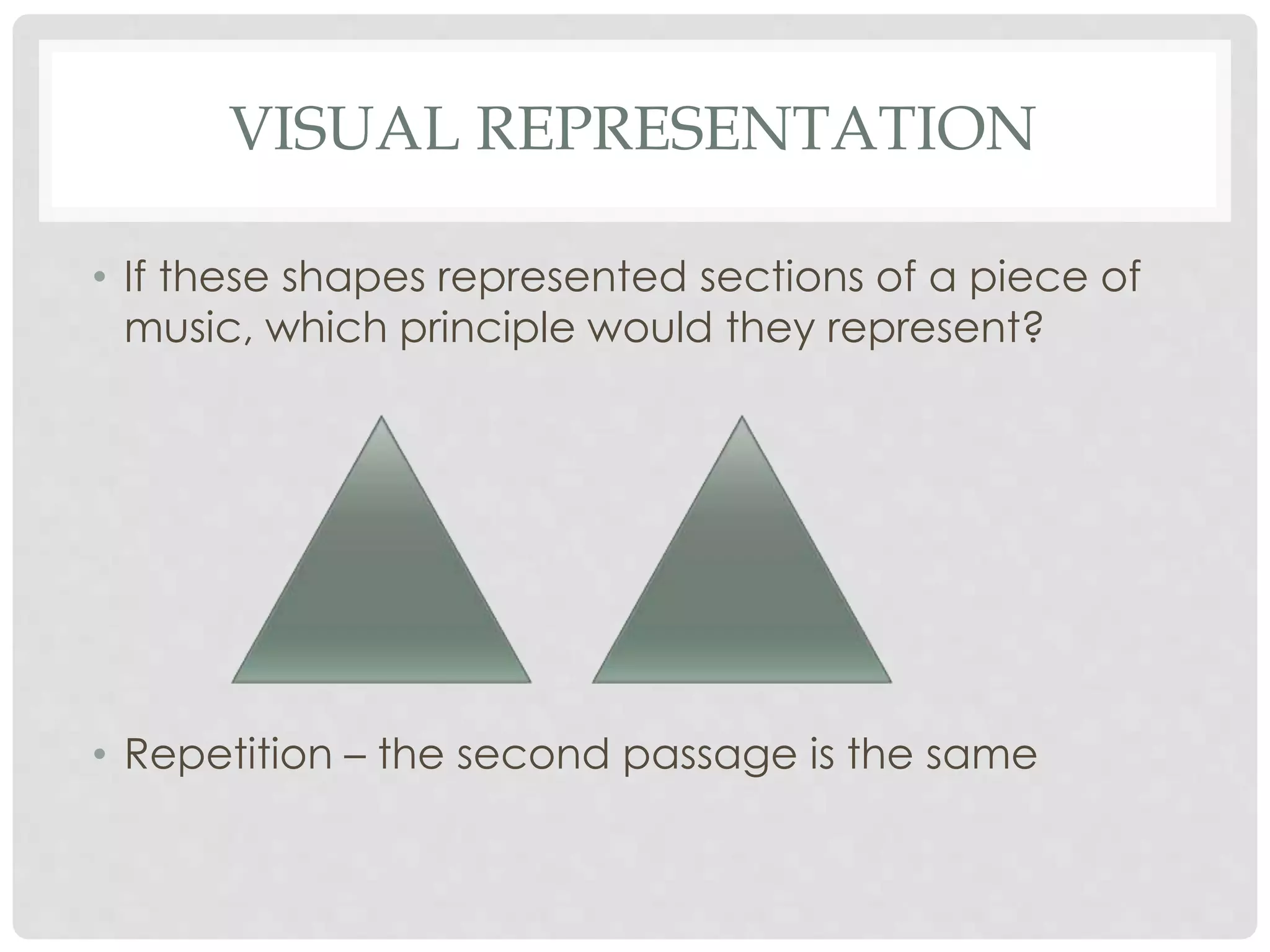
• If these shapes represented sections of a piece of
music, which principle would they represent?
• Contrast – the second passage is different
VISUAL REPRESENTATION
• If these shapes represented sections of a piece of
music, which principle would they represent?
• Repetition – the second passage is the same
VISUAL REPRESENTATION
• If these shapes represented sections of a piece of
music, which principles would they represent?
• Contrast and repetition
• The second section is different from the first
• The third section is the same as the first
VISUAL REPRESENTATION
• If these shapes represented sections of a piece of
music, which principles would they represent?
• Contrast and variation
• The second section is different from the first
• The third section is the similar to, but not same as, the first
BINARY AND TERNARY FORM
• If a piece has two sections, it is binary
• If a piece has three sections, it is ternary
• We use these terms, even if the sections in question
are themselves made up of smaller sections
LABELING FORM
• We use letters to label sections or structures in a
piece of music
• If there is repetition, we use the same letter
• If there is contrast, we use a new letter
A A A B
LABELING FORM
• Because variation involves familiar music with
changes, we add an extra symbol to the letter
• We label variation with the same letter as the earlier
familiar section plus an added “prime” (apostrophe)
A A’B
LABELING FORM
• In the case of a more complex form, we still use
upper case letters to label the larger sections
• We also use lower case letters for subsections
A B
a b a c d c
RONDO FORM
• Rondo is based on medieval poetic form (rondeau)
• A line of text was repeated throughout the poem
• This repetition provided a structure for the text
• When these poems were set to music, the music for
the repeated text was always the same
• This musical form continued to be used long after
the poetic rondeau had fallen out of favor
• An example of a rondeau written by one of our
composers is on the next slide
• The repeated text is in bold, red type
“DOULZ VIAIRE GRACIEUS”
BY GUILLAUME DE MACHAUT
• Doulz viaire gracieus, de
fin cuer vous ay
servi. Weillies moy estre
piteus, Doulz viaire
gracieus, Se je sui un po
honteus, ne me mettes
en oubli: Doulz viaire
gracieus, de fin cuer
vous ay servi.
• Sweet gracious face, I have served
you with a sincere heart. If you will
have pity on me, sweet gracious
face, then if I am a bit shy, do not
embarrass me: Sweet gracious
face, I have served you with a sincere
heart.
RONDO FORM
• In music, rondos can have different patterns
• ABACABA
• ABACADA
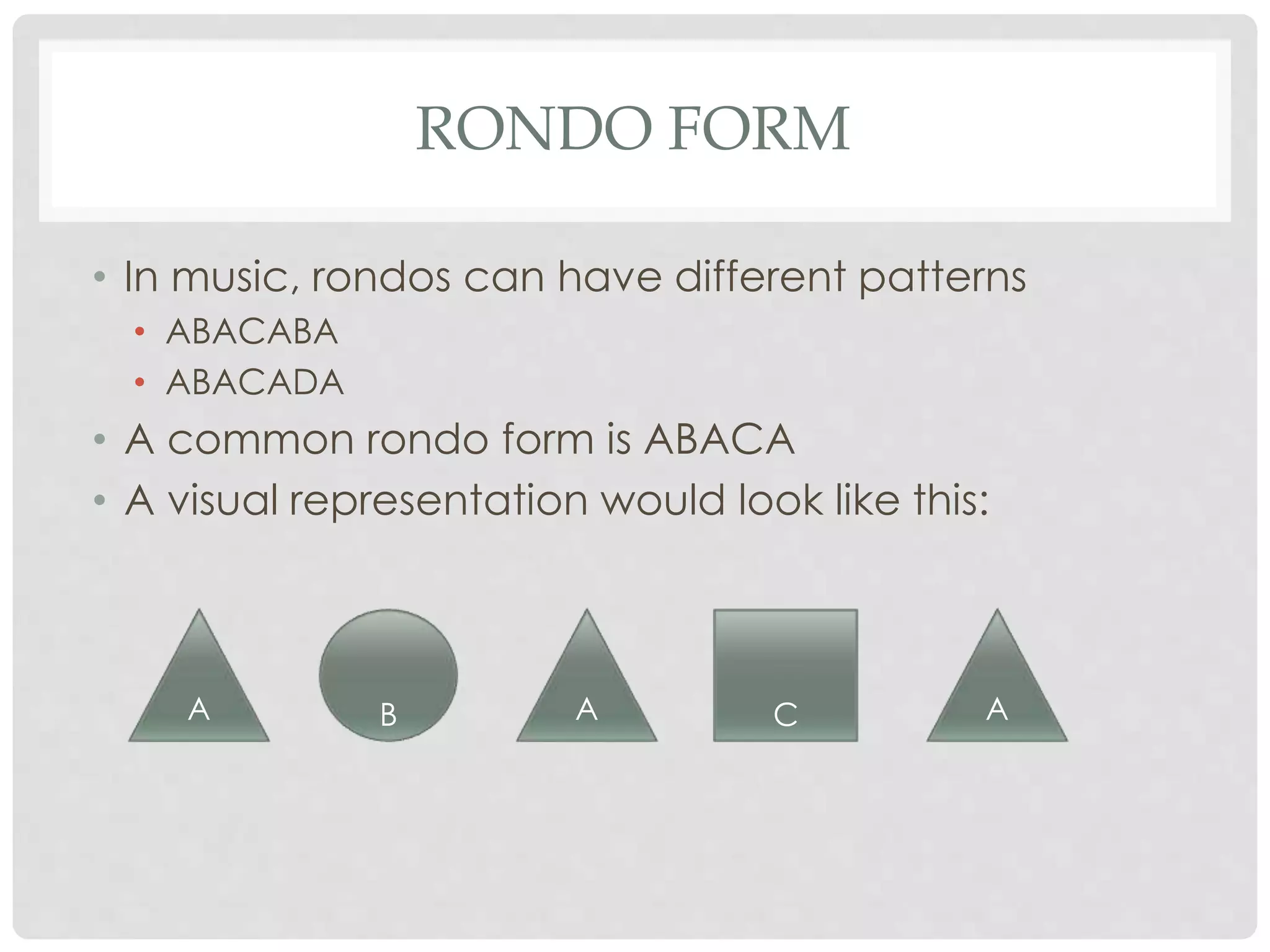
• A common rondo form is ABACA
• A visual representation would look like this:
A A AB C
MANY DIFFERENT FORMS
• The structures listed in this slideshow are examples of
simple, common musical forms
• The labels used in binary and ternary forms (upper
and lowercase letters) represent melody
• When we label a piece AA, it is generally because
the melody we heard first has come back
• Not all music makes such frequent use of repetition
• Some of the music in the Middle Ages and
Renaissance features very little melodic repetition
• That doesn’t mean those pieces have no form
SECTIONS BASED ON TEXTURE
• Musical forms are usually constructed out of smaller
sections within the piece
• While melody is an easy way to create sections
within a piece, other elements can also be used
• Josquin’s Ave Maria is an example of a piece that
uses contrasting textures to create sections
• At one point, texture and meter change giving that
section an even greater sense of contrast

Form

  • 1.
    A Q UIC K V I S UA L A N A L O G Y FORM
  • 2.
    PRINCIPLES OF FORM •Repetition • The return of the familiar • Contrast • The arrival of something different • Variation • The return of the familiar with some changes
  • 3.
    VISUAL REPRESENTATION • Ifthese shapes represented sections of a piece of music, which principle would they represent? • Contrast – the second passage is different
  • 4.
    VISUAL REPRESENTATION • Ifthese shapes represented sections of a piece of music, which principle would they represent? • Repetition – the second passage is the same
  • 5.
    VISUAL REPRESENTATION • Ifthese shapes represented sections of a piece of music, which principles would they represent? • Contrast and repetition • The second section is different from the first • The third section is the same as the first
  • 6.
    VISUAL REPRESENTATION • Ifthese shapes represented sections of a piece of music, which principles would they represent? • Contrast and variation • The second section is different from the first • The third section is the similar to, but not same as, the first
  • 7.
    BINARY AND TERNARYFORM • If a piece has two sections, it is binary • If a piece has three sections, it is ternary • We use these terms, even if the sections in question are themselves made up of smaller sections
  • 8.
    LABELING FORM • Weuse letters to label sections or structures in a piece of music • If there is repetition, we use the same letter • If there is contrast, we use a new letter A A A B
  • 9.
    LABELING FORM • Becausevariation involves familiar music with changes, we add an extra symbol to the letter • We label variation with the same letter as the earlier familiar section plus an added “prime” (apostrophe) A A’B
  • 10.
    LABELING FORM • Inthe case of a more complex form, we still use upper case letters to label the larger sections • We also use lower case letters for subsections A B a b a c d c
  • 11.
    RONDO FORM • Rondois based on medieval poetic form (rondeau) • A line of text was repeated throughout the poem • This repetition provided a structure for the text • When these poems were set to music, the music for the repeated text was always the same • This musical form continued to be used long after the poetic rondeau had fallen out of favor • An example of a rondeau written by one of our composers is on the next slide • The repeated text is in bold, red type
  • 12.
    “DOULZ VIAIRE GRACIEUS” BYGUILLAUME DE MACHAUT • Doulz viaire gracieus, de fin cuer vous ay servi. Weillies moy estre piteus, Doulz viaire gracieus, Se je sui un po honteus, ne me mettes en oubli: Doulz viaire gracieus, de fin cuer vous ay servi. • Sweet gracious face, I have served you with a sincere heart. If you will have pity on me, sweet gracious face, then if I am a bit shy, do not embarrass me: Sweet gracious face, I have served you with a sincere heart.
  • 13.
    RONDO FORM • Inmusic, rondos can have different patterns • ABACABA • ABACADA • A common rondo form is ABACA • A visual representation would look like this: A A AB C
  • 14.
    MANY DIFFERENT FORMS •The structures listed in this slideshow are examples of simple, common musical forms • The labels used in binary and ternary forms (upper and lowercase letters) represent melody • When we label a piece AA, it is generally because the melody we heard first has come back • Not all music makes such frequent use of repetition • Some of the music in the Middle Ages and Renaissance features very little melodic repetition • That doesn’t mean those pieces have no form
  • 15.
    SECTIONS BASED ONTEXTURE • Musical forms are usually constructed out of smaller sections within the piece • While melody is an easy way to create sections within a piece, other elements can also be used • Josquin’s Ave Maria is an example of a piece that uses contrasting textures to create sections • At one point, texture and meter change giving that section an even greater sense of contrast