
Overview
Institutional Arrangement of Energy Sector
Energy Access
Renewable Energy
Energy Efficiency
SE4ALL Initiatives & Findings of RA/GA report
Challenges
Institutional Arrangements
Ministry of Economic Affairs is the lead agency for Energy with
Five Departments to overlook the energy sector: DRE, DoHPS,
DHMS, DOT and DGM
Two Power Companies- DGPC and BPC
Independent Regulator- BEA
Existing Energy Related Policies:
Electricity Act of Bhutan, 2001
Economic Development Policy of the Kingdom of Bhutan, 2010
Sustainable Hydropower Development Policy 2008
Alternative Renewable Energy Policy 2013
Foreign Direct Investment Policy, 2010
Goal 1: Universal Energy Access
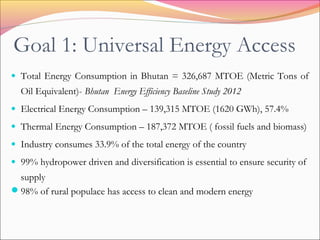
• Total Energy Consumption in Bhutan = 326,687 MTOE (Metric Tons of
Oil Equivalent)- Bhutan Energy Efficiency Baseline Study 2012
• Electrical Energy Consumption – 139,315 MTOE (1620 GWh), 57.4%
• Thermal Energy Consumption – 187,372 MTOE ( fossil fuels and biomass)
• Industry consumes 33.9% of the total energy of the country
• 99% hydropower driven and diversification is essential to ensure security of
supply
98% of rural populace has access to clean and modern energy
Goal 2: Energy Efficiency
No legal frameworks to address Energy Efficiency (EE)
Continuous awareness program on EE conducted
Baseline Study for Energy Efficiency conducted under UNDP funding
EE Study in Building Sector conducted and Building Energy Efficiency
Code drafted under UNDP funding
Energy Efficiency and Conservation Policy to be formulated under
Energy Plus (Norwegian funding)
Standards and Labeling for appliances to be developed under Energy
Plus
Demand Side Management through efficient lighting systems to be
implemented under Energy Plus (Norwegian Funding)
Goal 3 : Renewable Energy
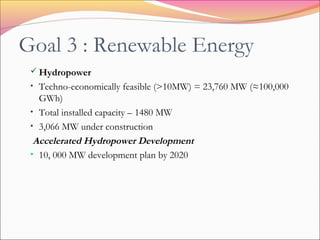
 Hydropower
• Techno-economically feasible (>10MW) = 23,760 MW (≈100,000
GWh)
• Total installed capacity – 1480 MW
• 3,066 MW under construction
Accelerated Hydropower Development
• 10, 000 MW development plan by 2020
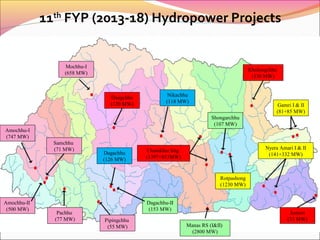
11th
FYP (2013-18) Hydropower Projects
Pipingchhu
(55 MW)
Mochhu-I
(658 MW)
Nikachhu
(118 MW)
Dangchhu
(120 MW)
Amochhu-I
(747 MW)
Amochhu-II
(500 MW)
Dagachhu-II
(153 MW)
Pachhu
(77 MW)
Samchhu
(71 MW)
Manas RS (I&II)
(2800 MW)
Jomori
(73 MW)
Gamri I & II
(81+85 MW)
Kholongchhu
(130 MW)
Chamkhar Intg.
(1397+853MW)
Shongarchhu
(107 MW)
Rotpashong
(1230 MW)
Nyera Amari I & II
(141+332 MW)Dagachhu
(126 MW)
Jun 19, 2014 8
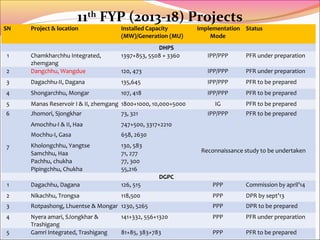
SN Project & location Installed Capacity
(MW)/Generation (MU)
Implementation
Mode
Status
DHPS
1 Chamkharchhu Integrated,
zhemgang
1397+853, 5508 + 3360 IPP/PPP PFR under preparation
2 Dangchhu, Wangdue 120, 473 IPP/PPP PFR under preparation
3 Dagachhu-II, Dagana 135,645 IPP/PPP PFR to be prepared
4 Shongarchhu, Mongar 107, 418 IPP/PPP PFR to be prepared
5 Manas Reservoir I & II, zhemgang 1800+1000, 10,000+5000 IG PFR to be prepared
6 Jhomori, Sjongkhar 73, 321 IPP/PPP PFR to be prepared
7
Amochhu-I & II, Haa 747+500, 3317+2210
Reconnaissance study to be undertaken
Mochhu-I, Gasa 658, 2630
Kholongchhu, Yangtse 130, 583
Samchhu, Haa 71, 277
Pachhu, chukha 77, 300
Pipingchhu, Chukha 55,216
DGPC
1 Dagachhu, Dagana 126, 515 PPP Commission by april’14
2 Nikachhu, Trongsa 118,500 PPP DPR by sept’13
3 Rotpashong, Lhuentse & Mongar 1230, 5265 PPP DPR to be prepared
4 Nyera amari, SJongkhar &
Trashigang
141+332, 556+1320 PPP PFR under preparation
5 Gamri Integrated, Trashigang 81+85, 383+783 PPP PFR to be prepared
11th
FYP (2013-18) Projects
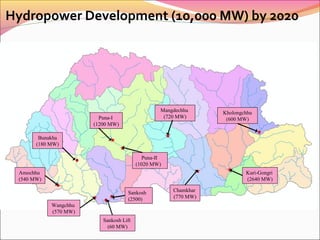
Hydropower Development (10,000 MW) by 2020
Amochhu
(540 MW)
Wangchhu
(570 MW)
Sankosh
(2500)
Sankosh Lift
(60 MW)
Bunakha
(180 MW)
Puna-I
(1200 MW)
Puna-II
(1020 MW)
Mangdechhu
(720 MW)
Chamkhar
(770 MW)
Kuri-Gongri
(2640 MW)
Kholongchhu
(600 MW)
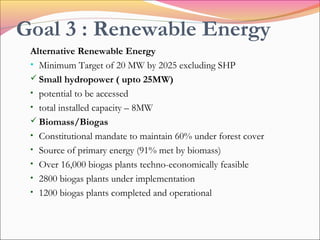
Goal 3 : Renewable Energy
Alternative Renewable Energy
• Minimum Target of 20 MW by 2025 excluding SHP
 Small hydropower ( upto 25MW)
• potential to be accessed
• total installed capacity – 8MW
 Biomass/Biogas
• Constitutional mandate to maintain 60% under forest cover
• Source of primary energy (91% met by biomass)
• Over 16,000 biogas plants techno-economically feasible
• 2800 biogas plants under implementation
• 1200 biogas plants completed and operational
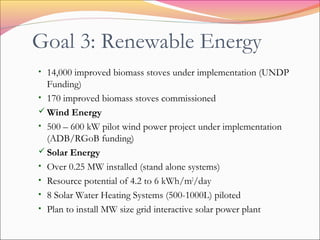
Goal 3: Renewable Energy
• 14,000 improved biomass stoves under implementation (UNDP
Funding)
• 170 improved biomass stoves commissioned
 Wind Energy
• 500 – 600 kW pilot wind power project under implementation
(ADB/RGoB funding)
 Solar Energy
• Over 0.25 MW installed (stand alone systems)
• Resource potential of 4.2 to 6 kWh/m2
/day
• 8 Solar Water Heating Systems (500-1000L) piloted
• Plan to install MW size grid interactive solar power plant
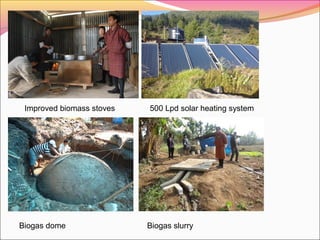
Improved biomass stoves 500 Lpd solar heating system
Biogas dome Biogas slurry
 Fossil Fuels
• Coal reserve of 1.96 MT
• No known reserve => Import dependent!.
• Imported over 86,000 KL of diesel, 24,000 KL of petrol and 6,000
KL of kerosene in 2010.
• 100% of fossil fuel imported (stability of supply and price volatility
- more stress on the economy)
• Renewable Energy’s role critical for energy security and fossil fuel
(import) substitution
Other Energy Sources
SE4 ALL Initiatives
Bhutan joined SE4ALL in 2012 after the Rio Brazil Summit.
Energy Plus Cooperation Partnership with funding from
Norwegian Government
Rapid Assessment and Gap Analysis study with funding from
ADB (2012)
Findings from Rapid Assessment & Gap Analysis Study:
Energy Access
No Clear policy targets to address reduced use of fuel wood for
cooking and heating
Require significant capacity building of public and private
agencies to develop Bhutan’s hydropower potential
Findings from RA/GA Study
Renewable Energy Systems:
Develop RE roadmap for each of the RE technologies and
appropriate feed-in tariff system to incentivize private sector
participation in the development of RE resources
DRE needs to strengthen their capacity and gain experience in
promoting and developing RE technologies
Strengthening of the capacity of private sector to implement RE
systems and financial institutions to finance RE systems
No specific budget prepared for developing RE
Energy Efficiency:
No detailed studies of the potential of EE in the country have
been undertaken nor EE specific programs developed
Findings from RA/GA Study
No Energy Efficiency and Conservation Policy in place
No specific institution to coordinate EE activities in the country
Private Sector to play an important role in implementing EE
Financing requirement of EE has not been estimated due to the
absence of policy in place
Challenges
Renewable Energy :
No legal framewok
Technology very expensive compared to large hydropower
Lack of Institutional capacity
Lack of private sector capacity
Limited access to funds
Difficult geographical terrains
Providing affordable and reliable access to Renewable Energy
Energy Efficiency:
No Energy Efficiency & Conservation Policy
Poor private sector participation.
Investment Opportunities
Preparatory studies are being undertaken for promotion of
RE and EE under Energy Plus (Norwegian Funding)
Investment opportunities will open up after the completion
of Preparatory studies
Hydropower:
Need funding for Ratposhong Project (1230 MW in
Eastern Bhutan) to execute DPR and later investment
under Public Private Partnership.
1-2 projects to be implemented under PPP/IPP in the 11th
FYP.
THANK YOU!!!
For further information visit www.moea.gov.bt

Bhutan Country Presentation at ACEF 2014

  • 2.
    Overview Institutional Arrangement ofEnergy Sector Energy Access Renewable Energy Energy Efficiency SE4ALL Initiatives & Findings of RA/GA report Challenges
  • 3.
    Institutional Arrangements Ministry ofEconomic Affairs is the lead agency for Energy with Five Departments to overlook the energy sector: DRE, DoHPS, DHMS, DOT and DGM Two Power Companies- DGPC and BPC Independent Regulator- BEA Existing Energy Related Policies: Electricity Act of Bhutan, 2001 Economic Development Policy of the Kingdom of Bhutan, 2010 Sustainable Hydropower Development Policy 2008 Alternative Renewable Energy Policy 2013 Foreign Direct Investment Policy, 2010
  • 4.
    Goal 1: UniversalEnergy Access • Total Energy Consumption in Bhutan = 326,687 MTOE (Metric Tons of Oil Equivalent)- Bhutan Energy Efficiency Baseline Study 2012 • Electrical Energy Consumption – 139,315 MTOE (1620 GWh), 57.4% • Thermal Energy Consumption – 187,372 MTOE ( fossil fuels and biomass) • Industry consumes 33.9% of the total energy of the country • 99% hydropower driven and diversification is essential to ensure security of supply 98% of rural populace has access to clean and modern energy
  • 5.
    Goal 2: EnergyEfficiency No legal frameworks to address Energy Efficiency (EE) Continuous awareness program on EE conducted Baseline Study for Energy Efficiency conducted under UNDP funding EE Study in Building Sector conducted and Building Energy Efficiency Code drafted under UNDP funding Energy Efficiency and Conservation Policy to be formulated under Energy Plus (Norwegian funding) Standards and Labeling for appliances to be developed under Energy Plus Demand Side Management through efficient lighting systems to be implemented under Energy Plus (Norwegian Funding)
  • 6.
    Goal 3 :Renewable Energy  Hydropower • Techno-economically feasible (>10MW) = 23,760 MW (≈100,000 GWh) • Total installed capacity – 1480 MW • 3,066 MW under construction Accelerated Hydropower Development • 10, 000 MW development plan by 2020
  • 7.
    11th FYP (2013-18) HydropowerProjects Pipingchhu (55 MW) Mochhu-I (658 MW) Nikachhu (118 MW) Dangchhu (120 MW) Amochhu-I (747 MW) Amochhu-II (500 MW) Dagachhu-II (153 MW) Pachhu (77 MW) Samchhu (71 MW) Manas RS (I&II) (2800 MW) Jomori (73 MW) Gamri I & II (81+85 MW) Kholongchhu (130 MW) Chamkhar Intg. (1397+853MW) Shongarchhu (107 MW) Rotpashong (1230 MW) Nyera Amari I & II (141+332 MW)Dagachhu (126 MW)
  • 8.
    Jun 19, 20148 SN Project & location Installed Capacity (MW)/Generation (MU) Implementation Mode Status DHPS 1 Chamkharchhu Integrated, zhemgang 1397+853, 5508 + 3360 IPP/PPP PFR under preparation 2 Dangchhu, Wangdue 120, 473 IPP/PPP PFR under preparation 3 Dagachhu-II, Dagana 135,645 IPP/PPP PFR to be prepared 4 Shongarchhu, Mongar 107, 418 IPP/PPP PFR to be prepared 5 Manas Reservoir I & II, zhemgang 1800+1000, 10,000+5000 IG PFR to be prepared 6 Jhomori, Sjongkhar 73, 321 IPP/PPP PFR to be prepared 7 Amochhu-I & II, Haa 747+500, 3317+2210 Reconnaissance study to be undertaken Mochhu-I, Gasa 658, 2630 Kholongchhu, Yangtse 130, 583 Samchhu, Haa 71, 277 Pachhu, chukha 77, 300 Pipingchhu, Chukha 55,216 DGPC 1 Dagachhu, Dagana 126, 515 PPP Commission by april’14 2 Nikachhu, Trongsa 118,500 PPP DPR by sept’13 3 Rotpashong, Lhuentse & Mongar 1230, 5265 PPP DPR to be prepared 4 Nyera amari, SJongkhar & Trashigang 141+332, 556+1320 PPP PFR under preparation 5 Gamri Integrated, Trashigang 81+85, 383+783 PPP PFR to be prepared 11th FYP (2013-18) Projects
  • 9.
    Hydropower Development (10,000MW) by 2020 Amochhu (540 MW) Wangchhu (570 MW) Sankosh (2500) Sankosh Lift (60 MW) Bunakha (180 MW) Puna-I (1200 MW) Puna-II (1020 MW) Mangdechhu (720 MW) Chamkhar (770 MW) Kuri-Gongri (2640 MW) Kholongchhu (600 MW)
  • 10.
    Goal 3 :Renewable Energy Alternative Renewable Energy • Minimum Target of 20 MW by 2025 excluding SHP  Small hydropower ( upto 25MW) • potential to be accessed • total installed capacity – 8MW  Biomass/Biogas • Constitutional mandate to maintain 60% under forest cover • Source of primary energy (91% met by biomass) • Over 16,000 biogas plants techno-economically feasible • 2800 biogas plants under implementation • 1200 biogas plants completed and operational
  • 11.
    Goal 3: RenewableEnergy • 14,000 improved biomass stoves under implementation (UNDP Funding) • 170 improved biomass stoves commissioned  Wind Energy • 500 – 600 kW pilot wind power project under implementation (ADB/RGoB funding)  Solar Energy • Over 0.25 MW installed (stand alone systems) • Resource potential of 4.2 to 6 kWh/m2 /day • 8 Solar Water Heating Systems (500-1000L) piloted • Plan to install MW size grid interactive solar power plant
  • 12.
    Improved biomass stoves500 Lpd solar heating system Biogas dome Biogas slurry
  • 13.
     Fossil Fuels •Coal reserve of 1.96 MT • No known reserve => Import dependent!. • Imported over 86,000 KL of diesel, 24,000 KL of petrol and 6,000 KL of kerosene in 2010. • 100% of fossil fuel imported (stability of supply and price volatility - more stress on the economy) • Renewable Energy’s role critical for energy security and fossil fuel (import) substitution Other Energy Sources
  • 14.
    SE4 ALL Initiatives Bhutanjoined SE4ALL in 2012 after the Rio Brazil Summit. Energy Plus Cooperation Partnership with funding from Norwegian Government Rapid Assessment and Gap Analysis study with funding from ADB (2012) Findings from Rapid Assessment & Gap Analysis Study: Energy Access No Clear policy targets to address reduced use of fuel wood for cooking and heating Require significant capacity building of public and private agencies to develop Bhutan’s hydropower potential
  • 15.
    Findings from RA/GAStudy Renewable Energy Systems: Develop RE roadmap for each of the RE technologies and appropriate feed-in tariff system to incentivize private sector participation in the development of RE resources DRE needs to strengthen their capacity and gain experience in promoting and developing RE technologies Strengthening of the capacity of private sector to implement RE systems and financial institutions to finance RE systems No specific budget prepared for developing RE Energy Efficiency: No detailed studies of the potential of EE in the country have been undertaken nor EE specific programs developed
  • 16.
    Findings from RA/GAStudy No Energy Efficiency and Conservation Policy in place No specific institution to coordinate EE activities in the country Private Sector to play an important role in implementing EE Financing requirement of EE has not been estimated due to the absence of policy in place
  • 17.
    Challenges Renewable Energy : Nolegal framewok Technology very expensive compared to large hydropower Lack of Institutional capacity Lack of private sector capacity Limited access to funds Difficult geographical terrains Providing affordable and reliable access to Renewable Energy Energy Efficiency: No Energy Efficiency & Conservation Policy Poor private sector participation.
  • 18.
    Investment Opportunities Preparatory studiesare being undertaken for promotion of RE and EE under Energy Plus (Norwegian Funding) Investment opportunities will open up after the completion of Preparatory studies Hydropower: Need funding for Ratposhong Project (1230 MW in Eastern Bhutan) to execute DPR and later investment under Public Private Partnership. 1-2 projects to be implemented under PPP/IPP in the 11th FYP.
  • 19.
    THANK YOU!!! For furtherinformation visit www.moea.gov.bt