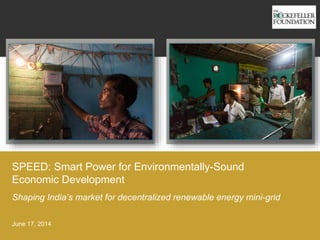

SPEED: Smart Power for Environmentally-Sound
Economic Development
June 17, 2014
Shaping India’s market for decentralized renewable energy mini-grid
| 2
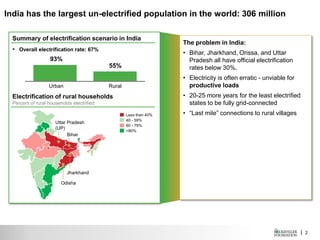
The problem in India:
• Bihar, Jharkhand, Orissa, and Uttar
Pradesh all have official electrification
rates below 30%.
• Electricity is often erratic - unviable for
productive loads
• 20-25 more years for the least electrified
states to be fully grid-connected
• “Last mile” connections to rural villages
India has the largest un-electrified population in the world: 306 million
▪ Overall electrification rate: 67%
Urban
55%
93%
Rural
Summary of electrification scenario in India
Electrification of rural households
Percent of rural households electrified
Uttar Pradesh
(UP)
Bihar
Jharkhand
Odisha
Less than 40%
40 - 59%
60 - 79%
>80%
| 3
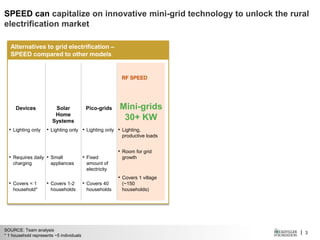
SPEED can capitalize on innovative mini-grid technology to unlock the rural
electrification market
SOURCE: Team analysis
* 1 household represents ~5 individuals
Devices Solar
Home
Systems
Pico-grids
▪ Lighting only
▪ Requires daily
charging
▪ Covers < 1
household*
▪ Lighting only
▪ Small
appliances
▪ Covers 1-2
households
▪ Lighting only
▪ Fixed
amount of
electricity
▪ Covers 40
households
Alternatives to grid electrification –
SPEED compared to other models
RF SPEED
Mini-grids
30+ KW
▪ Lighting,
productive loads
▪ Room for grid
growth
▪ Covers 1 village
(~150
households)
| 4
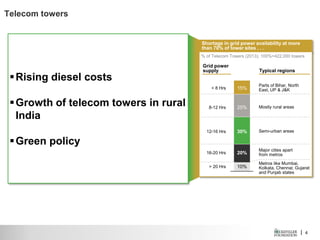
Rising diesel costs
Growth of telecom towers in rural
India
Green policy
Shortage in grid power availability at more
than 70% of tower sites . . .
> 20 Hrs
16-20 Hrs
12-16 Hrs
8-12 Hrs
< 8 Hrs
10%
25%
15%
20%
30%
Grid power
supply
% of Telecom Towers (2013); 100%=422,000 towers
Telecom towers
Parts of Bihar, North
East, UP & J&K
Mostly rural areas
Semi-urban areas
Major cities apart
from metros
Metros like Mumbai,
Kolkata, Chennai; Gujarat
and Punjab states
Typical regions
| 5
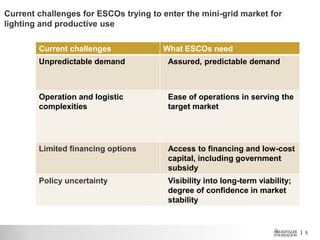
Current challenges for ESCOs trying to enter the mini-grid market for
lighting and productive use
Current challenges What ESCOs need
Unpredictable demand Assured, predictable demand
Operation and logistic
complexities
Ease of operations in serving the
target market
Limited financing options Access to financing and low-cost
capital, including government
subsidy
Policy uncertainty Visibility into long-term viability;
degree of confidence in market
stability
| 6
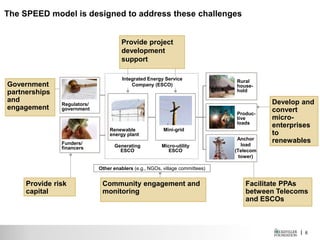
The SPEED model is designed to address these challenges
Develop and
convert
micro-
enterprises
to
renewables
Provide risk
capital
Facilitate PPAs
between Telecoms
and ESCOs
Community engagement and
monitoring
Government
partnerships
and
engagement
Renewable
energy plant
Mini-grid
Regulators/
government
Funders/
financers
Other enablers (e.g., NGOs, village committees)
Generating
ESCO
Micro-utility
ESCO
Integrated Energy Service
Company (ESCO)
Rural
house-
hold
Produc-
tive
loads
Anchor
load
(Telecom
tower)
Provide project
development
support
| 7
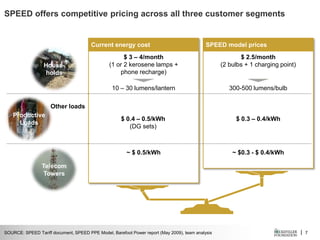
SPEED offers competitive pricing across all three customer segments
SOURCE: SPEED Tariff document, SPEED PPE Model, Barefoot Power report (May 2009), team analysis
SPEED model pricesCurrent energy cost
~ $ 0.5/kWh ~ $0.3 - $ 0.4/kWh
House-
holds
Productive
Loads
Telecom
Towers
$ 0.4 – 0.5/kWh
(DG sets)
$ 0.3 – 0.4/kWh
Other loads
$ 2.5/month
(2 bulbs + 1 charging point)
$ 3 – 4/month
(1 or 2 kerosene lamps +
phone recharge)
10 – 30 lumens/lantern 300-500 lumens/bulb
| 8
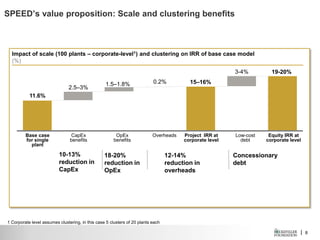
Impact of scale (100 plants – corporate-level1) and clustering on IRR of base case model
(%)
SPEED’s value proposition: Scale and clustering benefits
19-20%
Equity IRR at
corporate level
Project IRR at
corporate level
15–16%
Overheads
0.2%
OpEx
benefits
1.5–1.8%
CapEx
benefits
Base case
for single
plant
Low-cost
debt
2.5–3%
3-4%
11.6%
12-14%
reduction in
overheads
10-13%
reduction in
CapEx
18-20%
reduction in
OpEx
Concessionary
debt
1 Corporate level assumes clustering, in this case 5 clusters of 20 plants each
| 9
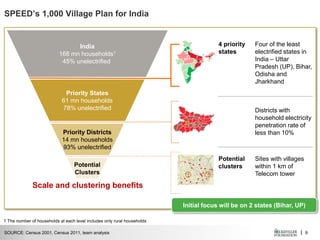
SPEED’s 1,000 Village Plan for India
SOURCE: Census 2001, Census 2011, team analysis
1 The number of households at each level includes only rural households
India
168 mn households1
45% unelectrified
Priority States
61 mn households
78% unelectrified
Priority Districts
14 mn households
93% unelectrified
Potential
Clusters
4 priority
states
Four of the least
electrified states in
India – Uttar
Pradesh (UP), Bihar,
Odisha and
Jharkhand
Districts with
household electricity
penetration rate of
less than 10%
Potential
clusters
Sites with villages
within 1 km of
Telecom tower
Initial focus will be on 2 states (Bihar, UP)
Scale and clustering benefits
| 10
End

Rockefeller Foundation at ACEF 2014

  • 1.
    SPEED: Smart Powerfor Environmentally-Sound Economic Development June 17, 2014 Shaping India’s market for decentralized renewable energy mini-grid
  • 2.
    | 2 The problemin India: • Bihar, Jharkhand, Orissa, and Uttar Pradesh all have official electrification rates below 30%. • Electricity is often erratic - unviable for productive loads • 20-25 more years for the least electrified states to be fully grid-connected • “Last mile” connections to rural villages India has the largest un-electrified population in the world: 306 million ▪ Overall electrification rate: 67% Urban 55% 93% Rural Summary of electrification scenario in India Electrification of rural households Percent of rural households electrified Uttar Pradesh (UP) Bihar Jharkhand Odisha Less than 40% 40 - 59% 60 - 79% >80%
  • 3.
    | 3 SPEED cancapitalize on innovative mini-grid technology to unlock the rural electrification market SOURCE: Team analysis * 1 household represents ~5 individuals Devices Solar Home Systems Pico-grids ▪ Lighting only ▪ Requires daily charging ▪ Covers < 1 household* ▪ Lighting only ▪ Small appliances ▪ Covers 1-2 households ▪ Lighting only ▪ Fixed amount of electricity ▪ Covers 40 households Alternatives to grid electrification – SPEED compared to other models RF SPEED Mini-grids 30+ KW ▪ Lighting, productive loads ▪ Room for grid growth ▪ Covers 1 village (~150 households)
  • 4.
    | 4 Rising dieselcosts Growth of telecom towers in rural India Green policy Shortage in grid power availability at more than 70% of tower sites . . . > 20 Hrs 16-20 Hrs 12-16 Hrs 8-12 Hrs < 8 Hrs 10% 25% 15% 20% 30% Grid power supply % of Telecom Towers (2013); 100%=422,000 towers Telecom towers Parts of Bihar, North East, UP & J&K Mostly rural areas Semi-urban areas Major cities apart from metros Metros like Mumbai, Kolkata, Chennai; Gujarat and Punjab states Typical regions
  • 5.
    | 5 Current challengesfor ESCOs trying to enter the mini-grid market for lighting and productive use Current challenges What ESCOs need Unpredictable demand Assured, predictable demand Operation and logistic complexities Ease of operations in serving the target market Limited financing options Access to financing and low-cost capital, including government subsidy Policy uncertainty Visibility into long-term viability; degree of confidence in market stability
  • 6.
    | 6 The SPEEDmodel is designed to address these challenges Develop and convert micro- enterprises to renewables Provide risk capital Facilitate PPAs between Telecoms and ESCOs Community engagement and monitoring Government partnerships and engagement Renewable energy plant Mini-grid Regulators/ government Funders/ financers Other enablers (e.g., NGOs, village committees) Generating ESCO Micro-utility ESCO Integrated Energy Service Company (ESCO) Rural house- hold Produc- tive loads Anchor load (Telecom tower) Provide project development support
  • 7.
    | 7 SPEED offerscompetitive pricing across all three customer segments SOURCE: SPEED Tariff document, SPEED PPE Model, Barefoot Power report (May 2009), team analysis SPEED model pricesCurrent energy cost ~ $ 0.5/kWh ~ $0.3 - $ 0.4/kWh House- holds Productive Loads Telecom Towers $ 0.4 – 0.5/kWh (DG sets) $ 0.3 – 0.4/kWh Other loads $ 2.5/month (2 bulbs + 1 charging point) $ 3 – 4/month (1 or 2 kerosene lamps + phone recharge) 10 – 30 lumens/lantern 300-500 lumens/bulb
  • 8.
    | 8 Impact ofscale (100 plants – corporate-level1) and clustering on IRR of base case model (%) SPEED’s value proposition: Scale and clustering benefits 19-20% Equity IRR at corporate level Project IRR at corporate level 15–16% Overheads 0.2% OpEx benefits 1.5–1.8% CapEx benefits Base case for single plant Low-cost debt 2.5–3% 3-4% 11.6% 12-14% reduction in overheads 10-13% reduction in CapEx 18-20% reduction in OpEx Concessionary debt 1 Corporate level assumes clustering, in this case 5 clusters of 20 plants each
  • 9.
    | 9 SPEED’s 1,000Village Plan for India SOURCE: Census 2001, Census 2011, team analysis 1 The number of households at each level includes only rural households India 168 mn households1 45% unelectrified Priority States 61 mn households 78% unelectrified Priority Districts 14 mn households 93% unelectrified Potential Clusters 4 priority states Four of the least electrified states in India – Uttar Pradesh (UP), Bihar, Odisha and Jharkhand Districts with household electricity penetration rate of less than 10% Potential clusters Sites with villages within 1 km of Telecom tower Initial focus will be on 2 states (Bihar, UP) Scale and clustering benefits
  • 10.

Editor's Notes