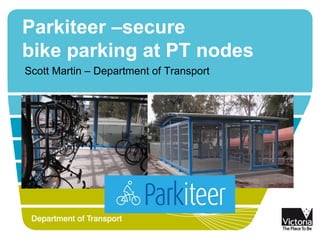
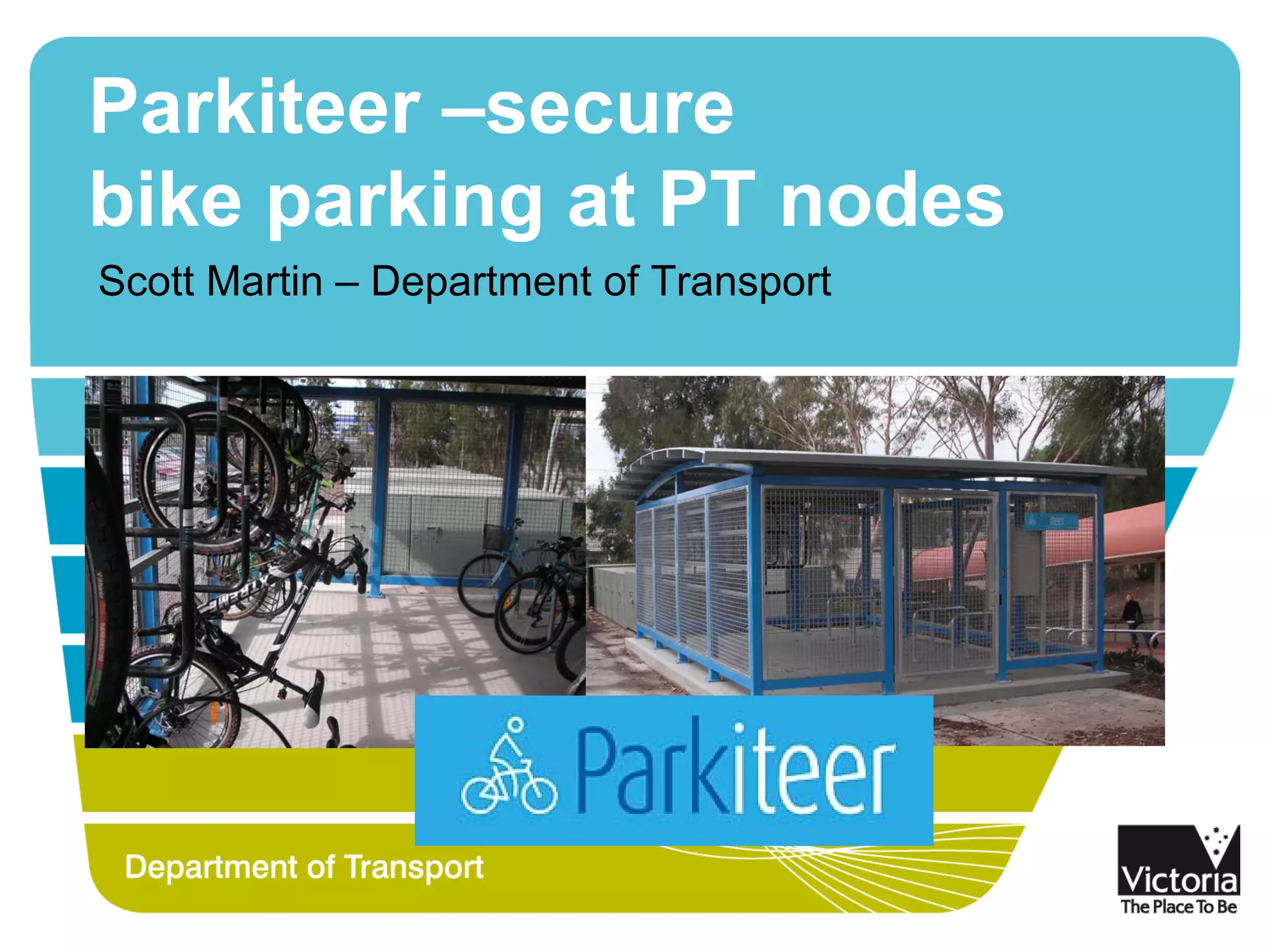
Parkiteer –secure
bike parking at PT nodes
Scott Martin – Department of Transport
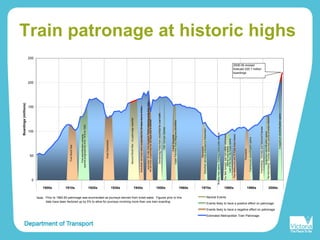
Train patronage at historic highs
FirstWorldWar
Firstelectrificationscheme
openedprogressivelyfrom1919to1923
GreatDepression
SecondWorldWar-nopatronagereported
Suburbanservicesweresuspendedfor34daysduetostrikes
suburban'20milelimitdropped;PetrolrationingendsFeb1950
Allservicessuspendedfor55daysduetostrikes
Dandenong-Pakenhamelectrifiedforcoaltraffic
1956OlympicGames
CreditSqueeze
UpperFerntreeGully-Belgraveelectrified
Recession
SuburbanservicesextendedtoPakenham
Burnleyloopopens,Comengtrainsenterservice
The'Met'formed,last'redrattler'withdrawn
AltonaLoopopens
Lastofthefourcityloopsopens
PortMelbourneandStKildalinesclosed.
Recession
Cranbourneelectrificationopens
Franchising-ConnexandNationalExpress
Sydenhamelectrificationopens
Re-franchising-Connexassumescontrolofentirenetwork
Craigieburnelectricficationopens
0
50
100
150
200
250
1900s 1910s 1920s 1930s 1940s 1950s 1960s 1970s 1980s 1990s 2000s
Boardings(millions)
Neutral Events
Events likely to have a positive effect on patronage
Events likely to have a negative effect on patronage
Estimated Metropolitan Train Patronage
2008-09 revised
forecast 220.1 million
boardings
Prior to 1982-83 patronage was enumerated as journeys derived from ticket sales. Figures prior to this
date have been factored up by 5% to allow for journeys involving more than one train boarding.
Note:
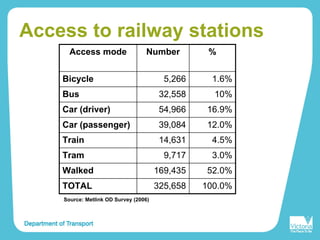
Access to railway stations
Source: Metlink OD Survey (2006)
Access mode Number %
Bicycle 5,266 1.6%
Bus 32,558 10%
Car (driver) 54,966 16.9%
Car (passenger) 39,084 12.0%
Train 14,631 4.5%
Tram 9,717 3.0%
Walked 169,435 52.0%
TOTAL 325,658 100.0%
Market segmentation
There are three distinct cycling markets that
combine bike riding with public transport:
1.‘Bike and Ride’ – cycle from home to entry
station
2.‘Bike and Ride and Bike’ – cycle to entry
station, take bike on train, cycle from exit
station
3.‘Ride and Bike’ – cycle from exit station to
destination
Is promoting ‘bike and ride’
commuting good for rail users?
• Riding to the station reduces time-based
‘interchange penalties’ from:
Walking to the station or feeder mode
(bus/tram) stop
Journey times on feeder modes
• Door-to-door journey times for riding on
short (2-3 km) trips are comparable with
car travel on local roads
• Wider health benefits from active
transport use
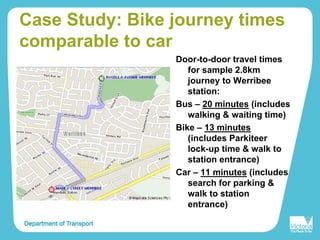
Case Study: Bike journey times
comparable to car
Door-to-door travel times
for sample 2.8km
journey to Werribee
station:
Bus – 20 minutes (includes
walking & waiting time)
Bike – 13 minutes
(includes Parkiteer
lock-up time & walk to
station entrance)
Car – 11 minutes (includes
search for parking &
walk to station
entrance)
Why is promoting ‘bike and
ride’ commuting good public
transport policy?
For rail operators ‘bike and ride’ can:
• Increase train capacity by removing
bikes from peak period trains
• Intensify land use around stations
• Reduce pressure on station car parking
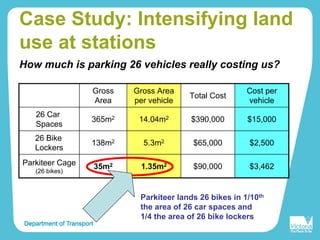
Case Study: Intensifying land
use at stations
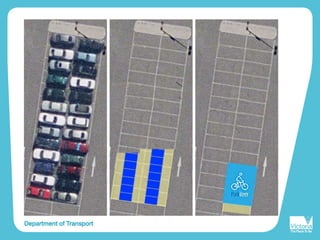
How much is parking 26 vehicles really costing us?
Gross
Area
Gross Area
per vehicle
Total Cost
Cost per
vehicle
26 Car
Spaces
365m2 14.04m2 $390,000 $15,000
26 Bike
Lockers
138m2 5.3m2 $65,000 $2,500
Parkiteer Cage
(26 bikes)
35m2 1.35m2 $90,000 $3,462
Parkiteer lands 26 bikes in 1/10th
the area of 26 car spaces and
1/4 the area of 26 bike lockers
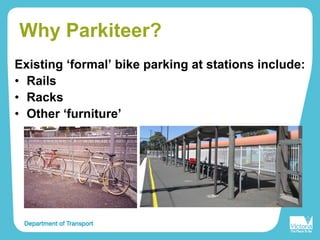
Why Parkiteer?
Existing ‘formal’ bike parking at stations include:
• Rails
• Racks
• Other ‘furniture’
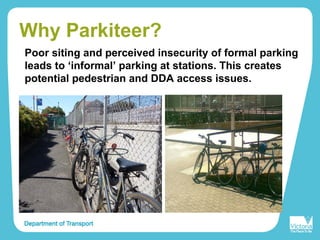
Why Parkiteer?
Poor siting and perceived insecurity of formal parking
leads to ‘informal’ parking at stations. This creates
potential pedestrian and DDA access issues.
Why Parkiteer?
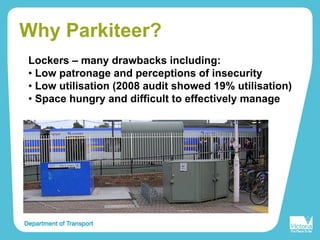
Lockers – many drawbacks including:
• Low patronage and perceptions of insecurity
• Low utilisation (2008 audit showed 19% utilisation)
• Space hungry and difficult to effectively manage
What is Parkiteer?
Parkiteer is a ‘machine ensemble’ made up of:
• Structural elements (the cage)
• Bike parking systems (rails and racks)
• Power supply (solar or shore power)
• Access controls (electronic door lock/
swipe card access)
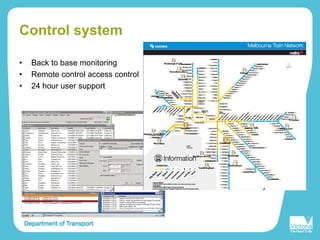
• Control systems (back to base monitoring)
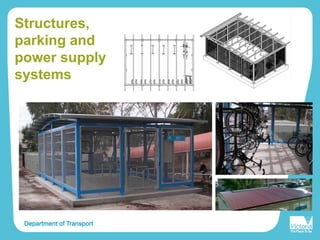
Structures,
parking and
power supply
systems
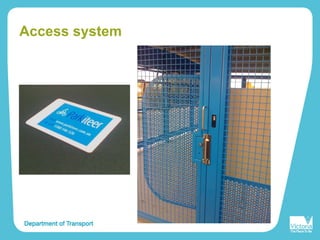
Access system
Control system
• Back to base monitoring
• Remote control access control
• 24 hour user support
Parkiteer rolls out
There are 43 Parkiteer cages currently in use.
There have been two main waves of Parkiteer
cages:
• Late 2008 – 20 cages (16 metro/4 regional)
• Mid 2009 – 15 cages (11 metro/4 regional)
Eight additional cages have rolled out as part
of station upgrades or new stations.
Marketing Parkiteer
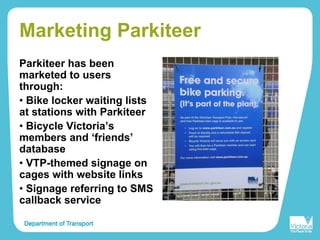
Parkiteer has been
marketed to users
through:
• Bike locker waiting lists
at stations with Parkiteer
• Bicycle Victoria’s
members and ‘friends’
database
• VTP-themed signage on
cages with website links
• Signage referring to SMS
callback service
Evaluating Parkiteer
Evaluation is still in progress, however
useful performance measures include:
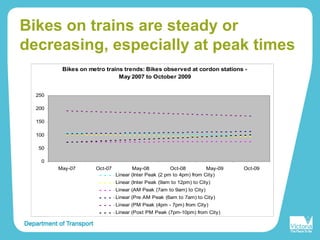
• Some reduction of bikes on trains,
especially in peak periods
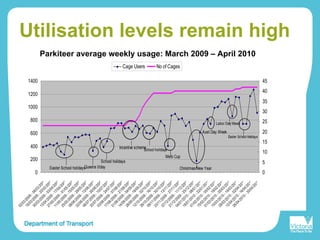
• High Parkiteer utilisation levels
• Conversion of car drivers and car
passengers to cyclists through Parkiteer
(average 40%)
Additionally, useful data has been gained
on who uses cages.
Bikes on trains are steady or
decreasing, especially at peak times
Bikes on metro trains trends: Bikes observed at cordon stations -
May 2007 to October 2009
0
50
100
150
200
250
May-07 Oct-07 May-08 Oct-08 May-09 Oct-09
Linear (Inter Peak (2 pm to 4pm) from City)
Linear (Inter Peak (9am to 12pm) to City)
Linear (AM Peak (7am to 9am) to City)
Linear (Pre AM Peak (6am to 7am) to City)
Linear (PM Peak (4pm - 7pm) from City)
Linear (Post PM Peak (7pm-10pm) from City)
Utilisation levels remain high
0
200
400
600
800
1000
1200
1400
02/03/2009
-06/03/2009
16/03/2009-20/03/2009
30/03/2009-03/04/2009
13/04/2009-17/04/2009
27/05/2009-01/05/2009
11/05/2009
-15/05/2009
25/05/2009-29/05/2009
08/06/2009
-12/06/2009
22/06/2009-26/06/2009
06/07/2009-10/07/2009
20/07/2009-24/07/2009
03/08/2009-07/08/2009
17/08/2009
-21/08/2009
31/08/2009-04/09/2009
14/09/2009
-18/09/2009
28/09/2009-02/10/2009
12/10/2009
-16/10/2009
26/10/2009-30/10/2009
09/11/2009-13/11/2009
23/11/2009
-27/11/2009
07/12/2009-11/12/2009
21/12/2009
-25/12/2009
04/01/2010-08/01/2010
18/01/2010-22/01/2010
01/02/2010-05/02/2010
15/02/2010-19/02/2010
01/03/2010
-05/03/2010
15/03/2010-19/03/2010
29/03/2010
-02/04/2010
12/04/2010-16/04/2010
26/04/2010-30/04/2010
0
5
10
15
20
25
30
35
40
45
Cage Users No of Cages
Easter School holidaysQueens b'day
School holidays
Incentive schemeSchool holidays
Melb Cup
Christmas/New Year
Aust Day Week
Labor DayWeek
Easter School Holidays
Parkiteer average weekly usage: March 2009 – April 2010
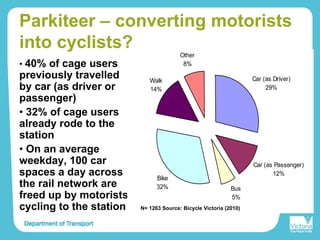
Parkiteer – converting motorists
into cyclists?
• 40% of cage users
previously travelled
by car (as driver or
passenger)
• 32% of cage users
already rode to the
station
• On an average
weekday, 100 car
spaces a day across
the rail network are
freed up by motorists
cycling to the station
Car (as Driver)
29%
Car (as Passenger)
12%
Bus
5%
Bike
32%
Walk
14%
Other
8%
N= 1263 Source: Bicycle Victoria (2010)
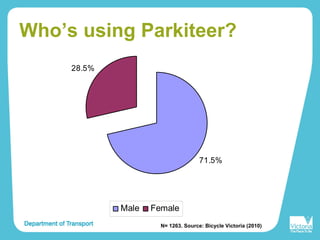
Who’s using Parkiteer?
71.5%
28.5%
Male Female
N= 1263. Source: Bicycle Victoria (2010)
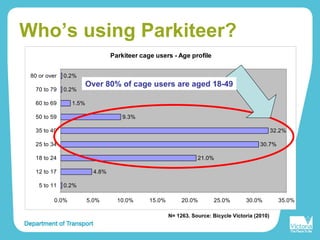
Who’s using Parkiteer?
Parkiteer cage users - Age profile
0.2%
4.8%
21.0%
30.7%
32.2%
9.3%
1.5%
0.2%
0.2%
0.0% 5.0% 10.0% 15.0% 20.0% 25.0% 30.0% 35.0%
5 to 11
12 to 17
18 to 24
25 to 34
35 to 49
50 to 59
60 to 69
70 to 79
80 or over
Over 80% of cage users are aged 18-49
N= 1263. Source: Bicycle Victoria (2010)
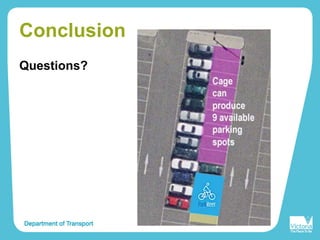
Conclusion
Questions?

Parkiteer - Secure bicycle access at Public Transport nodes

  • 1.
    Parkiteer –secure bike parkingat PT nodes Scott Martin – Department of Transport
  • 2.
    Train patronage athistoric highs FirstWorldWar Firstelectrificationscheme openedprogressivelyfrom1919to1923 GreatDepression SecondWorldWar-nopatronagereported Suburbanservicesweresuspendedfor34daysduetostrikes suburban'20milelimitdropped;PetrolrationingendsFeb1950 Allservicessuspendedfor55daysduetostrikes Dandenong-Pakenhamelectrifiedforcoaltraffic 1956OlympicGames CreditSqueeze UpperFerntreeGully-Belgraveelectrified Recession SuburbanservicesextendedtoPakenham Burnleyloopopens,Comengtrainsenterservice The'Met'formed,last'redrattler'withdrawn AltonaLoopopens Lastofthefourcityloopsopens PortMelbourneandStKildalinesclosed. Recession Cranbourneelectrificationopens Franchising-ConnexandNationalExpress Sydenhamelectrificationopens Re-franchising-Connexassumescontrolofentirenetwork Craigieburnelectricficationopens 0 50 100 150 200 250 1900s 1910s 1920s 1930s 1940s 1950s 1960s 1970s 1980s 1990s 2000s Boardings(millions) Neutral Events Events likely to have a positive effect on patronage Events likely to have a negative effect on patronage Estimated Metropolitan Train Patronage 2008-09 revised forecast 220.1 million boardings Prior to 1982-83 patronage was enumerated as journeys derived from ticket sales. Figures prior to this date have been factored up by 5% to allow for journeys involving more than one train boarding. Note:
  • 3.
    Access to railwaystations Source: Metlink OD Survey (2006) Access mode Number % Bicycle 5,266 1.6% Bus 32,558 10% Car (driver) 54,966 16.9% Car (passenger) 39,084 12.0% Train 14,631 4.5% Tram 9,717 3.0% Walked 169,435 52.0% TOTAL 325,658 100.0%
  • 4.
    Market segmentation There arethree distinct cycling markets that combine bike riding with public transport: 1.‘Bike and Ride’ – cycle from home to entry station 2.‘Bike and Ride and Bike’ – cycle to entry station, take bike on train, cycle from exit station 3.‘Ride and Bike’ – cycle from exit station to destination
  • 5.
    Is promoting ‘bikeand ride’ commuting good for rail users? • Riding to the station reduces time-based ‘interchange penalties’ from: Walking to the station or feeder mode (bus/tram) stop Journey times on feeder modes • Door-to-door journey times for riding on short (2-3 km) trips are comparable with car travel on local roads • Wider health benefits from active transport use
  • 6.
    Case Study: Bikejourney times comparable to car Door-to-door travel times for sample 2.8km journey to Werribee station: Bus – 20 minutes (includes walking & waiting time) Bike – 13 minutes (includes Parkiteer lock-up time & walk to station entrance) Car – 11 minutes (includes search for parking & walk to station entrance)
  • 7.
    Why is promoting‘bike and ride’ commuting good public transport policy? For rail operators ‘bike and ride’ can: • Increase train capacity by removing bikes from peak period trains • Intensify land use around stations • Reduce pressure on station car parking
  • 8.
    Case Study: Intensifyingland use at stations How much is parking 26 vehicles really costing us? Gross Area Gross Area per vehicle Total Cost Cost per vehicle 26 Car Spaces 365m2 14.04m2 $390,000 $15,000 26 Bike Lockers 138m2 5.3m2 $65,000 $2,500 Parkiteer Cage (26 bikes) 35m2 1.35m2 $90,000 $3,462 Parkiteer lands 26 bikes in 1/10th the area of 26 car spaces and 1/4 the area of 26 bike lockers
  • 10.
    Why Parkiteer? Existing ‘formal’bike parking at stations include: • Rails • Racks • Other ‘furniture’
  • 11.
    Why Parkiteer? Poor sitingand perceived insecurity of formal parking leads to ‘informal’ parking at stations. This creates potential pedestrian and DDA access issues.
  • 12.
    Why Parkiteer? Lockers –many drawbacks including: • Low patronage and perceptions of insecurity • Low utilisation (2008 audit showed 19% utilisation) • Space hungry and difficult to effectively manage
  • 13.
    What is Parkiteer? Parkiteeris a ‘machine ensemble’ made up of: • Structural elements (the cage) • Bike parking systems (rails and racks) • Power supply (solar or shore power) • Access controls (electronic door lock/ swipe card access) • Control systems (back to base monitoring)
  • 14.
  • 15.
  • 16.
    Control system • Backto base monitoring • Remote control access control • 24 hour user support
  • 17.
    Parkiteer rolls out Thereare 43 Parkiteer cages currently in use. There have been two main waves of Parkiteer cages: • Late 2008 – 20 cages (16 metro/4 regional) • Mid 2009 – 15 cages (11 metro/4 regional) Eight additional cages have rolled out as part of station upgrades or new stations.
  • 18.
    Marketing Parkiteer Parkiteer hasbeen marketed to users through: • Bike locker waiting lists at stations with Parkiteer • Bicycle Victoria’s members and ‘friends’ database • VTP-themed signage on cages with website links • Signage referring to SMS callback service
  • 19.
    Evaluating Parkiteer Evaluation isstill in progress, however useful performance measures include: • Some reduction of bikes on trains, especially in peak periods • High Parkiteer utilisation levels • Conversion of car drivers and car passengers to cyclists through Parkiteer (average 40%) Additionally, useful data has been gained on who uses cages.
  • 20.
    Bikes on trainsare steady or decreasing, especially at peak times Bikes on metro trains trends: Bikes observed at cordon stations - May 2007 to October 2009 0 50 100 150 200 250 May-07 Oct-07 May-08 Oct-08 May-09 Oct-09 Linear (Inter Peak (2 pm to 4pm) from City) Linear (Inter Peak (9am to 12pm) to City) Linear (AM Peak (7am to 9am) to City) Linear (Pre AM Peak (6am to 7am) to City) Linear (PM Peak (4pm - 7pm) from City) Linear (Post PM Peak (7pm-10pm) from City)
  • 21.
    Utilisation levels remainhigh 0 200 400 600 800 1000 1200 1400 02/03/2009 -06/03/2009 16/03/2009-20/03/2009 30/03/2009-03/04/2009 13/04/2009-17/04/2009 27/05/2009-01/05/2009 11/05/2009 -15/05/2009 25/05/2009-29/05/2009 08/06/2009 -12/06/2009 22/06/2009-26/06/2009 06/07/2009-10/07/2009 20/07/2009-24/07/2009 03/08/2009-07/08/2009 17/08/2009 -21/08/2009 31/08/2009-04/09/2009 14/09/2009 -18/09/2009 28/09/2009-02/10/2009 12/10/2009 -16/10/2009 26/10/2009-30/10/2009 09/11/2009-13/11/2009 23/11/2009 -27/11/2009 07/12/2009-11/12/2009 21/12/2009 -25/12/2009 04/01/2010-08/01/2010 18/01/2010-22/01/2010 01/02/2010-05/02/2010 15/02/2010-19/02/2010 01/03/2010 -05/03/2010 15/03/2010-19/03/2010 29/03/2010 -02/04/2010 12/04/2010-16/04/2010 26/04/2010-30/04/2010 0 5 10 15 20 25 30 35 40 45 Cage Users No of Cages Easter School holidaysQueens b'day School holidays Incentive schemeSchool holidays Melb Cup Christmas/New Year Aust Day Week Labor DayWeek Easter School Holidays Parkiteer average weekly usage: March 2009 – April 2010
  • 22.
    Parkiteer – convertingmotorists into cyclists? • 40% of cage users previously travelled by car (as driver or passenger) • 32% of cage users already rode to the station • On an average weekday, 100 car spaces a day across the rail network are freed up by motorists cycling to the station Car (as Driver) 29% Car (as Passenger) 12% Bus 5% Bike 32% Walk 14% Other 8% N= 1263 Source: Bicycle Victoria (2010)
  • 23.
    Who’s using Parkiteer? 71.5% 28.5% MaleFemale N= 1263. Source: Bicycle Victoria (2010)
  • 24.
    Who’s using Parkiteer? Parkiteercage users - Age profile 0.2% 4.8% 21.0% 30.7% 32.2% 9.3% 1.5% 0.2% 0.2% 0.0% 5.0% 10.0% 15.0% 20.0% 25.0% 30.0% 35.0% 5 to 11 12 to 17 18 to 24 25 to 34 35 to 49 50 to 59 60 to 69 70 to 79 80 or over Over 80% of cage users are aged 18-49 N= 1263. Source: Bicycle Victoria (2010)
  • 25.