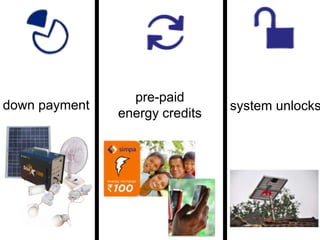
pre-paid
energy credits
system unlocksdown payment
1 10 102 103 104 105 106 107 108 109
$40
$400
$4,000
$40,000
$400,000
$4,000,000
$40,000,000
$400,000,000
$4,000,000,000
$40,000,000,000
Scaling Access to Energy
People
$40
$400
$4,000
$40,000
$400,000
$4,000,000
$40,000,000
$400,000,000
$4,000,000,000
$40,000,000,000
Scaling Access to Energy
People
1 10 102 103 104 105 106 107 108 109
prove
concept
impact
investors
$40
$400
$4,000
$40,000
$400,000
$4,000,000
$40,000,000
$400,000,000
$4,000,000,000
$40,000,000,000
Scaling Access to Energy
People
1 10 102 103 104 105 106 107 108 109
prove
concept
impact
investors
development
finance
prove
commercial
viability
$40
$400
$4,000
$40,000
$400,000
$4,000,000
$40,000,000
$400,000,000
$4,000,000,000
$40,000,000,000
impact
investors
Scaling Access to Energy
People
1 10 102 103 104 105 106 107 108 109
prove
concept
financial
returns
at scale
prove
commercial
viability
development
finance
commercial
investors
0
500
1000
1500
2000
2500
3000
Year 1 Year 2 Year 3
$7.2 M
Debt + Equity
June 2014
Simpa Networks at ACEF 2014

Simpa Networks at ACEF 2014

Editor's Notes

  • #2 key points: solar as a service to energy poor households and micro enterprises. capital is required to scale. Different kinds of capital, kinds of investors, at different times. We’re using this prepaid metering technology to operate a solar energy services business in India. At Simpa, We sell solar-as-a-service to energy-poor households and micro-enterprises in rural India.
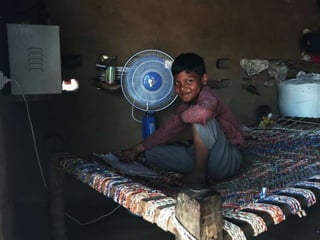
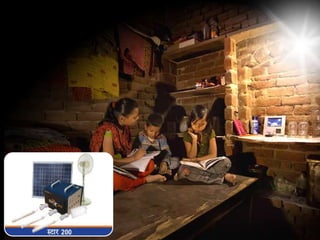
  • #3 I met this little boy a few weeks ago when I was touring around our sales areas. He lives in a small house with his sisters and his parents. They are farmers, and their house is close to their fields and not connected to the electricity grid. When we met them they had no access to electricity. Through the day they endure some scorching temperatures. Last week it got up to 48 degrees Celsius. Even at night there is very little relief: it dropped to 33 degrees most nights last week. They do not have not access to the electricity grid. So when the sun sets at about 7:15 it gets very dark quickly. His family are customers of our company, Simpa Energy. We provided to them a solar home system. In fact, we are leasing them a solar home system. The system includes a panel, a battery, two very bright LED high-efficiency lights, and an electric fan. When I visited a few weeks ago I was delighted to find this little boy sitting on his bed doing his home work. He was sitting beside the fan to keep cool. And his mom told me that he can study at night under the lights as well. Of course these are the moments we all love to see. This is the cliché photograph of a child studying under the power of a solar energy, but I can tell you honestly that when I meet families like this it underscores the importance for me of providing access to clean, reliable energy. And when I meet a child sitting happily doing their homework, it makes me wonder what I am doing wrong as a parent, because try as we might, Jackie and I just can’t seem to get our own kids to do their homework.
  • #4 Our company is called Simpa Networks, or Simpa Energy India. We sell solar-as-a-service to energy-poor households and micro-enterprises in rural India. Here’s how it works. First, the customer makes small initial payment to have a Simpa powered solar energy system installed. But it doesn‘t work, unless you top it up by purchasing energy credits. Small initial payment for the device... pay as you go for the electricity. And here’s the best part. Each of these small payments for electricity also add up towards the total purchase price, and once the customer has completed the contract, the whole system unlocks permanently, generating electricity, free and clear.
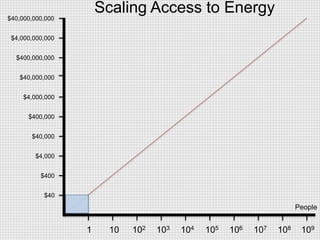
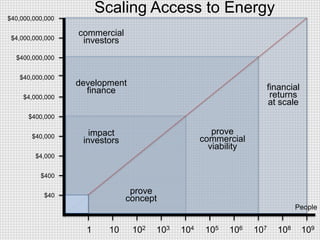
  • #5 We think that the only way to really scale up solutions such as ours is to do so through a for-profit business model that can attract commercial investment capital. Recall that there are over a billion people without access to electricity. That’s a very big number. Let’s think about how much capital would be required to meet the basic needs for electricity for a billion people with distributed solar. In India we see that a typical energy-poor household has on average 5 members. Their basic energy needs can be met by a small solar home that costs about $200 up front. And that’s about the right size system that’s actually affordable for most people to rent, if you can spread those payments out over 2-4 years under some kind of lease or rent-to-own program. Which means that to meet the basic electricity needs of a single person, requires an up front capital investment of about $40. Now costs are always coming down for the panels, but when you factor in all the costs of delivery, installation, etc. this is what we are seeing. $40 up front capital investment per person.
  • #6 Let’s see how much capital is needed to purchase and install enough small scale solar systems to meet the basic energy needs of these billion + people. Let’s go with this assumption of $40 per head. How much capital is required to scale this up to meaningful levels? And where is that capital going to come from? Who could finance the scale up of these clean energy solutions? Individual micro entrepreneurs are not going to be able to do this themselves of course. Other investors need to come in to finance the growth. And is there some “essential technology for development” that’s needed to unlock this capital?
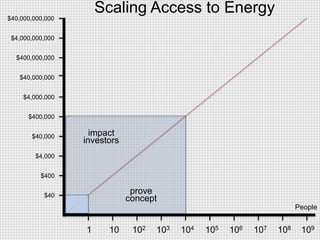
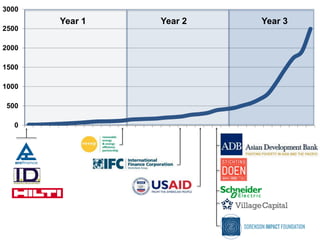
  • #7 There are a number of companies around the world now that are developing business models that can broadly be defined as solar-as-a-service. It could be rent-to-own solar systems like Simpa, or solar microgrids, or pure rental models. They all start in the same place, with a proof of concept. At this point you’re reaching 10^4 people, that’s 10,000 people, or about 2000 customers. That’s going to take about $400,000 investment in the up front capital cost for the solar equipment, batteries, lights, etc. It’s unlikely that individual entrepreneurs can fund that herself, so through this phase most companies in the energy access space have been able to raise capital from Impact Investors. At Simpa we raised money from some foundations, such as the Hilti Foundation, the DOEN Foundation, grants from USAID, and other smaller social impact investors. Those funds helped us get out there and sign up our first 2000 customers. Let’s keep an eye on the target: 1 billion people. That’s a sector wide target, not a target for individual companies. But individual companies move through these natural phases. The first phase is proof of concept: proving that customers buy-in to the offer. The next phase is really about developing a sales & distribution model to reach more customers.
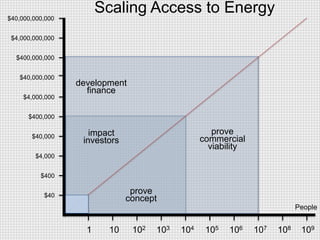
  • #8 In this second phase, companies need to scale up from 10,000 people, to 10 million people. At 5 people per household, that’s about 2,000,000 households. To fund the up front capital costs at this stage, companies might need to raise up to $400 million dollars, just to fund the up front capital costs for those 2,000,000 customers. Who’s going to provide that kind of capital, and what do they need in return? The early stage impact investors that funded the company in the early phase probably cannot make such large investments. Their role was to finance the proof of concept and early development. In this second phase, the company has to prove three big things: First, that they can build a sustainable distribution model to take this solution to scale. They have to demonstrate that they can cost effectively acquire new customers at scale. Second: they need to prove at meaningful scale, that customers will continue to pay! It’s easy enough to get 100 customers to pay. It’s a bit more difficult to manage 1000 or 2000 customers to pay. Third, and this is really the key one: you’ve got to prove that you’ve got an attractive, investible, commercially viable (ignoring the social impact!)
  • #9 Why do we care so much about commercial viability? Because we want to end energy poverty, and because we know that means reaching over a billion people, and we know that to reach those billion people with even very basic energy solutions is going to cost $40 billion dollars in invested capital. We want to achieve real scale, and to do so the sector cannot rely on social impact investors, and it cannot rely on philanthropic capital or development finance. Real scale needs to be financed by real money, and that’s gong to come from mainstream commercial investors. Mainstream commercial investors aren’t going to care about the social impact. They aren’t going to take much notice of the photos or stories of the customers. But they will finance the end to energy poverty if companies in our sector can demonstrate healthy financial returns for them. They also need transparency into customer payments. If they are going to underwrite the costs of these distributed solar assets, they want to know that the companies can monitor and remotely control, because we know that’s what’s needed to drive predictable customer payment behavior.
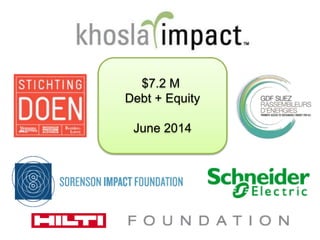
  • #11 We are in the process of closing a $7 million financing round. It is a mix of debt and equity and it will provide enough capital to finance the next 40,000 customers. I’m pleased to report that Khosla Impact Fund and GDF SUEZ, the world’s largest utility.
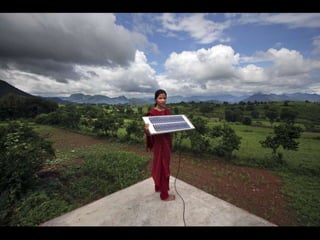
  • #12  I know that most of those billion people are not going to be satisfied with just basic electricity. A small scale solar solution can meet basic needs for lighting, cooling, mobile phone charging, but it’s really just a start, isn’t it. Most people are going to want more. For some people, these basic energy systems are going to expand their world view, expand their horizons, expand their opportunities, even expand their incomes. That’s going to stimulate demand for more energy services. I expect, that just like you and me, her demands for energy will just continue to grow over time. Imagine providing her that power, and imagine what she will do.