© 2007 Pearson Prentice Hall This work is protected by United States copyright laws and is provided solely for the use of instructors in teaching their courses and assessing student learning. Dissemination or sale of any part of this work (including on the World Wide Web) will destroy the integrity of the work and is not permitted. The work and materials from it should never be made available to students except by instructors using the accompanying text in their classes. All recipients of this work are expected to abide by these restrictions and to honor the intended pedagogical purposes and the needs of other instructors who rely on these materials. Lecture Outlines Chapter 4 Astronomy:  A Beginner’s Guide to the Universe 5 th  Edition Chaisson / McMillan
Chapter 4 The Solar System
Units of Chapter 4 An Inventory of the Solar System Interplanetary Matter The Formation of the Solar System Planets Beyond the Solar System
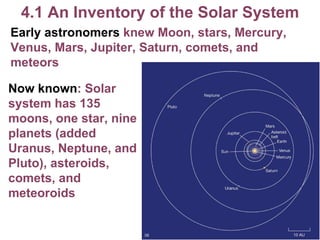
4.1 An Inventory of the Solar System Early astronomers   knew Moon, stars, Mercury, Venus, Mars, Jupiter, Saturn, comets, and meteors Now known : Solar system has 135 moons, one star, nine planets (added Uranus, Neptune, and Pluto), asteroids, comets, and meteoroids
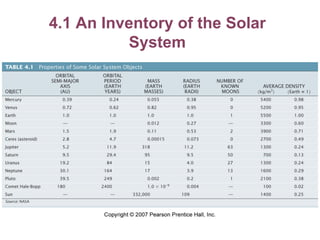
4.1 An Inventory of the Solar System
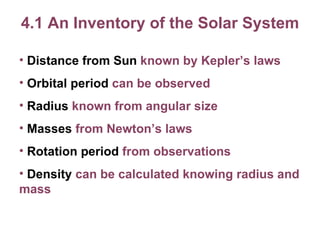
4.1 An Inventory of the Solar System Distance from Sun  known by Kepler’s laws Orbital period  can be observed Radius  known from angular size Masses  from Newton’s laws Rotation period  from observations Density  can be calculated knowing radius and mass
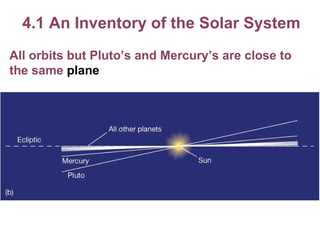
4.1 An Inventory of the Solar System All orbits but Pluto’s and Mercury’s are close to the same   plane
4.1 An Inventory of the Solar System
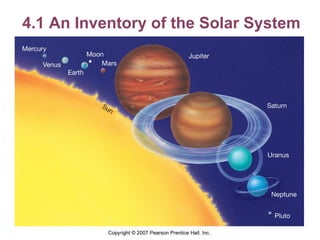
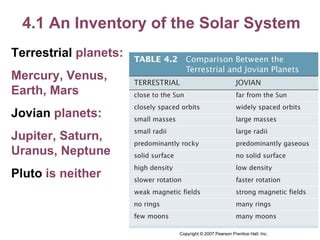
4.1 An Inventory of the Solar System Terrestrial   planets: Mercury, Venus, Earth, Mars Jovian   planets: Jupiter, Saturn, Uranus, Neptune Pluto   is neither
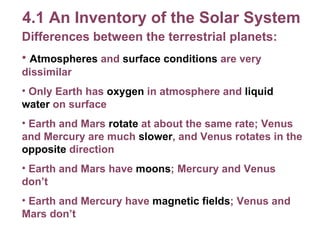
4.1 An Inventory of the Solar System Differences between the terrestrial planets: Atmospheres  and  surface conditions  are very dissimilar Only Earth has  oxygen  in atmosphere and  liquid water  on surface Earth and Mars  rotate  at about the same rate; Venus and Mercury are much  slower , and Venus rotates in the  opposite  direction Earth and Mars have  moons ; Mercury and Venus don’t Earth and Mercury have  magnetic fields ; Venus and Mars don’t
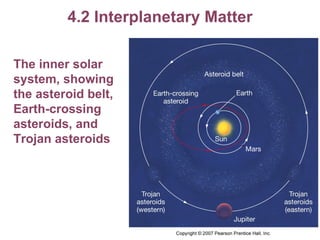
4.2 Interplanetary Matter The inner solar system, showing the asteroid belt, Earth-crossing asteroids, and Trojan asteroids
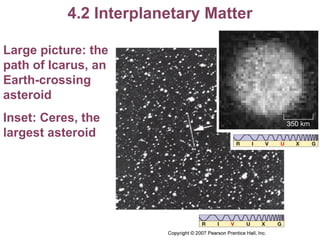
4.2 Interplanetary Matter Large picture: the path of Icarus, an Earth-crossing asteroid Inset: Ceres, the largest asteroid
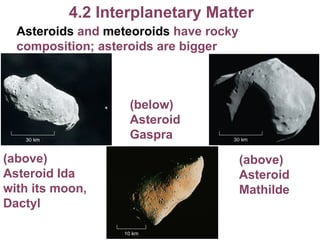
4.2 Interplanetary Matter Asteroids   and   meteoroids   have rocky composition; asteroids are bigger (above) Asteroid Ida with its moon, Dactyl (below) Asteroid Gaspra (above) Asteroid Mathilde
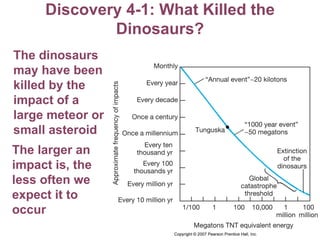
Discovery 4-1: What Killed the Dinosaurs? The larger an impact is, the less often we expect it to occur The dinosaurs may have been killed by the impact of a large meteor or small asteroid
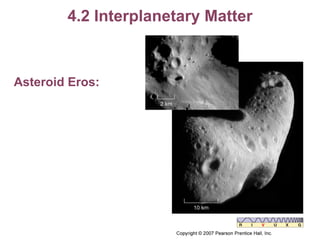
4.2 Interplanetary Matter Asteroid Eros:
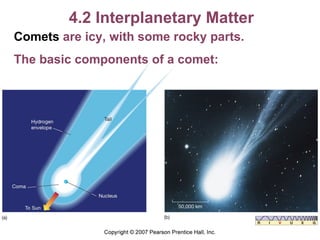
4.2 Interplanetary Matter Comets   are icy, with some rocky parts. The basic components of a comet:
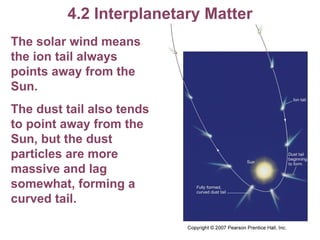
4.2 Interplanetary Matter The solar wind means the ion tail always points away from the Sun.  The dust tail also tends to point away from the Sun, but the dust particles are more massive and lag somewhat, forming a curved tail.
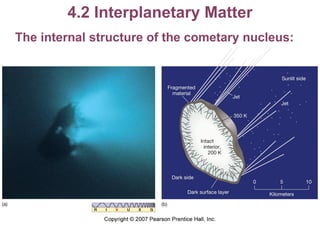
4.2 Interplanetary Matter The internal structure of the cometary nucleus:
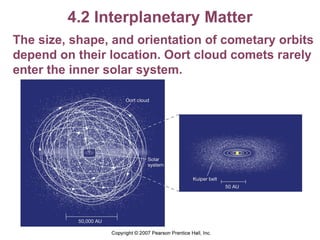
4.2 Interplanetary Matter The size, shape, and orientation of cometary orbits depend on their location. Oort cloud comets rarely enter the inner solar system.
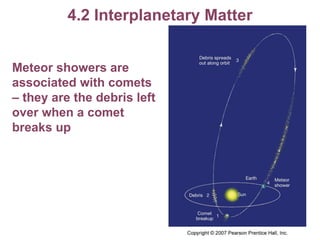
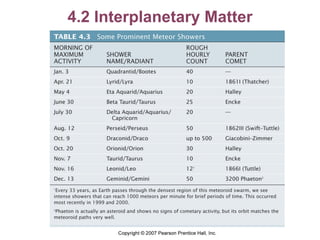
4.2 Interplanetary Matter Meteor showers are associated with comets – they are the debris left over when a comet breaks up
4.2 Interplanetary Matter
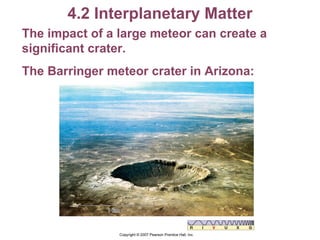
4.2 Interplanetary Matter The impact of a large meteor can create a significant crater. The Barringer meteor crater in Arizona:
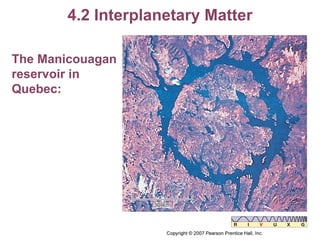
4.2 Interplanetary Matter The Manicouagan reservoir in Quebec:
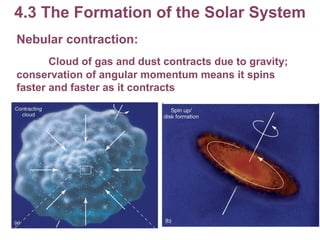
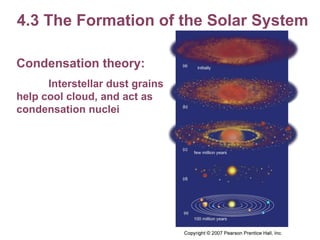
4.3 The Formation of the Solar System Nebular contraction: Cloud of gas and dust contracts due to gravity; conservation of angular momentum means it spins faster and faster as it contracts
4.3 The Formation of the Solar System Condensation theory: Interstellar dust grains help cool cloud, and act as condensation nuclei
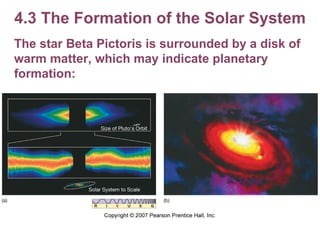
4.3 The Formation of the Solar System The star Beta Pictoris is surrounded by a disk of warm matter, which may indicate planetary formation:
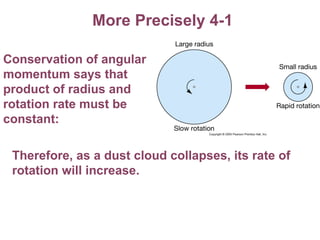
More Precisely 4-1 Conservation of angular momentum says that product of radius and rotation rate must be constant: Therefore, as a dust cloud collapses, its rate of rotation will increase.
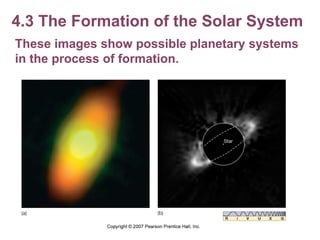
4.3 The Formation of the Solar System These images show possible planetary systems in the process of formation.
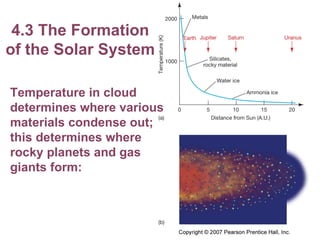
4.3 The Formation of the Solar System Temperature in cloud determines where various materials condense out; this determines where rocky planets and gas giants form:
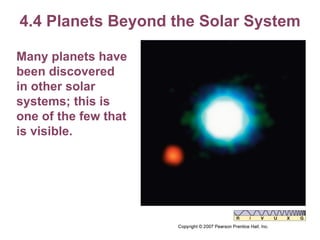
4.4 Planets Beyond the Solar System Many planets have been discovered in other solar systems; this is one of the few that is visible.
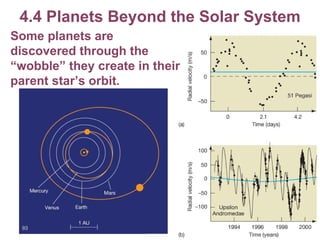
4.4 Planets Beyond the Solar System Some planets are discovered through the “wobble” they create in their parent star’s orbit.
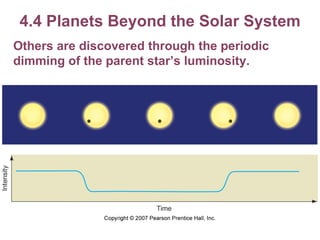
4.4 Planets Beyond the Solar System Others are discovered through the periodic dimming of the parent star’s luminosity.
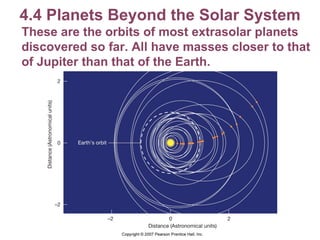
4.4 Planets Beyond the Solar System These are the orbits of most extrasolar planets discovered so far. All have masses closer to that of Jupiter than that of the Earth.
Summary of Chapter 4 Solar system consists of Sun and everything orbiting it Asteroids are rocky, and most orbit between orbits of Mars and Jupiter Comets are icy, and are believed to have formed early in the solar system’s life Major planets orbit Sun in same sense, and all but Venus rotate in that sense as well Planetary orbits lie almost in the same plane
Summary of Chapter 4 Four inner planets – terrestrial planets – are  rocky, small, and dense Four outer planets – Jovian planets – (omitting  Pluto) are gaseous and large Nebular theory of solar system formation: cloud of gas and dust gradually collapsed under its own gravity, spinning faster as it shrank Condensation theory says dust grains acted as condensation nuclei, beginning formation of larger objects
Summary of Chapter 4 Planets have been discovered in other solar systems Most are large and orbit much closer to the Sun than the large planets in our solar system do

Chapter 04 Lecture

  • 1.
    © 2007 PearsonPrentice Hall This work is protected by United States copyright laws and is provided solely for the use of instructors in teaching their courses and assessing student learning. Dissemination or sale of any part of this work (including on the World Wide Web) will destroy the integrity of the work and is not permitted. The work and materials from it should never be made available to students except by instructors using the accompanying text in their classes. All recipients of this work are expected to abide by these restrictions and to honor the intended pedagogical purposes and the needs of other instructors who rely on these materials. Lecture Outlines Chapter 4 Astronomy: A Beginner’s Guide to the Universe 5 th Edition Chaisson / McMillan
  • 2.
    Chapter 4 TheSolar System
  • 3.
    Units of Chapter4 An Inventory of the Solar System Interplanetary Matter The Formation of the Solar System Planets Beyond the Solar System
  • 4.
    4.1 An Inventoryof the Solar System Early astronomers knew Moon, stars, Mercury, Venus, Mars, Jupiter, Saturn, comets, and meteors Now known : Solar system has 135 moons, one star, nine planets (added Uranus, Neptune, and Pluto), asteroids, comets, and meteoroids
  • 5.
    4.1 An Inventoryof the Solar System
  • 6.
    4.1 An Inventoryof the Solar System Distance from Sun known by Kepler’s laws Orbital period can be observed Radius known from angular size Masses from Newton’s laws Rotation period from observations Density can be calculated knowing radius and mass
  • 7.
    4.1 An Inventoryof the Solar System All orbits but Pluto’s and Mercury’s are close to the same plane
  • 8.
    4.1 An Inventoryof the Solar System
  • 9.
    4.1 An Inventoryof the Solar System Terrestrial planets: Mercury, Venus, Earth, Mars Jovian planets: Jupiter, Saturn, Uranus, Neptune Pluto is neither
  • 10.
    4.1 An Inventoryof the Solar System Differences between the terrestrial planets: Atmospheres and surface conditions are very dissimilar Only Earth has oxygen in atmosphere and liquid water on surface Earth and Mars rotate at about the same rate; Venus and Mercury are much slower , and Venus rotates in the opposite direction Earth and Mars have moons ; Mercury and Venus don’t Earth and Mercury have magnetic fields ; Venus and Mars don’t
  • 11.
    4.2 Interplanetary MatterThe inner solar system, showing the asteroid belt, Earth-crossing asteroids, and Trojan asteroids
  • 12.
    4.2 Interplanetary MatterLarge picture: the path of Icarus, an Earth-crossing asteroid Inset: Ceres, the largest asteroid
  • 13.
    4.2 Interplanetary MatterAsteroids and meteoroids have rocky composition; asteroids are bigger (above) Asteroid Ida with its moon, Dactyl (below) Asteroid Gaspra (above) Asteroid Mathilde
  • 14.
    Discovery 4-1: WhatKilled the Dinosaurs? The larger an impact is, the less often we expect it to occur The dinosaurs may have been killed by the impact of a large meteor or small asteroid
  • 15.
  • 16.
    4.2 Interplanetary MatterComets are icy, with some rocky parts. The basic components of a comet:
  • 17.
    4.2 Interplanetary MatterThe solar wind means the ion tail always points away from the Sun. The dust tail also tends to point away from the Sun, but the dust particles are more massive and lag somewhat, forming a curved tail.
  • 18.
    4.2 Interplanetary MatterThe internal structure of the cometary nucleus:
  • 19.
    4.2 Interplanetary MatterThe size, shape, and orientation of cometary orbits depend on their location. Oort cloud comets rarely enter the inner solar system.
  • 20.
    4.2 Interplanetary MatterMeteor showers are associated with comets – they are the debris left over when a comet breaks up
  • 21.
  • 22.
    4.2 Interplanetary MatterThe impact of a large meteor can create a significant crater. The Barringer meteor crater in Arizona:
  • 23.
    4.2 Interplanetary MatterThe Manicouagan reservoir in Quebec:
  • 24.
    4.3 The Formationof the Solar System Nebular contraction: Cloud of gas and dust contracts due to gravity; conservation of angular momentum means it spins faster and faster as it contracts
  • 25.
    4.3 The Formationof the Solar System Condensation theory: Interstellar dust grains help cool cloud, and act as condensation nuclei
  • 26.
    4.3 The Formationof the Solar System The star Beta Pictoris is surrounded by a disk of warm matter, which may indicate planetary formation:
  • 27.
    More Precisely 4-1Conservation of angular momentum says that product of radius and rotation rate must be constant: Therefore, as a dust cloud collapses, its rate of rotation will increase.
  • 28.
    4.3 The Formationof the Solar System These images show possible planetary systems in the process of formation.
  • 29.
    4.3 The Formationof the Solar System Temperature in cloud determines where various materials condense out; this determines where rocky planets and gas giants form:
  • 30.
    4.4 Planets Beyondthe Solar System Many planets have been discovered in other solar systems; this is one of the few that is visible.
  • 31.
    4.4 Planets Beyondthe Solar System Some planets are discovered through the “wobble” they create in their parent star’s orbit.
  • 32.
    4.4 Planets Beyondthe Solar System Others are discovered through the periodic dimming of the parent star’s luminosity.
  • 33.
    4.4 Planets Beyondthe Solar System These are the orbits of most extrasolar planets discovered so far. All have masses closer to that of Jupiter than that of the Earth.
  • 34.
    Summary of Chapter4 Solar system consists of Sun and everything orbiting it Asteroids are rocky, and most orbit between orbits of Mars and Jupiter Comets are icy, and are believed to have formed early in the solar system’s life Major planets orbit Sun in same sense, and all but Venus rotate in that sense as well Planetary orbits lie almost in the same plane
  • 35.
    Summary of Chapter4 Four inner planets – terrestrial planets – are rocky, small, and dense Four outer planets – Jovian planets – (omitting Pluto) are gaseous and large Nebular theory of solar system formation: cloud of gas and dust gradually collapsed under its own gravity, spinning faster as it shrank Condensation theory says dust grains acted as condensation nuclei, beginning formation of larger objects
  • 36.
    Summary of Chapter4 Planets have been discovered in other solar systems Most are large and orbit much closer to the Sun than the large planets in our solar system do