Chapter Two Studying Human Sexuality
Sex, Advice Columnists,  and Pop Psychology The sex information/advice genre seeks to: Inform — transmit information that is factual and accurate Entertain — attract audiences through hosts’ personalities as well as high-interest or bizarre material Often includes moral judgments Use social science and psychiatry to give authority
Use and Abuse of Statistics Popular media may summarize social science research in an oversimplified or distorted manner Sensationalize findings Over generalize results of research Report statistics that agree with widely-held preconceptions Popular media may not emphasize the importance of replication
Thinking Critically about Sex Basic scientific principles require a commitment to  objectivity observation of reality while excluding researchers’ feelings or beliefs Subjectivity is to be avoided   Difficult to achieve especially in the area of sexuality Sexuality can bring out powerful emotions and moral ambivalence
Value Judgments:  Limitations Do not tell us what motivates people Do not tell us how frequently people behave in a given way Do not tell us how people feel Only tell us how we ourselves feel
Value Judgments vs. Objectivity Value judgments only reveal the thoughts or feelings of one person Objectivity describes reality Objective positions can be tested Cultural relativity requires that we examine appropriateness within the cultural norms where it exists
Value Judgments vs. Objectivity Value judgments imply how a person  ought  to behave Objective statements describe how people  actually  behave Value judgments cannot be empirically evaluated Objective statements can be empirically evaluated
Opinions, Biases, and Stereotypes Interfere with the Pursuit of Knowledge Opinions are unsubstantiated beliefs or conclusions according to an individual’s personal thoughts Biases are personal leanings or inclinations Stereotypes are sets of overgeneralized beliefs about an individual, a group, or an idea, etc.
Stereotypes A schema is a way of organizing information which often underlies stereotypes  Sexual stereotyping is often used to justify discrimination or social groups Women Poor people African Americans, Latino/as, Asian Americans Gay men, lesbians, bisexuals, transgender people
Stereotypes Stereotypes structure our knowledge by shaping:  What we see What we notice What we remember How we explain things
Attitudes and Behavior Attitude:  a predisposition a person has to act, think, or feel in certain ways Behavior:  the way a person acts Behavior does not predict attitude and vice versa Frequent discrepancies exist between the two on individual and cultural levels which can result in confusion
Common Fallacies:  Egocentrism and Ethnocentrism Fallacy:  an error in reasoning that affects our understanding of a subject Egocentric fallacy:  the belief that our own personal experience and values are generally held by others Ethnocentric fallacy:  the belief that one’s own ethnic group, nation, or culture’s values and customs are innately superior to others’
Egocentrism and Ethnocentrism Often occur in our consideration of different ethnic groups Transmitted from one generation to another Prevent understanding from a culturally relative position
Sex Research Methods Scientific Method:  the method by which a hypothesis is formed from impartially gathered data and tested empirically. Induction: drawing a general conclusion from specific facts Seeks to describe the world rather than to evaluate or judge it
Research Concerns Ethical Concerns use of human beings as subjects of research Methodological Concerns center on information-gathering techniques and accuracy A representative sample of people is necessary to draw accurate conclusions
Ethical Issues Informed consent Full disclosure of purpose, risk, benefits Agreement to participate may be withdrawn Protection from harm Emotional distress must be avoided Identity of subjects must be confidential
Sampling Sample: a portion of a larger group of people are observed or studied Inferences are made to the larger group Good samples are:  Random Representative Unbiased
Limitations of Samples Restrict Generalizations Depend on volunteers or clients Takes place at universities or colleges with student volunteers Some ethnic groups are underrepresented Gay men, lesbian women, bisexual and transgendered people may not be publicly identified
Clinical Research An in-depth examination of an individual or group that comes to a specialist for assistance with disorders and problems Limited by an emphasis on pathological   behavior Shaped by cultural definitions of what is pathological
Survey Research Questionnaires Administered quickly Forced choice allows many formats Interviews Allow more information to be gathered Allow subjects to guide topics Sexual diaries Collect richer information May work well with some subjects but not all
Survey Research Limitations Subjects may report self behavior with bias Interviewers may collect information with a bias Subjects may be embarrassed in an interview Accuracy of subjects’ memory fades as time passes Difficult for subjects to accurately estimate factors such as how long sexual encounters last
Observational Research The researcher unobtrusively observes and makes notes about people’s behavior Serious ethical issues in observing sexual behavior without subjects’ knowledge or consent Known observation generally affects behavior
Participant Observation The researcher participates in the behaviors which she or he is studying Used frequently by anthropologists Is sex research controversial because it compromises objectivity?
Experimental Research The systematic manipulation variables to examine the effect on behavior Independent variables:  factors that can be manipulated and changed by the experimenter Dependent variables:  factors that are likely to be affected by changes in the independent variable
An Example of Experimental Research Examine effect of various amounts of alcohol on sexual arousal Alcohol — independent variable Plethysmograph measurement of arousal — dependent variable Causal effect demonstrated
The Sex Researchers In 19 th  century, Western sexuality began to be studied from a scientific framework Fascinated with “pathologies” of sex: fetishism, sadism, masturbation, homosexuality Since that time, a liberalizing trend in our thinking about sexuality 20 th  century researchers viewed sexuality more positively
The Sex Researchers Three themes evident in later 20 th  century sex researchers’ work: Belief that sexual expression is essential to an individual’s well being Desire to broaden the range of legitimate sexual activity, including homosexuality Belief that female sexuality is equal to male sexuality
Richard von Krafft-Ebing (1840-1902) Psychopathia Sexualis  (1886):  A collection of the case histories of fetishists, sadists, masochists, and homosexuals Attributed variations in Victorian sexuality to “hereditary taint,” “moral degeneracy,” and masturbation Brought public attention to sexual behaviors that had never been documented
Sigmund Freud (1856-1939) Dramatically impacted Western ideas Sexuality begins at birth with five-stage development: Oral stage (birth to 1 year) Anal stage (age 1-3) Phallic stage (age 3-5) Latency stage (age 6-puberty) Genital stage (puberty onward)
Sigmund Freud:  Phallic stage Oedipal Complex:  Boy develops sexual desires for mother and fears father Castration anxiety:  Fears his father will cut off his penis:  castration anxiety Electra complex:  Girl develops sexual desire for father and fears mother Penis envy:   Girls never acquire the “lost penis” and therefore fail to develop an independent character like that of boys By age 6, boys and girls resolve their complexes by relinquishing their desires for their parents and identifying with their same-sex parent
Sigmund Freud:  Impact  Freud was pioneering in commitment to science and explorations of the unconscious Over the past generation, his influence among American sex researchers has dwindled Lack of empiricism  Inadequate description of female development Questions of relevance to contemporary society In the field of sex research, his work is now primarily of historical interest
Havelock Ellis (1859-1939) One of the first modern affirmers of sexuality Studies in the Psychology of Sex  (1897-1910) Pointed out the relativity of sexual values Appealed to case studies as well as studies in animal behavior, anthropology, and history Challenged view that masturbation was abnormal Documented existence of women’s sexual desires Reevaluated homosexuality as a congenital condition
Alfred Kinsey (1894-1956) The Kinsey Reports  Sexual Behavior in the Human Male (1948)  Sexual Behavior in the Human Female (1953) Statistical documentation of American sexual behavior Showed a significant discrepancy between  public  standards and  actual  standards of sexual behavior
Alfred Kinsey:  Impact Sexual Diversity and Variation Extraordinary diversity in behaviors of subjects Many subjects (e.g. 50% of men) had sexual experiences with members of the same-sex   Reevaluation of Masturbation Important for women Harmless Pleasurable
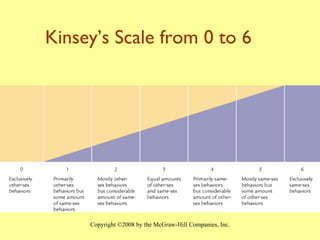
Alfred Kinsey: Controversy Same sex behavior Labels of “heterosexual” and “homosexual” were  inadequate ways of understanding sexual behavior Devised the “Kinsey Scale” Rejection of normal/abnormal dichotomy Sexual differences are a matter of degree, not kind Became an advocate of the tolerance Decline of society
Kinsey’s Scale from 0 to 6
Alfred Kinsey: Criticisms Statistical methodology: unrepresentative sampling  Emphasis on quantification of sexual behavior Rejection of the psychological dimension (reducing behavior to genital activity)
William Masters (1915-2001) and Virginia Johnson (1925-) Human Sexual Response  (1966) Detailed the sexual response cycles of hundreds of male and female research subjects Combined clinical observation with direct measurement of genital arousal using electronic devices
Masters and Johnson:  Outcomes Similarity of male and female sexual responses  Women achieve orgasms via clitoral stimulation Legitimized female masturbation
Masters and Johnson:  Outcomes Human Sexual Inadequacy  (1970) Argued that sexual problems were not the result of neuroses or personality disorders Rather, lack of information, poor communication, or relationship conflict contributed Used behavioral therapy to treat sexual problems with great success
Contemporary Research Studies Several large, national, or multi-site sexuality related studies have recently been conducted The National Health and Social Life Survey (1994) The Youth Risk Behavior Survey (biannual) The Behavioral Risk Factor Surveillance System (annual) The National Survey of Family Growth (periodic) College Alcohol Study (every few years) Community Intervention Trial for Youth Project
Contemporary Research Studies Large scale national sexuality related studies Smaller scale studies Difficulties due to political and social climate  Restricted funding
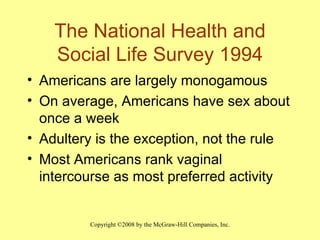
The National Health and Social Life Survey 1994 Americans are largely monogamous On average, Americans have sex about once a week Adultery is the exception, not the rule Most Americans rank vaginal intercourse as most preferred activity
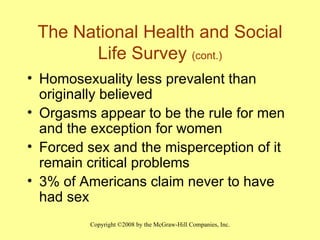
The National Health and Social Life Survey  (cont.) Homosexuality less prevalent than originally believed Orgasms appear to be the rule for men and the exception for women Forced sex and the misperception of it remain critical problems 3% of Americans claim never to have had sex
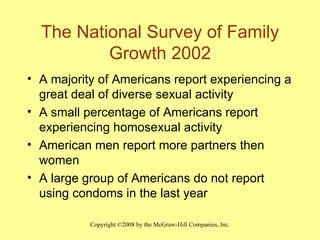
The National Survey of Family Growth 2002 A majority of Americans report experiencing a great deal of diverse sexual activity A small percentage of Americans report experiencing homosexual activity American men report more partners then women A large group of Americans do not report using condoms in the last year
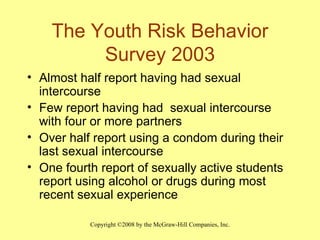
The Youth Risk Behavior Survey 2003 Almost half report having had sexual intercourse Few report having had  sexual intercourse with four or more partners Over half report using a condom during their last sexual intercourse One fourth report of sexually active students report using alcohol or drugs during most recent sexual experience
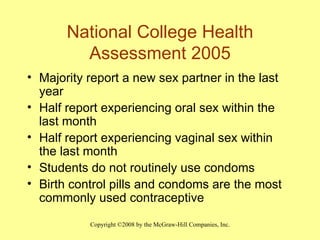
National College Health Assessment 2005 Majority report a new sex partner in the last year Half report experiencing oral sex within the last month Half report experiencing vaginal sex within the last month Students do not routinely use condoms  Birth control pills and condoms are the most commonly used contraceptive
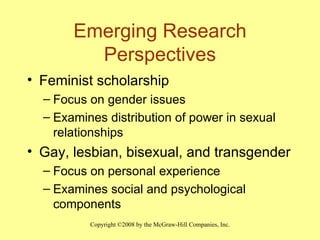
Emerging Research Perspectives Feminist scholarship Focus on gender issues Examines distribution of power in sexual relationships Gay, lesbian, bisexual, and transgender  Focus on personal experience Examines social and psychological components
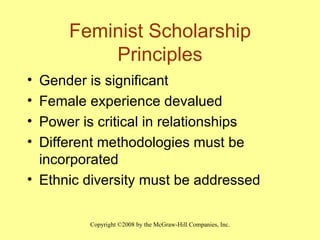
Feminist Scholarship Principles Gender is significant Female experience devalued Power is critical in relationships Different methodologies must be incorporated Ethnic diversity must be addressed
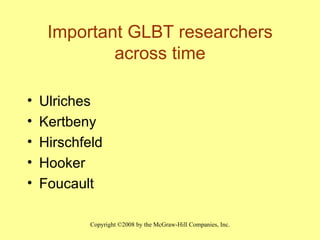
Important GLBT researchers across time Ulriches Kertbeny Hirschfeld Hooker Foucault
Critical Inclusions for Future Research Expanded definitions of sexuality Intervention based research Accepting and positive representation of sexuality
Directions for Future Research Global perspective Inclusion of other fields of scientific study
Ethnicity and Sexuality Researchers have begun to recognize differences among ethnic groups Related factors: socioeconomic status, environment, methodology, researcher’s stereotypes
African Americans and Research Sexual stereotypes Socioeconomic status Racism Black subcultures
Latinos and Research Sexual stereotypes Traditional cultures Catholicism Acculturation
Asian Americans and Pacific Islanders Increase in population Collectivist culture Immigration Sexual stereotypes
Summary Sex, advice columnists, and pop psychology Methods of sex research  History of sex research  Challenges for the future

strong6_ppt_ch02

  • 1.
    Chapter Two StudyingHuman Sexuality
  • 2.
    Sex, Advice Columnists, and Pop Psychology The sex information/advice genre seeks to: Inform — transmit information that is factual and accurate Entertain — attract audiences through hosts’ personalities as well as high-interest or bizarre material Often includes moral judgments Use social science and psychiatry to give authority
  • 3.
    Use and Abuseof Statistics Popular media may summarize social science research in an oversimplified or distorted manner Sensationalize findings Over generalize results of research Report statistics that agree with widely-held preconceptions Popular media may not emphasize the importance of replication
  • 4.
    Thinking Critically aboutSex Basic scientific principles require a commitment to objectivity observation of reality while excluding researchers’ feelings or beliefs Subjectivity is to be avoided Difficult to achieve especially in the area of sexuality Sexuality can bring out powerful emotions and moral ambivalence
  • 5.
    Value Judgments: Limitations Do not tell us what motivates people Do not tell us how frequently people behave in a given way Do not tell us how people feel Only tell us how we ourselves feel
  • 6.
    Value Judgments vs.Objectivity Value judgments only reveal the thoughts or feelings of one person Objectivity describes reality Objective positions can be tested Cultural relativity requires that we examine appropriateness within the cultural norms where it exists
  • 7.
    Value Judgments vs.Objectivity Value judgments imply how a person ought to behave Objective statements describe how people actually behave Value judgments cannot be empirically evaluated Objective statements can be empirically evaluated
  • 8.
    Opinions, Biases, andStereotypes Interfere with the Pursuit of Knowledge Opinions are unsubstantiated beliefs or conclusions according to an individual’s personal thoughts Biases are personal leanings or inclinations Stereotypes are sets of overgeneralized beliefs about an individual, a group, or an idea, etc.
  • 9.
    Stereotypes A schemais a way of organizing information which often underlies stereotypes Sexual stereotyping is often used to justify discrimination or social groups Women Poor people African Americans, Latino/as, Asian Americans Gay men, lesbians, bisexuals, transgender people
  • 10.
    Stereotypes Stereotypes structureour knowledge by shaping: What we see What we notice What we remember How we explain things
  • 11.
    Attitudes and BehaviorAttitude: a predisposition a person has to act, think, or feel in certain ways Behavior: the way a person acts Behavior does not predict attitude and vice versa Frequent discrepancies exist between the two on individual and cultural levels which can result in confusion
  • 12.
    Common Fallacies: Egocentrism and Ethnocentrism Fallacy: an error in reasoning that affects our understanding of a subject Egocentric fallacy: the belief that our own personal experience and values are generally held by others Ethnocentric fallacy: the belief that one’s own ethnic group, nation, or culture’s values and customs are innately superior to others’
  • 13.
    Egocentrism and EthnocentrismOften occur in our consideration of different ethnic groups Transmitted from one generation to another Prevent understanding from a culturally relative position
  • 14.
    Sex Research MethodsScientific Method: the method by which a hypothesis is formed from impartially gathered data and tested empirically. Induction: drawing a general conclusion from specific facts Seeks to describe the world rather than to evaluate or judge it
  • 15.
    Research Concerns EthicalConcerns use of human beings as subjects of research Methodological Concerns center on information-gathering techniques and accuracy A representative sample of people is necessary to draw accurate conclusions
  • 16.
    Ethical Issues Informedconsent Full disclosure of purpose, risk, benefits Agreement to participate may be withdrawn Protection from harm Emotional distress must be avoided Identity of subjects must be confidential
  • 17.
    Sampling Sample: aportion of a larger group of people are observed or studied Inferences are made to the larger group Good samples are: Random Representative Unbiased
  • 18.
    Limitations of SamplesRestrict Generalizations Depend on volunteers or clients Takes place at universities or colleges with student volunteers Some ethnic groups are underrepresented Gay men, lesbian women, bisexual and transgendered people may not be publicly identified
  • 19.
    Clinical Research Anin-depth examination of an individual or group that comes to a specialist for assistance with disorders and problems Limited by an emphasis on pathological behavior Shaped by cultural definitions of what is pathological
  • 20.
    Survey Research QuestionnairesAdministered quickly Forced choice allows many formats Interviews Allow more information to be gathered Allow subjects to guide topics Sexual diaries Collect richer information May work well with some subjects but not all
  • 21.
    Survey Research LimitationsSubjects may report self behavior with bias Interviewers may collect information with a bias Subjects may be embarrassed in an interview Accuracy of subjects’ memory fades as time passes Difficult for subjects to accurately estimate factors such as how long sexual encounters last
  • 22.
    Observational Research Theresearcher unobtrusively observes and makes notes about people’s behavior Serious ethical issues in observing sexual behavior without subjects’ knowledge or consent Known observation generally affects behavior
  • 23.
    Participant Observation Theresearcher participates in the behaviors which she or he is studying Used frequently by anthropologists Is sex research controversial because it compromises objectivity?
  • 24.
    Experimental Research Thesystematic manipulation variables to examine the effect on behavior Independent variables: factors that can be manipulated and changed by the experimenter Dependent variables: factors that are likely to be affected by changes in the independent variable
  • 25.
    An Example ofExperimental Research Examine effect of various amounts of alcohol on sexual arousal Alcohol — independent variable Plethysmograph measurement of arousal — dependent variable Causal effect demonstrated
  • 26.
    The Sex ResearchersIn 19 th century, Western sexuality began to be studied from a scientific framework Fascinated with “pathologies” of sex: fetishism, sadism, masturbation, homosexuality Since that time, a liberalizing trend in our thinking about sexuality 20 th century researchers viewed sexuality more positively
  • 27.
    The Sex ResearchersThree themes evident in later 20 th century sex researchers’ work: Belief that sexual expression is essential to an individual’s well being Desire to broaden the range of legitimate sexual activity, including homosexuality Belief that female sexuality is equal to male sexuality
  • 28.
    Richard von Krafft-Ebing(1840-1902) Psychopathia Sexualis (1886): A collection of the case histories of fetishists, sadists, masochists, and homosexuals Attributed variations in Victorian sexuality to “hereditary taint,” “moral degeneracy,” and masturbation Brought public attention to sexual behaviors that had never been documented
  • 29.
    Sigmund Freud (1856-1939)Dramatically impacted Western ideas Sexuality begins at birth with five-stage development: Oral stage (birth to 1 year) Anal stage (age 1-3) Phallic stage (age 3-5) Latency stage (age 6-puberty) Genital stage (puberty onward)
  • 30.
    Sigmund Freud: Phallic stage Oedipal Complex: Boy develops sexual desires for mother and fears father Castration anxiety: Fears his father will cut off his penis: castration anxiety Electra complex: Girl develops sexual desire for father and fears mother Penis envy: Girls never acquire the “lost penis” and therefore fail to develop an independent character like that of boys By age 6, boys and girls resolve their complexes by relinquishing their desires for their parents and identifying with their same-sex parent
  • 31.
    Sigmund Freud: Impact Freud was pioneering in commitment to science and explorations of the unconscious Over the past generation, his influence among American sex researchers has dwindled Lack of empiricism Inadequate description of female development Questions of relevance to contemporary society In the field of sex research, his work is now primarily of historical interest
  • 32.
    Havelock Ellis (1859-1939)One of the first modern affirmers of sexuality Studies in the Psychology of Sex (1897-1910) Pointed out the relativity of sexual values Appealed to case studies as well as studies in animal behavior, anthropology, and history Challenged view that masturbation was abnormal Documented existence of women’s sexual desires Reevaluated homosexuality as a congenital condition
  • 33.
    Alfred Kinsey (1894-1956)The Kinsey Reports Sexual Behavior in the Human Male (1948) Sexual Behavior in the Human Female (1953) Statistical documentation of American sexual behavior Showed a significant discrepancy between public standards and actual standards of sexual behavior
  • 34.
    Alfred Kinsey: Impact Sexual Diversity and Variation Extraordinary diversity in behaviors of subjects Many subjects (e.g. 50% of men) had sexual experiences with members of the same-sex Reevaluation of Masturbation Important for women Harmless Pleasurable
  • 35.
    Alfred Kinsey: ControversySame sex behavior Labels of “heterosexual” and “homosexual” were inadequate ways of understanding sexual behavior Devised the “Kinsey Scale” Rejection of normal/abnormal dichotomy Sexual differences are a matter of degree, not kind Became an advocate of the tolerance Decline of society
  • 36.
  • 37.
    Alfred Kinsey: CriticismsStatistical methodology: unrepresentative sampling Emphasis on quantification of sexual behavior Rejection of the psychological dimension (reducing behavior to genital activity)
  • 38.
    William Masters (1915-2001)and Virginia Johnson (1925-) Human Sexual Response (1966) Detailed the sexual response cycles of hundreds of male and female research subjects Combined clinical observation with direct measurement of genital arousal using electronic devices
  • 39.
    Masters and Johnson: Outcomes Similarity of male and female sexual responses Women achieve orgasms via clitoral stimulation Legitimized female masturbation
  • 40.
    Masters and Johnson: Outcomes Human Sexual Inadequacy (1970) Argued that sexual problems were not the result of neuroses or personality disorders Rather, lack of information, poor communication, or relationship conflict contributed Used behavioral therapy to treat sexual problems with great success
  • 41.
    Contemporary Research StudiesSeveral large, national, or multi-site sexuality related studies have recently been conducted The National Health and Social Life Survey (1994) The Youth Risk Behavior Survey (biannual) The Behavioral Risk Factor Surveillance System (annual) The National Survey of Family Growth (periodic) College Alcohol Study (every few years) Community Intervention Trial for Youth Project
  • 42.
    Contemporary Research StudiesLarge scale national sexuality related studies Smaller scale studies Difficulties due to political and social climate Restricted funding
  • 43.
    The National Healthand Social Life Survey 1994 Americans are largely monogamous On average, Americans have sex about once a week Adultery is the exception, not the rule Most Americans rank vaginal intercourse as most preferred activity
  • 44.
    The National Healthand Social Life Survey (cont.) Homosexuality less prevalent than originally believed Orgasms appear to be the rule for men and the exception for women Forced sex and the misperception of it remain critical problems 3% of Americans claim never to have had sex
  • 45.
    The National Surveyof Family Growth 2002 A majority of Americans report experiencing a great deal of diverse sexual activity A small percentage of Americans report experiencing homosexual activity American men report more partners then women A large group of Americans do not report using condoms in the last year
  • 46.
    The Youth RiskBehavior Survey 2003 Almost half report having had sexual intercourse Few report having had sexual intercourse with four or more partners Over half report using a condom during their last sexual intercourse One fourth report of sexually active students report using alcohol or drugs during most recent sexual experience
  • 47.
    National College HealthAssessment 2005 Majority report a new sex partner in the last year Half report experiencing oral sex within the last month Half report experiencing vaginal sex within the last month Students do not routinely use condoms Birth control pills and condoms are the most commonly used contraceptive
  • 48.
    Emerging Research PerspectivesFeminist scholarship Focus on gender issues Examines distribution of power in sexual relationships Gay, lesbian, bisexual, and transgender Focus on personal experience Examines social and psychological components
  • 49.
    Feminist Scholarship PrinciplesGender is significant Female experience devalued Power is critical in relationships Different methodologies must be incorporated Ethnic diversity must be addressed
  • 50.
    Important GLBT researchersacross time Ulriches Kertbeny Hirschfeld Hooker Foucault
  • 51.
    Critical Inclusions forFuture Research Expanded definitions of sexuality Intervention based research Accepting and positive representation of sexuality
  • 52.
    Directions for FutureResearch Global perspective Inclusion of other fields of scientific study
  • 53.
    Ethnicity and SexualityResearchers have begun to recognize differences among ethnic groups Related factors: socioeconomic status, environment, methodology, researcher’s stereotypes
  • 54.
    African Americans andResearch Sexual stereotypes Socioeconomic status Racism Black subcultures
  • 55.
    Latinos and ResearchSexual stereotypes Traditional cultures Catholicism Acculturation
  • 56.
    Asian Americans andPacific Islanders Increase in population Collectivist culture Immigration Sexual stereotypes
  • 57.
    Summary Sex, advicecolumnists, and pop psychology Methods of sex research History of sex research Challenges for the future