Modeling extrasolar planetary atmospheres   Planetary Systems as Potential Sites for Life Special Session SpS6 - Aug. 11th, 11h-11h20 France Allard Directrice de Recherche, CNRS Centre de Recherche Astrophysique de Lyon
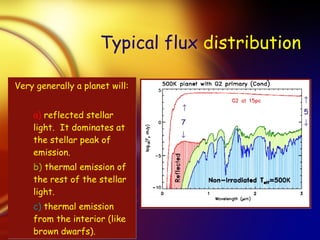
Typical flux  distribution Very generally a planet will: a)  reflected stellar light.  It dominates at the stellar peak of emission. b)  thermal emission of the rest of the stellar light. c)  thermal emission from the interior (like brown dwarfs).   7   5 
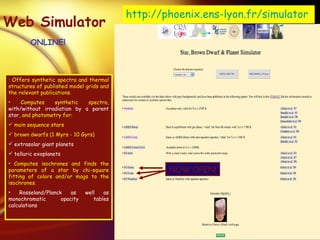
Web Simulator ONLINE! Offers synthetic spectra and thermal structures of published model grids and the relevant publications. Computes synthetic spectra,   with/without irradiation by a parent star , and photometry for: main sequence stars  brown dwarfs (1 Myrs - 10 Gyrs) extrasolar giant planets  telluric exoplanets Computes isochrones and finds the parameters of a star by chi-square fitting of colors and/or mags to the isochrones. Rosseland/Planck as well as monochromatic opacity tables calculations http://phoenix. ens-lyon . fr/simulator NOW OPEN!
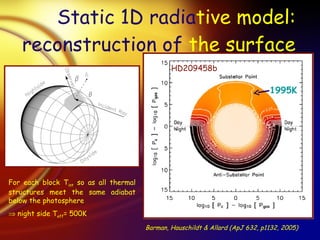
Static 1D   radia tive model:  reconstruction of  the surface Barman, Hauschildt & Allard (ApJ 632, p1132, 2005) For each block T int  so as all thermal structures meet the same adiabat below the photosphere     night side T eff = 500K HD209458b 1995K
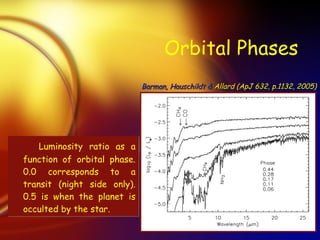
Orbital Phases Luminosity ratio as a function of orbital phase. 0.0 corresponds to a transit (night side only). 0.5 is when the planet is occulted by the star. Barman, Hauschildt &  Allard (ApJ 632, p.1132, 2005)
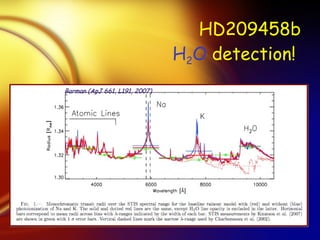
HD209458b  H 2 O  detection!   Barman (ApJ 661, L191, 2007)
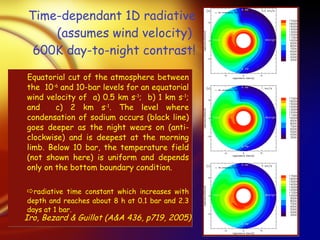
Time-dependant 1D radiative (assumes wind velocity)  600K day-to-night contrast! Equatorial cut of the atmosphere between the  10 -6  and 10-bar levels for an equatorial wind velocity of  a) 0.5 km s -1 ;  b) 1 km s -1 ; and  c) 2 km s -1 . The level where condensation of sodium occurs (black line) goes deeper as the night wears on (anti-clockwise) and is deepest at the morning limb. Below 10 bar, the temperature field (not shown here) is uniform and depends only on the bottom boundary condition.  radiative  time constant which increases with depth and reaches about 8 h at 0.1 bar and 2.3 days at 1 bar. Iro, Bezard & Guillot (A&A 436, p719, 2005)
Quasi-2D, single layered  fluid dynamics  [Left] Equatorial and polar views of potential vorticity (a flow tracer) in a specific hot Jupiter model from Cho et al. (2003, 2007). Note the prominent circumpolar vortices formed as a result of potential vorticity conservation. [Right] Corresponding zonally averaged wind profile, characterized by a small number of broad jets (three in this case).  Fig 3 of Showman, Menou & Cho (2007) Cho et al. (2003, 2007)
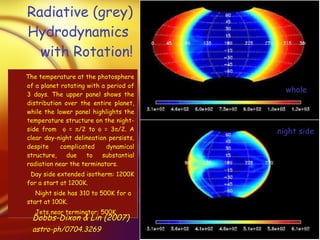
Radiative (grey) Hydrodynamics  with Rotation! The temperature at the photosphere of a planet rotating with a period of 3 days. The upper panel shows the distribution over the entire planet, while the lower panel highlights the temperature structure on the night-side from    =   /2 to    = 3  /2. A clear day-night delineation persists, despite complicated dynamical structure, due to substantial radiation near the terminators.   Day side extended isotherm: 1200K for a start at 1200K. Night side has 310 to 500K for a start at 100K. Jets near terminator: 500K Dobbs-Dixon & Lin (2007) astro-ph/0704.3269 night side whole
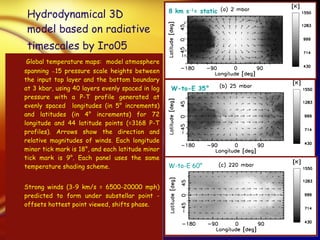
Hydrodynamical 3D  model based on radiative timescales by Iro05   Global temperature maps:  model atmosphere spanning  ∼ 15 pressure scale heights between the input top layer and the bottom boundary at 3 kbar, using 40 layers evenly spaced in log pressure with a P-T profile generated at evenly spaced  longitudes (in 5° increments) and latitudes (in 4° increments) for 72 longitude and 44 latitude points (=3168 P-T profiles). Arrows show the direction and relative magnitudes of winds. Each longitude minor tick mark is 18°, and each latitude minor tick mark is 9°. Each panel uses the same temperature shading scheme. Strong winds (3-9 km/s = 6500-20000 mph) predicted to form under substellar point - offsets hottest point viewed, shifts phase. Cooper & Showman (2006) 8 km s -1 = static W-to-E 35° W-to-E 60°
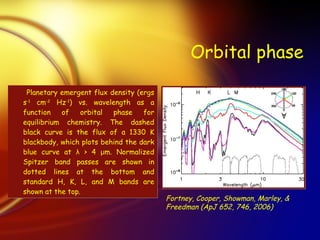
Orbital phase Planetary emergent flux density (ergs s -1  cm -2  Hz -1 ) vs. wavelength as a function of orbital phase for equilibrium chemistry. The dashed black curve is the flux of a 1330 K blackbody, which plots behind the dark blue curve at  λ  > 4  μ m. Normalized Spitzer band passes are shown in dotted lines at the bottom and standard H, K, L, and M bands are shown at the top. Fortney, Cooper, Showman, Marley, & Freedman (ApJ 652, 746, 2006)
 
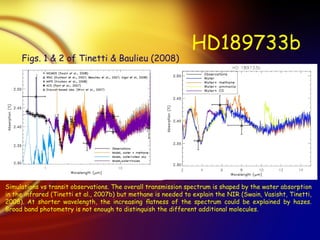
HD189733b Simulations vs transit observations. The overall transmission spectrum is shaped by the water absorption in the infrared (Tinetti et al., 2007b) but methane is needed to explain the NIR (Swain, Vasisht, Tinetti, 2008). At shorter wavelength, the increasing flatness of the spectrum could be explained by hazes. Broad band photometry is not enough to distinguish the different additional molecules. Figs. 1 & 2 of Tinetti & Baulieu (2008)
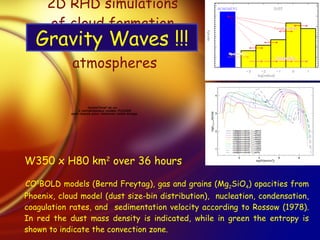
2D RHD simulations  of cloud formation  in brown dwarf atmospheres CO 5 BOLD models (Bernd Freytag), gas and grains (Mg 2 SiO 4 ) opacities from Phoenix, cloud model (dust size-bin distribution),  nucleation, condensation, coagulation rates, and  sedimentation velocity according to Rossow (1978).   In red the dust mass density is indicated, while in green the entropy is shown to indicate the convection zone. W350 x H80 km 2  over 36 hours   Gravity Waves !!!
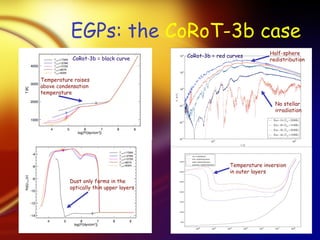
EGPs: the  CoRoT-3b case Temperature inversion in outer layers Temperature raises above condensation temperature Dust only forms in the optically thin upper layers CoRot-3b = black curve CoRot-3b = red curves No stellar irradiation Half-sphere redistribution
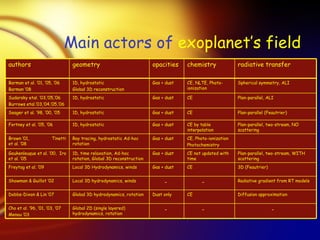
Main  actors  of  exoplanet’s field Plan-parallel, two-stream, WITH scattering CE not updated with time Gas + dust 1D, time relaxation, Ad-hoc rotation, Global 3D reconstruction Goukenleuque et al. ‘00,  Iro et al. ‘05 Plan-parallel (Feautrier) CE Gas + dust 1D, hydrostatic Seager et al. ‘98, ‘00, ‘05 Radiative gradient from RT models - - Local 3D hydrodynamics, winds Showman & Guillot ‘02 - - - Global 2D (single layered) hydrodynamics, rotation Cho et al. ‘96, ‘01, ‘03, ‘07 Menou ‘03 3D (Feautrier) CE Gas + dust Local 3D Hydrodynamics, winds Freytag et al. ‘09 CE, Photo-ionization Photochemistry Gas + dust Ray tracing, hydrostatic Ad-hoc rotation Brown ‘01,  Tinetti et al. ‘08 Diffusion approximation CE Dust only Global 3D hydrodynamics, rotation Dobbs-Dixon & Lin ‘07 Plan-parallel, two-stream, NO scattering CE by table interpolation Gas + dust 1D, hydrostatic Fortney et al. ‘05, ‘06 Plan-parallel, ALI CE Gas + dust 1D, hydrostatic Sudarsky etal. ‘03,‘05,‘06 Burrows etal.‘03,’04,’05,’06 opacities Gas + dust  Spherical symmetry, ALI CE, NLTE, Photo-ionization 1D, hydrostatic Global 3D reconstruction Barman et al. ‘01, ‘05, ‘06 Barman ‘08 radiative transfer chemistry geometry authors

Brazil2

  • 1.
    Modeling extrasolar planetaryatmospheres Planetary Systems as Potential Sites for Life Special Session SpS6 - Aug. 11th, 11h-11h20 France Allard Directrice de Recherche, CNRS Centre de Recherche Astrophysique de Lyon
  • 2.
    Typical flux distribution Very generally a planet will: a) reflected stellar light. It dominates at the stellar peak of emission. b) thermal emission of the rest of the stellar light. c) thermal emission from the interior (like brown dwarfs).  7   5 
  • 3.
    Web Simulator ONLINE!Offers synthetic spectra and thermal structures of published model grids and the relevant publications. Computes synthetic spectra, with/without irradiation by a parent star , and photometry for: main sequence stars brown dwarfs (1 Myrs - 10 Gyrs) extrasolar giant planets telluric exoplanets Computes isochrones and finds the parameters of a star by chi-square fitting of colors and/or mags to the isochrones. Rosseland/Planck as well as monochromatic opacity tables calculations http://phoenix. ens-lyon . fr/simulator NOW OPEN!
  • 4.
    Static 1D radia tive model: reconstruction of the surface Barman, Hauschildt & Allard (ApJ 632, p1132, 2005) For each block T int so as all thermal structures meet the same adiabat below the photosphere  night side T eff = 500K HD209458b 1995K
  • 5.
    Orbital Phases Luminosityratio as a function of orbital phase. 0.0 corresponds to a transit (night side only). 0.5 is when the planet is occulted by the star. Barman, Hauschildt & Allard (ApJ 632, p.1132, 2005)
  • 6.
    HD209458b H2 O detection! Barman (ApJ 661, L191, 2007)
  • 7.
    Time-dependant 1D radiative(assumes wind velocity) 600K day-to-night contrast! Equatorial cut of the atmosphere between the 10 -6 and 10-bar levels for an equatorial wind velocity of a) 0.5 km s -1 ; b) 1 km s -1 ; and c) 2 km s -1 . The level where condensation of sodium occurs (black line) goes deeper as the night wears on (anti-clockwise) and is deepest at the morning limb. Below 10 bar, the temperature field (not shown here) is uniform and depends only on the bottom boundary condition.  radiative time constant which increases with depth and reaches about 8 h at 0.1 bar and 2.3 days at 1 bar. Iro, Bezard & Guillot (A&A 436, p719, 2005)
  • 8.
    Quasi-2D, single layered fluid dynamics [Left] Equatorial and polar views of potential vorticity (a flow tracer) in a specific hot Jupiter model from Cho et al. (2003, 2007). Note the prominent circumpolar vortices formed as a result of potential vorticity conservation. [Right] Corresponding zonally averaged wind profile, characterized by a small number of broad jets (three in this case). Fig 3 of Showman, Menou & Cho (2007) Cho et al. (2003, 2007)
  • 9.
    Radiative (grey) Hydrodynamics with Rotation! The temperature at the photosphere of a planet rotating with a period of 3 days. The upper panel shows the distribution over the entire planet, while the lower panel highlights the temperature structure on the night-side from  =  /2 to  = 3  /2. A clear day-night delineation persists, despite complicated dynamical structure, due to substantial radiation near the terminators. Day side extended isotherm: 1200K for a start at 1200K. Night side has 310 to 500K for a start at 100K. Jets near terminator: 500K Dobbs-Dixon & Lin (2007) astro-ph/0704.3269 night side whole
  • 10.
    Hydrodynamical 3D model based on radiative timescales by Iro05 Global temperature maps: model atmosphere spanning ∼ 15 pressure scale heights between the input top layer and the bottom boundary at 3 kbar, using 40 layers evenly spaced in log pressure with a P-T profile generated at evenly spaced longitudes (in 5° increments) and latitudes (in 4° increments) for 72 longitude and 44 latitude points (=3168 P-T profiles). Arrows show the direction and relative magnitudes of winds. Each longitude minor tick mark is 18°, and each latitude minor tick mark is 9°. Each panel uses the same temperature shading scheme. Strong winds (3-9 km/s = 6500-20000 mph) predicted to form under substellar point - offsets hottest point viewed, shifts phase. Cooper & Showman (2006) 8 km s -1 = static W-to-E 35° W-to-E 60°
  • 11.
    Orbital phase Planetaryemergent flux density (ergs s -1 cm -2 Hz -1 ) vs. wavelength as a function of orbital phase for equilibrium chemistry. The dashed black curve is the flux of a 1330 K blackbody, which plots behind the dark blue curve at λ > 4 μ m. Normalized Spitzer band passes are shown in dotted lines at the bottom and standard H, K, L, and M bands are shown at the top. Fortney, Cooper, Showman, Marley, & Freedman (ApJ 652, 746, 2006)
  • 12.
  • 13.
    HD189733b Simulations vstransit observations. The overall transmission spectrum is shaped by the water absorption in the infrared (Tinetti et al., 2007b) but methane is needed to explain the NIR (Swain, Vasisht, Tinetti, 2008). At shorter wavelength, the increasing flatness of the spectrum could be explained by hazes. Broad band photometry is not enough to distinguish the different additional molecules. Figs. 1 & 2 of Tinetti & Baulieu (2008)
  • 14.
    2D RHD simulations of cloud formation in brown dwarf atmospheres CO 5 BOLD models (Bernd Freytag), gas and grains (Mg 2 SiO 4 ) opacities from Phoenix, cloud model (dust size-bin distribution), nucleation, condensation, coagulation rates, and sedimentation velocity according to Rossow (1978). In red the dust mass density is indicated, while in green the entropy is shown to indicate the convection zone. W350 x H80 km 2 over 36 hours Gravity Waves !!!
  • 15.
    EGPs: the CoRoT-3b case Temperature inversion in outer layers Temperature raises above condensation temperature Dust only forms in the optically thin upper layers CoRot-3b = black curve CoRot-3b = red curves No stellar irradiation Half-sphere redistribution
  • 16.
    Main actors of exoplanet’s field Plan-parallel, two-stream, WITH scattering CE not updated with time Gas + dust 1D, time relaxation, Ad-hoc rotation, Global 3D reconstruction Goukenleuque et al. ‘00, Iro et al. ‘05 Plan-parallel (Feautrier) CE Gas + dust 1D, hydrostatic Seager et al. ‘98, ‘00, ‘05 Radiative gradient from RT models - - Local 3D hydrodynamics, winds Showman & Guillot ‘02 - - - Global 2D (single layered) hydrodynamics, rotation Cho et al. ‘96, ‘01, ‘03, ‘07 Menou ‘03 3D (Feautrier) CE Gas + dust Local 3D Hydrodynamics, winds Freytag et al. ‘09 CE, Photo-ionization Photochemistry Gas + dust Ray tracing, hydrostatic Ad-hoc rotation Brown ‘01, Tinetti et al. ‘08 Diffusion approximation CE Dust only Global 3D hydrodynamics, rotation Dobbs-Dixon & Lin ‘07 Plan-parallel, two-stream, NO scattering CE by table interpolation Gas + dust 1D, hydrostatic Fortney et al. ‘05, ‘06 Plan-parallel, ALI CE Gas + dust 1D, hydrostatic Sudarsky etal. ‘03,‘05,‘06 Burrows etal.‘03,’04,’05,’06 opacities Gas + dust Spherical symmetry, ALI CE, NLTE, Photo-ionization 1D, hydrostatic Global 3D reconstruction Barman et al. ‘01, ‘05, ‘06 Barman ‘08 radiative transfer chemistry geometry authors