Chapter Eight Love and Communication in Intimate Relationships
Love Exists in all cultures Exists in all ethnic groups Exists in all orientations Dual nature: Feeling  Activity
Communication Connects sexuality and intimacy Sexual communication is tied to sexual satisfaction Sexual communication is unique
Friendship and Love Friendship is a strong foundation for strong love relationships Difference between friends and lovers Marriage
Love and Sexuality Sexuality and love are intimately related in our culture Our language connects love and sex Sexual satisfaction is tied to relationship satisfaction Level of intimacy and relationship duration are correlated with the decision to engage in sexual activity Cultural environment and physical environment
Sex Outside of Committed Relationships Young adult sex outside of marriage is now the norm Values in America have shifted Change is due to: Contraception and abortion Redefined gender roles Alterations in demographics
Men, Women, Sex, and Love Men separate sex and love more than women Heterosexual men  Gay men  Women value sex in the context of a relationship Lesbians share sex less than heterosexual couples of gay men
Love Without Sex Celibacy or asexuality A purposeful choice rather than a sexual problem 4% men and 14% women  Emphasis on friendship and other relationship qualities
Styles of Love: Lee Eros:  love of beauty Mania:  obsessive love Ludus:  playful love Storge:  companionate love Agape:  altruistic love Pragma:  practical love
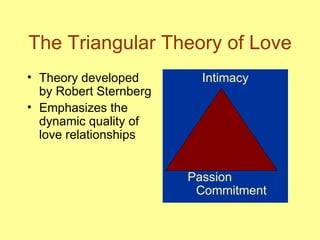
The Triangular Theory of Love Theory developed by Robert Sternberg Emphasizes the dynamic quality of love relationships Intimacy Passion  Commitment
The Components of Love: Ten Signs of Intimacy Wanting to promote your partner’s welfare Feeling happiness with your partner Holding your partner in high regard Being able to count on your partner in time of need Being able to understand each other
The Components of Love  (cont.) Sharing yourself and your possessions with your partner Receiving emotional support from your partner Giving emotional support to your partner Being able to communicate with your partner about intimate things Valuing partner’s presence in your life
Kinds of Love:  Sternberg Liking Intimacy only Infatuation Passion only Romantic Love  Intimacy and passion Companionate Love Intimacy and commitment Fatuous Love Passion and commitment Consummate love  Intimacy, passion, and commitment Empty love Commitment only Nonlove Absence of all three
Infant-Caregiver Attachment Attachment Bond depends on attachment object’s responsiveness Infant happier in attachment object presence Shares discoveries with attachment object. Coos, talks baby talk Feeling of oneness with attachment object Romantic love Feelings are related to lover’s interest Happier when lover is present Shares experiences with lover Lovers coo, talk baby talk Feeling of oneness with lover
Components of Attachment Attachment style endures across ones life Depends upon security and safety Open acceptance and honesty
Types of Attachment Secure attachments Find it relatively easy to get close to other people Anxious/ambivalent attachment Believe that other people didn’t get as close as they themselves wanted Avoidant attachments Feel discomfort being close to other people
Unrequited Love Love is not returned Causes distress to all involved Perspectives differ between the people who offer love and those who do not reciprocate
Jealousy Jealousy does not prove the existence of love Jealousy and love are not necessarily companions Jealousy is painful Jealousy can destroy or cement a relationship Jealously is linked to violence
Jealousy Aversive response to a real or imagined involvement with a third person Painful experience Absence may indicate relationship problems Occurs where there are commitments in a relationship Men and women differ in reported attempts to make their partner jealous
Managing Jealousy Jealousy can be unreasonable or realistic Dealing with irrational suspicions can be difficult Can work on underlying causes of our insecurity If jealousy is well-founded, relationship may need to be modified or ended Jealousy can be the catalyst for change
Extramarital Sex Exists in dating, cohabiting, and marital relationships Extramarital sex in exclusive marriages is related to three factors: Stronger sexual interests More permissive sexual values Greater sexual opportunities Weaker marital relationships
Making Love Last: From Passion to Intimacy Intimate love:  Each person knows they can count on the other Commitment:  Based on conscious choices rather than transitory feelings Caring:  Involves making another person’s needs as important as your own Self-disclosure:  Revealing ourselves—our hopes, our fears, our everyday thoughts to deepen understanding and intimacy
The Nature of Communication Communication: a transactional process  Involves conveying symbols, words, gestures, movements Goal of establishing human contact, exchanging information, and reinforcing or changing attitudes and behaviors
Contexts of Communication Cultural context  the language, values, beliefs, and customs in which communication takes place Social context  the roles we play in society Psychological context  how people communicate based on their personalities
Nonverbal Communication The ability to correctly interpret nonverbal communication is important in relationships Most of our “feeling” communication is nonverbal 3 important factors:  Proximity: nearness in physical space Eye contact: a symbol of interest Touching: signals intimacy, closeness
Sexual Communication Our interpersonal sexual scripts provide us with “instructions” on how to behave sexually In beginning relationships Halo effect Interest and opening lines In some cases: establishing sexual orientation First move and beyond Directing sexual activity
Sexual Communication  (Cont.) In established relationships initiating sexual activity For heterosexuals: men typically initiate more often In same-sex relationships: typically the more emotionally expressive partner initiates
Gender Differences in Partner Communication  Women send clearer messages to their partners than do men Men more than women tend to send negative messages or withdraw  Women tend to set the emotional tone of an argument Women tend to use more qualifiers in their style of speaking
Developing Communication Skills Talking about sex Keys to good communication Self disclosure Trust Feedback
Conflict and Intimacy Conflict is natural in intimate relationships A lack of arguing can signal trouble in a relationship Conflict isn’t dangerous; it’s the manner in which it is handled that can hurt or help relationship
Conflicts about Sex Fighting about sex Can result from a disagreement about sex Can also be used as a “scapegoat” for nonsexual problems Can be a cover-up for deeper feelings such as inadequacy It’s hard to tell during a fight if there are deeper causes
Conflict Resolution The way couples deal with conflict reflects and contributes to their happiness Strategies for conflict resolution Negotiating conflicts Bargaining Coexistence
Summary Love and sexuality Approaches and attitudes related to love Jealousy Sexual communication Developing communication skills  Conflict and intimacy

strong6_ppt_ch08

  • 1.
    Chapter Eight Loveand Communication in Intimate Relationships
  • 2.
    Love Exists inall cultures Exists in all ethnic groups Exists in all orientations Dual nature: Feeling Activity
  • 3.
    Communication Connects sexualityand intimacy Sexual communication is tied to sexual satisfaction Sexual communication is unique
  • 4.
    Friendship and LoveFriendship is a strong foundation for strong love relationships Difference between friends and lovers Marriage
  • 5.
    Love and SexualitySexuality and love are intimately related in our culture Our language connects love and sex Sexual satisfaction is tied to relationship satisfaction Level of intimacy and relationship duration are correlated with the decision to engage in sexual activity Cultural environment and physical environment
  • 6.
    Sex Outside ofCommitted Relationships Young adult sex outside of marriage is now the norm Values in America have shifted Change is due to: Contraception and abortion Redefined gender roles Alterations in demographics
  • 7.
    Men, Women, Sex,and Love Men separate sex and love more than women Heterosexual men Gay men Women value sex in the context of a relationship Lesbians share sex less than heterosexual couples of gay men
  • 8.
    Love Without SexCelibacy or asexuality A purposeful choice rather than a sexual problem 4% men and 14% women Emphasis on friendship and other relationship qualities
  • 9.
    Styles of Love:Lee Eros: love of beauty Mania: obsessive love Ludus: playful love Storge: companionate love Agape: altruistic love Pragma: practical love
  • 10.
    The Triangular Theoryof Love Theory developed by Robert Sternberg Emphasizes the dynamic quality of love relationships Intimacy Passion Commitment
  • 11.
    The Components ofLove: Ten Signs of Intimacy Wanting to promote your partner’s welfare Feeling happiness with your partner Holding your partner in high regard Being able to count on your partner in time of need Being able to understand each other
  • 12.
    The Components ofLove (cont.) Sharing yourself and your possessions with your partner Receiving emotional support from your partner Giving emotional support to your partner Being able to communicate with your partner about intimate things Valuing partner’s presence in your life
  • 13.
    Kinds of Love: Sternberg Liking Intimacy only Infatuation Passion only Romantic Love Intimacy and passion Companionate Love Intimacy and commitment Fatuous Love Passion and commitment Consummate love Intimacy, passion, and commitment Empty love Commitment only Nonlove Absence of all three
  • 14.
    Infant-Caregiver Attachment AttachmentBond depends on attachment object’s responsiveness Infant happier in attachment object presence Shares discoveries with attachment object. Coos, talks baby talk Feeling of oneness with attachment object Romantic love Feelings are related to lover’s interest Happier when lover is present Shares experiences with lover Lovers coo, talk baby talk Feeling of oneness with lover
  • 15.
    Components of AttachmentAttachment style endures across ones life Depends upon security and safety Open acceptance and honesty
  • 16.
    Types of AttachmentSecure attachments Find it relatively easy to get close to other people Anxious/ambivalent attachment Believe that other people didn’t get as close as they themselves wanted Avoidant attachments Feel discomfort being close to other people
  • 17.
    Unrequited Love Loveis not returned Causes distress to all involved Perspectives differ between the people who offer love and those who do not reciprocate
  • 18.
    Jealousy Jealousy doesnot prove the existence of love Jealousy and love are not necessarily companions Jealousy is painful Jealousy can destroy or cement a relationship Jealously is linked to violence
  • 19.
    Jealousy Aversive responseto a real or imagined involvement with a third person Painful experience Absence may indicate relationship problems Occurs where there are commitments in a relationship Men and women differ in reported attempts to make their partner jealous
  • 20.
    Managing Jealousy Jealousycan be unreasonable or realistic Dealing with irrational suspicions can be difficult Can work on underlying causes of our insecurity If jealousy is well-founded, relationship may need to be modified or ended Jealousy can be the catalyst for change
  • 21.
    Extramarital Sex Existsin dating, cohabiting, and marital relationships Extramarital sex in exclusive marriages is related to three factors: Stronger sexual interests More permissive sexual values Greater sexual opportunities Weaker marital relationships
  • 22.
    Making Love Last:From Passion to Intimacy Intimate love: Each person knows they can count on the other Commitment: Based on conscious choices rather than transitory feelings Caring: Involves making another person’s needs as important as your own Self-disclosure: Revealing ourselves—our hopes, our fears, our everyday thoughts to deepen understanding and intimacy
  • 23.
    The Nature ofCommunication Communication: a transactional process Involves conveying symbols, words, gestures, movements Goal of establishing human contact, exchanging information, and reinforcing or changing attitudes and behaviors
  • 24.
    Contexts of CommunicationCultural context the language, values, beliefs, and customs in which communication takes place Social context the roles we play in society Psychological context how people communicate based on their personalities
  • 25.
    Nonverbal Communication Theability to correctly interpret nonverbal communication is important in relationships Most of our “feeling” communication is nonverbal 3 important factors: Proximity: nearness in physical space Eye contact: a symbol of interest Touching: signals intimacy, closeness
  • 26.
    Sexual Communication Ourinterpersonal sexual scripts provide us with “instructions” on how to behave sexually In beginning relationships Halo effect Interest and opening lines In some cases: establishing sexual orientation First move and beyond Directing sexual activity
  • 27.
    Sexual Communication (Cont.) In established relationships initiating sexual activity For heterosexuals: men typically initiate more often In same-sex relationships: typically the more emotionally expressive partner initiates
  • 28.
    Gender Differences inPartner Communication Women send clearer messages to their partners than do men Men more than women tend to send negative messages or withdraw Women tend to set the emotional tone of an argument Women tend to use more qualifiers in their style of speaking
  • 29.
    Developing Communication SkillsTalking about sex Keys to good communication Self disclosure Trust Feedback
  • 30.
    Conflict and IntimacyConflict is natural in intimate relationships A lack of arguing can signal trouble in a relationship Conflict isn’t dangerous; it’s the manner in which it is handled that can hurt or help relationship
  • 31.
    Conflicts about SexFighting about sex Can result from a disagreement about sex Can also be used as a “scapegoat” for nonsexual problems Can be a cover-up for deeper feelings such as inadequacy It’s hard to tell during a fight if there are deeper causes
  • 32.
    Conflict Resolution Theway couples deal with conflict reflects and contributes to their happiness Strategies for conflict resolution Negotiating conflicts Bargaining Coexistence
  • 33.
    Summary Love andsexuality Approaches and attitudes related to love Jealousy Sexual communication Developing communication skills Conflict and intimacy

Editor's Notes