The Solar System
The Solar System
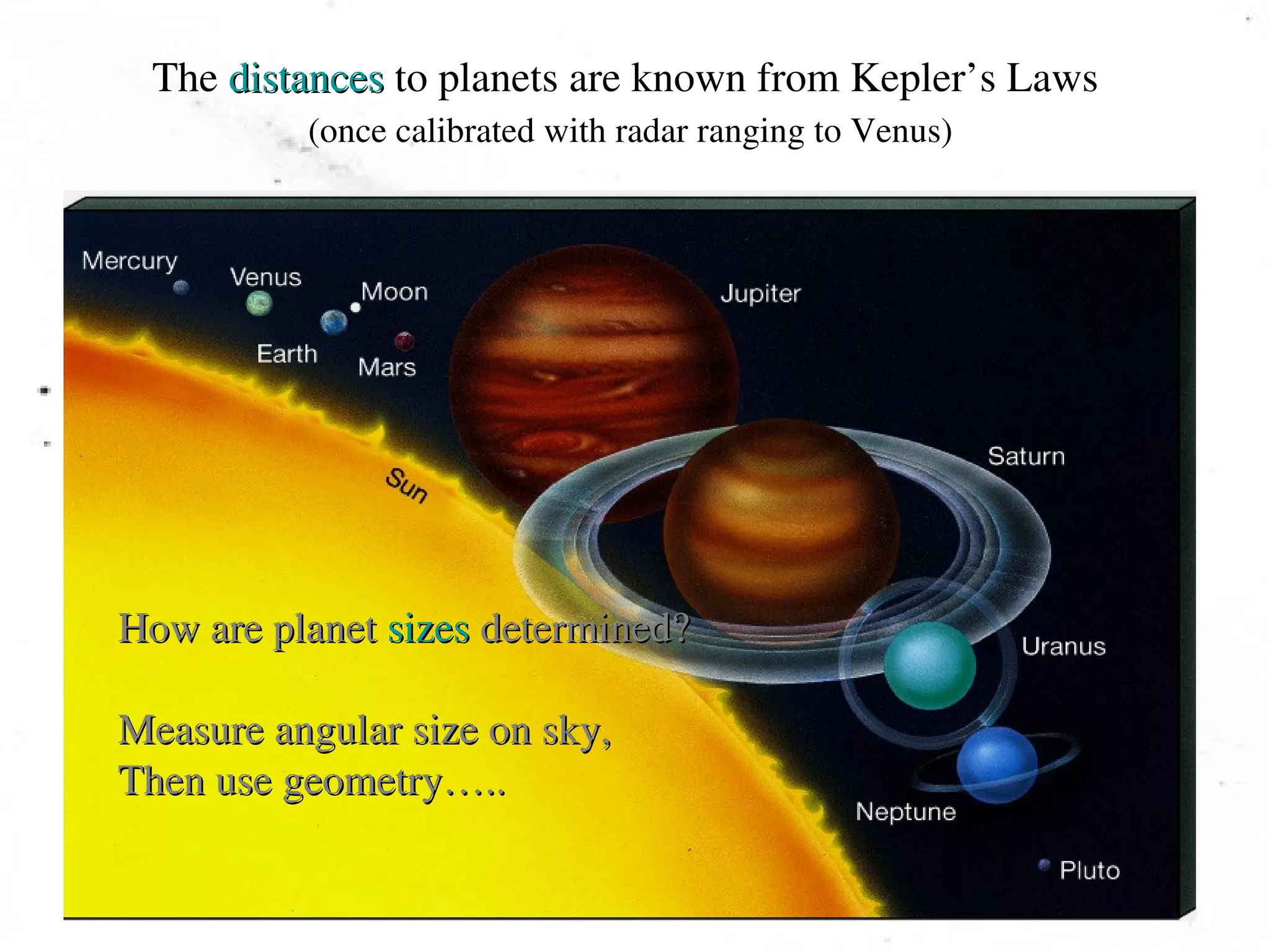
• 1 star
• 9 8 planets
• 63 (major) moons
• asteroids, comets, meteoroids
How are planet
How are planet sizes
sizes determined?
determined?
Measure angular size on sky,
Then use geometry…..
The distances
distances to planets are known from Kepler’s Laws
(once calibrated with radar ranging to Venus)
Using angular size to
get actual size
Masses
Masses - determined through observing the gravitational effect of the
planet on some nearby object (moons, nearby planets, satellites)
Density
Density - divide mass by volume
• Planets orbit the
sun counter-
clockwise as seen
from the North
Celestial Pole.
• All planets are
in the same orbital
plane EXCEPT
Mercury and
Pluto.
Terrestrial Planets
Terrestrial Planets
•Mercury, Venus, Earth
and Mars
•Close to Sun
•Small masses, radii
•Rocky, solid surfaces
•High densities
•Slow rotation
•Weak magnetic field
•No rings
•Few moons
Jovian Planets
Jovian Planets
•Jupiter, Saturn,
Uranus, and Neptune
•Far from Sun
•Large masses and radii
•Gaseous surface
•Low densities
•Fast rotation
•Strong magnetic field
•Many rings
•Many moons
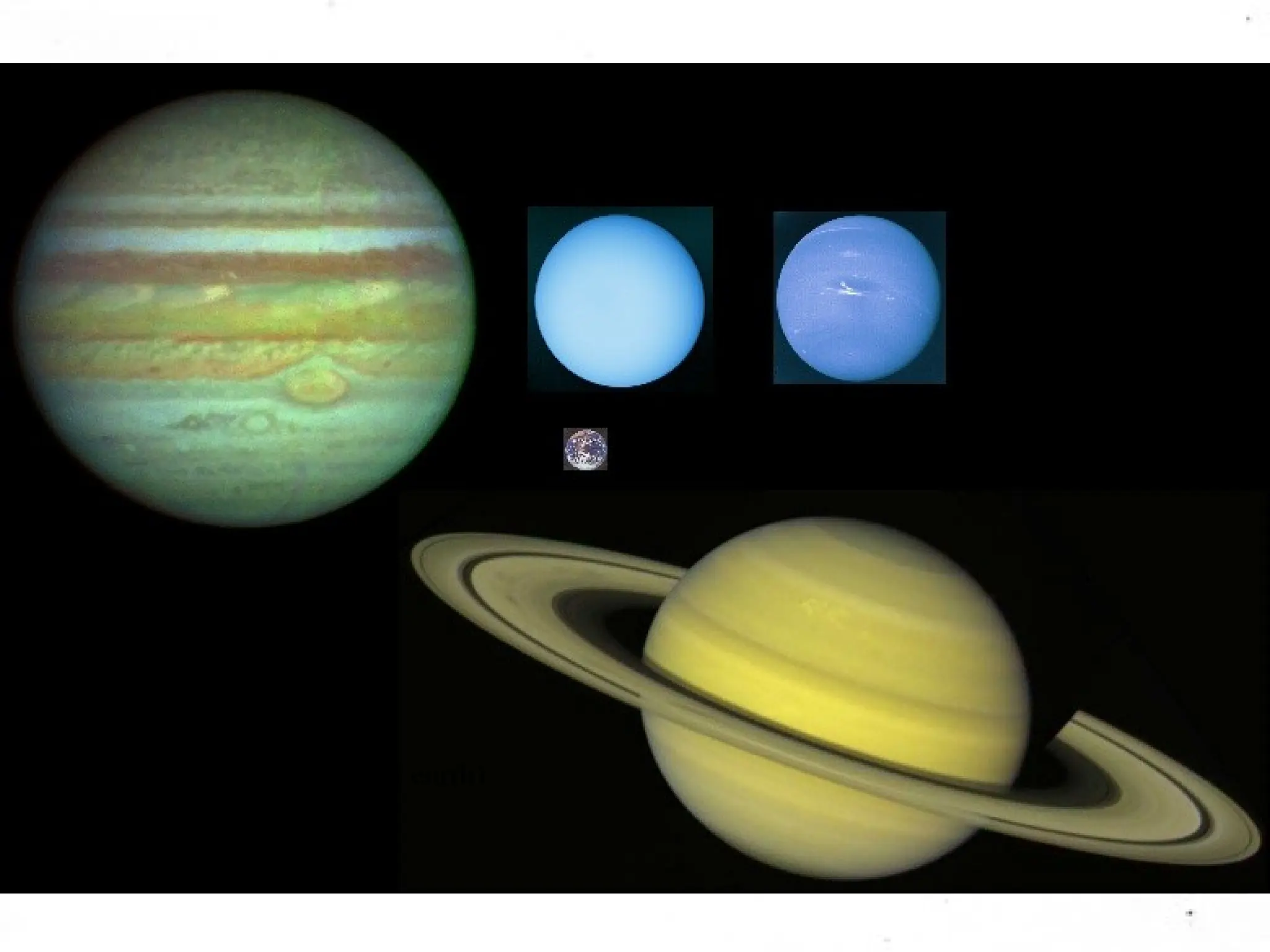
Terrestrial planets
Jovian planets (and earth)
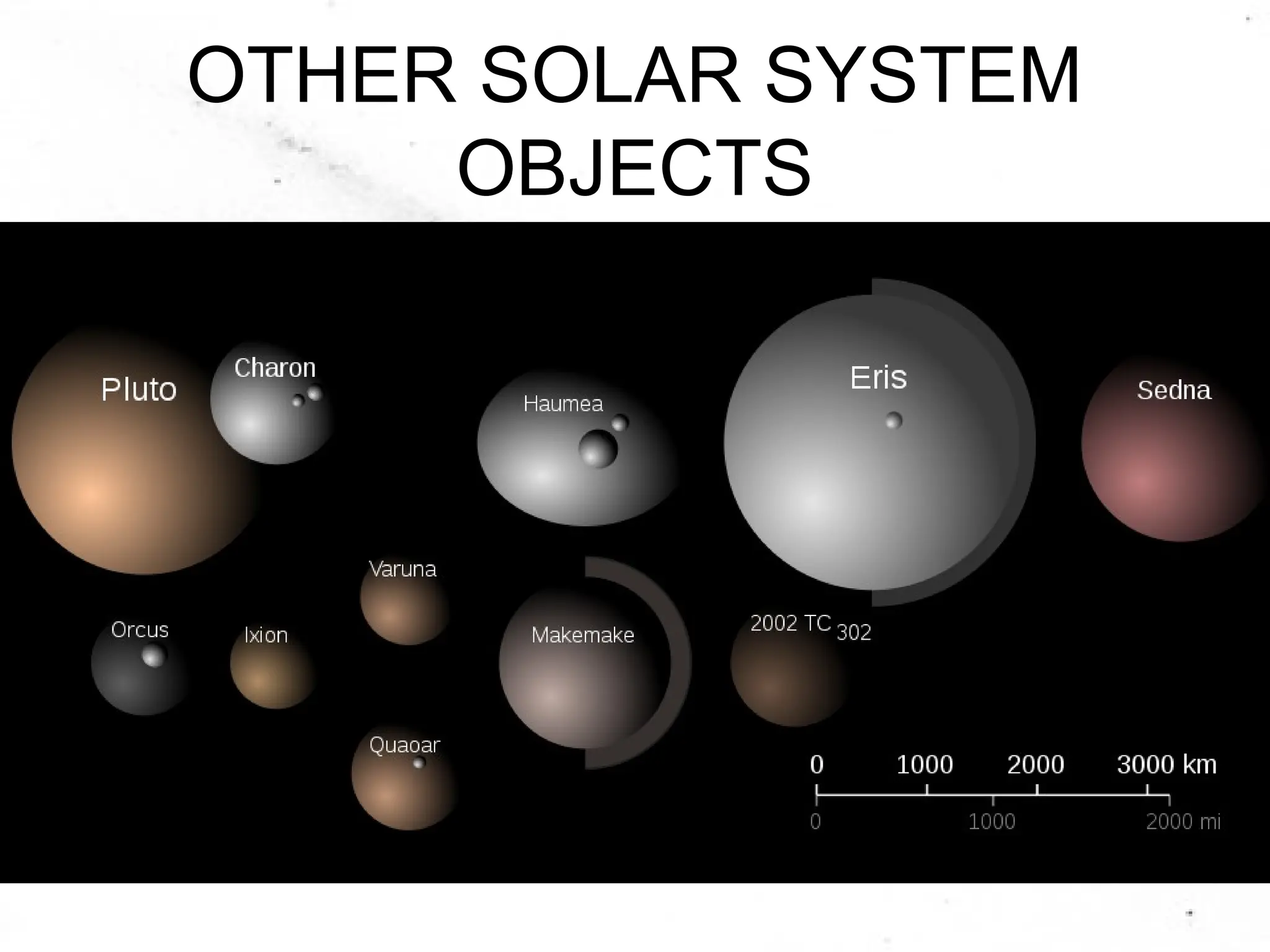
OTHER SOLAR SYSTEM
OBJECTS
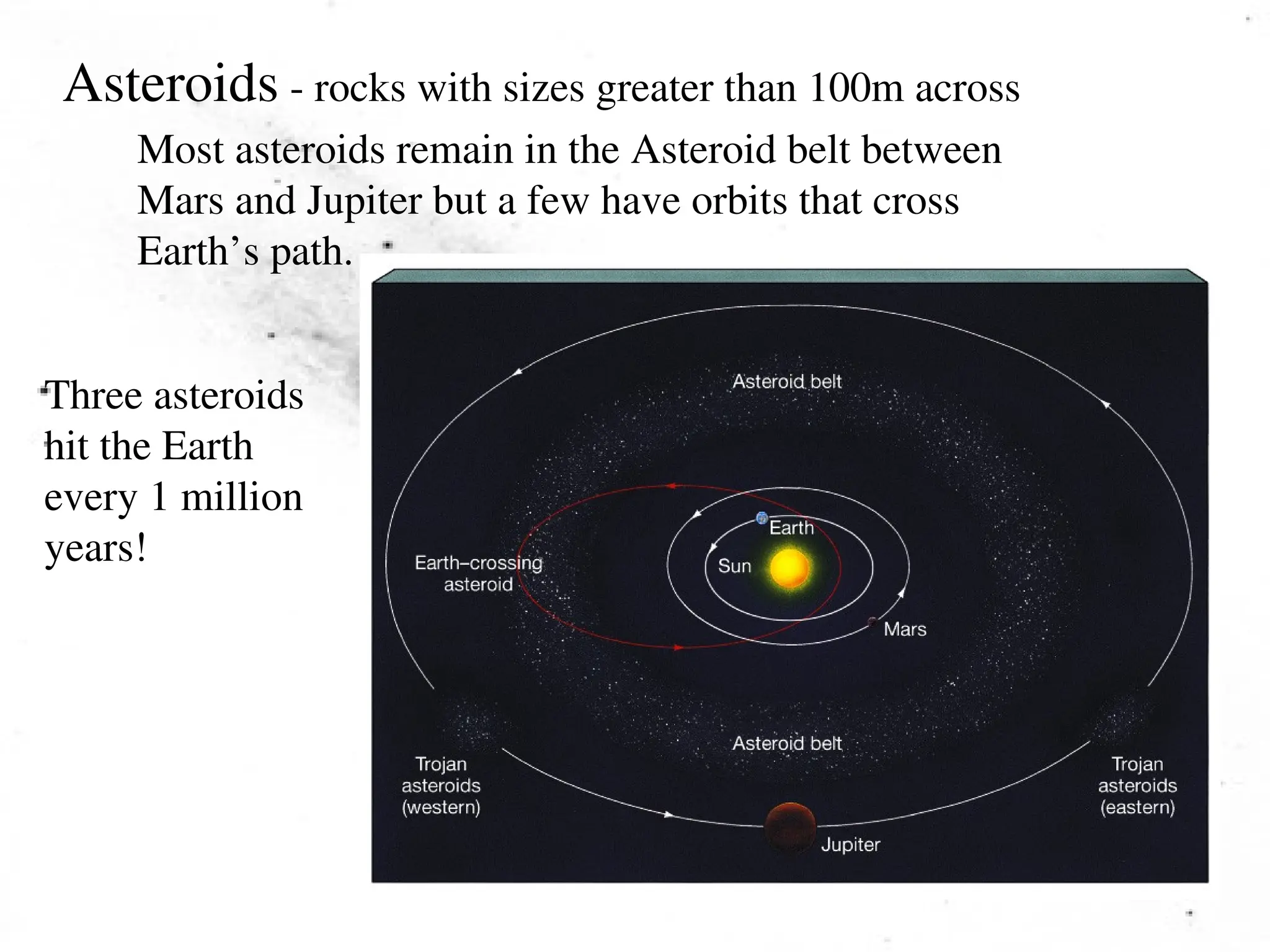
Asteroids - rocks with sizes greater than 100m across
Most asteroids remain in the Asteroid belt between
Mars and Jupiter but a few have orbits that cross
Earth’s path.
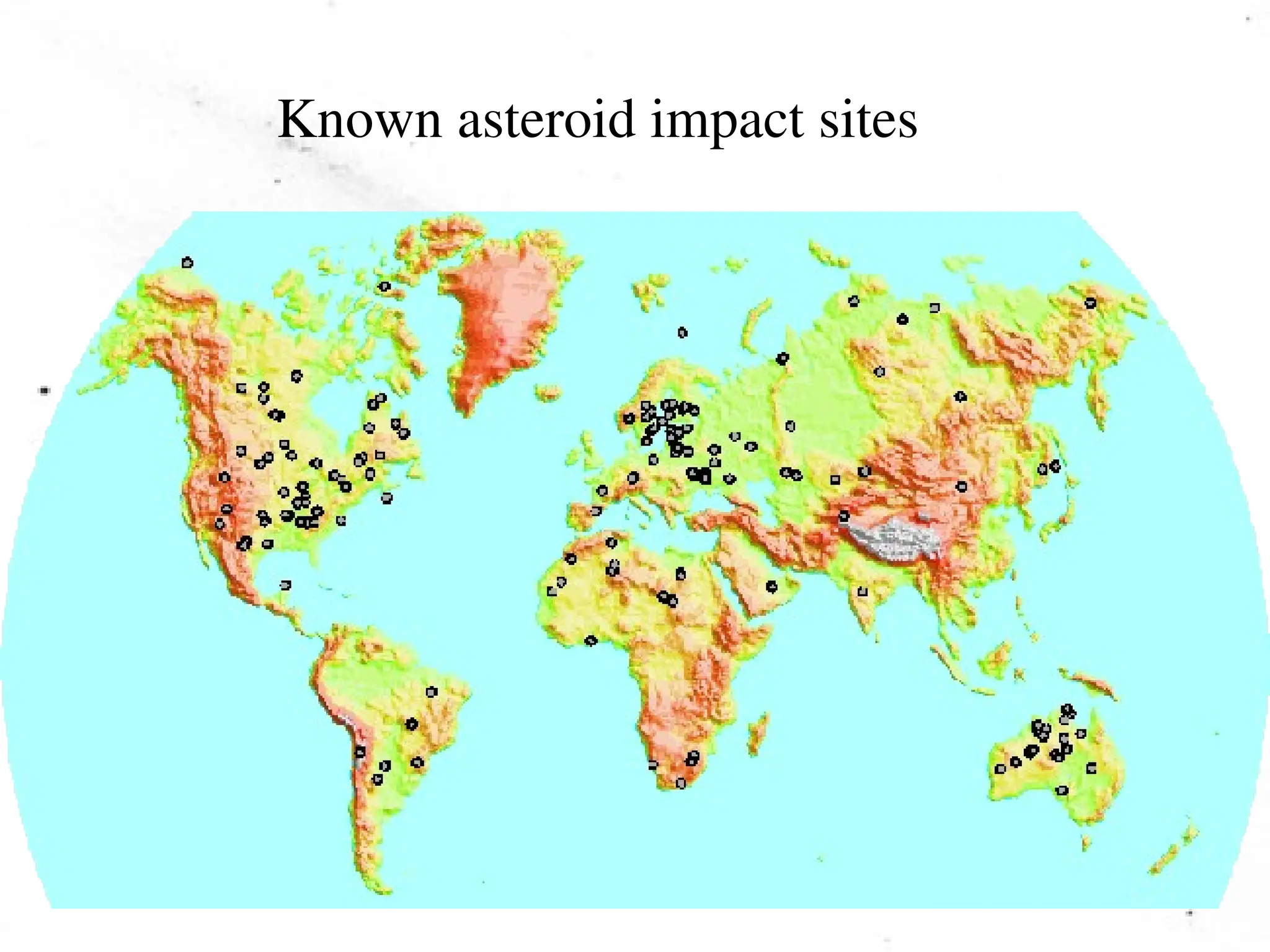
Three asteroids
hit the Earth
every 1 million
years!
Known asteroid impact sites
Asteroid sizes
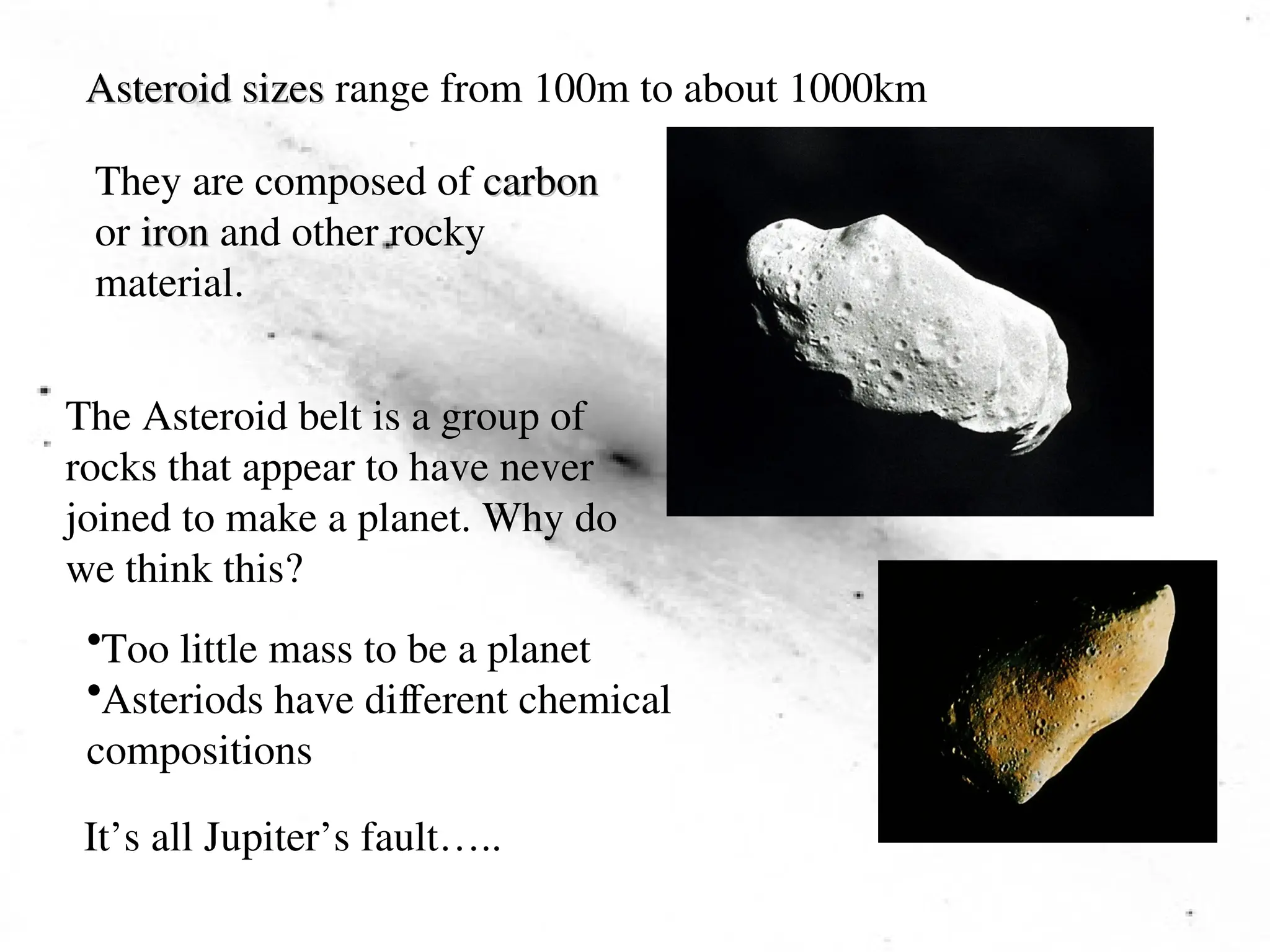
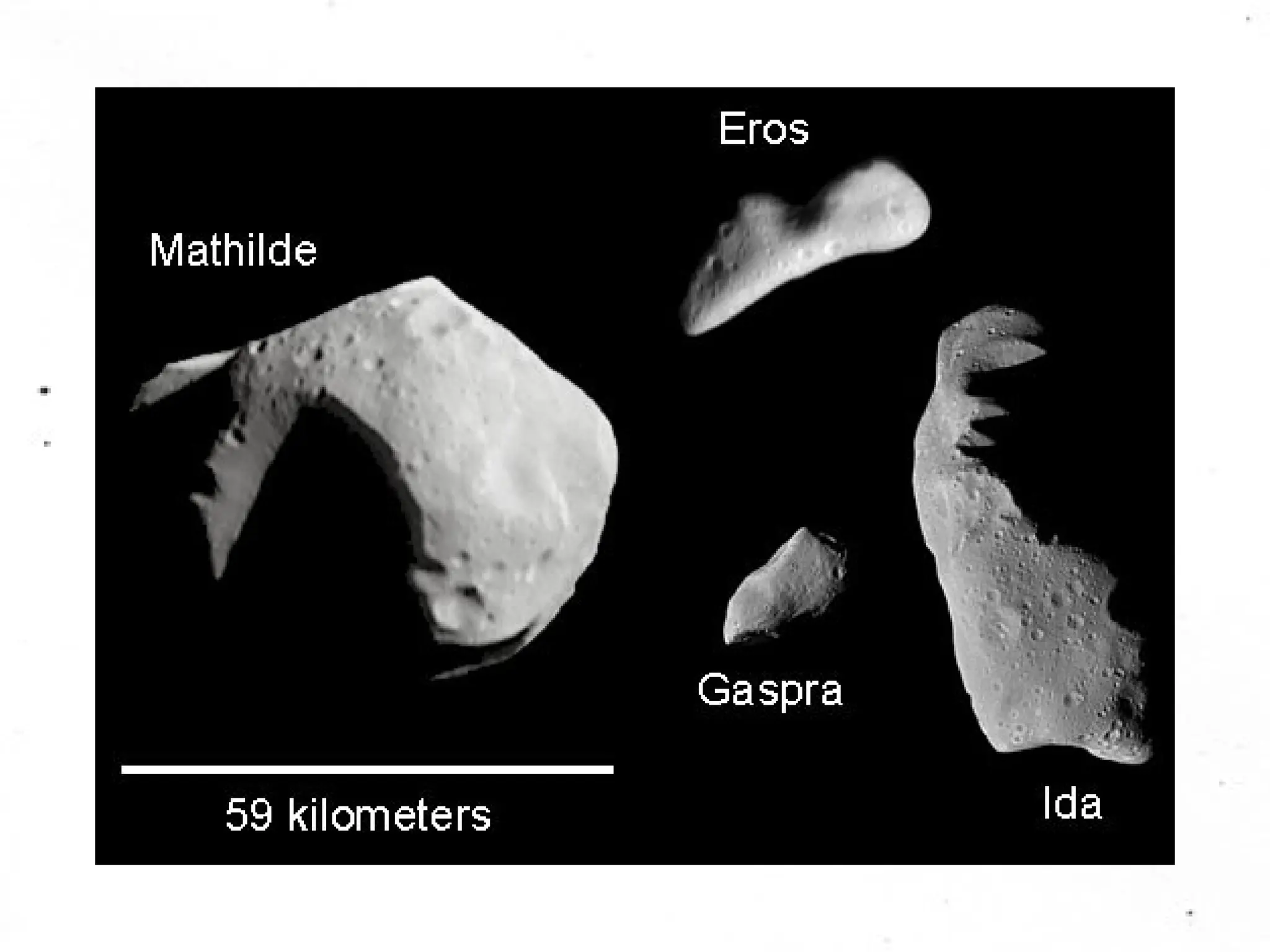
Asteroid sizes range from 100m to about 1000km
They are composed of carbon
carbon
or iron
iron and other rocky
material.
The Asteroid belt is a group of
rocks that appear to have never
joined to make a planet. Why do
we think this?
•Too little mass to be a planet
•Asteriods have different chemical
compositions
It’s all Jupiter’s fault…..
Meteoroids
Meteoroids –
–
interplanetary rocky
material smaller than 100m
(down to grain size).
•called a
called a meteor
meteor as it burns
as it burns
in the Earth’s atmosphere
•if it makes it to the ground,
if it makes it to the ground,
it is a
it is a meteorite
meteorite
Most meteor showers are
the result of the Earth
passing through the orbit of
a comet which has left
debris along its path
Meteor crater near
Winslow, AZ - the
culprit was
probably 50 m
across weighing
200,000 tons!
Meteors are rocky - mainly iron and nickel
Some contain carbonaceous material - rich in organic material
Meteors are old - 4.5 billion years - based on carbon dating
Meteor showers:
Meteor showers:
Orionid – Oct 21/22
Orionid – Oct 21/22
Leonid – Nov 18/19
Leonid – Nov 18/19
Geminid – Dec 14/15
Geminid – Dec 14/15
Comets
Comets
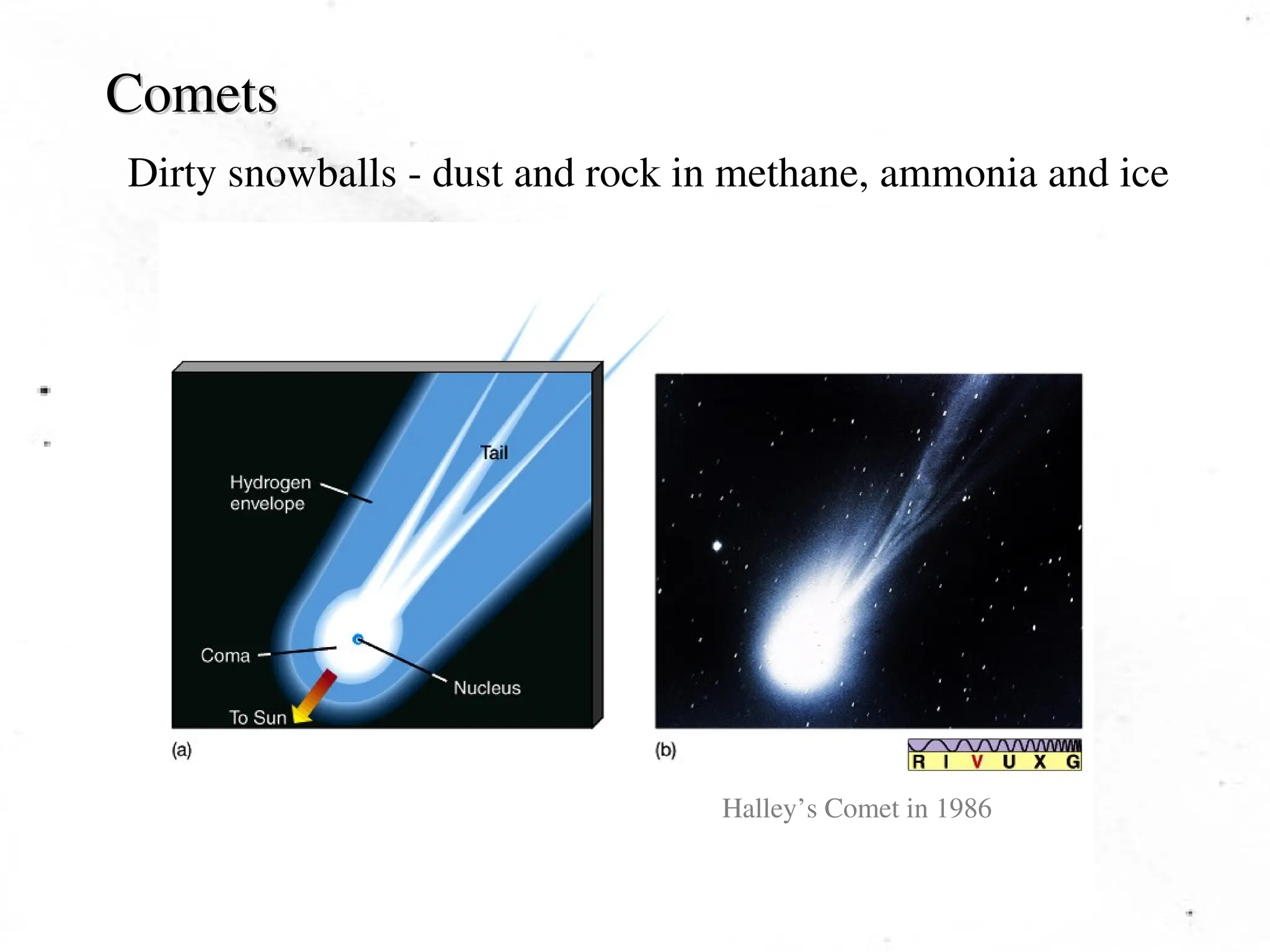
Dirty snowballs - dust and rock in methane, ammonia and ice
Halley’s Comet in 1986
All light is reflected from the Sun - the comet makes no light of its own
The nucleus is a few km in diameter
•Cometary orbits take them far beyond Pluto
•Many take up to 1 million years to orbit the Sun once!
•Short period comets (< 200 years) (like Halley’s comet)
•Short period comets may have originated in the Kuiper belt
•Kuiper belt comet gets “kicked” into an eccentric orbit, bringing
it into the solar system
•These long period comets probably originate in the Oort cloud
Formation of the Solar System
Any theory to describe the formation of our Solar System
must adhere to these facts:
1. Each planet is isolated in space
2. The orbits are nearly circular
3. The orbits of the planets all lie in roughly the same plane
4. The direction they orbit around the Sun is the same as the
Sun’s rotation on its axis
5. The direction most planets rotate on their axes is the same as
that for the Sun
6. The direction of a planet’s moon orbits is the same as that
planet’s direction of rotation
7. The Terrestrial planets are very different from the Jovian
planets
8. Asteroids are different from both types of planets
9. Comets are icy fragments that don’t orbit in the ecliptic plane
Our sun and the planets began from a cloud of dust and gas (nebula)
As the cloud contracts under its own
gravity, the Sun is formed at the
center.
The cloud starts to spin and the
smaller it contracts, the faster it
spins.
Conservation of angular momentum
Cloud forms a flattened, pancake shape.
Nebular Theory for Solar System formation
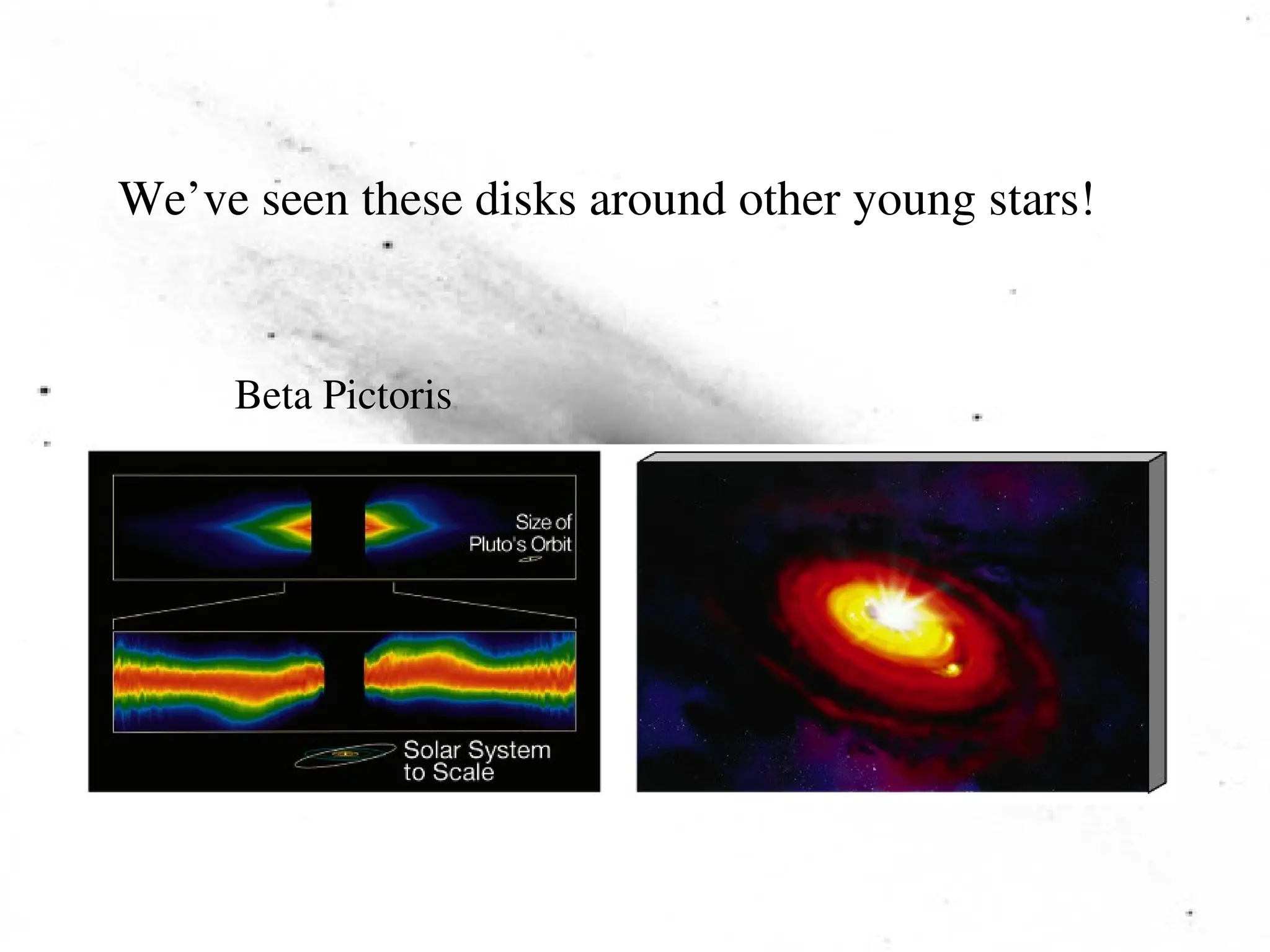
We’ve seen these disks around other young stars!
Beta Pictoris
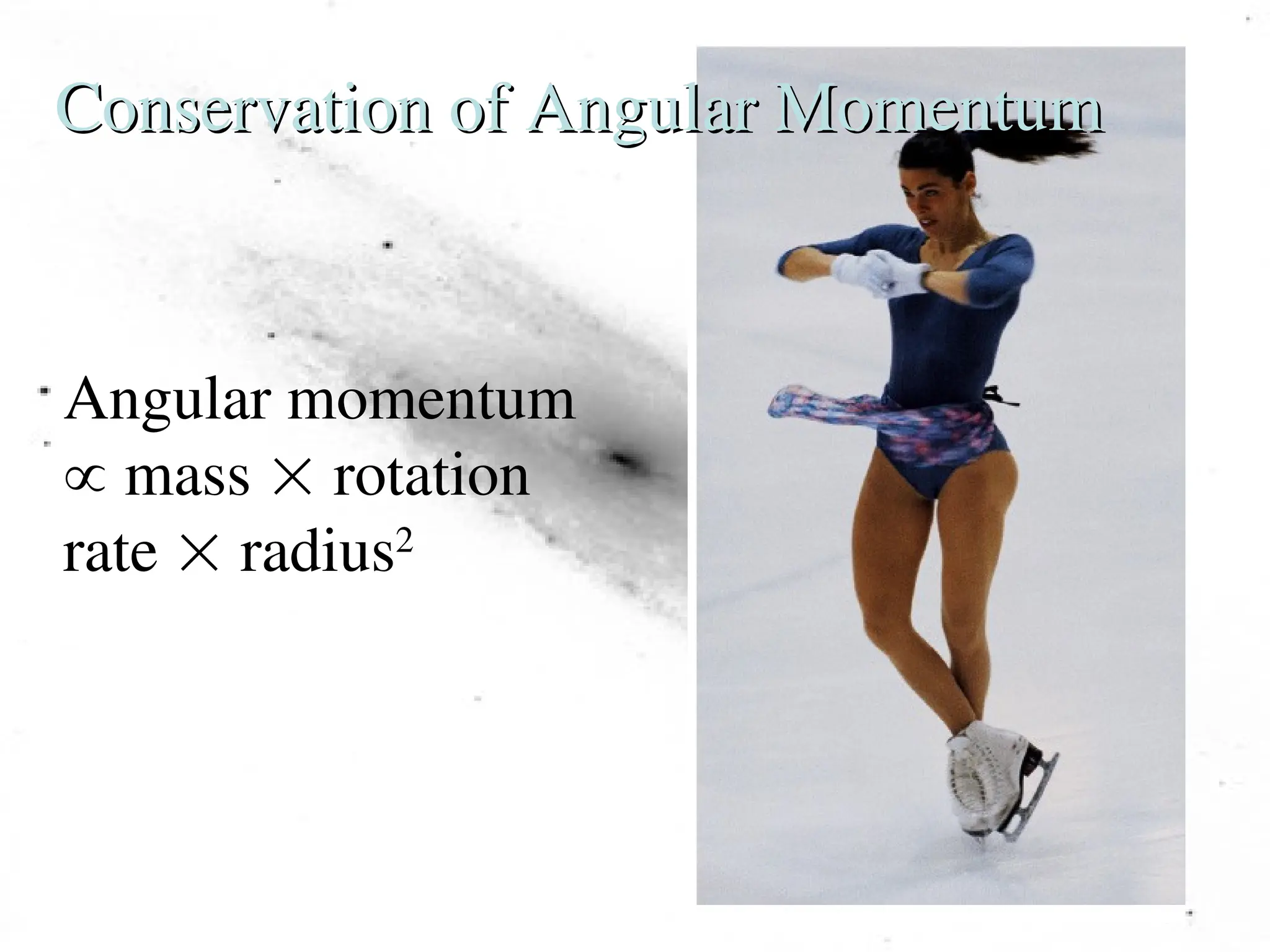
Conservation of Angular Momentum
Angular momentum
 mass  rotation
rate  radius2
Condensation Theory for Planet Formation
The gas in the flattened nebula would never eventually
clump together to form planets.
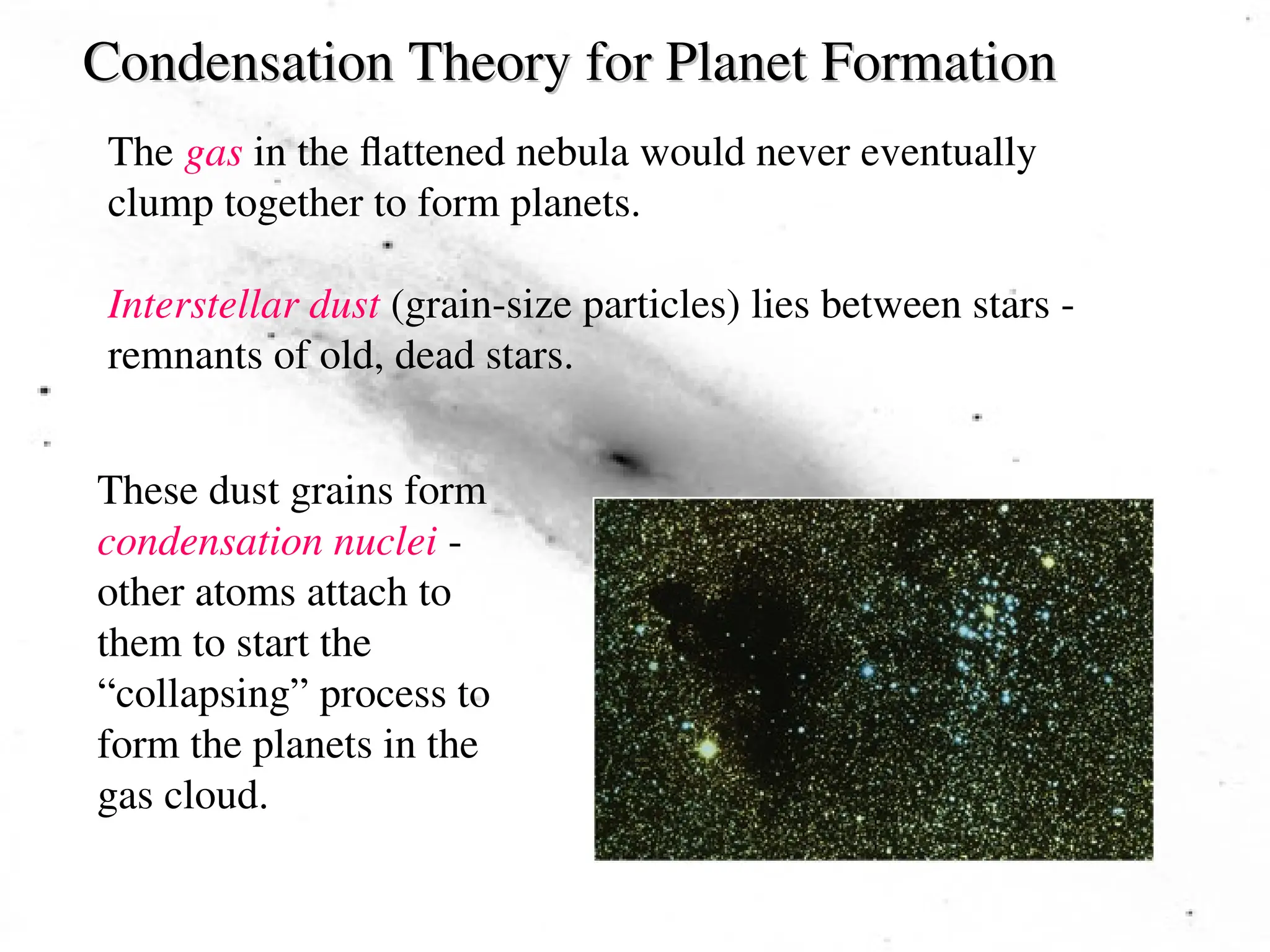
Interstellar dust (grain-size particles) lies between stars -
remnants of old, dead stars.
These dust grains form
condensation nuclei -
other atoms attach to
them to start the
“collapsing” process to
form the planets in the
gas cloud.
What happened next…..
A flattened solar nebula disk exists
after cloud spins and contracts
Condensation nuclei form clumps
that grow into moon-size
planetesimals
Solar wind from star formation (Sun
forming) blow out the rest of the gas
Planetesimals collide and grow
Planetesimals form the basic planets
over hundred million years
Why the difference between inner and outer planets?
•Rocky inner planets: The
type of the material that
condensed out of the nebular
cloud at these higher
temperatures was rocky in
nature.
•Gaseous, Bigger outer
planets: Both rock and gas
could condense out of the
cloud at lower temperatures
where these planets formed.
Why are they gaseous? - gas is present
Why are they bigger? - accretion onto the planet starts sooner
because they are further from the Sun, less effected by solar wind
TEMPERATURE!
TEMPERATURE!

Solar_System Whole universe planetary details.

  • 1.
    The Solar System TheSolar System • 1 star • 9 8 planets • 63 (major) moons • asteroids, comets, meteoroids
  • 2.
    How are planet Howare planet sizes sizes determined? determined? Measure angular size on sky, Measure angular size on sky, Then use geometry….. Then use geometry….. The distances distances to planets are known from Kepler’s Laws (once calibrated with radar ranging to Venus)
  • 3.
    Using angular sizeto get actual size
  • 4.
    Masses Masses - determinedthrough observing the gravitational effect of the planet on some nearby object (moons, nearby planets, satellites) Density Density - divide mass by volume • Planets orbit the sun counter- clockwise as seen from the North Celestial Pole. • All planets are in the same orbital plane EXCEPT Mercury and Pluto.
  • 5.
    Terrestrial Planets Terrestrial Planets •Mercury,Venus, Earth and Mars •Close to Sun •Small masses, radii •Rocky, solid surfaces •High densities •Slow rotation •Weak magnetic field •No rings •Few moons Jovian Planets Jovian Planets •Jupiter, Saturn, Uranus, and Neptune •Far from Sun •Large masses and radii •Gaseous surface •Low densities •Fast rotation •Strong magnetic field •Many rings •Many moons
  • 6.
  • 7.
  • 8.
  • 9.
    Asteroids - rockswith sizes greater than 100m across Most asteroids remain in the Asteroid belt between Mars and Jupiter but a few have orbits that cross Earth’s path. Three asteroids hit the Earth every 1 million years!
  • 10.
  • 11.
    Asteroid sizes Asteroid sizesrange from 100m to about 1000km They are composed of carbon carbon or iron iron and other rocky material. The Asteroid belt is a group of rocks that appear to have never joined to make a planet. Why do we think this? •Too little mass to be a planet •Asteriods have different chemical compositions It’s all Jupiter’s fault…..
  • 13.
    Meteoroids Meteoroids – – interplanetary rocky interplanetaryrocky material smaller than 100m material smaller than 100m (down to grain size). (down to grain size). •called a called a meteor meteor as it burns as it burns in the Earth’s atmosphere in the Earth’s atmosphere •if it makes it to the ground, if it makes it to the ground, it is a it is a meteorite meteorite Most meteor showers are the result of the Earth passing through the orbit of a comet which has left debris along its path
  • 14.
    Meteor crater near Winslow,AZ - the culprit was probably 50 m across weighing 200,000 tons! Meteors are rocky - mainly iron and nickel Some contain carbonaceous material - rich in organic material Meteors are old - 4.5 billion years - based on carbon dating Meteor showers: Meteor showers: Orionid – Oct 21/22 Orionid – Oct 21/22 Leonid – Nov 18/19 Leonid – Nov 18/19 Geminid – Dec 14/15 Geminid – Dec 14/15
  • 15.
    Comets Comets Dirty snowballs -dust and rock in methane, ammonia and ice Halley’s Comet in 1986 All light is reflected from the Sun - the comet makes no light of its own The nucleus is a few km in diameter
  • 16.
    •Cometary orbits takethem far beyond Pluto •Many take up to 1 million years to orbit the Sun once! •Short period comets (< 200 years) (like Halley’s comet) •Short period comets may have originated in the Kuiper belt •Kuiper belt comet gets “kicked” into an eccentric orbit, bringing it into the solar system •These long period comets probably originate in the Oort cloud
  • 17.
    Formation of theSolar System Formation of the Solar System Any theory to describe the formation of our Solar System must adhere to these facts: 1. Each planet is isolated in space 2. The orbits are nearly circular 3. The orbits of the planets all lie in roughly the same plane 4. The direction they orbit around the Sun is the same as the Sun’s rotation on its axis 5. The direction most planets rotate on their axes is the same as that for the Sun 6. The direction of a planet’s moon orbits is the same as that planet’s direction of rotation 7. The Terrestrial planets are very different from the Jovian planets 8. Asteroids are different from both types of planets 9. Comets are icy fragments that don’t orbit in the ecliptic plane
  • 18.
    Our sun andthe planets began from a cloud of dust and gas (nebula) As the cloud contracts under its own gravity, the Sun is formed at the center. The cloud starts to spin and the smaller it contracts, the faster it spins. Conservation of angular momentum Cloud forms a flattened, pancake shape. Nebular Theory for Solar System formation Nebular Theory for Solar System formation
  • 19.
    We’ve seen thesedisks around other young stars! Beta Pictoris
  • 20.
    Conservation of AngularMomentum Conservation of Angular Momentum Angular momentum  mass  rotation rate  radius2
  • 21.
    Condensation Theory forPlanet Formation Condensation Theory for Planet Formation The gas in the flattened nebula would never eventually clump together to form planets. Interstellar dust (grain-size particles) lies between stars - remnants of old, dead stars. These dust grains form condensation nuclei - other atoms attach to them to start the “collapsing” process to form the planets in the gas cloud.
  • 22.
    What happened next….. Whathappened next….. A flattened solar nebula disk exists after cloud spins and contracts Condensation nuclei form clumps that grow into moon-size planetesimals Solar wind from star formation (Sun forming) blow out the rest of the gas Planetesimals collide and grow Planetesimals form the basic planets over hundred million years
  • 23.
    Why the differencebetween inner and outer planets? •Rocky inner planets: The type of the material that condensed out of the nebular cloud at these higher temperatures was rocky in nature. •Gaseous, Bigger outer planets: Both rock and gas could condense out of the cloud at lower temperatures where these planets formed. Why are they gaseous? - gas is present Why are they bigger? - accretion onto the planet starts sooner because they are further from the Sun, less effected by solar wind TEMPERATURE! TEMPERATURE!