Touring  Our  Solar System Interactive Power Point Project Erin Lewis ED 205-05
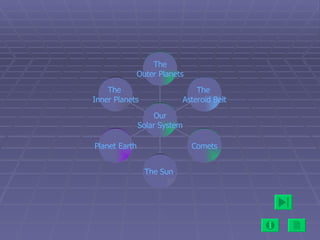
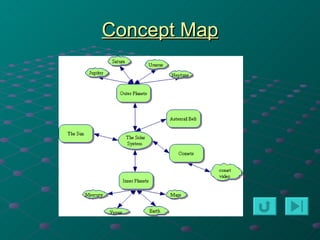
The Outer Planets The  Asteroid Belt Comets The Sun  Planet Earth The  Inner Planets Our Solar System
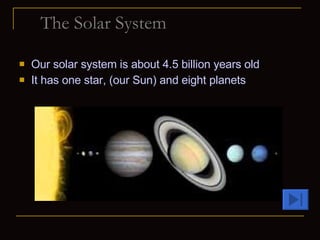
The Solar System Our solar system is about 4.5 billion years old It has one star, (our Sun) and eight planets
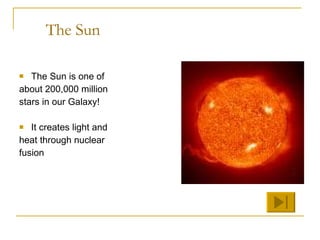
The Sun The Sun is one of about 200,000 million stars in our Galaxy! It creates light and  heat through nuclear fusion
The Inner Planets Mercury Venus Earth Mars The four “Inner” Planets of our solar system are made of mostly rock and metal They are also much smaller in size and mass compared to the “Outer” Planets
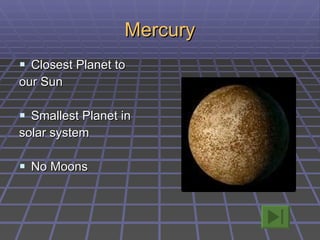
Mercury Closest Planet to our Sun Smallest Planet in solar system No Moons
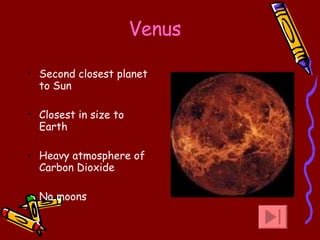
Venus Second closest planet to Sun Closest in size to Earth Heavy atmosphere of Carbon Dioxide No moons
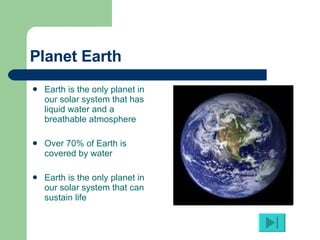
Planet Earth Earth is the only planet in our solar system that has liquid water and a breathable atmosphere Over 70% of Earth is covered by water Earth is the only planet in our solar system that can sustain life
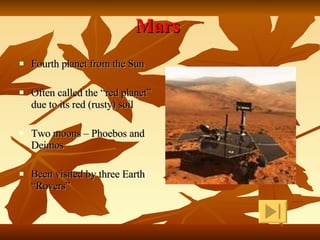
Mars Fourth planet from the Sun Often called the “red planet” due to its red (rusty) soil Two moons – Phoebos and Deimos Been visited by three Earth “Rovers”
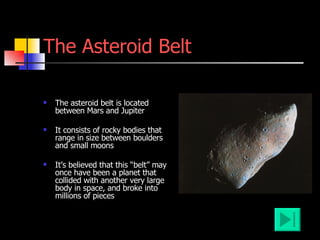
The Asteroid Belt The asteroid belt is located between Mars and Jupiter It consists of rocky bodies that range in size between boulders and small moons It’s believed that this “belt” may once have been a planet that collided with another very large body in space, and broke into millions of pieces
The Outer Planets Jupiter Saturn Uranus Neptune * Pluto  The Four “Outer” Planets of our solar system are made of gases, such as methane and hydrogen They are much larger in size and mass than the “Inner” Planets
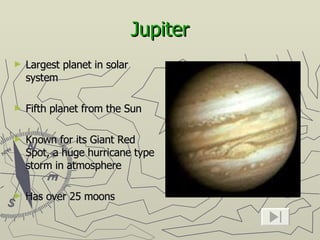
Jupiter Largest planet in solar system Fifth planet from the Sun Known for its Giant Red Spot, a huge hurricane type storm in atmosphere Has over 25 moons
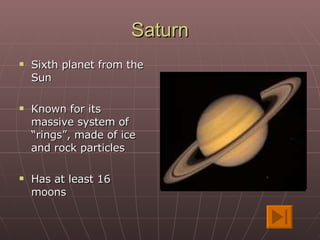
Saturn Sixth planet from the Sun Known for its massive system of “rings”, made of ice and rock particles Has at least 16 moons
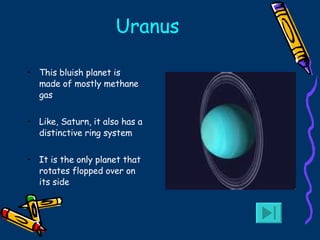
Uranus This bluish planet is made of mostly methane gas Like, Saturn, it also has a distinctive ring system It is the only planet that rotates flopped over on its side
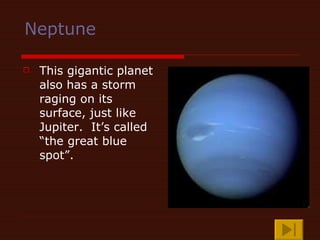
Neptune This gigantic planet also has a storm raging on its surface, just like Jupiter.  It’s called “the great blue spot”.
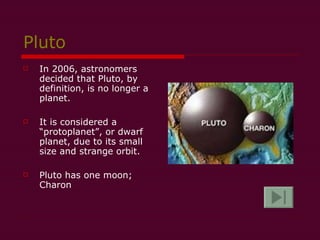
Pluto In 2006, astronomers decided that Pluto, by definition, is no longer a planet. It is considered a “protoplanet”, or dwarf planet, due to its small size and strange orbit. Pluto has one moon; Charon
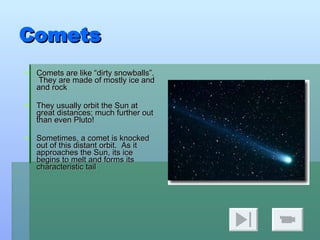
Comets Comets are like “dirty snowballs”.  They are made of mostly ice and and rock They usually orbit the Sun at great distances; much further out than even Pluto! Sometimes, a comet is knocked out of this distant orbit.  As it approaches the Sun, its ice begins to melt and forms its characteristic tail
Author’s Biography My name is Erin Lewis, and I’m a senior at GVSU.  My major is Group Social Studies, secondary education, with a minor in Earth/Space science.  This slide show represents a virtual tour of our solar system and its eight planets. For more information, please contact Erin Lewis by email at  [email_address] .
Resources photos of planets -  www.live.com Martian rover image -  www.photoshopsupport.com/resources/stock-photos/ Video –  “Formation of Comets in the Earliest Solar System”  –  http:// search.discoveryeducation.com /
Concept Map

Touring Solar System Final 2

  • 1.
    Touring Our Solar System Interactive Power Point Project Erin Lewis ED 205-05
  • 2.
    The Outer PlanetsThe Asteroid Belt Comets The Sun Planet Earth The Inner Planets Our Solar System
  • 3.
    The Solar SystemOur solar system is about 4.5 billion years old It has one star, (our Sun) and eight planets
  • 4.
    The Sun TheSun is one of about 200,000 million stars in our Galaxy! It creates light and heat through nuclear fusion
  • 5.
    The Inner PlanetsMercury Venus Earth Mars The four “Inner” Planets of our solar system are made of mostly rock and metal They are also much smaller in size and mass compared to the “Outer” Planets
  • 6.
    Mercury Closest Planetto our Sun Smallest Planet in solar system No Moons
  • 7.
    Venus Second closestplanet to Sun Closest in size to Earth Heavy atmosphere of Carbon Dioxide No moons
  • 8.
    Planet Earth Earthis the only planet in our solar system that has liquid water and a breathable atmosphere Over 70% of Earth is covered by water Earth is the only planet in our solar system that can sustain life
  • 9.
    Mars Fourth planetfrom the Sun Often called the “red planet” due to its red (rusty) soil Two moons – Phoebos and Deimos Been visited by three Earth “Rovers”
  • 10.
    The Asteroid BeltThe asteroid belt is located between Mars and Jupiter It consists of rocky bodies that range in size between boulders and small moons It’s believed that this “belt” may once have been a planet that collided with another very large body in space, and broke into millions of pieces
  • 11.
    The Outer PlanetsJupiter Saturn Uranus Neptune * Pluto The Four “Outer” Planets of our solar system are made of gases, such as methane and hydrogen They are much larger in size and mass than the “Inner” Planets
  • 12.
    Jupiter Largest planetin solar system Fifth planet from the Sun Known for its Giant Red Spot, a huge hurricane type storm in atmosphere Has over 25 moons
  • 13.
    Saturn Sixth planetfrom the Sun Known for its massive system of “rings”, made of ice and rock particles Has at least 16 moons
  • 14.
    Uranus This bluishplanet is made of mostly methane gas Like, Saturn, it also has a distinctive ring system It is the only planet that rotates flopped over on its side
  • 15.
    Neptune This giganticplanet also has a storm raging on its surface, just like Jupiter. It’s called “the great blue spot”.
  • 16.
    Pluto In 2006,astronomers decided that Pluto, by definition, is no longer a planet. It is considered a “protoplanet”, or dwarf planet, due to its small size and strange orbit. Pluto has one moon; Charon
  • 17.
    Comets Comets arelike “dirty snowballs”. They are made of mostly ice and and rock They usually orbit the Sun at great distances; much further out than even Pluto! Sometimes, a comet is knocked out of this distant orbit. As it approaches the Sun, its ice begins to melt and forms its characteristic tail
  • 18.
    Author’s Biography Myname is Erin Lewis, and I’m a senior at GVSU. My major is Group Social Studies, secondary education, with a minor in Earth/Space science. This slide show represents a virtual tour of our solar system and its eight planets. For more information, please contact Erin Lewis by email at [email_address] .
  • 19.
    Resources photos ofplanets - www.live.com Martian rover image - www.photoshopsupport.com/resources/stock-photos/ Video – “Formation of Comets in the Earliest Solar System” – http:// search.discoveryeducation.com /
  • 20.