4 Stages of Labor First Stage  0-10cm Second Stage  10cm to birth Third Stage  Birth of baby to birth of  the placenta Fourth Stage  Birth of placenta to 4 hours  postpartum
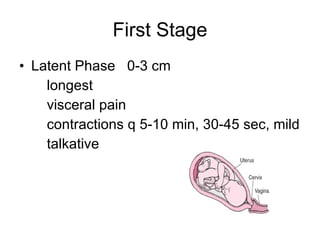
First Stage Latent Phase  0-3 cm longest  visceral pain contractions q 5-10 min, 30-45 sec, mild talkative
Nursing Care Establish relationship Review record Review birth plan Labor assessment Lab studies Explain and provide guidance V/S, pain, FHR, uterine activity, breathing
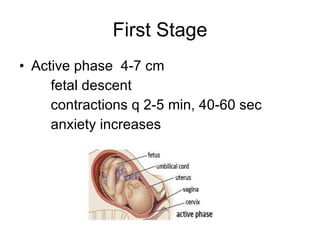
First Stage Active phase  4-7 cm fetal descent contractions q 2-5 min, 40-60 sec anxiety increases
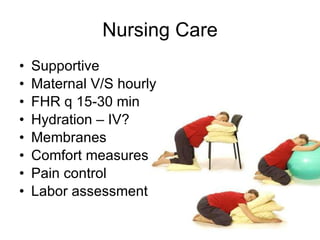
Nursing Care Supportive Maternal V/S hourly FHR q 15-30 min Hydration – IV? Membranes Comfort measures Pain control Labor assessment
First stage Transition Phase  8-10 cm significant anxiety contractions q 1 ½ - 2 min, 60-90 sec strong hot flashes, chills, N&V amnesic
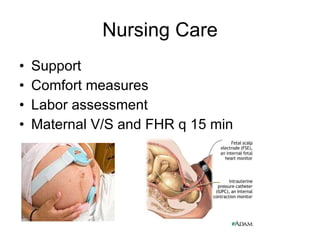
Nursing Care Support Comfort measures Labor assessment Maternal V/S and FHR q 15 min
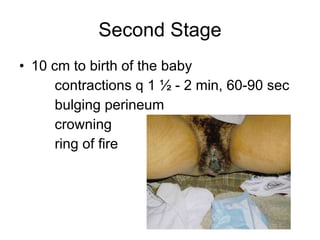
Second Stage 10 cm to birth of the baby contractions q 1 ½ - 2 min, 60-90 sec bulging perineum crowning ring of fire
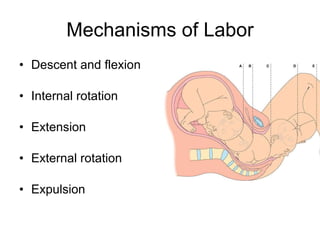
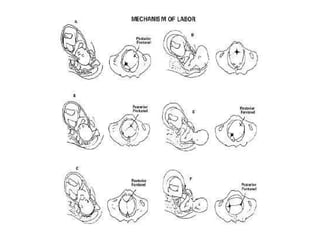
Mechanisms of Labor Descent and flexion Internal rotation Extension External rotation Expulsion
 
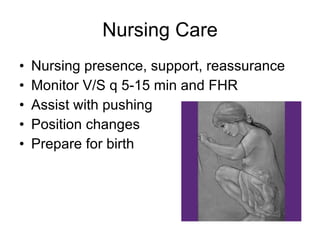
Nursing Care Nursing presence, support, reassurance Monitor V/S q 5-15 min and FHR Assist with pushing Position changes Prepare for birth
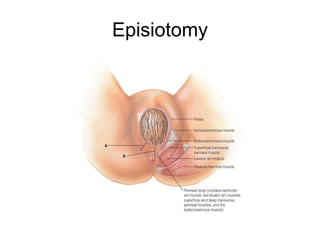
Episiotomy
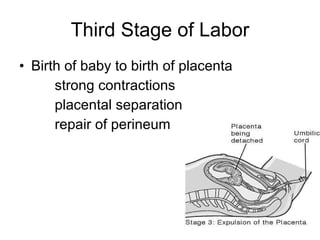
Third Stage of Labor Birth of baby to birth of placenta strong contractions placental separation repair of perineum
Nursing Care Focused on newborn and birth of placenta Pitocin Warmth Explain assessments Ascertain needs V/S q 15 min, fundal assessment Assist with breastfeeding
 
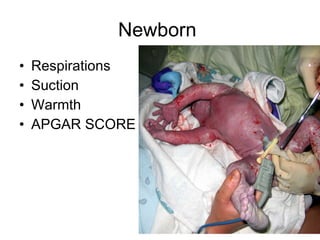
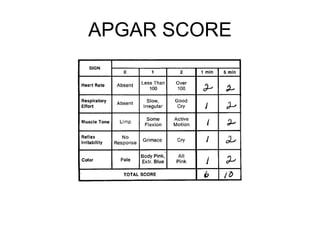
Newborn  Respirations Suction Warmth APGAR SCORE
APGAR SCORE
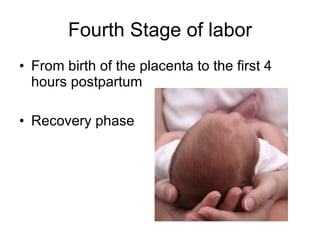
Fourth Stage of labor From birth of the placenta to the first 4 hours postpartum Recovery phase
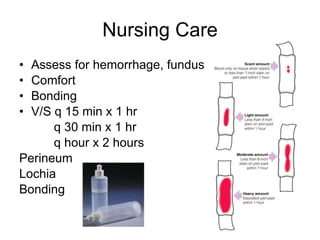
Nursing Care Assess for hemorrhage, fundus Comfort Bonding V/S q 15 min x 1 hr q 30 min x 1 hr q hour x 2 hours Perineum Lochia Bonding
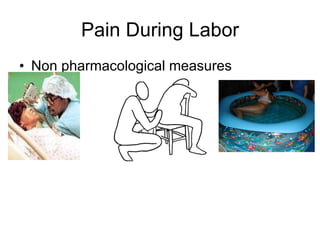
Pain During Labor Non pharmacological measures
Pain During Labor Pharmacologic Measures Opioids – stadol, demerol Opioid antagonist - narcan Barbituates – seconal Ataractics – phenegran
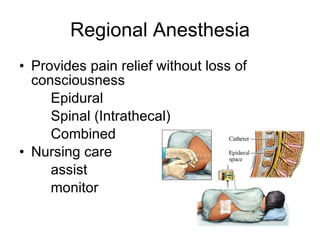
Regional Anesthesia Provides pain relief without loss of consciousness Epidural Spinal (Intrathecal) Combined Nursing care assist monitor
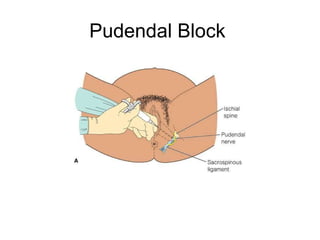
Pudendal Block
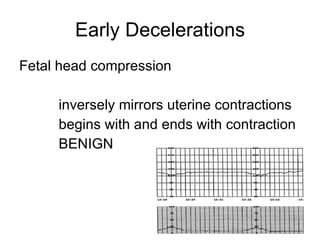
Early Decelerations Fetal head compression inversely mirrors uterine contractions begins with and ends with contraction BENIGN
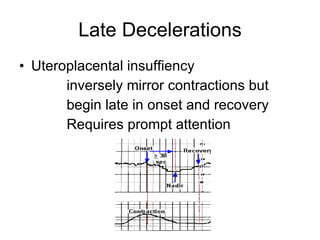
Late Decelerations Uteroplacental insuffiency inversely mirror contractions but begin late in onset and recovery Requires prompt attention
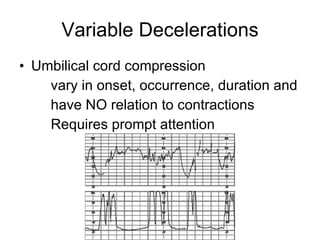
Variable Decelerations Umbilical cord compression vary in onset, occurrence, duration and have NO relation to contractions Requires prompt attention

4 Stages of Labor

  • 1.
    4 Stages ofLabor First Stage 0-10cm Second Stage 10cm to birth Third Stage Birth of baby to birth of the placenta Fourth Stage Birth of placenta to 4 hours postpartum
  • 2.
    First Stage LatentPhase 0-3 cm longest visceral pain contractions q 5-10 min, 30-45 sec, mild talkative
  • 3.
    Nursing Care Establishrelationship Review record Review birth plan Labor assessment Lab studies Explain and provide guidance V/S, pain, FHR, uterine activity, breathing
  • 4.
    First Stage Activephase 4-7 cm fetal descent contractions q 2-5 min, 40-60 sec anxiety increases
  • 5.
    Nursing Care SupportiveMaternal V/S hourly FHR q 15-30 min Hydration – IV? Membranes Comfort measures Pain control Labor assessment
  • 6.
    First stage TransitionPhase 8-10 cm significant anxiety contractions q 1 ½ - 2 min, 60-90 sec strong hot flashes, chills, N&V amnesic
  • 7.
    Nursing Care SupportComfort measures Labor assessment Maternal V/S and FHR q 15 min
  • 8.
    Second Stage 10cm to birth of the baby contractions q 1 ½ - 2 min, 60-90 sec bulging perineum crowning ring of fire
  • 9.
    Mechanisms of LaborDescent and flexion Internal rotation Extension External rotation Expulsion
  • 10.
  • 11.
    Nursing Care Nursingpresence, support, reassurance Monitor V/S q 5-15 min and FHR Assist with pushing Position changes Prepare for birth
  • 12.
  • 13.
    Third Stage ofLabor Birth of baby to birth of placenta strong contractions placental separation repair of perineum
  • 14.
    Nursing Care Focusedon newborn and birth of placenta Pitocin Warmth Explain assessments Ascertain needs V/S q 15 min, fundal assessment Assist with breastfeeding
  • 15.
  • 16.
    Newborn RespirationsSuction Warmth APGAR SCORE
  • 17.
  • 18.
    Fourth Stage oflabor From birth of the placenta to the first 4 hours postpartum Recovery phase
  • 19.
    Nursing Care Assessfor hemorrhage, fundus Comfort Bonding V/S q 15 min x 1 hr q 30 min x 1 hr q hour x 2 hours Perineum Lochia Bonding
  • 20.
    Pain During LaborNon pharmacological measures
  • 21.
    Pain During LaborPharmacologic Measures Opioids – stadol, demerol Opioid antagonist - narcan Barbituates – seconal Ataractics – phenegran
  • 22.
    Regional Anesthesia Providespain relief without loss of consciousness Epidural Spinal (Intrathecal) Combined Nursing care assist monitor
  • 23.
  • 24.
    Early Decelerations Fetalhead compression inversely mirrors uterine contractions begins with and ends with contraction BENIGN
  • 25.
    Late Decelerations Uteroplacentalinsuffiency inversely mirror contractions but begin late in onset and recovery Requires prompt attention
  • 26.
    Variable Decelerations Umbilicalcord compression vary in onset, occurrence, duration and have NO relation to contractions Requires prompt attention