Kathleen JohnsonSeattle AcademyGreen Librarian7Arcs of INNOVATIONDedicated to Buffy Hamilton, tireless advocate for School Libraries
Ladies and GentlemenRight about nowYou are rockin’ with the best of ‘em all
You are now rockin’ with the best
WLMA Librarians !Get ready to rumble!
Kathleen JohnsonSeattle AcademyGreen Librarian7Arcs of INNOVATIONDedicated to Buffy Hamilton, tireless advocate for School Libraries
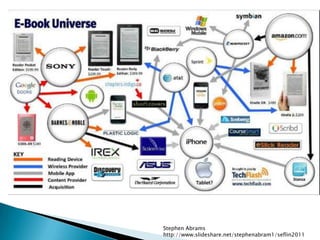
Stephen Abramshttp://www.slideshare.net/stephenabram1/seflin2011
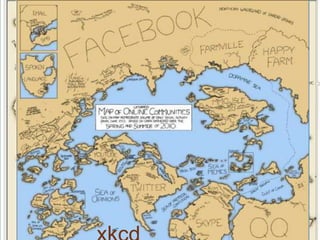
xkcd
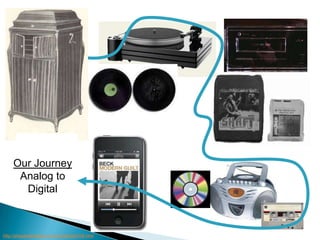
Our Journey Analog to Digitalhttp://shepardartstudio.com/contentdmV8.html
Realms of ChangeEvery aspect of our work and environment is changing.LibrariansStandardsPhysical SpaceOur Materials / Services / AcquisitionsOur StudentsHow Libraries work together
Librarians
LiteracyOur Foundation
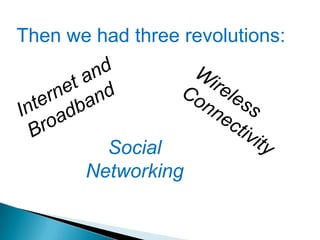
Then we had three revolutions:Internet and Broadband Wireless ConnectivitySocial Networking
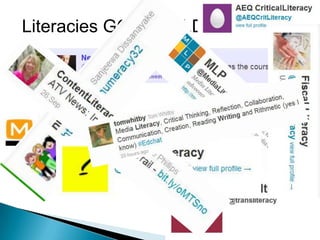
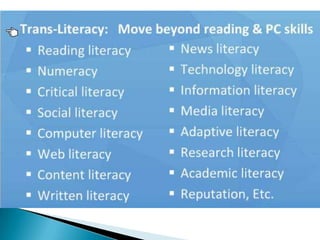
Literacies GONE WILD
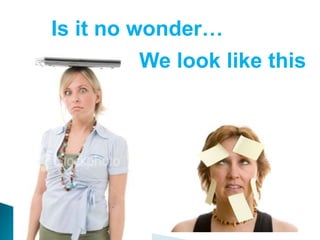
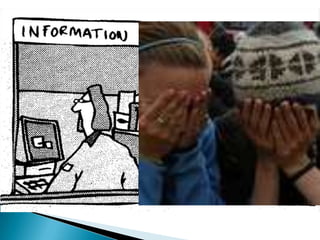
Is it no wonder…We look like this
Almost everyday…We…
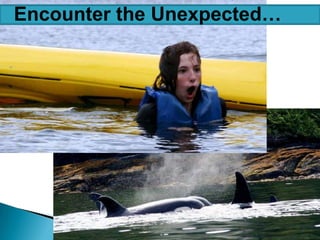
Encounter the Unexpected…
TransitionsReadRead, view, listenStudent LearnerLifelong LearnerPersonal Learner
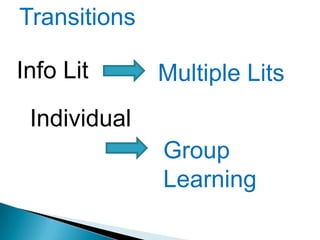
TransitionsInfo LitMultiple LitsIndividualGroup Learning
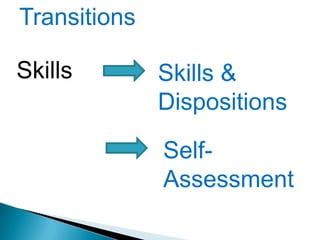
TransitionsSkillsSkills & DispositionsSelf-Assessment
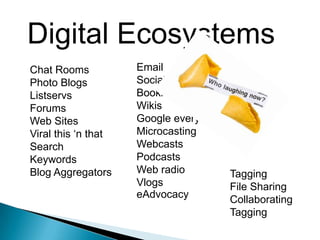
Digital EcosystemsEmailSocial Networking BookmarkingWikisGoogle everythingMicrocastingWebcasts PodcastsWeb radioVlogseAdvocacyChat RoomsPhoto BlogsListservsForumsWeb SitesViral this ‘n thatSearchKeywordsBlog AggregatorsTaggingFile SharingCollaboratingTagging
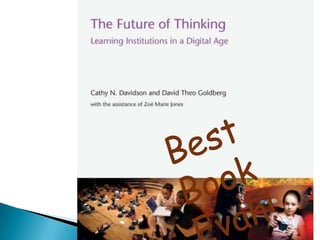
Best Book Evah!
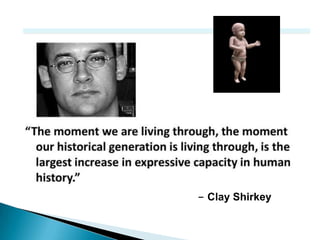
- Clay Shirkey
Kathleen JohnsonSeattle AcademyGreen Librarian7Arcs of INNOVATIONDedicated to Buffy Hamilton, tireless advocate for School Libraries
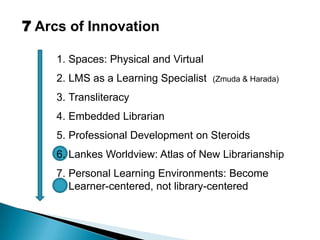
7 Arcs of InnovationSpaces: Physical and Virtual LMS as a Learning Specialist (Zmuda & Harada)Transliteracy      Embedded LibrarianProfessional Development on SteroidsLankes Worldview: Atlas of New LibrarianshipPersonal Learning Environments: Become Learner-centered, not library-centered
1.Spaces:Physical & Virtual
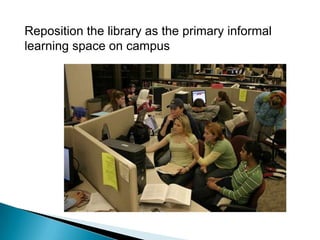
Reposition the library as the primary informal learning space on campus
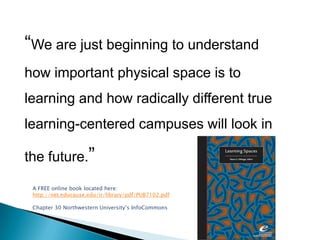
“We are just beginning to understand how important physical space is to learning and how radically different true learning-centered campuses will look in the future.”A FREE online book located here:http://net.educause.edu/ir/library/pdf/PUB7102.pdfChapter 30 Northwestern University’s InfoCommons
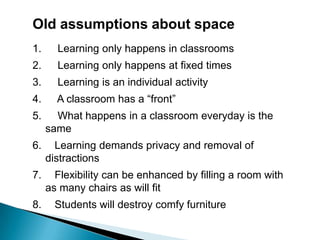
Old assumptions about space  Learning only happens in classrooms  Learning only happens at fixed times  Learning is an individual activity  A classroom has a “front”  What happens in a classroom everyday is the                       same Learning demands privacy and removal of   distractions Flexibility can be enhanced by filling a room with as many chairs as will fit Students will destroy comfy furniture
2.LMS:As Learning Specialist
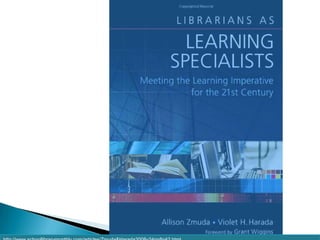
http://www.schoollibrarymonthly.com/articles/Zmuda&Harada2008v24nn8p42.html
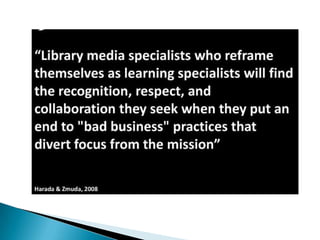
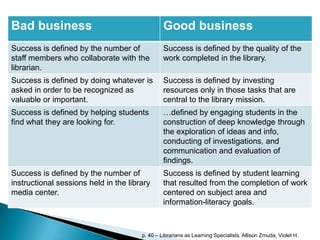
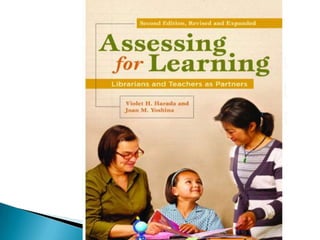
p. 40 – Librarians as Learning Specialists. Allison Zmuda, Violet H. Harada
3.Transliteracy
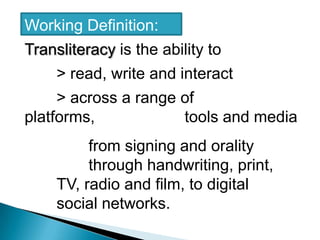
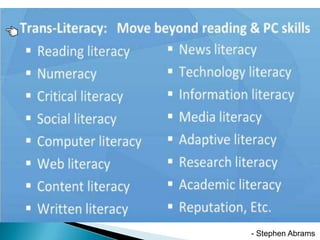
Working Definition: Transliteracy is the ability to 	> read, write and interact 	> across a range of platforms,            		tools and media 		from signing and orality 			through handwriting, print, 		TV, radio and film, to digital 		social networks.
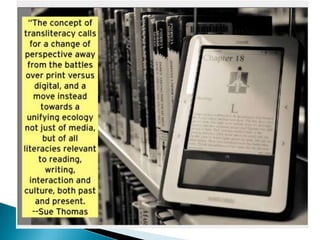
- Stephen Abrams
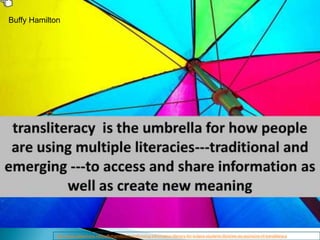
Buffy Hamiltonhttp://www.slideshare.net/buffyjhamilton/transforming-information-literacy-for-todays-students-libraries-as-sponsors-of-transliteracy
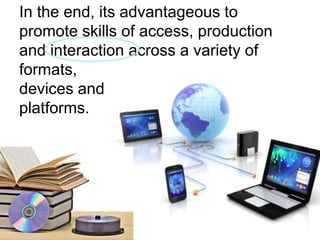
In the end, its advantageous to promote skills of access, production and interaction across a variety of formats, devices andplatforms.
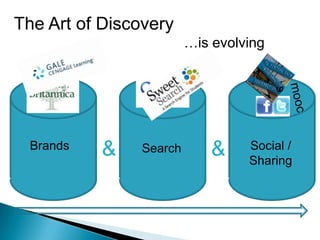
The Art of Discovery 	                                   …is evolvingmoocs&&BrandsSocial / SharingSearch
4.The EmbeddedLibrarian (and Library)
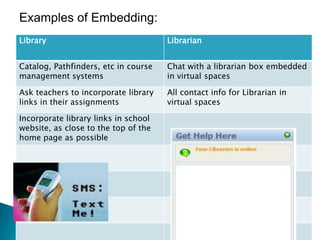
Examples of Embedding:
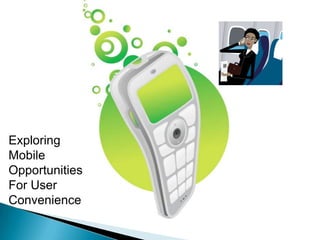
ExploringMobileOpportunitiesFor UserConvenience
Deliver library resources and services at the point of need in a manner that users want and understand.                        - Excerpt from 					OCLC Vision
5.Professional Development on Steroids
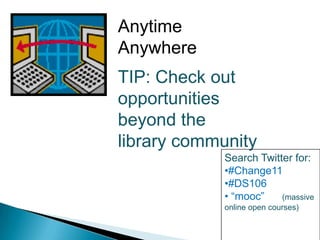
Anytime AnywhereTIP: Check out opportunities beyond the library communitySearch Twitter for:#Change11
#DS106
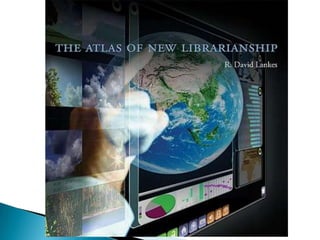
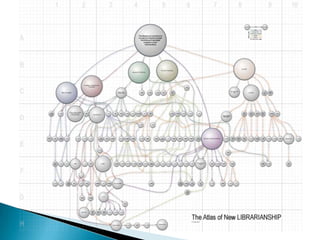
 “mooc”      (massive online open courses)6.The Atlas of NEWLibrarianship(David Lankes)“… a new librarianship based not on books and artifacts but on knowledge and learning…”
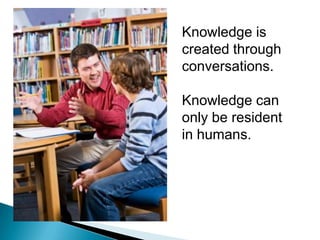
Knowledge is created through conversations.Knowledge can only be resident in humans.
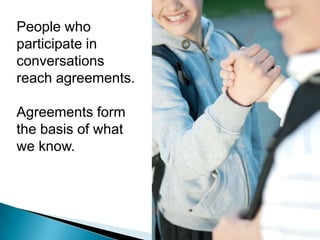
People who participate in conversations reach agreements.Agreements form the basis of what we know.
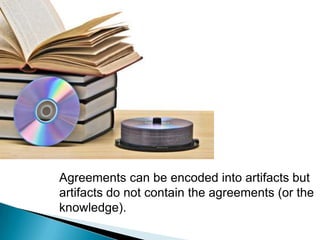
Agreements can be encoded into artifacts but artifacts do not contain the agreements (or the knowledge).
Memory function: Librarians preserve artifacts to enhance conversations by providing the memory of past agreements.
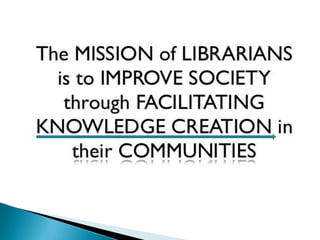
Therefore if…The mission of Librarians is to improve society through facilitating knowledge creation in their communities…AND knowledge is created through conversation, THEN we are in the conversation business.
Atlas of New LibrarianshipCompanion Website/ Participatory Sitehttp://www.newlibrarianship.org/wordpress/p. xii:  “This book is all about conversations. The Atlas is my contribution to that conversation and it is really an invitation for you to join in.”					- R. David Lankes
7.Personal LearningEnvironmentshyperlinks
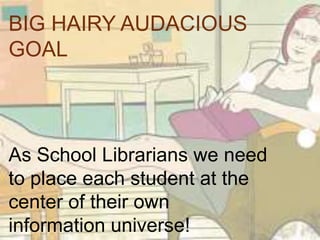
BIG HAIRY AUDACIOUS GOALAs School Librarians we need to place each student at the center of their own information universe!  
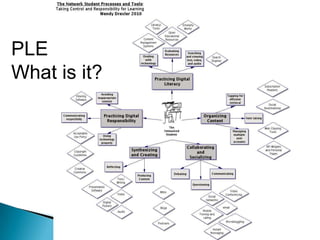
PLEWhat is it?
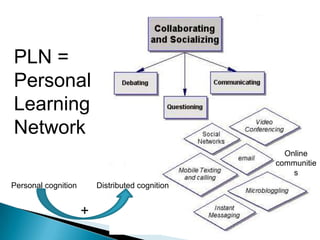
PLN =PersonalLearningNetworkOnline communitiesPersonal cognition     Distributed cognition+
As we continue to move from a broadcast model of information to a networked one, we will continue to see a reworking of the information landscape.                                      -danahboydhttp://www.educause.edu/EDUCAUSE+Review/EDUCAUSEReviewMagazineVolume45/StreamsofContentLimitedAttenti/213923
“This world of learning will be customized, connected, amplified, authentic, relevant, and resilient and it is beginning to unfold now.”
Why PLEs?“…real-world problems are now too complex to be solved by a single person. The knowledge and expertise needed to solve them is increasingly distributed across networks.”- Paavola & Hakkarainen, 2005; Nardi, et al, 2000)
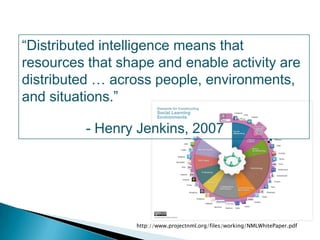
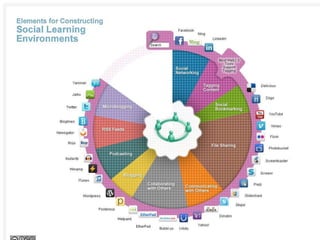
“Distributed intelligence means that resources that shape and enable activity are distributed … across people, environments, and situations.”   		- Henry Jenkins, 2007 http://www.projectnml.org/files/working/NMLWhitePaper.pdf
The emergence of new internet environments in the last decade now require that students master the ability to ...capture “flows” of real-time information as they stream through RSS (really simple syndication) technologies and micro-blogs.  
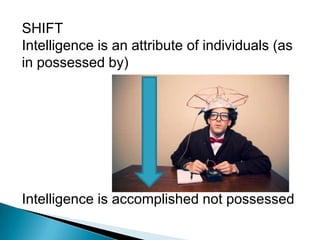
SHIFTIntelligence is an attribute of individuals (as in possessed by)				Intelligence is accomplished not possessed
Learn how to conceptualize and use your subject guides as more than a static web page -- we'll explore how subject guides can anchor partnerships for learning, introduce social scholarship, and model processes and skills for networked learners who are creating personal learning environments.Buffy HamiltonThe UnQuiet Librarian
8.Event: Next Chapter http://nextchapter.reimagine-ed.org/
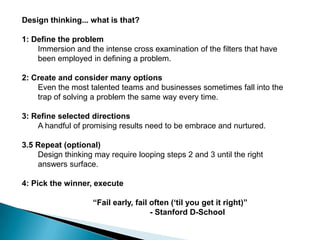
Design thinking... what is that?1: Define the problemImmersion and the intense cross examination of the filters that have been employed in defining a problem. 2: Create and consider many optionsEven the most talented teams and businesses sometimes fall into the trap of solving a problem the same way every time. 3: Refine selected directionsA handful of promising results need to be embrace and nurtured. 3.5 Repeat (optional)Design thinking may require looping steps 2 and 3 until the right answers surface.4: Pick the winner, execute                                “Fail early, fail often (‘til you get it right)”			- Stanford D-School
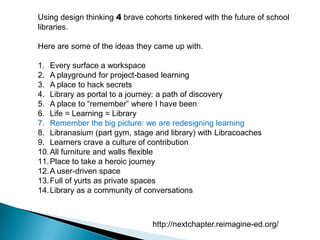
Using design thinking 4 brave cohorts tinkered with the future of school libraries.Here are some of the ideas they came up with. Every surface a workspaceA playground for project-based learningA place to hack secrets Library as portal to a journey: a path of discoveryA place to “remember” where I have beenLife = Learning = LibraryRemember the big picture: we are redesigning learningLibranasium (part gym, stage and library) with LibracoachesLearners crave a culture of contributionAll furniture and walls flexiblePlace to take a heroic journeyA user-driven spaceFull of yurts as private spacesLibrary as a community of conversationshttp://nextchapter.reimagine-ed.org/
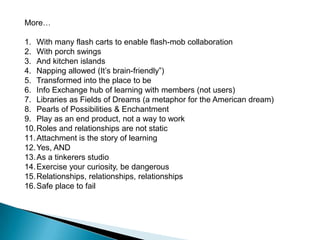
More…With many flash carts to enable flash-mob collaborationWith porch swingsAnd kitchen islandsNapping allowed (It’s brain-friendly”)Transformed into the place to beInfo Exchange hub of learning with members (not users)Libraries as Fields of Dreams (a metaphor for the American dream)Pearls of Possibilities & EnchantmentPlay as an end product, not a way to workRoles and relationships are not staticAttachment is the story of learningYes, ANDAs a tinkerers studioExercise your curiosity, be dangerousRelationships, relationships, relationshipsSafe place to fail
Catch my presentation November 2, 2011 at 5pm Pacific Timehttp://www.library20.com/page/2011-conference
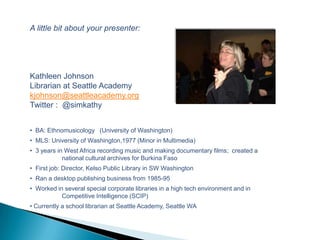
A little bit about your presenter:Kathleen JohnsonLibrarian at Seattle Academykjohnson@seattleacademy.orgTwitter :  @simkathy  BA: Ethnomusicology   (University of Washington)
  MLS: University of Washington,1977 (Minor in Multimedia)

Wlma 2011

  • 1.
    Kathleen JohnsonSeattle AcademyGreenLibrarian7Arcs of INNOVATIONDedicated to Buffy Hamilton, tireless advocate for School Libraries
  • 2.
    Kathleen JohnsonSeattle AcademyGreenLibrarian7Arcs of INNOVATIONDedicated to Buffy Hamilton, tireless advocate for School Libraries
  • 3.
    Ladies and GentlemenRightabout nowYou are rockin’ with the best of ‘em all
  • 4.
    You are nowrockin’ with the best
  • 5.
    WLMA Librarians !Getready to rumble!
  • 6.
    Kathleen JohnsonSeattle AcademyGreenLibrarian7Arcs of INNOVATIONDedicated to Buffy Hamilton, tireless advocate for School Libraries
  • 9.
  • 11.
  • 12.
    Our Journey Analogto Digitalhttp://shepardartstudio.com/contentdmV8.html
  • 13.
    Realms of ChangeEveryaspect of our work and environment is changing.LibrariansStandardsPhysical SpaceOur Materials / Services / AcquisitionsOur StudentsHow Libraries work together
  • 14.
  • 15.
  • 16.
    Then we hadthree revolutions:Internet and Broadband Wireless ConnectivitySocial Networking
  • 17.
  • 19.
    Is it nowonder…We look like this
  • 20.
  • 21.
  • 22.
    TransitionsReadRead, view, listenStudentLearnerLifelong LearnerPersonal Learner
  • 23.
  • 24.
  • 25.
    Digital EcosystemsEmailSocial NetworkingBookmarkingWikisGoogle everythingMicrocastingWebcasts PodcastsWeb radioVlogseAdvocacyChat RoomsPhoto BlogsListservsForumsWeb SitesViral this ‘n thatSearchKeywordsBlog AggregatorsTaggingFile SharingCollaboratingTagging
  • 27.
  • 30.
  • 33.
    Kathleen JohnsonSeattle AcademyGreenLibrarian7Arcs of INNOVATIONDedicated to Buffy Hamilton, tireless advocate for School Libraries
  • 34.
    7 Arcs ofInnovationSpaces: Physical and Virtual LMS as a Learning Specialist (Zmuda & Harada)Transliteracy      Embedded LibrarianProfessional Development on SteroidsLankes Worldview: Atlas of New LibrarianshipPersonal Learning Environments: Become Learner-centered, not library-centered
  • 35.
  • 36.
    Reposition the libraryas the primary informal learning space on campus
  • 37.
    “We are justbeginning to understand how important physical space is to learning and how radically different true learning-centered campuses will look in the future.”A FREE online book located here:http://net.educause.edu/ir/library/pdf/PUB7102.pdfChapter 30 Northwestern University’s InfoCommons
  • 38.
    Old assumptions aboutspace Learning only happens in classrooms Learning only happens at fixed times Learning is an individual activity A classroom has a “front” What happens in a classroom everyday is the same Learning demands privacy and removal of distractions Flexibility can be enhanced by filling a room with as many chairs as will fit Students will destroy comfy furniture
  • 39.
  • 40.
  • 42.
    p. 40 –Librarians as Learning Specialists. Allison Zmuda, Violet H. Harada
  • 44.
  • 45.
    Working Definition: Transliteracyis the ability to > read, write and interact > across a range of platforms, tools and media from signing and orality through handwriting, print, TV, radio and film, to digital social networks.
  • 47.
  • 48.
  • 49.
    In the end,its advantageous to promote skills of access, production and interaction across a variety of formats, devices andplatforms.
  • 50.
    The Art ofDiscovery …is evolvingmoocs&&BrandsSocial / SharingSearch
  • 51.
  • 52.
  • 54.
  • 56.
    Deliver library resourcesand services at the point of need in a manner that users want and understand. - Excerpt from OCLC Vision
  • 57.
  • 58.
    Anytime AnywhereTIP: Checkout opportunities beyond the library communitySearch Twitter for:#Change11
  • 59.
  • 60.
    “mooc” (massive online open courses)6.The Atlas of NEWLibrarianship(David Lankes)“… a new librarianship based not on books and artifacts but on knowledge and learning…”
  • 64.
    Knowledge is createdthrough conversations.Knowledge can only be resident in humans.
  • 65.
    People who participatein conversations reach agreements.Agreements form the basis of what we know.
  • 66.
    Agreements can beencoded into artifacts but artifacts do not contain the agreements (or the knowledge).
  • 67.
    Memory function: Librarianspreserve artifacts to enhance conversations by providing the memory of past agreements.
  • 68.
    Therefore if…The missionof Librarians is to improve society through facilitating knowledge creation in their communities…AND knowledge is created through conversation, THEN we are in the conversation business.
  • 69.
    Atlas of NewLibrarianshipCompanion Website/ Participatory Sitehttp://www.newlibrarianship.org/wordpress/p. xii: “This book is all about conversations. The Atlas is my contribution to that conversation and it is really an invitation for you to join in.” - R. David Lankes
  • 70.
  • 71.
    BIG HAIRY AUDACIOUSGOALAs School Librarians we need to place each student at the center of their own information universe!  
  • 72.
  • 73.
  • 74.
    As we continueto move from a broadcast model of information to a networked one, we will continue to see a reworking of the information landscape. -danahboydhttp://www.educause.edu/EDUCAUSE+Review/EDUCAUSEReviewMagazineVolume45/StreamsofContentLimitedAttenti/213923
  • 75.
    “This world oflearning will be customized, connected, amplified, authentic, relevant, and resilient and it is beginning to unfold now.”
  • 76.
    Why PLEs?“…real-world problemsare now too complex to be solved by a single person. The knowledge and expertise needed to solve them is increasingly distributed across networks.”- Paavola & Hakkarainen, 2005; Nardi, et al, 2000)
  • 77.
    “Distributed intelligence meansthat resources that shape and enable activity are distributed … across people, environments, and situations.” - Henry Jenkins, 2007 http://www.projectnml.org/files/working/NMLWhitePaper.pdf
  • 79.
    The emergence ofnew internet environments in the last decade now require that students master the ability to ...capture “flows” of real-time information as they stream through RSS (really simple syndication) technologies and micro-blogs.  
  • 80.
    SHIFTIntelligence is anattribute of individuals (as in possessed by) Intelligence is accomplished not possessed
  • 81.
    Learn how toconceptualize and use your subject guides as more than a static web page -- we'll explore how subject guides can anchor partnerships for learning, introduce social scholarship, and model processes and skills for networked learners who are creating personal learning environments.Buffy HamiltonThe UnQuiet Librarian
  • 82.
    8.Event: Next Chapterhttp://nextchapter.reimagine-ed.org/
  • 84.
    Design thinking... whatis that?1: Define the problemImmersion and the intense cross examination of the filters that have been employed in defining a problem. 2: Create and consider many optionsEven the most talented teams and businesses sometimes fall into the trap of solving a problem the same way every time. 3: Refine selected directionsA handful of promising results need to be embrace and nurtured. 3.5 Repeat (optional)Design thinking may require looping steps 2 and 3 until the right answers surface.4: Pick the winner, execute “Fail early, fail often (‘til you get it right)” - Stanford D-School
  • 85.
    Using design thinking4 brave cohorts tinkered with the future of school libraries.Here are some of the ideas they came up with. Every surface a workspaceA playground for project-based learningA place to hack secrets Library as portal to a journey: a path of discoveryA place to “remember” where I have beenLife = Learning = LibraryRemember the big picture: we are redesigning learningLibranasium (part gym, stage and library) with LibracoachesLearners crave a culture of contributionAll furniture and walls flexiblePlace to take a heroic journeyA user-driven spaceFull of yurts as private spacesLibrary as a community of conversationshttp://nextchapter.reimagine-ed.org/
  • 86.
    More…With many flashcarts to enable flash-mob collaborationWith porch swingsAnd kitchen islandsNapping allowed (It’s brain-friendly”)Transformed into the place to beInfo Exchange hub of learning with members (not users)Libraries as Fields of Dreams (a metaphor for the American dream)Pearls of Possibilities & EnchantmentPlay as an end product, not a way to workRoles and relationships are not staticAttachment is the story of learningYes, ANDAs a tinkerers studioExercise your curiosity, be dangerousRelationships, relationships, relationshipsSafe place to fail
  • 87.
    Catch my presentationNovember 2, 2011 at 5pm Pacific Timehttp://www.library20.com/page/2011-conference
  • 88.
    A little bitabout your presenter:Kathleen JohnsonLibrarian at Seattle Academykjohnson@seattleacademy.orgTwitter : @simkathy BA: Ethnomusicology (University of Washington)
  • 89.
    MLS:University of Washington,1977 (Minor in Multimedia)

Editor's Notes

  • #2 So with that short introduction, back to the topic at hand.
  • #3 So with that short introduction, back to the topic at hand.
  • #7 So with that short introduction, back to the topic at hand.
  • #13 http://shepardartstudio.com/contentdmV8.htmlAnd if all that change isn’t enough… remember this evolution of music and sound? It’s all information, no matter what format it comes in.
  • #14 When I began to review how we have responded as a profession, it became clear that all major aspects of Libraries and being a Librarian have been affected. There have even been changes that don’t fit into our conventional thinking about libraries.. And we’ll get to that later.
  • #16 SAAS – independent college prep school, laptop school since 1997, the emphasis on arts shows here in the original posters we make. That was a collaboration with Rebekah our photography teacher.And here are a few random and dramatic facts about me
  • #34 So with that short introduction, back to the topic at hand.
  • #37 One screen,Four chairs EqualsCollaboration