1/6/2013


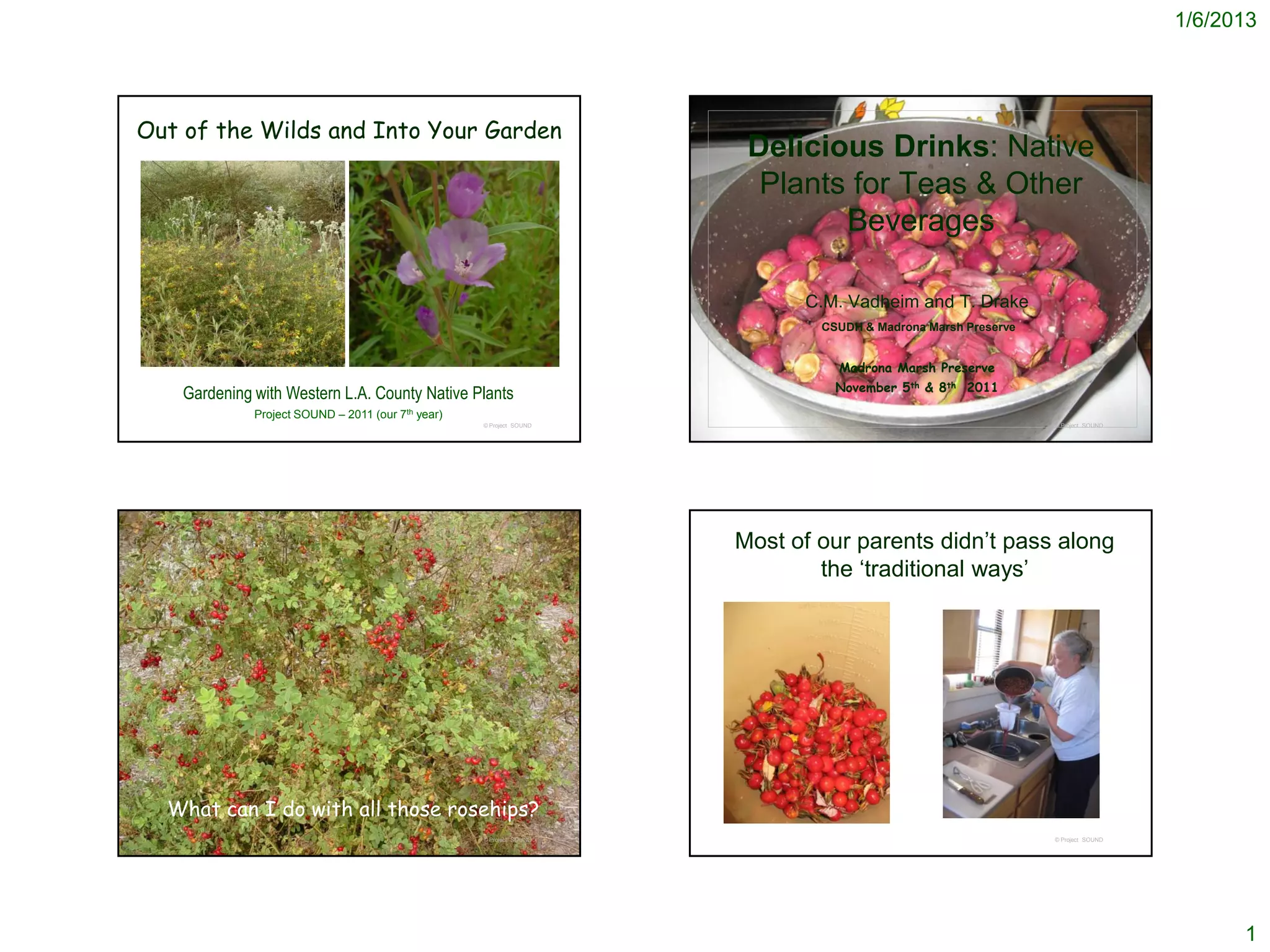
Out of the Wilds and Into Your Garden
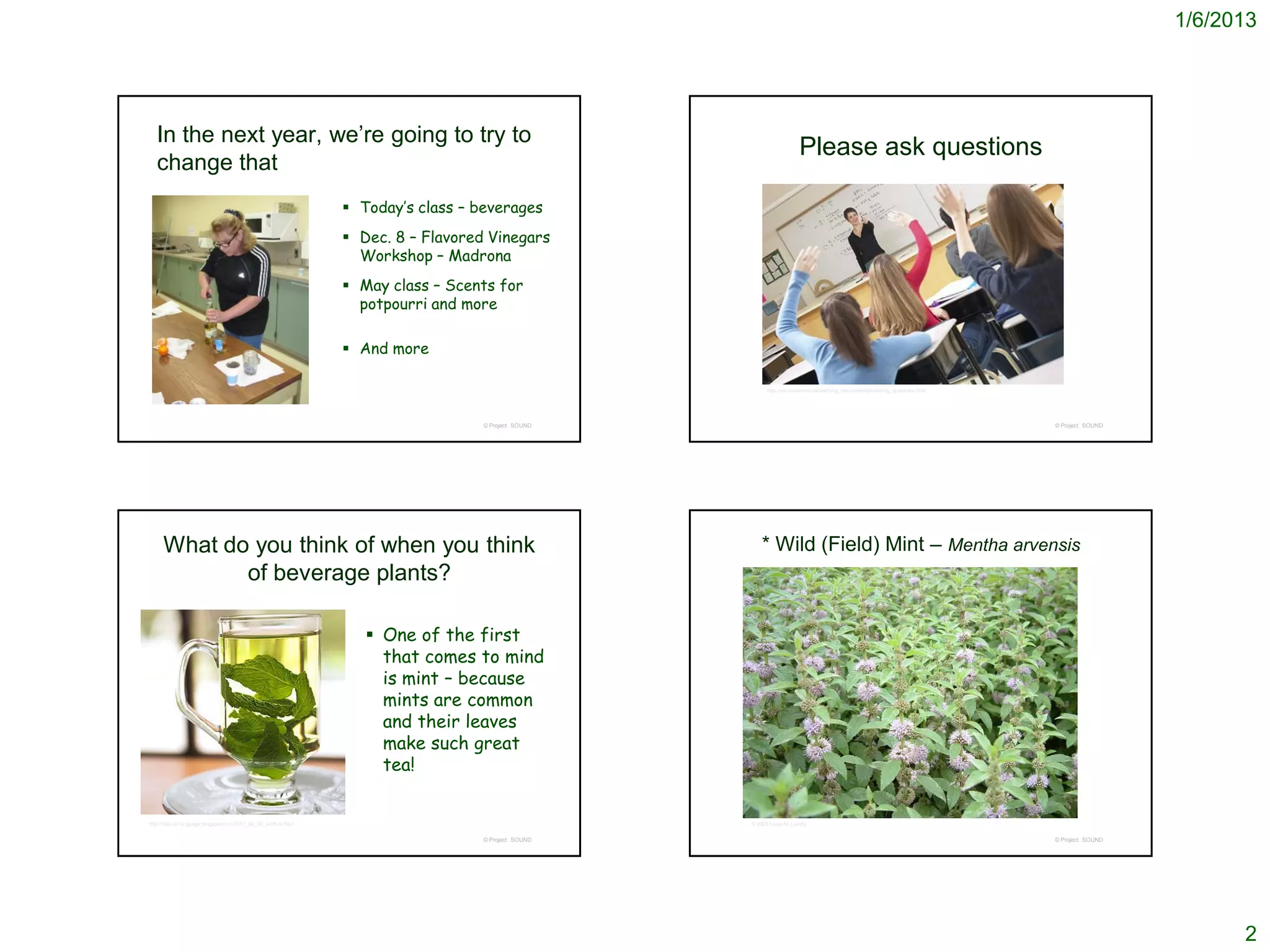
                                                                       Delicious Drinks: Native
                                                                        Plants for Teas & Other
                                                                              Beverages

                                                                            C.M. Vadheim and T. Drake
                                                                              CSUDH & Madrona Marsh Preserve


                                                                                Madrona Marsh Preserve
                                                                                November 5th & 8th 2011
    Gardening with Western L.A. County Native Plants
              Project SOUND – 2011 (our 7th year)
                                                    © Project SOUND                                            © Project SOUND


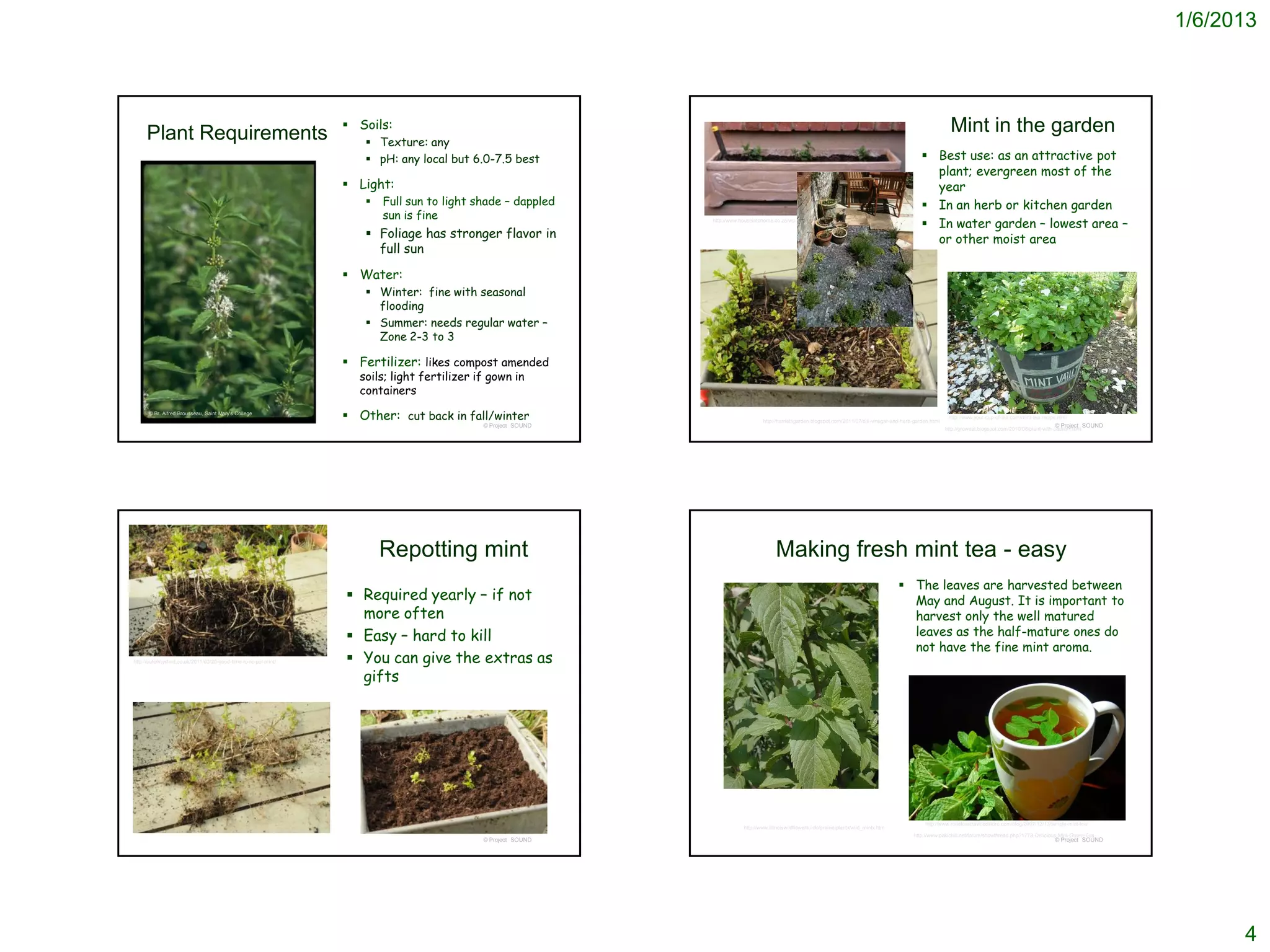
                                                                      Most of our parents didn’t pass along
                                                                              the ‘traditional ways’


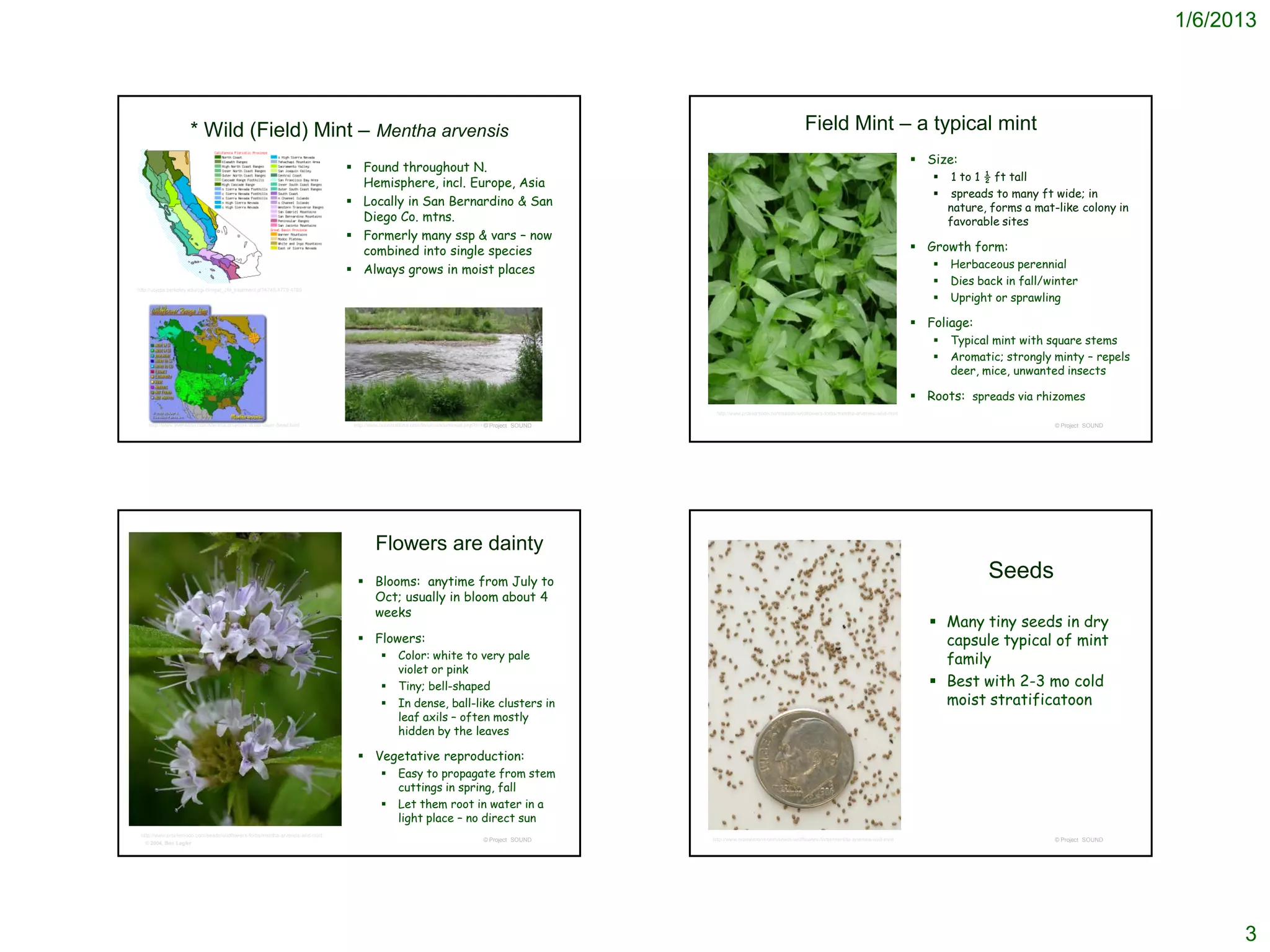
  What can I do with all those rosehips?
                                                    © Project SOUND                                            © Project SOUND


                                                                                                                                       1
1/6/2013


   In the next year, we’re going to try to
                                                                                                                        Please ask questions
   change that
                                                                Today’s class – beverages
                                                                Dec. 8 – Flavored Vinegars
                                                                 Workshop – Madrona
                                                                May class – Scents for
                                                                 potpourri and more

                                                                And more

                                                                                                          http://cte.uwaterloo.ca/teaching_resources/tips/asking_questions.html


                                                                                  © Project SOUND                                                                                 © Project SOUND


     What do you think of when you think                                                                * Wild (Field) Mint – Mentha arvensis
            of beverage plants?

                                                                   One of the first
                                                                    that comes to mind
                                                                    is mint – because
                                                                    mints are common
                                                                    and their leaves
                                                                    make such great
                                                                    tea!


http://natural-language.blogspot.com/2011_02_28_archive.html                                        © 2005 Louis-M. Landry


                                                                                  © Project SOUND                                                                                 © Project SOUND


                                                                                                                                                                                                          2
1/6/2013


                      * Wild (Field) Mint – Mentha arvensis                                                                                                                                  Field Mint – a typical mint
                                                                                                                                                                                                                                        Size:
                                                                                 Found throughout N.
                                                                                                                                                                                                                                              1 to 1 ½ ft tall
                                                                                  Hemisphere, incl. Europe, Asia
                                                                                                                                                                                                                                              spreads to many ft wide; in
                                                                                 Locally in San Bernardino & San                                                                                                                             nature, forms a mat-like colony in
                                                                                  Diego Co. mtns.                                                                                                                                             favorable sites
                                                                                 Formerly many ssp & vars – now
                                                                                  combined into single species                                                                                                                          Growth form:
                                                                                 Always grows in moist places                                                                                                                               Herbaceous perennial
                                                                                                                                                                                                                                             Dies back in fall/winter
http://ucjeps.berkeley.edu/cgi-bin/get_JM_treatment.pl?4745,4779,4780
                                                                                                                                                                                                                                             Upright or sprawling

                                                                                                                                                                                                                                        Foliage:
                                                                                                                                                                                                                                             Typical mint with square stems
                                                                                                                                                                                                                                             Aromatic; strongly minty – repels
                                                                                                                                                                                                                                              deer, mice, unwanted insects

                                                                                                                                                                                                                                        Roots: spreads via rhizomes
                                                                                                                                                        http://www.prairiemoon.com/seeds/wildflowers-forbs/mentha-arvensis-wild-mint

    http://www.everwilde.com/Mentha-arvensis-WildFlower-Seed.html                http://www.bushcraftusa.com/forum/showthread.php?t=41276
                                                                                                                                     © Project SOUND                                                                                                              © Project SOUND


                                                                                         Flowers are dainty
                                                                                   Blooms: anytime from July to
                                                                                                                                                                                                                                                     Seeds
                                                                                    Oct; usually in bloom about 4
                                                                                    weeks
                                                                                                                                                                                                                                           Many tiny seeds in dry
                                                                                   Flowers:                                                                                                                                                capsule typical of mint
                                                                                                Color: white to very pale                                                                                                                  family
                                                                                                 violet or pink
                                                                                                Tiny; bell-shaped                                                                                                                         Best with 2-3 mo cold
                                                                                                In dense, ball-like clusters in                                                                                                            moist stratificatoon
                                                                                                 leaf axils – often mostly
                                                                                                 hidden by the leaves

                                                                                   Vegetative reproduction:
                                                                                                Easy to propagate from stem
                                                                                                 cuttings in spring, fall
                                                                                                Let them root in water in a
                                                                                                 light place – no direct sun
 http://www.prairiemoon.com/seeds/wildflowers-forbs/mentha-arvensis-wild-mint
                                                                                                                                 © Project SOUND       http://www.prairiemoon.com/seeds/wildflowers-forbs/mentha-arvensis-wild-mint                               © Project SOUND
   © 2004, Ben Legler


                                                                                                                                                                                                                                                                                          3
1/6/2013


                                                                 Soils:                                                                                                                                          Mint in the garden
     Plant Requirements                                             Texture: any
                                                                    pH: any local but 6.0-7.5 best                                                                                                   Best use: as an attractive pot
                                                                                                                                                                                                       plant; evergreen most of the
                                                                 Light:                                                                                                                               year
                                                                      Full sun to light shade – dappled                                                                                              In an herb or kitchen garden
                                                                       sun is fine                           http://www.houseintohome.co.za/wp-content/uploads/2008/08/
                                                                                                                                                                                                      In water garden – lowest area –
                                                                    Foliage has stronger flavor in                                                                                                    or other moist area
                                                                     full sun

                                                                 Water:
                                                                    Winter: fine with seasonal
                                                                     flooding
                                                                    Summer: needs regular water –
                                                                     Zone 2-3 to 3

                                                                 Fertilizer: likes compost amended
                                                                  soils; light fertilizer if gown in
                                                                  containers
      © Br. Alfred Brousseau, Saint Mary's College
                                                                 Other: cut back in fall/winter                                 http://harrietsgarden.blogspot.com/2011/07/dill-vinegar-and-herb-garden.html
                                                                                                                                                                                                                 http://www.your-cup-of-tea.com/mint-tea-recipe.html
                                                                                           © Project SOUND                                                                                                                                                     © Project SOUND
                                                                                                                                                                                                                http://groweat.blogspot.com/2010/06/plant-with-caution.html


                                                                       Repotting mint                                                  Making fresh mint tea - easy
                                                                                                                                                                                              The leaves are harvested between
                                                                 Required yearly – if not                                                                                                     May and August. It is important to
                                                                  more often                                                                                                                   harvest only the well matured
                                                                 Easy – hard to kill                                                                                                          leaves as the half-mature ones do
                                                                                                                                                                                               not have the fine mint aroma.
http://outofmyshed.co.uk/2011/03/20/good-time-to-re-pot-mint/    You can give the extras as
                                                                  gifts


                                                                                                                                                                                                      http://www.roadlesstraveledstore.com/blog/2007/12/13/simple-mint-tea/
                                                                                                                         http://www.illinoiswildflowers.info/prairie/plantx/wild_mintx.htm
                                                                                                                                                                                                 http://www.pakichill.net/forum/showthread.php?1778-Delicious-Mint-Green-Tea
                                                                                           © Project SOUND                                                                                                                                                     © Project SOUND


                                                                                                                                                                                                                                                                                       4
1/6/2013


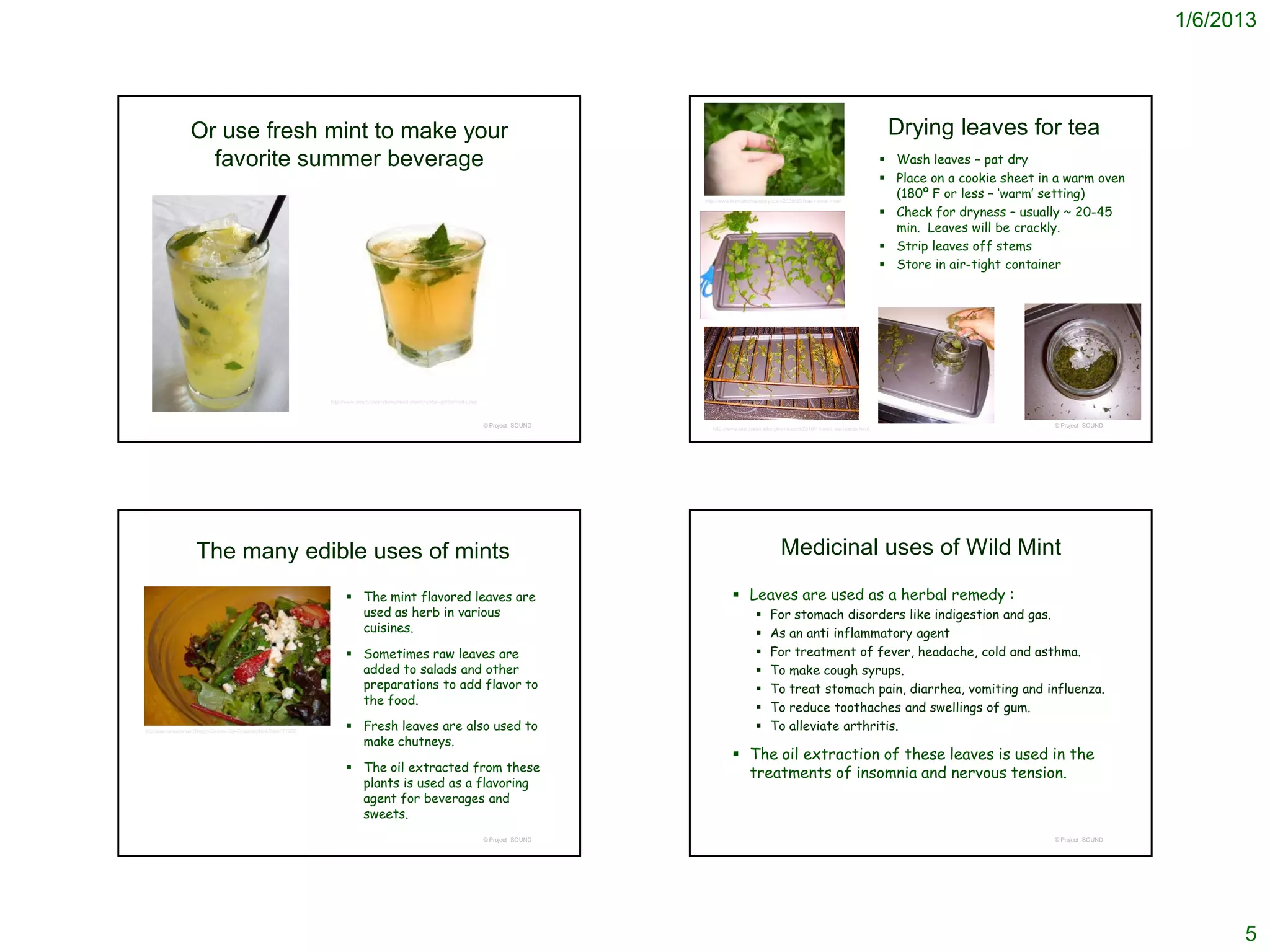
                     Or use fresh mint to make your                                                                                                                                                                               Drying leaves for tea
                       favorite summer beverage                                                                                                                                                                                   Wash leaves – pat dry
                                                                                                                                                                                                                                  Place on a cookie sheet in a warm oven
                                                                                                                                                            http://www.howipinchapenny.com/2009/06/how-i-save-mint/
                                                                                                                                                                                                                                   (180º F or less – ‘warm’ setting)
                                                                                                                                                                                                                                  Check for dryness – usually ~ 20-45
                                                                                                                                                                                                                                   min. Leaves will be crackly.
                                                                                                                                                                                                                                  Strip leaves off stems
                                                                                                                                                                                                                                  Store in air-tight container


                                                                           http://www.amctv.com/shows/mad-men/cocktail-guide/mint-julep


                                                                                                                                          © Project SOUND                                                                                                    © Project SOUND
                                                                                                                                                               http://www.twentysomethinghome.com/2010/11/mint-tea-leaves.html


                        The many edible uses of mints                                                                                                                                     Medicinal uses of Wild Mint

                                                                                  The mint flavored leaves are                                                        Leaves are used as a herbal remedy :
                                                                                   used as herb in various                                                                           For stomach disorders like indigestion and gas.
                                                                                   cuisines.                                                                                         As an anti inflammatory agent
                                                                                  Sometimes raw leaves are                                                                          For treatment of fever, headache, cold and asthma.
                                                                                   added to salads and other                                                                         To make cough syrups.
                                                                                   preparations to add flavor to                                                                     To treat stomach pain, diarrhea, vomiting and influenza.
                                                                                   the food.
                                                                                                                                                                                     To reduce toothaches and swellings of gum.
http://www.yumsugar.com/Snappy-Summer-Side-Strawberry-Mint-Salad-1713036
                                                                                  Fresh leaves are also used to                                                                     To alleviate arthritis.
                                                                                   make chutneys.
                                                                                                                                                                       The oil extraction of these leaves is used in the
                                                                                  The oil extracted from these                                                         treatments of insomnia and nervous tension.
                                                                                   plants is used as a flavoring
                                                                                   agent for beverages and
                                                                                   sweets.
                                                                                                                                          © Project SOUND                                                                                                    © Project SOUND


                                                                                                                                                                                                                                                                                     5
1/6/2013


                       The tea/medicinal connection
                                                                             Many herbal teas are not only
                                                                              delicious, they also may have
                                                                              soothing & other effects
                                                                                                                                                                   The medicinal benefits of
                                                                             Plants make a number of                                                               specific herbs are often
                                                                              plant-specific chemicals                                                              anecdotal or controversial,
                                                                              (phytochemicals)                                                                      and in some countries
                                                                                Some are pleasant tasting to us                                                    (including the United
                                                                                 – but actually repel herbivores                                                    States) makers of herbal
                                                                                 [Mint]                                                                             teas are not allowed to
http://peacecooking.blogspot.com/2010/01/delicious-moroccan-mint-tea.html


Since infusions are an easy                                                     Some play similar, often                                                           make unsubstantiated
means of extracting plant                                                        medicinal, roles in both plants &                                                  claims about the medicinal
chemicals it’s not surprising that                                               animals                                                                            effects of their products.
                                                                                                                       http://www.abs-herbs.com.ph/prod-tea.htm
they are used as both traditional                                               These chemicals are the basis
medicines and beverages                                                          of many traditional & ‘modern’
                                                                                 medicines           © Project SOUND                                                                   © Project SOUND


                                                                                                                                The benefits of making beverages from
                                      A few words of caution                                                                      plants growing in your own garden

       Herbal teas can have different effects from                                                                                                                You know what the plant is –
        person to person – always start with a little, and                                                                                                          so you don’t mistakenly
        never overdo                                                                                                                                                substitute a toxic plant for
                                                                                                                                                                    an edible one
       Some plants/plant parts are toxic; correct
        identification and correct preparation is essential                                                                                                        You can control the
                                                                                                                                                                    chemicals used on the
       If you are pregnant, nursing, taking prescription                                                                                                           plants
        medications, or have known allergies to certain
        foods or plants, caution and consultation with a                                                                                                           You can pick plant parts
        physician or pharmacist are advised.                                                                                                                        when they are at the ‘peak
                                                                                                                                                                    of flavor’
                                                                                                     © Project SOUND                                                                   © Project SOUND


                                                                                                                                                                                                               6
1/6/2013


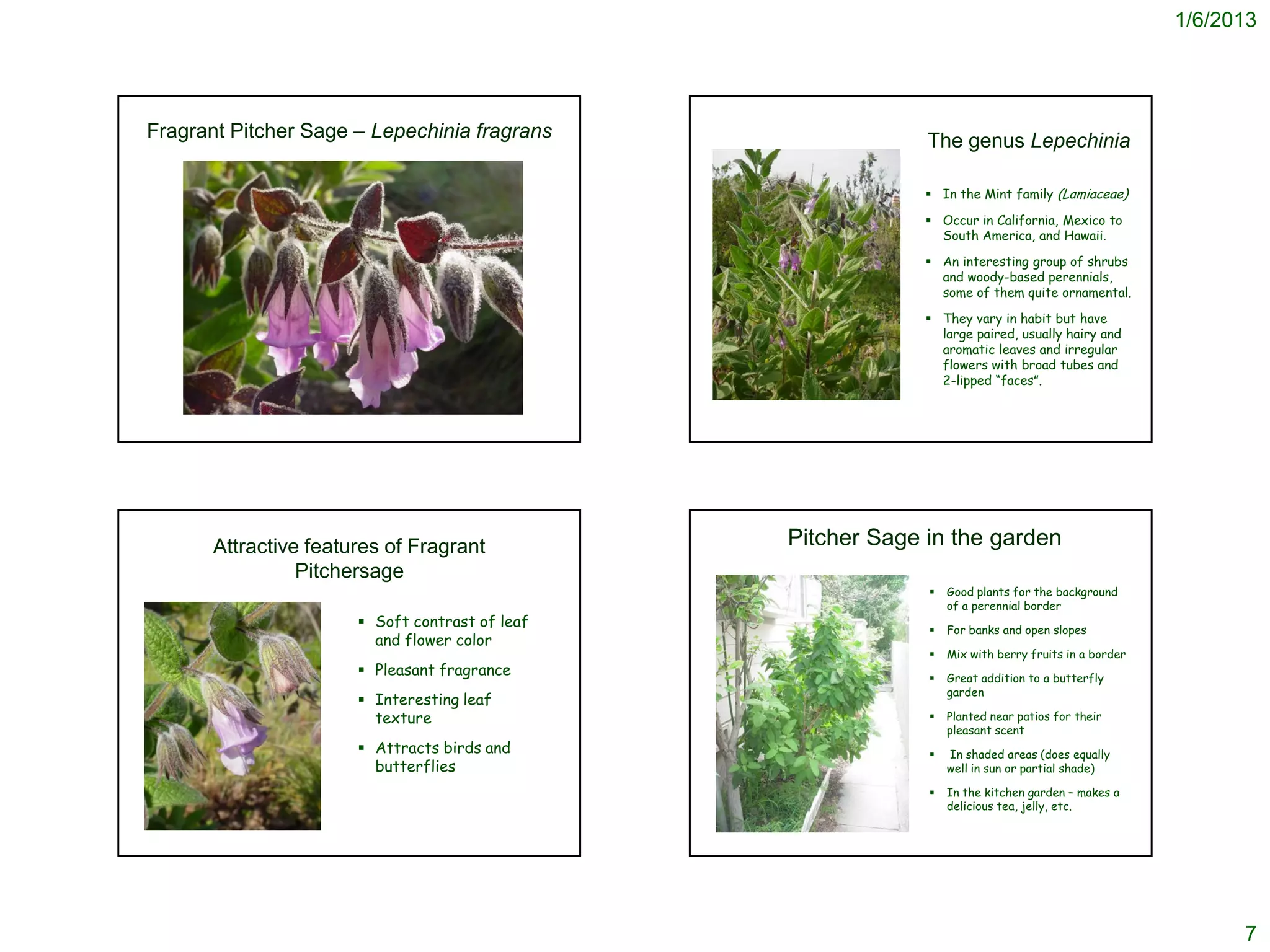
Fragrant Pitcher Sage – Lepechinia fragrans                   The genus Lepechinia

                                                               In the Mint family (Lamiaceae)

                                                               Occur in California, Mexico to
                                                                South America, and Hawaii.

                                                               An interesting group of shrubs
                                                                and woody-based perennials,
                                                                some of them quite ornamental.

                                                               They vary in habit but have
                                                                large paired, usually hairy and
                                                                aromatic leaves and irregular
                                                                flowers with broad tubes and
                                                                2-lipped “faces”.


       Attractive features of Fragrant           Pitcher Sage in the garden
                 Pitchersage
                                                                 Good plants for the background
                                                                  of a perennial border
                        Soft contrast of leaf                   For banks and open slopes
                         and flower color
                                                                 Mix with berry fruits in a border
                        Pleasant fragrance                      Great addition to a butterfly
                                                                  garden
                        Interesting leaf
                         texture                                 Planted near patios for their
                                                                  pleasant scent
                        Attracts birds and                      In shaded areas (does equally
                         butterflies                              well in sun or partial shade)

                                                                 In the kitchen garden – makes a
                                                                  delicious tea, jelly, etc.


                                                                                                            7
1/6/2013


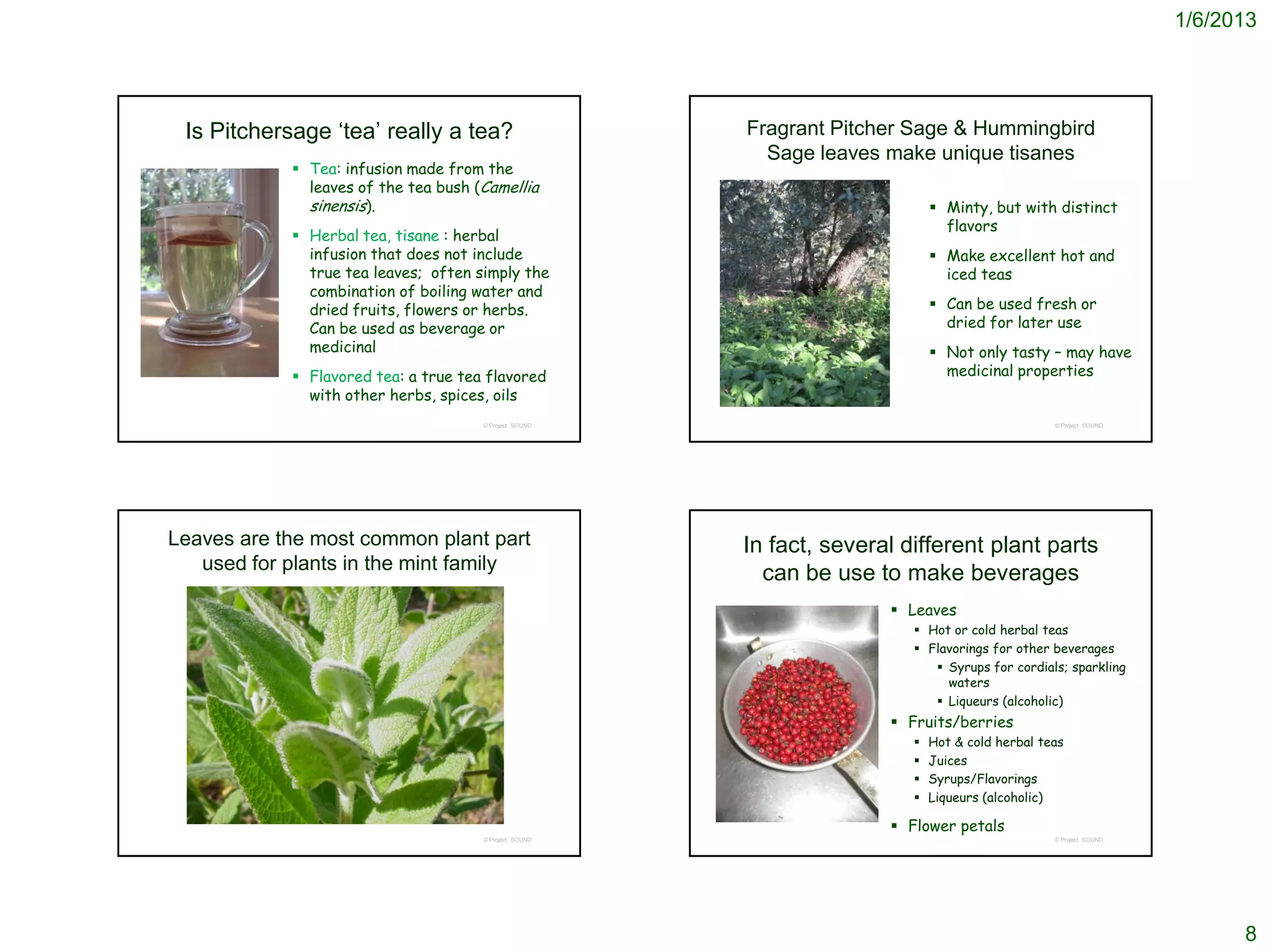
 Is Pitchersage ‘tea’ really a tea?                     Fragrant Pitcher Sage & Hummingbird
                                                          Sage leaves make unique tisanes
             Tea: infusion made from the
              leaves of the tea bush (Camellia
              sinensis).                                                       Minty, but with distinct
                                                                                flavors
             Herbal tea, tisane : herbal
              infusion that does not include                                   Make excellent hot and
              true tea leaves; often simply the                                 iced teas
              combination of boiling water and
              dried fruits, flowers or herbs.                                  Can be used fresh or
              Can be used as beverage or                                        dried for later use
              medicinal                                                        Not only tasty – may have
             Flavored tea: a true tea flavored                                 medicinal properties
              with other herbs, spices, oils
                                      © Project SOUND                                             © Project SOUND


Leaves are the most common plant part                   In fact, several different plant parts
   used for plants in the mint family                     can be use to make beverages
                                                                        Leaves
                                                                           Hot or cold herbal teas
                                                                           Flavorings for other beverages
                                                                              Syrups for cordials; sparkling
                                                                               waters
                                                                              Liqueurs (alcoholic)
                                                                        Fruits/berries
                                                                             Hot & cold herbal teas
                                                                             Juices
                                                                             Syrups/Flavorings
                                                                             Liqueurs (alcoholic)

                                                                        Flower petals
                                      © Project SOUND                                             © Project SOUND


                                                                                                                          8
1/6/2013


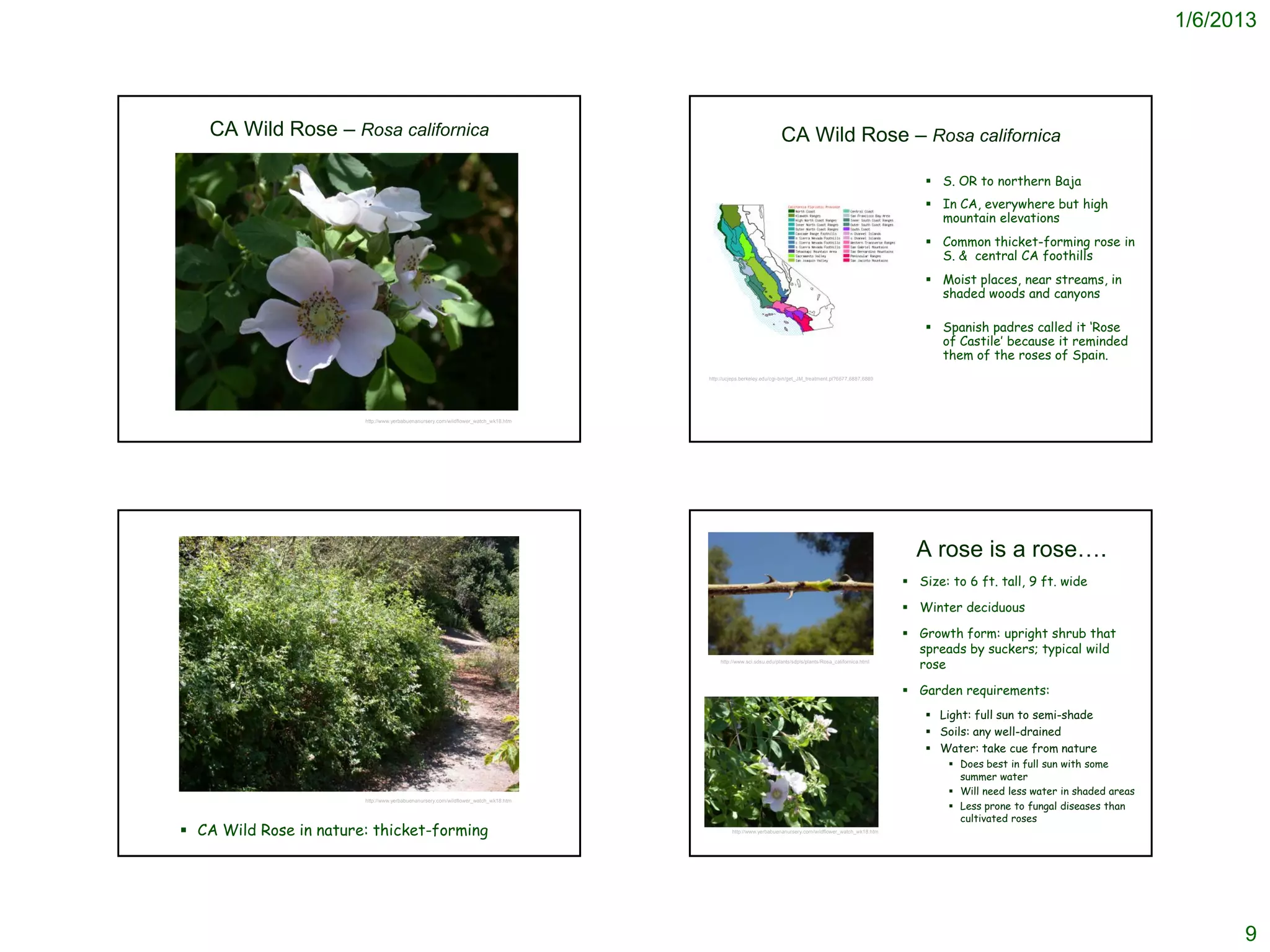
   CA Wild Rose – Rosa californica                                                                                 CA Wild Rose – Rosa californica

                                                                                                                                                                  S. OR to northern Baja
                                                                                                                                                                  In CA, everywhere but high
                                                                                                                                                                   mountain elevations
                                                                                                                                                                  Common thicket-forming rose in
                                                                                                                                                                   S. & central CA foothills
                                                                                                                                                                  Moist places, near streams, in
                                                                                                                                                                   shaded woods and canyons

                                                                                                                                                                  Spanish padres called it ‘Rose
                                                                                                                                                                   of Castile’ because it reminded
                                                                                                                                                                   them of the roses of Spain.
                                                                                     http://ucjeps.berkeley.edu/cgi-bin/get_JM_treatment.pl?6677,6887,6889


                        http://www.yerbabuenanursery.com/wildflower_watch_wk18.htm


                                                                                                                                                               A rose is a rose….
                                                                                                                                                              Size: to 6 ft. tall, 9 ft. wide

                                                                                                                                                              Winter deciduous

                                                                                                                                                              Growth form: upright shrub that
                                                                                                                                                               spreads by suckers; typical wild
                                                                                         http://www.sci.sdsu.edu/plants/sdpls/plants/Rosa_californica.html
                                                                                                                                                               rose

                                                                                                                                                              Garden requirements:
                                                                                                                                                                  Light: full sun to semi-shade
                                                                                                                                                                  Soils: any well-drained
                                                                                                                                                                  Water: take cue from nature
                                                                                                                                                                      Does best in full sun with some
                                                                                                                                                                       summer water
                                                                                                                                                                      Will need less water in shaded areas
                                                                                                                                                                      Less prone to fungal diseases than
                        http://www.yerbabuenanursery.com/wildflower_watch_wk18.htm


                                                                                                                                                                       cultivated roses
 CA Wild Rose in nature: thicket-forming                                                     http://www.yerbabuenanursery.com/wildflower_watch_wk18.htm


                                                                                                                                                                                                                    9
1/6/2013


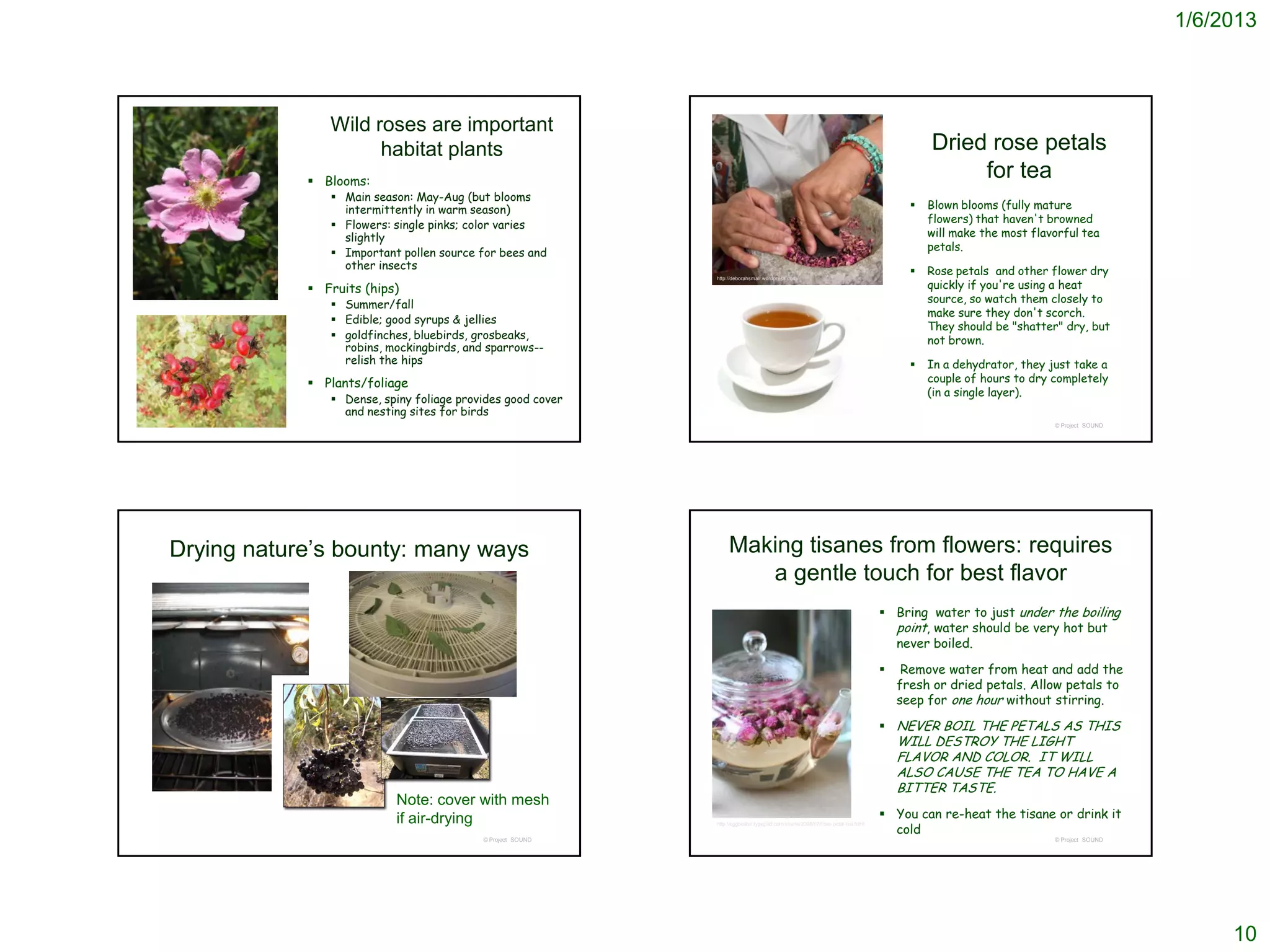
               Wild roses are important
                     habitat plants                                                                                                    Dried rose petals
             Blooms:
                                                                                                                                            for tea
                Main season: May-Aug (but blooms
                 intermittently in warm season)                                                                                       Blown blooms (fully mature
                                                                                                                                       flowers) that haven't browned
                Flowers: single pinks; color varies
                 slightly                                                                                                              will make the most flavorful tea
                                                                                                                                       petals.
                Important pollen source for bees and
                 other insects                                                                                                        Rose petals and other flower dry
                                                                                                                                       quickly if you're using a heat
                                                            http://deborahsmall.wordpress.com/

             Fruits (hips)
                Summer/fall                                                                                                           source, so watch them closely to
                                                                                                                                       make sure they don't scorch.
                Edible; good syrups & jellies
                                                                                                                                       They should be "shatter" dry, but
                goldfinches, bluebirds, grosbeaks,                                                                                    not brown.
                 robins, mockingbirds, and sparrows--
                 relish the hips                                                                                                      In a dehydrator, they just take a
             Plants/foliage                                                                                                           couple of hours to dry completely
                                                                                                                                       (in a single layer).
                Dense, spiny foliage provides good cover
                 and nesting sites for birds
                                                                                                                                                              © Project SOUND


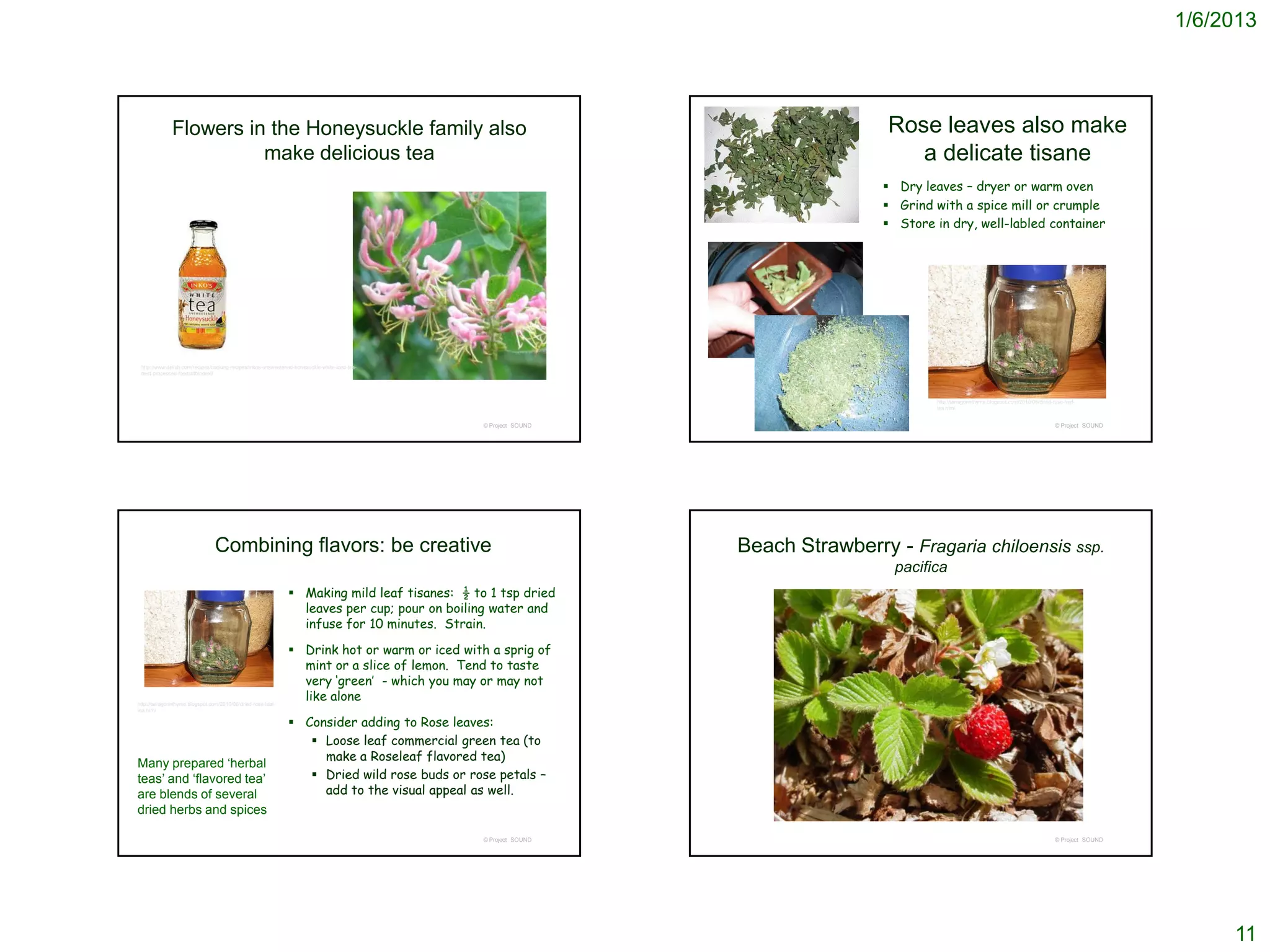
Drying nature’s bounty: many ways                                Making tisanes from flowers: requires
                                                                    a gentle touch for best flavor
                                                                                                                              Bring water to just under the boiling
                                                                                                                               point, water should be very hot but
                                                                                                                               never boiled.

                                                                                                                                 Remove water from heat and add the
                                                                                                                                 fresh or dried petals. Allow petals to
                                                                                                                                 seep for one hour without stirring.

                                                                                                                              NEVER BOIL THE PETALS AS THIS
                                                                                                                                 WILL DESTROY THE LIGHT
                                                                                                                                 FLAVOR AND COLOR. IT WILL
                                                                                                                                 ALSO CAUSE THE TEA TO HAVE A
                                                                                                                                 BITTER TASTE.
                          Note: cover with mesh
                          if air-drying                                                                                       You can re-heat the tisane or drink it
                                                                                                                               cold
                                                            http://eggbeater.typepad.com/shuna/2008/07/rose-petal-tea.html


                                          © Project SOUND                                                                                                     © Project SOUND


                                                                                                                                                                                     10
1/6/2013


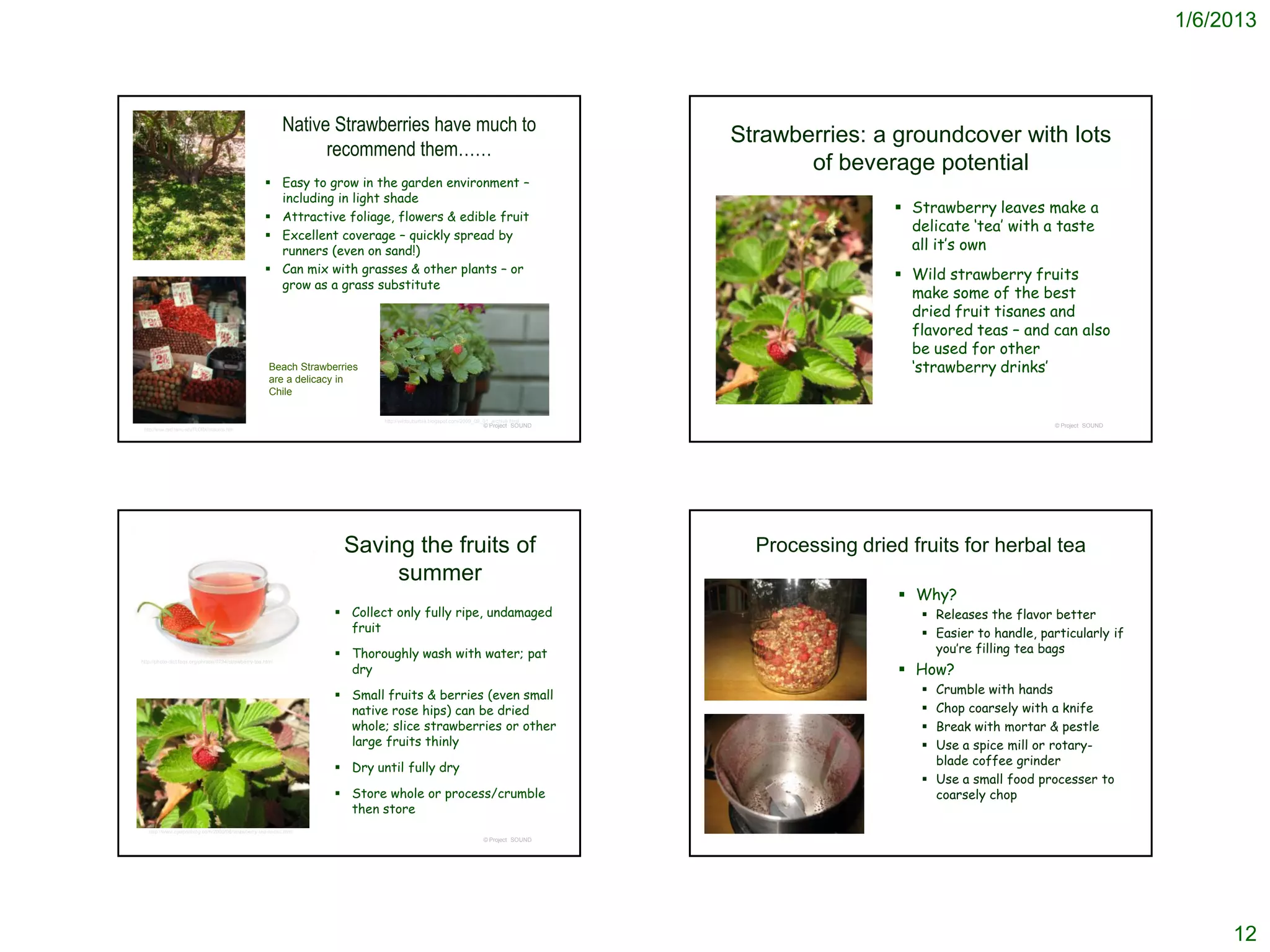
              Flowers in the Honeysuckle family also                                                                             Rose leaves also make
                        make delicious tea                                                                                          a delicate tisane
                                                                                                                                  Dry leaves – dryer or warm oven
                                                                                                                                  Grind with a spice mill or crumple
                                                                                                                                  Store in dry, well-labled container


 http://www.delish.com/recipes/cooking-recipes/inkos-unsweetened-honesuckle-white-iced-tea-
 best-processed-foods#fbIndex9


                                                                                                                                         http://tarragonnthyme.blogspot.com/2010/06/dried-rose-leaf-
                                                                                                                                         tea.html


                                                                                              © Project SOUND                                                                              © Project SOUND


                                 Combining flavors: be creative                                                 Beach Strawberry - Fragaria chiloensis ssp.
                                                                                                                                  pacifica
                                                               Making mild leaf tisanes: ½ to 1 tsp dried
                                                                leaves per cup; pour on boiling water and
                                                                infuse for 10 minutes. Strain.

                                                               Drink hot or warm or iced with a sprig of
                                                                mint or a slice of lemon. Tend to taste
                                                                very ‘green’ - which you may or may not
http://tarragonnthyme.blogspot.com/2010/06/dried-rose-leaf-
                                                                like alone
tea.html

                                                               Consider adding to Rose leaves:
                                                                  Loose leaf commercial green tea (to
                                                                   make a Roseleaf flavored tea)
Many prepared ‘herbal
teas’ and ‘flavored tea’                                          Dried wild rose buds or rose petals –
are blends of several                                              add to the visual appeal as well.
dried herbs and spices

                                                                                              © Project SOUND                                                                              © Project SOUND


                                                                                                                                                                                                                  11
1/6/2013


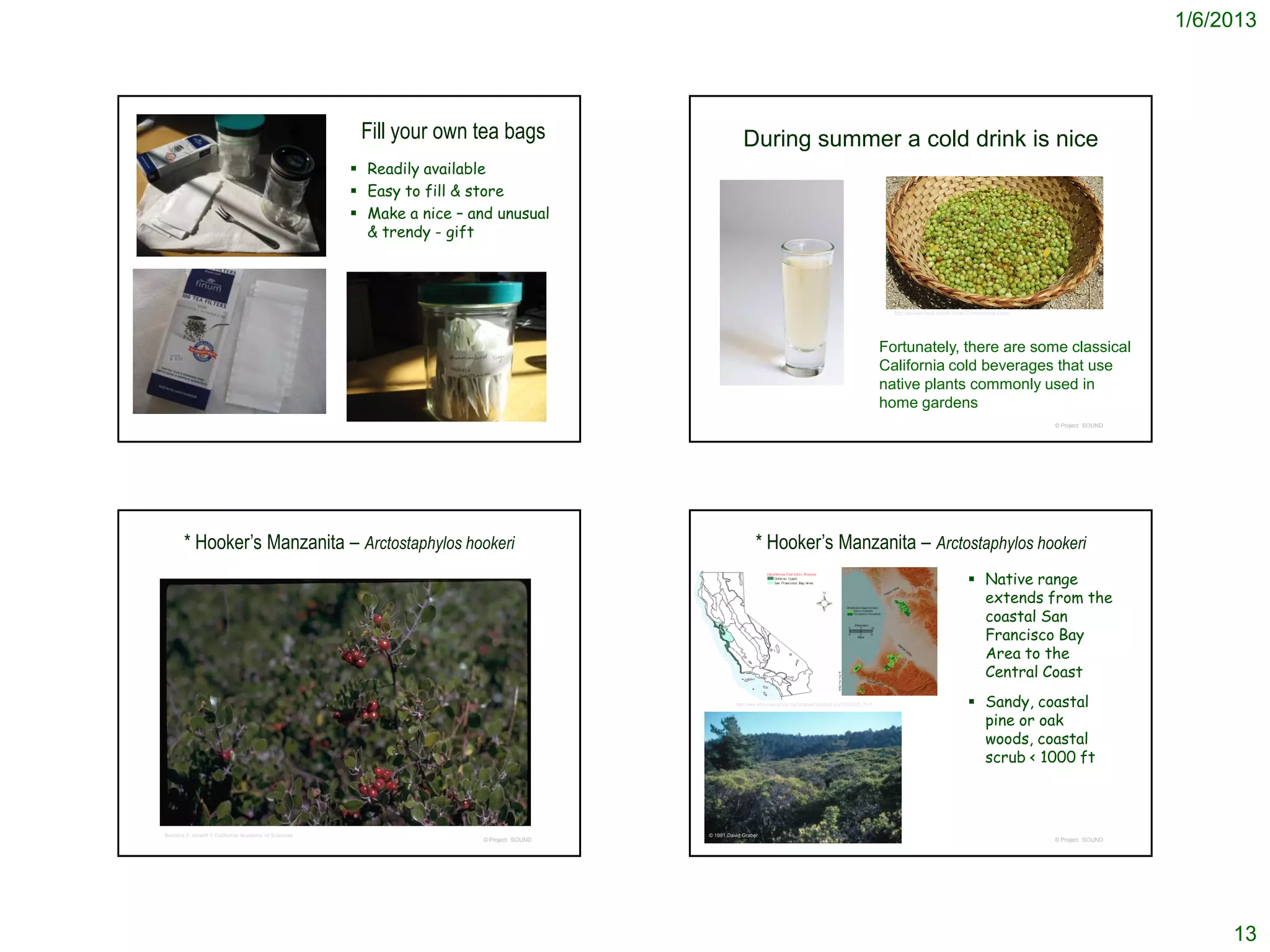
                                                             Native Strawberries have much to
                                                                                                                                        Strawberries: a groundcover with lots
                                                                   recommend them……
                                                                                                                                               of beverage potential
                                                       Easy to grow in the garden environment –
                                                        including in light shade
                                                                                                                                                          Strawberry leaves make a
                                                       Attractive foliage, flowers & edible fruit
                                                                                                                                                           delicate ‘tea’ with a taste
                                                       Excellent coverage – quickly spread by
                                                        runners (even on sand!)                                                                            all it’s own
                                                       Can mix with grasses & other plants – or                                                          Wild strawberry fruits
                                                        grow as a grass substitute
                                                                                                                                                           make some of the best
                                                                                                                                                           dried fruit tisanes and
                                                                                                                                                           flavored teas – and can also
                                                                                                                                                           be used for other
                                                        Beach Strawberries                                                                                 ‘strawberry drinks’
                                                        are a delicacy in
                                                        Chile

                                                                             http://wildsuburbia.blogspot.com/2009_09_01_archive.html
                                                                                                                      © Project SOUND                                               © Project SOUND
 http://www.csdl.tamu.edu/FLORA/imaxxros.htm


                                                                       Saving the fruits of                                               Processing dried fruits for herbal tea
                                                                            summer
                                                                                                                                                           Why?
                                                                      Collect only fully ripe, undamaged                                                     Releases the flavor better
                                                                       fruit                                                                                  Easier to handle, particularly if
                                                                      Thoroughly wash with water; pat                                                         you’re filling tea bags
                                                                       dry                                                                                 How?
http://photo-dict.faqs.org/phrase/9734/strawberry-tea.html


                                                                      Small fruits & berries (even small                                                     Crumble with hands
                                                                       native rose hips) can be dried                                                         Chop coarsely with a knife
                                                                       whole; slice strawberries or other                                                     Break with mortar & pestle
                                                                       large fruits thinly                                                                    Use a spice mill or rotary-
                                                                                                                                                               blade coffee grinder
                                                                      Dry until fully dry
                                                                                                                                                              Use a small food processer to
                                                                      Store whole or process/crumble                                                          coarsely chop
                                                                       then store
   http://www.cpaphilblog.com/2009/06/strawberry-tea-aholic.html
                                                                                                                      © Project SOUND


                                                                                                                                                                                                           12
1/6/2013


                                                       Fill your own tea bags                          During summer a cold drink is nice
                                                       Readily available
                                                       Easy to fill & store
                                                       Make a nice – and unusual
                                                        & trendy - gift


                                                                                                                                                                             http://honest-food.net/2010/08/22/manzanita-cider/


                                                                                                                                                                           Fortunately, there are some classical
                                                                                                                                                                           California cold beverages that use
                                                                                                                                                                           native plants commonly used in
                                                                                                                                                                           home gardens
                                                                                                                                                                                                                                  © Project SOUND


       * Hooker’s Manzanita – Arctostaphylos hookeri                                                         * Hooker’s Manzanita – Arctostaphylos hookeri
                                                                                                                                                                                                             Native range
                                                                                                                                                                                                              extends from the
                                                                                                                                                                                                              coastal San
                                                                                                                                                                                                              Francisco Bay
                                                                                                                                                                                                              Area to the
                                                                                                                                                                                                              Central Coast
                                                                                                    http://www.elkhornsloughctp.org/factsheet/factsheet.php?SPECIES_ID=1                                     Sandy, coastal
                                                                                                                                                                                                              pine or oak
                                                                                                                                                                                                              woods, coastal
                                                                                                                                                                                                              scrub < 1000 ft


Beatrice F. Howitt © California Academy of Sciences                                       © 1991 David Graber
                                                                        © Project SOUND                                                                                                                                           © Project SOUND


                                                                                                                                                                                                                                                         13
1/6/2013


                                                                                                              Hooker’s Manzanita makes a good
                                                   Several rare sub-species                                         coastal groundcover
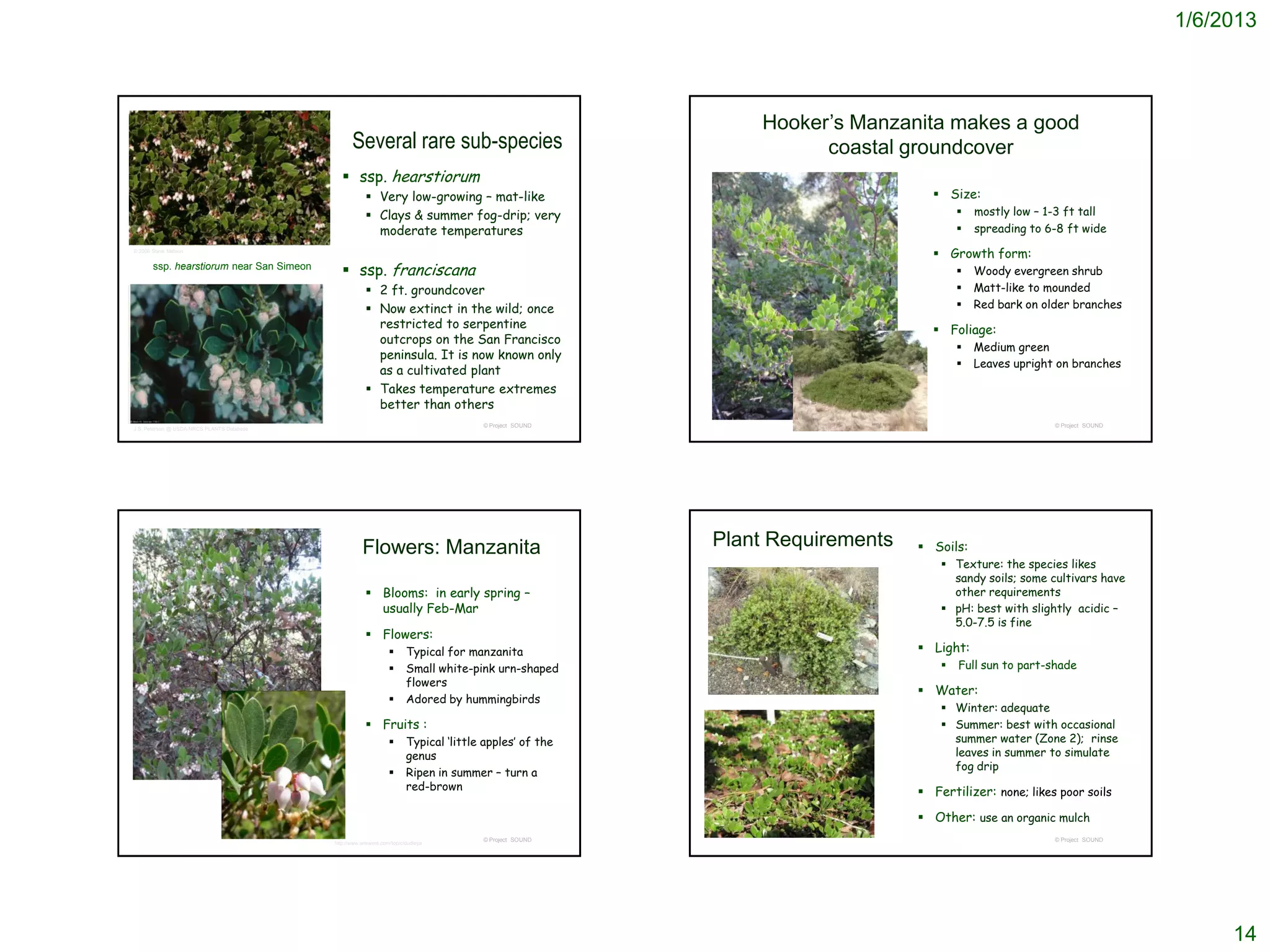
                                                ssp. hearstiorum
                                                         Very low-growing – mat-like                                             Size:
                                                         Clays & summer fog-drip; very                                                   mostly low – 1-3 ft tall
                                                          moderate temperatures                                                           spreading to 6-8 ft wide
© 2011 Chris Winchell

© 2006 Steve Matson
                                                                                                                                  Growth form:
       ssp. hearstiorum near San Simeon
                                                ssp. franciscana                                                                         Woody evergreen shrub
                                                         2 ft. groundcover                                                               Matt-like to mounded
                                                         Now extinct in the wild; once                                                   Red bark on older branches
                                                          restricted to serpentine                                                Foliage:
                                                          outcrops on the San Francisco
                                                                                                                                          Medium green
                                                          peninsula. It is now known only
                                                                                                                                          Leaves upright on branches
                                                          as a cultivated plant
                                                         Takes temperature extremes
                                                          better than others
                                                                                        © Project SOUND                                                  © Project SOUND
J.S. Peterson @ USDA-NRCS PLANTS Database


                                                       Flowers: Manzanita                                 Plant Requirements    Soils:
                                                                                                                                    Texture: the species likes
                                                                                                                                     sandy soils; some cultivars have
                                                         Blooms: in early spring –                                                  other requirements
                                                          usually Feb-Mar                                                           pH: best with slightly acidic –
                                                                                                                                     5.0-7.5 is fine
                                                         Flowers:
                                                                        Typical for manzanita                                  Light:
                                                                        Small white-pink urn-shaped                                  Full sun to part-shade
                                                                         flowers
                                                                                                                                Water:
                                                                        Adored by hummingbirds
                                                                                                                                    Winter: adequate
                                                         Fruits :                                                                  Summer: best with occasional
                                                                        Typical ‘little apples’ of the                              summer water (Zone 2); rinse
                                                                         genus                                                       leaves in summer to simulate
                                                                                                                                     fog drip
                                                                        Ripen in summer – turn a
                                                                         red-brown                                              Fertilizer: none; likes poor soils

                                                                                                                                Other: use an organic mulch
                                                                                        © Project SOUND                                                  © Project SOUND
                                            http://www.answers.com/topic/dudleya


                                                                                                                                                                                14
1/6/2013


                                                                                                                                                                               Hooker’s Manzanita is a
                                       Managing manzanitas                                                                                                                      natural groundcover
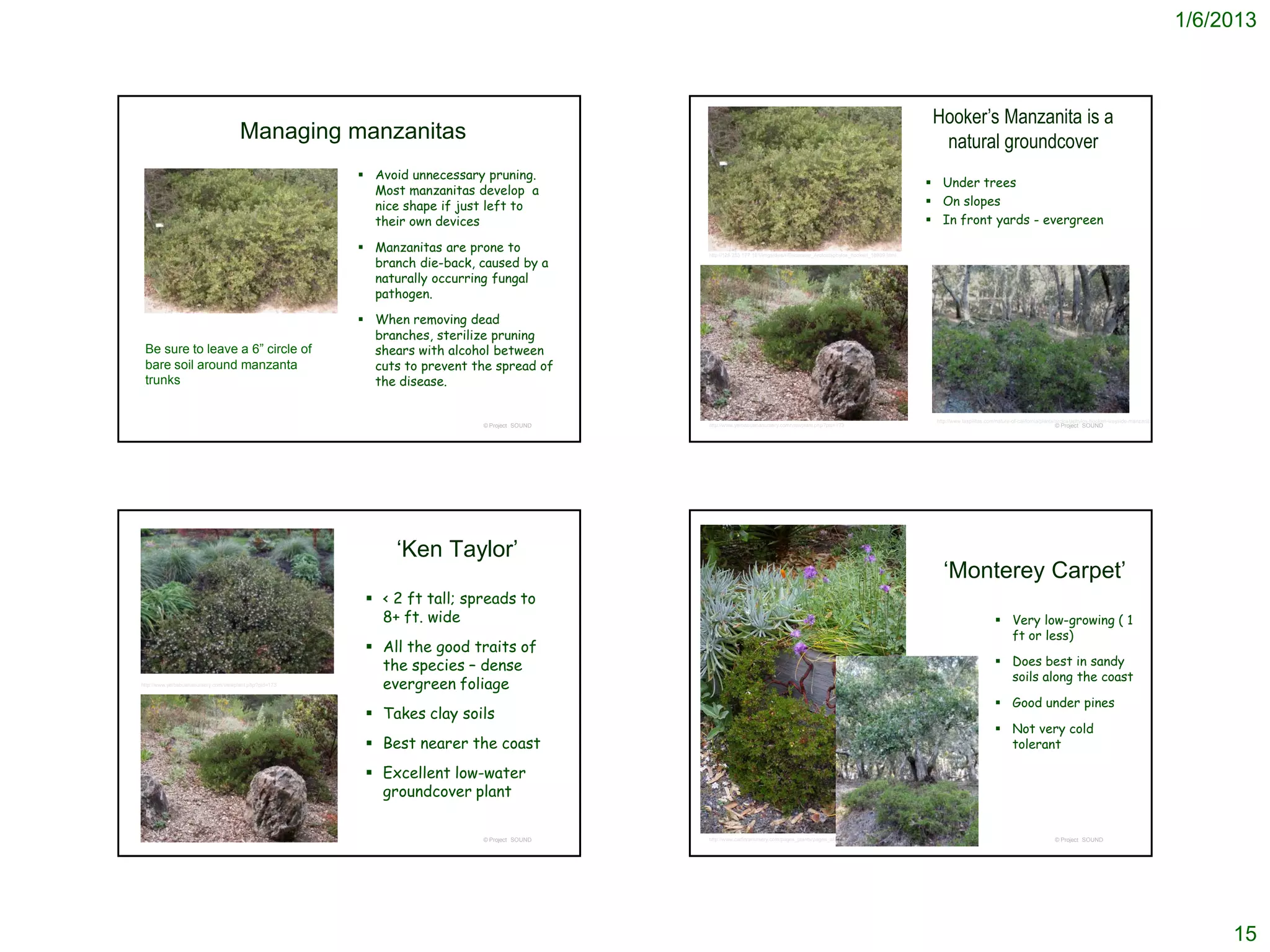
                                                          Avoid unnecessary pruning.
                                                                                                                                                                               Under trees
                                                           Most manzanitas develop a
                                                           nice shape if just left to                                                                                          On slopes
                                                           their own devices                                                                                                   In front yards - evergreen

                                                          Manzanitas are prone to             http://absbonsai.org/gallery/displayimage.php?pid=834


                                                           branch die-back, caused by a
                                                                                              http://128.253.177.181/imgs/dws/r/Ericaceae_Arctostaphylos_hookeri_18909.html


                                                           naturally occurring fungal
                                                           pathogen.

                                                          When removing dead
                                                           branches, sterilize pruning
 Be sure to leave a 6” circle of                           shears with alcohol between
 bare soil around manzanta                                 cuts to prevent the spread of
 trunks                                                    the disease.

                                                                                                                                                                               http://www.laspilitas.com/nature-of-california/plants/arctostaphylos-hookeri-wayside-manzanita
                                                                            © Project SOUND   http://www.yerbabuenanursery.com/viewplant.php?pid=173                                                                              © Project SOUND


                                                               ‘Ken Taylor’
                                                                                                                                                                                 ‘Monterey Carpet’
                                                           < 2 ft tall; spreads to
                                                            8+ ft. wide                                                                                                                                  Very low-growing ( 1
                                                                                                                                                                                                          ft or less)
                                                           All the good traits of
                                                            the species – dense                                                                                                                          Does best in sandy
                                                                                                                                                                                                          soils along the coast
http://www.yerbabuenanursery.com/viewplant.php?pid=173      evergreen foliage
                                                                                                                                                                                                         Good under pines
                                                           Takes clay soils
                                                                                                                                                                                                         Not very cold
                                                           Best nearer the coast                                                                                                                         tolerant

                                                           Excellent low-water
                                                            groundcover plant

                                                                            © Project SOUND   http://www.calfloranursery.com/pages_plants/pages_a/archoomoncar.html                                                               © Project SOUND


                                                                                                                                                                                                                                                                                     15
1/6/2013


                                                                                                                                                                             If you have a bumper crop of manzanita
                                                                                                              ‘Wayside’                                                           berries, consider yourself lucky

                                                                                                   2-3 ft tall x 8-10 ft wide                                                                                                  Manzanita ‘cider’
                                                                                                   Low, mounding habit                                                                                                          for now
                                                                                                   Vigorous; fast-growing
http://www.laspilitas.com/nature-of-california/plants/arctostaphylos-hookeri-wayside-manzanita


                                                                                                                                                                                                                                Jams & jellies for
                                                                                                   Takes heat & cold better                                                                                                     gifts
                                                                                                    than other cultivars

                                                                                                   Best in part-shade in hot                                                                                                   Syrup (can be used
                                                                                                    gardens                                                          http://www.livingwild.org/seasonal-blog/page/2/
                                                                                                                                                                                                                                 for beverages) for
                                                                                                                                                                                                                                 later


                                                            http://www.theodorepayne.org/mediawiki/index.php?title=Arctostaphylos_hookeri_'Wayside' Project SOUND
                                                                                                                                                  ©                                                                                                                                         © Project SOUND


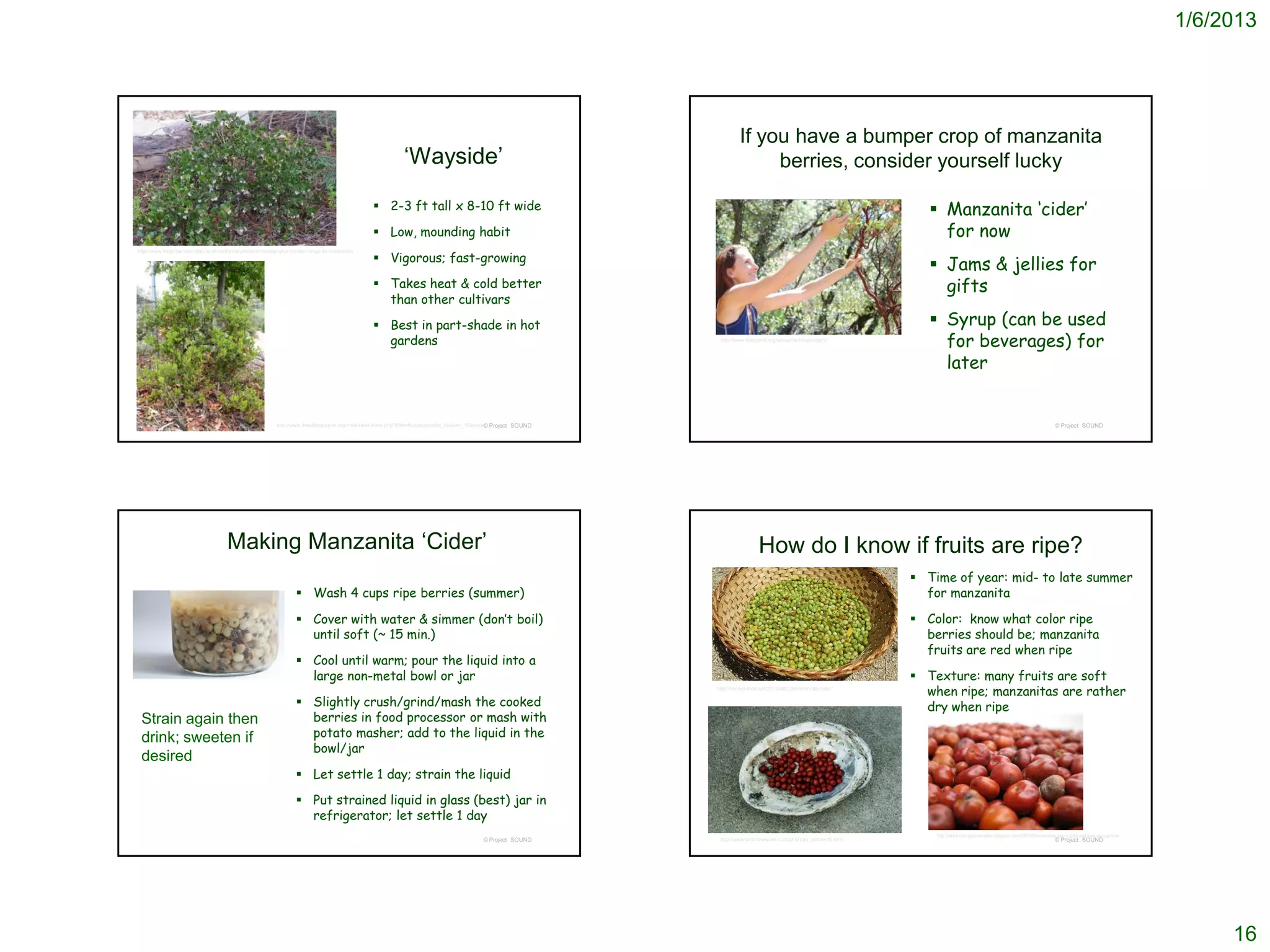
                                       Making Manzanita ‘Cider’                                                                                                                       How do I know if fruits are ripe?
                                                                                                                                                                                                                             Time of year: mid- to late summer
                                                                      Wash 4 cups ripe berries (summer)                                                                                                                      for manzanita

                                                                      Cover with water & simmer (don’t boil)                                                                                                                Color: know what color ripe
                                                                       until soft (~ 15 min.)                                                                                                                                 berries should be; manzanita
                                                                                                                                                                                                                              fruits are red when ripe
                                                                      Cool until warm; pour the liquid into a
                                                                       large non-metal bowl or jar                                                                                                                           Texture: many fruits are soft
                                                                                                                                                                    http://honest-food.net/2010/08/22/manzanita-cider/
                                                                                                                                                                                                                              when ripe; manzanitas are rather
                                                                      Slightly crush/grind/mash the cooked                                                                                                                   dry when ripe
 Strain again then                                                     berries in food processor or mash with
 drink; sweeten if                                                     potato masher; add to the liquid in the
                                                                       bowl/jar
 desired
                                                                      Let settle 1 day; strain the liquid

                                                                      Put strained liquid in glass (best) jar in
                                                                       refrigerator; let settle 1 day
                                                                                                                                                                                                                                http://elkhornsloughrestoration.blogspot.com/2009/09/manzanita-berry-cider-and-how-we-use.html
                                                                                                                                             © Project SOUND         http://www.primitiveways.com/pt-photo_gallery16.html                                                                   © Project SOUND


                                                                                                                                                                                                                                                                                                                                      16
1/6/2013


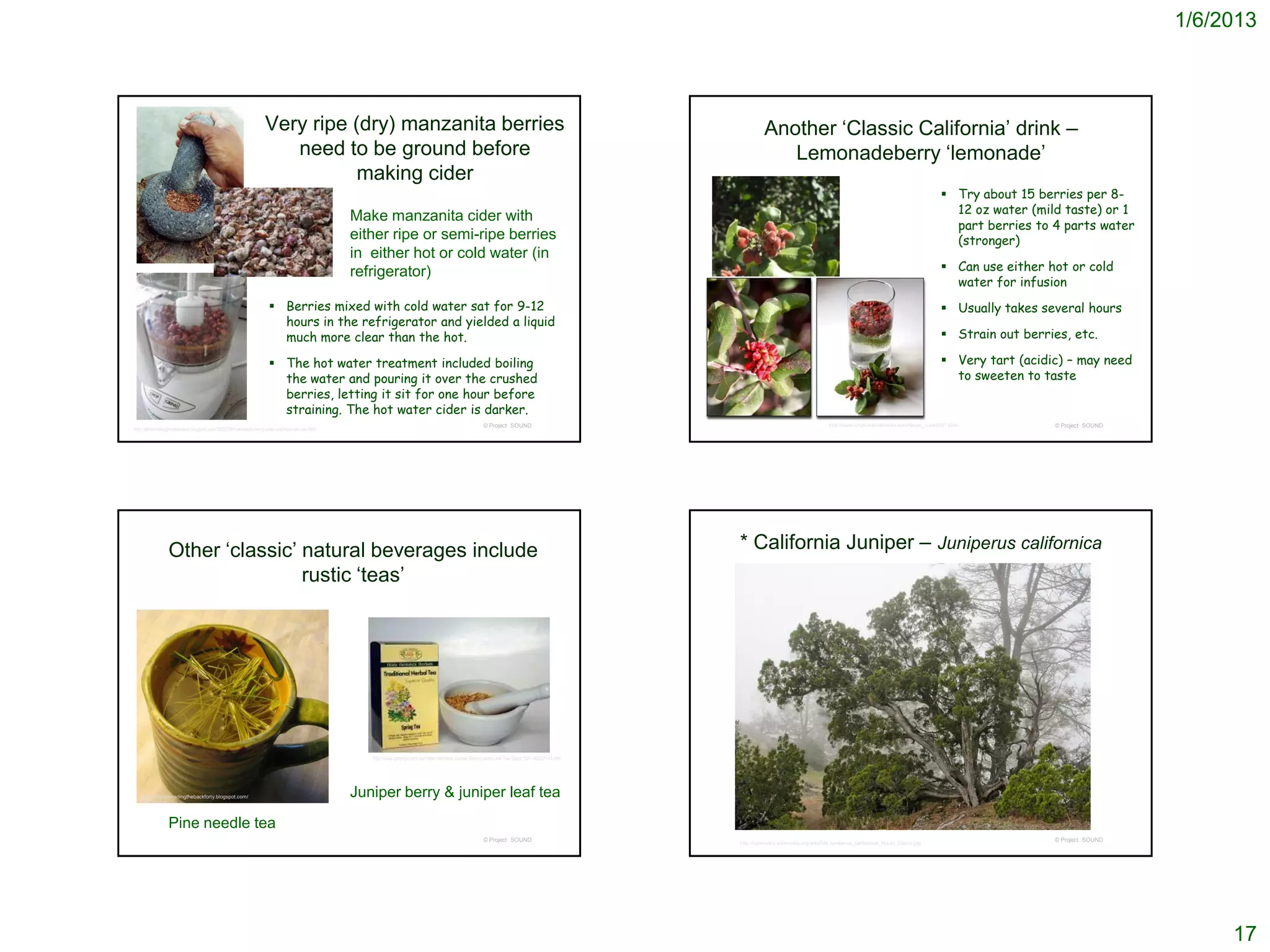
                                                                   Very ripe (dry) manzanita berries                                                                                                        Another ‘Classic California’ drink –
                                                                      need to be ground before                                                                                                                 Lemonadeberry ‘lemonade’
                                                                              making cider
                                                                                                                                                                                                                                                                                     Try about 15 berries per 8-
                                                                                                                                                                                                                                                                                      12 oz water (mild taste) or 1
                                                                                                 Make manzanita cider with
                                                                                                                                                                                                                                                                                      part berries to 4 parts water
                                                                                                 either ripe or semi-ripe berries                                                                                                                                                     (stronger)
                                                                                                 in either hot or cold water (in
                                                                                                 refrigerator)                                                                                                                                                                       Can use either hot or cold
                                                                                                                                                                                                                                                                                      water for infusion
                                                                      Berries mixed with cold water sat for 9-12                                                                                                                                                                    Usually takes several hours
                                                                       hours in the refrigerator and yielded a liquid
                                                                       much more clear than the hot.                                                                                                                                                                                 Strain out berries, etc.

                                                                      The hot water treatment included boiling                                                                                                                                                                      Very tart (acidic) – may need
                                                                       the water and pouring it over the crushed                                                                                                                                                                      to sweeten to taste
                                                                       berries, letting it sit for one hour before
                                                                       straining. The hot water cider is darker.
                                                                                                                                                         © Project SOUND                                                               http://www.urbanoutdoorskills.com/News_June2001.html           © Project SOUND
http://elkhornsloughrestoration.blogspot.com/2009/09/manzanita-berry-cider-and-how-we-use.html


                 Other ‘classic’ natural beverages include                                                                                                                                        * California Juniper – Juniperus californica
                                 rustic ‘teas’


                                                                                                    http://www.getprice.com.au/Hilde-Hemmes-Juniper-Berry-Loose-Leaf-Tea-Gpnc_631--43207143.htm


   http://homesteadingthebackforty.blogspot.com/                                                 Juniper berry & juniper leaf tea
                 Pine needle tea
                                                                                                                                                         © Project SOUND                                                                                                                              © Project SOUND
                                                                                                                                                                                                  http://commons.wikimedia.org/wiki/File:Juniperus_californica_Mount_Diablo.jpg


                                                                                                                                                                                                                                                                                                                             17
1/6/2013


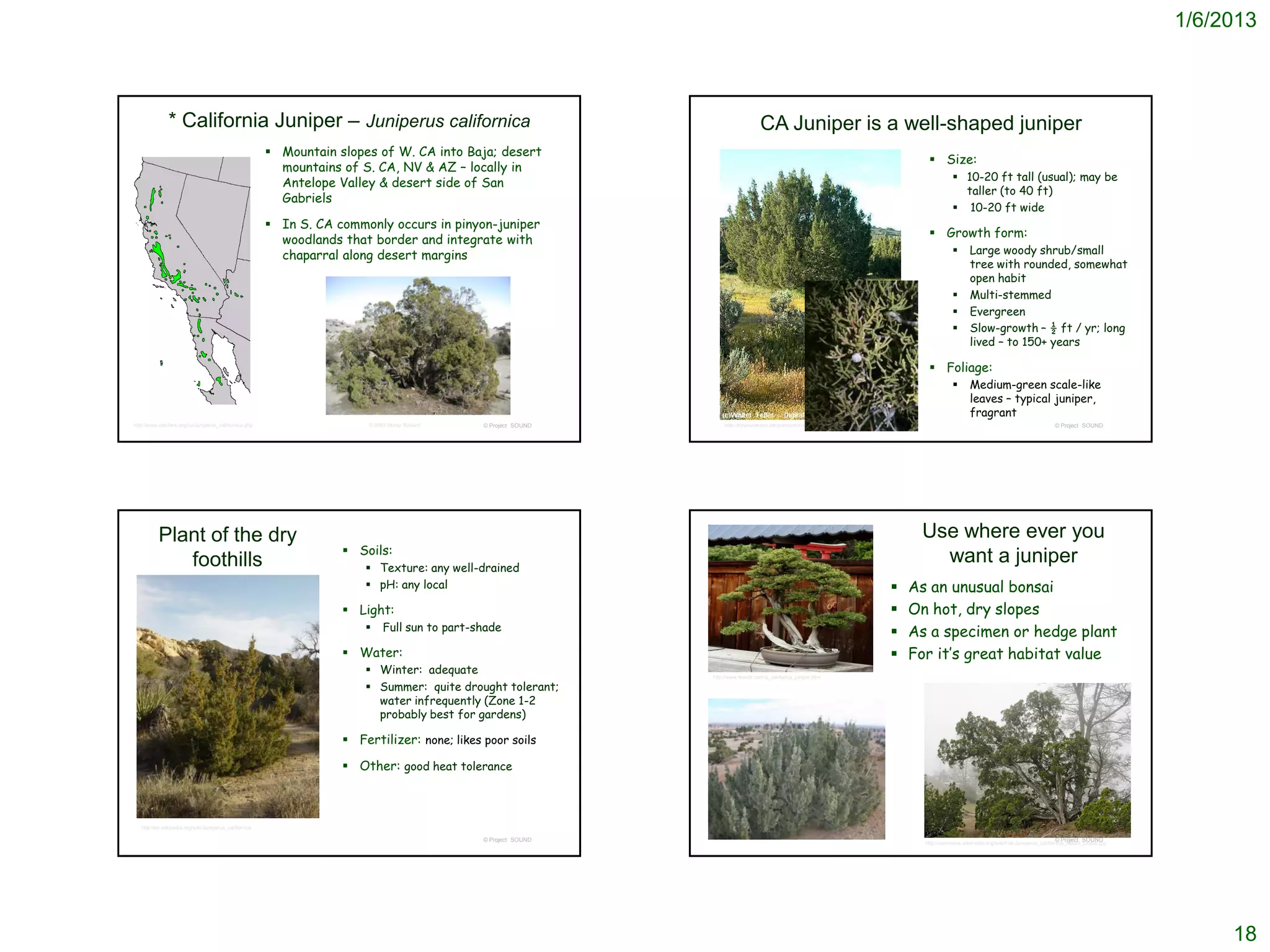
               * California Juniper – Juniperus californica                                                                           CA Juniper is a well-shaped juniper
                                                         Mountain slopes of W. CA into Baja; desert
                                                                                                                                                                                    Size:
                                                          mountains of S. CA, NV & AZ – locally in
                                                                                                                                                                                              10-20 ft tall (usual); may be
                                                          Antelope Valley & desert side of San
                                                                                                                                                                                               taller (to 40 ft)
                                                          Gabriels
                                                                                                                                                                                              10-20 ft wide
                                                         In S. CA commonly occurs in pinyon-juniper
                                                                                                                                                                                    Growth form:
                                                          woodlands that border and integrate with
                                                          chaparral along desert margins                                                                                                           Large woody shrub/small
                                                                                                                                                                                                    tree with rounded, somewhat
                                                                                                                                                                                                    open habit
                                                                                                                                                                                                   Multi-stemmed
                                                                                                                                                                                                   Evergreen
                                                                                                                                                                                                   Slow-growth – ½ ft / yr; long
                                                                                                                                                                                                    lived – to 150+ years

                                                                                                                                                                                    Foliage:
                                                                                                                                                                                                   Medium-green scale-like
                                                                                                                                                                                                    leaves – typical juniper,
                                                                                                                                                                                                    fragrant
http://www.conifers.org/cu/Juniperus_californica.php                     © 2003 Monty Rickard   © Project SOUND        http://mojavedesert.net/plants/shrubs/juniper.html                                                                © Project SOUND


          Plant of the dry                                                                                                                                                       Use where ever you
                                                                     Soils:
             foothills                                                   Texture: any well-drained
                                                                                                                                                                                   want a juniper
                                                                         pH: any local                                                                                        As an unusual bonsai
                                                                     Light:                                                                                                   On hot, dry slopes
                                                                             Full sun to part-shade                                                                           As a specimen or hedge plant
                                                                     Water:                                                                                                   For it’s great habitat value
                                                                         Winter: adequate                        http://www.fourdir.com/p_california_juniper.htm

                                                                         Summer: quite drought tolerant;
                                                                          water infrequently (Zone 1-2
                                                                          probably best for gardens)

                                                                     Fertilizer: none; likes poor soils

                                                                     Other: good heat tolerance


   http://en.wikipedia.org/wiki/Juniperus_californica

                                                                                                © Project SOUND                                                                                                                          © Project SOUND
                                                                                                                                                                                  http://commons.wikimedia.org/wiki/File:Juniperus_californica_Mount_Diablo.jpg


                                                                                                                                                                                                                                                                       18
1/6/2013


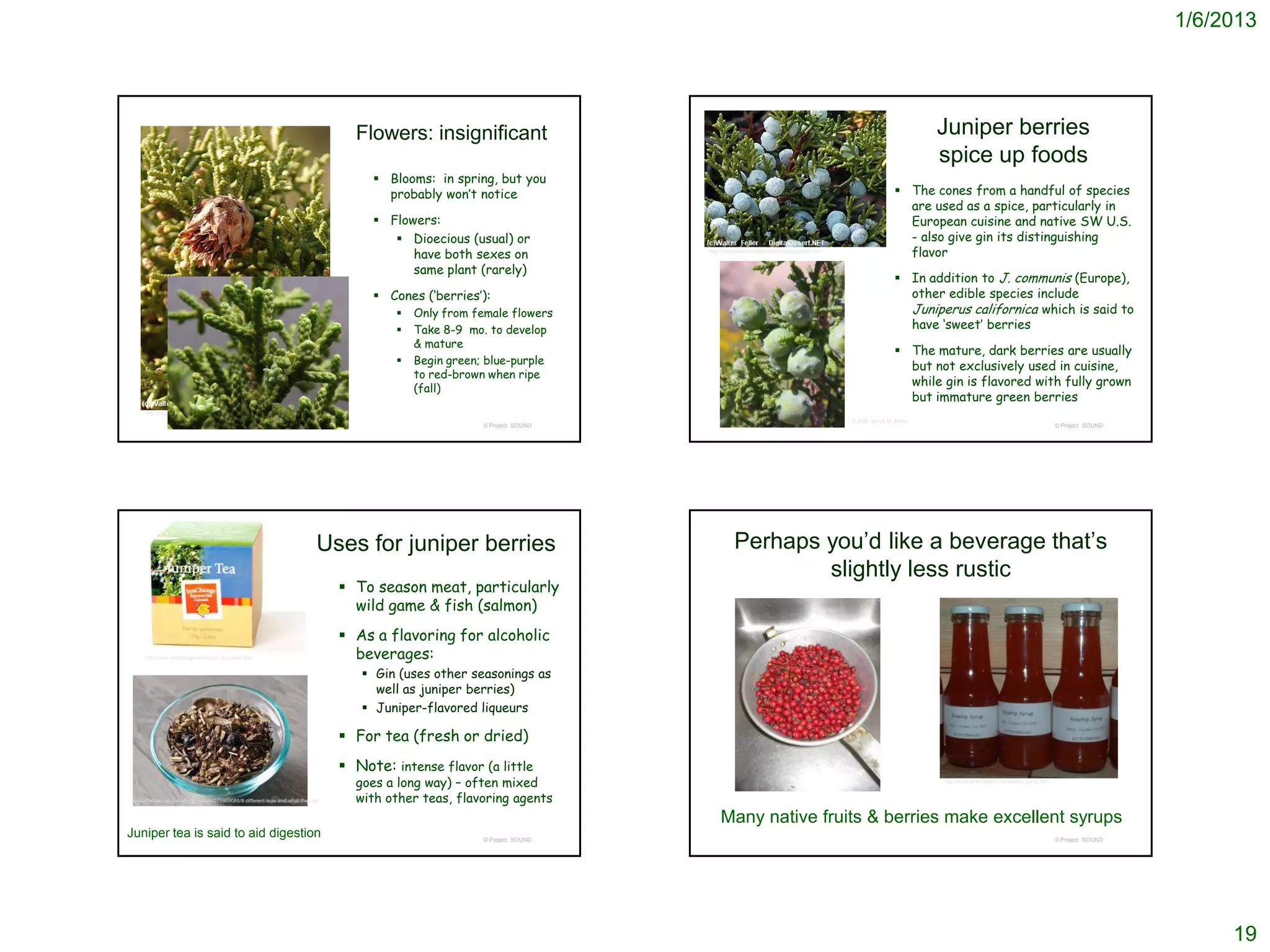
                                                                                    Flowers: insignificant                                                                                                Juniper berries
                                                                                                                                                                                                          spice up foods
                                                                                        Blooms: in spring, but you
                                                                                         probably won’t notice                                                                                     The cones from a handful of species
                                                                                                                                                                                                    are used as a spice, particularly in
                                                                                        Flowers:                                                                                                   European cuisine and native SW U.S.
                                                                                           Dioecious (usual) or                                                                                    - also give gin its distinguishing
                                                                                             have both sexes on              http://mojavedesert.net/plants/shrubs/juniper.html
                                                                                                                                                                                                    flavor
                                                                                             same plant (rarely)
                                                                                                                                                                                                   In addition to J. communis (Europe),
                                                                                        Cones (‘berries’):                                                                                         other edible species include
                                                                                              Only from female flowers                                                                             Juniperus californica which is said to
                                                                                              Take 8-9 mo. to develop                                                                              have ‘sweet’ berries
                                                                                               & mature
                                                                                                                                                                                                   The mature, dark berries are usually
                                                                                              Begin green; blue-purple
                                                                                                                                                                                                    but not exclusively used in cuisine,
                                                                                               to red-brown when ripe
                                                                                               (fall)
                                                                                                                                                                                                    while gin is flavored with fully grown
                                                                                                                                                                                                    but immature green berries
     http://mojavedesert.net/plants/shrubs/juniper.html
                                                                                                                                                                                  © 2005 James M. Andre
                                                                                                           © Project SOUND                                                                                                                               © Project SOUND


                                                                              Uses for juniper berries                                  Perhaps you’d like a beverage that’s
                                                                                                                                                slightly less rustic
                                                                                   To season meat, particularly
                                                                                    wild game & fish (salmon)
                                                                                   As a flavoring for alcoholic
     http://www.seachangesavouries.ca/juniper-tea/                                  beverages:
                                                                                      Gin (uses other seasonings as
                                                                                       well as juniper berries)
                                                                                      Juniper-flavored liqueurs

                                                                                   For tea (fresh or dried)
                                                                                   Note: intense flavor (a little
                                                                                    goes a long way) – often mixed                                                                                        http://www.jeremytaylor.eu/rosehip_syrup.htm


 http://theteacosy.tumblr.com/post/4075869086/8-different-teas-and-what-they-do     with other teas, flavoring agents
                                                                                                                                  Many native fruits & berries make excellent syrups
Juniper tea is said to aid digestion                                                                       © Project SOUND                                                                                                                               © Project SOUND


                                                                                                                                                                                                                                                                                19
1/6/2013


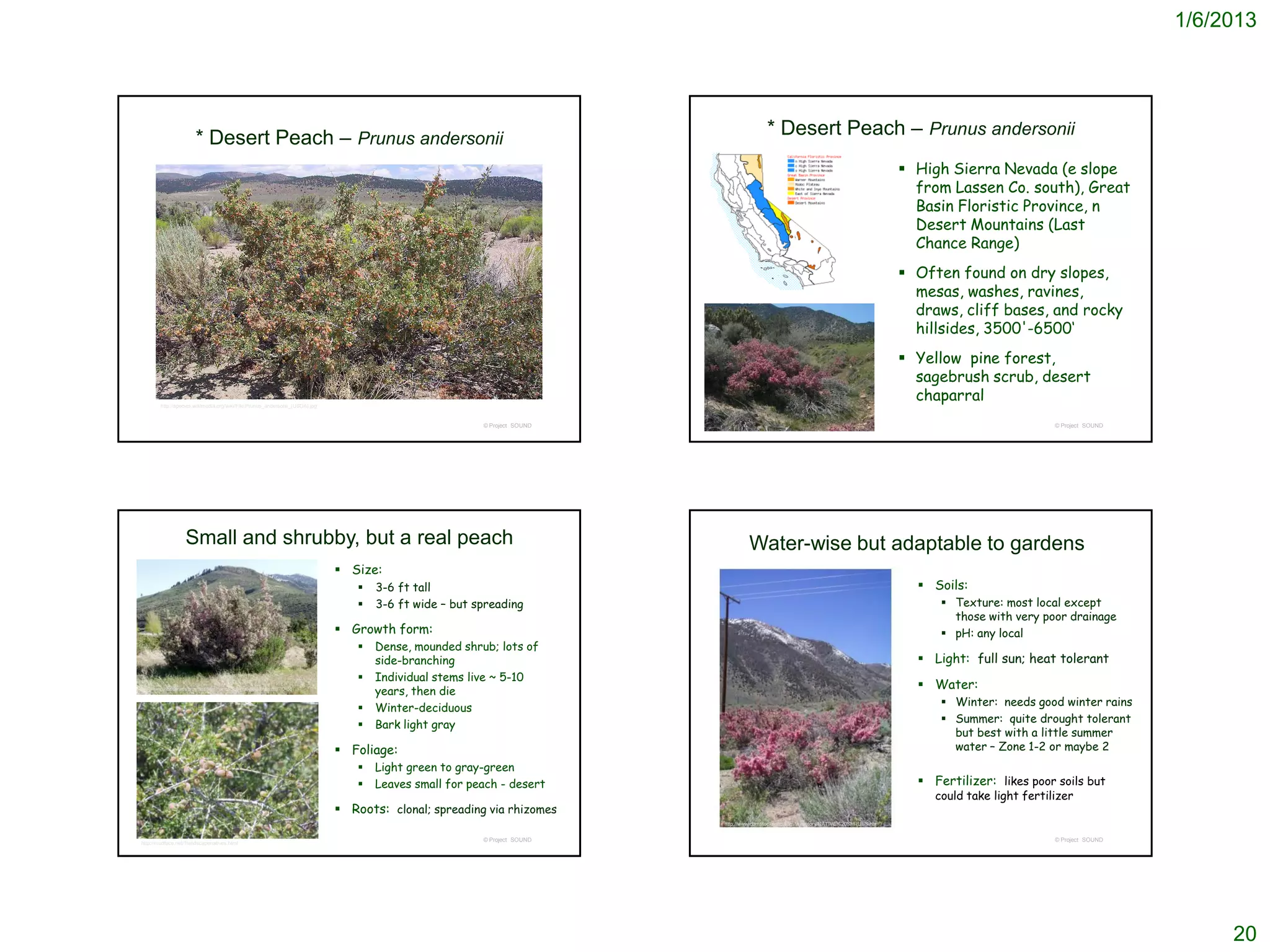
                            * Desert Peach – Prunus andersonii                                                                                 * Desert Peach – Prunus andersonii
                                                                                                                                                                                             High Sierra Nevada (e slope
                                                                                                                                                                                              from Lassen Co. south), Great
                                                                                                                                                                                              Basin Floristic Province, n
                                                                                                                                                                                              Desert Mountains (Last
                                                                                                                                                                                              Chance Range)
                                                                                                                                                                                             Often found on dry slopes,
                                                                                                                                                                                              mesas, washes, ravines,
                                                                                                                                                                                              draws, cliff bases, and rocky
                                                                                                                                                                                              hillsides, 3500'-6500‘
                                                                                                                                                                                             Yellow pine forest,
                                                                                                                                                                                              sagebrush scrub, desert
          http://species.wikimedia.org/wiki/File:Prunus_andersonii_(USDA).jpg
                                                                                                                                                                                              chaparral
                                                                                                              © Project SOUND                                                                                           © Project SOUND


                       Small and shrubby, but a real peach                                                                               Water-wise but adaptable to gardens
                                                                                    Size:
                                                                                          3-6 ft tall                                                                                         Soils:
                                                                                          3-6 ft wide – but spreading                                                                             Texture: most local except
                                                                                                                                                                                                    those with very poor drainage
                                                                                    Growth form:                                                                                                  pH: any local
                                                                                          Dense, mounded shrub; lots of
                                                                                           side-branching                                                                                      Light: full sun; heat tolerant
                                                                                          Individual stems live ~ 5-10
http://www.unce.unr.edu/programs/sites/nemo/lid/plantlist/plantdetails.asp?ID=38
                                                                                           years, then die
                                                                                                                                                                                               Water:
                                                                                                                                                                                                   Winter: needs good winter rains
                                                                                          Winter-deciduous
                                                                                                                                                                                                   Summer: quite drought tolerant
                                                                                          Bark light gray
                                                                                                                                                                                                    but best with a little summer
                                                                                    Foliage:                                                                                                       water – Zone 1-2 or maybe 2
                                                                                          Light green to gray-green
                                                                                          Leaves small for peach - desert                                                                     Fertilizer: likes poor soils but
                                                                                                                                                                                                 could take light fertilizer
                                                                                    Roots: clonal; spreading via rhizomes
                                                                                                                                http://www.comstockseed.com/Inventory/NATIVE%20SHRUBS.htm


                                                                                                              © Project SOUND                                                                                           © Project SOUND
http://mudface.net/1landscapenatives.html


                                                                                                                                                                                                                                               20
1/6/2013


                                                                       Where to put a peach?                                                                  Flowers are fantastic!
                                                                          Hot dry areas of yard
                                                                          In a desert-themed garden                                                            Blooms: Spring – usually
                                                                          As a natural hedge                                                                    Mar-Apr but may be
                                                                          In the edible & habitat                                                               earlier
                                                                           garden – great plant for                                                             Flowers:
                                                                           birds, pollinators
http://131.230.176.4/imgs/pso/r/Rosaceae_Prunus_andersonii_2097.html
                                                                                                           © 1982 Gary A. Monroe
                                                                                                                                                                   Typical pink peach
                                                                                                                                                                    flowers ½ to 1 inch
                                                                                                                                                                    across

                                                                                                                                                                   Plants are just loaded
                                                                                                                                                                    with blooms –
                                                                                                                                                                    extremely showy

                                                                                                                                                                   Great nectar for
                                                                                                                                                                    native pollinators

 http://www.drycreekgarden.com/plants/common/desert_peach.cfm                                               Charles Webber © California Academy of Sciences
                                                                                         © Project SOUND                                                                        © Project SOUND


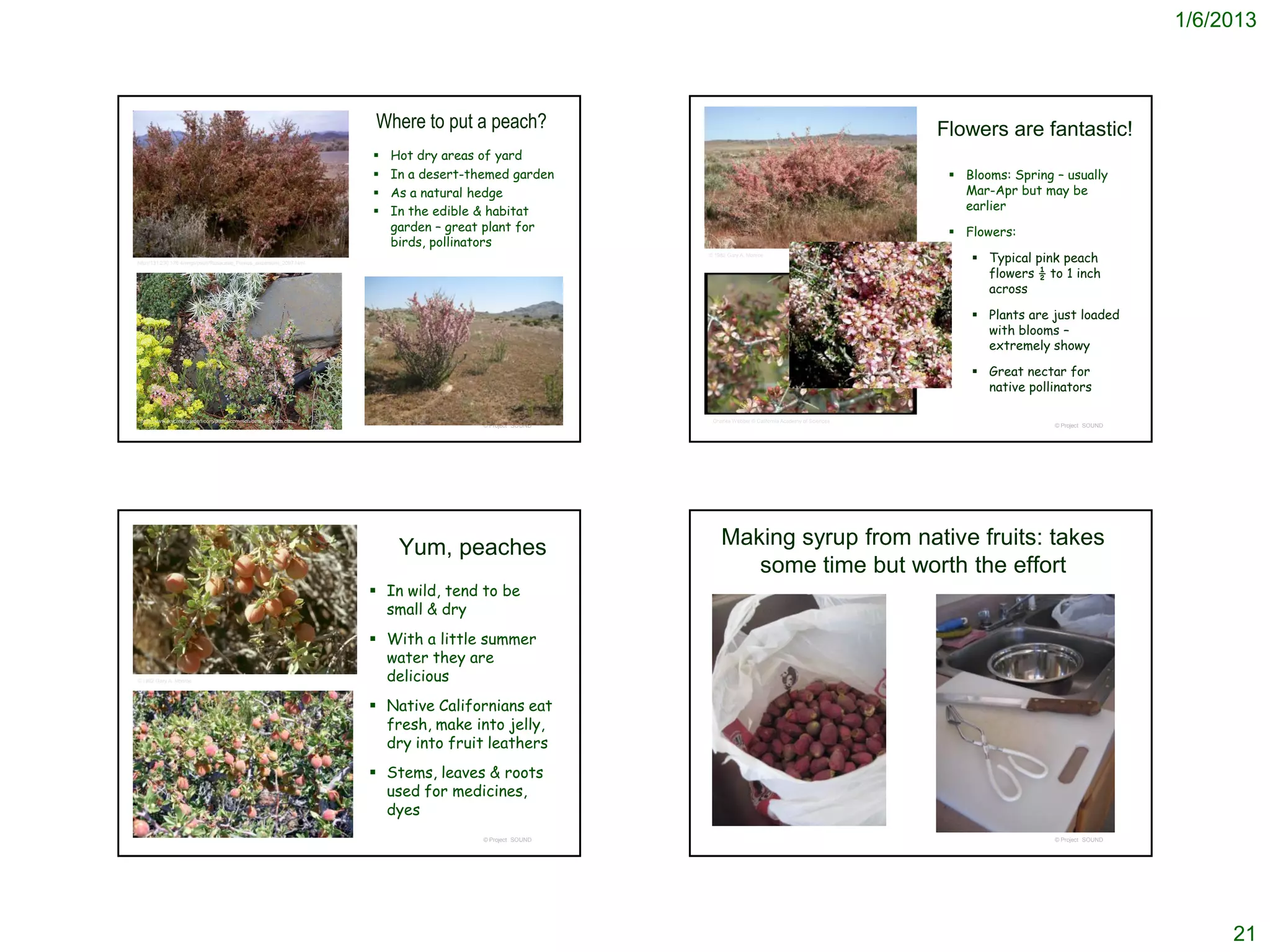
                                                                            Yum, peaches                       Making syrup from native fruits: takes
                                                                                                                  some time but worth the effort
                                                                        In wild, tend to be
                                                                         small & dry
                                                                        With a little summer
                                                                         water they are
© 1982 Gary A. Monroe                                                    delicious
                                                                        Native Californians eat
                                                                         fresh, make into jelly,
                                                                         dry into fruit leathers
                                                                        Stems, leaves & roots
                                                                         used for medicines,
                                                                         dyes
                                                                                         © Project SOUND                                                                        © Project SOUND


                                                                                                                                                                                                       21
1/6/2013


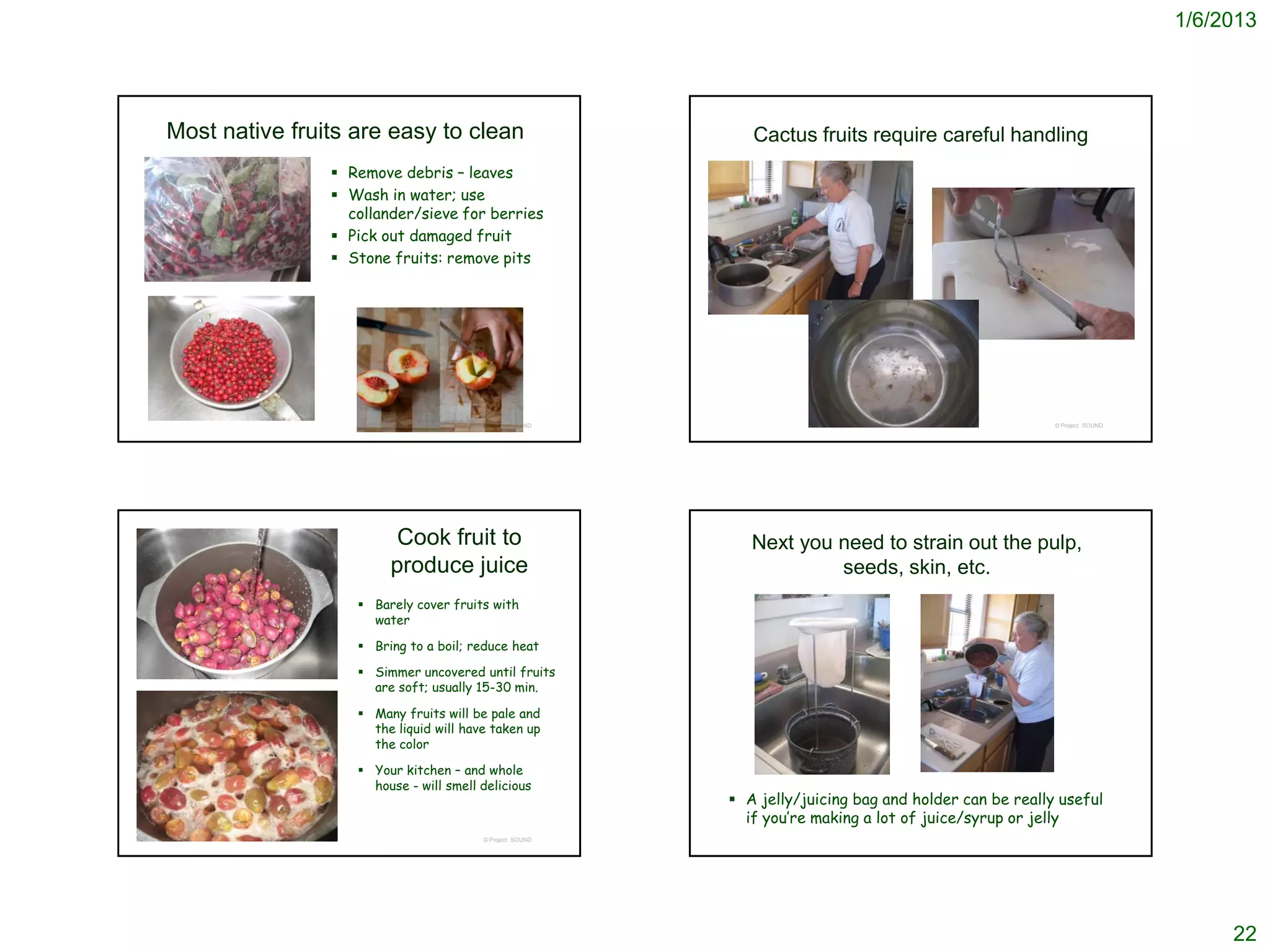
Most native fruits are easy to clean                         Cactus fruits require careful handling
                 Remove debris – leaves
                 Wash in water; use
                  collander/sieve for berries
                 Pick out damaged fruit
                 Stone fruits: remove pits


                                        © Project SOUND                                                 © Project SOUND


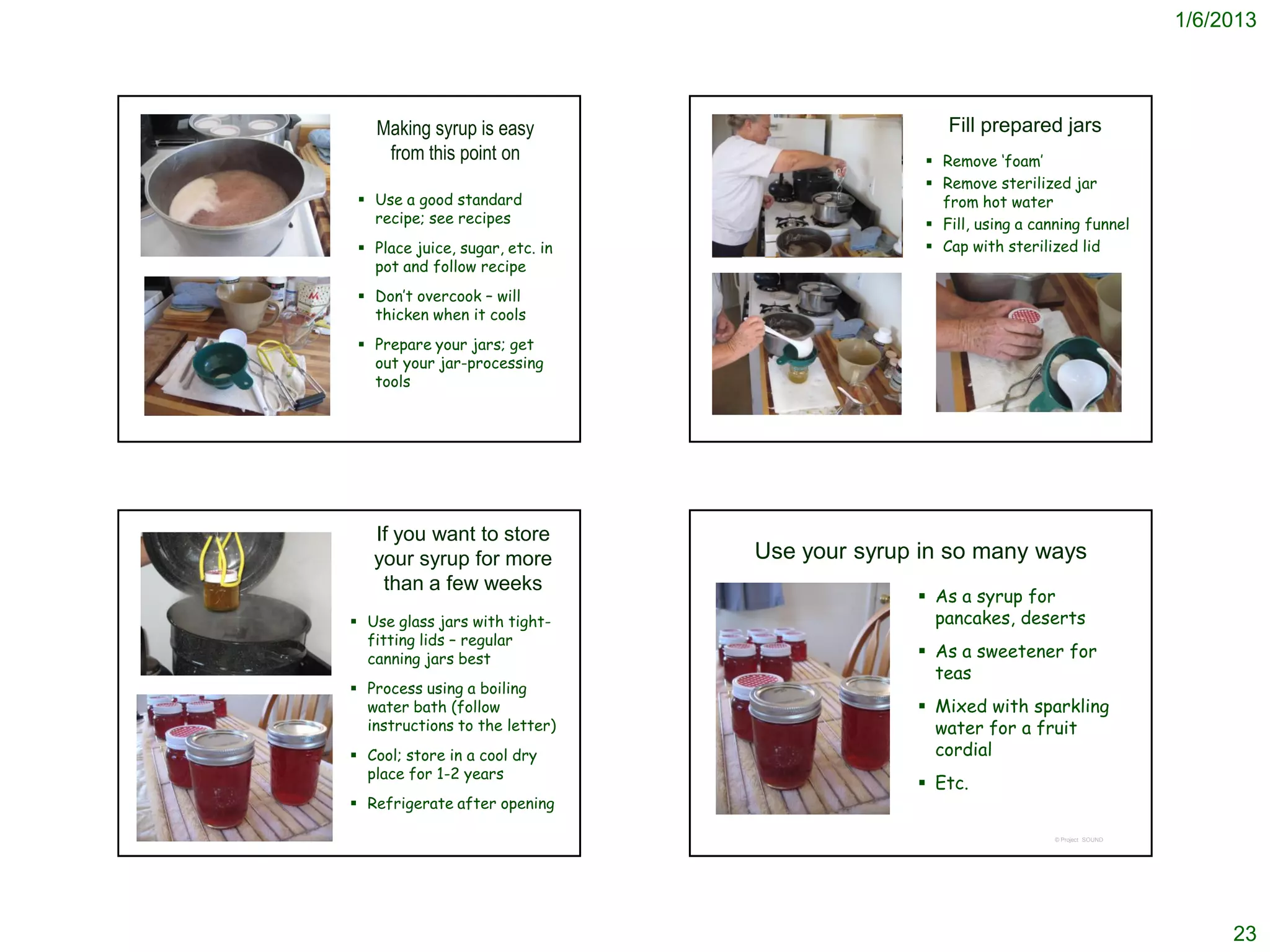
                         Cook fruit to                       Next you need to strain out the pulp,
                        produce juice                                 seeds, skin, etc.
                    Barely cover fruits with
                     water

                    Bring to a boil; reduce heat

                    Simmer uncovered until fruits
                     are soft; usually 15-30 min.

                    Many fruits will be pale and
                     the liquid will have taken up
                     the color

                    Your kitchen – and whole
                     house - will smell delicious
                                                           A jelly/juicing bag and holder can be really useful
                                                            if you’re making a lot of juice/syrup or jelly
                                        © Project SOUND


                                                                                                                               22
1/6/2013


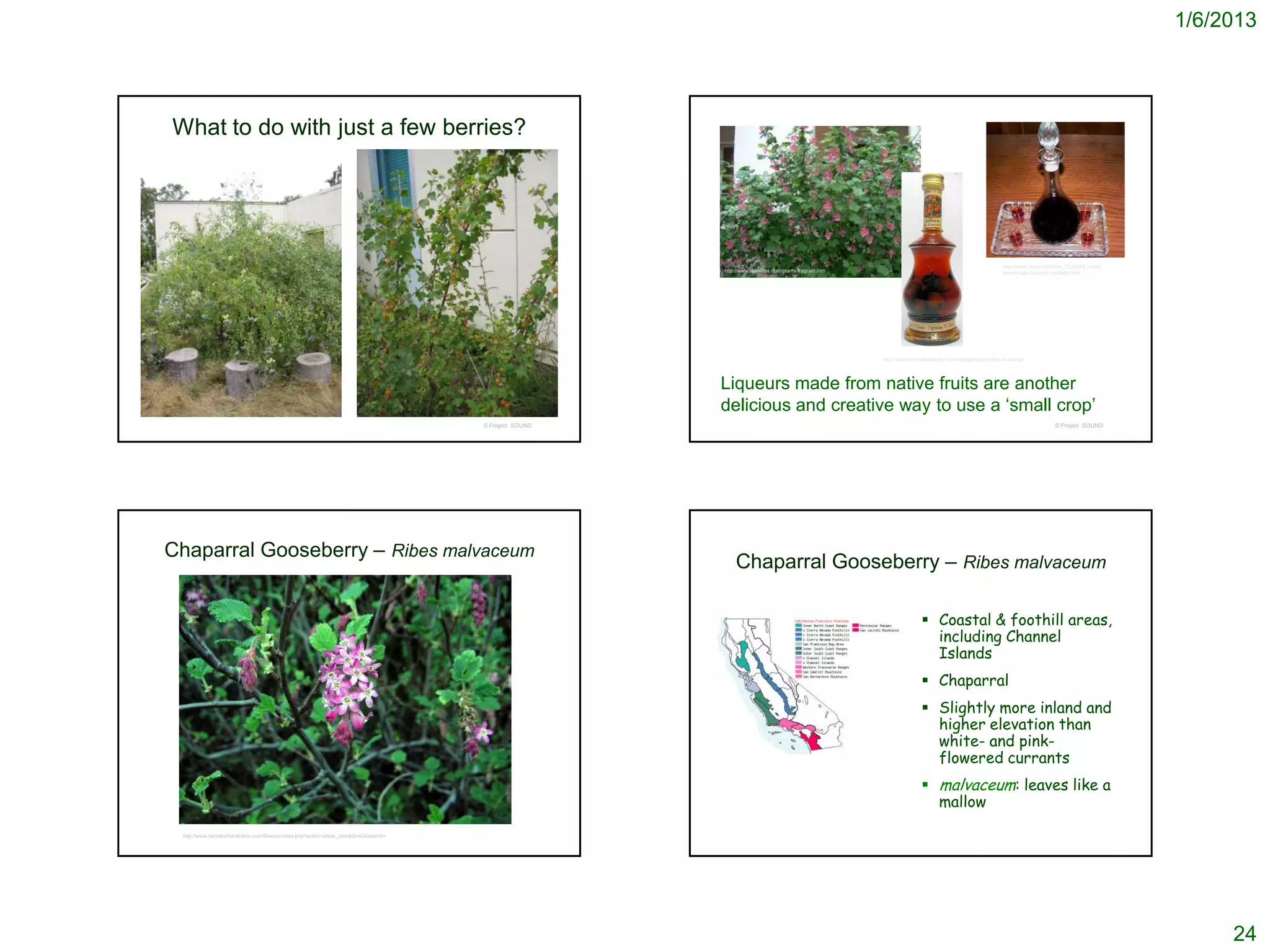
   Making syrup is easy                            Fill prepared jars
    from this point on                           Remove ‘foam’
                                                 Remove sterilized jar
  Use a good standard                            from hot water
   recipe; see recipes                           Fill, using a canning funnel
  Place juice, sugar, etc. in                   Cap with sterilized lid
   pot and follow recipe
  Don’t overcook – will
   thicken when it cools
  Prepare your jars; get
   out your jar-processing
   tools


   If you want to store
   your syrup for more           Use your syrup in so many ways
    than a few weeks
                                                As a syrup for
 Use glass jars with tight-                     pancakes, deserts
  fitting lids – regular
  canning jars best                             As a sweetener for
                                                 teas
 Process using a boiling
  water bath (follow                            Mixed with sparkling
  instructions to the letter)                    water for a fruit
 Cool; store in a cool dry                      cordial
  place for 1-2 years
                                                Etc.
 Refrigerate after opening

                                                                   © Project SOUND


                                                                                          23
1/6/2013


What to do with just a few berries?


                                                                                                                                                                                                           http://www.ehow.com/how_7346089_make-
                                                                                                       http://www.laspilitas.com/plants/fragrant.htm                                                       homemade-liqueurs-cordials.html


                                                                                                                                                       http://www.minibottlelibrary.com/mbl/alpha/christian-di-marco/


                                                                                                       Liqueurs made from native fruits are another
                                                                                                       delicious and creative way to use a ‘small crop’
                                                                                     © Project SOUND                                                                                                                          © Project SOUND


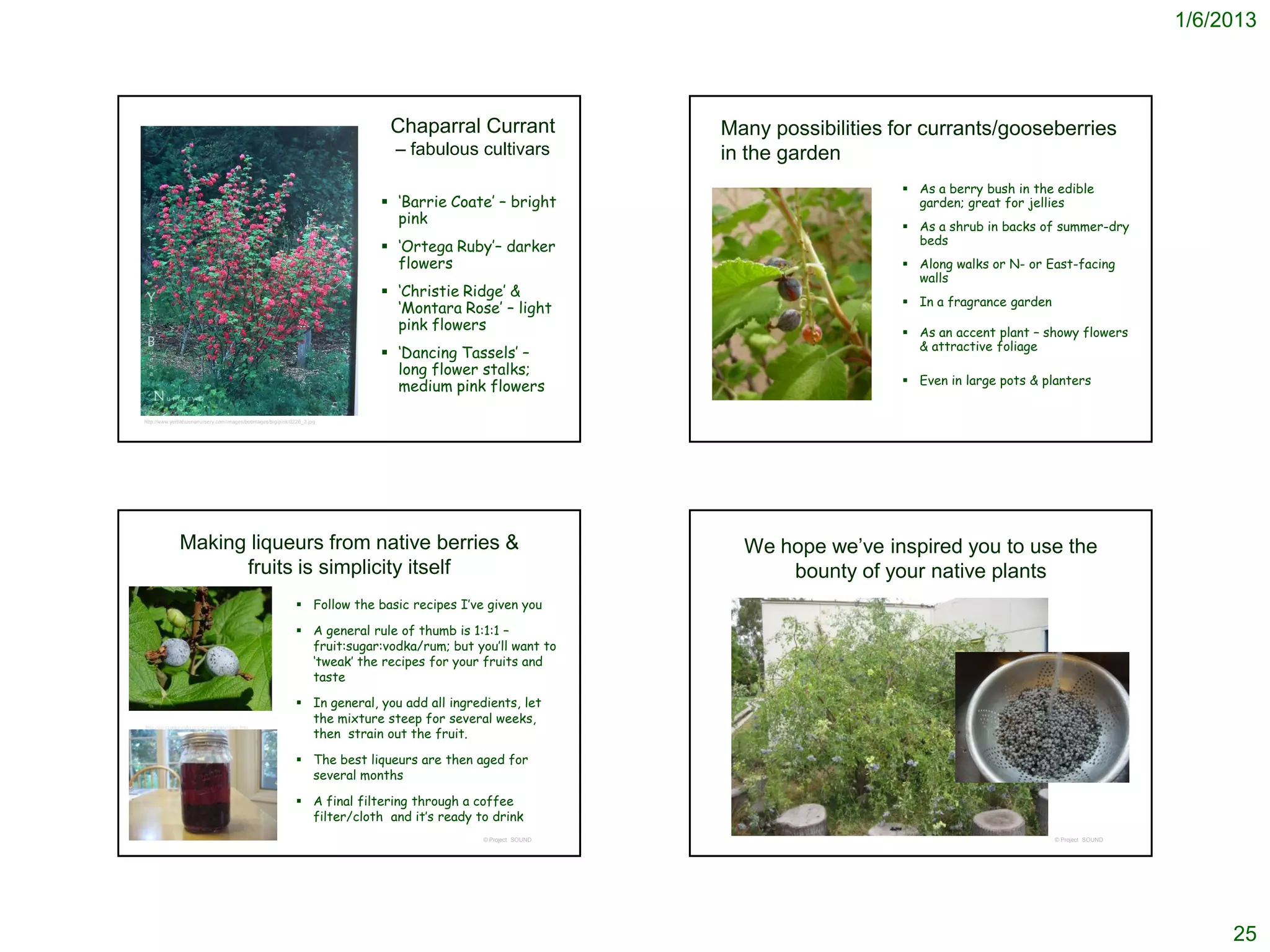
Chaparral Gooseberry – Ribes malvaceum
                                                                                                            Chaparral Gooseberry – Ribes malvaceum

                                                                                                                                                                         Coastal & foothill areas,
                                                                                                                                                                          including Channel
                                                                                                                                                                          Islands
                                                                                                                                                                         Chaparral
                                                                                                                                                                         Slightly more inland and
                                                                                                                                                                          higher elevation than
                                                                                                                                                                          white- and pink-
                                                                                                                                                                          flowered currants
                                                                                                                                                                         malvaceum: leaves like a
                                                                                                                                                                          mallow
 http://www.santabarbarahikes.com/flowers/index.php?action=show_item&id=42&search=


                                                                                                                                                                                                                                                        24
1/6/2013


                                                                             Chaparral Currant                 Many possibilities for currants/gooseberries
                                                                              – fabulous cultivars             in the garden
                                                                                                                                    As a berry bush in the edible
                                                                            ‘Barrie Coate’ – bright                                 garden; great for jellies
                                                                             pink                                                   As a shrub in backs of summer-dry
                                                                                                                                     beds
                                                                            ‘Ortega Ruby’– darker
                                                                             flowers                                                Along walks or N- or East-facing
                                                                                                                                     walls
                                                                            ‘Christie Ridge’ &
                                                                                                                                    In a fragrance garden
                                                                             ‘Montara Rose’ – light
                                                                             pink flowers                                           As an accent plant – showy flowers
                                                                                                                                     & attractive foliage
                                                                            ‘Dancing Tassels’ –
                                                                             long flower stalks;
                                                                             medium pink flowers                                    Even in large pots & planters

http://www.yerbabuenanursery.com/images/botimages/big/pink/0226_3.jpg


                Making liqueurs from native berries &                                                            We hope we’ve inspired you to use the
                      fruits is simplicity itself                                                                    bounty of your native plants
                                                              Follow the basic recipes I’ve given you

                                                              A general rule of thumb is 1:1:1 –
                                                               fruit:sugar:vodka/rum; but you’ll want to
                                                               ‘tweak’ the recipes for your fruits and
                                                               taste

                                                              In general, you add all ingredients, let
                                                               the mixture steep for several weeks,
                                                               then strain out the fruit.
http://luirig.altervista.org/generinam/ribes.htm


                                                              The best liqueurs are then aged for
                                                               several months

                                                              A final filtering through a coffee
                                                               filter/cloth and it’s ready to drink
                                                                                             © Project SOUND                                                 © Project SOUND


                                                                                                                                                                                    25
1/6/2013


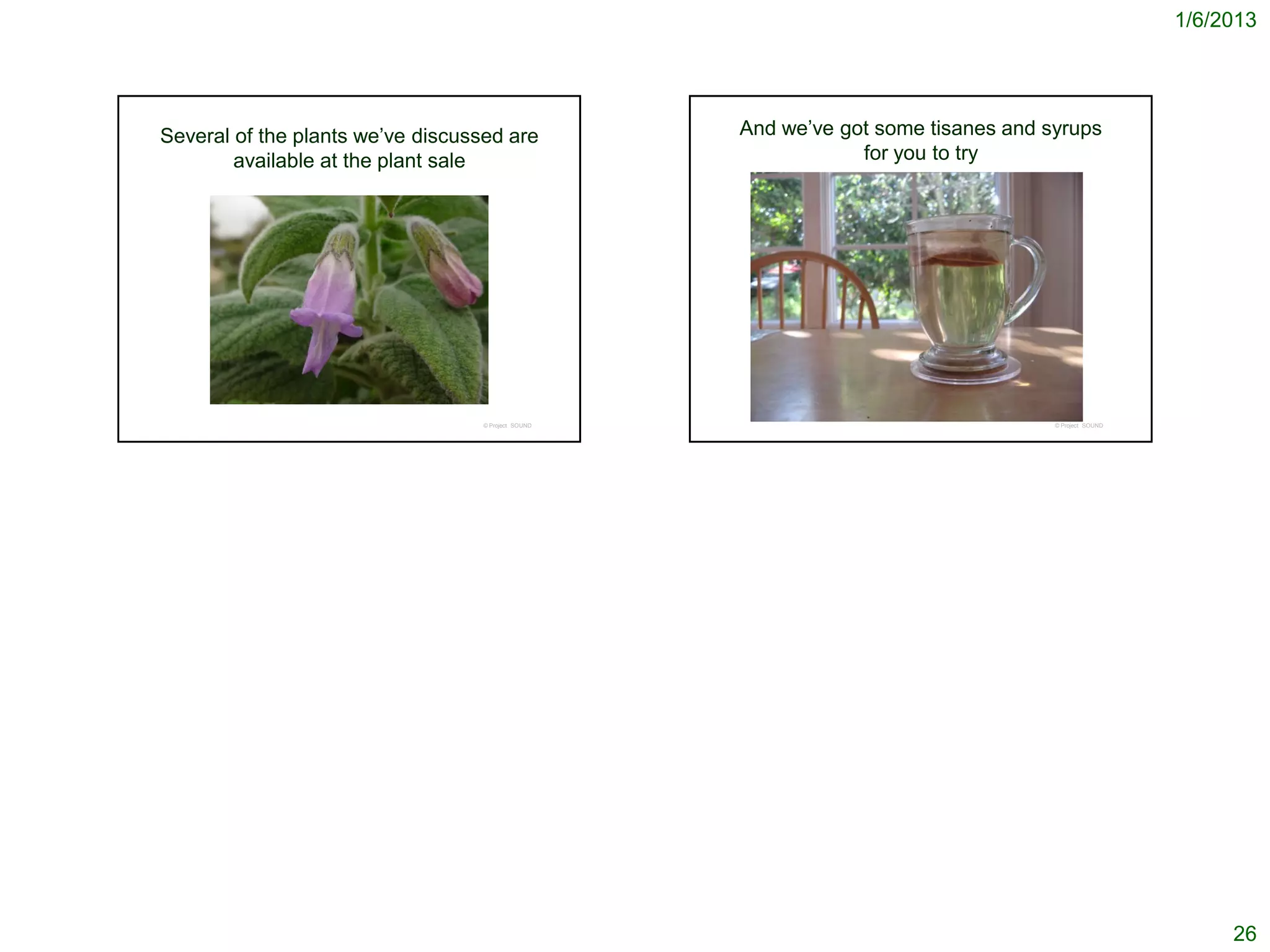
Several of the plants we’ve discussed are            And we’ve got some tisanes and syrups
        available at the plant sale                              for you to try


                                   © Project SOUND                                   © Project SOUND


                                                                                                            26

Beverages from Native Plants - Notes

  • 1.
    1/6/2013 Out of theWilds and Into Your Garden Delicious Drinks: Native Plants for Teas & Other Beverages C.M. Vadheim and T. Drake CSUDH & Madrona Marsh Preserve Madrona Marsh Preserve November 5th & 8th 2011 Gardening with Western L.A. County Native Plants Project SOUND – 2011 (our 7th year) © Project SOUND © Project SOUND Most of our parents didn’t pass along the ‘traditional ways’ What can I do with all those rosehips? © Project SOUND © Project SOUND 1
  • 2.
    1/6/2013 In the next year, we’re going to try to Please ask questions change that  Today’s class – beverages  Dec. 8 – Flavored Vinegars Workshop – Madrona  May class – Scents for potpourri and more  And more http://cte.uwaterloo.ca/teaching_resources/tips/asking_questions.html © Project SOUND © Project SOUND What do you think of when you think * Wild (Field) Mint – Mentha arvensis of beverage plants?  One of the first that comes to mind is mint – because mints are common and their leaves make such great tea! http://natural-language.blogspot.com/2011_02_28_archive.html © 2005 Louis-M. Landry © Project SOUND © Project SOUND 2
  • 3.
    1/6/2013 * Wild (Field) Mint – Mentha arvensis Field Mint – a typical mint  Size:  Found throughout N.  1 to 1 ½ ft tall Hemisphere, incl. Europe, Asia  spreads to many ft wide; in  Locally in San Bernardino & San nature, forms a mat-like colony in Diego Co. mtns. favorable sites  Formerly many ssp & vars – now combined into single species  Growth form:  Always grows in moist places  Herbaceous perennial  Dies back in fall/winter http://ucjeps.berkeley.edu/cgi-bin/get_JM_treatment.pl?4745,4779,4780  Upright or sprawling  Foliage:  Typical mint with square stems  Aromatic; strongly minty – repels deer, mice, unwanted insects  Roots: spreads via rhizomes http://www.prairiemoon.com/seeds/wildflowers-forbs/mentha-arvensis-wild-mint http://www.everwilde.com/Mentha-arvensis-WildFlower-Seed.html http://www.bushcraftusa.com/forum/showthread.php?t=41276 © Project SOUND © Project SOUND Flowers are dainty  Blooms: anytime from July to Seeds Oct; usually in bloom about 4 weeks  Many tiny seeds in dry  Flowers: capsule typical of mint  Color: white to very pale family violet or pink  Tiny; bell-shaped  Best with 2-3 mo cold  In dense, ball-like clusters in moist stratificatoon leaf axils – often mostly hidden by the leaves  Vegetative reproduction:  Easy to propagate from stem cuttings in spring, fall  Let them root in water in a light place – no direct sun http://www.prairiemoon.com/seeds/wildflowers-forbs/mentha-arvensis-wild-mint © Project SOUND http://www.prairiemoon.com/seeds/wildflowers-forbs/mentha-arvensis-wild-mint © Project SOUND © 2004, Ben Legler 3
  • 4.
    1/6/2013  Soils: Mint in the garden Plant Requirements  Texture: any  pH: any local but 6.0-7.5 best  Best use: as an attractive pot plant; evergreen most of the  Light: year  Full sun to light shade – dappled  In an herb or kitchen garden sun is fine http://www.houseintohome.co.za/wp-content/uploads/2008/08/  In water garden – lowest area –  Foliage has stronger flavor in or other moist area full sun  Water:  Winter: fine with seasonal flooding  Summer: needs regular water – Zone 2-3 to 3  Fertilizer: likes compost amended soils; light fertilizer if gown in containers © Br. Alfred Brousseau, Saint Mary's College  Other: cut back in fall/winter http://harrietsgarden.blogspot.com/2011/07/dill-vinegar-and-herb-garden.html http://www.your-cup-of-tea.com/mint-tea-recipe.html © Project SOUND © Project SOUND http://groweat.blogspot.com/2010/06/plant-with-caution.html Repotting mint Making fresh mint tea - easy  The leaves are harvested between  Required yearly – if not May and August. It is important to more often harvest only the well matured  Easy – hard to kill leaves as the half-mature ones do not have the fine mint aroma. http://outofmyshed.co.uk/2011/03/20/good-time-to-re-pot-mint/  You can give the extras as gifts http://www.roadlesstraveledstore.com/blog/2007/12/13/simple-mint-tea/ http://www.illinoiswildflowers.info/prairie/plantx/wild_mintx.htm http://www.pakichill.net/forum/showthread.php?1778-Delicious-Mint-Green-Tea © Project SOUND © Project SOUND 4
  • 5.
    1/6/2013 Or use fresh mint to make your Drying leaves for tea favorite summer beverage  Wash leaves – pat dry  Place on a cookie sheet in a warm oven http://www.howipinchapenny.com/2009/06/how-i-save-mint/ (180º F or less – ‘warm’ setting)  Check for dryness – usually ~ 20-45 min. Leaves will be crackly.  Strip leaves off stems  Store in air-tight container http://www.amctv.com/shows/mad-men/cocktail-guide/mint-julep © Project SOUND © Project SOUND http://www.twentysomethinghome.com/2010/11/mint-tea-leaves.html The many edible uses of mints Medicinal uses of Wild Mint  The mint flavored leaves are  Leaves are used as a herbal remedy : used as herb in various  For stomach disorders like indigestion and gas. cuisines.  As an anti inflammatory agent  Sometimes raw leaves are  For treatment of fever, headache, cold and asthma. added to salads and other  To make cough syrups. preparations to add flavor to  To treat stomach pain, diarrhea, vomiting and influenza. the food.  To reduce toothaches and swellings of gum. http://www.yumsugar.com/Snappy-Summer-Side-Strawberry-Mint-Salad-1713036  Fresh leaves are also used to  To alleviate arthritis. make chutneys.  The oil extraction of these leaves is used in the  The oil extracted from these treatments of insomnia and nervous tension. plants is used as a flavoring agent for beverages and sweets. © Project SOUND © Project SOUND 5
  • 6.
    1/6/2013 The tea/medicinal connection  Many herbal teas are not only delicious, they also may have soothing & other effects  The medicinal benefits of  Plants make a number of specific herbs are often plant-specific chemicals anecdotal or controversial, (phytochemicals) and in some countries  Some are pleasant tasting to us (including the United – but actually repel herbivores States) makers of herbal [Mint] teas are not allowed to http://peacecooking.blogspot.com/2010/01/delicious-moroccan-mint-tea.html Since infusions are an easy  Some play similar, often make unsubstantiated means of extracting plant medicinal, roles in both plants & claims about the medicinal chemicals it’s not surprising that animals effects of their products. http://www.abs-herbs.com.ph/prod-tea.htm they are used as both traditional  These chemicals are the basis medicines and beverages of many traditional & ‘modern’ medicines © Project SOUND © Project SOUND The benefits of making beverages from A few words of caution plants growing in your own garden  Herbal teas can have different effects from  You know what the plant is – person to person – always start with a little, and so you don’t mistakenly never overdo substitute a toxic plant for an edible one  Some plants/plant parts are toxic; correct identification and correct preparation is essential  You can control the chemicals used on the  If you are pregnant, nursing, taking prescription plants medications, or have known allergies to certain foods or plants, caution and consultation with a  You can pick plant parts physician or pharmacist are advised. when they are at the ‘peak of flavor’ © Project SOUND © Project SOUND 6
  • 7.
    1/6/2013 Fragrant Pitcher Sage– Lepechinia fragrans The genus Lepechinia  In the Mint family (Lamiaceae)  Occur in California, Mexico to South America, and Hawaii.  An interesting group of shrubs and woody-based perennials, some of them quite ornamental.  They vary in habit but have large paired, usually hairy and aromatic leaves and irregular flowers with broad tubes and 2-lipped “faces”. Attractive features of Fragrant Pitcher Sage in the garden Pitchersage  Good plants for the background of a perennial border  Soft contrast of leaf  For banks and open slopes and flower color  Mix with berry fruits in a border  Pleasant fragrance  Great addition to a butterfly garden  Interesting leaf texture  Planted near patios for their pleasant scent  Attracts birds and  In shaded areas (does equally butterflies well in sun or partial shade)  In the kitchen garden – makes a delicious tea, jelly, etc. 7
  • 8.
    1/6/2013 Is Pitchersage‘tea’ really a tea? Fragrant Pitcher Sage & Hummingbird Sage leaves make unique tisanes  Tea: infusion made from the leaves of the tea bush (Camellia sinensis).  Minty, but with distinct flavors  Herbal tea, tisane : herbal infusion that does not include  Make excellent hot and true tea leaves; often simply the iced teas combination of boiling water and dried fruits, flowers or herbs.  Can be used fresh or Can be used as beverage or dried for later use medicinal  Not only tasty – may have  Flavored tea: a true tea flavored medicinal properties with other herbs, spices, oils © Project SOUND © Project SOUND Leaves are the most common plant part In fact, several different plant parts used for plants in the mint family can be use to make beverages  Leaves  Hot or cold herbal teas  Flavorings for other beverages  Syrups for cordials; sparkling waters  Liqueurs (alcoholic)  Fruits/berries  Hot & cold herbal teas  Juices  Syrups/Flavorings  Liqueurs (alcoholic)  Flower petals © Project SOUND © Project SOUND 8
  • 9.
    1/6/2013 CA Wild Rose – Rosa californica CA Wild Rose – Rosa californica  S. OR to northern Baja  In CA, everywhere but high mountain elevations  Common thicket-forming rose in S. & central CA foothills  Moist places, near streams, in shaded woods and canyons  Spanish padres called it ‘Rose of Castile’ because it reminded them of the roses of Spain. http://ucjeps.berkeley.edu/cgi-bin/get_JM_treatment.pl?6677,6887,6889 http://www.yerbabuenanursery.com/wildflower_watch_wk18.htm A rose is a rose….  Size: to 6 ft. tall, 9 ft. wide  Winter deciduous  Growth form: upright shrub that spreads by suckers; typical wild http://www.sci.sdsu.edu/plants/sdpls/plants/Rosa_californica.html rose  Garden requirements:  Light: full sun to semi-shade  Soils: any well-drained  Water: take cue from nature  Does best in full sun with some summer water  Will need less water in shaded areas  Less prone to fungal diseases than http://www.yerbabuenanursery.com/wildflower_watch_wk18.htm cultivated roses  CA Wild Rose in nature: thicket-forming http://www.yerbabuenanursery.com/wildflower_watch_wk18.htm 9
  • 10.
    1/6/2013 Wild roses are important habitat plants Dried rose petals  Blooms: for tea  Main season: May-Aug (but blooms intermittently in warm season)  Blown blooms (fully mature flowers) that haven't browned  Flowers: single pinks; color varies slightly will make the most flavorful tea petals.  Important pollen source for bees and other insects  Rose petals and other flower dry quickly if you're using a heat http://deborahsmall.wordpress.com/  Fruits (hips)  Summer/fall source, so watch them closely to make sure they don't scorch.  Edible; good syrups & jellies They should be "shatter" dry, but  goldfinches, bluebirds, grosbeaks, not brown. robins, mockingbirds, and sparrows-- relish the hips  In a dehydrator, they just take a  Plants/foliage couple of hours to dry completely (in a single layer).  Dense, spiny foliage provides good cover and nesting sites for birds © Project SOUND Drying nature’s bounty: many ways Making tisanes from flowers: requires a gentle touch for best flavor  Bring water to just under the boiling point, water should be very hot but never boiled.  Remove water from heat and add the fresh or dried petals. Allow petals to seep for one hour without stirring.  NEVER BOIL THE PETALS AS THIS WILL DESTROY THE LIGHT FLAVOR AND COLOR. IT WILL ALSO CAUSE THE TEA TO HAVE A BITTER TASTE. Note: cover with mesh if air-drying  You can re-heat the tisane or drink it cold http://eggbeater.typepad.com/shuna/2008/07/rose-petal-tea.html © Project SOUND © Project SOUND 10
  • 11.
    1/6/2013 Flowers in the Honeysuckle family also Rose leaves also make make delicious tea a delicate tisane  Dry leaves – dryer or warm oven  Grind with a spice mill or crumple  Store in dry, well-labled container http://www.delish.com/recipes/cooking-recipes/inkos-unsweetened-honesuckle-white-iced-tea- best-processed-foods#fbIndex9 http://tarragonnthyme.blogspot.com/2010/06/dried-rose-leaf- tea.html © Project SOUND © Project SOUND Combining flavors: be creative Beach Strawberry - Fragaria chiloensis ssp. pacifica  Making mild leaf tisanes: ½ to 1 tsp dried leaves per cup; pour on boiling water and infuse for 10 minutes. Strain.  Drink hot or warm or iced with a sprig of mint or a slice of lemon. Tend to taste very ‘green’ - which you may or may not http://tarragonnthyme.blogspot.com/2010/06/dried-rose-leaf- like alone tea.html  Consider adding to Rose leaves:  Loose leaf commercial green tea (to make a Roseleaf flavored tea) Many prepared ‘herbal teas’ and ‘flavored tea’  Dried wild rose buds or rose petals – are blends of several add to the visual appeal as well. dried herbs and spices © Project SOUND © Project SOUND 11
  • 12.
    1/6/2013 Native Strawberries have much to Strawberries: a groundcover with lots recommend them…… of beverage potential  Easy to grow in the garden environment – including in light shade  Strawberry leaves make a  Attractive foliage, flowers & edible fruit delicate ‘tea’ with a taste  Excellent coverage – quickly spread by runners (even on sand!) all it’s own  Can mix with grasses & other plants – or  Wild strawberry fruits grow as a grass substitute make some of the best dried fruit tisanes and flavored teas – and can also be used for other Beach Strawberries ‘strawberry drinks’ are a delicacy in Chile http://wildsuburbia.blogspot.com/2009_09_01_archive.html © Project SOUND © Project SOUND http://www.csdl.tamu.edu/FLORA/imaxxros.htm Saving the fruits of Processing dried fruits for herbal tea summer  Why?  Collect only fully ripe, undamaged  Releases the flavor better fruit  Easier to handle, particularly if  Thoroughly wash with water; pat you’re filling tea bags dry  How? http://photo-dict.faqs.org/phrase/9734/strawberry-tea.html  Small fruits & berries (even small  Crumble with hands native rose hips) can be dried  Chop coarsely with a knife whole; slice strawberries or other  Break with mortar & pestle large fruits thinly  Use a spice mill or rotary- blade coffee grinder  Dry until fully dry  Use a small food processer to  Store whole or process/crumble coarsely chop then store http://www.cpaphilblog.com/2009/06/strawberry-tea-aholic.html © Project SOUND 12
  • 13.
    1/6/2013 Fill your own tea bags During summer a cold drink is nice  Readily available  Easy to fill & store  Make a nice – and unusual & trendy - gift http://honest-food.net/2010/08/22/manzanita-cider/ Fortunately, there are some classical California cold beverages that use native plants commonly used in home gardens © Project SOUND * Hooker’s Manzanita – Arctostaphylos hookeri * Hooker’s Manzanita – Arctostaphylos hookeri  Native range extends from the coastal San Francisco Bay Area to the Central Coast http://www.elkhornsloughctp.org/factsheet/factsheet.php?SPECIES_ID=1  Sandy, coastal pine or oak woods, coastal scrub < 1000 ft Beatrice F. Howitt © California Academy of Sciences © 1991 David Graber © Project SOUND © Project SOUND 13
  • 14.
    1/6/2013 Hooker’s Manzanita makes a good Several rare sub-species coastal groundcover  ssp. hearstiorum  Very low-growing – mat-like  Size:  Clays & summer fog-drip; very  mostly low – 1-3 ft tall moderate temperatures  spreading to 6-8 ft wide © 2011 Chris Winchell © 2006 Steve Matson  Growth form: ssp. hearstiorum near San Simeon  ssp. franciscana  Woody evergreen shrub  2 ft. groundcover  Matt-like to mounded  Now extinct in the wild; once  Red bark on older branches restricted to serpentine  Foliage: outcrops on the San Francisco  Medium green peninsula. It is now known only  Leaves upright on branches as a cultivated plant  Takes temperature extremes better than others © Project SOUND © Project SOUND J.S. Peterson @ USDA-NRCS PLANTS Database Flowers: Manzanita Plant Requirements  Soils:  Texture: the species likes sandy soils; some cultivars have  Blooms: in early spring – other requirements usually Feb-Mar  pH: best with slightly acidic – 5.0-7.5 is fine  Flowers:  Typical for manzanita  Light:  Small white-pink urn-shaped  Full sun to part-shade flowers  Water:  Adored by hummingbirds  Winter: adequate  Fruits :  Summer: best with occasional  Typical ‘little apples’ of the summer water (Zone 2); rinse genus leaves in summer to simulate fog drip  Ripen in summer – turn a red-brown  Fertilizer: none; likes poor soils  Other: use an organic mulch © Project SOUND © Project SOUND http://www.answers.com/topic/dudleya 14
  • 15.
    1/6/2013 Hooker’s Manzanita is a Managing manzanitas natural groundcover  Avoid unnecessary pruning.  Under trees Most manzanitas develop a nice shape if just left to  On slopes their own devices  In front yards - evergreen  Manzanitas are prone to http://absbonsai.org/gallery/displayimage.php?pid=834 branch die-back, caused by a http://128.253.177.181/imgs/dws/r/Ericaceae_Arctostaphylos_hookeri_18909.html naturally occurring fungal pathogen.  When removing dead branches, sterilize pruning Be sure to leave a 6” circle of shears with alcohol between bare soil around manzanta cuts to prevent the spread of trunks the disease. http://www.laspilitas.com/nature-of-california/plants/arctostaphylos-hookeri-wayside-manzanita © Project SOUND http://www.yerbabuenanursery.com/viewplant.php?pid=173 © Project SOUND ‘Ken Taylor’ ‘Monterey Carpet’  < 2 ft tall; spreads to 8+ ft. wide  Very low-growing ( 1 ft or less)  All the good traits of the species – dense  Does best in sandy soils along the coast http://www.yerbabuenanursery.com/viewplant.php?pid=173 evergreen foliage  Good under pines  Takes clay soils  Not very cold  Best nearer the coast tolerant  Excellent low-water groundcover plant © Project SOUND http://www.calfloranursery.com/pages_plants/pages_a/archoomoncar.html © Project SOUND 15
  • 16.
    1/6/2013 If you have a bumper crop of manzanita ‘Wayside’ berries, consider yourself lucky  2-3 ft tall x 8-10 ft wide  Manzanita ‘cider’  Low, mounding habit for now  Vigorous; fast-growing http://www.laspilitas.com/nature-of-california/plants/arctostaphylos-hookeri-wayside-manzanita  Jams & jellies for  Takes heat & cold better gifts than other cultivars  Best in part-shade in hot  Syrup (can be used gardens http://www.livingwild.org/seasonal-blog/page/2/ for beverages) for later http://www.theodorepayne.org/mediawiki/index.php?title=Arctostaphylos_hookeri_'Wayside' Project SOUND © © Project SOUND Making Manzanita ‘Cider’ How do I know if fruits are ripe?  Time of year: mid- to late summer  Wash 4 cups ripe berries (summer) for manzanita  Cover with water & simmer (don’t boil)  Color: know what color ripe until soft (~ 15 min.) berries should be; manzanita fruits are red when ripe  Cool until warm; pour the liquid into a large non-metal bowl or jar  Texture: many fruits are soft http://honest-food.net/2010/08/22/manzanita-cider/ when ripe; manzanitas are rather  Slightly crush/grind/mash the cooked dry when ripe Strain again then berries in food processor or mash with drink; sweeten if potato masher; add to the liquid in the bowl/jar desired  Let settle 1 day; strain the liquid  Put strained liquid in glass (best) jar in refrigerator; let settle 1 day http://elkhornsloughrestoration.blogspot.com/2009/09/manzanita-berry-cider-and-how-we-use.html © Project SOUND http://www.primitiveways.com/pt-photo_gallery16.html © Project SOUND 16
  • 17.
    1/6/2013 Very ripe (dry) manzanita berries Another ‘Classic California’ drink – need to be ground before Lemonadeberry ‘lemonade’ making cider  Try about 15 berries per 8- 12 oz water (mild taste) or 1 Make manzanita cider with part berries to 4 parts water either ripe or semi-ripe berries (stronger) in either hot or cold water (in refrigerator)  Can use either hot or cold water for infusion  Berries mixed with cold water sat for 9-12  Usually takes several hours hours in the refrigerator and yielded a liquid much more clear than the hot.  Strain out berries, etc.  The hot water treatment included boiling  Very tart (acidic) – may need the water and pouring it over the crushed to sweeten to taste berries, letting it sit for one hour before straining. The hot water cider is darker. © Project SOUND http://www.urbanoutdoorskills.com/News_June2001.html © Project SOUND http://elkhornsloughrestoration.blogspot.com/2009/09/manzanita-berry-cider-and-how-we-use.html Other ‘classic’ natural beverages include * California Juniper – Juniperus californica rustic ‘teas’ http://www.getprice.com.au/Hilde-Hemmes-Juniper-Berry-Loose-Leaf-Tea-Gpnc_631--43207143.htm http://homesteadingthebackforty.blogspot.com/ Juniper berry & juniper leaf tea Pine needle tea © Project SOUND © Project SOUND http://commons.wikimedia.org/wiki/File:Juniperus_californica_Mount_Diablo.jpg 17
  • 18.
    1/6/2013 * California Juniper – Juniperus californica CA Juniper is a well-shaped juniper  Mountain slopes of W. CA into Baja; desert  Size: mountains of S. CA, NV & AZ – locally in  10-20 ft tall (usual); may be Antelope Valley & desert side of San taller (to 40 ft) Gabriels  10-20 ft wide  In S. CA commonly occurs in pinyon-juniper  Growth form: woodlands that border and integrate with chaparral along desert margins  Large woody shrub/small tree with rounded, somewhat open habit  Multi-stemmed  Evergreen  Slow-growth – ½ ft / yr; long lived – to 150+ years  Foliage:  Medium-green scale-like leaves – typical juniper, fragrant http://www.conifers.org/cu/Juniperus_californica.php © 2003 Monty Rickard © Project SOUND http://mojavedesert.net/plants/shrubs/juniper.html © Project SOUND Plant of the dry Use where ever you  Soils: foothills  Texture: any well-drained want a juniper  pH: any local  As an unusual bonsai  Light:  On hot, dry slopes  Full sun to part-shade  As a specimen or hedge plant  Water:  For it’s great habitat value  Winter: adequate http://www.fourdir.com/p_california_juniper.htm  Summer: quite drought tolerant; water infrequently (Zone 1-2 probably best for gardens)  Fertilizer: none; likes poor soils  Other: good heat tolerance http://en.wikipedia.org/wiki/Juniperus_californica © Project SOUND © Project SOUND http://commons.wikimedia.org/wiki/File:Juniperus_californica_Mount_Diablo.jpg 18
  • 19.
    1/6/2013 Flowers: insignificant Juniper berries spice up foods  Blooms: in spring, but you probably won’t notice  The cones from a handful of species are used as a spice, particularly in  Flowers: European cuisine and native SW U.S.  Dioecious (usual) or - also give gin its distinguishing have both sexes on http://mojavedesert.net/plants/shrubs/juniper.html flavor same plant (rarely)  In addition to J. communis (Europe),  Cones (‘berries’): other edible species include  Only from female flowers Juniperus californica which is said to  Take 8-9 mo. to develop have ‘sweet’ berries & mature  The mature, dark berries are usually  Begin green; blue-purple but not exclusively used in cuisine, to red-brown when ripe (fall) while gin is flavored with fully grown but immature green berries http://mojavedesert.net/plants/shrubs/juniper.html © 2005 James M. Andre © Project SOUND © Project SOUND Uses for juniper berries Perhaps you’d like a beverage that’s slightly less rustic  To season meat, particularly wild game & fish (salmon)  As a flavoring for alcoholic http://www.seachangesavouries.ca/juniper-tea/ beverages:  Gin (uses other seasonings as well as juniper berries)  Juniper-flavored liqueurs  For tea (fresh or dried)  Note: intense flavor (a little goes a long way) – often mixed http://www.jeremytaylor.eu/rosehip_syrup.htm http://theteacosy.tumblr.com/post/4075869086/8-different-teas-and-what-they-do with other teas, flavoring agents Many native fruits & berries make excellent syrups Juniper tea is said to aid digestion © Project SOUND © Project SOUND 19
  • 20.
    1/6/2013 * Desert Peach – Prunus andersonii * Desert Peach – Prunus andersonii  High Sierra Nevada (e slope from Lassen Co. south), Great Basin Floristic Province, n Desert Mountains (Last Chance Range)  Often found on dry slopes, mesas, washes, ravines, draws, cliff bases, and rocky hillsides, 3500'-6500‘  Yellow pine forest, sagebrush scrub, desert http://species.wikimedia.org/wiki/File:Prunus_andersonii_(USDA).jpg chaparral © Project SOUND © Project SOUND Small and shrubby, but a real peach Water-wise but adaptable to gardens  Size:  3-6 ft tall  Soils:  3-6 ft wide – but spreading  Texture: most local except those with very poor drainage  Growth form:  pH: any local  Dense, mounded shrub; lots of side-branching  Light: full sun; heat tolerant  Individual stems live ~ 5-10 http://www.unce.unr.edu/programs/sites/nemo/lid/plantlist/plantdetails.asp?ID=38 years, then die  Water:  Winter: needs good winter rains  Winter-deciduous  Summer: quite drought tolerant  Bark light gray but best with a little summer  Foliage: water – Zone 1-2 or maybe 2  Light green to gray-green  Leaves small for peach - desert  Fertilizer: likes poor soils but could take light fertilizer  Roots: clonal; spreading via rhizomes http://www.comstockseed.com/Inventory/NATIVE%20SHRUBS.htm © Project SOUND © Project SOUND http://mudface.net/1landscapenatives.html 20
  • 21.
    1/6/2013 Where to put a peach? Flowers are fantastic!  Hot dry areas of yard  In a desert-themed garden  Blooms: Spring – usually  As a natural hedge Mar-Apr but may be  In the edible & habitat earlier garden – great plant for  Flowers: birds, pollinators http://131.230.176.4/imgs/pso/r/Rosaceae_Prunus_andersonii_2097.html © 1982 Gary A. Monroe  Typical pink peach flowers ½ to 1 inch across  Plants are just loaded with blooms – extremely showy  Great nectar for native pollinators http://www.drycreekgarden.com/plants/common/desert_peach.cfm Charles Webber © California Academy of Sciences © Project SOUND © Project SOUND Yum, peaches Making syrup from native fruits: takes some time but worth the effort  In wild, tend to be small & dry  With a little summer water they are © 1982 Gary A. Monroe delicious  Native Californians eat fresh, make into jelly, dry into fruit leathers  Stems, leaves & roots used for medicines, dyes © Project SOUND © Project SOUND 21
  • 22.
    1/6/2013 Most native fruitsare easy to clean Cactus fruits require careful handling  Remove debris – leaves  Wash in water; use collander/sieve for berries  Pick out damaged fruit  Stone fruits: remove pits © Project SOUND © Project SOUND Cook fruit to Next you need to strain out the pulp, produce juice seeds, skin, etc.  Barely cover fruits with water  Bring to a boil; reduce heat  Simmer uncovered until fruits are soft; usually 15-30 min.  Many fruits will be pale and the liquid will have taken up the color  Your kitchen – and whole house - will smell delicious  A jelly/juicing bag and holder can be really useful if you’re making a lot of juice/syrup or jelly © Project SOUND 22
  • 23.
    1/6/2013 Making syrup is easy Fill prepared jars from this point on  Remove ‘foam’  Remove sterilized jar  Use a good standard from hot water recipe; see recipes  Fill, using a canning funnel  Place juice, sugar, etc. in  Cap with sterilized lid pot and follow recipe  Don’t overcook – will thicken when it cools  Prepare your jars; get out your jar-processing tools If you want to store your syrup for more Use your syrup in so many ways than a few weeks  As a syrup for  Use glass jars with tight- pancakes, deserts fitting lids – regular canning jars best  As a sweetener for teas  Process using a boiling water bath (follow  Mixed with sparkling instructions to the letter) water for a fruit  Cool; store in a cool dry cordial place for 1-2 years  Etc.  Refrigerate after opening © Project SOUND 23
  • 24.
    1/6/2013 What to dowith just a few berries? http://www.ehow.com/how_7346089_make- http://www.laspilitas.com/plants/fragrant.htm homemade-liqueurs-cordials.html http://www.minibottlelibrary.com/mbl/alpha/christian-di-marco/ Liqueurs made from native fruits are another delicious and creative way to use a ‘small crop’ © Project SOUND © Project SOUND Chaparral Gooseberry – Ribes malvaceum Chaparral Gooseberry – Ribes malvaceum  Coastal & foothill areas, including Channel Islands  Chaparral  Slightly more inland and higher elevation than white- and pink- flowered currants  malvaceum: leaves like a mallow http://www.santabarbarahikes.com/flowers/index.php?action=show_item&id=42&search= 24
  • 25.
    1/6/2013 Chaparral Currant Many possibilities for currants/gooseberries – fabulous cultivars in the garden  As a berry bush in the edible  ‘Barrie Coate’ – bright garden; great for jellies pink  As a shrub in backs of summer-dry beds  ‘Ortega Ruby’– darker flowers  Along walks or N- or East-facing walls  ‘Christie Ridge’ &  In a fragrance garden ‘Montara Rose’ – light pink flowers  As an accent plant – showy flowers & attractive foliage  ‘Dancing Tassels’ – long flower stalks; medium pink flowers  Even in large pots & planters http://www.yerbabuenanursery.com/images/botimages/big/pink/0226_3.jpg Making liqueurs from native berries & We hope we’ve inspired you to use the fruits is simplicity itself bounty of your native plants  Follow the basic recipes I’ve given you  A general rule of thumb is 1:1:1 – fruit:sugar:vodka/rum; but you’ll want to ‘tweak’ the recipes for your fruits and taste  In general, you add all ingredients, let the mixture steep for several weeks, then strain out the fruit. http://luirig.altervista.org/generinam/ribes.htm  The best liqueurs are then aged for several months  A final filtering through a coffee filter/cloth and it’s ready to drink © Project SOUND © Project SOUND 25
  • 26.
    1/6/2013 Several of theplants we’ve discussed are And we’ve got some tisanes and syrups available at the plant sale for you to try © Project SOUND © Project SOUND 26