1/6/2013


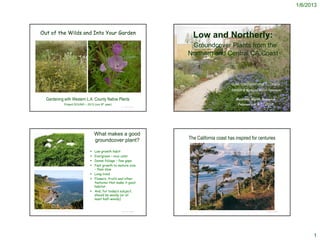
    Out of the Wilds and Into Your Garden
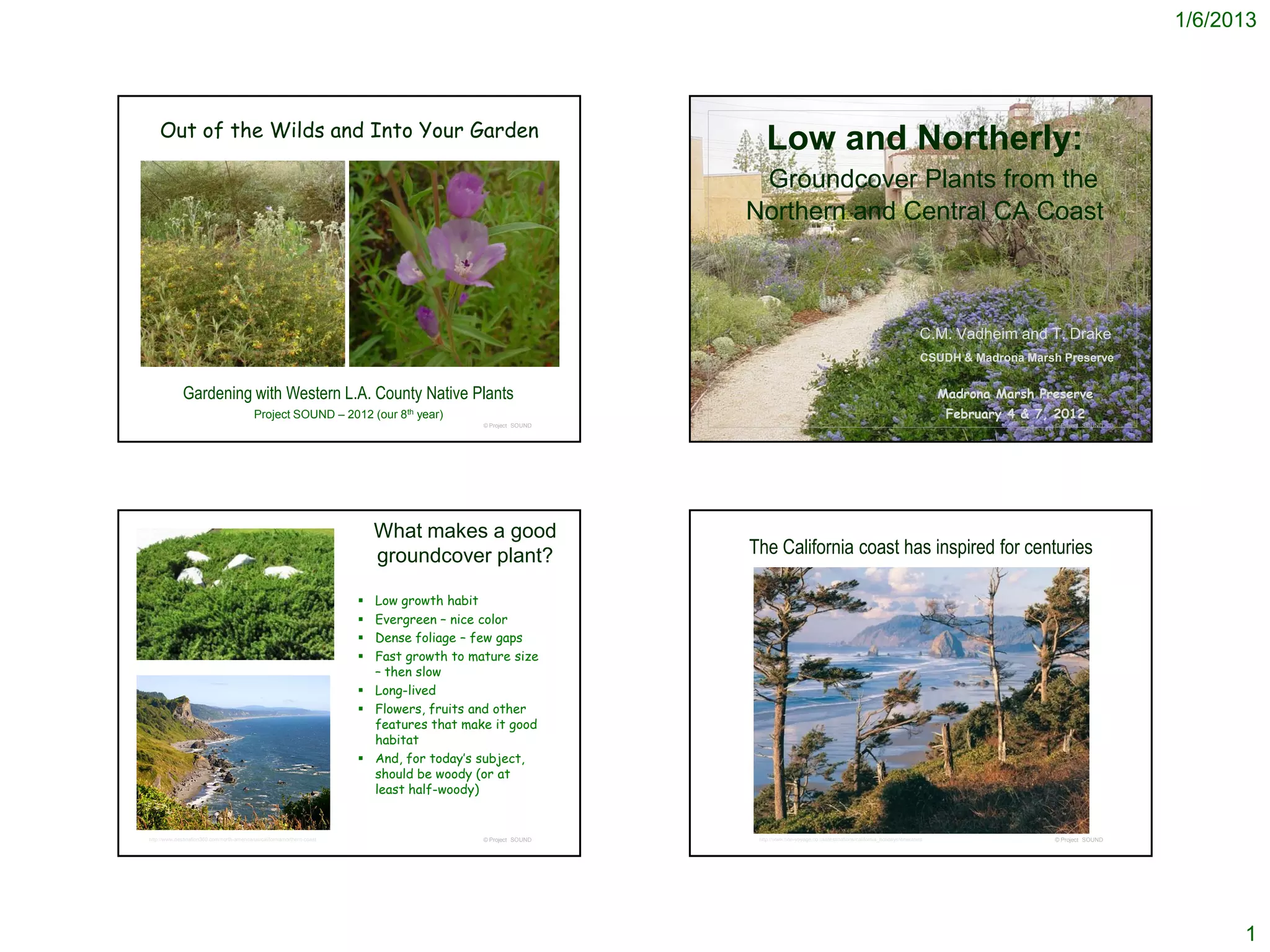
                                                                                                                    Low and Northerly:
                                                                                                                 Groundcover Plants from the
                                                                                                                Northern and Central CA Coast


                                                                                                                                                                                       C.M. Vadheim and T. Drake
                                                                                                                                                                                        CSUDH & Madrona Marsh Preserve


              Gardening with Western L.A. County Native Plants                                                                                                                              Madrona Marsh Preserve
                                             Project SOUND – 2012 (our 8th year)                                                                                                             February 4 & 7, 2012
                                                                                              © Project SOUND                                                                                               © Project SOUND


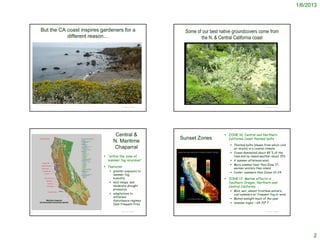
                                                                               What makes a good
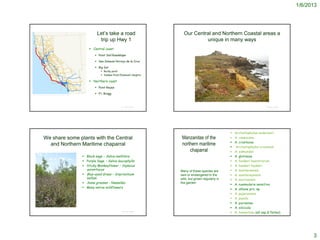
                                                                               groundcover plant?               The California coast has inspired for centuries

                                                                            Low growth habit
                                                                            Evergreen – nice color
                                                                            Dense foliage – few gaps
                                                                            Fast growth to mature size
                                                                             – then slow
                                                                            Long-lived
                                                                            Flowers, fruits and other
                                                                             features that make it good
                                                                             habitat
                                                                            And, for today’s subject,
                                                                             should be woody (or at
                                                                             least half-woody)


http://www.destination360.com/north-america/us/california/northern-coast                      © Project SOUND    http://www.bon-voyage.co.uk/destinations/california_holidays/itineraries                   © Project SOUND


                                                                                                                                                                                                                                    1
1/6/2013


            But the CA coast inspires gardeners for a                                                                                            Some of our best native groundcovers come from
                       different reason…                                                                                                                the N. & Central California coast


    http://blog.travelpod.com/travel-photo/ranlo/2/1279124248/northern-california-coast.jpg/tpod.html
                                                                                                                                                 © Br. Alfred Brousseau, Saint Mary's College
                                                                                                                   © Project SOUND                                                                                                      © Project SOUND


                                                                                                              Central &                                                                                      ZONE 16: Central and Northern
                                                                                                                                        Sunset Zones                                                          California Coast thermal belts
                                                                                                             N. Maritime
                                                                                                                                                                                                                Thermal belts (slopes from which cold
                                                                                                             Chaparral                                                                                           air drains) in a coastal climate
                                                                                                                                                                                                                Ocean dominated about 85 % of the
                                                                                                         “within the zone of                                                                                    time and by inland weather about 15%
                                                                                                          summer fog incursion”                                                                                 A summer afternoon wind
                                                                                                                                                                                                                More summer heat than Zone 17;
                                                                                                         Features:                                                                                              warmer winters than inland
                                                                                                            greater exposure to                                                                                Cooler summers than Zones 22-24
                                                                                                             summer fog,
                                                                                                             humidity                                                                                        ZONE 17: Marine effects in
                                                                                                            mild temps. and                                                                                  Southern Oregon, Northern and
                                                                                                             moderate drought                                                                                 Central California
                                                                                                             pressures
                                                                                                                                                                                                                Mild, wet, almost frostless winters;
                                                                                                            adaptations to                                                                                      cool summers w/ frequent fog or wind.
                                                                                                             different
                                                                                                                                                                                                                Muted sunlight much of the year
                                                                                                             disturbance regimes
                                                                                                             (less frequent fire).   http://www.digitalseed.com/gardener/climate/plantclimate_map_ca.html
                                                                                                                                                                                                                Summer highs ~ 65-70º F

                                                                                                                   © Project SOUND                                                                                                      © Project SOUND
http://www.elkhornsloughctp.org/reference/subissue_detail.php?SUBISSUE_ID=1


                                                                                                                                                                                                                                                                2
1/6/2013


                                                                            Let’s take a road                   Our Central and Northern Coastal areas a
                                                                             trip up Hwy 1                               unique in many ways
                                                                      Central coast
                                                                          Point Sal/Guadalupe

                                                                          San Simeon/Arroyo de la Cruz

                                                                          Big Sur
                                                                              Rocky point
                                                                              Yankee Point/Diamond Heights

                                                                      Northern coast
                                                                          Point Reyes

http://en.wikipedia.org/wiki/File:California_State_Route_1.svg
                                                                          Ft. Bragg


                                                                                            © Project SOUND                                                           © Project SOUND


                                                                                                                                                Arctostaphylos andersonii
                 We share some plants with the Central                                                         Manzanitas of the                A. canescens
                                                                                                                                                A. crustacea
                   and Northern Maritime chaparral                                                             northern maritime
                                                                                                                                                Arctostaphylos cruzensis
                                                                                                                   chaparral                    A. edmundsii
                                                                  Black sage – Salvia mellifera                                                A. glutinosa
                                                                  Purple Sage – Salvia leucophylla                                             A. hookeri hearstiorum
                                                                  Sticky Monkeyflower – Diplacus                                               A. hookeri hookeri
                                                                   aurantiacus                                Many of these species are         A. montaraensis
                                                                  Blue-eyed Grass – Sisyrinchium             rare or endangered in the         A. montereyensis
                                                                   bellum                                     wild, but grown regularly in      A. morroensis
                                                                  Some grasses - Nassellas                   the garden
                                                                                                                                                A. nummularia sensitiva
                                                                  Many native wildflowers                                                      A. ohlone pro. sp.
                                                                                                                                                A. pajaroensis
                                                                                                                                                A. pumila
                                                                                                                                                A. purissima
                                                                                                                                                A. silvicola
                                                                                            © Project SOUND
                                                                                                                                                A. tomentosa (all ssp &Prforms)
                                                                                                                                                                       ©   SOUND


                                                                                                                                                                                              3
1/6/2013


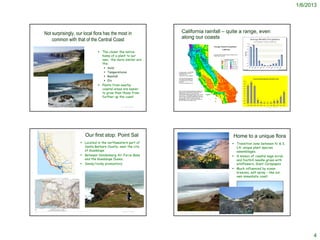
                 Not surprisingly, our local flora has the most in                                                                                                           California rainfall – quite a range, even
                     common with that of the Central Coast                                                                                                                   along our coasts

                                                                                                   The closer the native
                                                                                                    home of a plant to our
                                                                                                    own, the more similar are
                                                                                                    the:
                                                                                                                 Soils
                                                                                                                 Temperatures                                                                                                                                  http://www.abovetopsecret.com/forum/thread775456/pg2


http://coast-santabarbara.org/
                                                                                                                 Rainfall
                                                                                                                 Etc
                                                                                                   Plants from nearby
                                                                                                    coastal areas are easier
                                                                                                    to grow than those from
                                                                                                    further up the coast


                                                                                                                                           © Project SOUND                                                                                                                                     © Project SOUND


                                                                             Our first stop: Point Sal                                                                                                                                         Home to a unique flora
                                                                      Located in the northwestern part of                                                                                                                                      Transition zone between N. & S.
                                                                       Santa Barbara County, near the city                                                                                                                                       CA: unique plant species
                                                                       of Guadalupe                                                                                                                                                              assemblages.
                                                                      Between Vandenberg Air Force Base                                                                                                                                        A mosaic of coastal sage scrub
                                                                       and the Guadalupe Dunes.                                                                                                                                                  and foothill needle-grass with
                                                                      Sandy/rocky promontory                                                                                                                                                    wildflowers, Giant Corepopsis
                                                                                                                                                                                                                                                Much influenced by ocean
                                 *                                                                                                                                       http://kcbx.net/~bdenneen/

                                                                                                                                                                                                                                                 breezes, salt spray – like our
                                                                                                                                                                                                                                                 own immediate coast


                                                                              http://www.cityprofile.com/california/photos/36781-guadalupe-point-sal-state-beach1.html

 http://www.localhikes.com/HikeData.ASP?DispType=1&ActiveHike=0&GetHikesStateID=&ID=42                                                     © Project SOUND                                                                                                                                     © Project SOUND
 66                                                                                                                                                                         http://soundwaves.usgs.gov/2001/09/fieldwork2.html
                                                                                                                                                                                                 http://www.ryono.net/pointsal/pointsal.html      http://blogbisogno.wordpress.com/2009/08/page/2/


                                                                                                                                                                                                                                                                                                                             4
1/6/2013


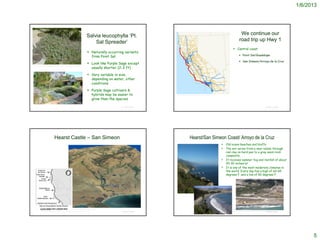
                                                                                    Salvia leucophylla ‘Pt.                                                                                                       We continue our
                                                                                        Sal Spreader’                                                                                                            road trip up Hwy 1
                                                                                                                                                                                                         Central coast
                                                                                      Naturally occurring variants
                                                                                       from Point Sal                                                                                                             Point Sal/Guadalupe

                                                                                                                                                                                                                  San Simeon/Arroyo de la Cruz
                                                                                      Look like Purple Sage except
                                                                                       usually shorter (2-3 ft)
http://www.sm.watersavingplants.com/eplant.php?plantnum=24489&return=l2_aO


                                                                                      Very variable in size,
                                                                                       depending on water, other                                  *
                                                                                       conditions
                                                                                      Purple Sage cultivars &
                                                                                       hybrids may be easier to             http://en.wikipedia.org/wiki/File:California_State_Route_1.svg


                                                                                       grow than the species

                                                                                                         © Project SOUND                                                                                                                                  © Project SOUND


                                Hearst Castle – San Simeon                                                                                       Hearst/San Simeon Coast/ Arroyo de la Cruz
                                                                                                                                                                                                Old ocean beaches and bluffs
                                                                                                                                                                                                The soil varies from a near adobe through
                                                                                                                                                                                                 red clay on hard pan to a gray sand-rock
                                                                                                                                                                                                 composite.
                                                                                                                                                                                                It receives summer fog and rainfall of about
                                                                                                                                                                                                 20-30 inches/yr
                                                                                                                                                                                                It is one of the most moderate climates in
                                                                                                                                                                                                 the world. Every day has a high of 60-65
                                                                                                                                                                                                 degrees F. and a low of 50 degrees F.


                                                          http://www.nordicgeospatial.com/about_us                                                                                                  http://www.californiacoastline.org/cgi-
            http://www.coastandocean.org/coast_v23_no3_2007/articles/Hiking_Hearst_04.htm                © Project SOUND                                                                            bin/location.cgi?flags=0&year=current&latdeg=35.591167&longdeg=121.131667
                                                                                                                                                                                                                                                              © Project SOUND
                                                                                                                           http://justinsomnia.org/2006/09/driving-down-the-big-sur-coast/


                                                                                                                                                                                                                                                                                      5
1/6/2013


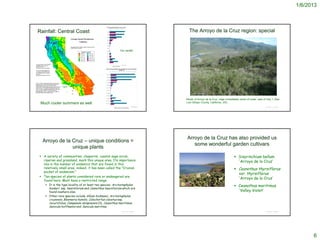
Rainfall: Central Coast                                                                    The Arroyo de la Cruz region: special


                                                          Our rainfall


                                                                                              © 2011 Chris Winchell


                                                                                      Mouth of Arroyo de la Cruz, ridge immediately south of creek, east of Hwy 1 (San
 Much cooler summers as well                                                          Luis Obispo County, California, US)
                                                           © Project SOUND                                                                                          © Project SOUND


                                                                                        Arroyo de la Cruz has also provided us
  Arroyo de la Cruz – unique conditions =
                                                                                           some wonderful garden cultivars
               unique plants
 A variety of communities, chaparral, coastal sage scrub,                                                                                          Sisyrinchium bellum
  riparian and grassland, mark this unique area. Its importance                                                                                      'Arroyo de la Cruz‘
  lies in the number of endemics that are found in this
  relatively small area; indeed, it has been called the "Cruzian                                                                                    Ceanothus thyrsiflorus
  pocket of endemism."
                                                                                                                                                     var. thyrsiflorus
 Ten species of plants considered rare or endangered are
                                                                                                                                                     'Arroyo de la Cruz‘
  found here. Most have a restricted range.
     It is the type locality of at least two species, Arctostaphylos                                                                               Ceanothus maritimus
      hookeri ssp. hearstiorum and Ceanothus hearstiorum which are
                                                                                                                                                     'Valley Violet‘
                                                                             http://www.flickriver.com/photos/billbouton/sets/72157603552645540/


      found nowhere else.
     Other rare species include Allium hickmanii, Arctostaphylos
      cruzensis, Bloomeria humilis, Calochortus clavatus ssp.
      recurvfolius, Campanula obispoensis (?), Ceanothus maritimus,
      Sanicula hoffmannii and Sanicula maritima.
                                                           © Project SOUND                                                                                          © Project SOUND


                                                                                                                                                                                            6
1/6/2013


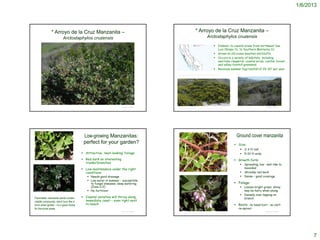
                          * Arroyo de la Cruz Manzanita –                                                                                    * Arroyo de la Cruz Manzanita –
                                             Arctostaphylos cruzensis                                                                                             Arctostaphylos cruzensis
                                                                                                                                                                                     Endemic to coastal areas from northwest San
                                                                                                                                                                                      Luis Obispo Co. to Southern Monterey Co.
                                                                                                                                                                                     Grows on old ocean beaches and bluffs
                                                                                                                                                                                     Occurs in a variety of habitats, including
                                                                                                                                                                                      maritime chaparral, coastal scrub, conifer forest,
                                                                                                                                                                                      and valley-foothill grassland.
                                                                                                                                                                                     Receives summer fog/rainfall of 20-30” per year
                                                                                                                http://ucjeps.berkeley.edu/cgi-bin/get_JM_treatment.pl?3449,3454,3466


            © 2011 Chris Winchell


                                                                                              © Project SOUND                                                                                          © 2011 Chris Winchell   © Project SOUND
                                                                                                                http://www.laspilitas.com/nature-of-california/plants/arctostaphylos-cruzensis


                                                                   Low-growing Manzanitas:                                                                                                           Ground cover manzanita
                                                                   perfect for your garden?                                                                                                          Size:
                                                                                                                                                                                                        2-3 ft tall
                                                                   Attractive, ‘neat-looking’ foliage                                                                                                        5-10 ft wide
                                                 ©J.S. Peterson
                                                                   Red bark on interesting                                                                                                          Growth form:
                                                                    trunks/branches
                                                                                                                                                                                                              Spreading, low : mat-like to
                                                                   Low-maintenance under the right                http://www.laspilitas.com/nature-of-california/plants/arctostaphylos-cruzensis
                                                                                                                                                                                                               mounded
                                                                    conditions:                                                                                                                               Shreddy red bark
                                                                      Needs good drainage                                                                                                                    Dense – good coverage
                                                                      Low water in summer - susceptible
                                                                       to fungal diseases; deep watering                                                                                             Foliage:
                                                                       (Zone 1/2)                                                                                                                             Leaves bright green, shiny;
Jo-Ann Ordano © California Academy of Sciences                        No fertilizer                                                                                                                           may be hairy when young
                                                                                                                                                                                                              Densely over-lapping on
Flammable: manzanita plants contain                                Coastal varieties will thrive along                                                                                                        branch
volatile compounds, which burn like a                               immediate coast – even right next
torch when ignited – no a good choice                               to beach                                                                                                                         Roots: no basal burl – so can’t
for fire-prone areas                                                                                                                                                                                   re-sprout
                                                                                              © Project SOUND                                                                                                                  © Project SOUND


                                                                                                                                                                                                                                                       7
1/6/2013


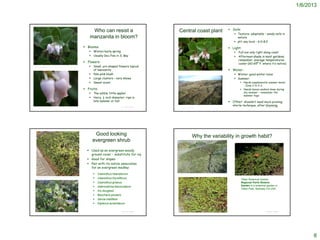
                                                                                          Who can resist a                                                                                  Soils:
                                                                                                                                     Central coast plant
                                                                                                                                                                                               Texture: adaptable – sandy soils in
                                                                                         manzanita in bloom?                                                                                    nature
                                                                                                                                                                                               pH: any local – 6.0-8.0
                                                                                      Blooms:                                                                                              Light:
                                                                                           Winter/early spring                                                                                     Full sun only right along coast
                                                                                           Usually Dec-Feb in S. Bay                                                                               Afternoon shade in most gardens;
                                                                                                                                                                                                     remember, average temperatures
                                                                                      Flowers:                                                                                                      cooler (60-65º F. where it’s native)
© 2006 Steve Matson                                                                        Small, urn-shaped flowers typical
                                                                                            of manzanita                                                                                    Water:
                                                                                           Pale pink blush                                                                                    Winter: good winter rains
                                                                                           Large clusters – very showy                                                                        Summer:
                                                                                           Sweet scent                                                                                                 Needs supplemental summer water
                                                                                                                                                                                                         – Zone 2 to 2-3
                                                                                      Fruits:                                                                                                          Needs leaves washed down during
                                                                                           The edible ‘little apples’                                                                                   dry summer – remember the
                                                                                                                                                                                                         summer fogs
                                                                                           Hairy, ½ inch diameter; ripe in
                                                                                            late summer or fall                                                                             Other: shouldn’t need much pruning;
                                                                                                                 © Project SOUND
                                                                                                                                                                                             sterile technique, after blooming
                                                                                                                                                                                                                      © Project SOUND
                                                                                                                                         © 2002 David Graber


                                                                                             Good looking                                                   Why the variability in growth habit?
                                                                                            evergreen shrub
                                                                                        Used as an evergreen woody
                                                                                         ground cover – substitute for ivy
                                                                                        Good for slopes
                                                                                        Pair with its native associates
                                                                                         for an evergreen medley:
                                                                                               Ceanothus hearstiorum               © 2011 Chris Winchell
                                                                                                                                                                                                  © 2006 Steve Matson


    http://www.laspilitas.com/nature-of-california/plants/arctostaphylos-cruzensis
                                                                                               Ceanothus thyrsiflorus                                                                                   Tilden Botanical Garden
                                                                                               Ceanothus griseus                                                                                        Regional Parks Botanic
                                                                                               Adenostoma fasciculatum                                                                                  Garden is a botanical garden in
                                                                                                                                                                                                         Tilden Park, Berkeley CA USA
                                                                                               Iris douglasii
                                                                                               Baccharis pilularis
                                                                                               Salvia mellifera
                                                                                               Diplacus aurantiacus

                                                                                                                                   http://en.wikipedia.org/wiki/Arctostaphylos_cruzensis
                                                                                                                 © Project SOUND                                                                                              © Project SOUND


                                                                                                                                                                                                                                                      8
1/6/2013


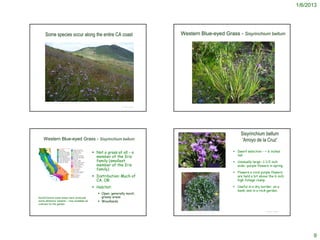
     Some species occur along the entire CA coast                                                       Western Blue-eyed Grass - Sisyrinchium bellum


      http://www.flickr.com/photos/mechanoid_dolly/5682527020/


                                                                                   © Project SOUND


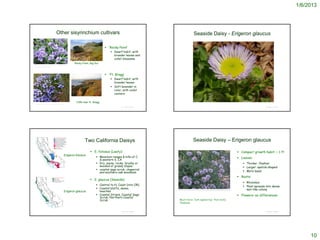
                                                                                                                                                                        Sisyrinchium bellum
    Western Blue-eyed Grass - Sisyrinchium bellum                                                                                                                        'Arroyo de la Cruz'

                                                                  Not a grass at all – a                                                                           Dwarf selection - ~ 6 inches
                                                                   member of the Iris                                                                                tall
                                                                   family (smallest                                                                                 Unusually large--1 1/2 inch
                                                                   member of the Iris                                                                                wide--purple flowers in spring
                                                                   family)                           http://www.yerbabuenanursery.com/viewplant.php?pid=1292


                                                                                                                                                                    Flowers a vivid purple flowers
                                                                  Distribution: Much of                                                                             are held a bit above the 6 inch
                                                                   CA, OR                                                                                            high foliage clump.

                                                                  Habitat:                                                                                         Useful in a dry border, on a
                                                                                                                                                                     bank, and in a rock garden.
                                                                     Open, generally moist,
North/Central coast areas have produced                               grassy areas
some attractive variants – now available as                          Woodlands
cultivars for the garden

                                                                                                                                                                                        © Project SOUND
                                                                                                           http://www.flickr.com/photos/eastbaywilds/5712113309/


                                                                                                                                                                                                                9
1/6/2013


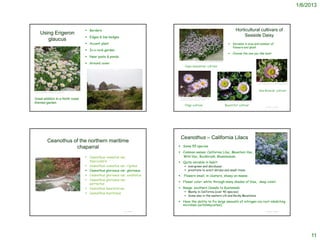
                                     Other sisyrinchium cultivars                                                                                                      Seaside Daisy - Erigeron glaucus

                                                                                                             ‘Rocky Point’
                                                                                                                Dwarf habit, with
                                                                                                                 broader leaves and
                                                                                                                 violet blossoms
                                                            Rocky Point, Big Sur
http://nativeson.typepad.com/plants/2010/05/sisyrinchi
um-bellum-rocky-point.html


                                                                                                             ‘Ft. Bragg’
                                                                                                                Dwarf habit, with
                                                                                                                 broader leaves
                                                                                                                Soft lavender in
                                                                                                                 color, with violet
                                                                                                                 centers
                                                         http://www.city-data.com/picfilesv/picv20278.php


                                                               Cliffs near Ft. Bragg
 http://www.flickr.com/photos/dreedyphoto/page6/

                                                                                                                       © Project SOUND                                                                                                                                    © Project SOUND


                                                                              Two California Daisys                                                                   Seaside Daisy – Erigeron glaucus

                                                                                        E. foliosus (Leafy):                                                                                                                                           Compact growth habit: < 1 ft
                                                   Erigeron foliosus
                                                                                                  Mountain ranges & hills of C.                                                                                                                        Leaves:
                                                                                                   & western S. CA
                                                                                                  Dry, sunny, rocky, brushy or                                                                                                                            Thicker, fleshier
                                                                                                   wooded or grassy slopes                                                                                                                                 Larger: spatula shaped
                                                                                                  coastal sage scrub, chaparral
                                                                                                   and southern oak woodland                                                                                                                               More basal
                                                                                                                                                                                                                                                        Roots:
                                                                                        E. glaucus (Seaside)
                                                                                                                                                                                                                                                           Rhizomes
                                                                                                  Central to N. Coast (into OR)
                                                                                                                                                                                                                                                           Plant spreads into dense
                                                                                                  Coastal bluffs, dunes,                                                                                                                                   mat-like colony
                                                   Erigeron glaucus                                beaches                               http://www.calhortsociety.org/seed-exchange/seed-exchange-2002/seed-list-pages/large/Erigeron-glaucus-2.jpg


                                                                                                  Coastal Strand, Coastal Sage                                                                                                                         Flowers: no differences
                                                                                                   Scrub, Northern Coastal
                                                                                                   Scrub                                   Much more “lush appearing” than leafy
                                                                                                                                           fleabane


                                                                                                                       © Project SOUND                                                                                                                                    © Project SOUND


                                                                                                                                                                                                                                                                                                 10
1/6/2013


                                                      Borders                                                                                                                                                 Horticultural cultivars of
        Using Erigeron                                                                                                                                                                                              Seaside Daisy
                                                      Edges & low hedges
           glaucus
                                                      Accent plant                                                                                                                                     Variable in size and number of
                                                                                                                                                                                                         flowers and plant
                                                      In a rock garden
                                                                                                                                                                                                        Choose the one you like best
                                                      Near pools & ponds
                                                                                                                              http://www.mostlynatives.com/notes/erigeronglaucuscs.jpg
                                                      Ground cover
                                                                                                         ‘Cape Sebastian’ cultivar


                                                                                                                                                                                                                                                       http://www.elnativogrowers.com/Photographs_page/eriglasb.htm


http://www.laspilitas.com/plants/pictures/a269.jpg
                                                                                                                                                                                                                                                       ‘Sea Breeze’ cultivar

Great addition to a North coast                                                                   http://www.callutheran.edu/Academic_Programs/Departments/
                                                                                                  Biology/Wildflowers/gf/plants/category/gar-1670.htm
                                                                                                                                                                             http://www.smgrowers.com/products/plants/plantdisplay.asp?plant_id=2213
themed garden
                                                                                                         ‘Olga’ cultivar                                                                 ‘Bountiful’ cultivar
                                                                            © Project SOUND                                                                                                                                                                         © Project SOUND


                                                                                                  Ceanothus – California Lilacs
                    Ceanothus of the northern maritime
                               chaparral                                                       Some 55 species
                                                                                               Common names: California Lilac, Mountain lilac,
                                                      Ceanothus cuneatus var.                  Wild lilac, Buckbrush, Blueblossum
                                                       fascicularis                            Quite variable in habit:
                                                      Ceanothus cuneatus var. rigidus                    evergreen and deciduous
                                                      Ceanothus gloriosus var. gloriosus                 prostrate to erect shrubs and small trees.
                                                      Ceanothus gloriosus var. exaltatus              Flowers small, in clusters, showy en masse
                                                      Ceanothus gloriosus var.
                                                                                               Flower color: white through many shades of blue, deep violet.
                                                       porrectus
                                                      Ceanothus hearstiorum                   Range: southern Canada to Guatemala
                                                      Ceanothus maritimus                                Mainly in California (over 40 species)
                                                                                                          Some also in the eastern US and Rocky Mountains.

                                                                                               Have the ability to fix large amounts of nitrogen via root-inhabiting
                                                                                                microbes (actinomycetes).
                                                                             © Pr SOUND                                                                                                                                                                             © Project SOUND


                                                                                                                                                                                                                                                                                                                           11
1/6/2013


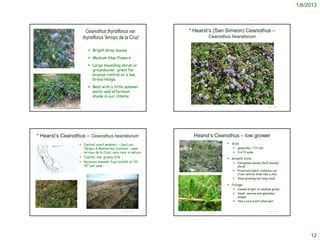
                                                                                    Ceanothus thyrsiflorus var.                         * Hearst’s (San Simeon) Ceanothus –
                                                                                  thyrsiflorus 'Arroyo de la Cruz'                                                      Ceanothus hearstiorum


                                                                                      Bright shiny leaves
                                                                                      Medium-blue flowers
                                                                                      Large mounding shrub or
http://www.laspilitas.com/nature-of-california/plants/ceanothus-
thyrsiflorus-big-sur-california-lilac                                                  groundcover, great for
                                                                                       erosion control or a low,
                                                                                       broad hedge.
                                                                                      Best with a little summer
                                                                                       water and afternoon
                                                                                       shade in our climate

                                                                                                                                         http://commons.wikimedia.org/wiki/Ceanothus_hearstiorum
                                                                                                        © Project SOUND                                                                                                           © Project SOUND
 http://plantayflor.blogspot.com/2010/09/ceanothus-thyrsiflorus-var-repens.html


   * Hearst’s Ceanothus – Ceanothus hearstiorum                                                                                                  Hearst’s Ceanothus – low grower
                                                                             Central coast endemic – San Luis                                                                                      Size:
                                                                              Obispo & Monterrey counties – near                                                                                         generally < 1 ft tall
                                                                              Arroyo de la Cruz; very rare in nature                                                                                     3-6 ft wide
                                                                             Coastal, low, grassy hills                                                                                            Growth form:
                                                                             Receives summer fog/rainfall of 20-                                                                                        Evergreen woody (half-woody)
                                                                              30” per year                                                                                                                shrub
                                                                                                                                                                                                         Prostrate habit; radiates out
                                                                                                                           Picture from Rob Rizzardi
                                                                                                                                                                                                          from central stem like a star
                                                                                                                                                                                                         Slow-growing but long-lived

                                                                                                                                                                                                    Foliage:
                                                                                                                                                                                                         Leaves bright to medium green
                                                                                                                                                                                                         Small, narrow and glandular;
                                                                                                                                                                                                          unique
                                                                                                                                                                                                         Has a nice scent when wet

   © 2006 Steve Matson
                                                                                                        © Project SOUND                                                                                                           © Project SOUND
                                                                                                                          http://commons.wikimedia.org/wiki/Ceanothus_hearstiorum


                                                                                                                                                                                                                                                         12
1/6/2013


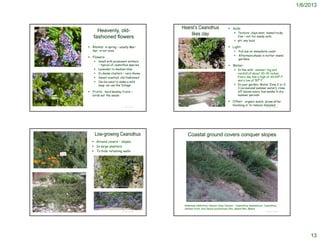
                                                                                                                                                  Hearst’s Ceanothus                                              Soils:
                                                                               Heavenly, old-
                                                                                                                                                      likes clay                                                     Texture: clays best, loams/rocky
                                                                                                                                                                                                                      fine – not for sandy soils
                                                                             fashioned flowers
                                                                                                                                                                                                                     pH: any local

                                                                           Blooms: in spring – usually Mar-                                                                                                      Light:
                                                                             Apr in our area                                                                                                                           Full sun on immediate coast
                                                                                                                                                                                                                       Afternoon shade in hotter inland
                                                                           Flowers:
                                                                                                                                                                                                                        gardens
                                                                                     Small with prominent anthers
                                                                                      – typical of ceanothus species                                                                                              Water:
                                                                                     Lavender to medium blue                                                                                                        In the wild: summer fog and
 http://commons.wikimedia.org/wiki/Ceanothus_hearstiorum
                                                                                                                                               http://www.baynatives.com/plants/Ceanothus-hearstiorum/

                                                                                     In dense clusters – very showy                                                                                                  rainfall of about 20-30 inches.
                                                                                     Sweet scented; old-fashioned                                                                                                    Every day has a high of 60-65º F.
                                                                                     Can be used to make a mild                                                                                                      and a low of 50º F.
                                                                                      soap –as can the foliage                                                                                                       In your garden: Water Zone 2 or 2-
                                                                                                                                                                                                                      3 (occasional summer water); rinse
                                                                           Fruits: hard knobby fruits –                                                                                                              off leaves every few weeks in dry
                                                                             birds eat the seeds                                                                                                                      summer periods

                                                                                                                                                                                                                  Other: organic mulch; prune after
                                                                                                                                                                                                                   blooming or to remove diseased
                                                                                                                             © Project SOUND                                                                                               © Project SOUND
                                                                                                                                               Picture from Rob Rizzardi


                                                                              Low-growing Ceanothus                                                         Coastal ground covers conquer slopes
                                                                             Ground covers – slopes
                                                                             In large planters
                                                                             To hide retaining walls


http://www.smgrowers.com/products/plants/plantdisplay.asp?plant_id=3107


                                                                              http://www.baynatives.com/plants/Ceanothus-hearstiorum/


                                                                                                                                                             http://www.laspilitas.com/garden/howto/slope.html


                                                                                                                                                       Artemisia californica Canyon Gray Canyon , Ceanothus hearstiorum, Ceanothus
                                                                                  http://www.laspilitas.com/garden/may.htm                             Yankee Point, and Salvia sonomensis Mrs. Beard Mrs. Beard.
                                                                                                                             © Project SOUND                                                                                               © Project SOUND
http://www.yerbabuenanursery.com/viewplant.php?pid=1249


                                                                                                                                                                                                                                                                  13
1/6/2013


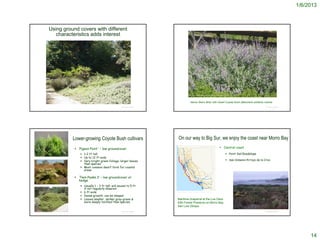
Using ground covers with different
   characteristics adds interest


                                                                                      http://www.intermountainnursery.com/demonstration_garden_list.htm


                                                                                        Salvia ‘Bee’s Bliss’ with Dwarf Coyote Bush (Baccharis pilularis) cultivar
                                              © Project SOUND                                                                                                               © Project SOUND


          Lower-growing Coyote Bush cultivars                      On our way to Big Sur, we enjoy the coast near Morro Bay
            ‘Pigeon Point' – low groundcover                                                                                           Central coast
               1-2 ft tall                                                                                                                       Point Sal/Guadalupe
               Up to 12 ft wide
               Very bright green foliage; larger leaves                                                                                          San Simeon/Arroyo de la Cruz
                than species
               Most common dwarf form for coastal
                areas

            ‘Twin Peaks 2’ – low groundcover or                            *
             hedge
               Usually 1 – 3 ft tall; will mound to 5 ft
                if not regularly sheared
               6 ft wide                                       http://en.wikipedia.org/wiki/File:California_State_Route_1.svg


               Dense growth; can be shaped
               Leaves smaller, darker gray-green &              Maritime chaparral at the Los Osos
                more deeply toothed than species                 Elfin Forest Preserve on Morro Bay,
                                                                 San Luis Obispo
                                              © Project SOUND                                                                                                               © Project SOUND


                                                                                                                                                                                                   14
1/6/2013


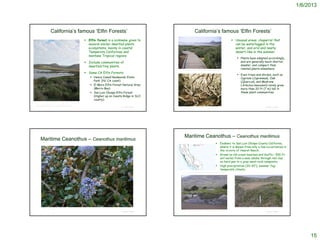
                           California’s famous ‘Elfin Forests’                                                                               California’s famous ‘Elfin Forests’
                                                                         Elfin forest is a nickname given to                                                                                         Unusual areas: chaparral that
                                                                          several similar dwarfed plants                                                                                               can be waterlogged in the
                                                                          ecosystems, mainly in coastal                                                                                                winter, and arid and nearly
                                                                          Temperate Californian and                                                                                                    desert-like in the summer
                                                                          montane Tropical regions
                                                                                                                                                                                                          Plants have adapted accordingly,
                                                                         Include communities of                                                                                                           and are generally much shorter,
                                                                          dwarfed/tiny plants.                                                                                                             smaller, and compact than
                                                                                                                   http://blog.slocountyhomes.com/2009/03/elfin-forest-boardwalk-trail.html/
                                                                                                                                                                                                           related plants elsewhere.
                                                                         Some CA Elfin Forests:
                                                                                                                                                                                                          Even trees and shrubs, such as
                                                                            Henry Cowell Redwoods State                                                                                                   Cypress (Cupressus), Oak
                                                                             Park (N/ CA coast)                                                                                                            (Quercus), and Madrone
                                                                            El Moro Elfin Forest Natural Area                                                                                             (Arbutus menziesii) rarely grow
                                                                             (Morro Bay)                                                                                                                   more than 20 ft (7 m) tall in
                                                                            San Luis Obispo Elfin Forest                                                                                                  these plant communities.
                                                                             (Higher up on Cuesta Ridge in SLO
                                                                             county).
http://www.tripadvisor.com/Attraction_Review-g32661-d2169512-Reviews-
Elfin_Forest_Preserve-Los_Osos_San_Luis_Obispo_County_California.html                            © Project SOUND   http://www.kayharden.com/galy16b.html                                                                        © Project SOUND


                                                                                                                           Maritime Ceanothus – Ceanothus maritimus
       Maritime Ceanothus – Ceanothus maritimus
                                                                                                                                                                                        Endemic to San Luis Obispo County California,
                                                                                                                                                                                         where it is known from only a few occurrences in
                                                                                                                                                                                         the vicinity of Hearst Ranch.
                                                                                                                                                                                        Grows on old ocean beaches and bluffs < 500 ft;
                                                                                                                                                                                         soil varies from a near adobe through red clay
                                                                                                                                                                                         on hard pan to a gray sand-rock composite
                                                                                                                                                                                        High precipitation (20-30”); summer fog;
                                                                                                                                                                                         temperate climate
                                                                                                                        http://ucjeps.berkeley.edu/cgi-bin/get_JM_treatment.pl?6586,6589,6625


                                                                                                                                                                                                        © 2011 Chris Winchell
           © 2006 Steve Matson
                                                                                                                         http://www.laspilitas.com/nature-of-california/plants/ceanothus-maritimus
                                                                                                 © Project SOUND                                                                                                                © Project SOUND


                                                                                                                                                                                                                                                       15
1/6/2013


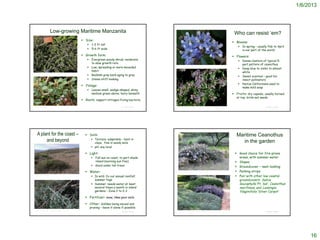
                         Low-growing Maritime Manzanita                                                                                                                          Who can resist ‘em?
                                                          Size:
                                                                                                                                                                                 Blooms:
                                                                 1-3 ft tall
                                                                                                                                                                                       In spring – usually Feb to April
                                                                 5-6 ft wide                                                                                                           in our part of the world
                                                          Growth form:                                                                                                          Flowers:
                                                                 Evergreen woody shrub; moderate                                                                                      Dense clusters of typical 5-
                                                                  to slow growth rate                          http://en.wikipedia.org/wiki/Ceanothus_maritimus
                                                                                                                                                                                        part pattern of ceanothus
                                                                 Low, spreading or more mounded                                                                                       Deep blue to violet to almost
                                                                  habit                                                                                                                 white
                                                                 Reddish gray bark aging to gray                                                                                      Sweet scented – good for
                                                                 Stems stiff-looking                                                                                                   insect pollinators
                                                                                                                                                                                       Native Californians used to
                                                          Foliage:
                                                                                                                                                                                        make mild soap
                                                                 Leaves small, wedge-shaped, shiny
                                                                  medium green above; hairy beneath                                                                              Fruits: dry capsule, usually horned
                                                                                                                                                                                   at top; birds eat seeds
                                                          Roots: support nitrogen-fixing bacteria

© 2006 Steve Matson                                                                       © Project SOUND   http://www.pfaf.org/user/Plant.aspx?LatinName=Ceanothus+maritimus                            © Project SOUND


   A plant for the coast –                                  Soils:                                                                                                                Maritime Ceanothus
        and beyond                                                 Texture: adaptable – best in
                                                                    clays, fine in sandy soils                                                                                        in the garden
                                                                   pH: any local

                                                            Light:                                                                                                                Good choice for fire-prone
                                                                     Full sun on coast, to part shade                                                                              areas, with summer water
                                                                      inland (morning sun fine)                                                                                    Slopes
                                                                     Good under tall trees                                                                                        Groundcover – neat-looking
                                                            Water:                                                                                                                Parking strips
 © 2011 Chris Winchell
                                                                   In wild: 2x our annual rainfall;                                                                               Pair with other low coastal
                                                                    summer fogs                                                                                                     groundcovers: Salvia
                                                                   Summer: needs water at least                                                                                    leucophylla ‘Pt. Sal’, Ceanothus
                                                                    several times a month in inland                                                                                 maritimus, and Lessingia
                                                                    gardens – Zone 2 to 2-3                                                                                         filaginifolia ‘Silver Carpet’
                                                            Fertilizer: none; likes poor soils

                                                            Other: dislikes being moved and
                                                                 pruning – leave it alone if possible
 http://www.baynatives.com/plants/Ceanothus-maritimus/
                                                                                          © Project SOUND    http://www.vcstar.com/photos/2010/feb/08/86887/                                             © Project SOUND


                                                                                                                                                                                                                                16
1/6/2013


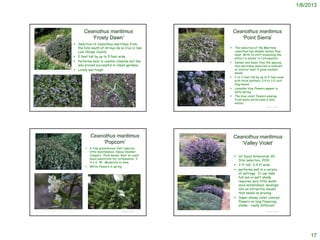
                                                                              Ceanothus maritimus                                                                                                                                                 Ceanothus maritimus
                                                                                 ‘Frosty Dawn’                                                                                                                                                       ‘Point Sierra’
                                                               Selection of Ceanothus maritimus from
                                                                the hills south of Arroyo de la Cruz in San                                                                                                                                      This selection of the Maritime
                                                                Luis Obispo County                                                                                                                                                                ceanothus has smaller leaves than
                                                                                                                                                                                                                                                  most. With its stiff branching the
                                                               2 feet tall by up to 5 feet wide
                                                                                                                                                                                                                                                  effect is similar to Cotoneaster.
                                                               Performs best in coastal climates but has                                                                                                                                        Denser and lower than the species,
                                                                also proved successful in inland gardens.                                                                                                                                         this maritimus selection is tolerant
                                                               Lovely and tough
http://www.flickriver.com/photos/eastbaywilds/sets/72157625418384199/
                                                                                                                                                                                                                                                  of interior heat if given modest
                                                                                                                                                                                                                                                  shade
                                                                                                                                                                                                                                                 2 to 3 feet tall by up to 5 feet wide
                                                                                                                                                                                                                                                  with thick leathery 1/4 to 1/2 inch
                                                                                                                                                                                                                                                  long leaves
                                                                                                                                                                                                                                                 Lavender blue flowers appear in
                                                                                                                                                                                                                                                  early spring.
                                                                                                                                                                                                                                                 The blue violet flowers emerge
                                                                                                                                                                                                                                                  from dusty white buds in late
                                                                                                                                                                                                                                                  winter.
                                                                                                                                               © Project SOUND                                                                                                           © Project SOUND
http://greenlifestudios.com/gallery-                                                        http://www.theodorepayne.org/mediawiki/index.php?title=Ceanothus_maritimus_'Frosty_dawn'
detail.php?id=15&cat_id=2&keywords=Frosty_Dawn_California_Lilac


                                                                                         Ceanothus maritimus                                                                                                                                      Ceanothus maritimus
                                                                                             ‘Popcorn’                                                                                                                                               ‘Valley Violet’
                                                                                       A tidy groundcover that requires
                                                                                        little maintenance. Heavy bloomer.
                                                                                        Compact, thick leaves. Best on coast.                                                                                                                      UC Davis Arboretum All-
                                                                                        Good substitute for cotoneaster. 3'
                                                                                                                                                                                                                                                    Star selection, 2010.
                                                                                        H x 6' W. Moderate to slow.
                                                                                       White flowers in spring
                                                                                                                                                                                                                                                   3 ft tall; 3-4 ft wide
                                                                                                                                                                                       http://arboretum.ucdavis.edu/allstars_detail_57.aspx
                                                                                                                                                                                                                                                   performs well in a variety
                                                                                                                                                                                                                                                    of settings. It can take
                                                                                                                                                                                                                                                    full sun or part shade,
                                                                                                                                                                                                                                                    requires very little water
                                                                                                                                                                                                                                                    once established, develops
                                                                                                                                                                                                                                                    into an attractive mound
                                                                                                                                                                                                                                                    that needs no pruning
                                                                                                                                                                                                                                                   Super-showy violet colored
                                                                                                                                                                                                                                                    flowers on long flowering
                                                                                                                                                                                                                                                    stalks – really different
                                                                                        http://cascadiannurseries.blogspot.com/2011/07/first-look-monrovias-new-introductions.html
http://www.calfloranursery.com/pages_plants/pages_c/ceamarpop.html                                                                             © Project SOUND                                                                                                           © Project SOUND
 http://www.theodorepayne.org/mediawiki/index.php?title=Ceanothus_maritimus_'Popcorn'


                                                                                                                                                                                                                                                                                                17
1/6/2013


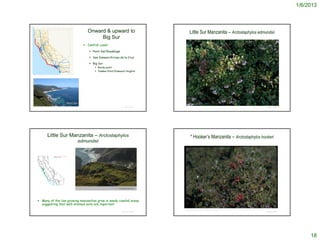
                                                                                    Onward & upward to                                              Little Sur Manzanita – Arctostaphylos edmundsii
                                                                                         Big Sur
                                                                              Central coast
                                                                                       Point Sal/Guadalupe

            *                                                                          San Simeon/Arroyo de la Cruz

                                                                                       Big Sur
                                                                                                Rocky point
                                                                                                Yankee Point/Diamond Heights
http://en.wikipedia.org/wiki/File:California_State_Route_1.svg


                                                          Point Sur                                                                            © 2007 Penny DeWind

                                                                                                                            © Project SOUND                                                         © Project SOUND


                        Little Sur Manzanita – Arctostaphylos                                                                                        * Hooker’s Manzanita – Arctostaphylos hookeri
                                                                      edmundsii


                                                                  http://slosson.ucdavis.edu/documents/2005-200610653.pdf


       Many of the low-growing manzanitas grow in sandy coastal areas,
        suggesting that well-drained soils are important
                                                                                                                                              Beatrice F. Howitt © California Academy of Sciences
                                                                                                                            © Project SOUND                                                         © Project SOUND


                                                                                                                                                                                                                           18
1/6/2013


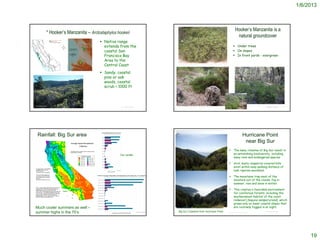
                                                                                                                                                                                                             Hooker’s Manzanita is a
                   * Hooker’s Manzanita – Arctostaphylos hookeri
                                                                                                                                                                                                              natural groundcover
                                                                                  Native range
                                                                                   extends from the                                                                                                       Under trees
                                                                                   coastal San                                                                                                            On slopes
                                                                                   Francisco Bay                                                                                                          In front yards - evergreen
                                                                                   Area to the                   http://absbonsai.org/gallery/displayimage.php?pid=834

                                                                                   Central Coast               http://128.253.177.181/imgs/dws/r/Ericaceae_Arctostaphylos_hookeri_18909.html


          http://www.elkhornsloughctp.org/factsheet/factsheet.php?SPECIES_ID=1    Sandy, coastal
                                                                                   pine or oak
                                                                                   woods, coastal
                                                                                   scrub < 1000 ft


© 1991 David Graber                                                                                                                                                                                           http://www.laspilitas.com/nature-of-california/plants/arctostaphylos-hookeri-wayside-manzanita
                                                                                            © Project SOUND    http://www.yerbabuenanursery.com/viewplant.php?pid=173                                                                                            © Project SOUND


    Rainfall: Big Sur area                                                                                                                                                                                                Hurricane Point
                                                                                                                                                                                                                           near Big Sur
                                                                                                                                                                                                         The many climates of Big Sur result in
                                                                                           Our rainfall                                                                                                   an astonishing biodiversity, including
                                                                                                                                                                                                          many rare and endangered species

                                                                                                                                                                                                         Arid, dusty chaparral-covered hills
                                                                                                              http://xasauantoday.com/2011/09/16/serra-hill/                                              exist within easy walking distance of
                                                                                                                                                                                                          lush riparian woodland.

                                                                                                                                                                                                         The mountains trap most of the
                                                                                                                                                                                                          moisture out of the clouds; fog in
                                                                                                                                                                                                          summer, rain and snow in winter.

                                                                                                                                                                                                         This creates a favorable environment
                                                                                                                                                                                                          for coniferous forests, including the
                                                                                                                                                                                                          southernmost habitat of the coast
                                                                                                                                                                                                          redwood (Sequoia sempervirens), which
                                                                                                                                                                                                          grows only on lower coastal slopes that
 Much cooler summers as well –                                                                                http://www.cs.berkeley.edu/~karthik/pics/2005-06-1-BigSur/web/html/dscf0076.html
                                                                                                                                                                                                          are routinely fogged in at night.
 summer highs in the 70’s                                                                   © Project SOUND    Big Sur Coastline from Hurricane Point                                            http://en.wikipedia.org/wiki/Big_Sur
                                                                                                                                                                                                                                                                 © Project SOUND


                                                                                                                                                                                                                                                                                                                    19
1/6/2013


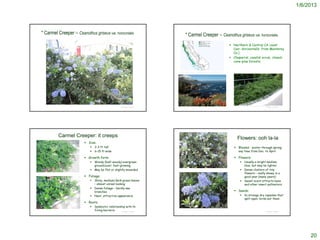
* Carmel Creeper – Ceanothus griseus var. horizontalis                           * Carmel Creeper – Ceanothus griseus var. horizontalis
                                                                                                                                                    Northern & Central CA coast
                                                                                                                                                     (var. horizontalis from Monterey
                                                                                                                                                     Co.)
                                                                                                                                                    Chaparral, coastal scrub, closed-
                                                                                                                                                     cone-pine forests.


                                                                           http://ucjeps.berkeley.edu/cgi-bin/get_JM_treatment.pl?6586,6589,6615


                                                                                                                                                      http://www.sb.watersavingplants.com/listplants.php?index=9
                                                      © Project SOUND   http://www.flickriver.com/photos/80651083@N00/tags/montereycounty/                                                               © Project SOUND


         Carmel Creeper: it creeps                                                                                                                       Flowers: ooh la-la
                          Size:
                               2-3 ft tall                                                                                                            Blooms: winter through spring:
                               6-15 ft wide                                                                                                               any time from Dec. to April

                          Growth form:                                                                                                                Flowers:
                               Woody (half-woody) evergreen                                                                                                        Usually a bright medium
                                groundcover; fast-growing                                                                                                            blue, but may be lighter
                               May be flat or slightly mounded                                                                                                     Dense clusters of tiny
                                                                                                                                                                     flowers – really showy in a
                          Foliage:                                                                                                                                  good year (many years)
                               Shiny, medium/dark green leaves                                                                                                     Sweet scent attracts bees
                                – almost unreal looking                                                                                                              and other insect pollinators
                               Dense foliage – hardly see
                                branches                                                                                                               Seeds:
                               Neat, attractive appearance                                                                                                         In strange dry capsules that
                                                                                                                                                                     split open; birds eat them
                          Roots:
                               Symbiotic relationship with N-
                                fixing bacteria    © Project SOUND                                                                                                                                       © Project SOUND


                                                                                                                                                                                                                                20
1/6/2013


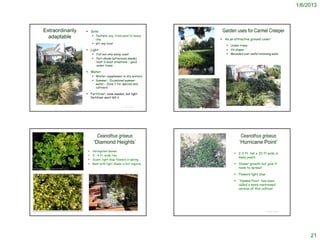
               Extraordinarily                           Soils:                                                                                       Garden uses for Carmel Creeper
                                                               Texture: any, from sand to heavy
                 adaptable                                      clay                                                                                   As an attractive ground cover:
                                                               pH: any local
                                                                                                                                                            Under trees
                                                         Light:                                                                                            On slopes
                                                                     Full sun only along coast                                                             Mounded over walls/retaining walls
                                                                     Part-shade (afternoon shade)
                                                                      best in most situations – good
                                                                      under trees

                                                         Water:
                                                               Winter: supplement in dry winters
                                                               Summer: Occasional summer
                                                                water – Zone 2 for species and
                                                                cultivars

                                                         Fertilizer: none needed, but light
                                                             fertilizer won’t kill it


                                                                                                                 © Project SOUND                                                      © Project SOUND


                                                                    Ceanothus griseus                                                                               Ceanothus griseus
                                                                  ‘Diamond Heights’                                                                                ‘Hurricane Point’
                                                              Variegated leaves
                                                                                                                                                                2-3 ft. tall x 20 ft wide in
                                                              3 - 4 ft. wide; low
                                                                                                                                                                 many years
                                                              Scant, light blue flowers in spring
                                                              Best with light shade in hot regions.                                                            Slower growth but give it
http://blog.jannelsonlandscapedesign.com/?cat=78                                                                                                                 room to spread

                                                                                                                                                                Flowers light blue

                                                                                                                                                                'Yankee Point' has been
                                                                                                                                                                 called a more restrained
                                                                                                                                                                 version of this cultivar.


                                                          http://thehumanfootprint.wordpress.com/2009/11/29/california-natives-part-3-groundcovers-
                                                                                                                 © Project SOUND                                                      © Project SOUND
http://www.bambooandmore.info/2012_01_09_archive.html     manzanitas-ceanothus/


                                                                                                                                                                                                             21
1/6/2013


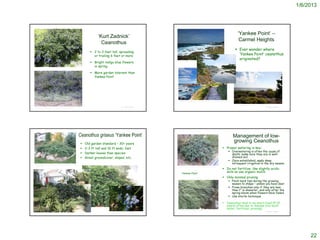
                                                                                                                                                                                                           ‘Yankee Point’ –
                                                                                ‘Kurt Zadnick’
                                                                                                                                                                                                            Carmel Heights
                                                                                  Ceanothus
                                                                                                                                                                                                         Ever wonder where
                                                                            2 to 3 feet tall, spreading
                                                                             or trailing 6 feet or more                                                                                                   ‘Yankee Point’ ceanothus
                                                                                                                                                                                                          originated?
                                                                            Bright indigo blue flowers           http://www.sawbuck.com/property/California/93923_Carmel/7659172-98-Yankee-Point


                                                                             in spring

                                                                            More garden tolerant than
                                                                             Yankee Point


                                                                                                                   http://www.carmelrealtycompany.com/index.cfm/person-Barbara_Ehrenpreis_11.htm


                                                                                                                                                                                                        http://www.sammcleod.com/properties/111YANKEEPOINT.html
                                                                                                © Project SOUND                                                                                                                                       © Project SOUND
http://www.landscaperesource.com/plants/ceanothus-kurt-zadnik.htm


                                                                    Ceanothus griseus ‘Yankee Point’                                                                                                  Management of low-
                                                                       Old garden standard – 30+ years
                                                                                                                                                                                                      growing Ceanothus
                                                                       2-3 ft tall and 10 ft wide; fast                                                                                    Proper watering is key:
                                                                                                                                                                                                    Overwatering is often the cause of
                                                                       Darker leaves than species                                                                                                   death; make sure they are in well-
                                                                       Great groundcover, slopes, etc.                                                                                              drained soil.
                                                                                                                                                                                                    Once established, apply deep
http://www.fresno.watersavingplants.com/eplant.php?plantnum=2419
                                                                                                                                                                                                     infrequent irrigation in the dry season.
4&return=l5_aS                                                                                                       http://www.cuyamaca.edu/oh170/Thumbnail_Pages/Ceanothus_griseus.asp
                                                                                                                                                                                            Do not fertilize; like slightly acidic
                                                                                                                      ‘Yankee Point’                                                         soils so use organic mulch
                                                                                                                                                                                            Only minimal pruning
                                                                                                                                                                                                    Pinch back tips during the growing
                                                                                                                                                                                                     season to shape – unless you have deer
                                                                                                                                                                                                    Prune branches only if they are less
                                                                                                                                                                                                     than 1” in diameter, and only after the
                                                                                                                                                                                                     spring bloom when flowers have faded.
                                                                                                                                                                                                    Use sterile technique

                                                                                                                                                                                              Ceanothus tend to be short-lived (5-15
                                                                                                                                                                                               years) often due to disease (too much
                                                                                                                                                                                               water, fertilizer, pruning)
                                                                                                                      http://oregonstate.edu/dept/ldplants/cegrhyp3.htm
                                                                                                © Project SOUND                                                                                                                                       © Project SOUND


                                                                                                                                                                                                                                                                             22
1/6/2013


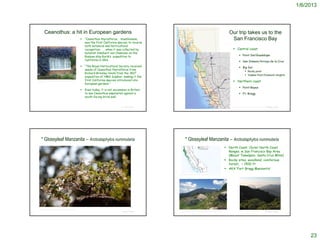
          Ceanothus: a hit in European gardens                                                                                                                                                     Our trip takes us to the
                                                                     “Ceanothus thyrisflorus, blueblossom,                                                                                         San Francisco Bay
                                                                      was the first California species to receive
                                                                      both botanical and horticultural
                                                                      recognition . . . when it was collected by                                                                                        Central coast
                                                                      botanist Adelbert von Chamisso on the
                                                                      Russian ship Rurik’s expedition to                                                                                                         Point Sal/Guadalupe
                                                                      California in 1816.                                                                                                                        San Simeon/Arroyo de la Cruz
                                                                     “The Royal Horticultural Society received                                                                                                  Big Sur
                                                                      seeds of Ceanothus thyrisflorus from
                                                                                                                                                                                                                          Rocky point
                                                                      Richard Brinsley Hinds from the 1837
                                                                                                                                                                                                                          Yankee Point/Diamond Heights
                                                                      expedition of HMS Sulphur, making it the
                                                                                                                    http://en.wikipedia.org/wiki/File:California_State_Route_1.svg


http://www.gardenaction.co.uk/plantfinder/ceanothus-california-       first California species introduced into                                                                                          Northern coast
                                                                      European gardens “
lilac_1.asp


                                                                                                                                                                                                                 Point Reyes
                                                                     Even today, it is not uncommon in Britain
                                                                      to see Ceanothus espaliered against a                                                                                                      Ft. Bragg
                                                                      south-facing brick wall.


                                                                                                 © Project SOUND                                                                                     http://swr.nmfs.noaa.gov/recovery/mapped93/index.php?p=dom-NCCC SOUND
                                                                                                                                                                                                                                                             © Project


    * Glossyleaf Manzanita – Arctostaphylos nummularia                                                                           * Glossyleaf Manzanita – Arctostaphylos nummularia
                                                                                                                                                                                                  North Coast, Outer North Coast
                                                                                                                                                                                                   Ranges, w San Francisco Bay Area
                                                                                                                                                                                                   (Mount Tamalpais, Santa Cruz Mtns)
                                                                                                                                                                                                  Rocky sites, woodland, coniferous
                                                                                                                                                                                                   forest, < 1500 ft
                                                                                                                                                                                                  AKA ‘Fort Bragg Manzanita’
                                                                                                                       http://ucjeps.berkeley.edu/cgi-bin/get_JM_treatment.pl?3449,3454,3510


http://www.baynatives.com/plants/Arctostaphylos-nummularia/
                                                                                                                                                                                                                   http://www.thevoiceofalliant.com/FunSun.html
                                                                                                 © Project SOUND         http://www.parksconservancy.org/visit/park-sites/mount-tamalpais.html                                                              © Project SOUND


                                                                                                                                                                                                                                                                                   23
1/6/2013


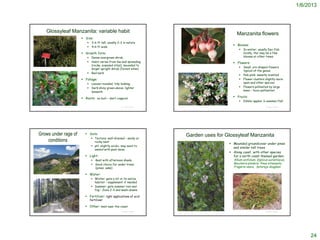
                      Glossyleaf Manzanita: variable habit                                                                                                                                  Manzanita flowers
                                                                     Size:
                                                                            2-6 ft tall; usually 2-3 in nature
                                                                                                                                                                                       Blooms:
                                                                            4-6 ft wide
                                                                                                                                                                                                      In winter; usually Dec-Feb
                                                                     Growth form:                                                                                                                     locally, tho’ may be a few
                                                                            Dense evergreen shrub                                                                                                     blooms at other times
                                                                            Habit varies from low and spreading                                                                       Flowers:
                                                                             (rocky, exposed sites), mounded to             © 2006 Steve Matson
                                                                                                                                                                                                      Small, urn-shaped flowers
   © 2006 Steve Matson
                                                                             larger upright shrub (forest sites)
                                                                                                                                                                                                       typical of the genus
                                                                            Red bark
                                                                                                                                                                                                      Pale pink; sweetly scented
                                                                     Foliage:                                                                                                                        Flower clusters slightly more
                                                                            Leaves rounded, tidy looking                                                                                              open and other species
                                                                            Dark shiny green above; lighter                                                                                          Flowers pollinated by large
                                                                             beneath                                                                                                                   bees – ‘buzz pollination’

                                                                     Roots: no burl – don’t coppice!                                                                                  Fruits:
                                                                                                                                                                                                      Edible ‘apples’ in summer/fall
http://en.wikipedia.org/wiki/File:Arctostaphylos_nummularia_1.jpg                                   © Project SOUND   http://www.baynatives.com/plants/Arctostaphylos-nummularia/                                                    © Project SOUND


        Grows under rage of                                            Soils:
                                                                                                                                  Garden uses for Glossyleaf Manzanita
                                                                              Texture: well-drained – sandy or
            conditions                                                         rocky best
                                                                                                                                                                                     Mounded groundcover under pines
                                                                              pH: slightly acidic; may want to
                                                                                                                                                                                      and similar tall trees
                                                                               amend with peat moss
                                                                                                                                                                                     Along coast, with other species
                                                                       Light:                                                                                                        for a north coast themed garden:
                                                                                Best with afternoon shade                                                                            Allium unifolium, Diplicus aurantiacus,
                                                                                Good choice for under trees                                                                          Baccharis pilularis, Pinus attenuata,
                                                                                 (pines; oaks)                                                                                        Fragaria vesca, Satureja douglasii

                                                                       Water:
                                                                              Winter: gets a lot in its native
   © 2004 Aaron Schusteff
                                                                               habitat – supplement if needed
                                                                              Summer: gets summer rain and
                                                                               fog – Zone 2-3 and wash-downs

                                                                       Fertilizer: light applications of acid
                                                                            fertilizer

                                                                       Other: best near the coast
                                                                                                                                                                                      © Br. Alfred Brousseau, Saint Mary's College
                                                                                                    © Project SOUND                                                                                                                  © Project SOUND
                                                                                                                      © 2004 Aaron Schusteff


                                                                                                                                                                                                                                                            24
1/6/2013


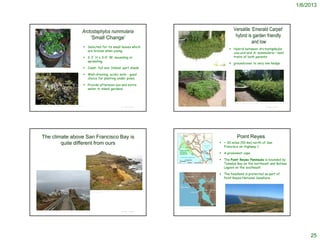
                                                                                          Arctostaphylos nummularia                                                                                                                                 Versatile ‘Emerald Carpet’
                                                                                              ‘Small Change’                                                                                                                                         hybrid is garden friendly
                                                                                                                                                                                                                                                              and low
                                                                                             Selected for its small leaves which
                                                                                                                                                                                                                                              Hybrid between Arctostaphylos
                                                                                              are bronze when young.
                                                                                                                                                                                                                                               uva-ursi and A. nummularia – best
                                                                                             2-3' H x 3-4' W; mounding or                                                                                                                     traits of both parents
                                                                                              spreading
                                                                                                                                                                                                                                              groundcover to very low hedge
                                                                                             Coast: full sun; Inland: part shade

                                                                                             Well-draining, acidic soils - good
                                                                                              choice for planting under pines.

                                                                                             Provide afternoon sun and extra
                                                                                              water in inland gardens.


                                                                                                                                                                                                                                                       http://www.pasadena.watersavingplants.com/eplant.php?plantnum=243&return=l8_aK

http://www.theodorepayne.org/mediawiki/index.php?title=Arctostaphylos_nummularia_'Small_Change'
                                                                                                                                                      © Project SOUND                                                                                                                                  © Project SOUND


          The climate above San Francisco Bay is                                                                                                                                                                                                           Point Reyes
                  quite different from ours                                                                                                                                                                                            ~ 30 miles (50 km) north of San
                                                                                                                                                                                                                                        Francisco on Highway 1

                                                                                                                                                                                                                                       A prominent cape

                                                                                                                                                                                                                                       The Point Reyes Peninsula is bounded by
                                                                                                                                                                                                                                        Tomales Bay on the northeast and Bolinas
                                                                                                                                                                                                                                        Lagoon on the southeast.

                                                                                                                                                                                                                                       The headland is protected as part of
                                                                                                                                                                                                                                        Point Reyes National Seashore.


                                                                                                  http://angrylambie-landscapes.buzznet.com/user/photos/wildflowers-northern-california-
                                                                                                  coast/?id=66160771


                                                                                                                                                                                           http://en.wikipedia.org/wiki/Point_Reyes

 http://en.wikipedia.org/wiki/Point_Reyes                                                                                                             © Project SOUND                                                                                                                                  © Project SOUND
                                                                                                                                                                                                                                          http://en.wikipedia.org/wiki/Point_Reyes


                                                                                                                                                                                                                                                                                                                                             25
1/6/2013


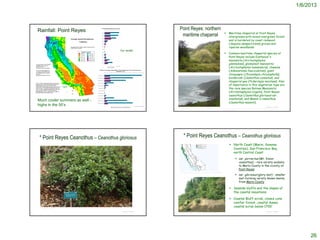
Rainfall: Point Reyes                                     Point Reyes: northern
                                                                                                                                             Maritime chaparral at Point Reyes
                                                           maritime chaparral                                                        
                                                                                                                                             intergrades with mixed evergreen forest
                                                                                                                                             and is bordered by coast redwood
                                                                                                                                             (Sequoia sempervirens) groves and
                                                                                                                                             riparian woodlands
                                      Our rainfall
                                                                                                                                            Common maritime chaparral species at
                                                                                                                                             Point Reyes include Eastwood's
                                                                                                                                             manzanita (Arctostaphylos
                                                                                                                                             glandulosa), glossyleaf manzanita
                                                                                                                                             (Arctostaphylos nummularia), chamise
                                                                                                                                             (Adenostoma fasciculatum), giant
                                                                                                                                             chinquapin (Chrysolepis chrysophylla),
                                                          http://www.meetup.com/bay-areakayakers/events/12581031/


                                                                                                                                             buckbrush (Ceanothus cuneatus), and
                                                                                                                                             chaparral pea (Pickeringia montana). Also
                                                                                                                                             of importance in this vegetation type are
                                                                                                                                             the rare species Bolinas Manzanita
                                                                                                                                             (Arctostaphylos virgata), Point Reyes
                                                                                                                                             ceanothus (Ceanothus gloriosus var.
Much cooler summers as well -                                                                                                                exaltatus), and Mason's ceanothus
                                                                                                                                             (Ceanothus masonii).
highs in the 50’s                      © Project SOUND                                                                                                                                                     © Project SOUND
                                                         http://www.math.cmu.edu/~pikhurko/Gallery/110320PointReyes/33.html         http://roadjournals.viamagazine.com/2012/01/17/point-reyes-national-seashore-
                                                                                                                                    hiking-tamales-point-trail/


 * Point Reyes Ceanothus – Ceanothus gloriosus                  * Point Reyes Ceanothus – Ceanothus gloriosus
                                                                                                                                              North Coast (Marin, Sonoma
                                                                                                                                               Counties), San Francisco Bay,
                                                                                                                                               north Central Coast
                                                                                                                                                        var. porrectus (Mt. Vision
                                                                                                                                                         ceanothus) - rare variety endemic
                                                                                                                                                         to Marin County in the vicinity of
                                                                                                                                                         Point Reyes
                                                            http://ucjeps.berkeley.edu/cgi-bin/get_JM_treatment.pl?6586,6589,6608

                                                                                                                                                        var. gloriosus (glory mat) - smaller
                                                                                                                                                         mat-forming variety known mainly
                                                                                                                                                         from Marin County

                                                                                                                                              Seaside bluffs and the slopes of
                                                                                                                                               the coastal mountains

                                                                                                                                              Coastal Bluff scrub, closed cone
                                                                                                                                               conifer forest, coastal dunes,
  © 2006 Steve Matson
                                                                                                                                               coastal scrub below 1700'
                                       © Project SOUND                                                                                                                                                     © Project SOUND
                                                          http://picasaweb.google.com/lh/photo/8u9p--NTHGj834b-n31gzg


                                                                                                                                                                                                                                  26
1/6/2013


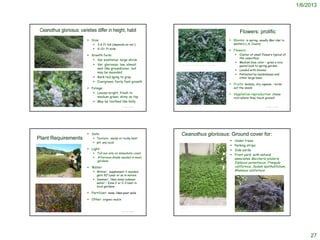
       Ceanothus gloriosus: varieties differ in height, habit                                                                                                                                                                      Flowers: prolific
                                                                                          Size:                                                                                                                          Blooms: in spring, usually Mar-Apr in
                                                                                                2-6 ft tall (depends on var.)                                                                                               western L.A. County
                                                                                                6-12+ ft wide
                                                                                                                                                                                                                          Flowers:
                                                                                          Growth form:                                                                                                                           Cluster of small flowers typical of
                                                                                                                                                                                                                                   the ceanothus
                                                                                             Var exaltatus: large shrub
                                                                                                                                                                                                                                  Medium blue color – gives a nice
                                                                                             Var. gloriosus: low, almost            http://www.easybloom.com/plantlibrary/plant/point-reyes-creeper
                                                                                                                                                                                                                                   pastel look to spring garden
http://beling.net/articles/about/Ceanothus_gloriosus                                          mat-like groundcover, but                                                                                                           Loaded with blooms
                                                                                              may be mounded
Gary A. Monroe @ USDA-NRCS PLANTS Database

                                                                                                                                                                                                                                  Pollinated by bumblebees and
                                                                                             Bark red aging to gray                                                                                                               other large bees
                                                                                             Evergreen; fairly fast growth
                                                                                                                                                                                                                          Fruits: knobby, dry capsule – birds
                                                                                          Foliage:                                                                                                                          eat the seeds
                                                                                             Leaves bright, fresh to                                                                                                     Vegetative reproduction: stems
                                                                                               medium green, shiny on top                                                                                                    root where they touch ground
                                                                                             May be toothed like holly
                                                                                                                                      http://oregonstate.edu/dept/ldplants/cegl2a.htm
                                                                                                                   © Project SOUND                                                                                                                                           © Project SOUND


                                                                                          Soils:                                        Ceanothus gloriosus: Ground cover for:
  Plant Requirements                                                                          Texture: sandy or rocky best
                                                                                                                                                                                                                            Under trees
                                                                                              pH: any local
                                                                                                                                                                                                                            Parking strips
                                                                                          Light:                                                                                                                           Side yards
                                                                                                Full sun only on immediate coast
                                                                                                                                                                                                                            Front yard: with natural
                                                                                                Afternoon shade needed in most                                                                                              associates Baccharis pilularis,
                                                                                                 gardens
                                                                                                                                                                                                                             Diplacus aurantiacus, Frangula
                                                                                          Water:                                                                                                                            californica, Sedum spathulifolium,
                                                                                              Winter: supplement it needed;                                                                                                 Rhamnus californica
                                                                                               gets 30”/year or so in nature
                                                                                              Summer: likes some summer
   http://atlantis.mendocino.edu/jxerogeanes/Plant%20ID2/Forms/DispForm.aspx?ID=301&Ro
   otFolder=%2Fjxerogeanes%2FPlant%20ID2%2FWeek%207

                                                                                               water – Zone 2 or 2-3 best in
                                                                                               local gardens

                                                                                          Fertilizer: none; likes poor soils

                                                                                          Other: organic mulch

                                                                                                                                        http://www.metrofieldguide.com/portfolio/flowering/ceanothusgloriosus/ceanothu
                                                                                                                                        sgloriosus.htm
                                                                                                                                                                                                                              http://www.wallyhood.org/wp-content/uploads/2011/05/IMG_1727.jpg
                                                                                                                   © Project SOUND                                                                                                                                           © Project SOUND


                                                                                                                                                                                                                                                                                                      27
1/6/2013


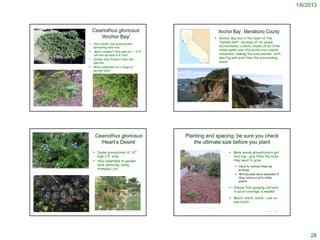
                                                                                              Ceanothus gloriosus                                                                                                                       ‘Anchor Bay’, Mendecino County
                                                                                                 'Anchor Bay'                                                                                                                       Anchor Bay lies in the heart of the
                                                                                             Very dense, low-growing and
                                                                                                                                                                                                                                     "banana belt", because of its unique
                                                                                              spreading selection                                                                                                                    microclimate; a warm column of air from
                                                                                              More compact than species: ~ 2 ft
                                                                                                                                                                                                                                     inland spills over the protective coastal
                                                                                              tall and spreads 6-8 feet.                                                                                                             mountains, making the area warmer, with
                                                                                             Darker blue flowers than the
                                                                                                                                                                                                                                     less fog and wind than the surrounding
                                                                                              species.                                                                                                                               areas.
 http://www.smgrowers.com/products/plants/plantdisplay.asp?plant_id=1755
                                                                                             More adaptable to a range of
                                                                                              garden soils


 http://www.yerbabuenanursery.com/images/new_botimages/large/0102_j.jpg                                                                    © Project SOUND                                                                                                                                      © Project SOUND
   http://www.flickr.com/photos/70207652@N00/page8/                                                                                                                                                                http://www.california-blog.com/photos-information-places/tag/anchor-bay-ca


                                                                                               Ceanothus gloriosus                                                                Planting and spacing: be sure you check
                                                                                                 ‘Heart’s Desire’                                                                    the ultimate size before you plant
                                                                                               Dense groundcover 6"-12"                                                                                                                                     Many woody groundcovers get
                                                                                                high x 5' wide                                                                                                                                                very big – give them the room
                                                                                               Very adaptable to garden                                                                                                                                      they need to grow
                                                                                                soils, watering, being                                                                                                                                                 Hard to contain them by
                                                                                                trampled, etc.                                                                                                                                                          pruning
http://www.laspilitas.com/nature-of-california/plants/ceanothus-gloriosus-hearts-desire

                                                                                                                                                                                                                                                                       Will become more mounded if
                                                                                                                                                                                                                                                                        they interact with other
                                                                                                                                                                                                                                                                        plants

                                                                                                                                                                                                                                                             Choose fast-growing cultivars
                                                                                                                                                                                                                                                              if quick coverage is needed

                                                                                                                                                                                                                                                             Mulch, mulch, mulch – and re-
                                                                                                                                                                                                                                                              new mulch
                                                                                                                                                                              http://tmousecmouse.blogspot.com/2011/10/planting-time-plant-sale-time.html


                                                                                               http://thehumanfootprint.wordpress.com/2009/11/29/california-natives-part-3-
                                                                                                                                          © Project SOUND                                                                                                                                       © Project SOUND
                                                                                               groundcovers-manzanitas-ceanothus/


                                                                                                                                                                                                                                                                                                                       28
1/6/2013


Why did my groundcover plant grow so                                                                                                                          Jug Handle State Park
tall? It was supposed to be short!!!!@@@                                                                                                                      provides some answers
                                                                                                                                                    S. of Ft. Bragg
                   Genetic dwarfs
                                                                                                                                                    Each of five ancient terraces
                   Plants stunted by environmental
                                                                                                                                                     represents one stage in a
                    conditions
                                                                                                                                                     progression of successional
                        Wind
                                                                                                                                                     environments.
                        Salt spray/salty soils
                        Sandy soils                                                                                                                Terraces formed at intervals of
                        Low soil fertility - serpentine                                                                                             approximately 100,000 years and
                        Acidic soils                                                                                                                involved about 100 feet of uplift
                        ‘shallow soils’ – close to bedrock or                                                                                       to form each of the terraces.
                         hardpan
                                                                                                                                                    Provides a rare opportunity to
                        Herbivory – ‘animal pruning’
                                                                                                                                                     view ecological succession and
                   A combination of genetic and                                                                                                     landscape evolution in a CA
                    environmental causes                                                                                                             coastal environment.
                                                                                                                              http://www.fire.ca.gov/resource_mgt/downloads/reports/FinalReportD
                                                 © Project SOUND                                                              escriptionAndInterpretation.pdf                                      © Project SOUND


                             Some terraces include                             Soil chemistry and effect on plant growth
 But there’s more…..          pygmy forest communities –
                              right next to the same                                                                                Analyses of pygmy forest soils show low levels
                              species that are of normal                                                                             of macro— and micro—nutrients, and high
                              size                                                                                                   levels of exchangeable aluminum, which limits
                                                                                                                                     the ability of plants to grow. Low pH
                             This allows us to see the                                                                              conditions support formation of an iron
                              effect of specific aspects                                                                             hardpan, preventing the trees from setting
                              of the environment that are                                                                            deep roots and preventing internal drainage of
                                                                                                                                     soil water.
                              associated with stunted                 http://en.wikipedia.org/wiki/Pygmy_forest


                              growth
                                                                                                                                    As a result, the pine trees in the area are
                             In this case, there are                                                                                rarely more than three or four feet high, in a
                              several factors:                                                                                       sort of natural bonsai effect. Many of the
                                   Shallow soils                                                                                    tree trunks, though only an inch thick, contain
                                   Low pH
                                                                                                                                     80 or more growth rings. Only yards away, but
                                                                                                                                     with younger soils, the same species of tree
                                   Nutrient depletion
                                                                                                                                     grows many dozens of feet high.
                                   High levels of Aluminum

                                                                   http://www.everystockphoto.com/photo.php?imageId=3410677


                                                 © Project SOUND                                                                                                                                   © Project SOUND


                                                                                                                                                                                                                          29
1/6/2013


                Lessons from the Central & N. Coast                                                                               Summary: Envi stresses
                                                                                                                                            Decreased mineral nutrition
                                                                                                                                               Nutrient-poor soils
                                                                                     Plants tend to be shorter;                                   Leached/sandy
                                                                                      growth habit                                                 Just poor nutrient value – sepentine
                                                                                                                                                   Competition (with weeds and other
                                                                                     Overall moisture requirements                                 plants)
                                                                                                                                               Factors effecting root growth
                                                                                     Moisture patterns                                            Shallow soils
                                                                                                                                                   Soils at pH extremes
                                                                                                                                                   Soil water extremes
                                                                                     Soils
                                                                                                                                            Other stresses
                                                                                                                                               Repeated injury:
                                                                                                                                                     Herbivory
                                                                                                                                                     Disease
                                                                                                                                                     Pruning/bonsai
                                                                                                                                                     Wind/blowing sand
                                                                                                                                                     Salt
http://www.mrfs.net/trips/2005/Northern_California/Redwood_Coast/Redwood_Coast.ht
ml                                                                                                                                                   Air pollution
                                                                                                          © Project SOUND                                                  © Project SOUND


       We hope you’ve enjoyed our trip up the coast


                                                                                                                            Be a part of ‘Mother Nature’s Backyard
http://www.bon-voyage.co.uk/destinations/california_holidays/itineraries                                  © Project SOUND                                                  © Project SOUND


                                                                                                                                                                                                  30

Low Groundcovers - Notes

  • 1.
    1/6/2013 Out of the Wilds and Into Your Garden Low and Northerly: Groundcover Plants from the Northern and Central CA Coast C.M. Vadheim and T. Drake CSUDH & Madrona Marsh Preserve Gardening with Western L.A. County Native Plants Madrona Marsh Preserve Project SOUND – 2012 (our 8th year) February 4 & 7, 2012 © Project SOUND © Project SOUND What makes a good groundcover plant? The California coast has inspired for centuries  Low growth habit  Evergreen – nice color  Dense foliage – few gaps  Fast growth to mature size – then slow  Long-lived  Flowers, fruits and other features that make it good habitat  And, for today’s subject, should be woody (or at least half-woody) http://www.destination360.com/north-america/us/california/northern-coast © Project SOUND http://www.bon-voyage.co.uk/destinations/california_holidays/itineraries © Project SOUND 1
  • 2.
    1/6/2013 But the CA coast inspires gardeners for a Some of our best native groundcovers come from different reason… the N. & Central California coast http://blog.travelpod.com/travel-photo/ranlo/2/1279124248/northern-california-coast.jpg/tpod.html © Br. Alfred Brousseau, Saint Mary's College © Project SOUND © Project SOUND Central &  ZONE 16: Central and Northern Sunset Zones California Coast thermal belts N. Maritime  Thermal belts (slopes from which cold Chaparral air drains) in a coastal climate  Ocean dominated about 85 % of the  “within the zone of time and by inland weather about 15% summer fog incursion”  A summer afternoon wind  More summer heat than Zone 17;  Features: warmer winters than inland  greater exposure to  Cooler summers than Zones 22-24 summer fog, humidity  ZONE 17: Marine effects in  mild temps. and Southern Oregon, Northern and moderate drought Central California pressures  Mild, wet, almost frostless winters;  adaptations to cool summers w/ frequent fog or wind. different  Muted sunlight much of the year disturbance regimes (less frequent fire). http://www.digitalseed.com/gardener/climate/plantclimate_map_ca.html  Summer highs ~ 65-70º F © Project SOUND © Project SOUND http://www.elkhornsloughctp.org/reference/subissue_detail.php?SUBISSUE_ID=1 2
  • 3.
    1/6/2013 Let’s take a road Our Central and Northern Coastal areas a trip up Hwy 1 unique in many ways  Central coast  Point Sal/Guadalupe  San Simeon/Arroyo de la Cruz  Big Sur  Rocky point  Yankee Point/Diamond Heights  Northern coast  Point Reyes http://en.wikipedia.org/wiki/File:California_State_Route_1.svg  Ft. Bragg © Project SOUND © Project SOUND  Arctostaphylos andersonii We share some plants with the Central Manzanitas of the  A. canescens  A. crustacea and Northern Maritime chaparral northern maritime  Arctostaphylos cruzensis chaparral  A. edmundsii  Black sage – Salvia mellifera  A. glutinosa  Purple Sage – Salvia leucophylla  A. hookeri hearstiorum  Sticky Monkeyflower – Diplacus  A. hookeri hookeri aurantiacus Many of these species are  A. montaraensis  Blue-eyed Grass – Sisyrinchium rare or endangered in the  A. montereyensis bellum wild, but grown regularly in  A. morroensis  Some grasses - Nassellas the garden  A. nummularia sensitiva  Many native wildflowers  A. ohlone pro. sp.  A. pajaroensis  A. pumila  A. purissima  A. silvicola © Project SOUND  A. tomentosa (all ssp &Prforms) © SOUND 3
  • 4.
    1/6/2013 Not surprisingly, our local flora has the most in California rainfall – quite a range, even common with that of the Central Coast along our coasts  The closer the native home of a plant to our own, the more similar are the:  Soils  Temperatures http://www.abovetopsecret.com/forum/thread775456/pg2 http://coast-santabarbara.org/  Rainfall  Etc  Plants from nearby coastal areas are easier to grow than those from further up the coast © Project SOUND © Project SOUND Our first stop: Point Sal Home to a unique flora  Located in the northwestern part of  Transition zone between N. & S. Santa Barbara County, near the city CA: unique plant species of Guadalupe assemblages.  Between Vandenberg Air Force Base  A mosaic of coastal sage scrub and the Guadalupe Dunes. and foothill needle-grass with  Sandy/rocky promontory wildflowers, Giant Corepopsis  Much influenced by ocean * http://kcbx.net/~bdenneen/ breezes, salt spray – like our own immediate coast http://www.cityprofile.com/california/photos/36781-guadalupe-point-sal-state-beach1.html http://www.localhikes.com/HikeData.ASP?DispType=1&ActiveHike=0&GetHikesStateID=&ID=42 © Project SOUND © Project SOUND 66 http://soundwaves.usgs.gov/2001/09/fieldwork2.html http://www.ryono.net/pointsal/pointsal.html http://blogbisogno.wordpress.com/2009/08/page/2/ 4
  • 5.
    1/6/2013 Salvia leucophylla ‘Pt. We continue our Sal Spreader’ road trip up Hwy 1  Central coast  Naturally occurring variants from Point Sal  Point Sal/Guadalupe  San Simeon/Arroyo de la Cruz  Look like Purple Sage except usually shorter (2-3 ft) http://www.sm.watersavingplants.com/eplant.php?plantnum=24489&return=l2_aO  Very variable in size, depending on water, other * conditions  Purple Sage cultivars & hybrids may be easier to http://en.wikipedia.org/wiki/File:California_State_Route_1.svg grow than the species © Project SOUND © Project SOUND Hearst Castle – San Simeon Hearst/San Simeon Coast/ Arroyo de la Cruz  Old ocean beaches and bluffs  The soil varies from a near adobe through red clay on hard pan to a gray sand-rock composite.  It receives summer fog and rainfall of about 20-30 inches/yr  It is one of the most moderate climates in the world. Every day has a high of 60-65 degrees F. and a low of 50 degrees F. http://www.nordicgeospatial.com/about_us http://www.californiacoastline.org/cgi- http://www.coastandocean.org/coast_v23_no3_2007/articles/Hiking_Hearst_04.htm © Project SOUND bin/location.cgi?flags=0&year=current&latdeg=35.591167&longdeg=121.131667 © Project SOUND http://justinsomnia.org/2006/09/driving-down-the-big-sur-coast/ 5
  • 6.
    1/6/2013 Rainfall: Central Coast The Arroyo de la Cruz region: special Our rainfall © 2011 Chris Winchell Mouth of Arroyo de la Cruz, ridge immediately south of creek, east of Hwy 1 (San Much cooler summers as well Luis Obispo County, California, US) © Project SOUND © Project SOUND Arroyo de la Cruz has also provided us Arroyo de la Cruz – unique conditions = some wonderful garden cultivars unique plants  A variety of communities, chaparral, coastal sage scrub,  Sisyrinchium bellum riparian and grassland, mark this unique area. Its importance 'Arroyo de la Cruz‘ lies in the number of endemics that are found in this relatively small area; indeed, it has been called the "Cruzian  Ceanothus thyrsiflorus pocket of endemism." var. thyrsiflorus  Ten species of plants considered rare or endangered are 'Arroyo de la Cruz‘ found here. Most have a restricted range.  It is the type locality of at least two species, Arctostaphylos  Ceanothus maritimus hookeri ssp. hearstiorum and Ceanothus hearstiorum which are 'Valley Violet‘ http://www.flickriver.com/photos/billbouton/sets/72157603552645540/ found nowhere else.  Other rare species include Allium hickmanii, Arctostaphylos cruzensis, Bloomeria humilis, Calochortus clavatus ssp. recurvfolius, Campanula obispoensis (?), Ceanothus maritimus, Sanicula hoffmannii and Sanicula maritima. © Project SOUND © Project SOUND 6
  • 7.
    1/6/2013 * Arroyo de la Cruz Manzanita – * Arroyo de la Cruz Manzanita – Arctostaphylos cruzensis Arctostaphylos cruzensis  Endemic to coastal areas from northwest San Luis Obispo Co. to Southern Monterey Co.  Grows on old ocean beaches and bluffs  Occurs in a variety of habitats, including maritime chaparral, coastal scrub, conifer forest, and valley-foothill grassland.  Receives summer fog/rainfall of 20-30” per year http://ucjeps.berkeley.edu/cgi-bin/get_JM_treatment.pl?3449,3454,3466 © 2011 Chris Winchell © Project SOUND © 2011 Chris Winchell © Project SOUND http://www.laspilitas.com/nature-of-california/plants/arctostaphylos-cruzensis Low-growing Manzanitas: Ground cover manzanita perfect for your garden?  Size:  2-3 ft tall  Attractive, ‘neat-looking’ foliage  5-10 ft wide ©J.S. Peterson  Red bark on interesting  Growth form: trunks/branches  Spreading, low : mat-like to  Low-maintenance under the right http://www.laspilitas.com/nature-of-california/plants/arctostaphylos-cruzensis mounded conditions:  Shreddy red bark  Needs good drainage  Dense – good coverage  Low water in summer - susceptible to fungal diseases; deep watering  Foliage: (Zone 1/2)  Leaves bright green, shiny; Jo-Ann Ordano © California Academy of Sciences  No fertilizer may be hairy when young  Densely over-lapping on Flammable: manzanita plants contain  Coastal varieties will thrive along branch volatile compounds, which burn like a immediate coast – even right next torch when ignited – no a good choice to beach  Roots: no basal burl – so can’t for fire-prone areas re-sprout © Project SOUND © Project SOUND 7
  • 8.
    1/6/2013 Who can resist a  Soils: Central coast plant  Texture: adaptable – sandy soils in manzanita in bloom? nature  pH: any local – 6.0-8.0  Blooms:  Light:  Winter/early spring  Full sun only right along coast  Usually Dec-Feb in S. Bay  Afternoon shade in most gardens; remember, average temperatures  Flowers: cooler (60-65º F. where it’s native) © 2006 Steve Matson  Small, urn-shaped flowers typical of manzanita  Water:  Pale pink blush  Winter: good winter rains  Large clusters – very showy  Summer:  Sweet scent  Needs supplemental summer water – Zone 2 to 2-3  Fruits:  Needs leaves washed down during  The edible ‘little apples’ dry summer – remember the summer fogs  Hairy, ½ inch diameter; ripe in late summer or fall  Other: shouldn’t need much pruning; © Project SOUND sterile technique, after blooming © Project SOUND © 2002 David Graber Good looking Why the variability in growth habit? evergreen shrub  Used as an evergreen woody ground cover – substitute for ivy  Good for slopes  Pair with its native associates for an evergreen medley:  Ceanothus hearstiorum © 2011 Chris Winchell © 2006 Steve Matson http://www.laspilitas.com/nature-of-california/plants/arctostaphylos-cruzensis  Ceanothus thyrsiflorus Tilden Botanical Garden  Ceanothus griseus Regional Parks Botanic  Adenostoma fasciculatum Garden is a botanical garden in Tilden Park, Berkeley CA USA  Iris douglasii  Baccharis pilularis  Salvia mellifera  Diplacus aurantiacus http://en.wikipedia.org/wiki/Arctostaphylos_cruzensis © Project SOUND © Project SOUND 8
  • 9.
    1/6/2013 Some species occur along the entire CA coast Western Blue-eyed Grass - Sisyrinchium bellum http://www.flickr.com/photos/mechanoid_dolly/5682527020/ © Project SOUND Sisyrinchium bellum Western Blue-eyed Grass - Sisyrinchium bellum 'Arroyo de la Cruz'  Not a grass at all – a  Dwarf selection - ~ 6 inches member of the Iris tall family (smallest  Unusually large--1 1/2 inch member of the Iris wide--purple flowers in spring family) http://www.yerbabuenanursery.com/viewplant.php?pid=1292  Flowers a vivid purple flowers  Distribution: Much of are held a bit above the 6 inch CA, OR high foliage clump.  Habitat:  Useful in a dry border, on a bank, and in a rock garden.  Open, generally moist, North/Central coast areas have produced grassy areas some attractive variants – now available as  Woodlands cultivars for the garden © Project SOUND http://www.flickr.com/photos/eastbaywilds/5712113309/ 9
  • 10.
    1/6/2013 Other sisyrinchium cultivars Seaside Daisy - Erigeron glaucus  ‘Rocky Point’  Dwarf habit, with broader leaves and violet blossoms Rocky Point, Big Sur http://nativeson.typepad.com/plants/2010/05/sisyrinchi um-bellum-rocky-point.html  ‘Ft. Bragg’  Dwarf habit, with broader leaves  Soft lavender in color, with violet centers http://www.city-data.com/picfilesv/picv20278.php Cliffs near Ft. Bragg http://www.flickr.com/photos/dreedyphoto/page6/ © Project SOUND © Project SOUND Two California Daisys Seaside Daisy – Erigeron glaucus  E. foliosus (Leafy):  Compact growth habit: < 1 ft Erigeron foliosus  Mountain ranges & hills of C.  Leaves: & western S. CA  Dry, sunny, rocky, brushy or  Thicker, fleshier wooded or grassy slopes  Larger: spatula shaped  coastal sage scrub, chaparral and southern oak woodland  More basal  Roots:  E. glaucus (Seaside)  Rhizomes  Central to N. Coast (into OR)  Plant spreads into dense  Coastal bluffs, dunes, mat-like colony Erigeron glaucus beaches http://www.calhortsociety.org/seed-exchange/seed-exchange-2002/seed-list-pages/large/Erigeron-glaucus-2.jpg  Coastal Strand, Coastal Sage  Flowers: no differences Scrub, Northern Coastal Scrub Much more “lush appearing” than leafy fleabane © Project SOUND © Project SOUND 10
  • 11.
    1/6/2013  Borders Horticultural cultivars of Using Erigeron Seaside Daisy  Edges & low hedges glaucus  Accent plant  Variable in size and number of flowers and plant  In a rock garden  Choose the one you like best  Near pools & ponds http://www.mostlynatives.com/notes/erigeronglaucuscs.jpg  Ground cover ‘Cape Sebastian’ cultivar http://www.elnativogrowers.com/Photographs_page/eriglasb.htm http://www.laspilitas.com/plants/pictures/a269.jpg ‘Sea Breeze’ cultivar Great addition to a North coast http://www.callutheran.edu/Academic_Programs/Departments/ Biology/Wildflowers/gf/plants/category/gar-1670.htm http://www.smgrowers.com/products/plants/plantdisplay.asp?plant_id=2213 themed garden ‘Olga’ cultivar ‘Bountiful’ cultivar © Project SOUND © Project SOUND Ceanothus – California Lilacs Ceanothus of the northern maritime chaparral  Some 55 species  Common names: California Lilac, Mountain lilac,  Ceanothus cuneatus var. Wild lilac, Buckbrush, Blueblossum fascicularis  Quite variable in habit:  Ceanothus cuneatus var. rigidus  evergreen and deciduous  Ceanothus gloriosus var. gloriosus  prostrate to erect shrubs and small trees.  Ceanothus gloriosus var. exaltatus  Flowers small, in clusters, showy en masse  Ceanothus gloriosus var.  Flower color: white through many shades of blue, deep violet. porrectus  Ceanothus hearstiorum  Range: southern Canada to Guatemala  Ceanothus maritimus  Mainly in California (over 40 species)  Some also in the eastern US and Rocky Mountains.  Have the ability to fix large amounts of nitrogen via root-inhabiting microbes (actinomycetes). © Pr SOUND © Project SOUND 11
  • 12.
    1/6/2013 Ceanothus thyrsiflorus var. * Hearst’s (San Simeon) Ceanothus – thyrsiflorus 'Arroyo de la Cruz' Ceanothus hearstiorum  Bright shiny leaves  Medium-blue flowers  Large mounding shrub or http://www.laspilitas.com/nature-of-california/plants/ceanothus- thyrsiflorus-big-sur-california-lilac groundcover, great for erosion control or a low, broad hedge.  Best with a little summer water and afternoon shade in our climate http://commons.wikimedia.org/wiki/Ceanothus_hearstiorum © Project SOUND © Project SOUND http://plantayflor.blogspot.com/2010/09/ceanothus-thyrsiflorus-var-repens.html * Hearst’s Ceanothus – Ceanothus hearstiorum Hearst’s Ceanothus – low grower  Central coast endemic – San Luis  Size: Obispo & Monterrey counties – near  generally < 1 ft tall Arroyo de la Cruz; very rare in nature  3-6 ft wide  Coastal, low, grassy hills  Growth form:  Receives summer fog/rainfall of 20-  Evergreen woody (half-woody) 30” per year shrub  Prostrate habit; radiates out Picture from Rob Rizzardi from central stem like a star  Slow-growing but long-lived  Foliage:  Leaves bright to medium green  Small, narrow and glandular; unique  Has a nice scent when wet © 2006 Steve Matson © Project SOUND © Project SOUND http://commons.wikimedia.org/wiki/Ceanothus_hearstiorum 12
  • 13.
    1/6/2013 Hearst’s Ceanothus  Soils: Heavenly, old- likes clay  Texture: clays best, loams/rocky fine – not for sandy soils fashioned flowers  pH: any local  Blooms: in spring – usually Mar-  Light: Apr in our area  Full sun on immediate coast  Afternoon shade in hotter inland  Flowers: gardens  Small with prominent anthers – typical of ceanothus species  Water:  Lavender to medium blue  In the wild: summer fog and http://commons.wikimedia.org/wiki/Ceanothus_hearstiorum http://www.baynatives.com/plants/Ceanothus-hearstiorum/  In dense clusters – very showy rainfall of about 20-30 inches.  Sweet scented; old-fashioned Every day has a high of 60-65º F.  Can be used to make a mild and a low of 50º F. soap –as can the foliage  In your garden: Water Zone 2 or 2- 3 (occasional summer water); rinse  Fruits: hard knobby fruits – off leaves every few weeks in dry birds eat the seeds summer periods  Other: organic mulch; prune after blooming or to remove diseased © Project SOUND © Project SOUND Picture from Rob Rizzardi Low-growing Ceanothus Coastal ground covers conquer slopes  Ground covers – slopes  In large planters  To hide retaining walls http://www.smgrowers.com/products/plants/plantdisplay.asp?plant_id=3107 http://www.baynatives.com/plants/Ceanothus-hearstiorum/ http://www.laspilitas.com/garden/howto/slope.html Artemisia californica Canyon Gray Canyon , Ceanothus hearstiorum, Ceanothus http://www.laspilitas.com/garden/may.htm Yankee Point, and Salvia sonomensis Mrs. Beard Mrs. Beard. © Project SOUND © Project SOUND http://www.yerbabuenanursery.com/viewplant.php?pid=1249 13
  • 14.
    1/6/2013 Using ground coverswith different characteristics adds interest http://www.intermountainnursery.com/demonstration_garden_list.htm Salvia ‘Bee’s Bliss’ with Dwarf Coyote Bush (Baccharis pilularis) cultivar © Project SOUND © Project SOUND Lower-growing Coyote Bush cultivars On our way to Big Sur, we enjoy the coast near Morro Bay  ‘Pigeon Point' – low groundcover  Central coast  1-2 ft tall  Point Sal/Guadalupe  Up to 12 ft wide  Very bright green foliage; larger leaves  San Simeon/Arroyo de la Cruz than species  Most common dwarf form for coastal areas  ‘Twin Peaks 2’ – low groundcover or * hedge  Usually 1 – 3 ft tall; will mound to 5 ft if not regularly sheared  6 ft wide http://en.wikipedia.org/wiki/File:California_State_Route_1.svg  Dense growth; can be shaped  Leaves smaller, darker gray-green & Maritime chaparral at the Los Osos more deeply toothed than species Elfin Forest Preserve on Morro Bay, San Luis Obispo © Project SOUND © Project SOUND 14
  • 15.
    1/6/2013 California’s famous ‘Elfin Forests’ California’s famous ‘Elfin Forests’  Elfin forest is a nickname given to  Unusual areas: chaparral that several similar dwarfed plants can be waterlogged in the ecosystems, mainly in coastal winter, and arid and nearly Temperate Californian and desert-like in the summer montane Tropical regions  Plants have adapted accordingly,  Include communities of and are generally much shorter, dwarfed/tiny plants. smaller, and compact than http://blog.slocountyhomes.com/2009/03/elfin-forest-boardwalk-trail.html/ related plants elsewhere.  Some CA Elfin Forests:  Even trees and shrubs, such as  Henry Cowell Redwoods State Cypress (Cupressus), Oak Park (N/ CA coast) (Quercus), and Madrone  El Moro Elfin Forest Natural Area (Arbutus menziesii) rarely grow (Morro Bay) more than 20 ft (7 m) tall in  San Luis Obispo Elfin Forest these plant communities. (Higher up on Cuesta Ridge in SLO county). http://www.tripadvisor.com/Attraction_Review-g32661-d2169512-Reviews- Elfin_Forest_Preserve-Los_Osos_San_Luis_Obispo_County_California.html © Project SOUND http://www.kayharden.com/galy16b.html © Project SOUND Maritime Ceanothus – Ceanothus maritimus Maritime Ceanothus – Ceanothus maritimus  Endemic to San Luis Obispo County California, where it is known from only a few occurrences in the vicinity of Hearst Ranch.  Grows on old ocean beaches and bluffs < 500 ft; soil varies from a near adobe through red clay on hard pan to a gray sand-rock composite  High precipitation (20-30”); summer fog; temperate climate http://ucjeps.berkeley.edu/cgi-bin/get_JM_treatment.pl?6586,6589,6625 © 2011 Chris Winchell © 2006 Steve Matson http://www.laspilitas.com/nature-of-california/plants/ceanothus-maritimus © Project SOUND © Project SOUND 15
  • 16.
    1/6/2013 Low-growing Maritime Manzanita Who can resist ‘em?  Size:  Blooms:  1-3 ft tall  In spring – usually Feb to April  5-6 ft wide in our part of the world  Growth form:  Flowers:  Evergreen woody shrub; moderate  Dense clusters of typical 5- to slow growth rate http://en.wikipedia.org/wiki/Ceanothus_maritimus part pattern of ceanothus  Low, spreading or more mounded  Deep blue to violet to almost habit white  Reddish gray bark aging to gray  Sweet scented – good for  Stems stiff-looking insect pollinators  Native Californians used to  Foliage: make mild soap  Leaves small, wedge-shaped, shiny medium green above; hairy beneath  Fruits: dry capsule, usually horned at top; birds eat seeds  Roots: support nitrogen-fixing bacteria © 2006 Steve Matson © Project SOUND http://www.pfaf.org/user/Plant.aspx?LatinName=Ceanothus+maritimus © Project SOUND A plant for the coast –  Soils: Maritime Ceanothus and beyond  Texture: adaptable – best in clays, fine in sandy soils in the garden  pH: any local  Light:  Good choice for fire-prone  Full sun on coast, to part shade areas, with summer water inland (morning sun fine)  Slopes  Good under tall trees  Groundcover – neat-looking  Water:  Parking strips © 2011 Chris Winchell  In wild: 2x our annual rainfall;  Pair with other low coastal summer fogs groundcovers: Salvia  Summer: needs water at least leucophylla ‘Pt. Sal’, Ceanothus several times a month in inland maritimus, and Lessingia gardens – Zone 2 to 2-3 filaginifolia ‘Silver Carpet’  Fertilizer: none; likes poor soils  Other: dislikes being moved and pruning – leave it alone if possible http://www.baynatives.com/plants/Ceanothus-maritimus/ © Project SOUND http://www.vcstar.com/photos/2010/feb/08/86887/ © Project SOUND 16
  • 17.
    1/6/2013 Ceanothus maritimus Ceanothus maritimus ‘Frosty Dawn’ ‘Point Sierra’  Selection of Ceanothus maritimus from the hills south of Arroyo de la Cruz in San  This selection of the Maritime Luis Obispo County ceanothus has smaller leaves than most. With its stiff branching the  2 feet tall by up to 5 feet wide effect is similar to Cotoneaster.  Performs best in coastal climates but has  Denser and lower than the species, also proved successful in inland gardens. this maritimus selection is tolerant  Lovely and tough http://www.flickriver.com/photos/eastbaywilds/sets/72157625418384199/ of interior heat if given modest shade  2 to 3 feet tall by up to 5 feet wide with thick leathery 1/4 to 1/2 inch long leaves  Lavender blue flowers appear in early spring.  The blue violet flowers emerge from dusty white buds in late winter. © Project SOUND © Project SOUND http://greenlifestudios.com/gallery- http://www.theodorepayne.org/mediawiki/index.php?title=Ceanothus_maritimus_'Frosty_dawn' detail.php?id=15&cat_id=2&keywords=Frosty_Dawn_California_Lilac Ceanothus maritimus Ceanothus maritimus ‘Popcorn’ ‘Valley Violet’  A tidy groundcover that requires little maintenance. Heavy bloomer. Compact, thick leaves. Best on coast.  UC Davis Arboretum All- Good substitute for cotoneaster. 3' Star selection, 2010. H x 6' W. Moderate to slow.  White flowers in spring  3 ft tall; 3-4 ft wide http://arboretum.ucdavis.edu/allstars_detail_57.aspx  performs well in a variety of settings. It can take full sun or part shade, requires very little water once established, develops into an attractive mound that needs no pruning  Super-showy violet colored flowers on long flowering stalks – really different http://cascadiannurseries.blogspot.com/2011/07/first-look-monrovias-new-introductions.html http://www.calfloranursery.com/pages_plants/pages_c/ceamarpop.html © Project SOUND © Project SOUND http://www.theodorepayne.org/mediawiki/index.php?title=Ceanothus_maritimus_'Popcorn' 17
  • 18.
    1/6/2013 Onward & upward to Little Sur Manzanita – Arctostaphylos edmundsii Big Sur  Central coast  Point Sal/Guadalupe *  San Simeon/Arroyo de la Cruz  Big Sur  Rocky point  Yankee Point/Diamond Heights http://en.wikipedia.org/wiki/File:California_State_Route_1.svg Point Sur © 2007 Penny DeWind © Project SOUND © Project SOUND Little Sur Manzanita – Arctostaphylos * Hooker’s Manzanita – Arctostaphylos hookeri edmundsii http://slosson.ucdavis.edu/documents/2005-200610653.pdf  Many of the low-growing manzanitas grow in sandy coastal areas, suggesting that well-drained soils are important Beatrice F. Howitt © California Academy of Sciences © Project SOUND © Project SOUND 18
  • 19.
    1/6/2013 Hooker’s Manzanita is a * Hooker’s Manzanita – Arctostaphylos hookeri natural groundcover  Native range extends from the  Under trees coastal San  On slopes Francisco Bay  In front yards - evergreen Area to the http://absbonsai.org/gallery/displayimage.php?pid=834 Central Coast http://128.253.177.181/imgs/dws/r/Ericaceae_Arctostaphylos_hookeri_18909.html http://www.elkhornsloughctp.org/factsheet/factsheet.php?SPECIES_ID=1  Sandy, coastal pine or oak woods, coastal scrub < 1000 ft © 1991 David Graber http://www.laspilitas.com/nature-of-california/plants/arctostaphylos-hookeri-wayside-manzanita © Project SOUND http://www.yerbabuenanursery.com/viewplant.php?pid=173 © Project SOUND Rainfall: Big Sur area Hurricane Point near Big Sur  The many climates of Big Sur result in Our rainfall an astonishing biodiversity, including many rare and endangered species  Arid, dusty chaparral-covered hills http://xasauantoday.com/2011/09/16/serra-hill/ exist within easy walking distance of lush riparian woodland.  The mountains trap most of the moisture out of the clouds; fog in summer, rain and snow in winter.  This creates a favorable environment for coniferous forests, including the southernmost habitat of the coast redwood (Sequoia sempervirens), which grows only on lower coastal slopes that Much cooler summers as well – http://www.cs.berkeley.edu/~karthik/pics/2005-06-1-BigSur/web/html/dscf0076.html are routinely fogged in at night. summer highs in the 70’s © Project SOUND Big Sur Coastline from Hurricane Point http://en.wikipedia.org/wiki/Big_Sur © Project SOUND 19
  • 20.
    1/6/2013 * Carmel Creeper– Ceanothus griseus var. horizontalis * Carmel Creeper – Ceanothus griseus var. horizontalis  Northern & Central CA coast (var. horizontalis from Monterey Co.)  Chaparral, coastal scrub, closed- cone-pine forests. http://ucjeps.berkeley.edu/cgi-bin/get_JM_treatment.pl?6586,6589,6615 http://www.sb.watersavingplants.com/listplants.php?index=9 © Project SOUND http://www.flickriver.com/photos/80651083@N00/tags/montereycounty/ © Project SOUND Carmel Creeper: it creeps Flowers: ooh la-la  Size:  2-3 ft tall  Blooms: winter through spring:  6-15 ft wide any time from Dec. to April  Growth form:  Flowers:  Woody (half-woody) evergreen  Usually a bright medium groundcover; fast-growing blue, but may be lighter  May be flat or slightly mounded  Dense clusters of tiny flowers – really showy in a  Foliage: good year (many years)  Shiny, medium/dark green leaves  Sweet scent attracts bees – almost unreal looking and other insect pollinators  Dense foliage – hardly see branches  Seeds:  Neat, attractive appearance  In strange dry capsules that split open; birds eat them  Roots:  Symbiotic relationship with N- fixing bacteria © Project SOUND © Project SOUND 20
  • 21.
    1/6/2013 Extraordinarily  Soils: Garden uses for Carmel Creeper  Texture: any, from sand to heavy adaptable clay  As an attractive ground cover:  pH: any local  Under trees  Light:  On slopes  Full sun only along coast  Mounded over walls/retaining walls  Part-shade (afternoon shade) best in most situations – good under trees  Water:  Winter: supplement in dry winters  Summer: Occasional summer water – Zone 2 for species and cultivars  Fertilizer: none needed, but light fertilizer won’t kill it © Project SOUND © Project SOUND Ceanothus griseus Ceanothus griseus ‘Diamond Heights’ ‘Hurricane Point’  Variegated leaves  2-3 ft. tall x 20 ft wide in  3 - 4 ft. wide; low many years  Scant, light blue flowers in spring  Best with light shade in hot regions.  Slower growth but give it http://blog.jannelsonlandscapedesign.com/?cat=78 room to spread  Flowers light blue  'Yankee Point' has been called a more restrained version of this cultivar. http://thehumanfootprint.wordpress.com/2009/11/29/california-natives-part-3-groundcovers- © Project SOUND © Project SOUND http://www.bambooandmore.info/2012_01_09_archive.html manzanitas-ceanothus/ 21
  • 22.
    1/6/2013 ‘Yankee Point’ – ‘Kurt Zadnick’ Carmel Heights Ceanothus  Ever wonder where  2 to 3 feet tall, spreading or trailing 6 feet or more ‘Yankee Point’ ceanothus originated?  Bright indigo blue flowers http://www.sawbuck.com/property/California/93923_Carmel/7659172-98-Yankee-Point in spring  More garden tolerant than Yankee Point http://www.carmelrealtycompany.com/index.cfm/person-Barbara_Ehrenpreis_11.htm http://www.sammcleod.com/properties/111YANKEEPOINT.html © Project SOUND © Project SOUND http://www.landscaperesource.com/plants/ceanothus-kurt-zadnik.htm Ceanothus griseus ‘Yankee Point’ Management of low-  Old garden standard – 30+ years growing Ceanothus  2-3 ft tall and 10 ft wide; fast  Proper watering is key:  Overwatering is often the cause of  Darker leaves than species death; make sure they are in well-  Great groundcover, slopes, etc. drained soil.  Once established, apply deep http://www.fresno.watersavingplants.com/eplant.php?plantnum=2419 infrequent irrigation in the dry season. 4&return=l5_aS http://www.cuyamaca.edu/oh170/Thumbnail_Pages/Ceanothus_griseus.asp  Do not fertilize; like slightly acidic ‘Yankee Point’ soils so use organic mulch  Only minimal pruning  Pinch back tips during the growing season to shape – unless you have deer  Prune branches only if they are less than 1” in diameter, and only after the spring bloom when flowers have faded.  Use sterile technique  Ceanothus tend to be short-lived (5-15 years) often due to disease (too much water, fertilizer, pruning) http://oregonstate.edu/dept/ldplants/cegrhyp3.htm © Project SOUND © Project SOUND 22
  • 23.
    1/6/2013 Ceanothus: a hit in European gardens Our trip takes us to the  “Ceanothus thyrisflorus, blueblossom, San Francisco Bay was the first California species to receive both botanical and horticultural recognition . . . when it was collected by  Central coast botanist Adelbert von Chamisso on the Russian ship Rurik’s expedition to  Point Sal/Guadalupe California in 1816.  San Simeon/Arroyo de la Cruz  “The Royal Horticultural Society received  Big Sur seeds of Ceanothus thyrisflorus from  Rocky point Richard Brinsley Hinds from the 1837  Yankee Point/Diamond Heights expedition of HMS Sulphur, making it the http://en.wikipedia.org/wiki/File:California_State_Route_1.svg http://www.gardenaction.co.uk/plantfinder/ceanothus-california- first California species introduced into  Northern coast European gardens “ lilac_1.asp  Point Reyes  Even today, it is not uncommon in Britain to see Ceanothus espaliered against a  Ft. Bragg south-facing brick wall. © Project SOUND http://swr.nmfs.noaa.gov/recovery/mapped93/index.php?p=dom-NCCC SOUND © Project * Glossyleaf Manzanita – Arctostaphylos nummularia * Glossyleaf Manzanita – Arctostaphylos nummularia  North Coast, Outer North Coast Ranges, w San Francisco Bay Area (Mount Tamalpais, Santa Cruz Mtns)  Rocky sites, woodland, coniferous forest, < 1500 ft  AKA ‘Fort Bragg Manzanita’ http://ucjeps.berkeley.edu/cgi-bin/get_JM_treatment.pl?3449,3454,3510 http://www.baynatives.com/plants/Arctostaphylos-nummularia/ http://www.thevoiceofalliant.com/FunSun.html © Project SOUND http://www.parksconservancy.org/visit/park-sites/mount-tamalpais.html © Project SOUND 23
  • 24.
    1/6/2013 Glossyleaf Manzanita: variable habit Manzanita flowers  Size:  2-6 ft tall; usually 2-3 in nature  Blooms:  4-6 ft wide  In winter; usually Dec-Feb  Growth form: locally, tho’ may be a few  Dense evergreen shrub blooms at other times  Habit varies from low and spreading  Flowers: (rocky, exposed sites), mounded to © 2006 Steve Matson  Small, urn-shaped flowers © 2006 Steve Matson larger upright shrub (forest sites) typical of the genus  Red bark  Pale pink; sweetly scented  Foliage:  Flower clusters slightly more  Leaves rounded, tidy looking open and other species  Dark shiny green above; lighter  Flowers pollinated by large beneath bees – ‘buzz pollination’  Roots: no burl – don’t coppice!  Fruits:  Edible ‘apples’ in summer/fall http://en.wikipedia.org/wiki/File:Arctostaphylos_nummularia_1.jpg © Project SOUND http://www.baynatives.com/plants/Arctostaphylos-nummularia/ © Project SOUND Grows under rage of  Soils: Garden uses for Glossyleaf Manzanita  Texture: well-drained – sandy or conditions rocky best  Mounded groundcover under pines  pH: slightly acidic; may want to and similar tall trees amend with peat moss  Along coast, with other species  Light: for a north coast themed garden:  Best with afternoon shade Allium unifolium, Diplicus aurantiacus,  Good choice for under trees Baccharis pilularis, Pinus attenuata, (pines; oaks) Fragaria vesca, Satureja douglasii  Water:  Winter: gets a lot in its native © 2004 Aaron Schusteff habitat – supplement if needed  Summer: gets summer rain and fog – Zone 2-3 and wash-downs  Fertilizer: light applications of acid fertilizer  Other: best near the coast © Br. Alfred Brousseau, Saint Mary's College © Project SOUND © Project SOUND © 2004 Aaron Schusteff 24
  • 25.
    1/6/2013 Arctostaphylos nummularia Versatile ‘Emerald Carpet’ ‘Small Change’ hybrid is garden friendly and low  Selected for its small leaves which  Hybrid between Arctostaphylos are bronze when young. uva-ursi and A. nummularia – best  2-3' H x 3-4' W; mounding or traits of both parents spreading  groundcover to very low hedge  Coast: full sun; Inland: part shade  Well-draining, acidic soils - good choice for planting under pines.  Provide afternoon sun and extra water in inland gardens. http://www.pasadena.watersavingplants.com/eplant.php?plantnum=243&return=l8_aK http://www.theodorepayne.org/mediawiki/index.php?title=Arctostaphylos_nummularia_'Small_Change' © Project SOUND © Project SOUND The climate above San Francisco Bay is Point Reyes quite different from ours  ~ 30 miles (50 km) north of San Francisco on Highway 1  A prominent cape  The Point Reyes Peninsula is bounded by Tomales Bay on the northeast and Bolinas Lagoon on the southeast.  The headland is protected as part of Point Reyes National Seashore. http://angrylambie-landscapes.buzznet.com/user/photos/wildflowers-northern-california- coast/?id=66160771 http://en.wikipedia.org/wiki/Point_Reyes http://en.wikipedia.org/wiki/Point_Reyes © Project SOUND © Project SOUND http://en.wikipedia.org/wiki/Point_Reyes 25
  • 26.
    1/6/2013 Rainfall: Point Reyes Point Reyes: northern Maritime chaparral at Point Reyes maritime chaparral  intergrades with mixed evergreen forest and is bordered by coast redwood (Sequoia sempervirens) groves and riparian woodlands Our rainfall  Common maritime chaparral species at Point Reyes include Eastwood's manzanita (Arctostaphylos glandulosa), glossyleaf manzanita (Arctostaphylos nummularia), chamise (Adenostoma fasciculatum), giant chinquapin (Chrysolepis chrysophylla), http://www.meetup.com/bay-areakayakers/events/12581031/ buckbrush (Ceanothus cuneatus), and chaparral pea (Pickeringia montana). Also of importance in this vegetation type are the rare species Bolinas Manzanita (Arctostaphylos virgata), Point Reyes ceanothus (Ceanothus gloriosus var. Much cooler summers as well - exaltatus), and Mason's ceanothus (Ceanothus masonii). highs in the 50’s © Project SOUND © Project SOUND http://www.math.cmu.edu/~pikhurko/Gallery/110320PointReyes/33.html http://roadjournals.viamagazine.com/2012/01/17/point-reyes-national-seashore- hiking-tamales-point-trail/ * Point Reyes Ceanothus – Ceanothus gloriosus * Point Reyes Ceanothus – Ceanothus gloriosus  North Coast (Marin, Sonoma Counties), San Francisco Bay, north Central Coast  var. porrectus (Mt. Vision ceanothus) - rare variety endemic to Marin County in the vicinity of Point Reyes http://ucjeps.berkeley.edu/cgi-bin/get_JM_treatment.pl?6586,6589,6608  var. gloriosus (glory mat) - smaller mat-forming variety known mainly from Marin County  Seaside bluffs and the slopes of the coastal mountains  Coastal Bluff scrub, closed cone conifer forest, coastal dunes, © 2006 Steve Matson coastal scrub below 1700' © Project SOUND © Project SOUND http://picasaweb.google.com/lh/photo/8u9p--NTHGj834b-n31gzg 26
  • 27.
    1/6/2013 Ceanothus gloriosus: varieties differ in height, habit Flowers: prolific  Size:  Blooms: in spring, usually Mar-Apr in  2-6 ft tall (depends on var.) western L.A. County  6-12+ ft wide  Flowers:  Growth form:  Cluster of small flowers typical of the ceanothus  Var exaltatus: large shrub  Medium blue color – gives a nice  Var. gloriosus: low, almost http://www.easybloom.com/plantlibrary/plant/point-reyes-creeper pastel look to spring garden http://beling.net/articles/about/Ceanothus_gloriosus mat-like groundcover, but  Loaded with blooms may be mounded Gary A. Monroe @ USDA-NRCS PLANTS Database  Pollinated by bumblebees and  Bark red aging to gray other large bees  Evergreen; fairly fast growth  Fruits: knobby, dry capsule – birds  Foliage: eat the seeds  Leaves bright, fresh to  Vegetative reproduction: stems medium green, shiny on top root where they touch ground  May be toothed like holly http://oregonstate.edu/dept/ldplants/cegl2a.htm © Project SOUND © Project SOUND  Soils: Ceanothus gloriosus: Ground cover for: Plant Requirements  Texture: sandy or rocky best  Under trees  pH: any local  Parking strips  Light:  Side yards  Full sun only on immediate coast  Front yard: with natural  Afternoon shade needed in most associates Baccharis pilularis, gardens Diplacus aurantiacus, Frangula  Water: californica, Sedum spathulifolium,  Winter: supplement it needed; Rhamnus californica gets 30”/year or so in nature  Summer: likes some summer http://atlantis.mendocino.edu/jxerogeanes/Plant%20ID2/Forms/DispForm.aspx?ID=301&Ro otFolder=%2Fjxerogeanes%2FPlant%20ID2%2FWeek%207 water – Zone 2 or 2-3 best in local gardens  Fertilizer: none; likes poor soils  Other: organic mulch http://www.metrofieldguide.com/portfolio/flowering/ceanothusgloriosus/ceanothu sgloriosus.htm http://www.wallyhood.org/wp-content/uploads/2011/05/IMG_1727.jpg © Project SOUND © Project SOUND 27
  • 28.
    1/6/2013 Ceanothus gloriosus ‘Anchor Bay’, Mendecino County 'Anchor Bay'  Anchor Bay lies in the heart of the  Very dense, low-growing and "banana belt", because of its unique spreading selection microclimate; a warm column of air from  More compact than species: ~ 2 ft inland spills over the protective coastal tall and spreads 6-8 feet. mountains, making the area warmer, with  Darker blue flowers than the less fog and wind than the surrounding species. areas. http://www.smgrowers.com/products/plants/plantdisplay.asp?plant_id=1755  More adaptable to a range of garden soils http://www.yerbabuenanursery.com/images/new_botimages/large/0102_j.jpg © Project SOUND © Project SOUND http://www.flickr.com/photos/70207652@N00/page8/ http://www.california-blog.com/photos-information-places/tag/anchor-bay-ca Ceanothus gloriosus Planting and spacing: be sure you check ‘Heart’s Desire’ the ultimate size before you plant  Dense groundcover 6"-12"  Many woody groundcovers get high x 5' wide very big – give them the room  Very adaptable to garden they need to grow soils, watering, being  Hard to contain them by trampled, etc. pruning http://www.laspilitas.com/nature-of-california/plants/ceanothus-gloriosus-hearts-desire  Will become more mounded if they interact with other plants  Choose fast-growing cultivars if quick coverage is needed  Mulch, mulch, mulch – and re- new mulch http://tmousecmouse.blogspot.com/2011/10/planting-time-plant-sale-time.html http://thehumanfootprint.wordpress.com/2009/11/29/california-natives-part-3- © Project SOUND © Project SOUND groundcovers-manzanitas-ceanothus/ 28
  • 29.
    1/6/2013 Why did mygroundcover plant grow so Jug Handle State Park tall? It was supposed to be short!!!!@@@ provides some answers  S. of Ft. Bragg  Genetic dwarfs  Each of five ancient terraces  Plants stunted by environmental represents one stage in a conditions progression of successional  Wind environments.  Salt spray/salty soils  Sandy soils  Terraces formed at intervals of  Low soil fertility - serpentine approximately 100,000 years and  Acidic soils involved about 100 feet of uplift  ‘shallow soils’ – close to bedrock or to form each of the terraces. hardpan  Provides a rare opportunity to  Herbivory – ‘animal pruning’ view ecological succession and  A combination of genetic and landscape evolution in a CA environmental causes coastal environment. http://www.fire.ca.gov/resource_mgt/downloads/reports/FinalReportD © Project SOUND escriptionAndInterpretation.pdf © Project SOUND  Some terraces include Soil chemistry and effect on plant growth But there’s more….. pygmy forest communities – right next to the same  Analyses of pygmy forest soils show low levels species that are of normal of macro— and micro—nutrients, and high size levels of exchangeable aluminum, which limits the ability of plants to grow. Low pH  This allows us to see the conditions support formation of an iron effect of specific aspects hardpan, preventing the trees from setting of the environment that are deep roots and preventing internal drainage of soil water. associated with stunted http://en.wikipedia.org/wiki/Pygmy_forest growth  As a result, the pine trees in the area are  In this case, there are rarely more than three or four feet high, in a several factors: sort of natural bonsai effect. Many of the  Shallow soils tree trunks, though only an inch thick, contain  Low pH 80 or more growth rings. Only yards away, but with younger soils, the same species of tree  Nutrient depletion grows many dozens of feet high.  High levels of Aluminum http://www.everystockphoto.com/photo.php?imageId=3410677 © Project SOUND © Project SOUND 29
  • 30.
    1/6/2013 Lessons from the Central & N. Coast Summary: Envi stresses  Decreased mineral nutrition  Nutrient-poor soils  Plants tend to be shorter;  Leached/sandy growth habit  Just poor nutrient value – sepentine  Competition (with weeds and other  Overall moisture requirements plants)  Factors effecting root growth  Moisture patterns  Shallow soils  Soils at pH extremes  Soil water extremes  Soils  Other stresses  Repeated injury:  Herbivory  Disease  Pruning/bonsai  Wind/blowing sand  Salt http://www.mrfs.net/trips/2005/Northern_California/Redwood_Coast/Redwood_Coast.ht ml  Air pollution © Project SOUND © Project SOUND We hope you’ve enjoyed our trip up the coast Be a part of ‘Mother Nature’s Backyard http://www.bon-voyage.co.uk/destinations/california_holidays/itineraries © Project SOUND © Project SOUND 30