1/6/2013


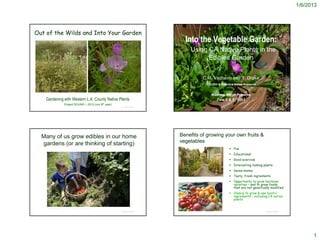
Out of the Wilds and Into Your Garden
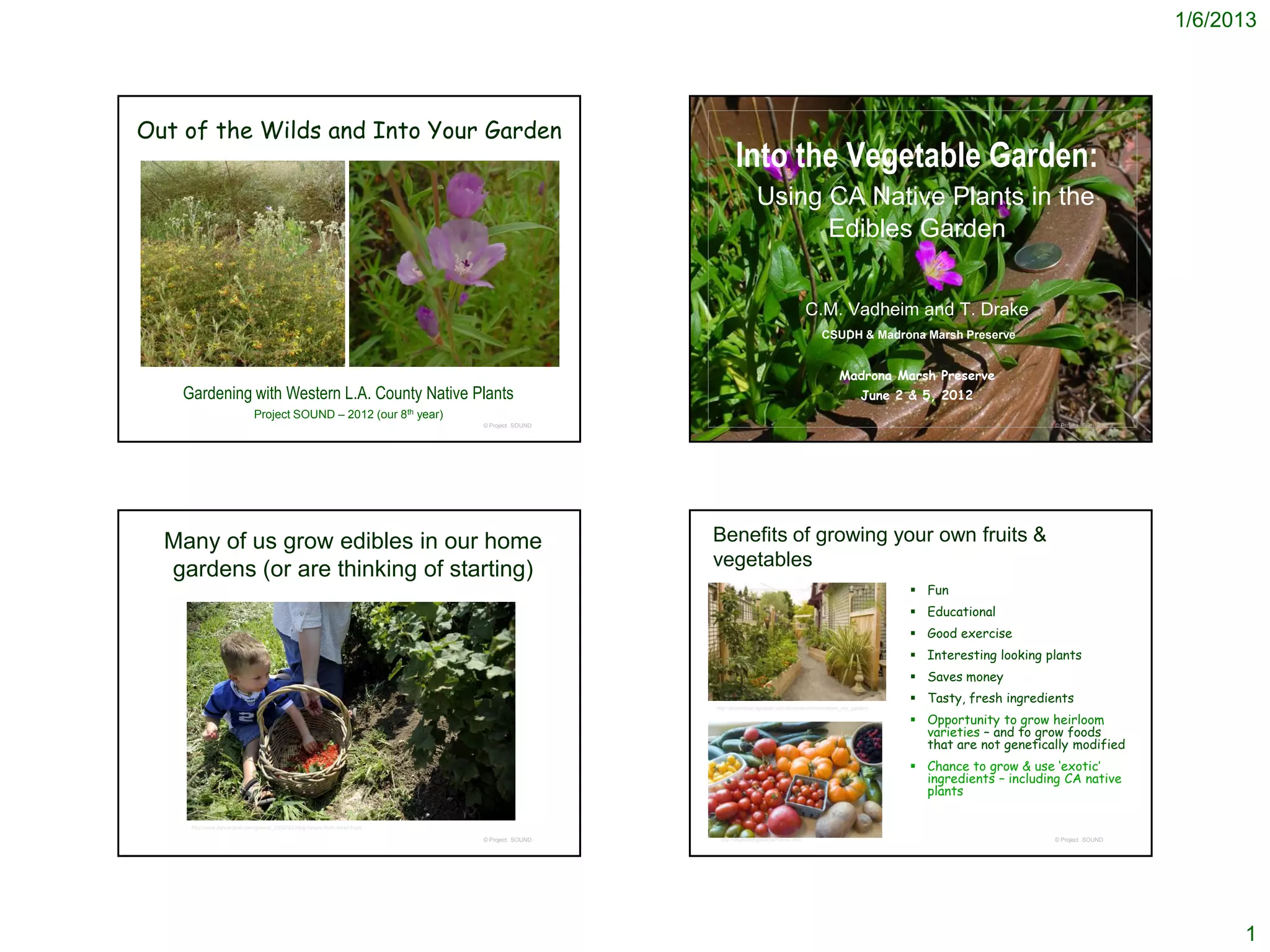
                                                                                                         Into the Vegetable Garden:
                                                                                                                 Using CA Native Plants in the
                                                                                                                       Edibles Garden


                                                                                                                                       C.M. Vadheim and T. Drake
                                                                                                                                          CSUDH & Madrona Marsh Preserve


                                                                                                                                                 Madrona Marsh Preserve
    Gardening with Western L.A. County Native Plants                                                                                                     June 2 & 5, 2012
                               Project SOUND – 2012 (our 8th year)
                                                                                © Project SOUND                                                                                        © Project SOUND


  Many of us grow edibles in our home                                                             Benefits of growing your own fruits &
  gardens (or are thinking of starting)                                                           vegetables
                                                                                                                                                                 Fun
                                                                                                                                                                 Educational
                                                                                                                                                                 Good exercise
                                                                                                                                                                 Interesting looking plants
                                                                                                                                                                 Saves money
                                                                                                                                                                 Tasty, fresh ingredients
                                                                                                  http://bloomtown.typepad.com/bloomtown/bloomtown_my_garden/

                                                                                                                                                                 Opportunity to grow heirloom
                                                                                                                                                                  varieties – and to grow foods
                                                                                                                                                                  that are not genetically modified
                                                                                                                                                                 Chance to grow & use ‘exotic’
                                                                                                                                                                  ingredients – including CA native
                                                                                                                                                                  plants

     http://www.denverpost.com/grow/ci_20587823/big-flavors-from-small-fruits

                                                                                © Project SOUND    http://vegetablegardenathome.com/                                                   © Project SOUND


                                                                                                                                                                                                               1
1/6/2013


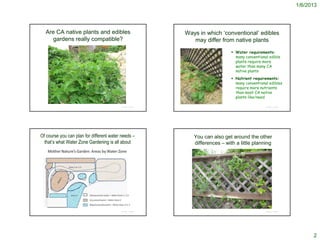
  Are CA native plants and edibles                           Ways in which ‘conventional’ edibles
     gardens really compatible?                                 may differ from native plants

                                                                                  Water requirements:
                                                                                   many conventional edible
                                                                                   plants require more
                                                                                   water than many CA
                                                                                   native plants
                                                                                  Nutrient requirements:
                                                                                   many conventional edibles
                                                                                   require more nutrients
                                                                                   than most CA native
                                                                                   plants like/need

                                           © Project SOUND                                         © Project SOUND


Of course you can plan for different water needs –              You can also get around the other
  that’s what Water Zone Gardening is all about                 differences – with a little planning


                                           © Project SOUND                                         © Project SOUND


                                                                                                                           2
1/6/2013


                                                                                                                                            We look on-line for some inspiration
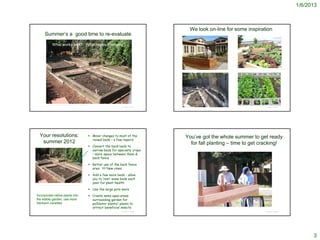
               Summer’s a good time to re-evaluate
                            What works well? What needs changing?


                                                                                                                                  http://efnep.ucdavis.edu/?blogpost=4501&blogasset=17351
                                                                                                                                                                                                                  http://pcnatthegreenshow.wordpress.com/2010/04/18/california-spring-trials-day-3-along-the-central-coast/


                http://blog.gardenerd.com/2007/10/13/raised-beds--part-1-materials.aspx
                                                                                                                                                                                                                        http://www.thriftyfun.com/tf16684008.tip.html
                                                                                                                © Project SOUND                                                                                                                                                 © Project SOUND
                                                                                                                                  http://timberglade.typepad.com/outside/vegetables/


       Your resolutions:                                                                   Minor changes to most of the             You’ve got the whole summer to get ready
                                                                                            raised beds – a few repairs
        summer 2012                                                                                                                    for fall planting – time to get cracking!
                                                                                           Convert the back beds to
                                                                                            narrow beds for specialty crops
                                                                                            – more space between them &
                                                                                            back fence

                                                                                           Better use of the back fence
                                                                                            area: ?? New vines

                                                                                           Add a few more beds – allow
                                                                                            you to ‘rest’ some beds each
                                                                                            year for plant health
http://blog.gardenerd.com/2007/10/13/raised-beds--part-1-materials.aspx


                                                                                           Use the large pots more
 Incorporate native plants into                                                            Create some open areas
 the edible garden; use more                                                                surrounding garden for
 heirloom varieties                                                                         pollinator plants/ plants to
                                                                                            attract beneficial insects                                      http://www.mastergardeners.org/projects/gilroy.html


                                                                                                                © Project SOUND                                                                                                                                                 © Project SOUND


                                                                                                                                                                                                                                                                                                                                    3
1/6/2013


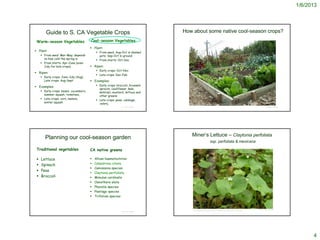
        Guide to S. CA Vegetable Crops                                           How about some native cool-season crops?
 Warm-season Vegetables                 Cool-season Vegetables
                                         Plant:
 Plant:                                     From seed: Aug-Oct in shaded
      From seed: Mar-May; depends            pots; Sep-Oct in ground
       on how cold the spring is             From starts: Oct-Dec
      From starts: Apr-June (even
       July for late crops)              Ripen:
                                             Early crops: Oct-Nov
 Ripen:
                                             Late crops: Dec-Feb
      Early crops: June-July (Aug)
       Late crops: Aug-Sept              Examples:
 Examples:                                  Early crops: broccoli, brussels
                                              sprouts, cauliflower, kale,
      Early crops: beans, cucumbers,         kohlrabi, mustard, lettuce and
       summer squash, tomatoes,               other greens
      Late crops: corn, melons,             Late crops: peas, cabbage,
       winter squash                          celery,                               http://www.amillionlives.net/vegetable-gardening-tips-easy-ideas-for-great-produces.html

                                                               © Project SOUND                                                                                                          © Project SOUND


                                                                                       Miner’s Lettuce – Claytonia perfoliata
        Planning our cool-season garden
                                                                                                                     ssp. perfoliata & mexicana

 Traditional vegetables                 CA native greens

    Lettuce                               Allium haematochiton
    Spinach                               Calandrinia ciliata
                                           Camissonia species
    Peas
                                           Claytonia perfoliata
    Broccoli                              Mimulus cardinalis
                                           Oenothera elata
                                           Phacelia species
                                           Plantago species
                                           Trifolium species


                                                                                                                                                                               © 2001 Steven Thorsted
                                                                                         http://nativeplantsocietyca.tribe.net/photos/cfd27d18-6ba7-4365-b1d9-c1c7c67b9cbe
                                                               © Project SOUND


                                                                                                                                                                                                                4
1/6/2013


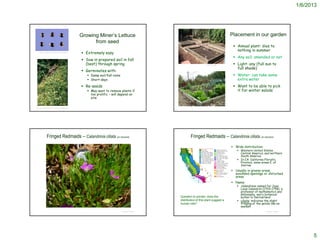
                                                            Growing Miner’s Lettuce                                                                Placement in our garden
                                                                  from seed
                                                                                                                                                     Annual plant: dies to
                                                                                                                                                      nothing in summer
     Steve Hurst @ USDA-NRCS PLANTS Database
                                                             Extremely easy
                                                                                                                                                     Any soil: amended or not
                                                             Sow in prepared soil in fall
                                                              (best) through spring                                            © by Gena Zolotar     Light: any (full sun to
                                                                                                                                                      full shade)
                                                             Germinates with:
                                                                Damp soil/fall rains                                                                Water: can take some
                                                                Short days                                                                           extra water
                                                             Re-seeds                                                                               Want to be able to pick
                                                                May want to remove plants if                                                         it for winter salads
                                                                 too prolific – will depend on
                                                                 site

http://www.pacifichorticulture.org/phv66n3.editorial.html


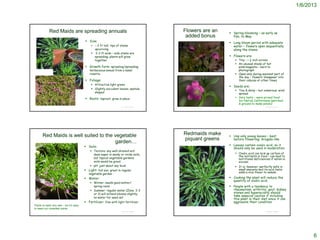
                  Fringed Redmaids – Calandrinia ciliata var menziesii                                            Fringed Redmaids – Calandrinia ciliata var menziesii
                                                                                                                                                    Wide distribution:
                                                                                                                                                       Western United States ,
                                                                                                                                                        Central America, and northern
                                                                                                                                                        South America.
                                                                                                                                                       In CA: California Floristic
                                                                                                                                                        Province, some areas E. of
                                                                                                                                                        Sierras
                                                                                                                                                    Usually in grassy areas,
                                                                                                                                                     woodland openings or disturbed
                                                                                                                                                     areas
                                                                                                                                                    Name:
                                                                                                                                                       Calandrinia: named for Jean
                                                                                                                                                        Louis Calandrini (1703-1758), a
                                                                                                                                                        professor of mathematics and
                                                                                                                                                        philosophy, and a botanical
                                                                                                          Question to ponder: does the                  author in Switzerland
                                                                                                          distribution of this plant suggest a         ciliata: indicates the slight
                                                                                                          human role?                                   fringing of the petals like an
                                                                                                                                                        eyelash
                                                                                        © Project SOUND                                                                   © Project SOUND


                                                                                                                                                                                                  5
1/6/2013


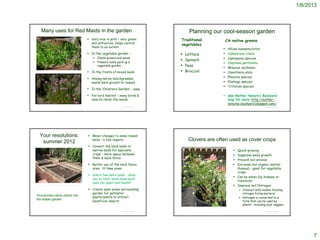
                        Red Maids are spreading annuals                                           Flowers are an                             Spring-blooming – as early as
                                                                                                   added bonus                                Feb. to May
                                            Size:                                                                                           Long bloom period with adequate
                                                   < 2 ft tall; tips of stems                                                                water – flowers open sequentially
                                                    upcurviing                                                                                along the stems
                                                    2-3 ft wide – side stems are
                                                    spreading; plants will grow                                                              Flowers are:
                                                    together                                                                                     Tiny - < ½ inch across
                                                                                                                                                 An unusual shade of hot
                                            Growth form: sprawling/spreading                                                                     pink/magenta – hard to
                                               herbaceous annual from a basal                                                                     photograph
                                               rosette.                                    Robert Potts © California Academy of Sciences
                                                                                                                                                 Open only during sunniest part of
                                                                                                                                                  the day – flowers ‘disappear’ into
                                            Foliage:                                                                                             their calyces at other times
                                                 Attractive light green
                                                                                                                                             Seeds are:
                                                 Slightly succulent leaves; spatula
                                                                                                                                                 Tiny & shiny – but numerous; wind
                                                  shaped                                                                                          spread
                                            Roots: taproot; grow in place                                                                       Very tasty – were prized food
                                                                                                                                                  for Native Californians (parched
                                                                                                                                                  & ground to make pinole)
  © 2006 Chris Wagner
                                                                         © Project SOUND                                                                               © Project SOUND
                                                                                           Jo-Ann Ordano © California Academy of Sciences


           Red Maids is well suited to the vegetable                                               Redmaids make                             Use only young leaves – best
                                                                                                   piquant greens                             before flowering; Arugala-like
                                           garden…
                                            Soils:                                                                                          Leaves contain oxalic acid, so it
                                                                                                                                              should only be used in moderation.
                                                Texture: any well-drained soil;
                                                 does super in sandy or rocky soils,                                                             Oxalic acid can lock up certain of
                                                                                                                                                  the nutrients in food - can lead to
                                                 but typical vegetable gardens                                                                    nutritional deficiencies if eaten in
                                                 soils would be great                                                                             excess.
                                                pH: just about any local                                                                        It is, however, perfectly safe in
                                            Light: full sun; great in regular                                                                    small amounts and its acid taste
                                                                                                                                                  adds a nice flavor to salads.
                                              vegetable garden
                                            Water:                                                                                          Cooking the plant will reduce the
                                                                                                                                              quantity of oxalic acid.
                                                Winter: needs good winter/
                                                 spring rains                                                                                People with a tendency to
                                                Summer: regular water (Zone 2-3                                                              rheumatism, arthritis, gout, kidney
                                                 or 3) will extend blooms slightly;                                                           stones and hyperacidity should
                                                                                                                                              take especial caution if including
                                                 no water for seed set                                                                        this plant in their diet since it can
                                            Fertilizer: fine with light fertilizer                                                           aggravate their condition
Plants re-seed very well – but it’s easy
to weed out unwanted plants
                                                                         © Project SOUND                                                                               © Project SOUND


                                                                                                                                                                                               6
1/6/2013


         Many uses for Red Maids in the garden                                                                            Planning our cool-season garden
                                                                           Very nice in pots – very green          Traditional            CA native greens
                                                                            and attractive; helps control           vegetables
                                                                            them to an extent
                                                                                                                                           Allium haematochiton
                                                                           In the vegetable garden –                  Lettuce            Calandrinia ciliata
                                                                                Edible greens and seeds                                   Camissonia species
                                                                                                                       Spinach
                                                                                Flowers really perk up a                                  Claytonia perfoliata
                                                                                 vegetable garden                      Peas
                                                                                                                                           Mimulus cardinalis
                                                                           In the fronts of mixed beds                Broccoli           Oenothera elata
                                                                           Among native bunchgrasses;                                     Phacelia species
                                                                            needs bare ground to reseed                                    Plantago species
                                                                                                                                           Trifolium species
                                                                           In the ‘Children’s Garden’ – easy

                                                                           For bird habitat – many birds &                             See Mother Nature’s Backyard
                                                                            insects relish the seeds                                     blog for more-http://mother-
                                                                                                                                         natures-backyard.blogspot.com/
                                                                                                  © Project SOUND                                                     © Project SOUND


       Your resolutions:                                                   Minor changes to some raised
                                                                            beds – a few repairs                         Clovers are often used as cover crops
        summer 2012
                                                                           Convert the back beds to
                                                                            narrow beds for specialty                                           Quick growing
                                                                            crops – more space between                                          Suppress weed growth
                                                                            them & back fence
                                                                                                                                                Prevent soil erosion
                                                                           Better use of the back fence                                        Increase soil organic matter
                                                                            area: ?? New vines                                                   (humus) – good for vegetable
                                                                                                                                                 crops
                                                                           Add a few more beds – allow
                                                                                                                                                Can be eaten (by humans or
                                                                            you to ‘rest’ some beds each
                                                                                                                                                 livestock)
                                                                            year for plant/soil health
http://blog.gardenerd.com/2007/10/13/raised-beds--part-1-materials.aspx
                                                                                                                                                Improve soil Nitrogen:
                                                                           Create open areas surrounding                                           Interact with nodule-forming
                                                                            garden for pollinator                                                    nitrogen fixing bacteria
 Incorporate native plants into
                                                                            plants/plants to attract                                                Nitrogen is converted to a
 the edible garden
                                                                            beneficial insects                                                       form that can be used by
                                                                                                                                                     plants – including your veggies

                                                                                                  © Project SOUND                                                     © Project SOUND


                                                                                                                                                                                              7
1/6/2013


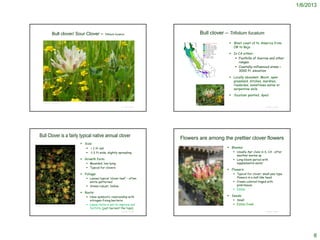
                         Bull clover/ Sour Clover –                Trifolium fucatum                           Bull clover – Trifolium fucatum
                                                                                                                                        West coast of N. America from
                                                                                                                                         OR to Baja

                                                                                                                                        In CA either:
                                                                                                                                           Foothills of Sierras and other
                                                                                                                                            ranges
                                                                                                                                           Coastally-influenced areas <
                                                                                                                                            3000 ft. elevation

                                                                                                                                        Locally abundant. Moist, open
                                                                                                                                         grassland, ditches, marshes,
                                                                                                                                         roadsides, sometimes saline or
                                                                                                                                         serpentine soils
                                                                                                                                        fucatum: painted, dyed

          © 2004 Carol W. Witham

                                                                                                          © 2005 George W. Hartwell
                                                                                 © Project SOUND                                                                © Project SOUND


    Bull Clover is a fairly typical native annual clover                                           Flowers are among the prettier clover flowers
                                                 Size:
                                                    < 1 ft tall                                                                       Blooms:
                                                       1-3 ft wide; slightly spreading                                                   Usually Apr-June in S. CA ; after
                                                                                                                                           weather warms up
                                                 Growth form:                                                                            Long bloom period with
                                                     Mounded; low-lying                                                                   supplemental water
                                                     Typical for clovers
                                                                                                                                       Flowers:
                                                 Foliage:                                                                                Typical for clover; small pea-type
                                                     Leaves typical ‘clover-leaf’ – often                                                 flowers in a ball-like head
                                                      white-patterned                                                                     Cream-colored tinged with
                                                     Stems robust, hollow                                                                 pink/mauve
                                                                                                                                          Edible
                                                 Roots:
                                                     Have symbiotic relationship with                                                 Seeds:
                                                      nitrogen-fixing bacteria                                                            Small
Robert Potts © California Academy of Sciences        Leave roots in soil to improve soil                                                 Edible fresh
                                                      fertility (just harvest the tops)
                                                                                 © Project SOUND                                                                © Project SOUND


                                                                                                                                                                                        8
1/6/2013


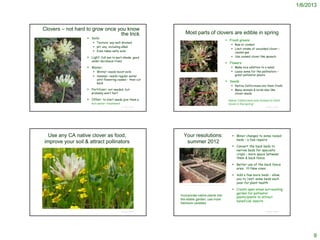
             Clovers – not hard to grow once you know
                                              the trick                                     Most parts of clovers are edible in spring
                                        Soils:
                                                                                                                                                             Fresh greens
                                            Texture: any well-drained
                                                                                                                                                                Raw or cooked
                                            pH: any, including alkali
                                                                                                                                                                Limit intake of uncooked clover –
                                            Even takes salty soils                                                                                              causes gas
                                        Light: full sun to part-shade; good                                                                                    Use cooked clover like spinach
                                          under deciduous trees
                                                                                                                                                             Flowers
                                        Water:                                                                                                                 Make nice addition to a salad
                                            Winter: needs moist soils                                                                                          Leave some for the pollinators –
                                            Summer: needs regular water                                                                                         great pollinator plants
                                             until flowering ceases – then cut
                                                                                                                                                             Seeds
                                             back
                                                                                                                                                                Native Californians ate them fresh
                                        Fertilizer: not needed, but                                                                                            Many animals & birds also like
                                          probably won’t hurt                                                                                                    clover seeds

                                        Other: to start seeds give them a                                                                                   Native Californians look forward to fresh
© 2007 Aaron Schusteff
                                          hot-water treatment                                                                                                clover in the spring!
                                                                © Project SOUND    © 2007 Neal Kramer                                                                                     © Project SOUND


                   Use any CA native clover as food,                                    Your resolutions:                                                        Minor changes to some raised
                                                                                                                                                                  beds – a few repairs
                 improve your soil & attract pollinators                                 summer 2012
                                                                                                                                                                 Convert the back beds to
                                                                                                                                                                  narrow beds for specialty
                                                                                                                                                                  crops – more space between
                                                                                                                                                                  them & back fence

                                                                                                                                                                 Better use of the back fence
                                                                                                                                                                  area: ?? New vines

                                                                                                                                                                 Add a few more beds – allow
                                                                                                                                                                  you to ‘rest’ some beds each
                                                                                                                                                                  year for plant health
                                                                                  http://blog.gardenerd.com/2007/10/13/raised-beds--part-1-materials.aspx


                                                                                                                                                                 Create open areas surrounding
                                                                                                                                                                  garden for pollinator
                                                                                   Incorporate native plants into
                                                                                                                                                                  plants/plants to attract
                                                                                   the edible garden; use more
                                                                                                                                                                  beneficial insects
                                                                                   heirloom varieties
              © 2004 Carol W. Witham


                                                                © Project SOUND                                                                                                           © Project SOUND


                                                                                                                                                                                                                  9
1/6/2013


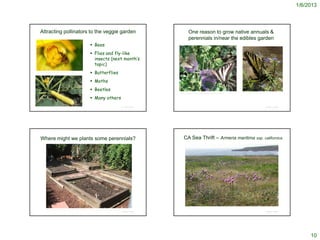
     Attracting pollinators to the veggie garden                                                                                      One reason to grow native annuals &
                                                                                                                                      perennials in/near the edibles garden
                                                                                        Bees
                                                                                        Flies and fly-like
                                                                                         insects (next month’s
                                                                                         topic)
 http://www.ars.usda.gov/is/graphics/photos/nov08/d1275-1.htm
                                                                                        Butterflies
                                                                                        Moths
                                                                                        Beetles
                                                                                                                         http://www.laspilitas.com/garden/august-native-garden-flowers-pictures.htm


                                                                                        Many others
http://www.ehow.com/how_8036705_do-flowers-blossomed-summer-squash.html                                © Project SOUND                                                                                © Project SOUND


     Where might we plants some perennials?                                                                                   CA Sea Thrift – Armeria maritima ssp. californica


                                                                                                                                  © 2007 Neal Kramer
             http://blog.gardenerd.com/2007/10/13/raised-beds--part-1-materials.aspx
                                                                                                       © Project SOUND                                                                                © Project SOUND


                                                                                                                                                                                                                             10
1/6/2013


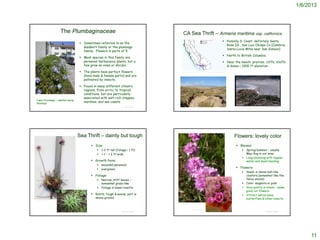
                                       The Plumbaginaceae                                                              CA Sea Thrift – Armeria maritima ssp. californica
                                                                                                                                                                                         Possibly S. Coast; definitely Santa
                                                                  Sometimes referred to as the
                                                                                                                                                                                          Rosa Isl., San Luis Obispo Co (Cambria;
                                                                   leadwort family or the plumbago
                                                                                                                                                                                          Santa Lucia Mtns near San Simeon)
                                                                   family. Flowers in parts of 5.
                                                                                                                                                                                         North to British Columbia
                                                                  Most species in this family are
                                                                   perennial herbaceous plants, but a                                                                                    Near the beach: prairies, cliffs, bluffs
                                                                   few grow as vines or shrubs.                                                                                           & dunes < 1000 ft elevation
                                                                  The plants have perfect flowers                    http://ucjeps.berkeley.edu/cgi-bin/get_JM_treatment.pl?5645,5646,0,5647


                                                                   (have male & female parts) and are
                                                                   pollinated by insects.

                                                                  Found in many different climatic
                                                                   regions, from arctic to tropical
http://www.hear.org/starr/images/image/?q=031108-0160&o=plants
                                                                   conditions, but are particularly
                                                                   associated with salt-rich steppes,
 Cape Plumbago – planted along
 freeways
                                                                   marshes, and sea coasts.
                                                                                                © Project SOUND                                                                                                                              © Project SOUND
                                                                                                                    © 2011 Chris Winchell                                                        Charles Webber © California Academy of Sciences


                                                                 Sea Thrift – dainty but tough                                                                                                  Flowers: lovely color
                                                                         Size:                                                                                                                   Blooms:
                                                                               1-2 ft tall (foliage < 1 ft)                                                                                                   Spring/summer – usually
                                                                               ~ 1 – 1 ½ ft wide                                                                                                               May-Aug in our area
                                                                                                                                                                                                               Long-blooming with regular
                                                                         Growth form:                                                                                                                          water and dead-heading
                                                                               mounded perennial
                                                                               evergreen
                                                                                                                                                                                                  Flowers:
                                                                                                                                                                                                               Small; in dense ball-like
                                                                         Foliage:                                                                                                                              clusters (somewhat like the
                                                                               Narrow, stiff leaves –                                                                                                          fancy onions)
                                                                                somewhat grass-like                                                                                                            Color: magenta or pink
                                                                               Foliage in basal rosette                                                                                                       Very pretty in bloom – make
                                                                                                                                                                                                                good cut flowers
                                                                         Roots: tough & woody; part is                                                                                                        Attract native bees,
                                                                           above-ground                                                                                                                         butterflies & other insects
© 2011 Chris Winchell

                                                                                                                  © 2007 Neal Kramer


                                                                                                                                    © 2004, Ben Legler
                                                                                                © Project SOUND                                                                                                                              © Project SOUND
                                   © 2007 Neal Kramer


                                                                                                                                                                                                                                                                    11
1/6/2013


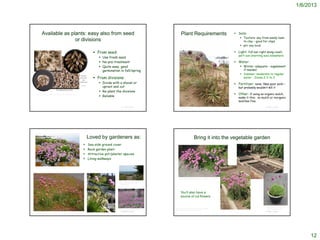
         Available as plants: easy also from seed                                                                                                                              Plant Requirements                                                                     Soils:
                                                                                                                                                                                                                                                                          Texture: any from sandy loam
                        or divisions                                                                                                                                                                                                                                       to clay – good for clays
                                                                                                                                                                                                                                                                          pH: any local

                                                                                    From seed:                                                                                                                                                                       Light: full sun right along coast;
                                                                                                                                                                                                                                                                        part-sun (morning sun) elsewhere
                                                                                              Use fresh seed
                                                                                              No pre-treatment                                                                                                                                                       Water:
                                                                                              Quite easy, good                                                                                                                                                           Winter: adequate – supplement
                                                                                               germination in fall/spring                                                                                                                                                  if needed
                                                                                                                                                                                                                                                                          Summer: moderate to regular
                                                                                    From divisions:                                                                                                                                                                       water – Zones 2-3 to 3
                                                                                              Divide with a shovel or                                                                                                                                                Fertilizer: none; likes poor soils –
                                                                                               uproot and cut                                                                                                                                                           but probably wouldn’t kill it
                                                                                              Re-plant the divisions
                                                                                                                                                                                                                                                                      Other: if using an organic mulch,
                                                                                              Reliable
 http://www.hazmac.biz/051128/051128AmeriaMaritimaCalifornica.html

                                                                                                                                                                                                                                                                        make it thin; no mulch or inorganic
                                                                                                                                                                                                                                                                        mulches fine
                                                                                                                              © Project SOUND                                                                                                                                                © Project SOUND
                                                                                                                                                                              © 2008 John Dittes


                                                                         Loved by gardeners as:                                                                                                         Bring it into the vegetable garden
                                                                        Sea-side ground cover
                                                                        Rock garden plant
                                                                        Attractive pot/planter species
                                                                        Lining walkways

 http://www.imagejuicy.com/images/plants/a/armeria/10/


                                                                                                                                                                            http://commons.wikimedia.org/wiki/File:Armeria_maritima,_Tower_Hill_Botanic_Garden.JPG

                                                                                                                           http://www.pacifichorticulture.org/web-
                                                                                                                           extras/70/3/sea-ranch-gardens-most-
                                                                                                                           successful-plants/


                                                                                                                                                                              You’ll also have a
                                                                                                                                                                              source of cut flowers


                                                                                                                                                                                                                                                                                              http://www.thienemans.com/ph
                                                                                                                                                                     http://www.elkhornnursery.com/default.aspx?pid=2989aedb                                                                  otos/index.php/Succulents-
                                                                                                                          http://www.cnps.org/cnps/grownative/tips   -2f5a-41ec-9c05-61c5ebfda0e9&PlantId=1115                                                                                Rock-Garden/IMG_0132
                                                                                                                          /lawn_alternatives.php
                                                                                                                               © Project SOUND                                                                                                                                               © Project SOUND
© 2004, Ben Legler                                                       http://www.calfloranursery.com/plants/armeria-
                                                                         maritima-ssp-californica


                                                                                                                                                                                                                                                                                                                                  12
1/6/2013


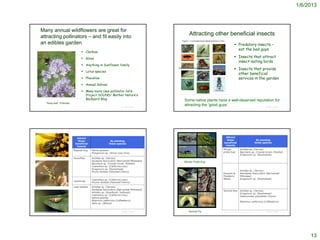
        Many annual wildflowers are great for
        attracting pollinators – and fit easily into
                                                                                                                                                                      Attracting other beneficial insects
        an edibles garden                                                                                                                                                                                                                       Predatory insects –
                                                                                                                                                                                                                                                 eat the bad guys
                                                                                Clarkias

                                                                                Gilias                                                                                                                                                         Insects that attract
                                                                                                                                                                                                                                                 insect-eating birds
                                                                                Anything in Sunflower family
                                                                                                                                                                                                                                                Insects that provide
                                                                                Lotus species
                                                                                                                                                                                                                                                 other beneficial
                                                                                Phacelias                                                                                                                                                       services in the garden
                                                                                Annual Salivas

                                                                                Many more (see pollinator lists:
                                                                                 Project SOUND/ Mother Nature’s                                          http://trishsgarden.blogspot.com/2008/03/very-late-march-1-garden-newsletter.html


        http://www.pfaf.org/user/Plant.aspx?LatinName=Phacelia+tanacetifolia
                                                                                 Backyard Blog                                                                Some native plants have a well-deserved reputation for
                 Tansy-leaf Phacelia
                                                                                                                                   © Project SOUND
                                                                                                                                                              attracting the ‘good guys’                                                                                               © Project SOUND


                                                                   Attract                                                                                                                                                        Attract
                                                                    these                                                  By planting                                                                                             these                                        By planting
                                                                  beneficial                                              these species                                                                                          beneficial                                    these species
                                                                   insects                                                                                                                                                        insects

                                                               Bigeyed bug                     Native grasses                                                                                                                  Minute                   Achillea sp. (Yarrow)
                                                                                               Polygonum sp. (Silver Lace Vine)                                                                                                pirate bug               Baccharis sp. (Coyote brush, Mulefat)
Copyright © 2007 Ron Hemberger                                                                                                                                                                                                                          Eriogonum sp. (Buckwheat)
                                                               Hoverflies                      Achillea sp. (Yarrow)                                 http://www.ipm.ucdavis.edu/PMG/NE/minute_pirate_bug.html
                                                                                               Asclepias fascicularis (Narrowleaf Milkweed)                   Minute Pirate Bug
                                                                                               Baccharis sp. (Coyote brush, Mulefat)
                                                                                               Ceanothus sp. (California Lilac)
                                                                                               Eriogonum sp. (Buckwheat)
                                                                                               Prunis ilicifolia (Hollyleaf Cherry)                                                                                                                     Achillea sp. (Yarrow)
                                                                                                                                                                                                                               Parasitic &              Aesclepias fascicularis (Narrowleaf
                                                                                                                                                                                                                               Predatory                Milkweed)
                                                                                               Ceanothus sp. (California Lilac)                                                                                                Wasps                    Eriogonum sp. (Buckwheat)
                                                               Lacewings
                                                                                               Prunus ilicifolia (Hollyleaf Cherry)

                                                               Lady beetles                    Achillea sp. (Yarrow)
                                                                                               Asclepias fascicularis (Narrowleaf Milkweed)                                                                                    Tachnid flies            Achillea sp. (Yarrow)
                                                                                               Atriplex sp. (Quailbush, Saltbush)
                                                                                                                                                                                                                                                        Eriogonum sp. (Buckwheat)
                                                                                               Ceanothus sp. (California Lilac)                                                                                                                         Heteromeles arbutifolia (Toyon)
                                                                                               Native grasses
                                                                                               Rhamnus californica (Coffeeberry)                                                                                                                        Rhamnus californica (Coffeeberry)
                                                                                               Salix sp. (Willow)

                                                                                                                                                     http://www.ipm.ucdavis.edu/PMG/NE/tachinid_flies.html
                                                                               http://www.stopwaste.org/home/index.asp?page=402
http://www.kunafin.com/lacewings.htm                                                                                               © Project SOUND                   Tachnid Fly                                            http://www.stopwaste.org/home/index.asp?page=402
                                                                                                                                                                                                                                                                                       © Project SOUND


                                                                                                                                                                                                                                                                                                              13
1/6/2013


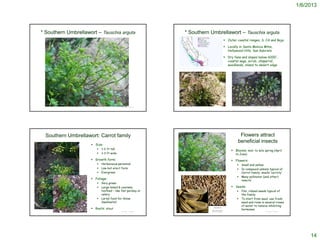
       * Southern Umbrellawort – Tauschia arguta                                                 * Southern Umbrellawort – Tauschia arguta
                                                                                                                                              Outer coastal ranges, S. CA and Baja

                                                                                                                                              Locally in Santa Monica Mtns,
                                                                                                                                               Hollywood Hills, San Gabriels

                                                                                                                                              Dry fans and slopes below 6000',
                                                                                                                                               coastal sage, scrub, chaparral,
                                                                                                                                               woodlands, inland to desert edge
                                                                                       http://ucjeps.berkeley.edu/cgi-bin/get_cpn.pl?TAAR2


                © 2006 Michelle Cloud-Hughes

                                                                     © Project SOUND      © 2003 Brent Miller                                      http://www.researchlearningcenter.org/bloom/species/Tauschia_arguta.htm
                                                                                                                                                                                                         © Project SOUND


               Southern Umbrellawort: Carrot family                                                                                                        Flowers attract
                                                                                                                                                          beneficial insects
                                                Size:
                                                     1-2 ft tall
                                                                                                                                                  Blooms: mid- to late spring (April
                                                     1-3 ft wide                                                                                     to June)
                                                Growth form:                                                                                     Flowers:
                                                     Herbaceous perennial                                                                                     Small and yellow
                                                     Low but erect form                                                                                       In compound umbels typical of
                                                     Evergreen                         © 2006 Michelle Cloud-Hughes                                            Carrot family; smells ‘carroty’
                                                                                                                                                               Many pollinator (and other)
                                                Foliage:                                                                                                       insects
                                                     Very green
                                                     Large-lobed & coarsely                                                                      Seeds:
                                                      toothed – like flat parsley or                                                                           Flat, ribbed seeds typical of
                                                      celery                                                                                                    the family
                                                     Larval food for Anise                                                                                    To start from seed, use fresh
                                                      Swallowtail                                                                                               seed and rinse in several rinses
                                                                                                                                                                of water to remove inhibiting
© 2006 Michelle Cloud-Hughes
                                                Roots: stout                                                                                                   hormones.
                                                                     © Project SOUND                                                                                                                  © Project SOUND


                                                                                                                                                                                                                                  14
1/6/2013


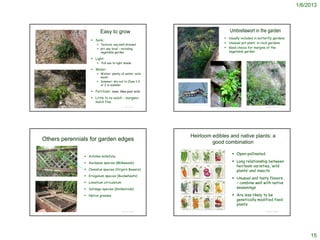
                                                                                    Easy to grow                                                                                                            Umbrellawort in the garden
                                                                                                                                                                                                    Usually included in butterfly gardens
                                                                             Soils:
                                                                                 Texture: any well-drained
                                                                                                                                                                                                    Unusual pot plant; in rock gardens
                                                                                 pH: any local – including                                                                                         Good choice for margins of the
                                                                                  vegetable garden                                                                                                   vegetable garden

                                                                             Light:
                                                                                   Full sun to light shade
   © 2010 Gary A. Monroe


                                                                             Water:
                                                                                 Winter: plenty of water; soils
                                                                                  moist
                                                                                 Summer: dry out to Zone 1-2
                                                                                  or 2 in summer

                                                                             Fertilizer: none; likes poor soils

                                                                             Little to no mulch – inorganic
                                                                              mulch fine
                                                                                                                     http://mamba.bio.uci.edu/~pjbryant/biodiv/lepidopt/papilio/anise.htm
                                                                                                   © Project SOUND                                                                                                                                                  © Project SOUND
                                                                                                                                                                               http://www.calflora.net/bloomingplants/southerntauschia.html Michelle Cloud-Hughes
                                                                                                                                                                                                                                      © 2006
http://www.laspilitas.com/nature-of-california/plants/tauschia-arguta


                                                                                                                                         Heirloom edibles and native plants: a
             Others perennials for garden edges                                                                                                   good combination

                                                                                                                                                                                                                 Open-pollinated
                                                                         Achillea millefolia

                                                                         Asclepias species (Milkweeds)                                                                                                          Long relationship between
                                                                                                                                                                                                                  heirloom varieties, ‘wild
                                                                         Clematus species (Virgin’s Bowers)                                                                                                      plants’ and insects
                                                                         Eriogonum species (Buckwheats)
                                                                                                                                                                                                                 Unusual and tasty flavors
                                                                         Lomatium utriculatum                                                                                                                    – combine well with native
                                                                         Solidago species (Goldenrods)                                                                                                           seasonings

                                                                         Native grasses                                                                                                                         Are less likely to be
                                                                                                                                                                                                                  genetically modified food
                                                                                                                                                                                                                  plants
                                                                                                                           http://www.byexample.com/homestead/gardens/heirloom_seeds.html
                                                                                                   © Project SOUND                                                                                                                                                  © Project SOUND


                                                                                                                                                                                                                                                                                           15
1/6/2013


                                                                                      Genetically modified foods are here
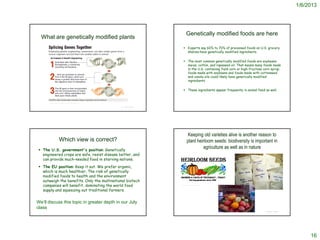
  What are genetically modified plants
                                                                                   Experts say 60% to 70% of processed foods on U.S. grocery
                                                                                    shelves have genetically modified ingredients.

                                                                                   The most common genetically modified foods are soybeans,
                                                                                    maize, cotton, and rapeseed oil. That means many foods made
                                                                                    in the U.S. containing field corn or high-fructose corn syrup;
                                                                                    foods made with soybeans and foods made with cottonseed
                                                                                    and canola oils could likely have genetically modified
                                                                                    ingredients.

                                                                                   These ingredients appear frequently in animal feed as well.


      http://www.precisionnutrition.com/all-about-gm-foods


                                                             © Project SOUND


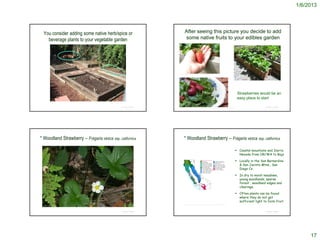
                                                                                       Keeping old varieties alive is another reason to
                      Which view is correct?                                           plant heirloom seeds: biodiversity is important in
  The U.S. government's position: Genetically
                                                                                                agriculture as well as in nature
   engineered crops are safe, resist disease better, and
   can provide much-needed food in starving nations.
  The EU position: Keep it out. We prefer organic,
   which is much healthier. The risk of genetically
   modified foods to health and the environment
   outweigh the benefits. Only the multinational biotech
   companies will benefit, dominating the world food                           http://www.heirloomseeds.com/


   supply and squeezing out traditional farmers.


We’ll discuss this topic in greater depth in our July
class
                                                                                                                                        © Project SOUND


                                                                                                                                                               16
1/6/2013


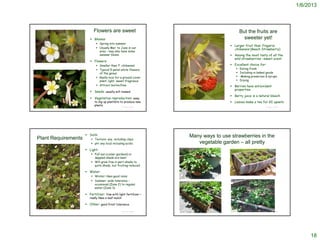
  You consider adding some native herb/spice or                         After seeing this picture you decide to add
    beverage plants to your vegetable garden                            some native fruits to your edibles garden


                                                                http://bumblelush.blogspot.com/2012/05/strawberry-season-is-here.html


                                                                                                                                                               Strawberries would be an
                                                                                                                                                               easy place to start

                                              © Project SOUND                                                                                                                  © Project SOUND
                                                                 http://www.dailyunadventuresincooking.com/2010/07/strawberry-and-arugula-salad-recipe.html/


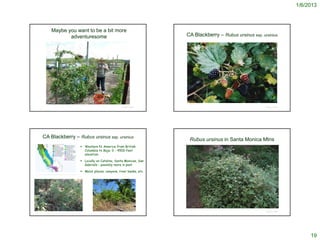
* Woodland Strawberry – Fragaria vesca ssp. californica                * Woodland Strawberry – Fragaria vesca ssp. californica

                                                                                                                                                            Coastal mountains and Sierra
                                                                                                                                                             Nevada from OR/WA to Baja

                                                                                                                                                            Locally in the San Bernardino
                                                                                                                                                             & San Jacinto Mtns., San
                                                                                                                                                             Diego Co.

                                                                                                                                                            In dry to moist meadows,
                                                                                                                                                             young woodlands, sparse
                                                                                                                                                             forest , woodland edges and
                                                                                                                                                             clearings.

                                                                                                                                                            Often plants can be found
                                                                                                                                                             where they do not get
                                                                                                                                                             sufficient light to form fruit.
                                                                        http://ucjeps.berkeley.edu/cgi-bin/get_JM_treatment.pl?6677,6723,6725
 © 2002 George Jackson


                                              © Project SOUND                                                                                                                  © Project SOUND


                                                                                                                                                                                                      17
1/6/2013


                                   Flowers are sweet                                                                                                          But the fruits are
                                 Blooms:                                                                                                                       sweeter yet!
                                      Spring into summer
                                                                                                                                                  Larger fruit than Fragaria
                                      Usually Mar. to June in our                                                                                 chiloensis (Beach Strawberry)
                                       area – may also have some
                                       summer bloom                                                                                               Among the most tasty of all the
                                                                                                                                                   wild strawberries –sweet scent
                                 Flowers:
© 2006 Dr. Amadej Trnkoczy
                                      Smaller than F. chiloensis                                                                                 Excellent choice for:
                                      Typical 5-petal white flowers                                                                                      Eating fresh
                                       of the genus                                                                                                       Including in baked goods
                                      Really nice for a ground-cover                                                                                     Making preserves & syrups
                                       plant; light, sweet fragrance                                                                                      Drying
                                      Attract butterflies                                                                                        Berries have antioxidant
                                                                                                                                                   properties
                                 Seeds: usually will reseed
                                                                                                                                                  Berry juice is a natural bleach
                                 Vegetative reproduction: easy
                                   to dig up plantlets to produce new          © 2006 Dr. Amadej Trnkoczy
                                                                                                                                                  Leaves make a tea for GI upsets
                                   plants
                                                            © Project SOUND                                                                                                                           © Project SOUND


                              Soils:                                                        Many ways to use strawberries in the
Plant Requirements                Texture: any, including clays
                                  pH: any local including acidic                               vegetable garden – all pretty
                              Light:
                                  Full sun (cooler gardens) or
                                   dappled shade are best
                                  Will grow fine in part-shade to
                                   quite shady, but fruiting reduced

                              Water:
                                  Winter: likes good rains
                                  Summer: wide tolerance –                   http://www.putteringinthegarden.com/category/fruit/strawberries/


                                   occasional (Zone 2) to regular
                                   water (Zone 3)

                              Fertilizer: fine with light fertilizer –
                                really likes a leaf mulch

                              Other: good frost tolerance
© 2006 Dr. Amadej Trnkoczy
                                                            © Project SOUND                                                                                                                           © Project SOUND
                                                                                                                                                 http://www.tipjunkie.com/how-to-grow-strawberries/


                                                                                                                                                                                                                             18
1/6/2013


                          Maybe you want to be a bit more
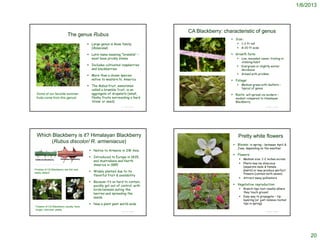
                                 adventuresome                                                                                                            CA Blackberry – Rubus ursinus ssp. ursinius


                                                                                                                                                          © 2005 Doreen L. Smith
                   http://groweat.blogspot.com/2011/04/derwood-demo-garden-update.html#axzz1wZrtwMAD
                                                                                                                                        © Project SOUND                                        © Project SOUND


           CA Blackberry – Rubus ursinus ssp. ursinius
                                                                                                                                                            Rubus ursinus in Santa Monica Mtns
                                                                         Western N. America from British
                                                                          Columbia to Baja; 0 - 4500 feet
                                                                          elevation

                                                                         Locally on Catalina, Santa Monicas, San
                                                                          Gabriels – possibly more in past

                                                                         Moist places: canyons, river banks, etc.
http://ucjeps.berkeley.edu/cgi-bin/get_JM_treatment.pl?6677,6899,6910


                                                                                                                                        © Project SOUND                                        © Project SOUND
© 2011 Michael O'Brien                                                                     http://www.plumjam.com/wildflowers/5-20-2011.cfm


                                                                                                                                                                                                                      19
1/6/2013


                                                                                                                        CA Blackberry: characteristic of genus
                                                        The genus Rubus
                                                                                                                                           Size:
                                                                  Large genus in Rose family                                                        1-3 ft tall
                                                                   (Rosaceae)                                                                        8-20 ft wide

                                                                  Latin name meaning “bramble” –                                          Growth form:
                                                                   most have prickly stems                                                           Low, mounded canes; trailing or
                                                                                                                                                      climbing habit
                                                                  Includes cultivated raspberries                                                   Evergreen or slightly winter
                                                                   and blackberries                                                                   deciduous
                                                                                                                                                     Armed with prickles
                                                                                                            © 2009 Zoya Akulova

                                                                  More than a dozen species
                                                                   native to western N. America                                            Foliage:
                                                                  The Rubus fruit, sometimes                                                        Medium green with leaflets –
    http://en.wikipedia.org/wiki/File:Blackberries_on_bush.jpg
                                                                                                                                                      typical of genus
                                                                   called a bramble fruit, is an
   Some of our favorite summer                                     aggregate of drupelets (small,                                          Roots: will spread via suckers –
   fruits come from this genus!                                    fleshy fruits surrounding a hard                                          modest compared to Himalayan
                                                                   ‘stone’ or seed)                                                          Blackberry
                                                                                        © Project SOUND     © 2009 Ben Stever                                          © Project SOUND


   Which Blackberry is it? Himalayan Blackberry                                                                                                Pretty white flowers
        (Rubus discolor/ R. armeniacus)
                                                                                                                                            Blooms: in spring – between April &
                                                                                                                                              June, depending on the weather
                                                                   Native to Armenia in SW Asia
                                                                                                                                            Flowers:
                                                                   Introduced to Europe in 1835,
                                                                                                                                                      Medium size: 1-2 inches across
                                                                    and Australasia and North
                                                                                                                                                      Plants may be dioecious
 http://kaweahoaks.com/html/calif_blackberry.html                   America in 1885
                                                                                                                                                       (separate male & female
Prickles of CA Blackberry are thin and
                                                                   Widely planted due to its
                                                                                                          © 2008 Gary McDonald
                                                                                                                                                       plants) or may produce perfect
easily detach                                                                                                                                          flowers (contain both sexes)
                                                                    flavorful fruit & availability
                                                                                                                                                      Attract many pollinators
                                                                   Because it’s so hard to contain,
                                                                    quickly got out of control, with                                        Vegetative reproduction:
                                                                    birds/animals eating the                                                          Branch tips root readily where
                                                                    berries and spreading the                                                          they touch ground
                                                                    seeds.                                                                            Easy way to propagate – tip-
http://www.nps.gov/prsf/naturescience/himalayan-blackberry.htm                                                                                         layering (or just remove rooted
                                                                   Now a plant pest world-wide                                                        tips in spring)
 Flowers of CA Blackberry usually have
 longer, narrower petals                                                                                  © 2007 Neal Kramer
                                                                                        © Project SOUND                                                                © Project SOUND


                                                                                                                                                                                              20
1/6/2013


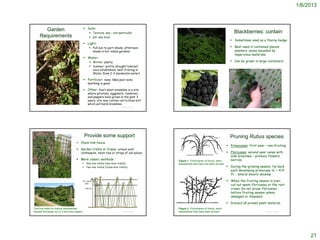
             Garden                                                           Soils:
                                                                                  Texture: any – not particular                                                                                                               Blackberries: contain
           Requirements                                                           pH: any local
                                                                                                                                                                                                                             Sometimes used as a thorny hedge
                                                                              Light:
                                                                                  Full sun to part-shade; afternoon                                                                                                         Best used in contained places;
                                                                                   shade in hot inland gardens                                                                                                                planters, areas bounded by
                                                                                                                                                                                                                              impervious materials
                                                                              Water:
                                                                                  Winter: plenty                                                                                                                            Can be grown in large containers
                                                                                  Summer: pretty drought tolerant             © 2010 Aaron Arthur


                                                                                   once established; best fruiting in
                                                                                   Water Zone 2-3 (moderate water)

                                                                              Fertilizer: none; likes poor soils;
                                                                                mulching is good

                                                                              Other: Don’t plant brambles in a site
                                                                                where potatoes, eggplants, tomatoes,
                                                                                and peppers have grown in the past 3
                                                                                years; site may contain verticillium wilt
                                                                                which will harm brambles.
      © 2012 Michael O'Brien
                                                                                                             © Project SOUND       http://www.ebay.com/itm/Wild-Northern-Blackberry-20-Seeds-Rubus-Ursinus/270983468691                             © Project SOUND


                                                                              Provide some support                                                                                                                          Pruning Rubus species
                                                                          Chain-link fence
                                                                                                                                                                                                                           Primocanes: first year – non-fruiting
                                                                          Garden trellis or frame: attach with
                                                                           clothespins, twist-ties or strips of old nylons                                                                                                 Floricanes: second year canes with
                                                                                                                                                                                                                            side branches – produce flowers,
                                                                          More classic methods                                Figure 1. Primocanes of thorny, erect                                                        berries
                                                                             One-line trellis (two-wire trellis)              blackberries that have not been pruned.
                                                                             Two-line trellis (Cross-arm trellis)                                                                                                         During the growing season, tip back
                                                                                                                                                                                                                            each developing primocane to ~ 4-5
                                                                                                                                                                                                                            ft. ; lateral shoots develop

                                                                                                                                                                                                                           When the fruiting season is over,
https://appserver1.kwantlen.ca/apps/plantid/plantid.nsf/lookup/73C488F
4F1EAF5628825772A0060BFD7?OpenDocument


                                                                                                                                                                                                                            cut out spent floricanes at the root
                                                                                                                                                                                                                            crown. Do not prune floricanes
                                                                                                                                                                                                                            before fruiting season unless
                                                                                                                                                                                                                            damaged or diseased.

                                                                                                                                                                                                                           Discard all pruned plant material.
 One-line trellis for trailing blackberries.                                                                                   Figure 2. Primocanes of thorny, erect
 Spread floricanes up on a two-wire system.                                                                  © Project SOUND   blackberries that have been pruned.                                                                                  © Project SOUND


                                                                                                                                                                                                                                                                           21
1/6/2013


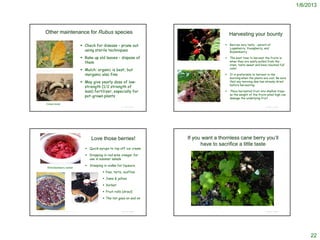
                  Other maintenance for Rubus species                                                                                                                                                   Harvesting your bounty

                                                                                      Check for disease – prune out                                                                                   Berries very tasty - parent of
                                                                                                                                                                                                        Loganberry, Youngberry, and
                                                                                       using sterile techniques                                                                                         Boysenberry

                                                                                      Rake up old leaves – dispose of                                                                                 The best time to harvest the fruits is
                                                                                       them                                      http://plants.montara.com/ListPages/FamPages/Rosa5.html                when they are easily pulled from the
                                                                                                                                                                                                        stem, taste sweet and have reached full
                                                                                                                                                                                                        color.
http://www.ncsu.edu/project/berries/diagnostic_tool/canes_and_or_lateral
s/general_decline_in_plant_vigor.html
                                                                                      Mulch: organic is best, but
                                                                                       inorganic also fine                                                                                             It is preferable to harvest in the
                                                                                                                                                                                                        morning when the plants are cool. Be sure
                                                                                      May give yearly dose of low-                                                                                     that any morning dew has already dried
                                                                                                                                                                                                        before harvesting.
                                                                                       strength (1/2 strength of
                                                                                       less) fertilizer, especially for                                                                                 Place harvested fruit into shallow trays
                                                                                                                                                                                                        as the weight of the fruits piled high can
                                                                                       pot-grown plants                                                                                                 damage the underlying fruit.
                                                                                                                                 http://imaginarybicycle.wordpress.com/category/desirables/
                    Crown borer
                                                                                                               © Project SOUND                                                                                                     © Project SOUND


                                                                                           Love those berries!                                  If you want a thornless cane berry you’ll
                                                                                                                                                      have to sacrifice a little taste
                                                                                        Quick syrups to top off ice cream

                                                                                        Dropping in red wine vinegar for
                                                                                         use in summer salads

                                                                                        Steeping in vodka for liqueurs.
          http://www.food52.com/recipes/6281_wild_blackberry_sorbet


                      Wild blackberry sorbet
                                                                                                   Pies, tarts, muffins

                                                                                                   Jams & jellies

                                                                                                   Sorbet

                                                                                                   Fruit rolls (dried)

                                                                                                   The list goes on and on

                                                                                                                                                        J.S. Peterson @ USDA-NRCS PLANTS Database


  http://tastingthelandscape.blogspot.com/2010/08/devils-shoelace-custard-pie.html                             © Project SOUND                                                                                                     © Project SOUND


                                                                                                                                                                                                                                                          22
1/6/2013


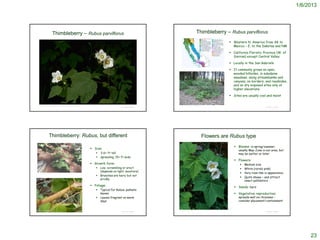
                         Thimbleberry – Rubus parviflorus                                                                              Thimbleberry – Rubus parviflorus
                                                                                                                                                           Western N. America from AK to
                                                                                                                                                            Mexico – E. to the Dakotas and NM

                                                                                                                                                           California Floristic Province (W. of
                                                                                                                                                            Sierras) except Central Valley

                                                                                                                                                           Locally in the San Gabriels

                                                                                                                                                           It commonly grows on open,
                                                                                                                                                            wooded hillsides, in subalpine
                                                                                                                                                            meadows, along streambanks and
                                                                                                                                                            canyons, on borders, and roadsides,
                                                                                                                                                            and on dry exposed sites only at
                                                                                                                                                            higher elevations.

                                                                                                                                                           Sites are usually cool and moist


    Dr. Robert T. and Margaret Orr © California Academy of Sciences                                            © 2009 Julie Kierstead Nelson
                                                                                            © Project SOUND                                                                         © Project SOUND


                 Thimbleberry: Rubus, but different                                                                                            Flowers are Rubus type
                                                                                                                                                              Blooms: in spring/summer;
                                                                       Size:
                                                                                                                                                                usually May-June in our area, but
                                                                            3-6+ ft tall                                                                       may be earlier or later
                                                                            spreading; 15+ ft wide
                                                                                                                                                              Flowers:
                                                                       Growth form:                                                                                Medium size
                                                                            Low, scrambling or erect                                                               White (rarely pink)
                                                                             (depends on light; moisture)
 © 1991 Gary A. Monroe                                                                                                                                              Very rose-like in appearance.
                                                                            Branches are hairy but not
                                                                                                                                                                    Quite showy – and attract
                                                                             prickly
                                                                                                                                                                     insect pollinators
                                                                       Foliage:                                                                              Seeds: hard
                                                                            Typical for Rubus; palmate
                                                                             leaves                                                                           Vegetative reproduction:
                                                                            Leaves fragrant on warm                                                            spreads well via rhizomes –
                                                                             days                                                                               consider placement/containment


© 2011 Zoya Akulova                                                                                           © 2004 Robert Sivinski
                                                                                            © Project SOUND                                                                         © Project SOUND


                                                                                                                                                                                                           23
1/6/2013


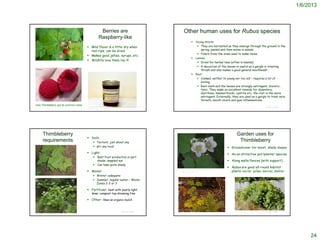
                                                          Berries are                                                                                     Other human uses for Rubus species
                                                         Raspberry-like
                                                                                                                                                                            Young shoots
                                        Mild flavor & a little dry when                                                                                                       They are harvested as they emerge through the ground in the
                                         red-ripe; can be dried                                                                                                                 spring, peeled and then eaten in salads.
                                                                                                                                                                               Fibers from the stem used to make twine
                                        Makes good jellies, syrups, etc.
                                                                                                                                                                            Leaves
                                        Wildlife love them too !!!
© 2004 Robert Sivinski
                                                                                                                                                                               Dried for herbal teas (often in blends)
                                                                                                                                                                               A decoction of the leaves is useful as a gargle in treating
                                                                                                                                                                                thrush and also makes a good general mouthwash.
                                                                                                                                                                            Root
                                                                                                                                                                               Cooked; neither to young nor too old - requires a lot of
                                                                                                                                                                                boiling.
                                                                                                                                                                               Root-bark and the leaves are strongly astringent, diuretic,
                                                                                                                                                                                tonic. They make an excellent remedy for dysentery,
                                                                                                                                                                                diarrhoea, haemorrhoids, cystitis etc, the root is the more
                                                                                                                                                                                astringent. Externally, they are used as a gargle to treat sore
                                                                                                                                                                                throats, mouth ulcers and gum inflammations.
How Thimbleberry got its common name
                                        http://upfoods.com/index.php?main_page=product_info&cPath=35&products_id=67&zenid=44f82b96b2f0219f31ab989
                                                                                                       © Project SOUND                                                                                                                                  © Project SOUND
                                        6b094afdc


          Thimbleberry                                                                                                                                                                                     Garden uses for
                                        Soils:
          requirements                          Texture: just about any                                                                                                                                    Thimbleberry
                                                pH: any local                                                                                                                                       Groundcover for moist, shady slopes
                                        Light:                                                                                                                                                      As an attractive pot/planter species
                                                      Best fruit production in part
                                                       shade; dappled sun                                                                                                                            Along walls/fences (with support)
                                                      Can take quite shady
                                                                                                                                                                                                     Rubus are good all-round habitat
                                        Water:                                                                                                      © 2009 Julie Kierstead Nelson                    plants: nectar, pollen, berries, shelter
                                                Winter: adequate
                                                Summer: regular water – Water
© 2001 Steven Thorsted


                                                 Zones 2-3 or 3

                                        Fertilizer: best with yearly light
                                            dose; compost top-dressing fine

                                        Other: likes an organic mulch

                                                                                                                                                    © 2010 Jean Pawek
                                                                                                     © Project SOUND                                                                                      http://www.baynatives.com/plants/Rubus-parviflorus/ Project SOUND
                                                                                                                                                                                                                                                            ©


                                                                                                                                                                                                                                                                                   24
1/6/2013


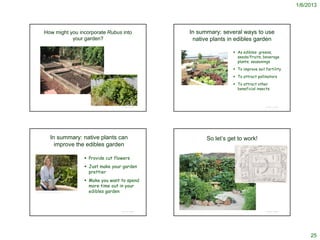
            How might you incorporate Rubus into                                                                                           In summary: several ways to use
                       your garden?                                                                                                         native plants in edibles garden

                                                                                                                                                            As edibles: greens,
                                                                                                                                                             seeds/fruits, beverage
                                                                                                                                                             plants; seasonings
                                                                                                                                                            To improve soil fertility
                                                                                                                                                            To attract pollinators
                                                                                                                                                            To attract other
                                                                                                                                                             beneficial insects


                                                                       http://www.baynatives.com/plants/Rubus-parviflorus/
                                                                                                                         © Project SOUND                                     © Project SOUND


                      In summary: native plants can                                                                                              So let’s get to work!
                        improve the edibles garden

                                                                     Provide cut flowers
                                                                     Just make your garden
                                                                      prettier
                                                                     Make you want to spend
                                                                      more time out in your
http://cathythomascooks.com/2012/05/01/culinary-gardener-kathryn-
agresto-shares-four-chefs-vegetable-gardens/                          edibles garden


                                                                                                                         © Project SOUND                                     © Project SOUND


                                                                                                                                                                                                    25

Native Plants in Vegetable Garden - Notes

  • 1.
    1/6/2013 Out of theWilds and Into Your Garden Into the Vegetable Garden: Using CA Native Plants in the Edibles Garden C.M. Vadheim and T. Drake CSUDH & Madrona Marsh Preserve Madrona Marsh Preserve Gardening with Western L.A. County Native Plants June 2 & 5, 2012 Project SOUND – 2012 (our 8th year) © Project SOUND © Project SOUND Many of us grow edibles in our home Benefits of growing your own fruits & gardens (or are thinking of starting) vegetables  Fun  Educational  Good exercise  Interesting looking plants  Saves money  Tasty, fresh ingredients http://bloomtown.typepad.com/bloomtown/bloomtown_my_garden/  Opportunity to grow heirloom varieties – and to grow foods that are not genetically modified  Chance to grow & use ‘exotic’ ingredients – including CA native plants http://www.denverpost.com/grow/ci_20587823/big-flavors-from-small-fruits © Project SOUND http://vegetablegardenathome.com/ © Project SOUND 1
  • 2.
    1/6/2013 AreCA native plants and edibles Ways in which ‘conventional’ edibles gardens really compatible? may differ from native plants  Water requirements: many conventional edible plants require more water than many CA native plants  Nutrient requirements: many conventional edibles require more nutrients than most CA native plants like/need © Project SOUND © Project SOUND Of course you can plan for different water needs – You can also get around the other that’s what Water Zone Gardening is all about differences – with a little planning © Project SOUND © Project SOUND 2
  • 3.
    1/6/2013 We look on-line for some inspiration Summer’s a good time to re-evaluate What works well? What needs changing? http://efnep.ucdavis.edu/?blogpost=4501&blogasset=17351 http://pcnatthegreenshow.wordpress.com/2010/04/18/california-spring-trials-day-3-along-the-central-coast/ http://blog.gardenerd.com/2007/10/13/raised-beds--part-1-materials.aspx http://www.thriftyfun.com/tf16684008.tip.html © Project SOUND © Project SOUND http://timberglade.typepad.com/outside/vegetables/ Your resolutions:  Minor changes to most of the You’ve got the whole summer to get ready raised beds – a few repairs summer 2012 for fall planting – time to get cracking!  Convert the back beds to narrow beds for specialty crops – more space between them & back fence  Better use of the back fence area: ?? New vines  Add a few more beds – allow you to ‘rest’ some beds each year for plant health http://blog.gardenerd.com/2007/10/13/raised-beds--part-1-materials.aspx  Use the large pots more Incorporate native plants into  Create some open areas the edible garden; use more surrounding garden for heirloom varieties pollinator plants/ plants to attract beneficial insects http://www.mastergardeners.org/projects/gilroy.html © Project SOUND © Project SOUND 3
  • 4.
    1/6/2013 Guide to S. CA Vegetable Crops How about some native cool-season crops? Warm-season Vegetables Cool-season Vegetables  Plant:  Plant:  From seed: Aug-Oct in shaded  From seed: Mar-May; depends pots; Sep-Oct in ground on how cold the spring is  From starts: Oct-Dec  From starts: Apr-June (even July for late crops)  Ripen:  Early crops: Oct-Nov  Ripen:  Late crops: Dec-Feb  Early crops: June-July (Aug) Late crops: Aug-Sept  Examples:  Examples:  Early crops: broccoli, brussels sprouts, cauliflower, kale,  Early crops: beans, cucumbers, kohlrabi, mustard, lettuce and summer squash, tomatoes, other greens  Late crops: corn, melons,  Late crops: peas, cabbage, winter squash celery, http://www.amillionlives.net/vegetable-gardening-tips-easy-ideas-for-great-produces.html © Project SOUND © Project SOUND Miner’s Lettuce – Claytonia perfoliata Planning our cool-season garden ssp. perfoliata & mexicana Traditional vegetables CA native greens  Lettuce  Allium haematochiton  Spinach  Calandrinia ciliata  Camissonia species  Peas  Claytonia perfoliata  Broccoli  Mimulus cardinalis  Oenothera elata  Phacelia species  Plantago species  Trifolium species © 2001 Steven Thorsted http://nativeplantsocietyca.tribe.net/photos/cfd27d18-6ba7-4365-b1d9-c1c7c67b9cbe © Project SOUND 4
  • 5.
    1/6/2013 Growing Miner’s Lettuce Placement in our garden from seed  Annual plant: dies to nothing in summer Steve Hurst @ USDA-NRCS PLANTS Database  Extremely easy  Any soil: amended or not  Sow in prepared soil in fall (best) through spring © by Gena Zolotar  Light: any (full sun to full shade)  Germinates with:  Damp soil/fall rains  Water: can take some  Short days extra water  Re-seeds  Want to be able to pick  May want to remove plants if it for winter salads too prolific – will depend on site http://www.pacifichorticulture.org/phv66n3.editorial.html Fringed Redmaids – Calandrinia ciliata var menziesii Fringed Redmaids – Calandrinia ciliata var menziesii  Wide distribution:  Western United States , Central America, and northern South America.  In CA: California Floristic Province, some areas E. of Sierras  Usually in grassy areas, woodland openings or disturbed areas  Name:  Calandrinia: named for Jean Louis Calandrini (1703-1758), a professor of mathematics and philosophy, and a botanical Question to ponder: does the author in Switzerland distribution of this plant suggest a  ciliata: indicates the slight human role? fringing of the petals like an eyelash © Project SOUND © Project SOUND 5
  • 6.
    1/6/2013 Red Maids are spreading annuals Flowers are an  Spring-blooming – as early as added bonus Feb. to May  Size:  Long bloom period with adequate  < 2 ft tall; tips of stems water – flowers open sequentially upcurviing along the stems  2-3 ft wide – side stems are spreading; plants will grow  Flowers are: together  Tiny - < ½ inch across  An unusual shade of hot  Growth form: sprawling/spreading pink/magenta – hard to herbaceous annual from a basal photograph rosette. Robert Potts © California Academy of Sciences  Open only during sunniest part of the day – flowers ‘disappear’ into  Foliage: their calyces at other times  Attractive light green  Seeds are:  Slightly succulent leaves; spatula  Tiny & shiny – but numerous; wind shaped spread  Roots: taproot; grow in place  Very tasty – were prized food for Native Californians (parched & ground to make pinole) © 2006 Chris Wagner © Project SOUND © Project SOUND Jo-Ann Ordano © California Academy of Sciences Red Maids is well suited to the vegetable Redmaids make  Use only young leaves – best piquant greens before flowering; Arugala-like garden…  Soils:  Leaves contain oxalic acid, so it should only be used in moderation.  Texture: any well-drained soil; does super in sandy or rocky soils,  Oxalic acid can lock up certain of the nutrients in food - can lead to but typical vegetable gardens nutritional deficiencies if eaten in soils would be great excess.  pH: just about any local  It is, however, perfectly safe in  Light: full sun; great in regular small amounts and its acid taste adds a nice flavor to salads. vegetable garden  Water:  Cooking the plant will reduce the quantity of oxalic acid.  Winter: needs good winter/ spring rains  People with a tendency to  Summer: regular water (Zone 2-3 rheumatism, arthritis, gout, kidney or 3) will extend blooms slightly; stones and hyperacidity should take especial caution if including no water for seed set this plant in their diet since it can  Fertilizer: fine with light fertilizer aggravate their condition Plants re-seed very well – but it’s easy to weed out unwanted plants © Project SOUND © Project SOUND 6
  • 7.
    1/6/2013 Many uses for Red Maids in the garden Planning our cool-season garden  Very nice in pots – very green Traditional CA native greens and attractive; helps control vegetables them to an extent  Allium haematochiton  In the vegetable garden –  Lettuce  Calandrinia ciliata  Edible greens and seeds  Camissonia species  Spinach  Flowers really perk up a  Claytonia perfoliata vegetable garden  Peas  Mimulus cardinalis  In the fronts of mixed beds  Broccoli  Oenothera elata  Among native bunchgrasses;  Phacelia species needs bare ground to reseed  Plantago species  Trifolium species  In the ‘Children’s Garden’ – easy  For bird habitat – many birds &  See Mother Nature’s Backyard insects relish the seeds blog for more-http://mother- natures-backyard.blogspot.com/ © Project SOUND © Project SOUND Your resolutions:  Minor changes to some raised beds – a few repairs Clovers are often used as cover crops summer 2012  Convert the back beds to narrow beds for specialty  Quick growing crops – more space between  Suppress weed growth them & back fence  Prevent soil erosion  Better use of the back fence  Increase soil organic matter area: ?? New vines (humus) – good for vegetable crops  Add a few more beds – allow  Can be eaten (by humans or you to ‘rest’ some beds each livestock) year for plant/soil health http://blog.gardenerd.com/2007/10/13/raised-beds--part-1-materials.aspx  Improve soil Nitrogen:  Create open areas surrounding  Interact with nodule-forming garden for pollinator nitrogen fixing bacteria Incorporate native plants into plants/plants to attract  Nitrogen is converted to a the edible garden beneficial insects form that can be used by plants – including your veggies © Project SOUND © Project SOUND 7
  • 8.
    1/6/2013 Bull clover/ Sour Clover – Trifolium fucatum Bull clover – Trifolium fucatum  West coast of N. America from OR to Baja  In CA either:  Foothills of Sierras and other ranges  Coastally-influenced areas < 3000 ft. elevation  Locally abundant. Moist, open grassland, ditches, marshes, roadsides, sometimes saline or serpentine soils  fucatum: painted, dyed © 2004 Carol W. Witham © 2005 George W. Hartwell © Project SOUND © Project SOUND Bull Clover is a fairly typical native annual clover Flowers are among the prettier clover flowers  Size:  < 1 ft tall  Blooms:  1-3 ft wide; slightly spreading  Usually Apr-June in S. CA ; after weather warms up  Growth form:  Long bloom period with  Mounded; low-lying supplemental water  Typical for clovers  Flowers:  Foliage:  Typical for clover; small pea-type  Leaves typical ‘clover-leaf’ – often flowers in a ball-like head white-patterned  Cream-colored tinged with  Stems robust, hollow pink/mauve  Edible  Roots:  Have symbiotic relationship with  Seeds: nitrogen-fixing bacteria  Small Robert Potts © California Academy of Sciences  Leave roots in soil to improve soil  Edible fresh fertility (just harvest the tops) © Project SOUND © Project SOUND 8
  • 9.
    1/6/2013 Clovers – not hard to grow once you know the trick Most parts of clovers are edible in spring  Soils:  Fresh greens  Texture: any well-drained  Raw or cooked  pH: any, including alkali  Limit intake of uncooked clover –  Even takes salty soils causes gas  Light: full sun to part-shade; good  Use cooked clover like spinach under deciduous trees  Flowers  Water:  Make nice addition to a salad  Winter: needs moist soils  Leave some for the pollinators –  Summer: needs regular water great pollinator plants until flowering ceases – then cut  Seeds back  Native Californians ate them fresh  Fertilizer: not needed, but  Many animals & birds also like probably won’t hurt clover seeds  Other: to start seeds give them a Native Californians look forward to fresh © 2007 Aaron Schusteff hot-water treatment clover in the spring! © Project SOUND © 2007 Neal Kramer © Project SOUND Use any CA native clover as food, Your resolutions:  Minor changes to some raised beds – a few repairs improve your soil & attract pollinators summer 2012  Convert the back beds to narrow beds for specialty crops – more space between them & back fence  Better use of the back fence area: ?? New vines  Add a few more beds – allow you to ‘rest’ some beds each year for plant health http://blog.gardenerd.com/2007/10/13/raised-beds--part-1-materials.aspx  Create open areas surrounding garden for pollinator Incorporate native plants into plants/plants to attract the edible garden; use more beneficial insects heirloom varieties © 2004 Carol W. Witham © Project SOUND © Project SOUND 9
  • 10.
    1/6/2013 Attracting pollinators to the veggie garden One reason to grow native annuals & perennials in/near the edibles garden  Bees  Flies and fly-like insects (next month’s topic) http://www.ars.usda.gov/is/graphics/photos/nov08/d1275-1.htm  Butterflies  Moths  Beetles http://www.laspilitas.com/garden/august-native-garden-flowers-pictures.htm  Many others http://www.ehow.com/how_8036705_do-flowers-blossomed-summer-squash.html © Project SOUND © Project SOUND Where might we plants some perennials? CA Sea Thrift – Armeria maritima ssp. californica © 2007 Neal Kramer http://blog.gardenerd.com/2007/10/13/raised-beds--part-1-materials.aspx © Project SOUND © Project SOUND 10
  • 11.
    1/6/2013 The Plumbaginaceae CA Sea Thrift – Armeria maritima ssp. californica  Possibly S. Coast; definitely Santa  Sometimes referred to as the Rosa Isl., San Luis Obispo Co (Cambria; leadwort family or the plumbago Santa Lucia Mtns near San Simeon) family. Flowers in parts of 5.  North to British Columbia  Most species in this family are perennial herbaceous plants, but a  Near the beach: prairies, cliffs, bluffs few grow as vines or shrubs. & dunes < 1000 ft elevation  The plants have perfect flowers http://ucjeps.berkeley.edu/cgi-bin/get_JM_treatment.pl?5645,5646,0,5647 (have male & female parts) and are pollinated by insects.  Found in many different climatic regions, from arctic to tropical http://www.hear.org/starr/images/image/?q=031108-0160&o=plants conditions, but are particularly associated with salt-rich steppes, Cape Plumbago – planted along freeways marshes, and sea coasts. © Project SOUND © Project SOUND © 2011 Chris Winchell Charles Webber © California Academy of Sciences Sea Thrift – dainty but tough Flowers: lovely color  Size:  Blooms:  1-2 ft tall (foliage < 1 ft)  Spring/summer – usually  ~ 1 – 1 ½ ft wide May-Aug in our area  Long-blooming with regular  Growth form: water and dead-heading  mounded perennial  evergreen  Flowers:  Small; in dense ball-like  Foliage: clusters (somewhat like the  Narrow, stiff leaves – fancy onions) somewhat grass-like  Color: magenta or pink  Foliage in basal rosette  Very pretty in bloom – make good cut flowers  Roots: tough & woody; part is  Attract native bees, above-ground butterflies & other insects © 2011 Chris Winchell © 2007 Neal Kramer © 2004, Ben Legler © Project SOUND © Project SOUND © 2007 Neal Kramer 11
  • 12.
    1/6/2013 Available as plants: easy also from seed Plant Requirements  Soils:  Texture: any from sandy loam or divisions to clay – good for clays  pH: any local  From seed:  Light: full sun right along coast; part-sun (morning sun) elsewhere  Use fresh seed  No pre-treatment  Water:  Quite easy, good  Winter: adequate – supplement germination in fall/spring if needed  Summer: moderate to regular  From divisions: water – Zones 2-3 to 3  Divide with a shovel or  Fertilizer: none; likes poor soils – uproot and cut but probably wouldn’t kill it  Re-plant the divisions  Other: if using an organic mulch,  Reliable http://www.hazmac.biz/051128/051128AmeriaMaritimaCalifornica.html make it thin; no mulch or inorganic mulches fine © Project SOUND © Project SOUND © 2008 John Dittes Loved by gardeners as: Bring it into the vegetable garden  Sea-side ground cover  Rock garden plant  Attractive pot/planter species  Lining walkways http://www.imagejuicy.com/images/plants/a/armeria/10/ http://commons.wikimedia.org/wiki/File:Armeria_maritima,_Tower_Hill_Botanic_Garden.JPG http://www.pacifichorticulture.org/web- extras/70/3/sea-ranch-gardens-most- successful-plants/ You’ll also have a source of cut flowers http://www.thienemans.com/ph http://www.elkhornnursery.com/default.aspx?pid=2989aedb otos/index.php/Succulents- http://www.cnps.org/cnps/grownative/tips -2f5a-41ec-9c05-61c5ebfda0e9&PlantId=1115 Rock-Garden/IMG_0132 /lawn_alternatives.php © Project SOUND © Project SOUND © 2004, Ben Legler http://www.calfloranursery.com/plants/armeria- maritima-ssp-californica 12
  • 13.
    1/6/2013 Many annual wildflowers are great for attracting pollinators – and fit easily into Attracting other beneficial insects an edibles garden  Predatory insects – eat the bad guys  Clarkias  Gilias  Insects that attract insect-eating birds  Anything in Sunflower family  Insects that provide  Lotus species other beneficial  Phacelias services in the garden  Annual Salivas  Many more (see pollinator lists: Project SOUND/ Mother Nature’s http://trishsgarden.blogspot.com/2008/03/very-late-march-1-garden-newsletter.html http://www.pfaf.org/user/Plant.aspx?LatinName=Phacelia+tanacetifolia Backyard Blog Some native plants have a well-deserved reputation for Tansy-leaf Phacelia © Project SOUND attracting the ‘good guys’ © Project SOUND Attract Attract these By planting these By planting beneficial these species beneficial these species insects insects Bigeyed bug Native grasses Minute Achillea sp. (Yarrow) Polygonum sp. (Silver Lace Vine) pirate bug Baccharis sp. (Coyote brush, Mulefat) Copyright © 2007 Ron Hemberger Eriogonum sp. (Buckwheat) Hoverflies Achillea sp. (Yarrow) http://www.ipm.ucdavis.edu/PMG/NE/minute_pirate_bug.html Asclepias fascicularis (Narrowleaf Milkweed) Minute Pirate Bug Baccharis sp. (Coyote brush, Mulefat) Ceanothus sp. (California Lilac) Eriogonum sp. (Buckwheat) Prunis ilicifolia (Hollyleaf Cherry) Achillea sp. (Yarrow) Parasitic & Aesclepias fascicularis (Narrowleaf Predatory Milkweed) Ceanothus sp. (California Lilac) Wasps Eriogonum sp. (Buckwheat) Lacewings Prunus ilicifolia (Hollyleaf Cherry) Lady beetles Achillea sp. (Yarrow) Asclepias fascicularis (Narrowleaf Milkweed) Tachnid flies Achillea sp. (Yarrow) Atriplex sp. (Quailbush, Saltbush) Eriogonum sp. (Buckwheat) Ceanothus sp. (California Lilac) Heteromeles arbutifolia (Toyon) Native grasses Rhamnus californica (Coffeeberry) Rhamnus californica (Coffeeberry) Salix sp. (Willow) http://www.ipm.ucdavis.edu/PMG/NE/tachinid_flies.html http://www.stopwaste.org/home/index.asp?page=402 http://www.kunafin.com/lacewings.htm © Project SOUND Tachnid Fly http://www.stopwaste.org/home/index.asp?page=402 © Project SOUND 13
  • 14.
    1/6/2013 * Southern Umbrellawort – Tauschia arguta * Southern Umbrellawort – Tauschia arguta  Outer coastal ranges, S. CA and Baja  Locally in Santa Monica Mtns, Hollywood Hills, San Gabriels  Dry fans and slopes below 6000', coastal sage, scrub, chaparral, woodlands, inland to desert edge http://ucjeps.berkeley.edu/cgi-bin/get_cpn.pl?TAAR2 © 2006 Michelle Cloud-Hughes © Project SOUND © 2003 Brent Miller http://www.researchlearningcenter.org/bloom/species/Tauschia_arguta.htm © Project SOUND Southern Umbrellawort: Carrot family Flowers attract beneficial insects  Size:  1-2 ft tall  Blooms: mid- to late spring (April  1-3 ft wide to June)  Growth form:  Flowers:  Herbaceous perennial  Small and yellow  Low but erect form  In compound umbels typical of  Evergreen © 2006 Michelle Cloud-Hughes Carrot family; smells ‘carroty’  Many pollinator (and other)  Foliage: insects  Very green  Large-lobed & coarsely  Seeds: toothed – like flat parsley or  Flat, ribbed seeds typical of celery the family  Larval food for Anise  To start from seed, use fresh Swallowtail seed and rinse in several rinses of water to remove inhibiting © 2006 Michelle Cloud-Hughes  Roots: stout hormones. © Project SOUND © Project SOUND 14
  • 15.
    1/6/2013 Easy to grow Umbrellawort in the garden  Usually included in butterfly gardens  Soils:  Texture: any well-drained  Unusual pot plant; in rock gardens  pH: any local – including  Good choice for margins of the vegetable garden vegetable garden  Light:  Full sun to light shade © 2010 Gary A. Monroe  Water:  Winter: plenty of water; soils moist  Summer: dry out to Zone 1-2 or 2 in summer  Fertilizer: none; likes poor soils  Little to no mulch – inorganic mulch fine http://mamba.bio.uci.edu/~pjbryant/biodiv/lepidopt/papilio/anise.htm © Project SOUND © Project SOUND http://www.calflora.net/bloomingplants/southerntauschia.html Michelle Cloud-Hughes © 2006 http://www.laspilitas.com/nature-of-california/plants/tauschia-arguta Heirloom edibles and native plants: a Others perennials for garden edges good combination  Open-pollinated  Achillea millefolia  Asclepias species (Milkweeds)  Long relationship between heirloom varieties, ‘wild  Clematus species (Virgin’s Bowers) plants’ and insects  Eriogonum species (Buckwheats)  Unusual and tasty flavors  Lomatium utriculatum – combine well with native  Solidago species (Goldenrods) seasonings  Native grasses  Are less likely to be genetically modified food plants http://www.byexample.com/homestead/gardens/heirloom_seeds.html © Project SOUND © Project SOUND 15
  • 16.
    1/6/2013 Genetically modified foods are here What are genetically modified plants  Experts say 60% to 70% of processed foods on U.S. grocery shelves have genetically modified ingredients.  The most common genetically modified foods are soybeans, maize, cotton, and rapeseed oil. That means many foods made in the U.S. containing field corn or high-fructose corn syrup; foods made with soybeans and foods made with cottonseed and canola oils could likely have genetically modified ingredients.  These ingredients appear frequently in animal feed as well. http://www.precisionnutrition.com/all-about-gm-foods © Project SOUND Keeping old varieties alive is another reason to Which view is correct? plant heirloom seeds: biodiversity is important in  The U.S. government's position: Genetically agriculture as well as in nature engineered crops are safe, resist disease better, and can provide much-needed food in starving nations.  The EU position: Keep it out. We prefer organic, which is much healthier. The risk of genetically modified foods to health and the environment outweigh the benefits. Only the multinational biotech companies will benefit, dominating the world food http://www.heirloomseeds.com/ supply and squeezing out traditional farmers. We’ll discuss this topic in greater depth in our July class © Project SOUND 16
  • 17.
    1/6/2013 Youconsider adding some native herb/spice or After seeing this picture you decide to add beverage plants to your vegetable garden some native fruits to your edibles garden http://bumblelush.blogspot.com/2012/05/strawberry-season-is-here.html Strawberries would be an easy place to start © Project SOUND © Project SOUND http://www.dailyunadventuresincooking.com/2010/07/strawberry-and-arugula-salad-recipe.html/ * Woodland Strawberry – Fragaria vesca ssp. californica * Woodland Strawberry – Fragaria vesca ssp. californica  Coastal mountains and Sierra Nevada from OR/WA to Baja  Locally in the San Bernardino & San Jacinto Mtns., San Diego Co.  In dry to moist meadows, young woodlands, sparse forest , woodland edges and clearings.  Often plants can be found where they do not get sufficient light to form fruit. http://ucjeps.berkeley.edu/cgi-bin/get_JM_treatment.pl?6677,6723,6725 © 2002 George Jackson © Project SOUND © Project SOUND 17
  • 18.
    1/6/2013 Flowers are sweet But the fruits are  Blooms: sweeter yet!  Spring into summer  Larger fruit than Fragaria  Usually Mar. to June in our chiloensis (Beach Strawberry) area – may also have some summer bloom  Among the most tasty of all the wild strawberries –sweet scent  Flowers: © 2006 Dr. Amadej Trnkoczy  Smaller than F. chiloensis  Excellent choice for:  Typical 5-petal white flowers  Eating fresh of the genus  Including in baked goods  Really nice for a ground-cover  Making preserves & syrups plant; light, sweet fragrance  Drying  Attract butterflies  Berries have antioxidant properties  Seeds: usually will reseed  Berry juice is a natural bleach  Vegetative reproduction: easy to dig up plantlets to produce new © 2006 Dr. Amadej Trnkoczy  Leaves make a tea for GI upsets plants © Project SOUND © Project SOUND  Soils: Many ways to use strawberries in the Plant Requirements  Texture: any, including clays  pH: any local including acidic vegetable garden – all pretty  Light:  Full sun (cooler gardens) or dappled shade are best  Will grow fine in part-shade to quite shady, but fruiting reduced  Water:  Winter: likes good rains  Summer: wide tolerance – http://www.putteringinthegarden.com/category/fruit/strawberries/ occasional (Zone 2) to regular water (Zone 3)  Fertilizer: fine with light fertilizer – really likes a leaf mulch  Other: good frost tolerance © 2006 Dr. Amadej Trnkoczy © Project SOUND © Project SOUND http://www.tipjunkie.com/how-to-grow-strawberries/ 18
  • 19.
    1/6/2013 Maybe you want to be a bit more adventuresome CA Blackberry – Rubus ursinus ssp. ursinius © 2005 Doreen L. Smith http://groweat.blogspot.com/2011/04/derwood-demo-garden-update.html#axzz1wZrtwMAD © Project SOUND © Project SOUND CA Blackberry – Rubus ursinus ssp. ursinius Rubus ursinus in Santa Monica Mtns  Western N. America from British Columbia to Baja; 0 - 4500 feet elevation  Locally on Catalina, Santa Monicas, San Gabriels – possibly more in past  Moist places: canyons, river banks, etc. http://ucjeps.berkeley.edu/cgi-bin/get_JM_treatment.pl?6677,6899,6910 © Project SOUND © Project SOUND © 2011 Michael O'Brien http://www.plumjam.com/wildflowers/5-20-2011.cfm 19
  • 20.
    1/6/2013 CA Blackberry: characteristic of genus The genus Rubus  Size:  Large genus in Rose family  1-3 ft tall (Rosaceae)  8-20 ft wide  Latin name meaning “bramble” –  Growth form: most have prickly stems  Low, mounded canes; trailing or climbing habit  Includes cultivated raspberries  Evergreen or slightly winter and blackberries deciduous  Armed with prickles © 2009 Zoya Akulova  More than a dozen species native to western N. America  Foliage:  The Rubus fruit, sometimes  Medium green with leaflets – http://en.wikipedia.org/wiki/File:Blackberries_on_bush.jpg typical of genus called a bramble fruit, is an Some of our favorite summer aggregate of drupelets (small,  Roots: will spread via suckers – fruits come from this genus! fleshy fruits surrounding a hard modest compared to Himalayan ‘stone’ or seed) Blackberry © Project SOUND © 2009 Ben Stever © Project SOUND Which Blackberry is it? Himalayan Blackberry Pretty white flowers (Rubus discolor/ R. armeniacus)  Blooms: in spring – between April & June, depending on the weather  Native to Armenia in SW Asia  Flowers:  Introduced to Europe in 1835,  Medium size: 1-2 inches across and Australasia and North  Plants may be dioecious http://kaweahoaks.com/html/calif_blackberry.html America in 1885 (separate male & female Prickles of CA Blackberry are thin and  Widely planted due to its © 2008 Gary McDonald plants) or may produce perfect easily detach flowers (contain both sexes) flavorful fruit & availability  Attract many pollinators  Because it’s so hard to contain, quickly got out of control, with  Vegetative reproduction: birds/animals eating the  Branch tips root readily where berries and spreading the they touch ground seeds.  Easy way to propagate – tip- http://www.nps.gov/prsf/naturescience/himalayan-blackberry.htm layering (or just remove rooted  Now a plant pest world-wide tips in spring) Flowers of CA Blackberry usually have longer, narrower petals © 2007 Neal Kramer © Project SOUND © Project SOUND 20
  • 21.
    1/6/2013 Garden  Soils:  Texture: any – not particular Blackberries: contain Requirements  pH: any local  Sometimes used as a thorny hedge  Light:  Full sun to part-shade; afternoon  Best used in contained places; shade in hot inland gardens planters, areas bounded by impervious materials  Water:  Winter: plenty  Can be grown in large containers  Summer: pretty drought tolerant © 2010 Aaron Arthur once established; best fruiting in Water Zone 2-3 (moderate water)  Fertilizer: none; likes poor soils; mulching is good  Other: Don’t plant brambles in a site where potatoes, eggplants, tomatoes, and peppers have grown in the past 3 years; site may contain verticillium wilt which will harm brambles. © 2012 Michael O'Brien © Project SOUND http://www.ebay.com/itm/Wild-Northern-Blackberry-20-Seeds-Rubus-Ursinus/270983468691 © Project SOUND Provide some support Pruning Rubus species  Chain-link fence  Primocanes: first year – non-fruiting  Garden trellis or frame: attach with clothespins, twist-ties or strips of old nylons  Floricanes: second year canes with side branches – produce flowers,  More classic methods Figure 1. Primocanes of thorny, erect berries  One-line trellis (two-wire trellis) blackberries that have not been pruned.  Two-line trellis (Cross-arm trellis)  During the growing season, tip back each developing primocane to ~ 4-5 ft. ; lateral shoots develop  When the fruiting season is over, https://appserver1.kwantlen.ca/apps/plantid/plantid.nsf/lookup/73C488F 4F1EAF5628825772A0060BFD7?OpenDocument cut out spent floricanes at the root crown. Do not prune floricanes before fruiting season unless damaged or diseased.  Discard all pruned plant material. One-line trellis for trailing blackberries. Figure 2. Primocanes of thorny, erect Spread floricanes up on a two-wire system. © Project SOUND blackberries that have been pruned. © Project SOUND 21
  • 22.
    1/6/2013 Other maintenance for Rubus species Harvesting your bounty  Check for disease – prune out  Berries very tasty - parent of Loganberry, Youngberry, and using sterile techniques Boysenberry  Rake up old leaves – dispose of  The best time to harvest the fruits is them http://plants.montara.com/ListPages/FamPages/Rosa5.html when they are easily pulled from the stem, taste sweet and have reached full color. http://www.ncsu.edu/project/berries/diagnostic_tool/canes_and_or_lateral s/general_decline_in_plant_vigor.html  Mulch: organic is best, but inorganic also fine  It is preferable to harvest in the morning when the plants are cool. Be sure  May give yearly dose of low- that any morning dew has already dried before harvesting. strength (1/2 strength of less) fertilizer, especially for  Place harvested fruit into shallow trays as the weight of the fruits piled high can pot-grown plants damage the underlying fruit. http://imaginarybicycle.wordpress.com/category/desirables/ Crown borer © Project SOUND © Project SOUND Love those berries! If you want a thornless cane berry you’ll have to sacrifice a little taste  Quick syrups to top off ice cream  Dropping in red wine vinegar for use in summer salads  Steeping in vodka for liqueurs. http://www.food52.com/recipes/6281_wild_blackberry_sorbet Wild blackberry sorbet  Pies, tarts, muffins  Jams & jellies  Sorbet  Fruit rolls (dried)  The list goes on and on J.S. Peterson @ USDA-NRCS PLANTS Database http://tastingthelandscape.blogspot.com/2010/08/devils-shoelace-custard-pie.html © Project SOUND © Project SOUND 22
  • 23.
    1/6/2013 Thimbleberry – Rubus parviflorus Thimbleberry – Rubus parviflorus  Western N. America from AK to Mexico – E. to the Dakotas and NM  California Floristic Province (W. of Sierras) except Central Valley  Locally in the San Gabriels  It commonly grows on open, wooded hillsides, in subalpine meadows, along streambanks and canyons, on borders, and roadsides, and on dry exposed sites only at higher elevations.  Sites are usually cool and moist Dr. Robert T. and Margaret Orr © California Academy of Sciences © 2009 Julie Kierstead Nelson © Project SOUND © Project SOUND Thimbleberry: Rubus, but different Flowers are Rubus type  Blooms: in spring/summer;  Size: usually May-June in our area, but  3-6+ ft tall may be earlier or later  spreading; 15+ ft wide  Flowers:  Growth form:  Medium size  Low, scrambling or erect  White (rarely pink) (depends on light; moisture) © 1991 Gary A. Monroe  Very rose-like in appearance.  Branches are hairy but not  Quite showy – and attract prickly insect pollinators  Foliage:  Seeds: hard  Typical for Rubus; palmate leaves  Vegetative reproduction:  Leaves fragrant on warm spreads well via rhizomes – days consider placement/containment © 2011 Zoya Akulova © 2004 Robert Sivinski © Project SOUND © Project SOUND 23
  • 24.
    1/6/2013 Berries are Other human uses for Rubus species Raspberry-like  Young shoots  Mild flavor & a little dry when  They are harvested as they emerge through the ground in the red-ripe; can be dried spring, peeled and then eaten in salads.  Fibers from the stem used to make twine  Makes good jellies, syrups, etc.  Leaves  Wildlife love them too !!! © 2004 Robert Sivinski  Dried for herbal teas (often in blends)  A decoction of the leaves is useful as a gargle in treating thrush and also makes a good general mouthwash.  Root  Cooked; neither to young nor too old - requires a lot of boiling.  Root-bark and the leaves are strongly astringent, diuretic, tonic. They make an excellent remedy for dysentery, diarrhoea, haemorrhoids, cystitis etc, the root is the more astringent. Externally, they are used as a gargle to treat sore throats, mouth ulcers and gum inflammations. How Thimbleberry got its common name http://upfoods.com/index.php?main_page=product_info&cPath=35&products_id=67&zenid=44f82b96b2f0219f31ab989 © Project SOUND © Project SOUND 6b094afdc Thimbleberry Garden uses for  Soils: requirements  Texture: just about any Thimbleberry  pH: any local  Groundcover for moist, shady slopes  Light:  As an attractive pot/planter species  Best fruit production in part shade; dappled sun  Along walls/fences (with support)  Can take quite shady  Rubus are good all-round habitat  Water: © 2009 Julie Kierstead Nelson plants: nectar, pollen, berries, shelter  Winter: adequate  Summer: regular water – Water © 2001 Steven Thorsted Zones 2-3 or 3  Fertilizer: best with yearly light dose; compost top-dressing fine  Other: likes an organic mulch © 2010 Jean Pawek © Project SOUND http://www.baynatives.com/plants/Rubus-parviflorus/ Project SOUND © 24
  • 25.
    1/6/2013 How might you incorporate Rubus into In summary: several ways to use your garden? native plants in edibles garden  As edibles: greens, seeds/fruits, beverage plants; seasonings  To improve soil fertility  To attract pollinators  To attract other beneficial insects http://www.baynatives.com/plants/Rubus-parviflorus/ © Project SOUND © Project SOUND In summary: native plants can So let’s get to work! improve the edibles garden  Provide cut flowers  Just make your garden prettier  Make you want to spend more time out in your http://cathythomascooks.com/2012/05/01/culinary-gardener-kathryn- agresto-shares-four-chefs-vegetable-gardens/ edibles garden © Project SOUND © Project SOUND 25