1/6/2013


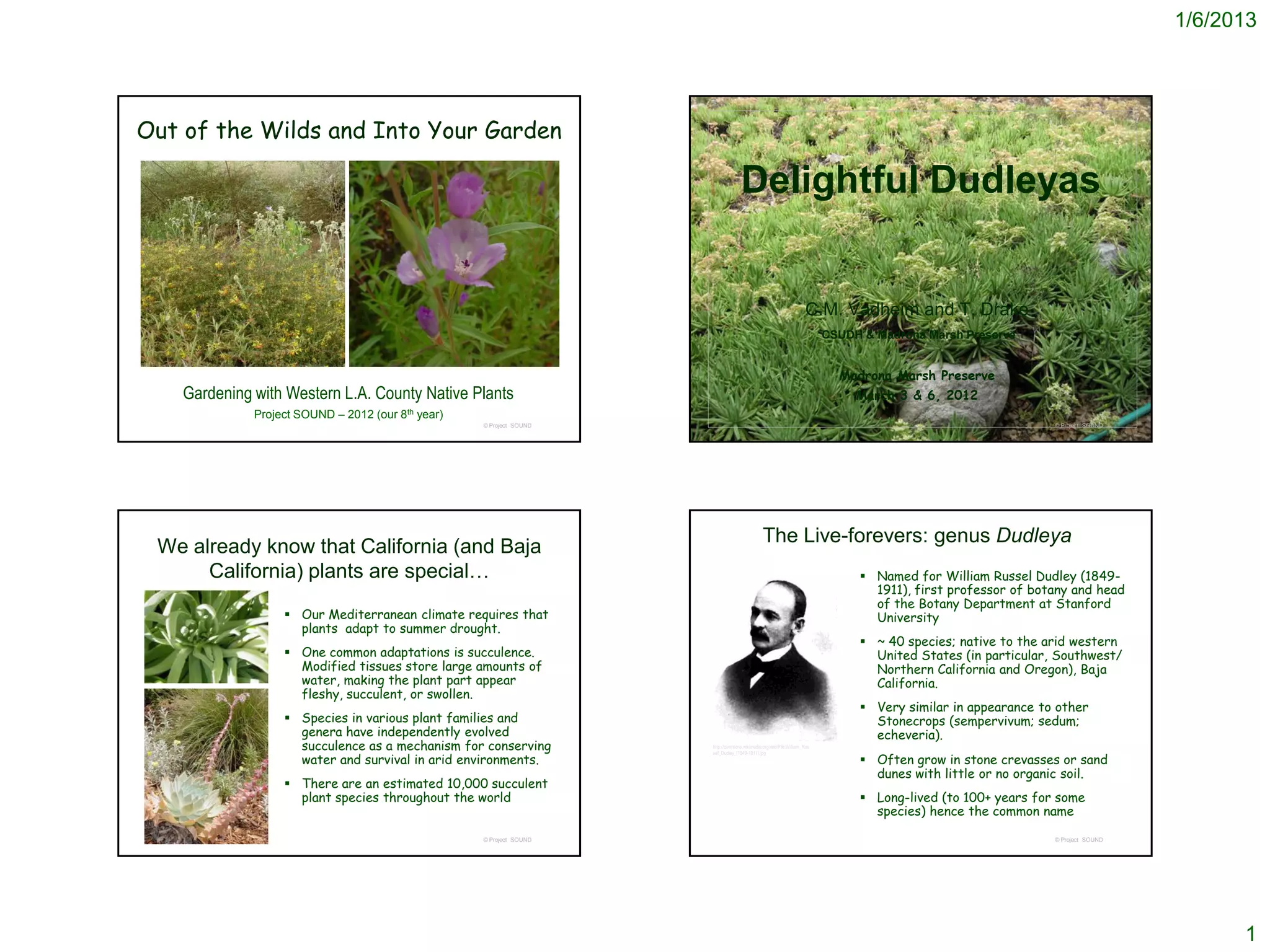
Out of the Wilds and Into Your Garden

                                                                                    Delightful Dudleyas


                                                                                                                     C.M. Vadheim and T. Drake
                                                                                                                           CSUDH & Madrona Marsh Preserve


                                                                                                                             Madrona Marsh Preserve
    Gardening with Western L.A. County Native Plants                                                                            March 3 & 6, 2012
              Project SOUND – 2012 (our 8th year)
                                                    © Project SOUND                                                                                            © Project SOUND


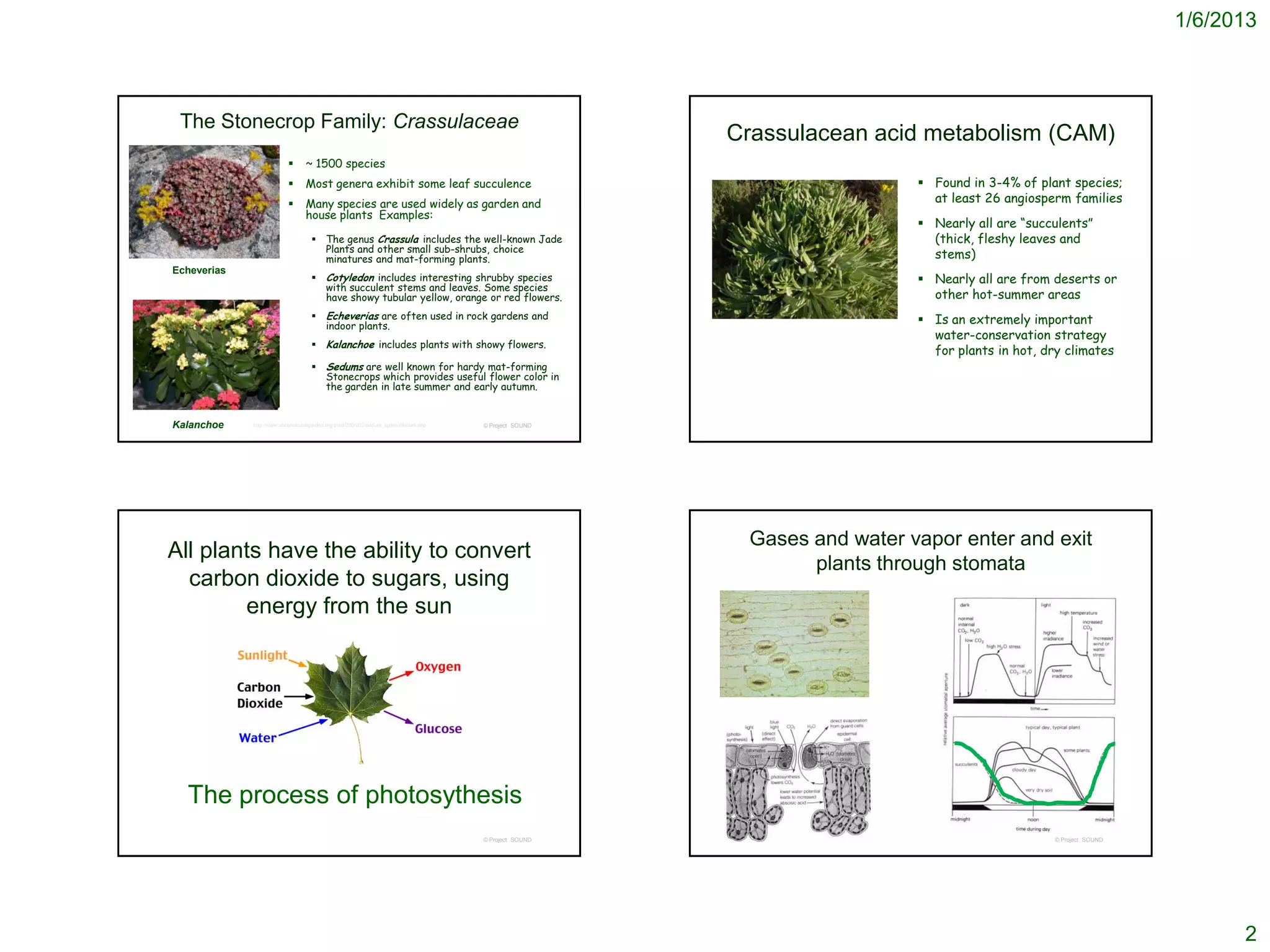
                                                                                               The Live-forevers: genus Dudleya
 We already know that California (and Baja
      California) plants are special…                                                                                            Named for William Russel Dudley (1849-
                                                                                                                                  1911), first professor of botany and head
                                                                                                                                  of the Botany Department at Stanford
                    Our Mediterranean climate requires that                                                                      University
                     plants adapt to summer drought.
                                                                                                                                 ~ 40 species; native to the arid western
                    One common adaptations is succulence.                                                                        United States (in particular, Southwest/
                     Modified tissues store large amounts of                                                                      Northern California and Oregon), Baja
                     water, making the plant part appear                                                                          California.
                     fleshy, succulent, or swollen.
                                                                                                                                 Very similar in appearance to other
                    Species in various plant families and                                                                        Stonecrops (sempervivum; sedum;
                     genera have independently evolved                                                                            echeveria).
                     succulence as a mechanism for conserving         http://commons.wikimedia.org/wiki/File:William_Rus


                     water and survival in arid environments.                                                                    Often grow in stone crevasses or sand
                                                                      sell_Dudley_(1849-1911).jpg


                                                                                                                                  dunes with little or no organic soil.
                    There are an estimated 10,000 succulent
                     plant species throughout the world                                                                          Long-lived (to 100+ years for some
                                                                                                                                  species) hence the common name

                                                    © Project SOUND                                                                                            © Project SOUND


                                                                                                                                                                                       1
1/6/2013


                 The Stonecrop Family: Crassulaceae
                                                                                                                                          Crassulacean acid metabolism (CAM)
                                                                  ~ 1500 species
                                                                  Most genera exhibit some leaf succulence                                                   Found in 3-4% of plant species;
                                                                  Many species are used widely as garden and                                                  at least 26 angiosperm families
                                                                   house plants Examples:
                                                                                                                                                              Nearly all are “succulents”
                                                                      The genus Crassula includes the well-known Jade                                         (thick, fleshy leaves and
                                                                       Plants and other small sub-shrubs, choice
http://www.southampton.bcss.org.uk/images/image145.jpg
                                                                       minatures and mat-forming plants.                                                       stems)
              Echeverias
                                                                      Cotyledon includes interesting shrubby species                                         Nearly all are from deserts or
                                                                       with succulent stems and leaves. Some species
                                                                       have showy tubular yellow, orange or red flowers.                                       other hot-summer areas
                                                                      Echeverias are often used in rock gardens and                                          Is an extremely important
                                                                       indoor plants.
                                                                                                                                                               water-conservation strategy
                                                                      Kalanchoe includes plants with showy flowers.
                                                                                                                                                               for plants in hot, dry climates
                                                                      Sedums are well known for hardy mat-forming
                                                                       Stonecrops which provides useful flower color in
                                                                       the garden in late summer and early autumn.


              Kalanchoe                       http://www.ubcbotanicalgarden.org/potd/2006/02/sedum_spathulifolium.php   © Project SOUND


                                                                                                                                            Gases and water vapor enter and exit
            All plants have the ability to convert
                                                                                                                                                  plants through stomata
              carbon dioxide to sugars, using
                    energy from the sun


                    The process of photosythesis
                                                                                                                        © Project SOUND                                             © Project SOUND


                                                                                                                                                                                                            2
1/6/2013


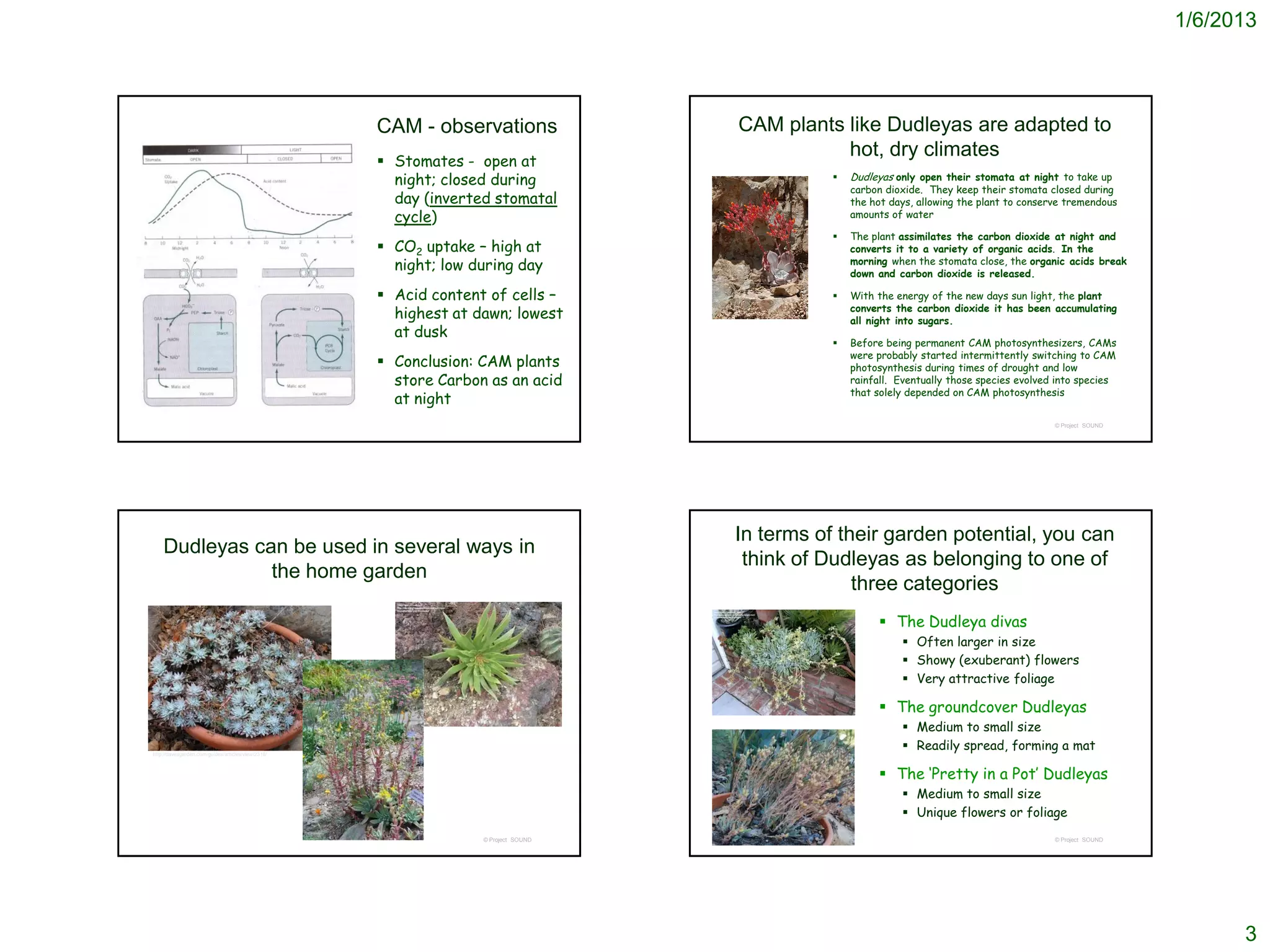
                                                    CAM - observations              CAM plants like Dudleyas are adapted to
                                                                                               hot, dry climates
                                                     Stomates - open at
                                                      night; closed during                        Dudleyas only open their stomata at night to take up
                                                                                                   carbon dioxide. They keep their stomata closed during
                                                      day (inverted stomatal                       the hot days, allowing the plant to conserve tremendous
                                                      cycle)                                       amounts of water

                                                                                                  The plant assimilates the carbon dioxide at night and
                                                     CO2 uptake – high at                         converts it to a variety of organic acids. In the
                                                      night; low during day                        morning when the stomata close, the organic acids break
                                                                                                   down and carbon dioxide is released.

                                                     Acid content of cells –                     With the energy of the new days sun light, the plant
                                                                                                   converts the carbon dioxide it has been accumulating
                                                      highest at dawn; lowest                      all night into sugars.
                                                      at dusk
                                                                                                  Before being permanent CAM photosynthesizers, CAMs
                                                                                                   were probably started intermittently switching to CAM
                                                     Conclusion: CAM plants                       photosynthesis during times of drought and low
                                                      store Carbon as an acid                      rainfall. Eventually those species evolved into species
                                                                                                   that solely depended on CAM photosynthesis
                                                      at night
                                                                                                                                             © Project SOUND


                                                                                    In terms of their garden potential, you can
    Dudleyas can be used in several ways in
                                                                                     think of Dudleyas as belonging to one of
               the home garden
                                                                                                  three categories
                                                                                                         The Dudleya divas
                                                                                                              Often larger in size
                                                                                                              Showy (exuberant) flowers
                                                                                                              Very attractive foliage

                                                                                                         The groundcover Dudleyas
                                                                                                              Medium to small size
http://davesgarden.com/guides/articles/view/2318/
                                                                                                              Readily spread, forming a mat

                                                                                                         The ‘Pretty in a Pot’ Dudleyas
                                                                                                              Medium to small size
                                                                                                              Unique flowers or foliage
                                                                  © Project SOUND                                                            © Project SOUND


                                                                                                                                                                     3
1/6/2013


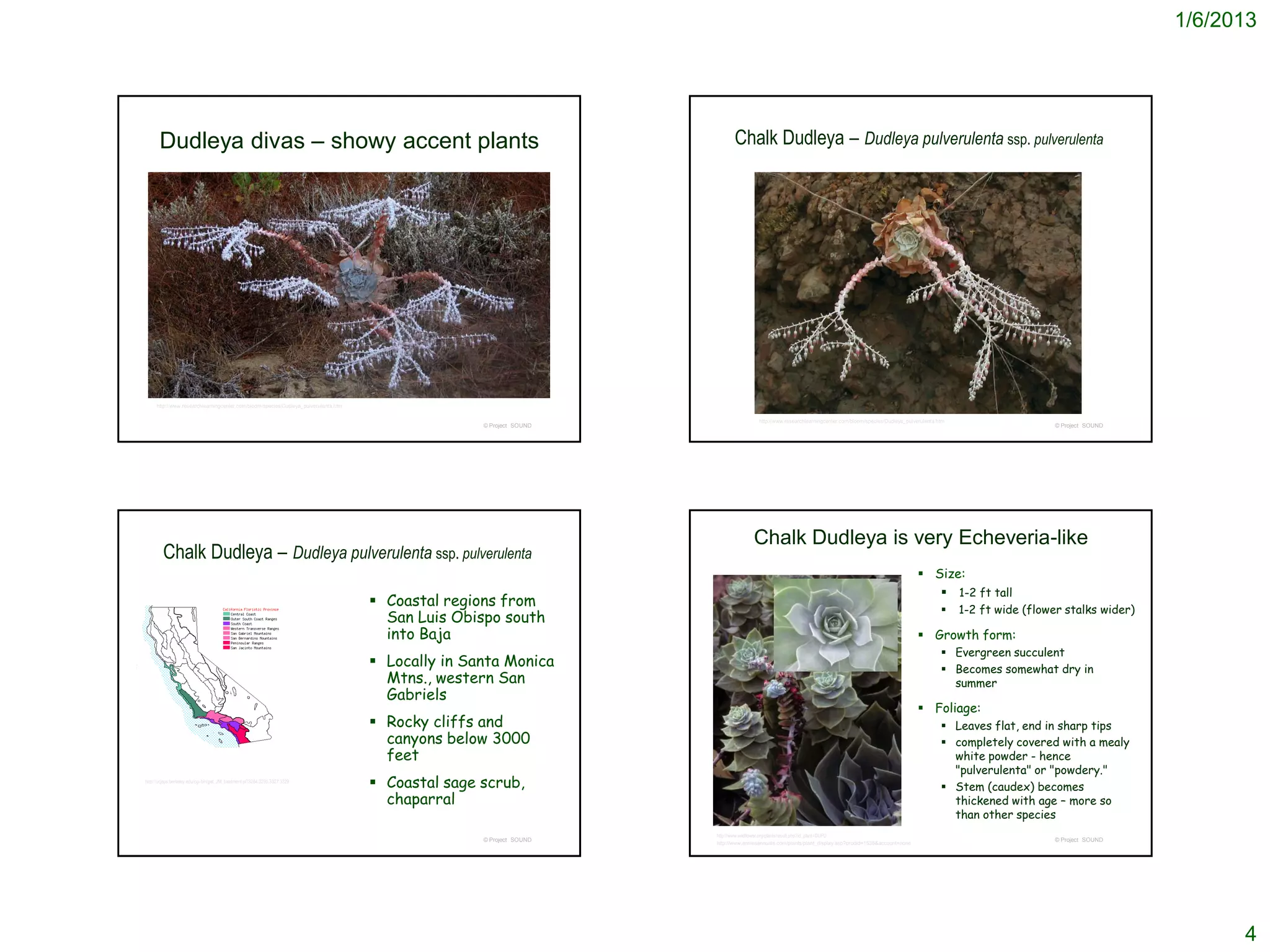
       Dudleya divas – showy accent plants                                                                                  Chalk Dudleya – Dudleya pulverulenta ssp. pulverulenta


     http://www.researchlearningcenter.com/bloom/species/Dudleya_pulverulenta.htm


                                                                                                                                      http://www.researchlearningcenter.com/bloom/species/Dudleya_pulverulenta.htm
                                                                                                   © Project SOUND                                                                                                                     © Project SOUND


                                                                                                                                   Chalk Dudleya is very Echeveria-like
         Chalk Dudleya – Dudleya pulverulenta ssp. pulverulenta
                                                                                                                                                                                                        Size:
                                                                                                                                                                                                           1-2 ft tall
                                                                                     Coastal regions from
                                                                                                                                                                                                                    1-2 ft wide (flower stalks wider)
                                                                                      San Luis Obispo south
                                                                                      into Baja                                                                                                         Growth form:
                                                                                                                                                                                                                 Evergreen succulent
                                                                                     Locally in Santa Monica                                                                                                    Becomes somewhat dry in
                                                                                      Mtns., western San                                                                                                          summer
                                                                                      Gabriels
                                                                                                                                                                                                        Foliage:
                                                                                     Rocky cliffs and                                                                                                           Leaves flat, end in sharp tips
                                                                                      canyons below 3000                                                                                                         completely covered with a mealy
                                                                                      feet                                                                                                                        white powder - hence
                                                                                                                                                                                                                  "pulverulenta" or "powdery."
http://ucjeps.berkeley.edu/cgi-bin/get_JM_treatment.pl?3284,3295,3327,3329
                                                                                     Coastal sage scrub,                                                                                                        Stem (caudex) becomes
                                                                                      chaparral                                                                                                                   thickened with age – more so
                                                                                                                                                                                                                  than other species
                                                                                                                     http://www.wildflower.org/plants/result.php?id_plant=DUPU
                                                                                                   © Project SOUND                                                                                                                     © Project SOUND
                                                                                                                     http://www.anniesannuals.com/plants/plant_display.asp?prodid=1536&account=none


                                                                                                                                                                                                                                                               4
1/6/2013


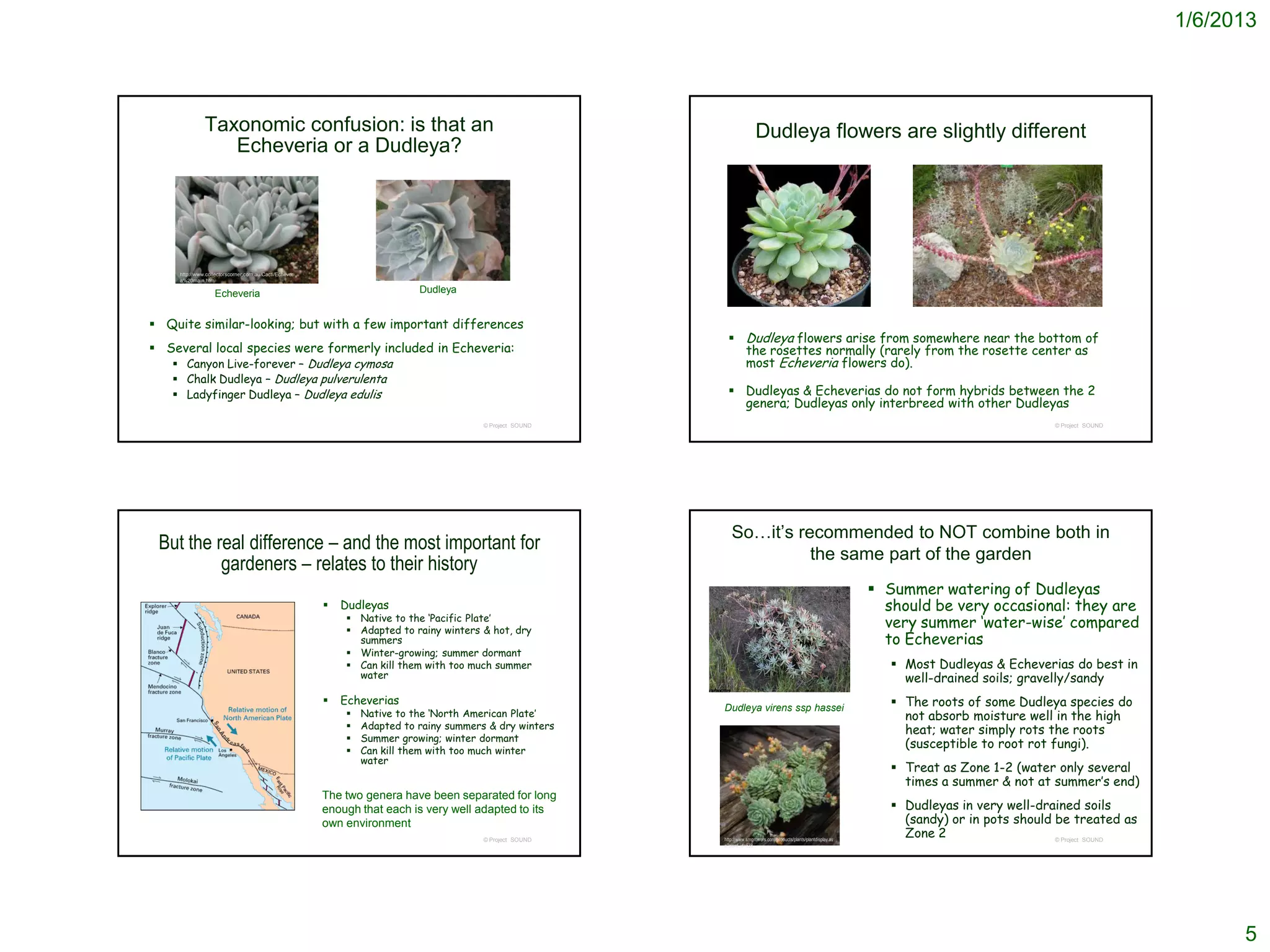
               Taxonomic confusion: is that an                                                                            Dudleya flowers are slightly different
                  Echeveria or a Dudleya?


     http://www.collectorscorner.com.au/Cacti/Echeveri
     a%20main.htm

                   Echeveria                                                Dudleya


 Quite similar-looking; but with a few important differences
                                                                                                             Dudleya flowers arise from somewhere near the bottom of
 Several local species were formerly included in Echeveria:                                                  the rosettes normally (rarely from the rosette center as
    Canyon Live-forever – Dudleya cymosa                                                                     most Echeveria flowers do).
    Chalk Dudleya – Dudleya pulverulenta
    Ladyfinger Dudleya – Dudleya edulis                                                                     Dudleyas & Echeverias do not form hybrids between the 2
                                                                                                              genera; Dudleyas only interbreed with other Dudleyas
                                                                                         © Project SOUND                                                                                             © Project SOUND


                                                                                                              So…it’s recommended to NOT combine both in
 But the real difference – and the most important for
                                                                                                                        the same part of the garden
          gardeners – relates to their history
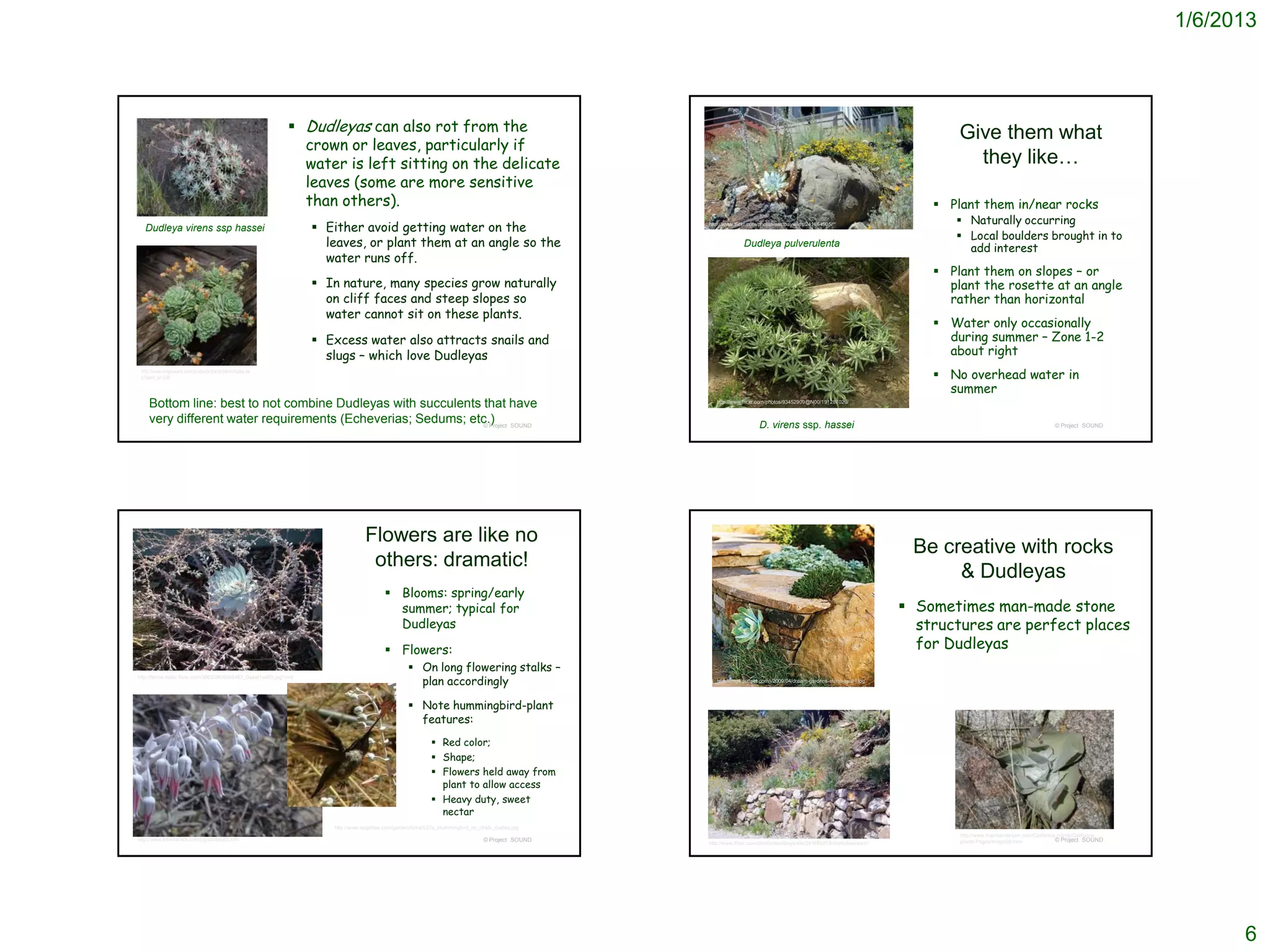
                                                                                                                                                                       Summer watering of Dudleyas
                                                            Dudleyas                                                                                                   should be very occasional: they are
                                                              Native to the ‘Pacific Plate’
                                                              Adapted to rainy winters & hot, dry
                                                                                                                                                                        very summer ‘water-wise’ compared
                                                               summers                                                                                                  to Echeverias
                                                              Winter-growing; summer dormant
                                                              Can kill them with too much summer                                                                         Most Dudleyas & Echeverias do best in
                                                               water                                                                                                       well-drained soils; gravelly/sandy
                                                            Echeverias                                                                                                   The roots of some Dudleya species do
                                                                                                           Dudleya virens ssp hassei
                                                                Native to the ‘North American Plate’                                                                      not absorb moisture well in the high
                                                                Adapted to rainy summers & dry winters                                                                    heat; water simply rots the roots
                                                                Summer growing; winter dormant
                                                                Can kill them with too much winter
                                                                                                                                                                           (susceptible to root rot fungi).
                                                                 water
                                                                                                                                                                          Treat as Zone 1-2 (water only several
                                                                                                                                                                           times a summer & not at summer’s end)
                                                         The two genera have been separated for long
                                                         enough that each is very well adapted to its                                                                     Dudleyas in very well-drained soils
                                                         own environment                                                                                                   (sandy) or in pots should be treated as
                                                                                         © Project SOUND   http://www.smgrowers.com/products/plants/plantdisplay.as
                                                                                                                                                                           Zone 2                    © Project SOUND
                                                                                                           p?plant_id=538


                                                                                                                                                                                                                             5
1/6/2013


                                                               Dudleyas can also rot from the                                                                                                                                    Give them what
                                                                crown or leaves, particularly if
                                                                water is left sitting on the delicate                                                                                                                               they like…
                                                                leaves (some are more sensitive
                                                                than others).                                                                                                                                                  Plant them in/near rocks
                                                                                                                                                                                                                                  Naturally occurring
   Dudleya virens ssp hassei                                         Either avoid getting water on the                                             http://www.flickr.com/photos/eastbaywilds/241664905/

                                                                                                                                                                                                                                  Local boulders brought in to
                                                                      leaves, or plant them at an angle so the                                                    Dudleya pulverulenta
                                                                                                                                                                                                                                   add interest
                                                                      water runs off.
                                                                                                                                                                                                                               Plant them on slopes – or
                                                                     In nature, many species grow naturally                                                                                                                    plant the rosette at an angle
                                                                      on cliff faces and steep slopes so                                                                                                                        rather than horizontal
                                                                      water cannot sit on these plants.
                                                                                                                                                                                                                               Water only occasionally
                                                                     Excess water also attracts snails and                                                                                                                     during summer – Zone 1-2
                                                                      slugs – which love Dudleyas                                                                                                                               about right
 http://www.smgrowers.com/products/plants/plantdisplay.as
 p?plant_id=538                                                                                                                                                                                                                No overhead water in
                                                                                                                                                                                                                                summer
     Bottom line: best to not combine Dudleyas with succulents that have                                                                               http://www.flickr.com/photos/93452909@N00/191287029/


     very different water requirements (Echeverias; Sedums; etc.) SOUND
                                                               © Project                                                                                                 D. virens ssp. hassei                                                                          © Project SOUND


                                                                                   Flowers are like no
                                                                                                                                                                                                                           Be creative with rocks
                                                                                    others: dramatic!
                                                                                                                                                                                                                                & Dudleyas
                                                                                           Blooms: spring/early
                                                                                            summer; typical for                                                                                                            Sometimes man-made stone
                                                                                            Dudleyas                                                                                                                        structures are perfect places
                                                                                           Flowers:                                                                                                                        for Dudleyas
                                                                                                     On long flowering stalks –
                                                                                                      plan accordingly
http://farm4.static.flickr.com/3003/2606066487_0aaaf1ed09.jpg?v=0
                                                                                                                                                       http://img4.sunset.com/i/2009/04/dream-gardens-stone-seat-l.jpg


                                                                                                     Note hummingbird-plant
                                                                                                      features:
                                                                                                              Red color;
                                                                                                              Shape;
                                                                                                              Flowers held away from
                                                                                                               plant to allow access
                                                                                                              Heavy duty, sweet
                                                                                                               nectar
                                                                       http://www.laspilitas.com/garden/Anna%27s_Hummingbird_on_chalk_dudlea.jpg
                                                                                                                                                                                                                                  http://www.marrsandersen.com/California-plants/California-
http://www.timetotrack.com/jay/dudleyc5.htm                                                                                       © Project SOUND                                                                                 plants-Pages/Image28.html              © Project SOUND
                                                                                                                                                    http://www.flickr.com/photos/eastbaywilds/241665013/in/photostream/


                                                                                                                                                                                                                                                                                                     6
1/6/2013


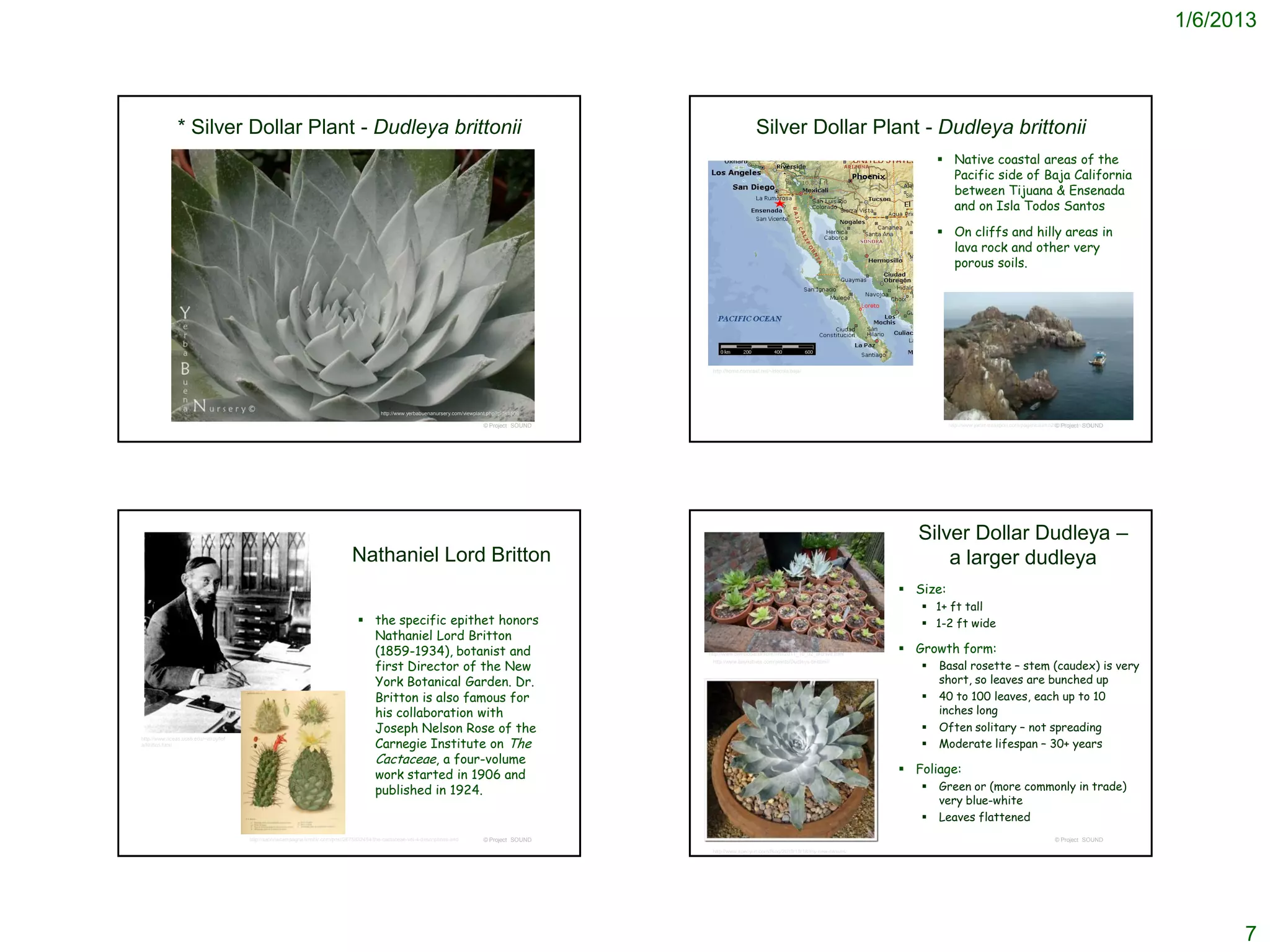
               * Silver Dollar Plant - Dudleya brittonii                                                                                                                  Silver Dollar Plant - Dudleya brittonii
                                                                                                                                                                                                                         Native coastal areas of the
                                                                                                                                                                                                                          Pacific side of Baja California
                                                                                                                                                                                                                          between Tijuana & Ensenada
                                                                                                                                                                                                                          and on Isla Todos Santos

                                                                                                                                                                                                                         On cliffs and hilly areas in
                                                                                                                                                                                                                          lava rock and other very
                                                                                                                                                                                                                          porous soils.


                                                                                                                                                        http://home.comcast.net/~ldecola/baja/


                                                                                             http://www.yerbabuenanursery.com/viewplant.php?pid=1509

                                                                                                                                     © Project SOUND                                                                       http://www.yacht-transport.com/page/autumn2009/Oregon.html
                                                                                                                                                                                                                                                                      © Project SOUND


                                                                                                                                                                                                                    Silver Dollar Dudleya –
                                                                                 Nathaniel Lord Britton                                                                                                                 a larger dudleya
                                                                                                                                                                                                                  Size:
                                                                                                                                                                                                                     1+ ft tall
                                                                                    the specific epithet honors                                                                                                     1-2 ft wide
                                                                                     Nathaniel Lord Britton
                                                                                     (1859-1934), botanist and                                         http://www.bambooandmore.info/2011_10_02_archive.html
                                                                                                                                                                                                                  Growth form:
                                                                                     first Director of the New                                                                                                         Basal rosette – stem (caudex) is very
                                                                                                                                                        http://www.baynatives.com/plants/Dudleya-brittonii/


                                                                                     York Botanical Garden. Dr.                                                                                                         short, so leaves are bunched up
                                                                                     Britton is also famous for                                                                                                        40 to 100 leaves, each up to 10
                                                                                     his collaboration with                                                                                                             inches long
                                                                                     Joseph Nelson Rose of the                                                                                                         Often solitary – not spreading
                                                                                     Carnegie Institute on The                                                                                                          Moderate lifespan – 30+ years
http://www.nceas.ucsb.edu/~alroy/lef
a/Britton.html                                                                                                                                                                                                      
                                                                                     Cactaceae, a four-volume
                                                                                     work started in 1906 and                                                                                                     Foliage:
                                                                                     published in 1924.                                                                                                                Green or (more commonly in trade)
                                                                                                                                                                                                                        very blue-white
                                                                                                                                                                                                                       Leaves flattened
                                       http://sabrinacampagna.tumblr.com/post/2675832454/the-cactaceae-vol-4-descriptions-and        © Project SOUND                                                                                                              © Project SOUND
                                                                                                                                                        http://www.soenyun.com/Blog/2010/10/18/my-new-natives/


                                                                                                                                                                                                                                                                                              7
1/6/2013


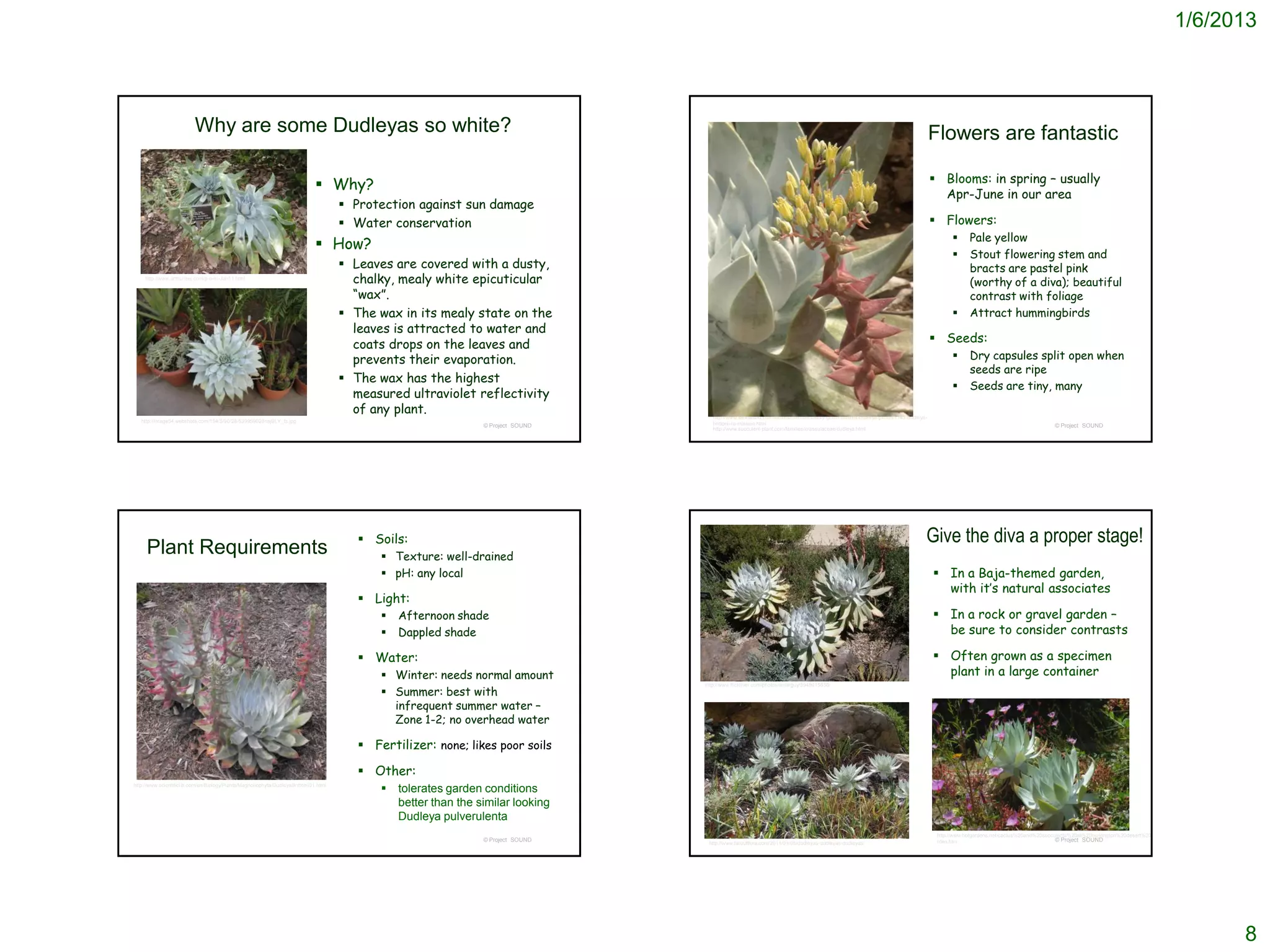
                          Why are some Dudleyas so white?                                                                                                                                                                            Flowers are fantastic

                                                                                Why?                                                                                                                                                 Blooms: in spring – usually
                                                                                                                                                                                                                                       Apr-June in our area
                                                                                        Protection against sun damage
                                                                                        Water conservation                                                                                                                           Flowers:
                                                                                                                                                                                                                                                 Pale yellow
                                                                                How?
                                                                                                                                                                                                                                                 Stout flowering stem and
                                                                                        Leaves are covered with a dusty,                                                                                                                         bracts are pastel pink
     http://www.arthurleej.com/p-o-m-Jan11.html
                                                                                         chalky, mealy white epicuticular                                                                                                                         (worthy of a diva); beautiful
                                                                                         “wax”.                                                                                                                                                   contrast with foliage
                                                                                        The wax in its mealy state on the                                                                                                                       Attract hummingbirds
                                                                                         leaves is attracted to water and
                                                                                         coats drops on the leaves and                                                                                                                Seeds:
                                                                                         prevents their evaporation.                                                                                                                             Dry capsules split open when
                                                                                                                                                                                                                                                  seeds are ripe
                                                                                        The wax has the highest
                                                                                                                                                                                                                                                 Seeds are tiny, many
                                                                                         measured ultraviolet reflectivity
                                                                                         of any plant.                                  http://www.xericworld.com/forums/members/kelly-griffin-albums-dudleya-picture1145-dudleya-
   http://image54.webshots.com/154/5/90/28/539959028nsjBLY_fs.jpg                                                                       brittonii-la-mission.html
                                                                                                                   © Project SOUND                                                                                                                                                © Project SOUND
                                                                                                                                        http://www.succulent-plant.com/families/crassulaceae/dudleya.html


                                                                                           Soils:                                                                                                                               Give the diva a proper stage!
     Plant Requirements                                                                        Texture: well-drained
                                                                                               pH: any local                                                                                                                         In a Baja-themed garden,
                                                                                                                                                                                                                                       with it’s natural associates
                                                                                           Light:
                                                                                                 Afternoon shade                                                                                                                     In a rock or gravel garden –
                                                                                                 Dappled shade                                                                                                                        be sure to consider contrasts

                                                                                           Water:                                                                                                                                    Often grown as a specimen
                                                                                               Winter: needs normal amount                                                                                                            plant in a large container
                                                                                               Summer: best with
                                                                                                                                     http://www.flickriver.com/photos/amarguy/3949915856/


                                                                                                infrequent summer water –
                                                                                                Zone 1-2; no overhead water

                                                                                           Fertilizer: none; likes poor soils

                                                                                           Other:
http://www.scientificlib.com/en/Biology/Plants/Magnoliophyta/DudleyaBrittonii01.html
                                                                                                 tolerates garden conditions
                                                                                                  better than the similar looking
                                                                                                  Dudleya pulverulenta
                                                                                                                                                                                                                                      http://www.hotgardens.net/cactus%20and%20succulents%20at%20huntington%20desert%20ga
                                                                                                                   © Project SOUND                                                                                                    rden.htm                                      © Project SOUND
                                                                                                                                      http://www.faroutflora.com/2011/01/08/dudleyas-dudleyas-dudleyas/


                                                                                                                                                                                                                                                                                                                                  8
1/6/2013


                                                                                                                                                                            Use contrast to show divas in their best light
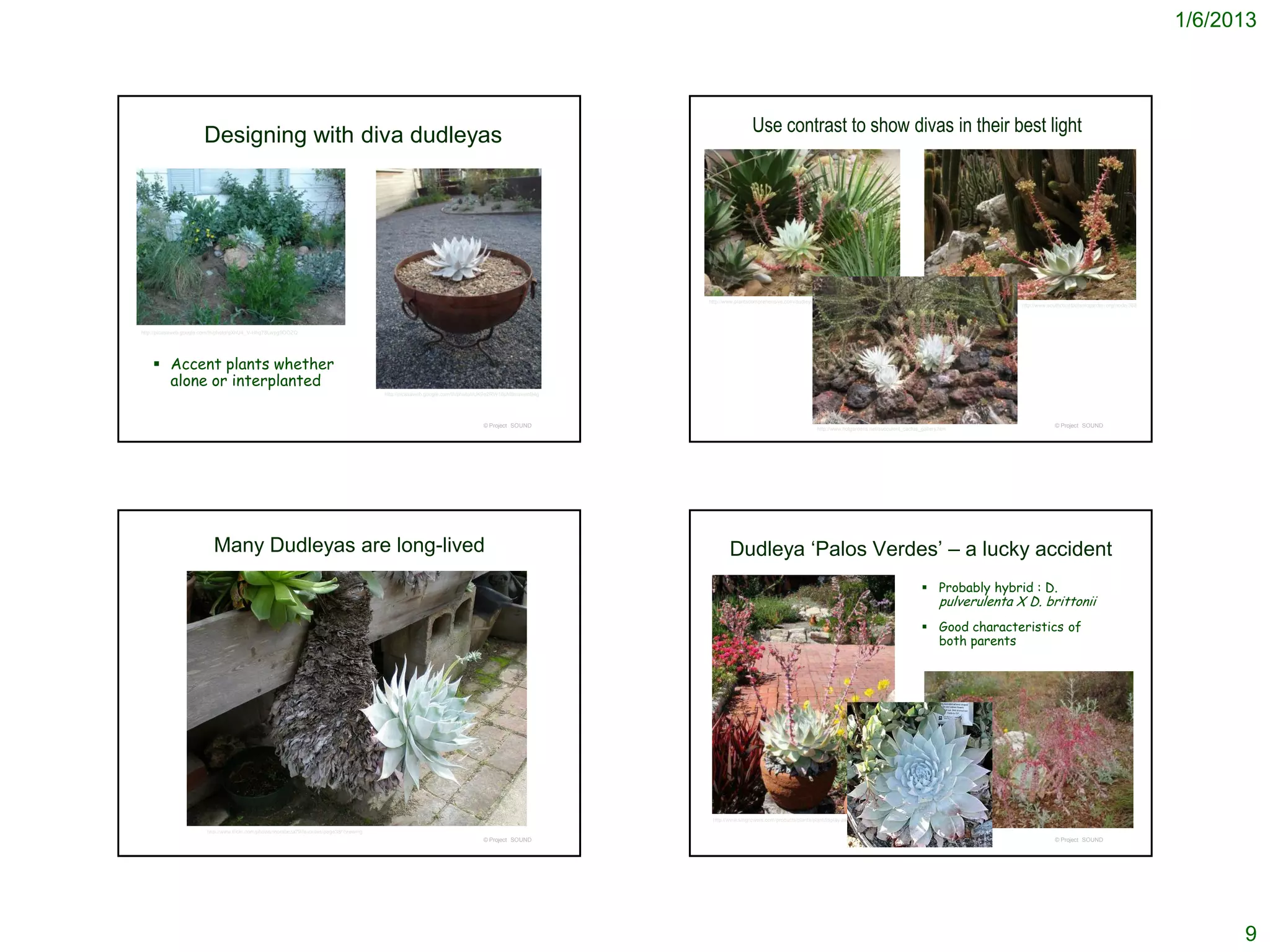
                       Designing with diva dudleyas


                                                                                                                                                          http://www.plantscomprehensive.com/dudleya-brittonii
                                                                                                                                                                                                                                                                        http://www.southcoastbotanicgarden.org/node/368


http://picasaweb.google.com/lh/photo/gXhU4_V-Hhg78Lwpg9OOZQ


     Accent plants whether
      alone or interplanted
                                                                                            http://picasaweb.google.com/lh/photo/iiUK9e2RW16pM8msvsmB4g


                                                                                                                                 © Project SOUND                                                                                                                                     © Project SOUND
                                                                                                                                                                                                       http://www.hotgardens.net/succulent_cactus_gallery.htm


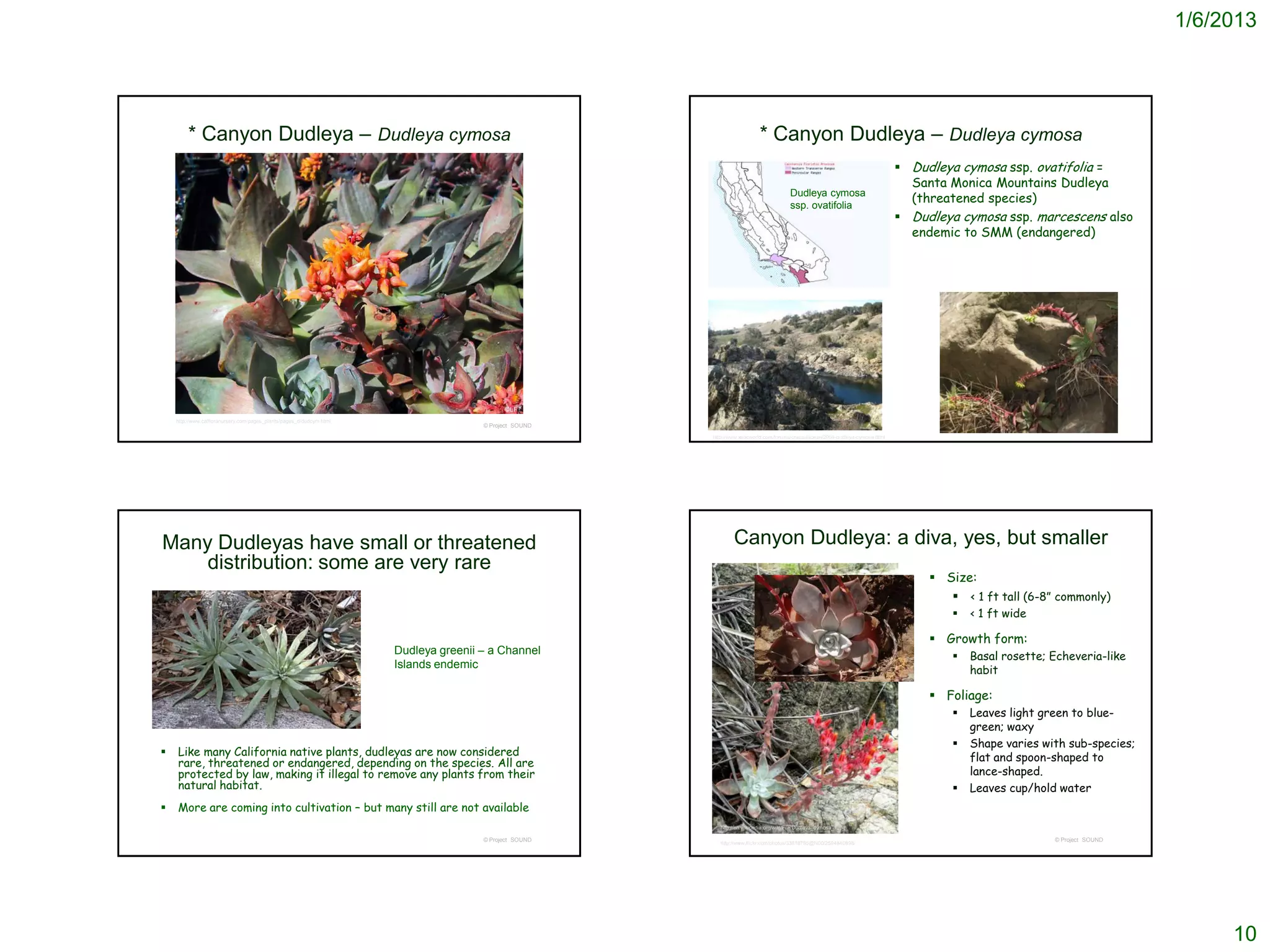
                           Many Dudleyas are long-lived                                                                                                           Dudleya ‘Palos Verdes’ – a lucky accident
                                                                                                                                                                                                                                                   Probably hybrid : D.
                                                                                                                                                                                                                                                          pulverulenta X D. brittonii
                                                                                                                                                                                                                                                   Good characteristics of
                                                                                                                                                                                                                                                    both parents


                                                                                                                                                           http://www.smgrowers.com/products/plants/plantdisplay.asp?plant_id=3232

                        http://www.flickr.com/photos/morabeza79/favorites/page38/?view=lg
                                                                                                                                 © Project SOUND                                                                                                                                     © Project SOUND


                                                                                                                                                                                                                                                                                                                                9
1/6/2013


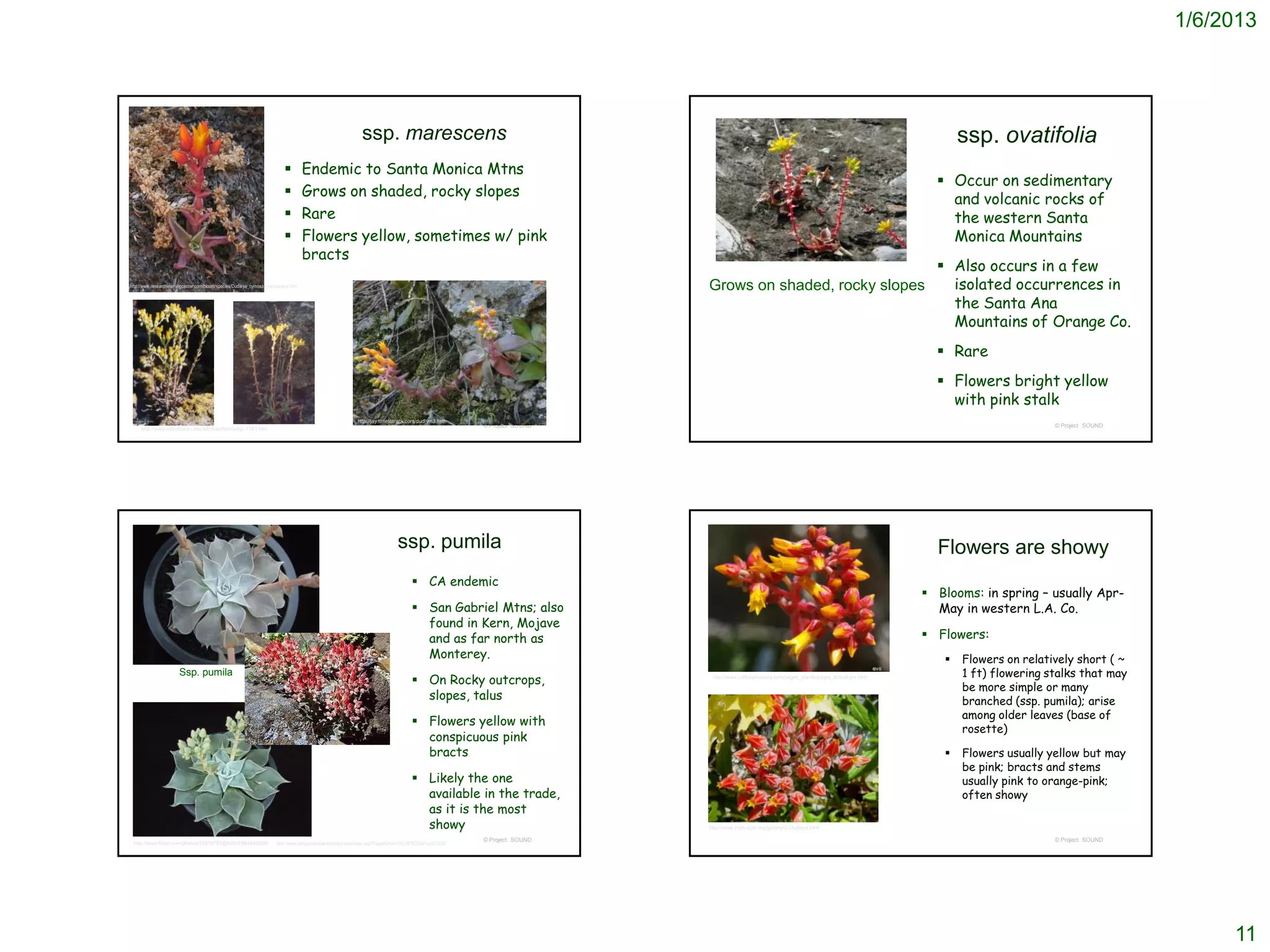
        * Canyon Dudleya – Dudleya cymosa                                                                                  * Canyon Dudleya – Dudleya cymosa
                                                                                                                                                                                  Dudleya cymosa ssp. ovatifolia =
                                                                                                                                                                                   Santa Monica Mountains Dudleya
                                                                                                                                         Dudleya cymosa
                                                                                                                                         ssp. ovatifolia
                                                                                                                                                                                   (threatened species)
                                                                                                                                                                                  Dudleya cymosa ssp. marcescens also
                                                                                                                                                                                   endemic to SMM (endangered)


                                                                                                        http://ucjeps.berkeley.edu/cgi-bin/get_JM_treatment.pl?3284,3295,3310


    http://www.calfloranursery.com/pages_plants/pages_d/dudcym.html
                                                                                      © Project SOUND                                                                                                        © Project SOUND
                                                                                                        http://www.xericworld.com/forums/crassulaceae/2906-dudleya-cymosa.html


Many Dudleyas have small or threatened                                                                          Canyon Dudleya: a diva, yes, but smaller
    distribution: some are very rare
                                                                                                                                                                                       Size:
                                                                                                                                                                                          < 1 ft tall (6-8” commonly)
                                                                                                                                                                                             < 1 ft wide

                                                                                                                                                                                       Growth form:
                                                                      Dudleya greenii – a Channel                                                                                            Basal rosette; Echeveria-like
                                                                      Islands endemic                                                                                                         habit

                                                                                                                                                                                       Foliage:
                                                                                                                                                                                             Leaves light green to blue-
                                                                                                                                                                                              green; waxy
                                                                                                                                                                                             Shape varies with sub-species;
   Like many California native plants, dudleyas are now considered                                                                                                                           flat and spoon-shaped to
    rare, threatened or endangered, depending on the species. All are
    protected by law, making it illegal to remove any plants from their                                                                                                                       lance-shaped.
    natural habitat.                                                                                                                                                                         Leaves cup/hold water
   More are coming into cultivation – but many still are not available
                                                                                                           http://en.wikipedia.org/wiki/File:Dudleya_cymosa_1.jpg

                                                                                      © Project SOUND                                                                                                        © Project SOUND
                                                                                                           http://www.flickr.com/photos/33818785@N00/2594840898/


                                                                                                                                                                                                                                    10
1/6/2013


                                                                                                               ssp. marescens                                                                                                                         ssp. ovatifolia
                                                                                   Endemic to Santa Monica Mtns
                                                                                                                                                                                                                                                  Occur on sedimentary
                                                                                   Grows on shaded, rocky slopes
                                                                                                                                                                                                                                                   and volcanic rocks of
                                                                                   Rare                                                                                                                                                           the western Santa
                                                                                   Flowers yellow, sometimes w/ pink                                                                                                                              Monica Mountains
                                                                                    bracts
                                                                                                                                                                                                                                                  Also occurs in a few
http://www.researchlearningcenter.com/bloom/species/Dudleya_cymosa_marcescens.htm                                                                                           Grows on shaded, rocky slopes                                          isolated occurrences in
                                                                                                                                                                                                                                                   the Santa Ana
                                                                                                                                                                                                                                                   Mountains of Orange Co.
                                                                                                                                                                                                                                                  Rare
                                                                                                                                                                                                                                                  Flowers bright yellow
                                                                                                                                                                                                                                                   with pink stalk
                                                                                                             http://jay.timetotrack.com/dudlym3.htm
                                                                                                                                                          © Project SOUND                                                                                              © Project SOUND
     http://www.callutheran.edu/wf/chap/family/bjc-1781.htm


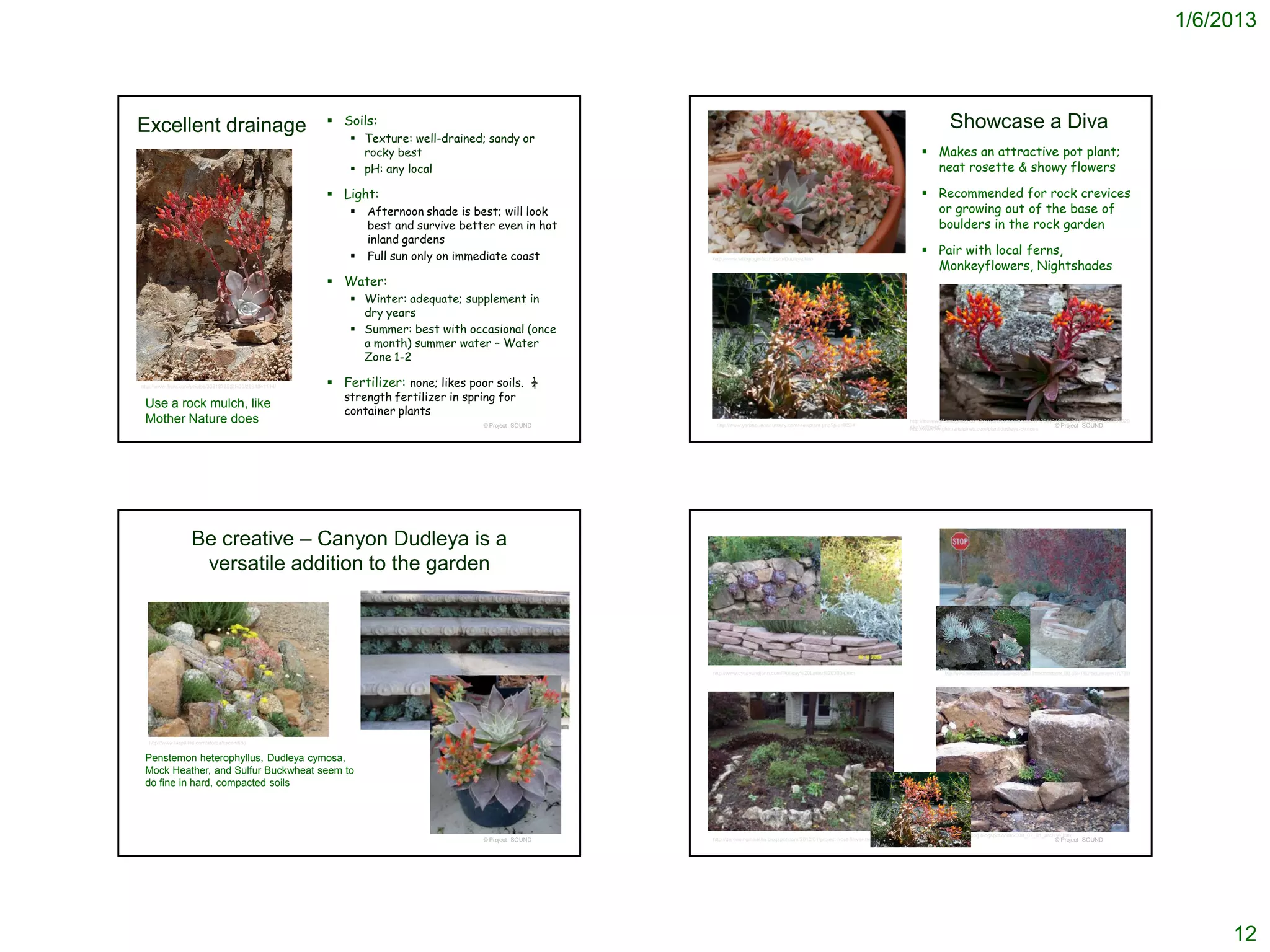
                                                                                                                                ssp. pumila                                                                                                      Flowers are showy
                                                                                                                                        CA endemic
                                                                                                                                                                                                                                                Blooms: in spring – usually Apr-
                                                                                                                                        San Gabriel Mtns; also                                                                                  May in western L.A. Co.
                                                                                                                                         found in Kern, Mojave
                                                                                                                                         and as far north as                                                                                    Flowers:
                                                                                                                                         Monterey.                                                                                                   Flowers on relatively short ( ~
                       Ssp. pumila                                                                                                                                                                                                                    1 ft) flowering stalks that may
                                                                                                                                        On Rocky outcrops,                  http://www.calfloranursery.com/pages_plants/pages_d/dudcym.html

                                                                                                                                                                                                                                                      be more simple or many
                                                                                                                                         slopes, talus                                                                                                branched (ssp. pumila); arise
                                                                                                                                                                                                                                                      among older leaves (base of
                                                                                                                                        Flowers yellow with
                                                                                                                                                                                                                                                      rosette)
                                                                                                                                         conspicuous pink
                                                                                                                                         bracts                                                                                                      Flowers usually yellow but may
                                                                                                                                                                                                                                                      be pink; bracts and stems
                                                                                                                                        Likely the one                                                                                               usually pink to orange-pink;
                                                                                                                                         available in the trade,                                                                                      often showy
                                                                                                                                         as it is the most
                                                                                                                                         showy                              http://www.cnps-sgm.org/gallery/G-Dudleya.html

                                                                                                                                                          © Project SOUND                                                                                              © Project SOUND
 http://www.flickr.com/photos/33818785@N00/2594840898/                 http://www.siskiyourareplantnursery.com/index.asp?PageAction=VIEWPROD&ProdID=200


                                                                                                                                                                                                                                                                                              11
1/6/2013


                                                         Soils:                                                                                                                                    Showcase a Diva
Excellent drainage
                                                             Texture: well-drained; sandy or
                                                              rocky best                                                                                                                  Makes an attractive pot plant;
                                                             pH: any local                                                                                                                neat rosette & showy flowers

                                                         Light:                                                                                                                          Recommended for rock crevices
                                                               Afternoon shade is best; will look                                                                                         or growing out of the base of
                                                                best and survive better even in hot                                                                                        boulders in the rock garden
                                                                inland gardens
                                                               Full sun only on immediate coast                                                                                          Pair with local ferns,
                                                                                                                                                                                           Monkeyflowers, Nightshades
                                                                                                       http://www.wildgingerfarm.com/Dudleya.htm


                                                         Water:
                                                             Winter: adequate; supplement in
                                                              dry years
                                                             Summer: best with occasional (once
                                                              a month) summer water – Water
                                                              Zone 1-2

http://www.flickr.com/photos/33818785@N00/2594841114/    Fertilizer: none; likes poor soils. ¼
                                                           strength fertilizer in spring for
 Use a rock mulch, like
                                                           container plants
 Mother Nature does                                                                  © Project SOUND    http://www.yerbabuenanursery.com/viewplant.php?pid=0284
                                                                                                                                                                                     http://stevewolf.smugmug.com/keyword/crassulaceae/1/1264431629_VzWnxbD#!i=1264431629
                                                                                                                                                                                     &k=VzWnxbD                                                © Project SOUND
                                                                                                                                                                                     http://www.wrightmanalpines.com/plant/dudleya-cymosa


                     Be creative – Canyon Dudleya is a
                      versatile addition to the garden


                                                                                                       http://www.cyndyandjohn.com/Holiday%20Letter%202004.htm                                    http://www.merchantcircle.com/business/Earth.Transformations.303-554-1352/picture/view/1707601


   http://www.laspilitas.com/stores/escondido


 Penstemon heterophyllus, Dudleya cymosa,
 Mock Heather, and Sulfur Buckwheat seem to
 do fine in hard, compacted soils


                                                                                                                                                                                               http://designerblog.blogspot.com/2008_07_01_archive.html
                                                                                     © Project SOUND   http://gardeninginaustin.blogspot.com/2012/01/project-front-flower-bed.html                                                                       © Project SOUND


                                                                                                                                                                                                                                                                                                        12
1/6/2013


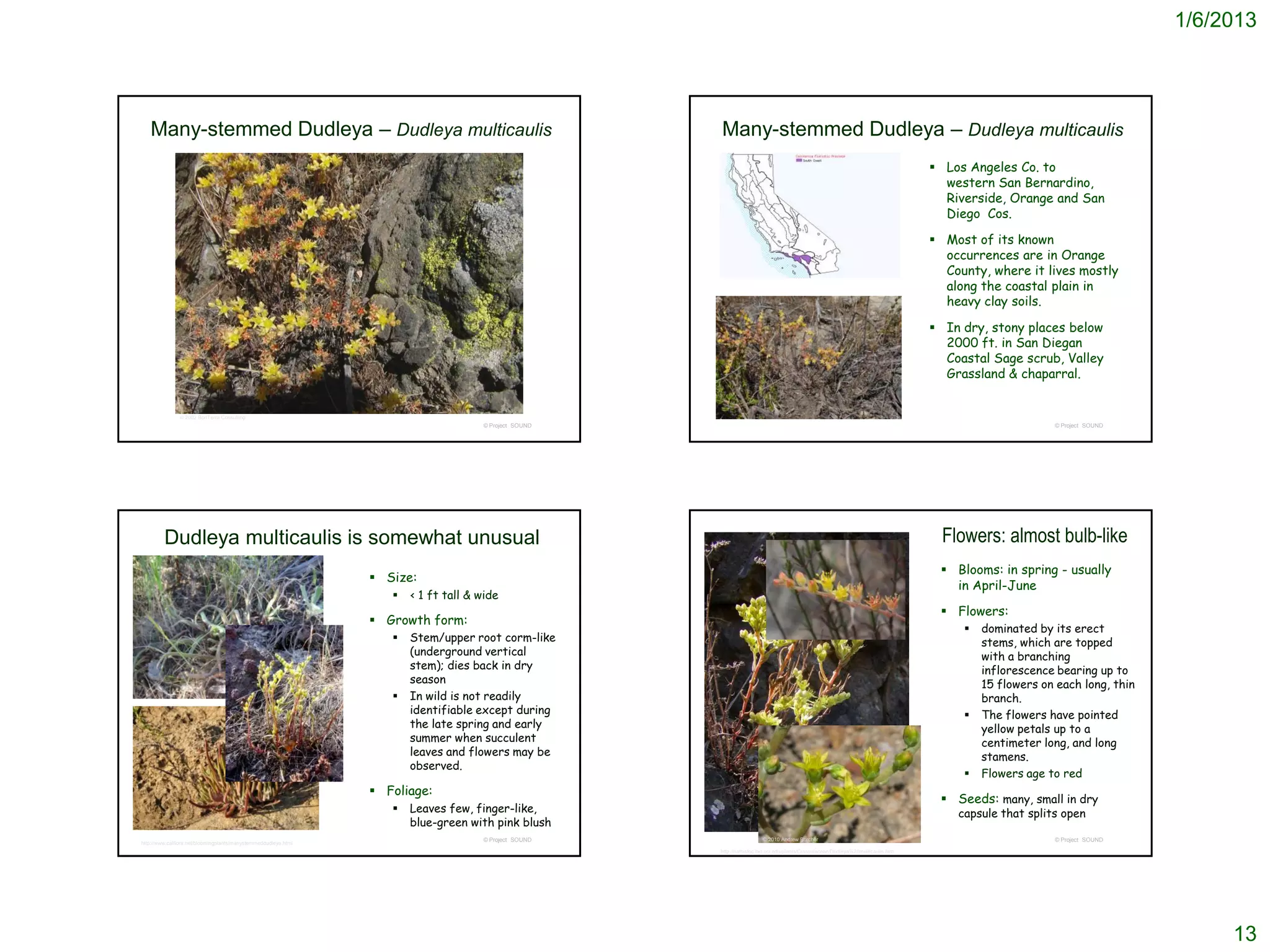
   Many-stemmed Dudleya – Dudleya multicaulis                                                           Many-stemmed Dudleya – Dudleya multicaulis
                                                                                                                                                                                      Los Angeles Co. to
                                                                                                                                                                                       western San Bernardino,
                                                                                                                                                                                       Riverside, Orange and San
                                                                                                                                                                                       Diego Cos.

                                                                                                                                                                                      Most of its known
                                                                                                                                                                                       occurrences are in Orange
                                                                                                                                                                                       County, where it lives mostly
                                                                                                                                                                                       along the coastal plain in
                                                                                                                                                                                       heavy clay soils.

                                                                                                                                                                                      In dry, stony places below
                                                                                                                                                                                       2000 ft. in San Diegan
                                                                                                                                                                                       Coastal Sage scrub, Valley
                                                                                                                                                                                       Grassland & chaparral.


               © 2002 BonTerra Consulting
                                                                                      © Project SOUND                                                                                                      © Project SOUND


         Dudleya multicaulis is somewhat unusual                                                                                                                                       Flowers: almost bulb-like
                                                                                                                                                                                       Blooms: in spring - usually
                                                                  Size:
                                                                                                                                                                                        in April-June
                                                                       < 1 ft tall & wide
                                                                                                                                                                                       Flowers:
                                                                  Growth form:
                                                                                                                                                                                             dominated by its erect
                                                                       Stem/upper root corm-like                                                                                             stems, which are topped
                                                                        (underground vertical                                                                                                 with a branching
                                                                        stem); dies back in dry                                                                                               inflorescence bearing up to
                                                                        season                                                                                                                15 flowers on each long, thin
                                                                       In wild is not readily                                                                                                branch.
                                                                        identifiable except during                                                                                           The flowers have pointed
                                                                        the late spring and early                                                                                             yellow petals up to a
                                                                        summer when succulent                                                                                                 centimeter long, and long
                                                                        leaves and flowers may be                                                                                             stamens.
                                                                        observed.
                                                                                                                                                                                             Flowers age to red
                                                                  Foliage:
                                                                                                                                                                                       Seeds: many, small in dry
                                                                       Leaves few, finger-like,                                                                                         capsule that splits open
                                                                        blue-green with pink blush
                                                                                      © Project SOUND                     © 2010 Andrew Borcher                                                            © Project SOUND
http://www.calflora.net/bloomingplants/manystemmeddudleya.html
                                                                                                        http://nathistoc.bio.uci.edu/plants/Crassulaceae/Dudleya%20multicaulis.htm


                                                                                                                                                                                                                                   13
1/6/2013


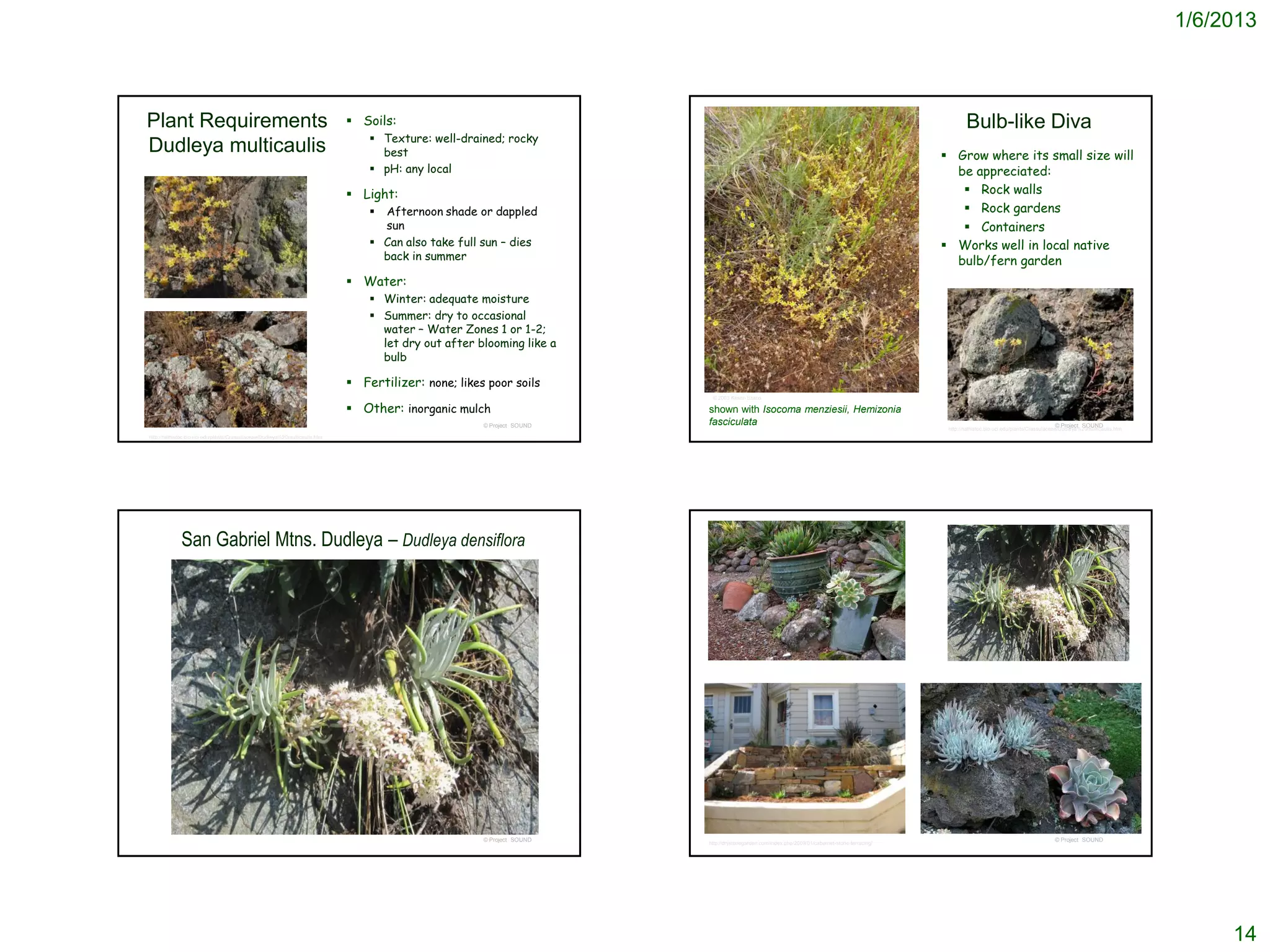
Plant Requirements                                                            Soils:                                                                                                                   Bulb-like Diva
                                                                                  Texture: well-drained; rocky
Dudleya multicaulis                                                                best                                                                                                          Grow where its small size will
                                                                                  pH: any local                                                                                                  be appreciated:
                                                                              Light:                                                                                                               Rock walls
                                                                                  Afternoon shade or dappled                                                                                       Rock gardens
                                                                                   sun                                                                                                              Containers
                                                                                  Can also take full sun – dies                                                                                 Works well in local native
                                                                                   back in summer                                                                                                 bulb/fern garden
                                                                              Water:
                                                                                  Winter: adequate moisture
                                                                                  Summer: dry to occasional
                                                                                   water – Water Zones 1 or 1-2;
                                                                                   let dry out after blooming like a
                                                                                   bulb

                                                                              Fertilizer: none; likes poor soils
                                                                                                                         © 2003 Kristin Szabo

                                                                              Other: inorganic mulch                   shown with Isocoma menziesii, Hemizonia
                                                                                                      © Project SOUND   fasciculata                                                                                                           © Project SOUND
                                                                                                                                                                                                 http://nathistoc.bio.uci.edu/plants/Crassulaceae/Dudleya%20multicaulis.htm
http://nathistoc.bio.uci.edu/plants/Crassulaceae/Dudleya%20multicaulis.htm


             San Gabriel Mtns. Dudleya – Dudleya densiflora


                                                                                                      © Project SOUND                                                                                                                         © Project SOUND
                                                                                                                        http://drystonegarden.com/index.php/2009/01/cabernet-stone-terracing/


                                                                                                                                                                                                                                                                                   14
1/6/2013


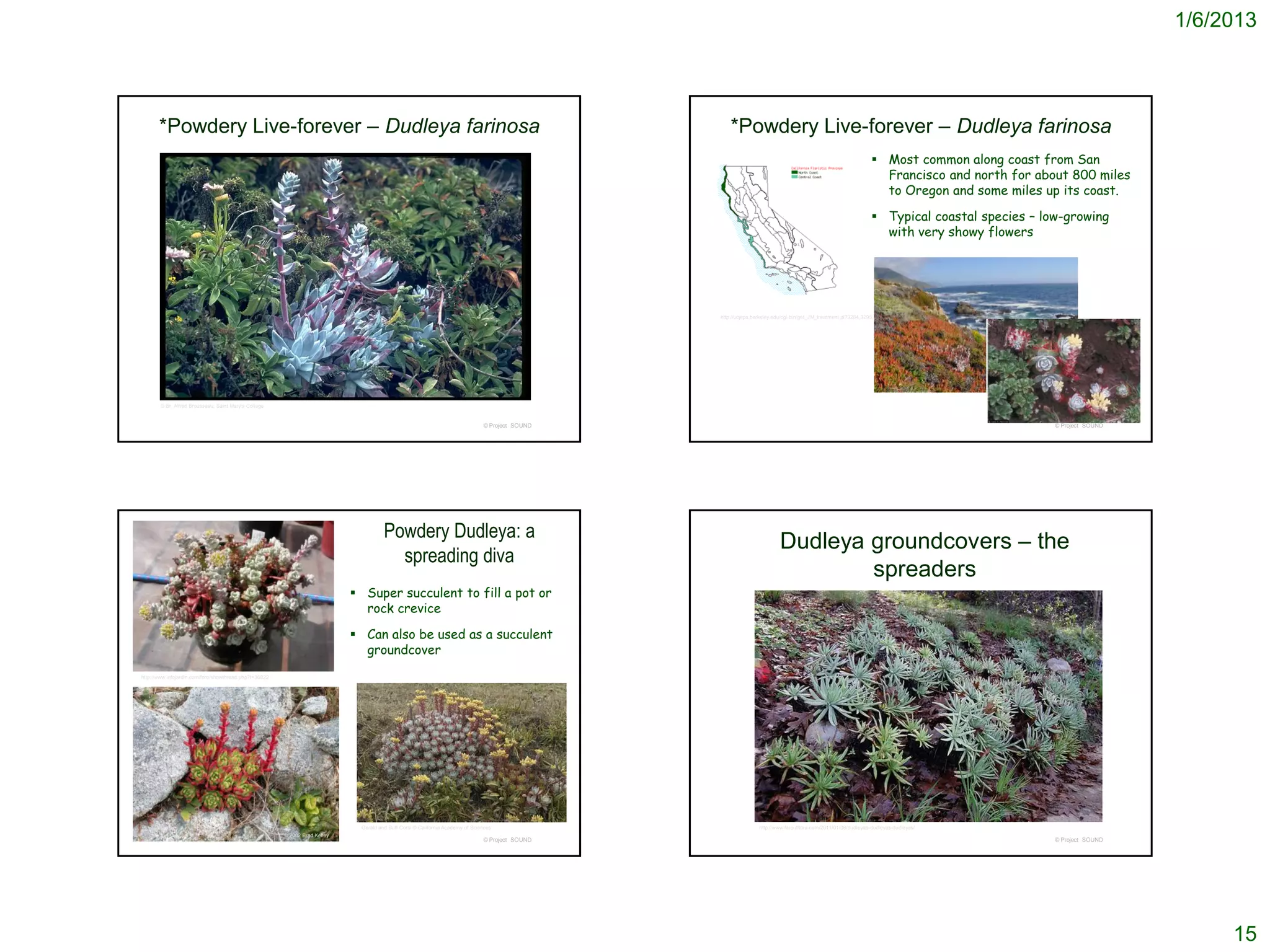
       *Powdery Live-forever – Dudleya farinosa                                                                                                       *Powdery Live-forever – Dudleya farinosa
                                                                                                                                                                                                                  Most common along coast from San
                                                                                                                                                                                                                   Francisco and north for about 800 miles
                                                                                                                                                                                                                   to Oregon and some miles up its coast.

                                                                                                                                                                                                                  Typical coastal species – low-growing
                                                                                                                                                                                                                   with very showy flowers


                                                                                                                                                  http://ucjeps.berkeley.edu/cgi-bin/get_JM_treatment.pl?3284,3295,3320


        © Br. Alfred Brousseau, Saint Mary's College


                                                                                                                                © Project SOUND                                                                                                © Project SOUND


                                                                                       Powdery Dudleya: a
                                                                                                                                                                          Dudleya groundcovers – the
                                                                                         spreading diva
                                                                                                                                                                                  spreaders
                                                                              Super succulent to fill a pot or
                                                                               rock crevice

                                                                              Can also be used as a succulent
                                                                               groundcover
http://www.infojardin.com/foro/showthread.php?t=36822


                                                                              Gerald and Buff Corsi © California Academy of Sciences                              http://www.faroutflora.com/2011/01/08/dudleyas-dudleyas-dudleyas/
                                                        © 2002 Brad Kelley
                                                                                                                                © Project SOUND                                                                                                © Project SOUND


                                                                                                                                                                                                                                                                      15
1/6/2013


                 Many Dudleyas work well in planters                                                                       Dudleyas are so versatile : formal or informal


   http://drystonegarden.com/index.php/2009/01/cabernet-stone-terracing/


                                                                                                                                                                                                                  http://kristamaxwell.com/garden/photos2.html


                                                                                                                                                                                                                   Dudleyas with strict
                                                                                                                                                                                                                    rosettes look quite formal
                                                                                                        © Project SOUND   http://www.ecosalon.com/wp-content/uploads/2009/04/more-showcase-2009-023-341x455.jpg                                                  © Project SOUND


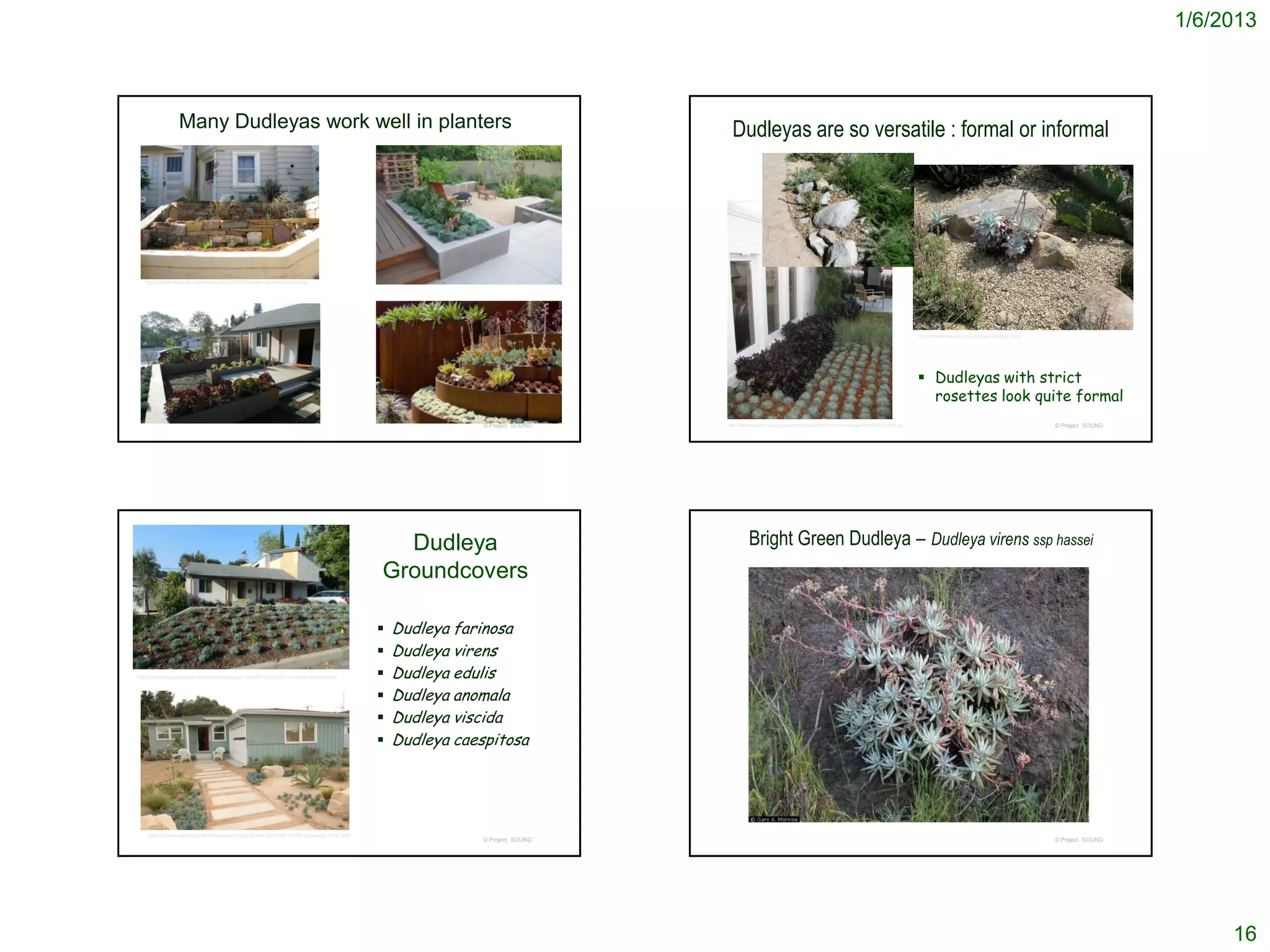
                                                                                          Dudleya                                  Bright Green Dudleya – Dudleya virens ssp hassei
                                                                                        Groundcovers

                                                                                           Dudleya farinosa
                                                                                           Dudleya virens
http://marvistagreengardenshowcase.blogspot.com/2012/02/3041-midvale-avenue.html           Dudleya edulis
                                                                                           Dudleya anomala
                                                                                           Dudleya viscida
                                                                                           Dudleya caespitosa


    http://marvistagreengardenshowcase.blogspot.com/2012/02/12806-stanwood-drive.html
                                                                                                        © Project SOUND                                                                                                                                          © Project SOUND


                                                                                                                                                                                                                                                                                        16
1/6/2013


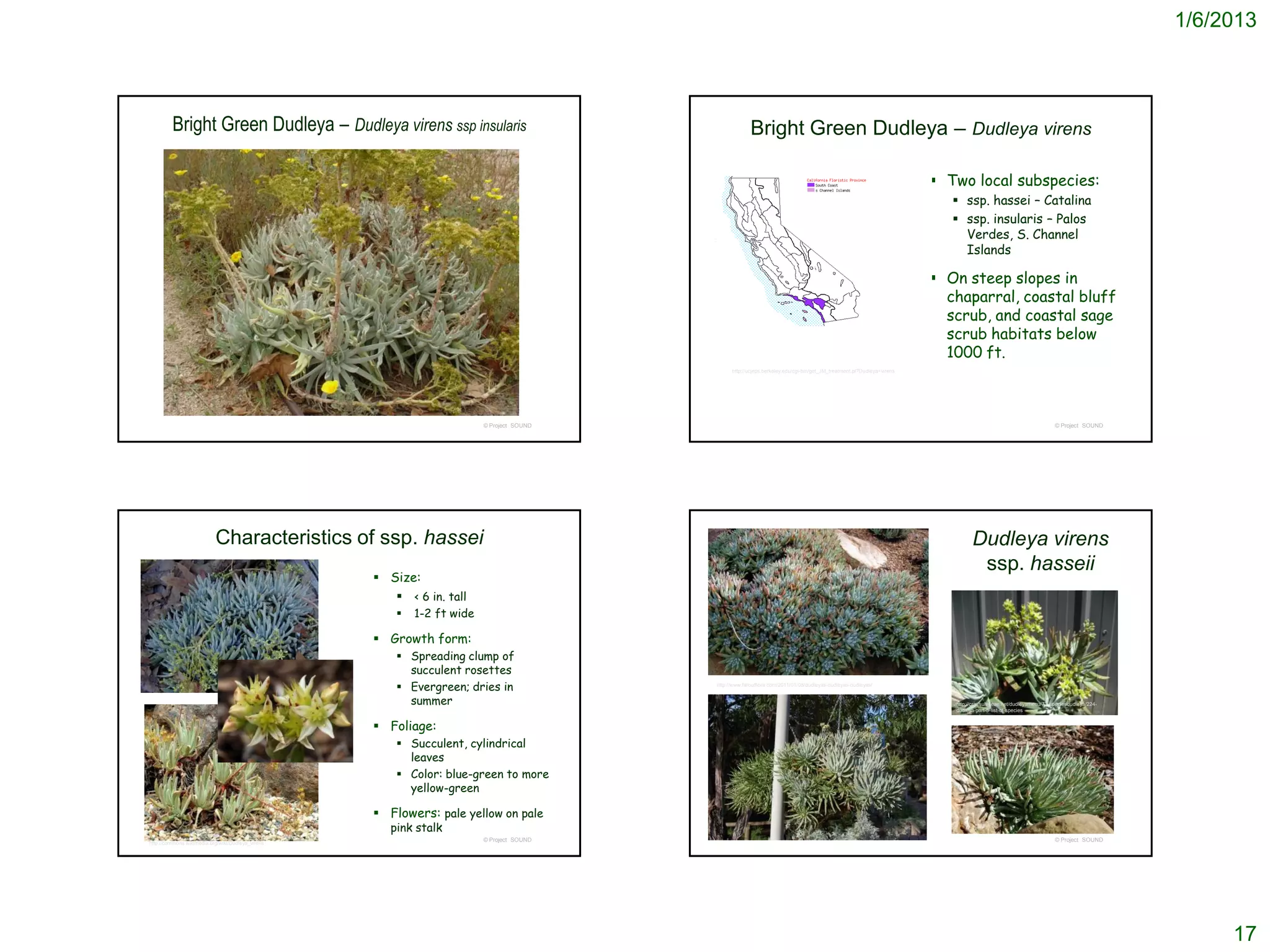
         Bright Green Dudleya – Dudleya virens ssp insularis                                             Bright Green Dudleya – Dudleya virens

                                                                                                                                                                          Two local subspecies:
                                                                                                                                                                             ssp. hassei – Catalina
                                                                                                                                                                             ssp. insularis – Palos
                                                                                                                                                                              Verdes, S. Channel
                                                                                                                                                                              Islands

                                                                                                                                                                          On steep slopes in
                                                                                                                                                                           chaparral, coastal bluff
                                                                                                                                                                           scrub, and coastal sage
                                                                                                                                                                           scrub habitats below
                                                                                                                                                                           1000 ft.
                                                                                                 http://ucjeps.berkeley.edu/cgi-bin/get_JM_treatment.pl?Dudleya+virens


                                                                         © Project SOUND                                                                                                                            © Project SOUND


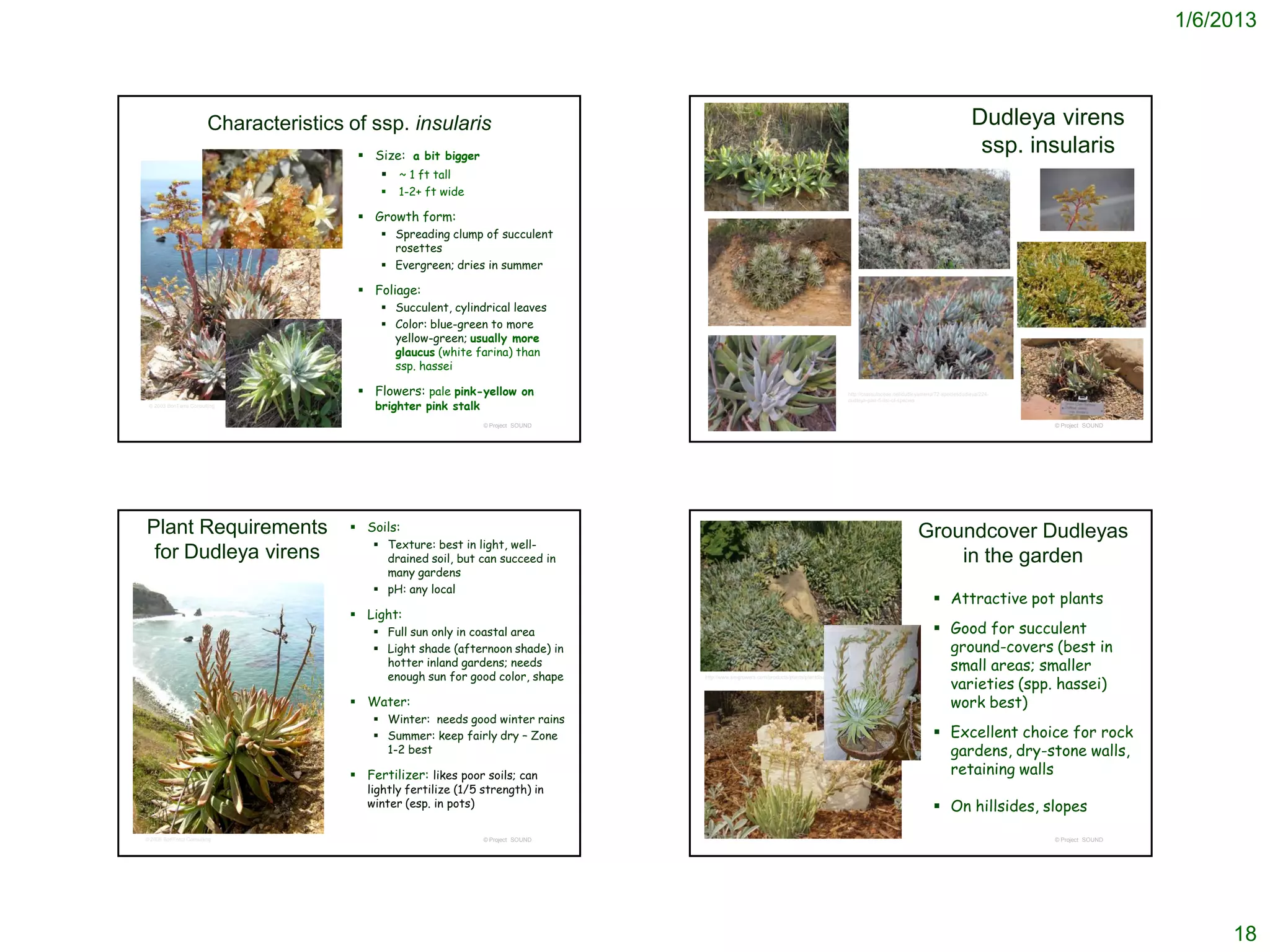
                           Characteristics of ssp. hassei                                                                                                                         Dudleya virens
                                                                                                                                                                                   ssp. hasseii
                                                    Size:
                                                       < 6 in. tall
                                                          1-2 ft wide

                                                    Growth form:
                                                        Spreading clump of
                                                         succulent rosettes
                                                        Evergreen; dries in               http://www.faroutflora.com/2011/01/08/dudleyas-dudleyas-dudleyas/


                                                         summer                                                                                                             http://crassulaceae.net/dudleyamenu/72-speciesdudleya/224-
                                                                                                                                                                            dudleya-part-5-list-of-species


                                                    Foliage:
                                                        Succulent, cylindrical
                                                         leaves
                                                        Color: blue-green to more
                                                         yellow-green

                                                    Flowers: pale yellow on pale
                                                      pink stalk
                                                                         © Project SOUND                                                                                                                            © Project SOUND
http://commons.wikimedia.org/wiki/Dudleya_virens


                                                                                                                                                                                                                                              17
1/6/2013


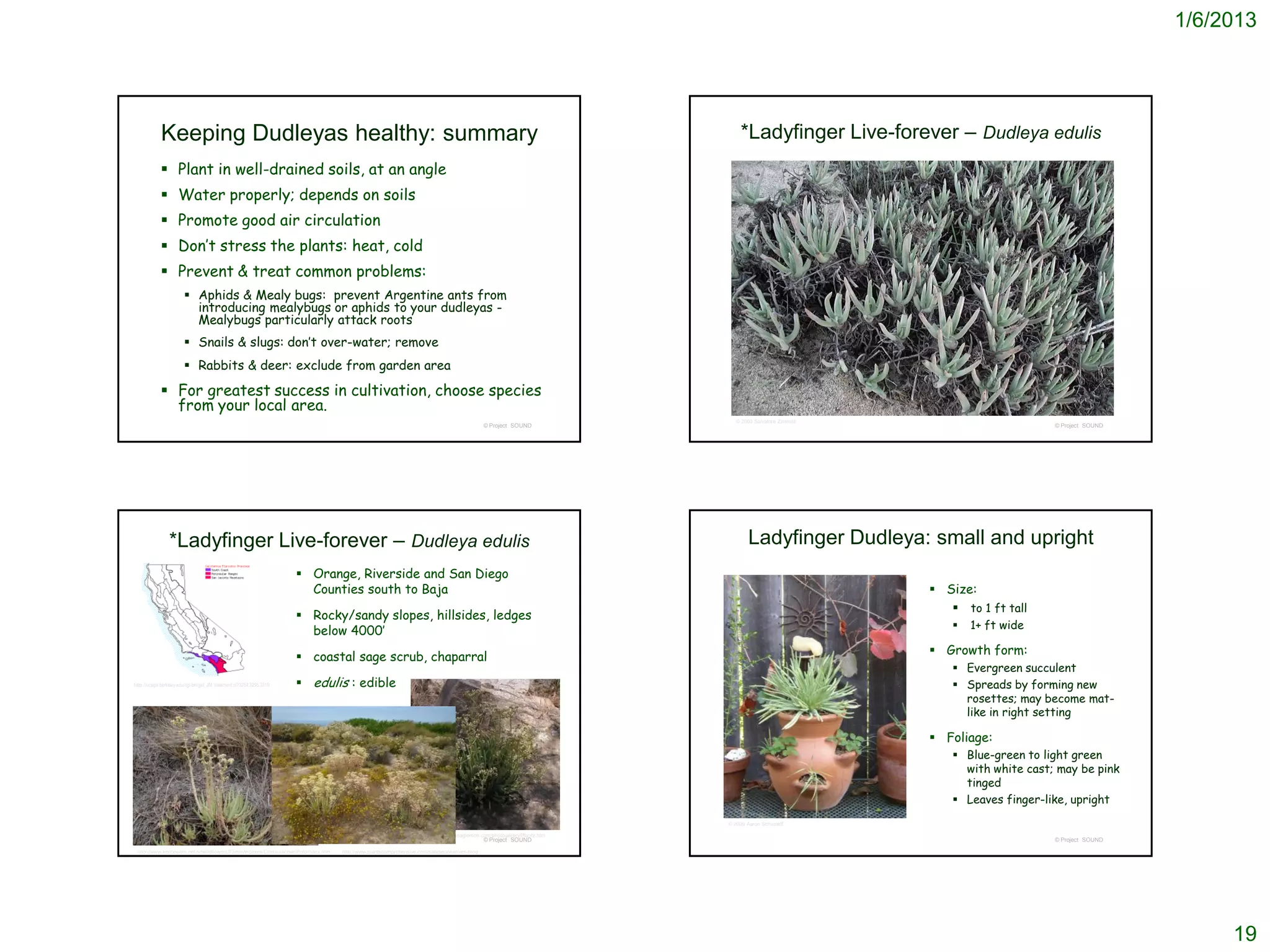
                        Characteristics of ssp. insularis                                                                                                                                       Dudleya virens
                                          Size: a bit bigger
                                                                                                                                                                                                 ssp. insularis
                                             ~ 1 ft tall
                                                1-2+ ft wide

                                          Growth form:
                                              Spreading clump of succulent
                                               rosettes
                                              Evergreen; dries in summer

                                          Foliage:
                                              Succulent, cylindrical leaves
                                              Color: blue-green to more
                                               yellow-green; usually more
                                               glaucus (white farina) than
                                               ssp. hassei

                                          Flowers: pale pink-yellow on                                                                       http://crassulaceae.net/dudleyamenu/72-speciesdudleya/224-

                                            brighter pink stalk
                                                                                                                                              dudleya-part-5-list-of-species
 © 2003 BonTerra Consulting


                                                                  © Project SOUND                                                                                                                          © Project SOUND


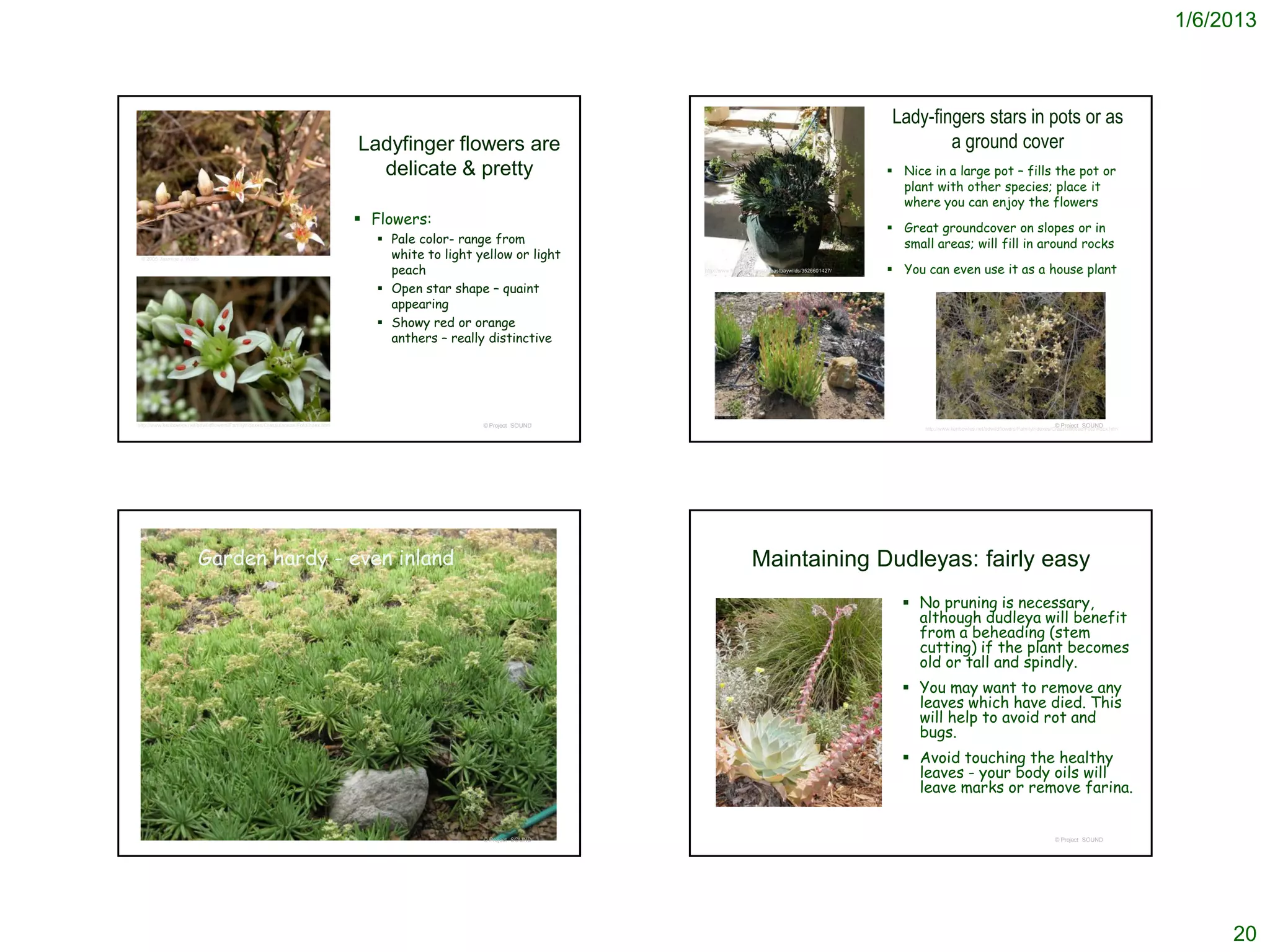
Plant Requirements                       Soils:                                                                                                                          Groundcover Dudleyas
                                             Texture: best in light, well-
 for Dudleya virens                           drained soil, but can succeed in                                                                                                in the garden
                                              many gardens
                                             pH: any local
                                                                                                                                                                                  Attractive pot plants
                                         Light:
                                             Full sun only in coastal area                                                                                                       Good for succulent
                                             Light shade (afternoon shade) in                                                                                                     ground-covers (best in
                                              hotter inland gardens; needs                                                                                                         small areas; smaller
                                              enough sun for good color, shape
                                                                                                                                                                                   varieties (spp. hassei)
                                                                                    http://www.smgrowers.com/products/plants/plantdisplay.asp?plant_id=2987


                                         Water:                                                                                                                                   work best)
                                             Winter: needs good winter rains
                                             Summer: keep fairly dry – Zone                                                                                                      Excellent choice for rock
                                              1-2 best                                                                                                                             gardens, dry-stone walls,
                                         Fertilizer: likes poor soils; can                                                                                                        retaining walls
                                           lightly fertilize (1/5 strength) in
                                           winter (esp. in pots)                                                                                                                  On hillsides, slopes
© 2005 BonTerra Consulting                                        © Project SOUND                                                                                                                          © Project SOUND


                                                                                                                                                                                                                                  18
1/6/2013


             Keeping Dudleyas healthy: summary                                                                                                                              *Ladyfinger Live-forever – Dudleya edulis
              Plant in well-drained soils, at an angle
              Water properly; depends on soils
              Promote good air circulation
              Don’t stress the plants: heat, cold
              Prevent & treat common problems:
                          Aphids & Mealy bugs: prevent Argentine ants from
                           introducing mealybugs or aphids to your dudleyas -
                           Mealybugs particularly attack roots
                          Snails & slugs: don’t over-water; remove
                          Rabbits & deer: exclude from garden area

              For greatest success in cultivation, choose species
               from your local area.
                                                                                                                                                                           © 2000 Salvatore Zimmitti
                                                                                                                                             © Project SOUND                                                                 © Project SOUND


                 *Ladyfinger Live-forever – Dudleya edulis                                                                                                                      Ladyfinger Dudleya: small and upright
                                                                         Orange, Riverside and San Diego
                                                                          Counties south to Baja                                                                                                        Size:
                                                                                                                                                                                                           to 1 ft tall
                                                                         Rocky/sandy slopes, hillsides, ledges
                                                                                                                                                                                                              1+ ft wide
                                                                          below 4000’

                                                                         coastal sage scrub, chaparral                                                                                                 Growth form:
                                                                                                                                                                                                            Evergreen succulent
http://ucjeps.berkeley.edu/cgi-bin/get_JM_treatment.pl?3284,3295,3319    edulis : edible                                                                                                                   Spreads by forming new
                                                                                                                                                                                                             rosettes; may become mat-
                                                                                                                                                                                                             like in right setting

                                                                                                                                                                                                        Foliage:
                                                                                                                                                                                                            Blue-green to light green
                                                                                                                                                                                                             with white cast; may be pink
                                                                                                                                                                                                             tinged
                                                                                                                                                                                                            Leaves finger-like, upright
                                                                                                                                                                        © 2009 Aaron Schusteff

                                                                                                                http://www.miriameaglemon.com/photogallery/Plants.htm
                                                                                                                                             © Project SOUND                                                                 © Project SOUND
 http://www.kenbowles.net/sdwildflowers/FamilyIndexes/Crassulaceae/FotoIndex.htm   http://www.plantscomprehensive.com/sandiegonatives-blog


                                                                                                                                                                                                                                                    19
1/6/2013


                                                                                                                                                                                Lady-fingers stars in pots or as
                                                                                  Ladyfinger flowers are                                                                                a ground cover
                                                                                    delicate & pretty                                                                            Nice in a large pot – fills the pot or
                                                                                                                                                                                  plant with other species; place it
                                                                                                                                                                                  where you can enjoy the flowers
                                                                                   Flowers:
                                                                                                                                                                                 Great groundcover on slopes or in
                                                                                     Pale color- range from                                                                      small areas; will fill in around rocks
 © 2005 Jasmine J. Watts                                                              white to light yellow or light
                                                                                      peach                             http://www.flickr.com/photos/eastbaywilds/3526601427/    You can even use it as a house plant
                                                                                     Open star shape – quaint
                                                                                      appearing
                                                                                     Showy red or orange
                                                                                      anthers – really distinctive


http://www.kenbowles.net/sdwildflowers/FamilyIndexes/Crassulaceae/FotoIndex.htm                       © Project SOUND                                                                                                                      © Project SOUND
                                                                                                                                                                                      http://www.kenbowles.net/sdwildflowers/FamilyIndexes/Crassulaceae/FotoIndex.htm


                        Garden hardy - even inland                                                                                         Maintaining Dudleyas: fairly easy
                                                                                                                                                                                   No pruning is necessary,
                                                                                                                                                                                    although dudleya will benefit
                                                                                                                                                                                    from a beheading (stem
                                                                                                                                                                                    cutting) if the plant becomes
                                                                                                                                                                                    old or tall and spindly.
                                                                                                                                                                                   You may want to remove any
                                                                                                                                                                                    leaves which have died. This
                                                                                                                                                                                    will help to avoid rot and
                                                                                                                                                                                    bugs.
                                                                                                                                                                                   Avoid touching the healthy
                                                                                                                                                                                    leaves - your body oils will
                                                                                                                                                                                    leave marks or remove farina.


                                                                                                      © Project SOUND                                                                                                                      © Project SOUND


                                                                                                                                                                                                                                                                             20
1/6/2013


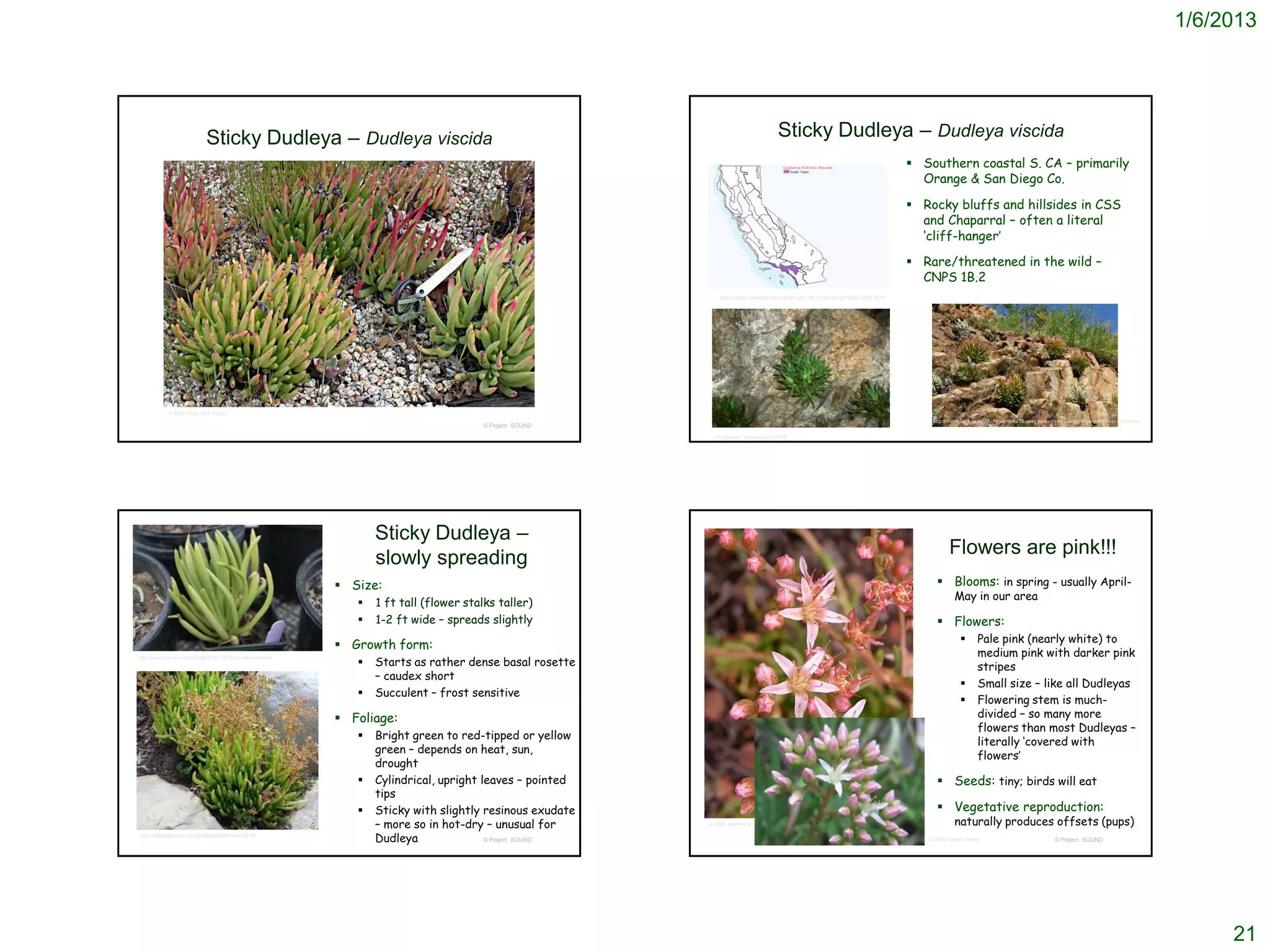
                            Sticky Dudleya – Dudleya viscida                                                                        Sticky Dudleya – Dudleya viscida
                                                                                                                                                                                     Southern coastal S. CA – primarily
                                                                                                                                                                                      Orange & San Diego Co.

                                                                                                                                                                                     Rocky bluffs and hillsides in CSS
                                                                                                                                                                                      and Chaparral – often a literal
                                                                                                                                                                                      ‘cliff-hanger’

                                                                                                                                                                                     Rare/threatened in the wild –
                                                                                                                                                                                      CNPS 1B.2
                                                                                                            http://ucjeps.berkeley.edu/cgi-bin/get_JM_treatment.pl?3284,3295,3339


            © 2002 Dean Wm. Taylor
                                                                                                                                                                                        http://crassulaceae.net/dudleyamenu/72-speciesdudleya/224-dudleya-part-5-list-of-species
                                                                                     © Project SOUND                                                                                                                                       © Project SOUND
                                                                                                           © Roxanne Bittman and CNPS


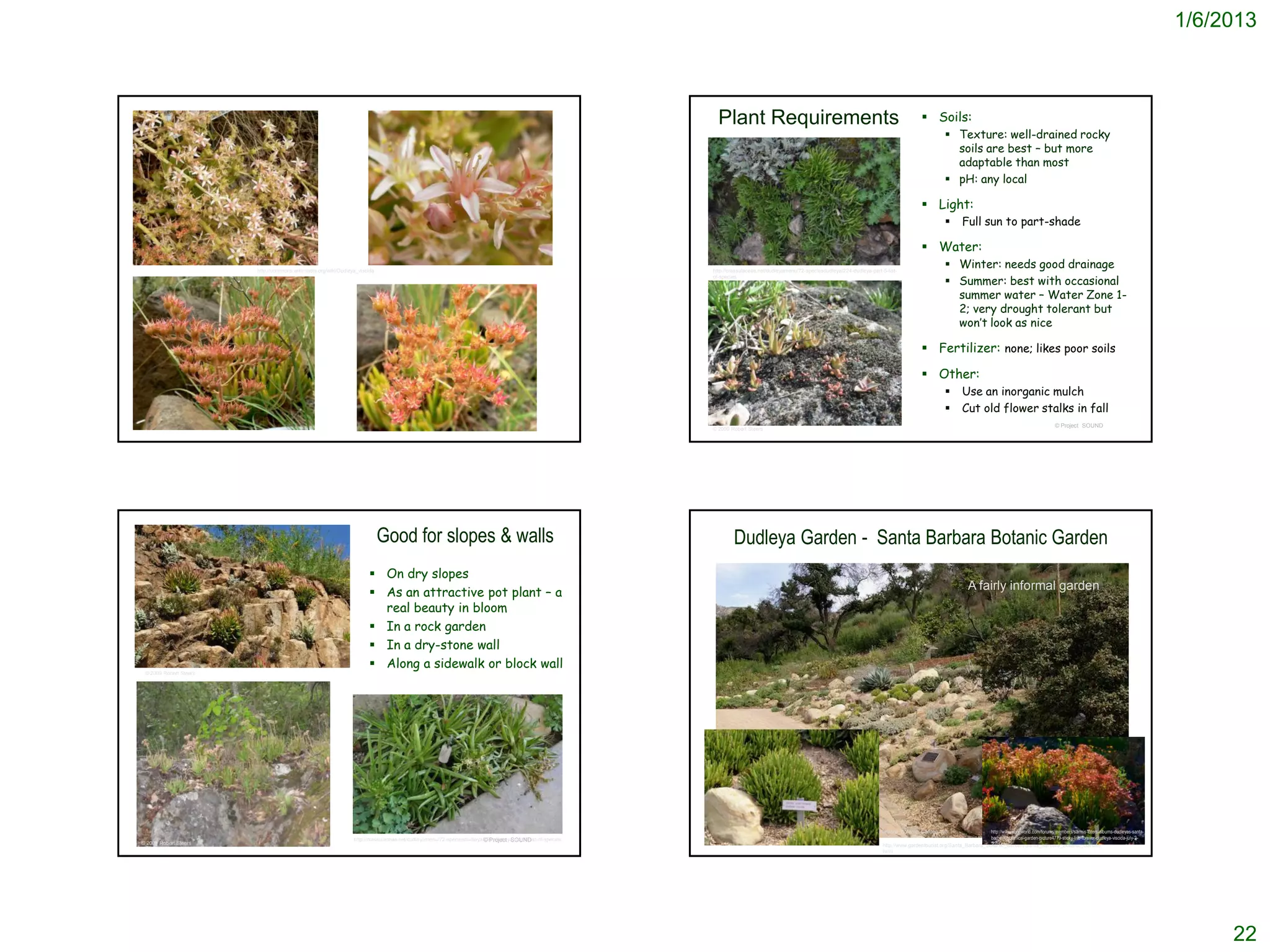
                                                                Sticky Dudleya –
                                                                                                                                                                                               Flowers are pink!!!
                                                                slowly spreading
                                                          Size:                                                                                                                           Blooms: in spring - usually April-
                                                                                                                                                                                                 May in our area
                                                               1 ft tall (flower stalks taller)
                                                               1-2 ft wide – spreads slightly                                                                                             Flowers:
                                                                                                                                                                                                         Pale pink (nearly white) to
                                                          Growth form:
                                                                                                                                                                                                          medium pink with darker pink
                                                               Starts as rather dense basal rosette
http://www.soenyun.com/Blog/2010/10/18/my-new-natives/

                                                                                                                                                                                                          stripes
                                                                – caudex short
                                                                                                                                                                                                         Small size – like all Dudleyas
                                                               Succulent – frost sensitive
                                                                                                                                                                                                         Flowering stem is much-
                                                          Foliage:                                                                                                                                       divided – so many more
                                                                                                                                                                                                          flowers than most Dudleyas –
                                                               Bright green to red-tipped or yellow
                                                                                                                                                                                                          literally ‘covered with
                                                                green – depends on heat, sun,
                                                                                                                                                                                                          flowers’
                                                                drought
                                                               Cylindrical, upright leaves – pointed                                                                                      Seeds: tiny; birds will eat
                                                                tips
                                                               Sticky with slightly resinous exudate                                                                                      Vegetative reproduction:
                                                                – more so in hot-dry – unusual for      © 2006 Jasmine J. Watts                                                                  naturally produces offsets (pups)
 http://davesgarden.com/guides/articles/view/2318/
                                                                Dudleya               © Project SOUND                                                                                  © 2009 Robert Steers                                © Project SOUND


                                                                                                                                                                                                                                                                                        21
1/6/2013


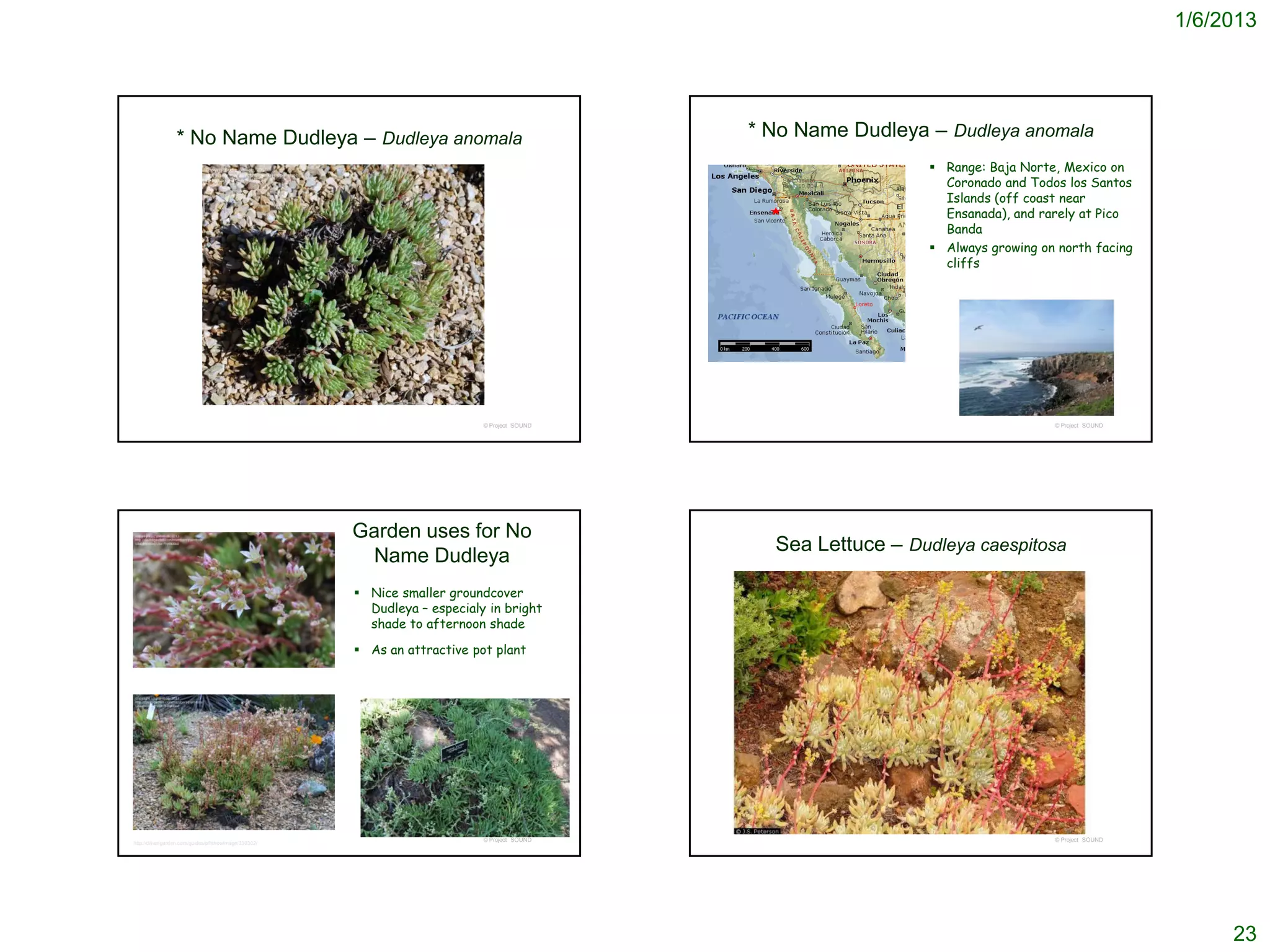
                                                                                                                                                             Plant Requirements                                                                       Soils:
                                                                                                                                                                                                                                                                 Texture: well-drained rocky
                                                                                                                                                                                                                                                                  soils are best – but more
                                                                                                                                                                                                                                                                  adaptable than most
                                                                                                                                                                                                                                                                 pH: any local

                                                                                                                                                                                                                                                      Light:
                                                                                                                                                                                                                                                                       Full sun to part-shade

                                                                                                                                                                                                                                                      Water:
                        http://commons.wikimedia.org/wiki/Dudleya_viscida                                                                                  http://crassulaceae.net/dudleyamenu/72-speciesdudleya/224-dudleya-part-5-list-
                                                                                                                                                                                                                                                                 Winter: needs good drainage
                                                                                                                                                                                                                                                                 Summer: best with occasional
                                                                                                                                                           of-species


                                                                                                                                                                                                                                                                  summer water – Water Zone 1-
                                                                                                                                                                                                                                                                  2; very drought tolerant but
                                                                                                                                                                                                                                                                  won’t look as nice

                                                                                                                                                                                                                                                      Fertilizer: none; likes poor soils

                                                                                                                                                                                                                                                      Other:
                                                                                                                                                                                                                                                                       Use an inorganic mulch
                                                                                                                                                                                                                                                                       Cut old flower stalks in fall
                                                                                                                      © Project SOUND                                                                                                                                                                                © Project SOUND
                                                                                                                                                           © 2009 Robert Steers


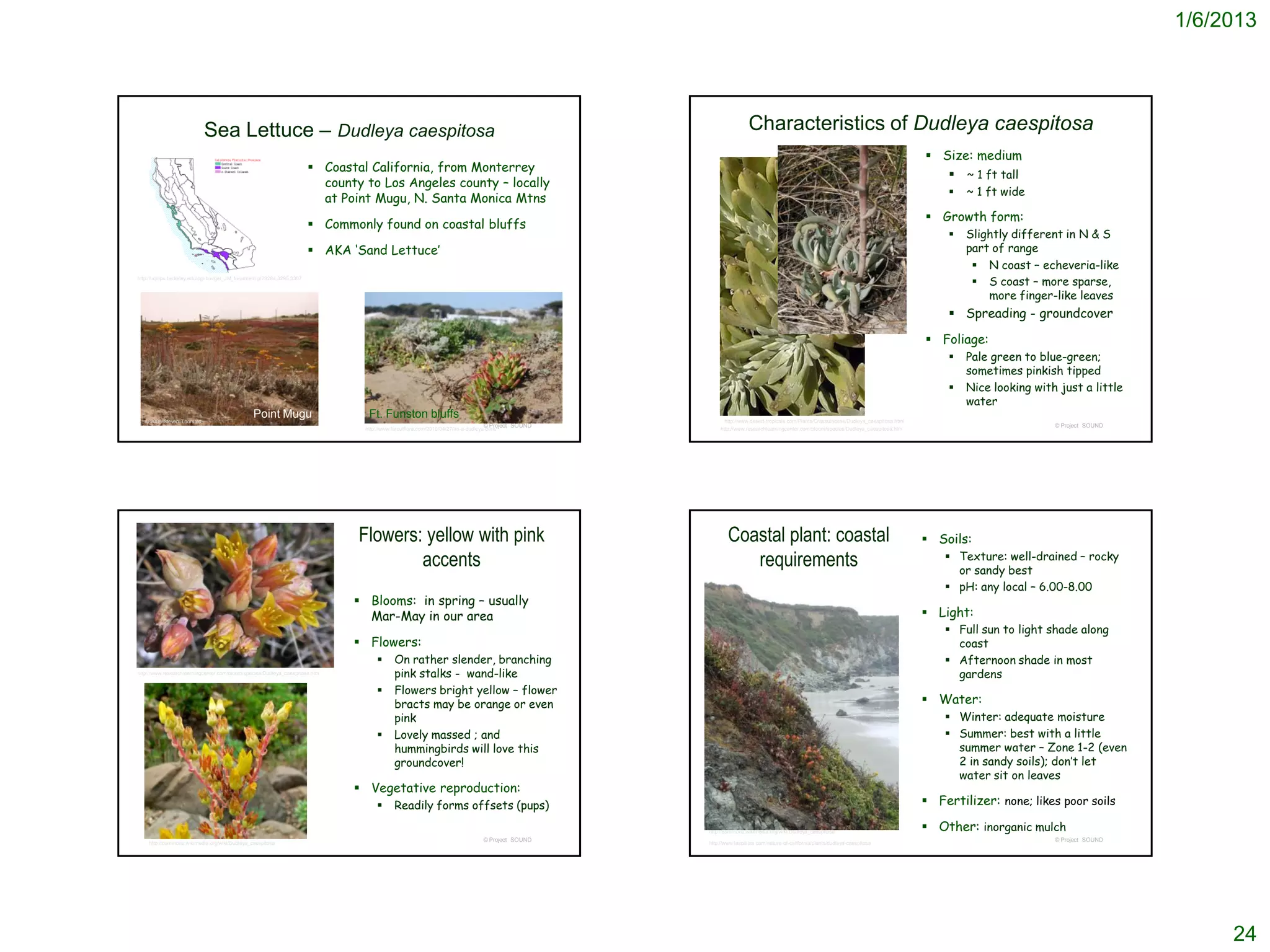
                                                                            Good for slopes & walls                                                                Dudleya Garden - Santa Barbara Botanic Garden
                                                                       On dry slopes
                                                                                                                                                                                                                                                                           A fairly informal garden
                                                                       As an attractive pot plant – a
                                                                        real beauty in bloom
                                                                       In a rock garden
                                                                       In a dry-stone wall
                                                                       Along a sidewalk or block wall
 © 2009 Robert Steers


                                                                                                                                                              http://www.gardentourist.org/Santa_Barbara_Botanic_Garden/Santa_Barbara_Botanic_Garden.html                       http://www.xericworld.com/forums/members/sarmis-luters-albums-dudleyas-santa-
                                                                http://crassulaceae.net/dudleyamenu/72-speciesdudleya/224-dudleya-part-5-list-of-species
                                                                                                                      © Project SOUND                                                                                                                                           barbara-botanical-garden-picture4779-sticky-live-forever-dudleya-viscida-july-2-
                                                                                                                                                                                                                                                                                                                 © Project SOUND
© 2009 Robert Steers                                                                                                                                                                                                                                                            2011.html
                                                                                                                                                                                                                                   http://www.gardentourist.org/Santa_Barbara_Botanic_Garden/Santa_Barbara_Botanic_Garden.
                                                                                                                                                                                                                                   html


                                                                                                                                                                                                                                                                                                                                                                        22
1/6/2013


                 * No Name Dudleya – Dudleya anomala                                        * No Name Dudleya – Dudleya anomala
                                                                                                               Range: Baja Norte, Mexico on
                                                                                                                Coronado and Todos los Santos
                                                                                                                Islands (off coast near
                                                                                                                Ensanada), and rarely at Pico
                                                                                                                Banda
                                                                                                               Always growing on north facing
                                                                                                                cliffs


                                                                          © Project SOUND                                        © Project SOUND


                                                     Garden uses for No
                                                                                              Sea Lettuce – Dudleya caespitosa
                                                      Name Dudleya
                                                      Nice smaller groundcover
                                                       Dudleya – especialy in bright
                                                       shade to afternoon shade

                                                      As an attractive pot plant


                                                                          © Project SOUND                                        © Project SOUND
http://davesgarden.com/guides/pf/showimage/330302/


                                                                                                                                                        23
1/6/2013


                            Sea Lettuce – Dudleya caespitosa                                                                                                          Characteristics of Dudleya caespitosa
                                                                                                                                                                                                                                          Size: medium
                                                                         Coastal California, from Monterrey
                                                                                                                                                                                                                                             ~ 1 ft tall
                                                                          county to Los Angeles county – locally
                                                                                                                                                                                                                                                 ~ 1 ft wide
                                                                          at Point Mugu, N. Santa Monica Mtns
                                                                                                                                                                                                                                          Growth form:
                                                                         Commonly found on coastal bluffs
                                                                                                                                                                                                                                                 Slightly different in N & S
                                                                         AKA ‘Sand Lettuce’                                                                                                                                                      part of range
                                                                                                                                                                                                                                                    N coast – echeveria-like
http://ucjeps.berkeley.edu/cgi-bin/get_JM_treatment.pl?3284,3295,3307
                                                                                                                                                                                                                                                    S coast – more sparse,
                                                                                                                                                                                                                                                      more finger-like leaves
                                                                                                                                                                                                                                               Spreading - groundcover

                                                                                                                                                                                                                                          Foliage:
                                                                                                                                                                                                                                                 Pale green to blue-green;
                                                                                                                                                                                                                                                  sometimes pinkish tipped
                                                                                                                                                                                                                                                 Nice looking with just a little
                                                                                                                                                                                                                                                  water
   © 2006 Steven Thorsted
                                                Point Mugu                        Ft. Funston bluffs                                                       http://www.desert-tropicals.com/Plants/Crassulaceae/Dudleya_caespitosa.html
                                                                                                                                   © Project SOUND                                                                                                                 © Project SOUND
                                                                                 http://www.faroutflora.com/2010/04/27/im-a-dudleya-dork/                 http://www.researchlearningcenter.com/bloom/species/Dudleya_caespitosa.htm


                                                                                Flowers: yellow with pink                                                    Coastal plant: coastal                                                       Soils:
                                                                                        accents                                                                 requirements                                                                  Texture: well-drained – rocky
                                                                                                                                                                                                                                               or sandy best
                                                                                                                                                                                                                                              pH: any local – 6.00-8.00
                                                                                Blooms: in spring – usually
                                                                                 Mar-May in our area                                                                                                                                      Light:
                                                                                                                                                                                                                                              Full sun to light shade along
                                                                                Flowers:                                                                                                                                                      coast
                                                                                            On rather slender, branching                                                                                                                     Afternoon shade in most
http://www.researchlearningcenter.com/bloom/species/Dudleya_caespitosa.htm                   pink stalks - wand-like                                                                                                                           gardens
                                                                                            Flowers bright yellow – flower
                                                                                             bracts may be orange or even                                                                                                                 Water:
                                                                                             pink                                                                                                                                             Winter: adequate moisture
                                                                                            Lovely massed ; and                                                                                                                              Summer: best with a little
                                                                                             hummingbirds will love this                                                                                                                       summer water – Zone 1-2 (even
                                                                                             groundcover!                                                                                                                                      2 in sandy soils); don’t let
                                                                                                                                                                                                                                               water sit on leaves
                                                                                Vegetative reproduction:
                                                                                            Readily forms offsets (pups)                                                                                                                 Fertilizer: none; likes poor soils

                                                                                                                                                     http://commons.wikimedia.org/wiki/Dudleya_caespitosa                                 Other: inorganic mulch
                                                                                                                                   © Project SOUND                                                                                                                 © Project SOUND
    http://commons.wikimedia.org/wiki/Dudleya_caespitosa                                                                                             http://www.laspilitas.com/nature-of-california/plants/dudleya-caespitosa


                                                                                                                                                                                                                                                                                          24
1/6/2013


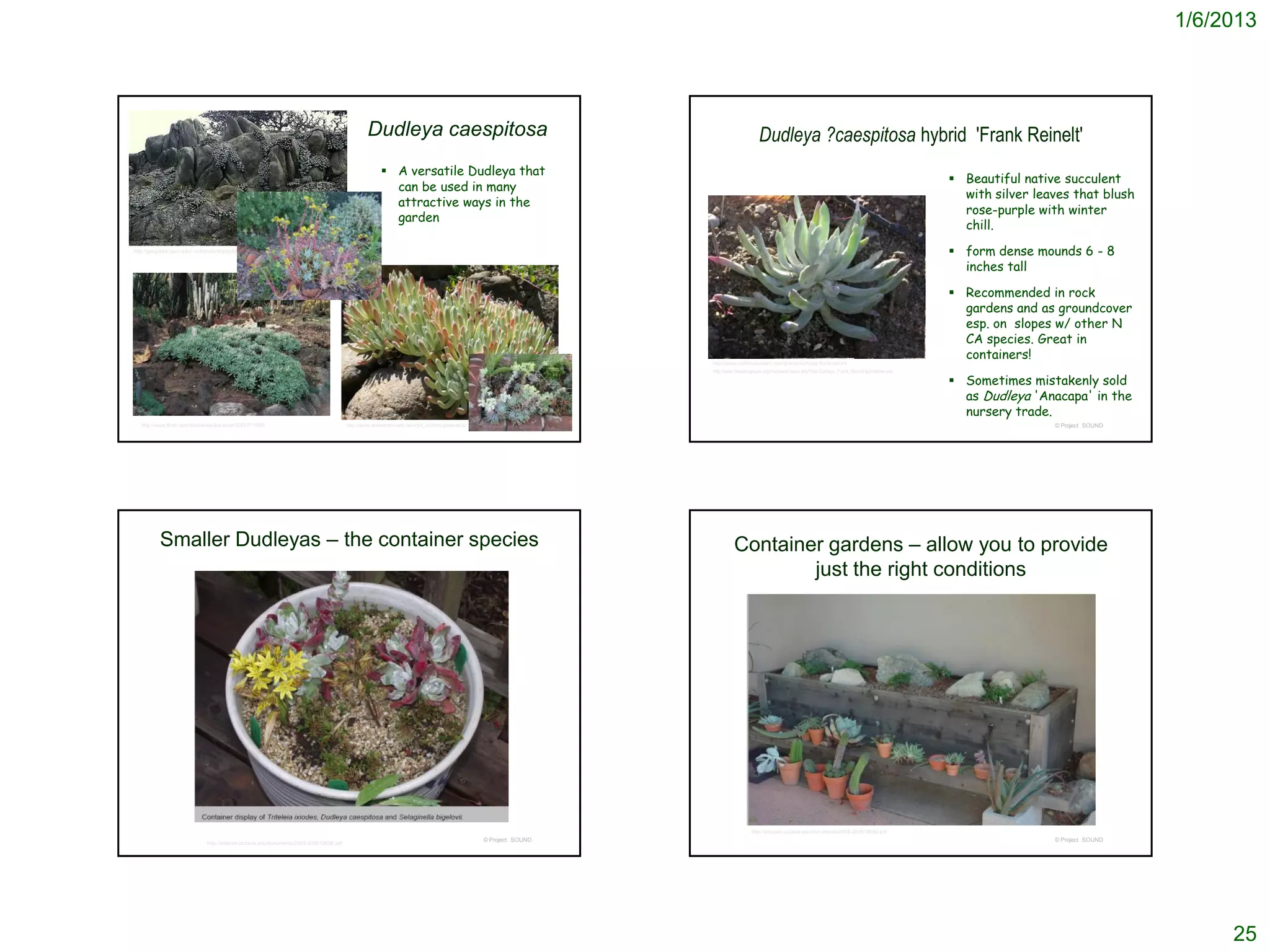
                                                                                                  Dudleya caespitosa                                                                            Dudleya ?caespitosa hybrid 'Frank Reinelt'
                                                                                                         A versatile Dudleya that
                                                                                                                                                                                                                                                                         Beautiful native succulent
                                                                                                          can be used in many
                                                                                                                                                                                                                                                                          with silver leaves that blush
                                                                                                          attractive ways in the
                                                                                                                                                                                                                                                                          rose-purple with winter
                                                                                                          garden
                                                                                                                                                                                                                                                                          chill.
                                                               Point Lobos
http://geogdata.csun.edu/~voltaire/ann/plant/pointlobos.html                                                                                                                                                                                                             form dense mounds 6 - 8
                                                                                                                                                                                                                                                                          inches tall

                                                                                                                                                                                                                                                                         Recommended in rock
                                                                                                                                                                                                                                                                          gardens and as groundcover
                                                                                                                                                                                                                                                                          esp. on slopes w/ other N
                                                                                                                                                                                                                                                                          CA species. Great in
                                                                                                                                                                         http://www.calfloranursery.com/plants/dudleya-frank-reinelt
                                                                                                                                                                                                                                                                          containers!
                                                                                                                                                                         http://www.theodorepayne.org/mediawiki/index.php?title=Dudleya_'Frank_Reinelt'&printable=yes

                                                                                                                                                                                                                                                                         Sometimes mistakenly sold
                                                                                                                                                                                                                                                                          as Dudleya 'Anacapa' in the
                                                                                                                                                                                                                                                                          nursery trade.
   http://www.flickr.com/photos/exuberance/3251771669/                                    http://www.anniesannuals.com/plt_lst/lists/general/lst.gen.asp?prodid=3942
                                                                                                                                                       © Project SOUND                                                                                                                   © Project SOUND


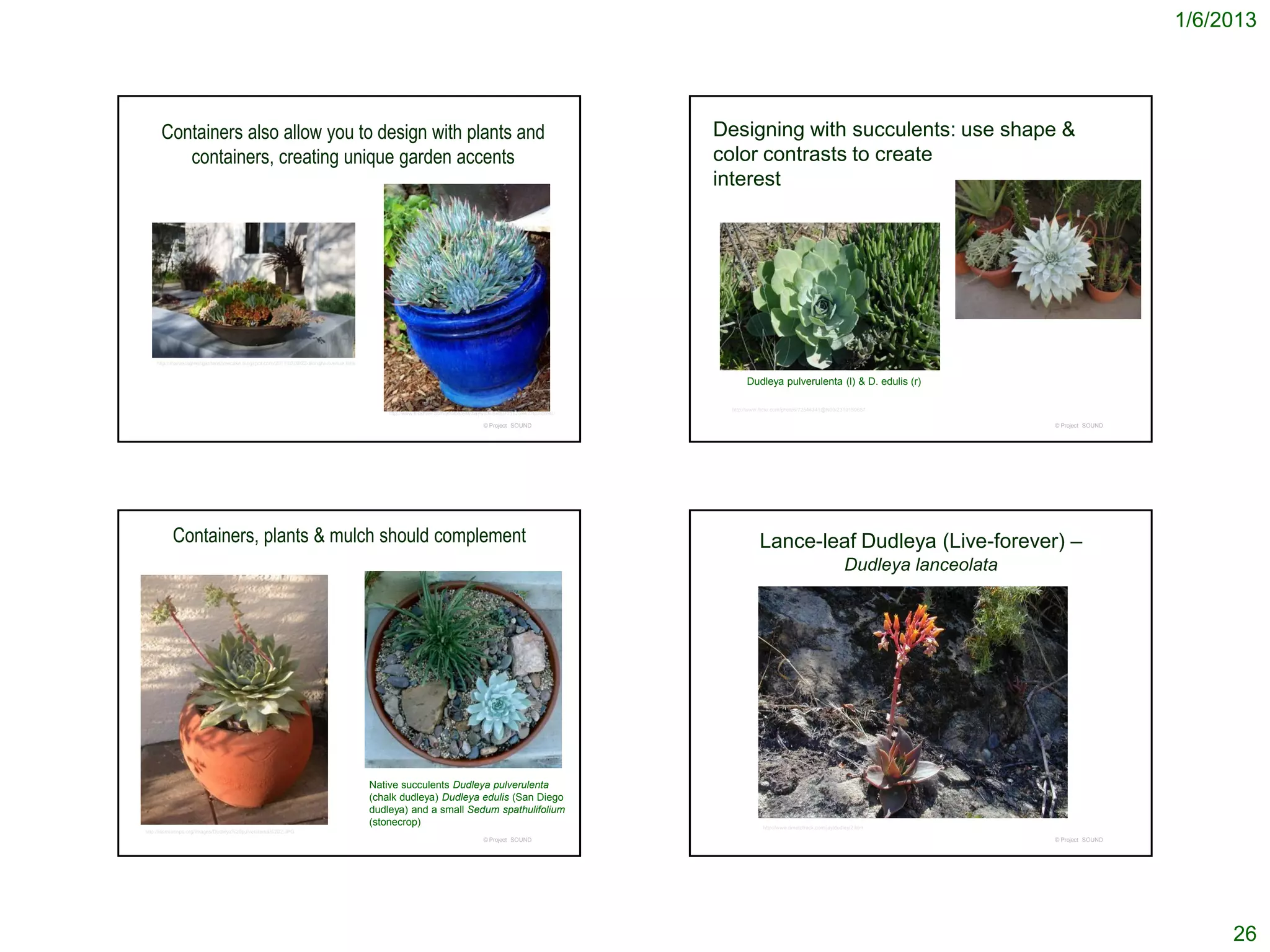
           Smaller Dudleyas – the container species                                                                                                                                Container gardens – allow you to provide
                                                                                                                                                                                           just the right conditions


                                                                                                                                                                                            http://slosson.ucdavis.edu/documents/2005-200610656.pdf
                                                                                                                                                  © Project SOUND                                                                                                                        © Project SOUND
                                http://slosson.ucdavis.edu/documents/2005-200610656.pdf


                                                                                                                                                                                                                                                                                                                25
1/6/2013


      Containers also allow you to design with plants and                                                                                                           Designing with succulents: use shape &
         containers, creating unique garden accents                                                                                                                 color contrasts to create
                                                                                                                                                                    interest


    http://marvistagreengardenshowcase.blogspot.com/2011/02/3922-albright-avenue.html


                                                                                                                                                                           Dudleya pulverulenta (l) & D. edulis (r)

                                                                                                                                                                      http://www.flickr.com/photos/72544341@N00/2310150657
                                                                                            http://www.flickriver.com/photos/eastbaywilds/sets/72157594276050096/

                                                                                                                                   © Project SOUND                                                                                       © Project SOUND


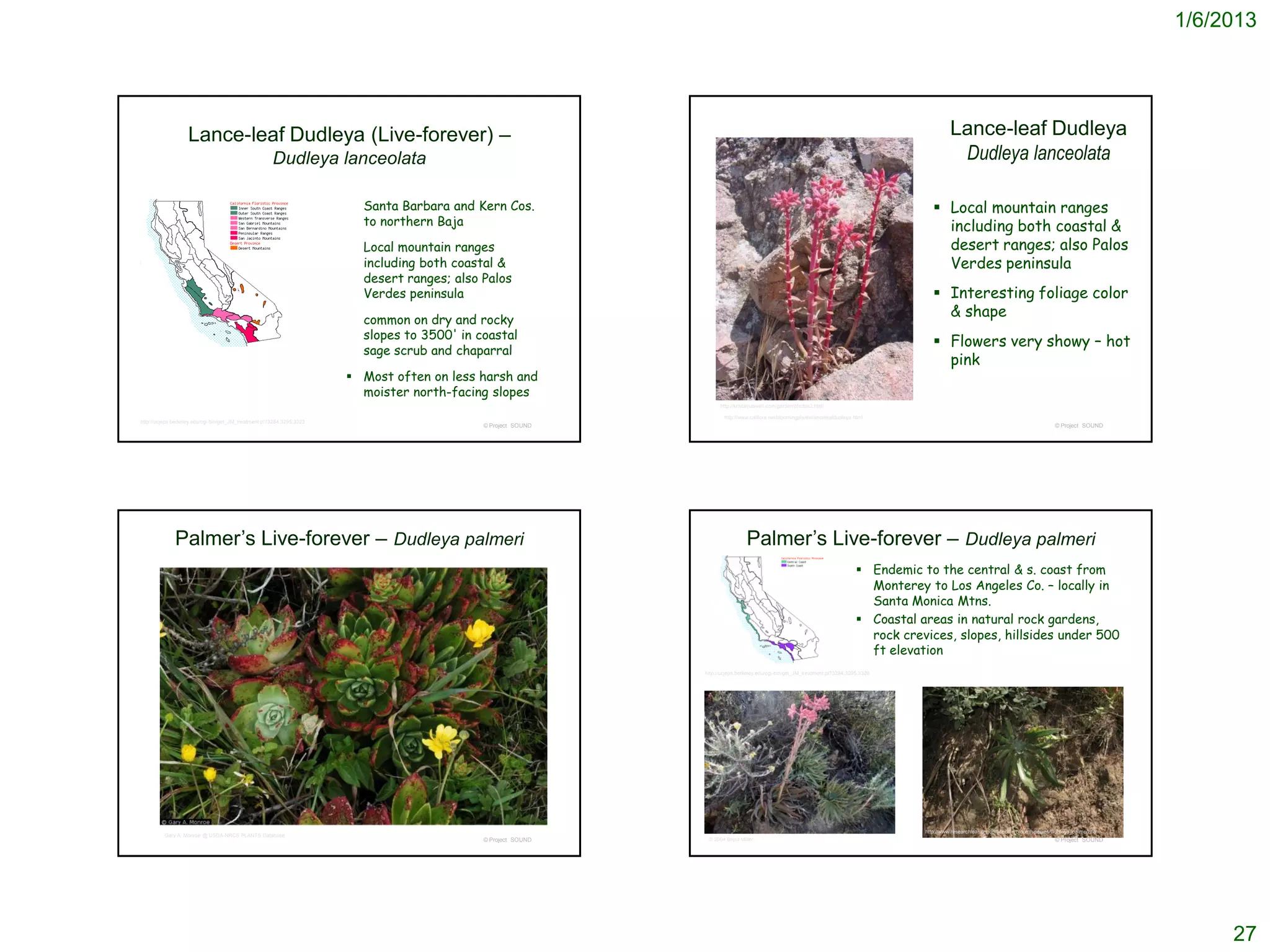
          Containers, plants & mulch should complement                                                                                                                          Lance-leaf Dudleya (Live-forever) –
                                                                                                                                                                                                                    Dudleya lanceolata


                                                                                        Native succulents Dudleya pulverulenta
                                                                                        (chalk dudleya) Dudleya edulis (San Diego
                                                                                        dudleya) and a small Sedum spathulifolium
                                                                                        (stonecrop)                                                                               http://www.timetotrack.com/jay/dudleyl2.htm
http://lasmmcnps.org/images/Dudleya%20pulverulenta%202.JPG
                                                                                                                                   © Project SOUND                                                                                       © Project SOUND


                                                                                                                                                                                                                                                                26
1/6/2013


                   Lance-leaf Dudleya (Live-forever) –                                                                                                                                                Lance-leaf Dudleya
                                                       Dudleya lanceolata                                                                                                                              Dudleya lanceolata

                                                                         Santa Barbara and Kern Cos.                                                                                           Local mountain ranges
                                                                          to northern Baja                                                                                                       including both coastal &
                                                                         Local mountain ranges                                                                                                  desert ranges; also Palos
                                                                          including both coastal &                                                                                               Verdes peninsula
                                                                          desert ranges; also Palos
                                                                          Verdes peninsula                                                                                                      Interesting foliage color
                                                                         common on dry and rocky
                                                                                                                                                                                                 & shape
                                                                          slopes to 3500' in coastal
                                                                                                                                                                                                Flowers very showy – hot
                                                                          sage scrub and chaparral
                                                                                                                                                                                                 pink
                                                                         Most often on less harsh and
                                                                          moister north-facing slopes
                                                                                                                      http://kristamaxwell.com/garden/photos2.html

                                                                                                                        http://www.calflora.net/bloomingplants/lanceleafdudleya.html
http://ucjeps.berkeley.edu/cgi-bin/get_JM_treatment.pl?3284,3295,3323
                                                                                              © Project SOUND                                                                                                                                   © Project SOUND


              Palmer’s Live-forever – Dudleya palmeri                                                                            Palmer’s Live-forever – Dudleya palmeri
                                                                                                                                                                                  Endemic to the central & s. coast from
                                                                                                                                                                                   Monterey to Los Angeles Co. – locally in
                                                                                                                                                                                   Santa Monica Mtns.
                                                                                                                                                                                  Coastal areas in natural rock gardens,
                                                                                                                                                                                   rock crevices, slopes, hillsides under 500
                                                                                                                                                                                   ft elevation
                                                                                                                http://ucjeps.berkeley.edu/cgi-bin/get_JM_treatment.pl?3284,3295,3326


                                                                                                                                                                                            http://www.researchlearningcenter.com/bloom/species/Dudleya_palmeri.htm
          Gary A. Monroe @ USDA-NRCS PLANTS Database
                                                                                              © Project SOUND    © 2004 Brent Miller                                                                                                            © Project SOUND


                                                                                                                                                                                                                                                                           27
1/6/2013


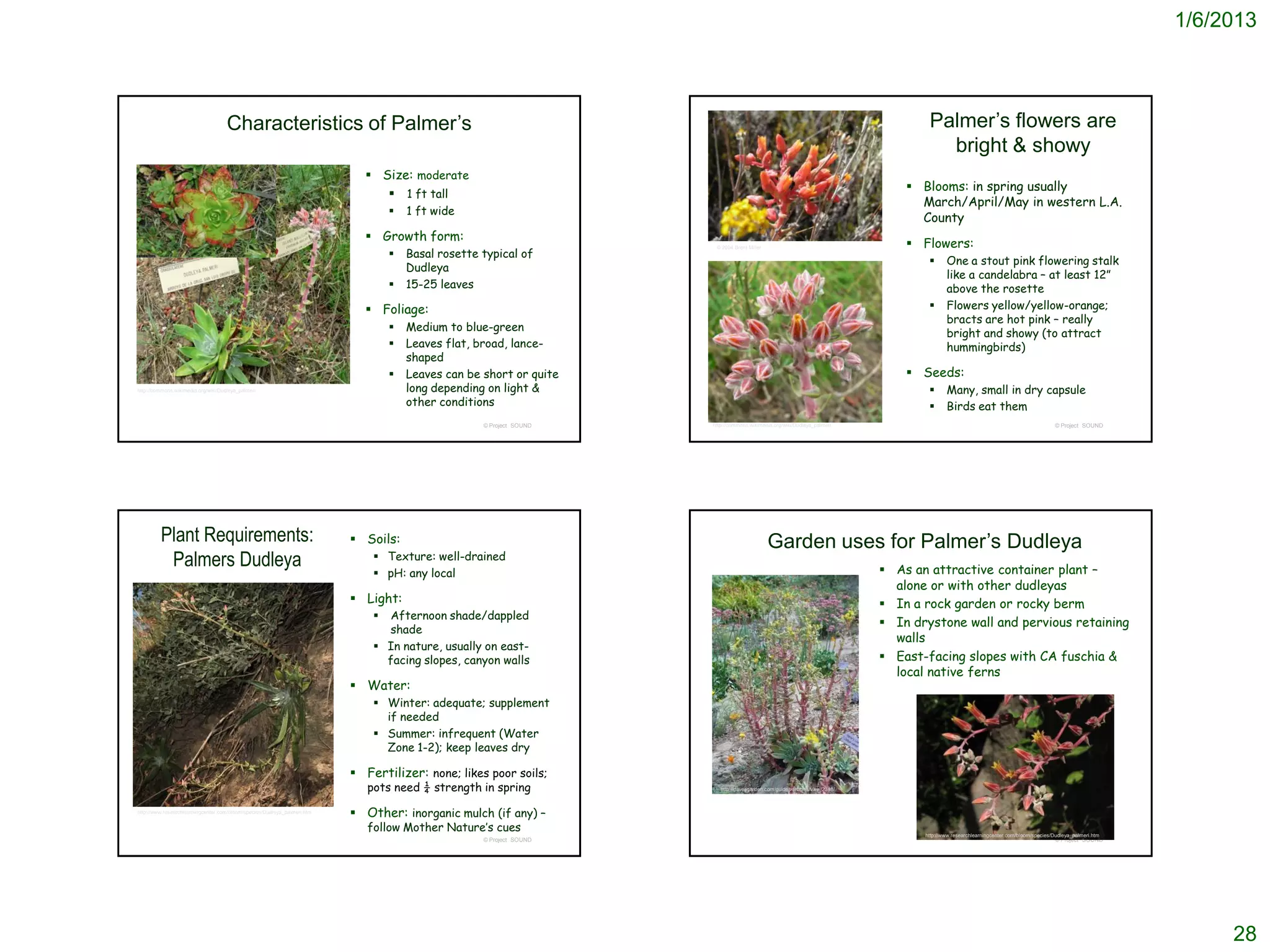
                                     Characteristics of Palmer’s                                                                                                                     Palmer’s flowers are
                                                                                                                                                                                       bright & showy
                                                                             Size: moderate
                                                                                                                                                                                  Blooms: in spring usually
                                                                                1 ft tall
                                                                                                                                                                                   March/April/May in western L.A.
                                                                                     1 ft wide
                                                                                                                                                                                   County
                                                                             Growth form:
                                                                                                                                                                                  Flowers:
                                                                                      Basal rosette typical of
                                                                                                                       © 2004 Brent Miller
                                                                                  
                                                                                                                                                                                           One a stout pink flowering stalk
                                                                                      Dudleya
                                                                                                                                                                                            like a candelabra – at least 12”
                                                                                     15-25 leaves                                                                                          above the rosette
                                                                             Foliage:                                                                                                     Flowers yellow/yellow-orange;
                                                                                                                                                                                            bracts are hot pink – really
                                                                                     Medium to blue-green
                                                                                                                                                                                            bright and showy (to attract
                                                                                     Leaves flat, broad, lance-                                                                            hummingbirds)
                                                                                      shaped
                                                                                     Leaves can be short or quite                                                                Seeds:
http://commons.wikimedia.org/wiki/Dudleya_palmeri                                     long depending on light &                                                                            Many, small in dry capsule
                                                                                      other conditions                                                                                     Birds eat them
                                                                                                    © Project SOUND   http://commons.wikimedia.org/wiki/Dudleya_palmeri                                                                 © Project SOUND


         Plant Requirements:                                               Soils:                                                           Garden uses for Palmer’s Dudleya
          Palmers Dudleya                                                      Texture: well-drained
                                                                                                                                                                              As an attractive container plant –
                                                                               pH: any local
                                                                                                                                                                               alone or with other dudleyas
                                                                           Light:                                                                                            In a rock garden or rocky berm
                                                                               Afternoon shade/dappled
                                                                                                                                                                              In drystone wall and pervious retaining
                                                                                shade
                                                                                                                                                                               walls
                                                                               In nature, usually on east-
                                                                                facing slopes, canyon walls                                                                   East-facing slopes with CA fuschia &
                                                                                                                                                                               local native ferns
                                                                           Water:
                                                                               Winter: adequate; supplement
                                                                                if needed
                                                                               Summer: infrequent (Water
                                                                                Zone 1-2); keep leaves dry

                                                                           Fertilizer: none; likes poor soils;
                                                                             pots need ¼ strength in spring              http://davesgarden.com/guides/articles/view/2318/


http://www.researchlearningcenter.com/bloom/species/Dudleya_palmeri.htm
                                                                           Other: inorganic mulch (if any) –
                                                                             follow Mother Nature’s cues
                                                                                                                                                                                    http://www.researchlearningcenter.com/bloom/species/Dudleya_palmeri.htm
                                                                                                    © Project SOUND                                                                                                                     © Project SOUND


                                                                                                                                                                                                                                                                   28
1/6/2013


                       Growing Dudleyas in containers                                                                                                           Other considerations for growing Dudleyas
                                                                                      Dudleyas grow well in pots and                                                                                                 Bright light is integral to the proper
                                                                                       make excellent outdoor                                                                                                          growth of this genus.
                                                                                       specimens in Mediterranean                                                                                                               Plants grown in low-light will lose their
                                                                                       climates.                                                                                                                                 color, grow tall and spindly and will
                                                                                                                                                                                                                                 eventually die.
                                                                                      Potting soil should be very well-
                                                                                       draining; amend potting soils with                                                                                                       Most Dudleyas make poor houseplants
                                                                                       sharp sand and pumice to insure
                                                                                       good drainage.                                                                                                                 Most Dudleyas do best with moderate
                                                                                                                                                                                                                       temperatures - protect from
                                                                                      Watering: treat as Zone 2;                                                                                                      blistering afternoon heat, frosts
                                                                                       monitor carefully in hot weather                                                                                                (particularly if in pots)
                                                                                      Light: afternoon shade or bright                                                                                               Potting soil should be very well-
                                                                                       shade best                                                                                                                      draining; use a cactus mix or amend
                      Dudleya farinosa
                                                                                      Propagation: easiest by removing                                                                                                available soils with sharp sand and
                                                                                       rooted offsets (pups), but can be                                                                                               pumice to insure good drainage.
                                                                                       from seed
                                                                                                                                       © Project SOUND                                                                                                                  © Project SOUND


                                                                                        Dudleya ‘Bright Sprite’                                                 Dudleya gnoma [D. greenei] - ‘White Sprite’
                                                                                    1 ft x 1 ft
                                                                                    Pale, pastel foliage and flowers
                                                                                    Sun to part-shade
                                                                                                                                                                                                                                                                    Native to
                                                                                    Occasional water
                                                                                                                                                                                                                                                                     Santa Rosa
                                                                                    Beautiful in rock gardens or
                                                                                                                                                                                                                                                                     Island – rare
                                                                                     containers. Excellent mass planted                                                                                                                                              in nature
                                                                                     or as an accent against darker
http://www.theodorepayne.org/mediawiki/index.php?title=Dudleya_'Bright_Sprite'
                                                                                     foliage such as Ceanothus                                                                                                                                                      Small and
                                                                                                                                                                                                                                                                     charming –
                                                                                                                                                                                                         http://crassulaceae.net/dudleyamenu/94-photos/538-
                                                                                                                                                                                                         dudleya-gnoma-white-sprite-photos                           very white
                                                                                                                                                                                                                                                                    Readily
                                                                                                                                                                                                                                                                     available
                                                                                                                                                         http://www.desert-
                                                                                                                                                         tropicals.com/Plants/Crassulaceae/Dudleya_gno
                                                                                                                                                         ma.html


                                                                                          http://photobucket.com/images/Dudleya+'Bright+Sprite'/
                                                                                                                                       © Project SOUND                                                   http://www.yerbabuenanursery.com/viewplant.php?pid=1531        © Project SOUND


                                                                                                                                                                                                                                                                                               29
1/6/2013


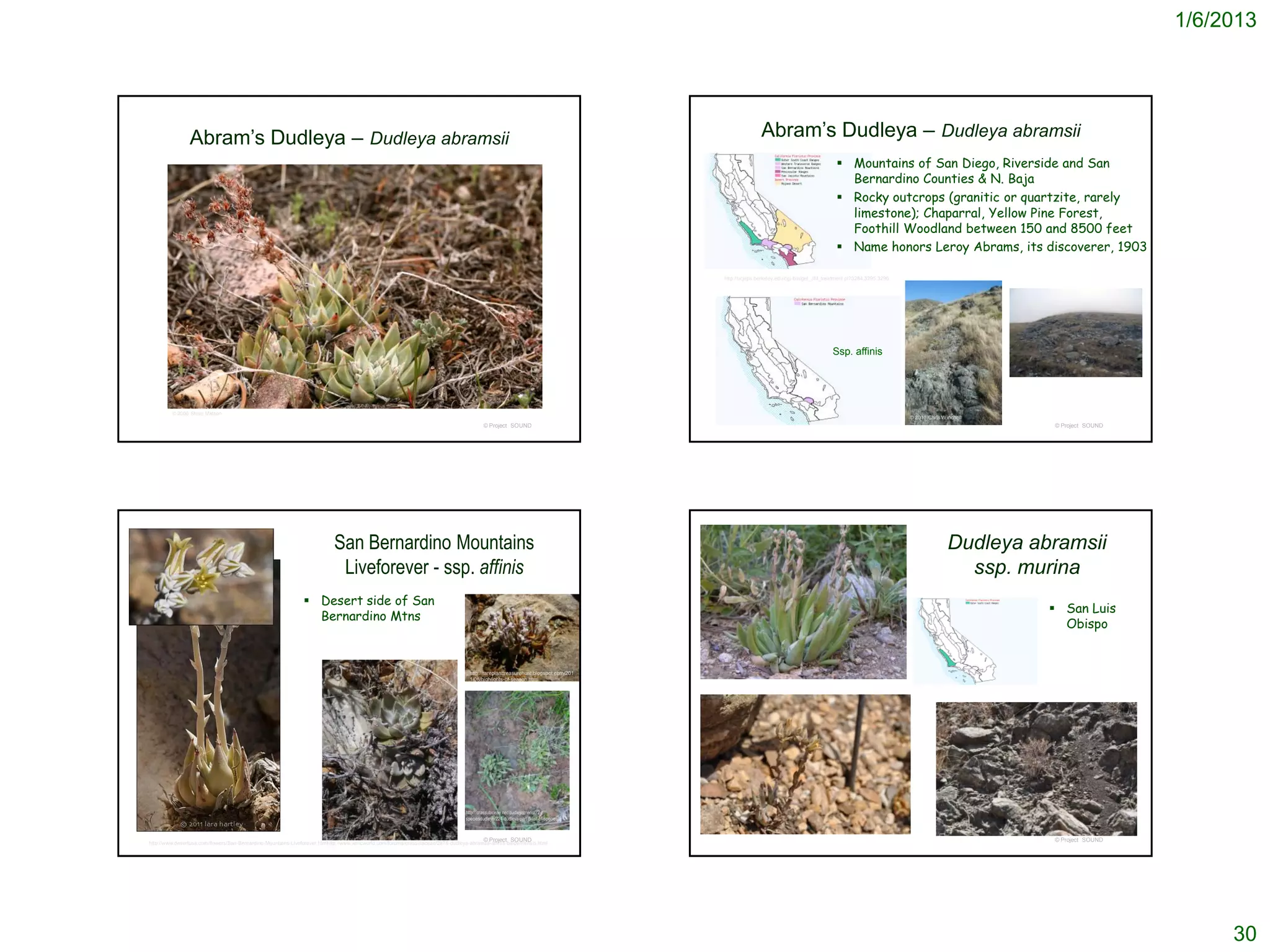
                 Abram’s Dudleya – Dudleya abramsii                                                                                                                                                            Abram’s Dudleya – Dudleya abramsii
                                                                                                                                                                                                                                                Mountains of San Diego, Riverside and San
                                                                                                                                                                                                                                                 Bernardino Counties & N. Baja
                                                                                                                                                                                                                                                Rocky outcrops (granitic or quartzite, rarely
                                                                                                                                                                                                                                                 limestone); Chaparral, Yellow Pine Forest,
                                                                                                                                                                                                                                                 Foothill Woodland between 150 and 8500 feet
                                                                                                                                                                                                                                                Name honors Leroy Abrams, its discoverer, 1903

                                                                                                                                                                                                http://ucjeps.berkeley.edu/cgi-bin/get_JM_treatment.pl?3284,3295,3296


                                                                                                                                                                                                                                              Ssp. affinis


         © 2006 Steve Matson
                                                                                                                                                                                                                                                                         © 2011 Chris Winchell
                                                                                                                                             © Project SOUND                                                                                                                                      © Project SOUND


                                                                             San Bernardino Mountains                                                                                                                                                                                   Dudleya abramsii
                                                                              Liveforever - ssp. affinis                                                                                                                                                                                  ssp. murina
                                                                 Desert side of San
                                                                                                                                                                                                                                                                                                   San Luis
                                                                  Bernardino Mtns
                                                                                                                                                                                                                                                                                                    Obispo


                                                                                                                                                                                        http://crassulaceae.net/dudleyamenu/72-speciesdudleya/224-dudleya-part-5-list-
                                                                                                                                      http://rareplanttreasurehunt.blogspot.com/201     of-species
                                                                                                                                      1/08/highlights-of-season.html


                                                                                                                                    http://crassulaceae.net/dudleyamenu/72-
                                                                                                                                    speciesdudleya/224-dudleya-part-5-list-of-species


                                                                                                                                             © Project SOUND                                                                                                                                      © Project SOUND
http://www.desertusa.com/flowers/San-Bernardino-Mountains-Liveforever.htmlhttp://www.xericworld.com/forums/crassulaceae/2878-dudleya-abramsii-affinis-baldwinensis.html


                                                                                                                                                                                                                                                                                                                         30
1/6/2013


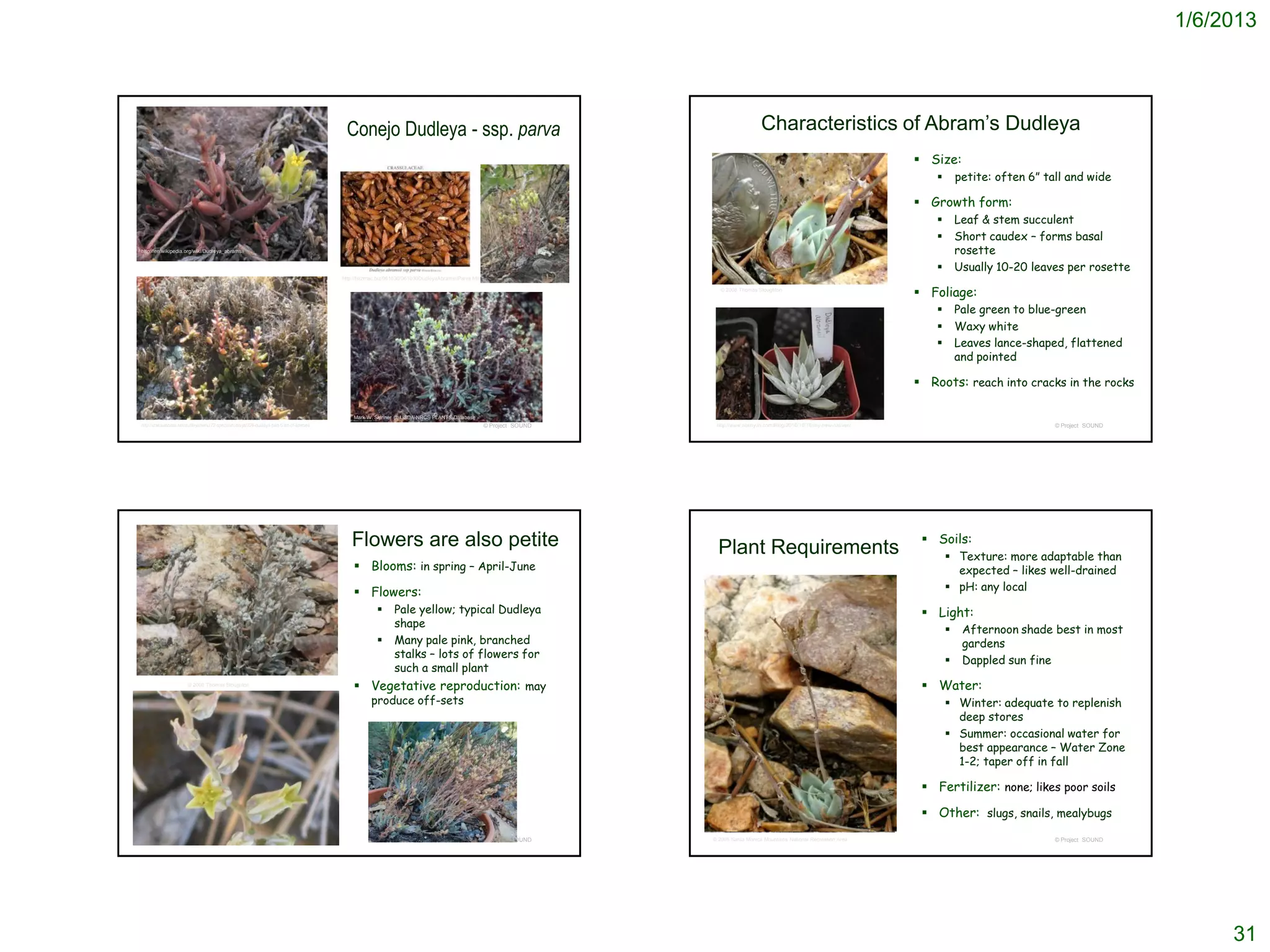
                                                                                            Conejo Dudleya - ssp. parva                                                                    Characteristics of Abram’s Dudleya
                                                                                                                                                                                                                                   Size:
                                                                                                                                                                                                                                             petite: often 6” tall and wide

                                                                                                                                                                                                                                   Growth form:
                                                                                                                                                                                                                                             Leaf & stem succulent
                                                                                                                                                                                                                                             Short caudex – forms basal
http://en.wikipedia.org/wiki/Dudleya_abramsii                                                                                                                                                                                                 rosette
                                                                                                                                                                                                                                             Usually 10-20 leaves per rosette
                                                                                           http://hazmac.biz/061030/061030DudleyaAbramsiiParva.html

                                                                                                                                                                           © 2008 Thomas Stoughton
                                                                                                                                                                                                                                   Foliage:
                                                                                                                                                                                                                                             Pale green to blue-green
                                                                                                                                                                                                                                             Waxy white
                                                                                                                                                                                                                                             Leaves lance-shaped, flattened
                                                                                                                                                                                                                                              and pointed

                                                                                                                                                                                                                                   Roots: reach into cracks in the rocks

                                                                                               Mark W. Skinner @ USDA-NRCS PLANTS Database
http://crassulaceae.net/dudleyamenu/72-speciesdudleya/224-dudleya-part-5-list-of-species                                                              © Project SOUND    http://www.soenyun.com/Blog/2010/10/18/my-new-natives/                                  © Project SOUND


                                                                                              Flowers are also petite                                                                                                               Soils:
                                                                                                                                                                          Plant Requirements                                               Texture: more adaptable than
                                                                                                Blooms: in spring – April-June                                                                                                             expected – likes well-drained
                                                                                                Flowers:                                                                                                                                  pH: any local
                                                                                                              Pale yellow; typical Dudleya                                                                                         Light:
                                                                                                               shape
                                                                                                                                                                                                                                              Afternoon shade best in most
                                                                                                              Many pale pink, branched                                                                                                        gardens
                                                                                                               stalks – lots of flowers for
                                                                                                                                                                                                                                              Dappled sun fine
                                                                                                               such a small plant
                        © 2008 Thomas Stoughton
                                                                                                Vegetative reproduction: may                                                                                                       Water:
                                                                                                      produce off-sets                                                                                                                     Winter: adequate to replenish
                                                                                                                                                                                                                                            deep stores
                                                                                                                                                                                                                                           Summer: occasional water for
                                                                                                                                                                                                                                            best appearance – Water Zone
                                                                                                                                                                                                                                            1-2; taper off in fall

                                                                                                                                                                                                                                    Fertilizer: none; likes poor soils

                                                                                                                                                                                                                                    Other: slugs, snails, mealybugs
                                                                                                                                                      © Project SOUND   © 2005 Santa Monica Mountains National Recreation Area                                   © Project SOUND


                                                                                                                                                                                                                                                                                        31
1/6/2013


                                    Place where you can                                More small-sized Dudleyas from S. CA
                                        appreciate it
                                                                                 Dudleya attenuata ssp. orcuttii      Dudleya cymosa ssp. pumila
                                   As an attractive pot plant
                                   In a rock garden – near the front
                                   On a rocky berm
                                   In a drystone wall
    © 2005 Chris Wagner, SBNF


                                                                                © 2006 Steve Matson
                                                                                                                    © 2006 Steve Matson


                                                                                © 2006 Vince Scheidt
                                      © 2011 Chris Winchell
© 2006 Steve Matson                                           © Project SOUND                                                             © Project SOUND


                                                                                          We hope you’ve gotten some ideas…


                                                                                         Photo: Griselda Sasayama
                                                              © Project SOUND                                                             © Project SOUND


                                                                                                                                                                 32
1/6/2013


                                                Hillsides work well               From lawn to
                                              for cacti & succulents           succulent garden…

                                               Promote plant health by
                                                providing good drainage
                                               Allow the viewer to
                                                see/appreciate each
                                                species
                                               A fire-wise alternative
                                               Decrease challenges of
                                                watering steep slopes

                                                                                                   http://www.indahbulan.com/tantenbaum.html

                                                             © Project SOUND                                                                   © Project SOUND
http://www.casperlandscape.com/22_view.html


                                                                                   We’ve come to the end of our
                                                                                    tour of Delightful Dudleyas


                                                             © Project SOUND                                                                   © Project SOUND


                                                                                                                                                                      33

Dudleyas - Notes

  • 1.
    1/6/2013 Out of theWilds and Into Your Garden Delightful Dudleyas C.M. Vadheim and T. Drake CSUDH & Madrona Marsh Preserve Madrona Marsh Preserve Gardening with Western L.A. County Native Plants March 3 & 6, 2012 Project SOUND – 2012 (our 8th year) © Project SOUND © Project SOUND The Live-forevers: genus Dudleya We already know that California (and Baja California) plants are special…  Named for William Russel Dudley (1849- 1911), first professor of botany and head of the Botany Department at Stanford  Our Mediterranean climate requires that University plants adapt to summer drought.  ~ 40 species; native to the arid western  One common adaptations is succulence. United States (in particular, Southwest/ Modified tissues store large amounts of Northern California and Oregon), Baja water, making the plant part appear California. fleshy, succulent, or swollen.  Very similar in appearance to other  Species in various plant families and Stonecrops (sempervivum; sedum; genera have independently evolved echeveria). succulence as a mechanism for conserving http://commons.wikimedia.org/wiki/File:William_Rus water and survival in arid environments.  Often grow in stone crevasses or sand sell_Dudley_(1849-1911).jpg dunes with little or no organic soil.  There are an estimated 10,000 succulent plant species throughout the world  Long-lived (to 100+ years for some species) hence the common name © Project SOUND © Project SOUND 1
  • 2.
    1/6/2013 The Stonecrop Family: Crassulaceae Crassulacean acid metabolism (CAM)  ~ 1500 species  Most genera exhibit some leaf succulence  Found in 3-4% of plant species;  Many species are used widely as garden and at least 26 angiosperm families house plants Examples:  Nearly all are “succulents”  The genus Crassula includes the well-known Jade (thick, fleshy leaves and Plants and other small sub-shrubs, choice http://www.southampton.bcss.org.uk/images/image145.jpg minatures and mat-forming plants. stems) Echeverias  Cotyledon includes interesting shrubby species  Nearly all are from deserts or with succulent stems and leaves. Some species have showy tubular yellow, orange or red flowers. other hot-summer areas  Echeverias are often used in rock gardens and  Is an extremely important indoor plants. water-conservation strategy  Kalanchoe includes plants with showy flowers. for plants in hot, dry climates  Sedums are well known for hardy mat-forming Stonecrops which provides useful flower color in the garden in late summer and early autumn. Kalanchoe http://www.ubcbotanicalgarden.org/potd/2006/02/sedum_spathulifolium.php © Project SOUND Gases and water vapor enter and exit All plants have the ability to convert plants through stomata carbon dioxide to sugars, using energy from the sun The process of photosythesis © Project SOUND © Project SOUND 2
  • 3.
    1/6/2013 CAM - observations CAM plants like Dudleyas are adapted to hot, dry climates  Stomates - open at night; closed during  Dudleyas only open their stomata at night to take up carbon dioxide. They keep their stomata closed during day (inverted stomatal the hot days, allowing the plant to conserve tremendous cycle) amounts of water  The plant assimilates the carbon dioxide at night and  CO2 uptake – high at converts it to a variety of organic acids. In the night; low during day morning when the stomata close, the organic acids break down and carbon dioxide is released.  Acid content of cells –  With the energy of the new days sun light, the plant converts the carbon dioxide it has been accumulating highest at dawn; lowest all night into sugars. at dusk  Before being permanent CAM photosynthesizers, CAMs were probably started intermittently switching to CAM  Conclusion: CAM plants photosynthesis during times of drought and low store Carbon as an acid rainfall. Eventually those species evolved into species that solely depended on CAM photosynthesis at night © Project SOUND In terms of their garden potential, you can Dudleyas can be used in several ways in think of Dudleyas as belonging to one of the home garden three categories  The Dudleya divas  Often larger in size  Showy (exuberant) flowers  Very attractive foliage  The groundcover Dudleyas  Medium to small size http://davesgarden.com/guides/articles/view/2318/  Readily spread, forming a mat  The ‘Pretty in a Pot’ Dudleyas  Medium to small size  Unique flowers or foliage © Project SOUND © Project SOUND 3
  • 4.
    1/6/2013 Dudleya divas – showy accent plants Chalk Dudleya – Dudleya pulverulenta ssp. pulverulenta http://www.researchlearningcenter.com/bloom/species/Dudleya_pulverulenta.htm http://www.researchlearningcenter.com/bloom/species/Dudleya_pulverulenta.htm © Project SOUND © Project SOUND Chalk Dudleya is very Echeveria-like Chalk Dudleya – Dudleya pulverulenta ssp. pulverulenta  Size:  1-2 ft tall  Coastal regions from  1-2 ft wide (flower stalks wider) San Luis Obispo south into Baja  Growth form:  Evergreen succulent  Locally in Santa Monica  Becomes somewhat dry in Mtns., western San summer Gabriels  Foliage:  Rocky cliffs and  Leaves flat, end in sharp tips canyons below 3000  completely covered with a mealy feet white powder - hence "pulverulenta" or "powdery." http://ucjeps.berkeley.edu/cgi-bin/get_JM_treatment.pl?3284,3295,3327,3329  Coastal sage scrub,  Stem (caudex) becomes chaparral thickened with age – more so than other species http://www.wildflower.org/plants/result.php?id_plant=DUPU © Project SOUND © Project SOUND http://www.anniesannuals.com/plants/plant_display.asp?prodid=1536&account=none 4
  • 5.
    1/6/2013 Taxonomic confusion: is that an Dudleya flowers are slightly different Echeveria or a Dudleya? http://www.collectorscorner.com.au/Cacti/Echeveri a%20main.htm Echeveria Dudleya  Quite similar-looking; but with a few important differences  Dudleya flowers arise from somewhere near the bottom of  Several local species were formerly included in Echeveria: the rosettes normally (rarely from the rosette center as  Canyon Live-forever – Dudleya cymosa most Echeveria flowers do).  Chalk Dudleya – Dudleya pulverulenta  Ladyfinger Dudleya – Dudleya edulis  Dudleyas & Echeverias do not form hybrids between the 2 genera; Dudleyas only interbreed with other Dudleyas © Project SOUND © Project SOUND So…it’s recommended to NOT combine both in But the real difference – and the most important for the same part of the garden gardeners – relates to their history  Summer watering of Dudleyas  Dudleyas should be very occasional: they are  Native to the ‘Pacific Plate’  Adapted to rainy winters & hot, dry very summer ‘water-wise’ compared summers to Echeverias  Winter-growing; summer dormant  Can kill them with too much summer  Most Dudleyas & Echeverias do best in water well-drained soils; gravelly/sandy  Echeverias  The roots of some Dudleya species do Dudleya virens ssp hassei  Native to the ‘North American Plate’ not absorb moisture well in the high  Adapted to rainy summers & dry winters heat; water simply rots the roots  Summer growing; winter dormant  Can kill them with too much winter (susceptible to root rot fungi). water  Treat as Zone 1-2 (water only several times a summer & not at summer’s end) The two genera have been separated for long enough that each is very well adapted to its  Dudleyas in very well-drained soils own environment (sandy) or in pots should be treated as © Project SOUND http://www.smgrowers.com/products/plants/plantdisplay.as Zone 2 © Project SOUND p?plant_id=538 5
  • 6.
    1/6/2013  Dudleyas can also rot from the Give them what crown or leaves, particularly if water is left sitting on the delicate they like… leaves (some are more sensitive than others).  Plant them in/near rocks  Naturally occurring Dudleya virens ssp hassei  Either avoid getting water on the http://www.flickr.com/photos/eastbaywilds/241664905/  Local boulders brought in to leaves, or plant them at an angle so the Dudleya pulverulenta add interest water runs off.  Plant them on slopes – or  In nature, many species grow naturally plant the rosette at an angle on cliff faces and steep slopes so rather than horizontal water cannot sit on these plants.  Water only occasionally  Excess water also attracts snails and during summer – Zone 1-2 slugs – which love Dudleyas about right http://www.smgrowers.com/products/plants/plantdisplay.as p?plant_id=538  No overhead water in summer Bottom line: best to not combine Dudleyas with succulents that have http://www.flickr.com/photos/93452909@N00/191287029/ very different water requirements (Echeverias; Sedums; etc.) SOUND © Project D. virens ssp. hassei © Project SOUND Flowers are like no Be creative with rocks others: dramatic! & Dudleyas  Blooms: spring/early summer; typical for  Sometimes man-made stone Dudleyas structures are perfect places  Flowers: for Dudleyas  On long flowering stalks – plan accordingly http://farm4.static.flickr.com/3003/2606066487_0aaaf1ed09.jpg?v=0 http://img4.sunset.com/i/2009/04/dream-gardens-stone-seat-l.jpg  Note hummingbird-plant features:  Red color;  Shape;  Flowers held away from plant to allow access  Heavy duty, sweet nectar http://www.laspilitas.com/garden/Anna%27s_Hummingbird_on_chalk_dudlea.jpg http://www.marrsandersen.com/California-plants/California- http://www.timetotrack.com/jay/dudleyc5.htm © Project SOUND plants-Pages/Image28.html © Project SOUND http://www.flickr.com/photos/eastbaywilds/241665013/in/photostream/ 6
  • 7.
    1/6/2013 * Silver Dollar Plant - Dudleya brittonii Silver Dollar Plant - Dudleya brittonii  Native coastal areas of the Pacific side of Baja California between Tijuana & Ensenada and on Isla Todos Santos  On cliffs and hilly areas in lava rock and other very porous soils. http://home.comcast.net/~ldecola/baja/ http://www.yerbabuenanursery.com/viewplant.php?pid=1509 © Project SOUND http://www.yacht-transport.com/page/autumn2009/Oregon.html © Project SOUND Silver Dollar Dudleya – Nathaniel Lord Britton a larger dudleya  Size:  1+ ft tall  the specific epithet honors  1-2 ft wide Nathaniel Lord Britton (1859-1934), botanist and http://www.bambooandmore.info/2011_10_02_archive.html  Growth form: first Director of the New  Basal rosette – stem (caudex) is very http://www.baynatives.com/plants/Dudleya-brittonii/ York Botanical Garden. Dr. short, so leaves are bunched up Britton is also famous for  40 to 100 leaves, each up to 10 his collaboration with inches long Joseph Nelson Rose of the  Often solitary – not spreading Carnegie Institute on The Moderate lifespan – 30+ years http://www.nceas.ucsb.edu/~alroy/lef a/Britton.html  Cactaceae, a four-volume work started in 1906 and  Foliage: published in 1924.  Green or (more commonly in trade) very blue-white  Leaves flattened http://sabrinacampagna.tumblr.com/post/2675832454/the-cactaceae-vol-4-descriptions-and © Project SOUND © Project SOUND http://www.soenyun.com/Blog/2010/10/18/my-new-natives/ 7
  • 8.
    1/6/2013 Why are some Dudleyas so white? Flowers are fantastic  Why?  Blooms: in spring – usually Apr-June in our area  Protection against sun damage  Water conservation  Flowers:  Pale yellow  How?  Stout flowering stem and  Leaves are covered with a dusty, bracts are pastel pink http://www.arthurleej.com/p-o-m-Jan11.html chalky, mealy white epicuticular (worthy of a diva); beautiful “wax”. contrast with foliage  The wax in its mealy state on the  Attract hummingbirds leaves is attracted to water and coats drops on the leaves and  Seeds: prevents their evaporation.  Dry capsules split open when seeds are ripe  The wax has the highest  Seeds are tiny, many measured ultraviolet reflectivity of any plant. http://www.xericworld.com/forums/members/kelly-griffin-albums-dudleya-picture1145-dudleya- http://image54.webshots.com/154/5/90/28/539959028nsjBLY_fs.jpg brittonii-la-mission.html © Project SOUND © Project SOUND http://www.succulent-plant.com/families/crassulaceae/dudleya.html  Soils: Give the diva a proper stage! Plant Requirements  Texture: well-drained  pH: any local  In a Baja-themed garden, with it’s natural associates  Light:  Afternoon shade  In a rock or gravel garden –  Dappled shade be sure to consider contrasts  Water:  Often grown as a specimen  Winter: needs normal amount plant in a large container  Summer: best with http://www.flickriver.com/photos/amarguy/3949915856/ infrequent summer water – Zone 1-2; no overhead water  Fertilizer: none; likes poor soils  Other: http://www.scientificlib.com/en/Biology/Plants/Magnoliophyta/DudleyaBrittonii01.html  tolerates garden conditions better than the similar looking Dudleya pulverulenta http://www.hotgardens.net/cactus%20and%20succulents%20at%20huntington%20desert%20ga © Project SOUND rden.htm © Project SOUND http://www.faroutflora.com/2011/01/08/dudleyas-dudleyas-dudleyas/ 8
  • 9.
    1/6/2013 Use contrast to show divas in their best light Designing with diva dudleyas http://www.plantscomprehensive.com/dudleya-brittonii http://www.southcoastbotanicgarden.org/node/368 http://picasaweb.google.com/lh/photo/gXhU4_V-Hhg78Lwpg9OOZQ  Accent plants whether alone or interplanted http://picasaweb.google.com/lh/photo/iiUK9e2RW16pM8msvsmB4g © Project SOUND © Project SOUND http://www.hotgardens.net/succulent_cactus_gallery.htm Many Dudleyas are long-lived Dudleya ‘Palos Verdes’ – a lucky accident  Probably hybrid : D. pulverulenta X D. brittonii  Good characteristics of both parents http://www.smgrowers.com/products/plants/plantdisplay.asp?plant_id=3232 http://www.flickr.com/photos/morabeza79/favorites/page38/?view=lg © Project SOUND © Project SOUND 9
  • 10.
    1/6/2013 * Canyon Dudleya – Dudleya cymosa * Canyon Dudleya – Dudleya cymosa  Dudleya cymosa ssp. ovatifolia = Santa Monica Mountains Dudleya Dudleya cymosa ssp. ovatifolia (threatened species)  Dudleya cymosa ssp. marcescens also endemic to SMM (endangered) http://ucjeps.berkeley.edu/cgi-bin/get_JM_treatment.pl?3284,3295,3310 http://www.calfloranursery.com/pages_plants/pages_d/dudcym.html © Project SOUND © Project SOUND http://www.xericworld.com/forums/crassulaceae/2906-dudleya-cymosa.html Many Dudleyas have small or threatened Canyon Dudleya: a diva, yes, but smaller distribution: some are very rare  Size:  < 1 ft tall (6-8” commonly)  < 1 ft wide  Growth form: Dudleya greenii – a Channel  Basal rosette; Echeveria-like Islands endemic habit  Foliage:  Leaves light green to blue- green; waxy  Shape varies with sub-species;  Like many California native plants, dudleyas are now considered flat and spoon-shaped to rare, threatened or endangered, depending on the species. All are protected by law, making it illegal to remove any plants from their lance-shaped. natural habitat.  Leaves cup/hold water  More are coming into cultivation – but many still are not available http://en.wikipedia.org/wiki/File:Dudleya_cymosa_1.jpg © Project SOUND © Project SOUND http://www.flickr.com/photos/33818785@N00/2594840898/ 10
  • 11.
    1/6/2013 ssp. marescens ssp. ovatifolia  Endemic to Santa Monica Mtns  Occur on sedimentary  Grows on shaded, rocky slopes and volcanic rocks of  Rare the western Santa  Flowers yellow, sometimes w/ pink Monica Mountains bracts  Also occurs in a few http://www.researchlearningcenter.com/bloom/species/Dudleya_cymosa_marcescens.htm Grows on shaded, rocky slopes isolated occurrences in the Santa Ana Mountains of Orange Co.  Rare  Flowers bright yellow with pink stalk http://jay.timetotrack.com/dudlym3.htm © Project SOUND © Project SOUND http://www.callutheran.edu/wf/chap/family/bjc-1781.htm ssp. pumila Flowers are showy  CA endemic  Blooms: in spring – usually Apr-  San Gabriel Mtns; also May in western L.A. Co. found in Kern, Mojave and as far north as  Flowers: Monterey.  Flowers on relatively short ( ~ Ssp. pumila 1 ft) flowering stalks that may  On Rocky outcrops, http://www.calfloranursery.com/pages_plants/pages_d/dudcym.html be more simple or many slopes, talus branched (ssp. pumila); arise among older leaves (base of  Flowers yellow with rosette) conspicuous pink bracts  Flowers usually yellow but may be pink; bracts and stems  Likely the one usually pink to orange-pink; available in the trade, often showy as it is the most showy http://www.cnps-sgm.org/gallery/G-Dudleya.html © Project SOUND © Project SOUND http://www.flickr.com/photos/33818785@N00/2594840898/ http://www.siskiyourareplantnursery.com/index.asp?PageAction=VIEWPROD&ProdID=200 11
  • 12.
    1/6/2013  Soils: Showcase a Diva Excellent drainage  Texture: well-drained; sandy or rocky best  Makes an attractive pot plant;  pH: any local neat rosette & showy flowers  Light:  Recommended for rock crevices  Afternoon shade is best; will look or growing out of the base of best and survive better even in hot boulders in the rock garden inland gardens  Full sun only on immediate coast  Pair with local ferns, Monkeyflowers, Nightshades http://www.wildgingerfarm.com/Dudleya.htm  Water:  Winter: adequate; supplement in dry years  Summer: best with occasional (once a month) summer water – Water Zone 1-2 http://www.flickr.com/photos/33818785@N00/2594841114/  Fertilizer: none; likes poor soils. ¼ strength fertilizer in spring for Use a rock mulch, like container plants Mother Nature does © Project SOUND http://www.yerbabuenanursery.com/viewplant.php?pid=0284 http://stevewolf.smugmug.com/keyword/crassulaceae/1/1264431629_VzWnxbD#!i=1264431629 &k=VzWnxbD © Project SOUND http://www.wrightmanalpines.com/plant/dudleya-cymosa Be creative – Canyon Dudleya is a versatile addition to the garden http://www.cyndyandjohn.com/Holiday%20Letter%202004.htm http://www.merchantcircle.com/business/Earth.Transformations.303-554-1352/picture/view/1707601 http://www.laspilitas.com/stores/escondido Penstemon heterophyllus, Dudleya cymosa, Mock Heather, and Sulfur Buckwheat seem to do fine in hard, compacted soils http://designerblog.blogspot.com/2008_07_01_archive.html © Project SOUND http://gardeninginaustin.blogspot.com/2012/01/project-front-flower-bed.html © Project SOUND 12
  • 13.
    1/6/2013 Many-stemmed Dudleya – Dudleya multicaulis Many-stemmed Dudleya – Dudleya multicaulis  Los Angeles Co. to western San Bernardino, Riverside, Orange and San Diego Cos.  Most of its known occurrences are in Orange County, where it lives mostly along the coastal plain in heavy clay soils.  In dry, stony places below 2000 ft. in San Diegan Coastal Sage scrub, Valley Grassland & chaparral. © 2002 BonTerra Consulting © Project SOUND © Project SOUND Dudleya multicaulis is somewhat unusual Flowers: almost bulb-like  Blooms: in spring - usually  Size: in April-June  < 1 ft tall & wide  Flowers:  Growth form:  dominated by its erect  Stem/upper root corm-like stems, which are topped (underground vertical with a branching stem); dies back in dry inflorescence bearing up to season 15 flowers on each long, thin  In wild is not readily branch. identifiable except during  The flowers have pointed the late spring and early yellow petals up to a summer when succulent centimeter long, and long leaves and flowers may be stamens. observed.  Flowers age to red  Foliage:  Seeds: many, small in dry  Leaves few, finger-like, capsule that splits open blue-green with pink blush © Project SOUND © 2010 Andrew Borcher © Project SOUND http://www.calflora.net/bloomingplants/manystemmeddudleya.html http://nathistoc.bio.uci.edu/plants/Crassulaceae/Dudleya%20multicaulis.htm 13
  • 14.
    1/6/2013 Plant Requirements  Soils: Bulb-like Diva  Texture: well-drained; rocky Dudleya multicaulis best  Grow where its small size will  pH: any local be appreciated:  Light:  Rock walls  Afternoon shade or dappled  Rock gardens sun  Containers  Can also take full sun – dies  Works well in local native back in summer bulb/fern garden  Water:  Winter: adequate moisture  Summer: dry to occasional water – Water Zones 1 or 1-2; let dry out after blooming like a bulb  Fertilizer: none; likes poor soils © 2003 Kristin Szabo  Other: inorganic mulch shown with Isocoma menziesii, Hemizonia © Project SOUND fasciculata © Project SOUND http://nathistoc.bio.uci.edu/plants/Crassulaceae/Dudleya%20multicaulis.htm http://nathistoc.bio.uci.edu/plants/Crassulaceae/Dudleya%20multicaulis.htm San Gabriel Mtns. Dudleya – Dudleya densiflora © Project SOUND © Project SOUND http://drystonegarden.com/index.php/2009/01/cabernet-stone-terracing/ 14
  • 15.
    1/6/2013 *Powdery Live-forever – Dudleya farinosa *Powdery Live-forever – Dudleya farinosa  Most common along coast from San Francisco and north for about 800 miles to Oregon and some miles up its coast.  Typical coastal species – low-growing with very showy flowers http://ucjeps.berkeley.edu/cgi-bin/get_JM_treatment.pl?3284,3295,3320 © Br. Alfred Brousseau, Saint Mary's College © Project SOUND © Project SOUND Powdery Dudleya: a Dudleya groundcovers – the spreading diva spreaders  Super succulent to fill a pot or rock crevice  Can also be used as a succulent groundcover http://www.infojardin.com/foro/showthread.php?t=36822 Gerald and Buff Corsi © California Academy of Sciences http://www.faroutflora.com/2011/01/08/dudleyas-dudleyas-dudleyas/ © 2002 Brad Kelley © Project SOUND © Project SOUND 15
  • 16.
    1/6/2013 Many Dudleyas work well in planters Dudleyas are so versatile : formal or informal http://drystonegarden.com/index.php/2009/01/cabernet-stone-terracing/ http://kristamaxwell.com/garden/photos2.html  Dudleyas with strict rosettes look quite formal © Project SOUND http://www.ecosalon.com/wp-content/uploads/2009/04/more-showcase-2009-023-341x455.jpg © Project SOUND Dudleya Bright Green Dudleya – Dudleya virens ssp hassei Groundcovers  Dudleya farinosa  Dudleya virens http://marvistagreengardenshowcase.blogspot.com/2012/02/3041-midvale-avenue.html  Dudleya edulis  Dudleya anomala  Dudleya viscida  Dudleya caespitosa http://marvistagreengardenshowcase.blogspot.com/2012/02/12806-stanwood-drive.html © Project SOUND © Project SOUND 16
  • 17.
    1/6/2013 Bright Green Dudleya – Dudleya virens ssp insularis Bright Green Dudleya – Dudleya virens  Two local subspecies:  ssp. hassei – Catalina  ssp. insularis – Palos Verdes, S. Channel Islands  On steep slopes in chaparral, coastal bluff scrub, and coastal sage scrub habitats below 1000 ft. http://ucjeps.berkeley.edu/cgi-bin/get_JM_treatment.pl?Dudleya+virens © Project SOUND © Project SOUND Characteristics of ssp. hassei Dudleya virens ssp. hasseii  Size:  < 6 in. tall  1-2 ft wide  Growth form:  Spreading clump of succulent rosettes  Evergreen; dries in http://www.faroutflora.com/2011/01/08/dudleyas-dudleyas-dudleyas/ summer http://crassulaceae.net/dudleyamenu/72-speciesdudleya/224- dudleya-part-5-list-of-species  Foliage:  Succulent, cylindrical leaves  Color: blue-green to more yellow-green  Flowers: pale yellow on pale pink stalk © Project SOUND © Project SOUND http://commons.wikimedia.org/wiki/Dudleya_virens 17
  • 18.
    1/6/2013 Characteristics of ssp. insularis Dudleya virens  Size: a bit bigger ssp. insularis  ~ 1 ft tall  1-2+ ft wide  Growth form:  Spreading clump of succulent rosettes  Evergreen; dries in summer  Foliage:  Succulent, cylindrical leaves  Color: blue-green to more yellow-green; usually more glaucus (white farina) than ssp. hassei  Flowers: pale pink-yellow on http://crassulaceae.net/dudleyamenu/72-speciesdudleya/224- brighter pink stalk dudleya-part-5-list-of-species © 2003 BonTerra Consulting © Project SOUND © Project SOUND Plant Requirements  Soils: Groundcover Dudleyas  Texture: best in light, well- for Dudleya virens drained soil, but can succeed in in the garden many gardens  pH: any local  Attractive pot plants  Light:  Full sun only in coastal area  Good for succulent  Light shade (afternoon shade) in ground-covers (best in hotter inland gardens; needs small areas; smaller enough sun for good color, shape varieties (spp. hassei) http://www.smgrowers.com/products/plants/plantdisplay.asp?plant_id=2987  Water: work best)  Winter: needs good winter rains  Summer: keep fairly dry – Zone  Excellent choice for rock 1-2 best gardens, dry-stone walls,  Fertilizer: likes poor soils; can retaining walls lightly fertilize (1/5 strength) in winter (esp. in pots)  On hillsides, slopes © 2005 BonTerra Consulting © Project SOUND © Project SOUND 18
  • 19.
    1/6/2013 Keeping Dudleyas healthy: summary *Ladyfinger Live-forever – Dudleya edulis  Plant in well-drained soils, at an angle  Water properly; depends on soils  Promote good air circulation  Don’t stress the plants: heat, cold  Prevent & treat common problems:  Aphids & Mealy bugs: prevent Argentine ants from introducing mealybugs or aphids to your dudleyas - Mealybugs particularly attack roots  Snails & slugs: don’t over-water; remove  Rabbits & deer: exclude from garden area  For greatest success in cultivation, choose species from your local area. © 2000 Salvatore Zimmitti © Project SOUND © Project SOUND *Ladyfinger Live-forever – Dudleya edulis Ladyfinger Dudleya: small and upright  Orange, Riverside and San Diego Counties south to Baja  Size:  to 1 ft tall  Rocky/sandy slopes, hillsides, ledges  1+ ft wide below 4000’  coastal sage scrub, chaparral  Growth form:  Evergreen succulent http://ucjeps.berkeley.edu/cgi-bin/get_JM_treatment.pl?3284,3295,3319  edulis : edible  Spreads by forming new rosettes; may become mat- like in right setting  Foliage:  Blue-green to light green with white cast; may be pink tinged  Leaves finger-like, upright © 2009 Aaron Schusteff http://www.miriameaglemon.com/photogallery/Plants.htm © Project SOUND © Project SOUND http://www.kenbowles.net/sdwildflowers/FamilyIndexes/Crassulaceae/FotoIndex.htm http://www.plantscomprehensive.com/sandiegonatives-blog 19
  • 20.
    1/6/2013 Lady-fingers stars in pots or as Ladyfinger flowers are a ground cover delicate & pretty  Nice in a large pot – fills the pot or plant with other species; place it where you can enjoy the flowers  Flowers:  Great groundcover on slopes or in  Pale color- range from small areas; will fill in around rocks © 2005 Jasmine J. Watts white to light yellow or light peach http://www.flickr.com/photos/eastbaywilds/3526601427/  You can even use it as a house plant  Open star shape – quaint appearing  Showy red or orange anthers – really distinctive http://www.kenbowles.net/sdwildflowers/FamilyIndexes/Crassulaceae/FotoIndex.htm © Project SOUND © Project SOUND http://www.kenbowles.net/sdwildflowers/FamilyIndexes/Crassulaceae/FotoIndex.htm Garden hardy - even inland Maintaining Dudleyas: fairly easy  No pruning is necessary, although dudleya will benefit from a beheading (stem cutting) if the plant becomes old or tall and spindly.  You may want to remove any leaves which have died. This will help to avoid rot and bugs.  Avoid touching the healthy leaves - your body oils will leave marks or remove farina. © Project SOUND © Project SOUND 20
  • 21.
    1/6/2013 Sticky Dudleya – Dudleya viscida Sticky Dudleya – Dudleya viscida  Southern coastal S. CA – primarily Orange & San Diego Co.  Rocky bluffs and hillsides in CSS and Chaparral – often a literal ‘cliff-hanger’  Rare/threatened in the wild – CNPS 1B.2 http://ucjeps.berkeley.edu/cgi-bin/get_JM_treatment.pl?3284,3295,3339 © 2002 Dean Wm. Taylor http://crassulaceae.net/dudleyamenu/72-speciesdudleya/224-dudleya-part-5-list-of-species © Project SOUND © Project SOUND © Roxanne Bittman and CNPS Sticky Dudleya – Flowers are pink!!! slowly spreading  Size:  Blooms: in spring - usually April- May in our area  1 ft tall (flower stalks taller)  1-2 ft wide – spreads slightly  Flowers:  Pale pink (nearly white) to  Growth form: medium pink with darker pink  Starts as rather dense basal rosette http://www.soenyun.com/Blog/2010/10/18/my-new-natives/ stripes – caudex short  Small size – like all Dudleyas  Succulent – frost sensitive  Flowering stem is much-  Foliage: divided – so many more flowers than most Dudleyas –  Bright green to red-tipped or yellow literally ‘covered with green – depends on heat, sun, flowers’ drought  Cylindrical, upright leaves – pointed  Seeds: tiny; birds will eat tips  Sticky with slightly resinous exudate  Vegetative reproduction: – more so in hot-dry – unusual for © 2006 Jasmine J. Watts naturally produces offsets (pups) http://davesgarden.com/guides/articles/view/2318/ Dudleya © Project SOUND © 2009 Robert Steers © Project SOUND 21
  • 22.
    1/6/2013 Plant Requirements  Soils:  Texture: well-drained rocky soils are best – but more adaptable than most  pH: any local  Light:  Full sun to part-shade  Water: http://commons.wikimedia.org/wiki/Dudleya_viscida http://crassulaceae.net/dudleyamenu/72-speciesdudleya/224-dudleya-part-5-list-  Winter: needs good drainage  Summer: best with occasional of-species summer water – Water Zone 1- 2; very drought tolerant but won’t look as nice  Fertilizer: none; likes poor soils  Other:  Use an inorganic mulch  Cut old flower stalks in fall © Project SOUND © Project SOUND © 2009 Robert Steers Good for slopes & walls Dudleya Garden - Santa Barbara Botanic Garden  On dry slopes A fairly informal garden  As an attractive pot plant – a real beauty in bloom  In a rock garden  In a dry-stone wall  Along a sidewalk or block wall © 2009 Robert Steers http://www.gardentourist.org/Santa_Barbara_Botanic_Garden/Santa_Barbara_Botanic_Garden.html http://www.xericworld.com/forums/members/sarmis-luters-albums-dudleyas-santa- http://crassulaceae.net/dudleyamenu/72-speciesdudleya/224-dudleya-part-5-list-of-species © Project SOUND barbara-botanical-garden-picture4779-sticky-live-forever-dudleya-viscida-july-2- © Project SOUND © 2009 Robert Steers 2011.html http://www.gardentourist.org/Santa_Barbara_Botanic_Garden/Santa_Barbara_Botanic_Garden. html 22
  • 23.
    1/6/2013 * No Name Dudleya – Dudleya anomala * No Name Dudleya – Dudleya anomala  Range: Baja Norte, Mexico on Coronado and Todos los Santos Islands (off coast near Ensanada), and rarely at Pico Banda  Always growing on north facing cliffs © Project SOUND © Project SOUND Garden uses for No Sea Lettuce – Dudleya caespitosa Name Dudleya  Nice smaller groundcover Dudleya – especialy in bright shade to afternoon shade  As an attractive pot plant © Project SOUND © Project SOUND http://davesgarden.com/guides/pf/showimage/330302/ 23
  • 24.
    1/6/2013 Sea Lettuce – Dudleya caespitosa Characteristics of Dudleya caespitosa  Size: medium  Coastal California, from Monterrey  ~ 1 ft tall county to Los Angeles county – locally  ~ 1 ft wide at Point Mugu, N. Santa Monica Mtns  Growth form:  Commonly found on coastal bluffs  Slightly different in N & S  AKA ‘Sand Lettuce’ part of range  N coast – echeveria-like http://ucjeps.berkeley.edu/cgi-bin/get_JM_treatment.pl?3284,3295,3307  S coast – more sparse, more finger-like leaves  Spreading - groundcover  Foliage:  Pale green to blue-green; sometimes pinkish tipped  Nice looking with just a little water © 2006 Steven Thorsted Point Mugu Ft. Funston bluffs http://www.desert-tropicals.com/Plants/Crassulaceae/Dudleya_caespitosa.html © Project SOUND © Project SOUND http://www.faroutflora.com/2010/04/27/im-a-dudleya-dork/ http://www.researchlearningcenter.com/bloom/species/Dudleya_caespitosa.htm Flowers: yellow with pink Coastal plant: coastal  Soils: accents requirements  Texture: well-drained – rocky or sandy best  pH: any local – 6.00-8.00  Blooms: in spring – usually Mar-May in our area  Light:  Full sun to light shade along  Flowers: coast  On rather slender, branching  Afternoon shade in most http://www.researchlearningcenter.com/bloom/species/Dudleya_caespitosa.htm pink stalks - wand-like gardens  Flowers bright yellow – flower bracts may be orange or even  Water: pink  Winter: adequate moisture  Lovely massed ; and  Summer: best with a little hummingbirds will love this summer water – Zone 1-2 (even groundcover! 2 in sandy soils); don’t let water sit on leaves  Vegetative reproduction:  Readily forms offsets (pups)  Fertilizer: none; likes poor soils http://commons.wikimedia.org/wiki/Dudleya_caespitosa  Other: inorganic mulch © Project SOUND © Project SOUND http://commons.wikimedia.org/wiki/Dudleya_caespitosa http://www.laspilitas.com/nature-of-california/plants/dudleya-caespitosa 24
  • 25.
    1/6/2013 Dudleya caespitosa Dudleya ?caespitosa hybrid 'Frank Reinelt'  A versatile Dudleya that  Beautiful native succulent can be used in many with silver leaves that blush attractive ways in the rose-purple with winter garden chill. Point Lobos http://geogdata.csun.edu/~voltaire/ann/plant/pointlobos.html  form dense mounds 6 - 8 inches tall  Recommended in rock gardens and as groundcover esp. on slopes w/ other N CA species. Great in http://www.calfloranursery.com/plants/dudleya-frank-reinelt containers! http://www.theodorepayne.org/mediawiki/index.php?title=Dudleya_'Frank_Reinelt'&printable=yes  Sometimes mistakenly sold as Dudleya 'Anacapa' in the nursery trade. http://www.flickr.com/photos/exuberance/3251771669/ http://www.anniesannuals.com/plt_lst/lists/general/lst.gen.asp?prodid=3942 © Project SOUND © Project SOUND Smaller Dudleyas – the container species Container gardens – allow you to provide just the right conditions http://slosson.ucdavis.edu/documents/2005-200610656.pdf © Project SOUND © Project SOUND http://slosson.ucdavis.edu/documents/2005-200610656.pdf 25
  • 26.
    1/6/2013 Containers also allow you to design with plants and Designing with succulents: use shape & containers, creating unique garden accents color contrasts to create interest http://marvistagreengardenshowcase.blogspot.com/2011/02/3922-albright-avenue.html Dudleya pulverulenta (l) & D. edulis (r) http://www.flickr.com/photos/72544341@N00/2310150657 http://www.flickriver.com/photos/eastbaywilds/sets/72157594276050096/ © Project SOUND © Project SOUND Containers, plants & mulch should complement Lance-leaf Dudleya (Live-forever) – Dudleya lanceolata Native succulents Dudleya pulverulenta (chalk dudleya) Dudleya edulis (San Diego dudleya) and a small Sedum spathulifolium (stonecrop) http://www.timetotrack.com/jay/dudleyl2.htm http://lasmmcnps.org/images/Dudleya%20pulverulenta%202.JPG © Project SOUND © Project SOUND 26
  • 27.
    1/6/2013 Lance-leaf Dudleya (Live-forever) – Lance-leaf Dudleya Dudleya lanceolata Dudleya lanceolata  Santa Barbara and Kern Cos.  Local mountain ranges to northern Baja including both coastal &  Local mountain ranges desert ranges; also Palos including both coastal & Verdes peninsula desert ranges; also Palos Verdes peninsula  Interesting foliage color  common on dry and rocky & shape slopes to 3500' in coastal  Flowers very showy – hot sage scrub and chaparral pink  Most often on less harsh and moister north-facing slopes http://kristamaxwell.com/garden/photos2.html http://www.calflora.net/bloomingplants/lanceleafdudleya.html http://ucjeps.berkeley.edu/cgi-bin/get_JM_treatment.pl?3284,3295,3323 © Project SOUND © Project SOUND Palmer’s Live-forever – Dudleya palmeri Palmer’s Live-forever – Dudleya palmeri  Endemic to the central & s. coast from Monterey to Los Angeles Co. – locally in Santa Monica Mtns.  Coastal areas in natural rock gardens, rock crevices, slopes, hillsides under 500 ft elevation http://ucjeps.berkeley.edu/cgi-bin/get_JM_treatment.pl?3284,3295,3326 http://www.researchlearningcenter.com/bloom/species/Dudleya_palmeri.htm Gary A. Monroe @ USDA-NRCS PLANTS Database © Project SOUND © 2004 Brent Miller © Project SOUND 27
  • 28.
    1/6/2013 Characteristics of Palmer’s Palmer’s flowers are bright & showy  Size: moderate  Blooms: in spring usually  1 ft tall March/April/May in western L.A.  1 ft wide County  Growth form:  Flowers: Basal rosette typical of © 2004 Brent Miller   One a stout pink flowering stalk Dudleya like a candelabra – at least 12”  15-25 leaves above the rosette  Foliage:  Flowers yellow/yellow-orange; bracts are hot pink – really  Medium to blue-green bright and showy (to attract  Leaves flat, broad, lance- hummingbirds) shaped  Leaves can be short or quite  Seeds: http://commons.wikimedia.org/wiki/Dudleya_palmeri long depending on light &  Many, small in dry capsule other conditions  Birds eat them © Project SOUND http://commons.wikimedia.org/wiki/Dudleya_palmeri © Project SOUND Plant Requirements:  Soils: Garden uses for Palmer’s Dudleya Palmers Dudleya  Texture: well-drained  As an attractive container plant –  pH: any local alone or with other dudleyas  Light:  In a rock garden or rocky berm  Afternoon shade/dappled  In drystone wall and pervious retaining shade walls  In nature, usually on east- facing slopes, canyon walls  East-facing slopes with CA fuschia & local native ferns  Water:  Winter: adequate; supplement if needed  Summer: infrequent (Water Zone 1-2); keep leaves dry  Fertilizer: none; likes poor soils; pots need ¼ strength in spring http://davesgarden.com/guides/articles/view/2318/ http://www.researchlearningcenter.com/bloom/species/Dudleya_palmeri.htm  Other: inorganic mulch (if any) – follow Mother Nature’s cues http://www.researchlearningcenter.com/bloom/species/Dudleya_palmeri.htm © Project SOUND © Project SOUND 28
  • 29.
    1/6/2013 Growing Dudleyas in containers Other considerations for growing Dudleyas  Dudleyas grow well in pots and  Bright light is integral to the proper make excellent outdoor growth of this genus. specimens in Mediterranean  Plants grown in low-light will lose their climates. color, grow tall and spindly and will eventually die.  Potting soil should be very well- draining; amend potting soils with  Most Dudleyas make poor houseplants sharp sand and pumice to insure good drainage.  Most Dudleyas do best with moderate temperatures - protect from  Watering: treat as Zone 2; blistering afternoon heat, frosts monitor carefully in hot weather (particularly if in pots)  Light: afternoon shade or bright  Potting soil should be very well- shade best draining; use a cactus mix or amend Dudleya farinosa  Propagation: easiest by removing available soils with sharp sand and rooted offsets (pups), but can be pumice to insure good drainage. from seed © Project SOUND © Project SOUND Dudleya ‘Bright Sprite’ Dudleya gnoma [D. greenei] - ‘White Sprite’  1 ft x 1 ft  Pale, pastel foliage and flowers  Sun to part-shade  Native to  Occasional water Santa Rosa  Beautiful in rock gardens or Island – rare containers. Excellent mass planted in nature or as an accent against darker http://www.theodorepayne.org/mediawiki/index.php?title=Dudleya_'Bright_Sprite' foliage such as Ceanothus  Small and charming – http://crassulaceae.net/dudleyamenu/94-photos/538- dudleya-gnoma-white-sprite-photos very white  Readily available http://www.desert- tropicals.com/Plants/Crassulaceae/Dudleya_gno ma.html http://photobucket.com/images/Dudleya+'Bright+Sprite'/ © Project SOUND http://www.yerbabuenanursery.com/viewplant.php?pid=1531 © Project SOUND 29
  • 30.
    1/6/2013 Abram’s Dudleya – Dudleya abramsii Abram’s Dudleya – Dudleya abramsii  Mountains of San Diego, Riverside and San Bernardino Counties & N. Baja  Rocky outcrops (granitic or quartzite, rarely limestone); Chaparral, Yellow Pine Forest, Foothill Woodland between 150 and 8500 feet  Name honors Leroy Abrams, its discoverer, 1903 http://ucjeps.berkeley.edu/cgi-bin/get_JM_treatment.pl?3284,3295,3296 Ssp. affinis © 2006 Steve Matson © 2011 Chris Winchell © Project SOUND © Project SOUND San Bernardino Mountains Dudleya abramsii Liveforever - ssp. affinis ssp. murina  Desert side of San  San Luis Bernardino Mtns Obispo http://crassulaceae.net/dudleyamenu/72-speciesdudleya/224-dudleya-part-5-list- http://rareplanttreasurehunt.blogspot.com/201 of-species 1/08/highlights-of-season.html http://crassulaceae.net/dudleyamenu/72- speciesdudleya/224-dudleya-part-5-list-of-species © Project SOUND © Project SOUND http://www.desertusa.com/flowers/San-Bernardino-Mountains-Liveforever.htmlhttp://www.xericworld.com/forums/crassulaceae/2878-dudleya-abramsii-affinis-baldwinensis.html 30
  • 31.
    1/6/2013 Conejo Dudleya - ssp. parva Characteristics of Abram’s Dudleya  Size:  petite: often 6” tall and wide  Growth form:  Leaf & stem succulent  Short caudex – forms basal http://en.wikipedia.org/wiki/Dudleya_abramsii rosette  Usually 10-20 leaves per rosette http://hazmac.biz/061030/061030DudleyaAbramsiiParva.html © 2008 Thomas Stoughton  Foliage:  Pale green to blue-green  Waxy white  Leaves lance-shaped, flattened and pointed  Roots: reach into cracks in the rocks Mark W. Skinner @ USDA-NRCS PLANTS Database http://crassulaceae.net/dudleyamenu/72-speciesdudleya/224-dudleya-part-5-list-of-species © Project SOUND http://www.soenyun.com/Blog/2010/10/18/my-new-natives/ © Project SOUND Flowers are also petite  Soils: Plant Requirements  Texture: more adaptable than  Blooms: in spring – April-June expected – likes well-drained  Flowers:  pH: any local  Pale yellow; typical Dudleya  Light: shape  Afternoon shade best in most  Many pale pink, branched gardens stalks – lots of flowers for  Dappled sun fine such a small plant © 2008 Thomas Stoughton  Vegetative reproduction: may  Water: produce off-sets  Winter: adequate to replenish deep stores  Summer: occasional water for best appearance – Water Zone 1-2; taper off in fall  Fertilizer: none; likes poor soils  Other: slugs, snails, mealybugs © Project SOUND © 2005 Santa Monica Mountains National Recreation Area © Project SOUND 31
  • 32.
    1/6/2013 Place where you can More small-sized Dudleyas from S. CA appreciate it Dudleya attenuata ssp. orcuttii Dudleya cymosa ssp. pumila  As an attractive pot plant  In a rock garden – near the front  On a rocky berm  In a drystone wall © 2005 Chris Wagner, SBNF © 2006 Steve Matson © 2006 Steve Matson © 2006 Vince Scheidt © 2011 Chris Winchell © 2006 Steve Matson © Project SOUND © Project SOUND We hope you’ve gotten some ideas… Photo: Griselda Sasayama © Project SOUND © Project SOUND 32
  • 33.
    1/6/2013 Hillsides work well From lawn to for cacti & succulents succulent garden…  Promote plant health by providing good drainage  Allow the viewer to see/appreciate each species  A fire-wise alternative  Decrease challenges of watering steep slopes http://www.indahbulan.com/tantenbaum.html © Project SOUND © Project SOUND http://www.casperlandscape.com/22_view.html We’ve come to the end of our tour of Delightful Dudleyas © Project SOUND © Project SOUND 33