1/7/2013


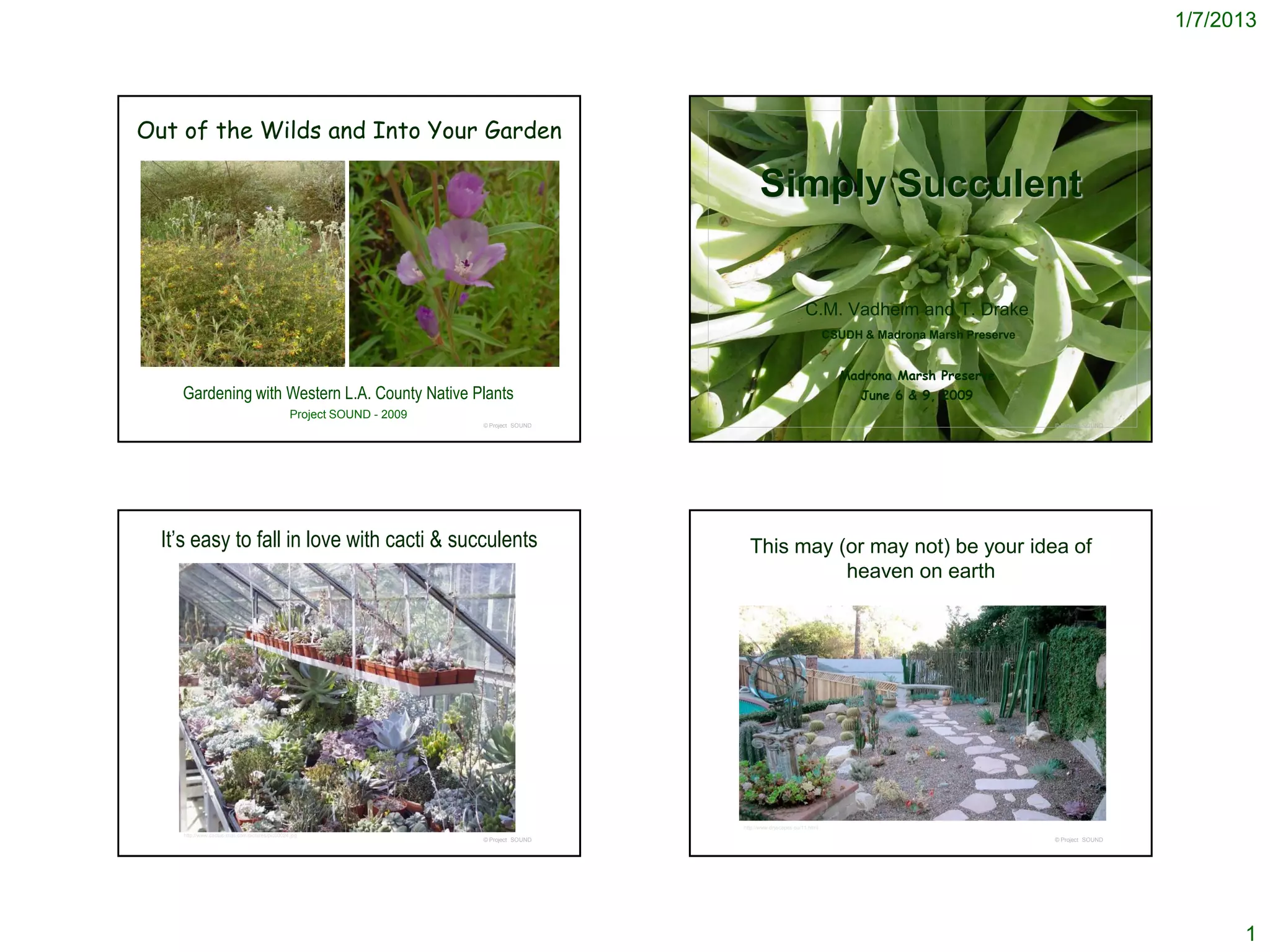
Out of the Wilds and Into Your Garden

                                                                                                Simply Succulent


                                                                                                                   C.M. Vadheim and T. Drake
                                                                                                                            CSUDH & Madrona Marsh Preserve


                                                                                                                              Madrona Marsh Preserve
    Gardening with Western L.A. County Native Plants                                                                              June 6 & 9, 2009
                                                 Project SOUND - 2009
                                                                        © Project SOUND                                                                      © Project SOUND


  It’s easy to fall in love with cacti & succulents                                         This may (or may not) be your idea of
                                                                                                      heaven on earth


                                                                                          http://www.dryscapes.eu/11.html
     http://www.cactus-mall.com/pictures/pic00024.jpg
                                                                        © Project SOUND                                                                      © Project SOUND


                                                                                                                                                                                     1
1/7/2013


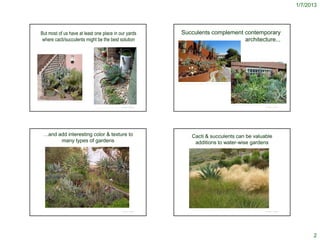
   But most of us have at least one place in our yards                                                                                             Succulents complement contemporary
    where cacti/succulents might be the best solution                                                                                                                    architecture...


                                                                                                                                                 http://www.rbgsyd.nsw.gov.au/__data/assets/image/0006/73491/Succulent-Garden.jpg


http://hotels.about.com/od/newmexico/ig/Sierra-Grande-Lodge/Cactus-Garden.htm


                                                                                                                                                                                                                                      http://home-and-garden.webshots.com/photo/1476610400079711680tHyVBV
                                                                                                                        © Project SOUND                                                                                                                                                 © Project SOUND
                                                                                http://image61.webshots.com/161/0/69/53/520706953KNboGn_fs.jpg


       …and add interesting color & texture to                                                                                                                      Cacti & succulents can be valuable
             many types of gardens                                                                                                                                   additions to water-wise gardens


            http://succulentplants.net/garden.htm
                                                                                                                                                                   http://paradiseenvironments.com/OutdoorLiving/outdoor_living.htm
                                                                                                                        © Project SOUND                                                                                                                                                 © Project SOUND


                                                                                                                                                                                                                                                                                                                  2
1/7/2013


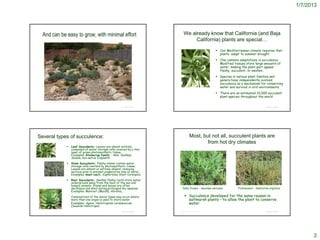
  And can be easy to grow, with minimal effort                                                          We already know that California (and Baja
                                                                                                             California) plants are special…

                                                                                                                                          Our Mediterranean climate requires that
                                                                                                                                           plants adapt to summer drought.
                                                                                                                                          One common adaptations is succulence.
                                                                                                                                           Modified tissues store large amounts of
                                                                                                                                           water, making the plant part appear
                                                                                                                                           fleshy, succulent, or swollen.
                                                                                                                                          Species in various plant families and
                                                                                                                                           genera have independently evolved
                                                                                                                                           succulence as a mechanism for conserving
                                                                                                                                           water and survival in arid environments.
                                                                                                                                          There are an estimated 10,000 succulent
                                                                                                                                           plant species throughout the world
   http://www.ci.poway.ca.us/Modules/ShowImage.aspx?imageid=1146


                                                                              © Project SOUND                                                                               © Project SOUND


Several types of succulence:                                                                                      Most, but not all, succulent plants are
                                                                                                                          from hot dry climates
                                         Leaf Succulents: Leaves are almost entirely
                                          composed of water storage cells covered by a thin
                                          layer of green photosynthetic tissue.
                                          Examples: Stonecrop family - Aloe, Dudleya,
                                          Sedum, non-native Iceplants
                                         Stem Succulents: Fleshy stems contain water
                                          storage cells overlaid by photosynthetic tissue.
                                          Leaves are almost or entirely absent, reducing
                                          surface area to prevent evaporative loss of water.
                                          Examples: most cacti, Euphorbias; Giant Coreopsis.
                                         Root Succulents: Swollen fleshy roots store water
                                          underground away from the heat of the sun and
                                          hungry animals. Stems and leaves are often
                                          deciduous and shed during prolonged dry seasons.            Salty Susan - Jaumea carnosa                     Pickleweed - Salicornia virginica
                                          Examples: Manroot (Marah), Abronia, .
                                          Combinations of the above types may occur where                  Succulence developed for the same reason in
                                          more than one organ is used to store water.                       saltmarsh plants – to allow the plant to conserve
                                          Examples: Agave, Heliotropium curassavicum                        water
                                          (Seaside Heliotrope)
                                                                              © Project SOUND   http://www.sanelijo.org/saltmarsh.html                                      © Project SOUND


                                                                                                                                                                                                    3
1/7/2013


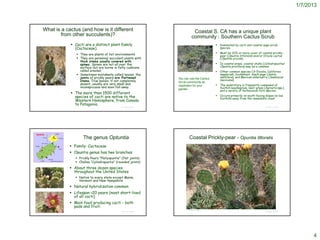
What is a cactus (and how is it different                                             Coastal S. CA has a unique plant
        from other succulents)?                                                      community : Southern Cactus Scrub
             Cacti are a distinct plant family                                                                           Dominated by cacti and coastal sage scrub
              (Cactaceae).                                                                                                 species.

                They are plants of hot environments                                                                      Must be 20% or more cover of coastal prickly-
                                                                                                                           pear (Opuntia littoralis) and/or Oracle cactus
                They are perennial succulent plants with                                                                  (Opuntia oricola).
                 thick stems usually covered with
                 spines. Spines are not all over the                                                                      In coastal areas, coastal cholla (Cylindropuntia/
                 surface but are borne in felty cushions                                                                   Opuntia prolifera) may be a common
                 called areoles.                                                                                          Other common species CA Encelia, California
                Sometimes mistakenly called leaves, the                                                                   sagebrush, buckwheat, black sage (Salvia
                                                                http://www.flickr.com/photos/liamkestrel/3383069515/


                 joints of prickly pears are flattened          You can use the Cactus                                     mellifera), and Mexican elderberry (Sambucus
                 stems. True leaves, if not completely                                                                     mexicana).
                                                                Scrub community as
                 absent, usually are very small and             inspiration for your                                      The understory is frequently composed of
                 inconspicuous and soon fall away.                                                                         foothill needlegrass, bent grass (Agrostis spp.),
                                                                garden
                                                                                                                           and a variety of herbaceous forb species.
             The more than 1500 different
              species of cacti are native to the                                                                          Occurs primarily on south-facing slopes on low
                                                                                                                           foothills away from the immediate coast.
              Western Hemisphere, from Canada
              to Patagonia.
                                              © Project SOUND                                                                                                © Project SOUND


                    The genus Optuntia                                           Coastal Prickly-pear - Opuntia littoralis
             Family: Cactaceae
             Opuntia genus has two branches
                Prickly Pears "Platyopuntia" (flat joints)
                Chollas "Cylindropuntia" (rounded joints)
             About three dozen species
              throughout the United States
                Native to every state except Maine,
                 Vermont and New Hampshire
             Natural hybridization common
             Lifespan <20 years (most short-lived
              of all cacti)
             Main food producing cacti - both
              pads and fruit.
                                                                                © 2002 Lynn Watson
                                              © Project SOUND                                                                                                © Project SOUND


                                                                                                                                                                                     4
1/7/2013


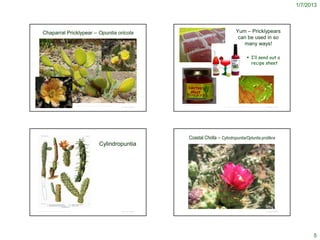
          Chaparral Pricklypear – Opuntia oricola                                                                                                                                                                                                Yum – Pricklypears
                                                                                                                                                                                                                                                  can be used in so
                                                                                                                                                                                                                                                    many ways!

                                                                                                                                                                                                                                                                  I’ll send out a
                                                                                                                                                           http://farm3.static.flickr.com/2391/2383907636_378192341a.jpg?v=0
                                                                                                                                                                                                                                                                   recipe sheet


      http://commons.wikimedia.org/wiki/Opuntia_oricola
                                                                                                                                                               http://www.arizonagift.com/convention_mini_gifts.htm
                                                               http://www.researchlearningcenter.com/bloom/species/Opuntia_oricola.htm
                                                                                                                                         © Project SOUND                                                                       http://www.sacatomato.com/2008/06/cooking_with_diana_kennedy.html © Project SOUND


                                                                                                                                                                        Coastal Cholla – Cylindropuntia/Optuntia prolifera
                                                                                                              Cylindropuntia


                                                                                                                                                                         © 2004 Vince Scheidt


http://commons.wikimedia.org/wiki/File:Opuntia4_filtered.jpg                                                                             © Project SOUND                                                                                                                                     © Project SOUND


                                                                                                                                                                                                                                                                                                                         5
1/7/2013


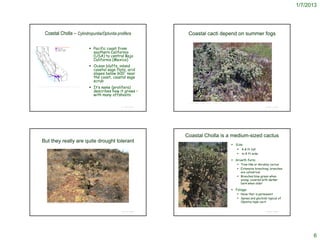
          Coastal Cholla – Cylindropuntia/Optuntia prolifera                                                                          Coastal cacti depend on summer fogs

                                                                                    Pacific coast from
                                                                                     southern California
                                                                                     (USA) to central Baja
                                                                                     California (Mexico)
                                                                                    Ocean bluffs, inland
                                                                                     coastal sage flats, arid
                                                                                     slopes below 600' near
                                                                                     the coast, coastal sage
                                                                                     scrub
http://ucjeps.berkeley.edu/cgi-bin/get_JM_treatment.pl?2702,2726,2749
                                                                                    It’s name (prolifera)
                                                                                     describes how it grows –
                                                                                     with many offshoots
                                                                                                                                     Gary A. Monroe @ USDA-NRCS PLANTS Database


                                                                                                     © Project SOUND                                                                                     © Project SOUND


                                                                                                                                 Coastal Cholla is a medium-sized cactus
     But they really are quite drought tolerant
                                                                                                                                                                                   Size:
                                                                                                                                                                                      4-8 ft tall
                                                                                                                                                                                        to 8 ft wide

                                                                                                                                                                                   Growth form:
                                                                                                                                                                                      Tree-like or shrubby cactus
                                                                                                                                                                                      Extensive branching; branches
                                                                                                                                                                                       are cylindrical
                                                                                                                                                                                      Branches blue-green when
                                                                                                                                                                                       young; covered with darker
                                                                                                                                                                                       bark when older

                                                                                                                                                                                   Foliage:
                                                                                                                                                                                      None that is permanent
                                                                                                                                                                                      Spines and glochids typical of
              http://www.researchlearningcenter.com/bloom/species/Opuntia_prolifera.htm
                                                                                                                                                                                       Opuntia-type cacti

                                                                                                                       © 2004 Vince Scheidt

                                                                                                     © Project SOUND                                                                                     © Project SOUND


                                                                                                                                                                                                                                 6
1/7/2013


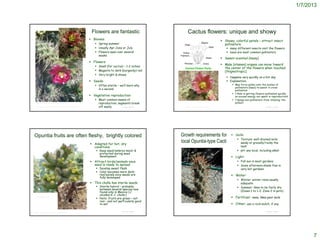
                                                                              Flowers are fantastic                           Cactus flowers: unique and showy
                                                                              Blooms:                                                                                        Showy, colorful petals – attract insect
                                                                                 Spring-summer                                                                                pollinators;
                                                                                 Usually Apr-June or July                                                                       many different insects visit the flowers
                                                                                 Flowers open over several                                                                      bees are most common pollinators
                                                                                  weeks
                                                                                                                                                                              Sweet-scented (many)
                                                                              Flowers:
                                                                                                                                                                              Male (stamen) organs can move toward
                                                                                 Small (for cactus) – 1-2 inches
                                                                                                                                                                               the center of the flowers when touched
                                                                                 Magenta to dark (burgandy) red                                                               (thigmotropic).
                                                                                 Very bright & showy
                                                                                                                                                                                 Happens very quickly on a hot day
                                                                              Seeds:                                                                                            Explanation:
                                                                                 Often sterile – we’ll learn why                                                                    May force pollen onto the bodies of
                                                                                                                                                                                      pollinators (bees) to assist in cross
                                                                                  in a second                                                                                         pollination
                                                                                                                                                                                     ? Role in getting flowers pollinated quickly
                                                                              Vegetative reproduction:                                                                               so excess energy not spent in reproduction?
                                                                                 Most common means of                                                                               ? keeps non-pollinators from ‘stealing’ the
   http://www.calflora.net/bloomingplants/coastcholla.html                        reproduction; segments break                                                                        pollen?
 http://www.researchlearningcenter.com/bloom/species/Opuntia_prolifera.htm        off easily       © Project SOUND        http://www.timetotrack.com/jay/chollac2.htm                                          © Project SOUND


Opuntia fruits are often fleshy, brightly colored                                                                     Growth requirements for                                        Soils:
                                                                                                                                                                                         Texture: well-drained soils;
                                                                              Adapted for hot, dry
                                                                                                                      local Opuntia-type Cacti                                            sandy or gravelly/rocky the
                                                                               conditions                                                                                                 best
                                                                                  Keep seed/embryo moist &                                                                              pH: any local, including alkali
                                                                                   protected during seed
                                                                                   development                                                                                       Light:
                                                                              Attract birds/animals once                                                                                Full sun in most gardens
                                                                               seed is ready to spread                                                                                   Some afternoon shade fine in
                                                                                  Develop sweet flesh                                                                                    very hot gardens
                                                                                  Color becomes more dark-
                                                                                   red/purple once seeds are                                                                         Water:
                                                                                   fully developed
                                                                                                                                                                                         Winter: winter rains usually
                                                                              This cholla has sterile seeds                                                                              adequate
                                                                                  Sterile hybrid – probably                                                                             Summer: likes to be fairly dry
                                                                                   between several species now
                                                                                   found only in Mexico (C.                                                                               (Zones 1 to 1-2; Zone 2 in pots)
                                                                                   alcahes X C. cholla )
   http://ucbglcs.blogspot.com/
                                                                                  Note: fruits are green – not                                                                      Fertilizer: none; likes poor soils
                                                                                   red – and not particularly good
                                                                                   to eat                             http://www.cactiguide.com/forum/viewtopic.php?t=6342           Other: use a rock mulch, if any

                                                                                                    © Project SOUND                                                                                            © Project SOUND
http://www.sanpedrorivervalley.org/old_road_byway.htm


                                                                                                                                                                                                                                           7
1/7/2013


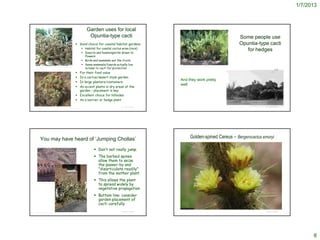
                                                                                Garden uses for local
                                                                                 Opuntia-type cacti                                                                                                 Some people use
                                                                       Good choice for coastal habitat gardens                                                                                     Opuntia-type cacti
                                                                              Habitat for coastal cactus wren (rare)
                                                                              Insects and hummingbirds drawn to
                                                                                                                                                                                                       for hedges
                                                                               flowers
                                                                              Birds and mammals eat the fruits
                                                                              Some mammals/lizards actually live          http://www.backtonatives.org/nativelandscapes.htm
 http://www.cnr.vt.edu/DENDRO/dendrology/Syllabus2/factshee
 t.cfm?ID=792                                                                  in/near to cacti for protection
                                                                       For their food value
                                                                       In a cactus/desert style garden
                                                                                                                           And they work pretty
                                                                       In large planters/containers
                                                                                                                           well
                                                                       As accent plants in dry areas of the
                                                                        garden – placement is key
                                                                       Excellent choice for hillsides
                                                                       As a barrier or hedge plant

                                                                                                         © Project SOUND                                                       http://content.ci.pomona.ca.us/cdm4/item_viewer.php?CISOROOT=/Frasher&CISOPTR=6863&CISOBOX=1&REC=20
                                                                                                                                                                                                                                                        © Project SOUND
 http://www.researchlearningcenter.com/bloom/species/Opuntia_prolifera.htm


          You may have heard of ‘Jumping Chollas’                                                                                         Golden-spined Cereus – Bergerocactus emoryi

                                                                                       Don’t not really jump.
                                                                                       The barbed spines
                                                                                        allow them to seize
                                                                                        the passer-by and
                                                                                        "disarticulate readily"
                                                                                        from the mother plant.
                                                                                       This allows the plant
       http://www.graci.com/photoday.htm
                                                                                        to spread widely by
                                                                                        vegetative propagation
                                                                                       Bottom line: consider
                                                                                        garden placement of
                                                                                        cacti carefully
                                                                                                                                           © 2006 Vince Scheidt


                                                                                                         © Project SOUND                                                                                                                           © Project SOUND
http://home-and-garden.webshots.com/photo/1053071767036424719YtiPgK


                                                                                                                                                                                                                                                                                           8
1/7/2013


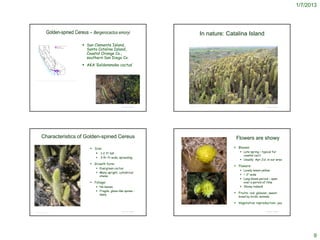
                 Golden-spined Cereus – Bergerocactus emoryi                                                                                     In nature: Catalina Island
                                                                         San Clemente Island,
                                                                          Santa Catalina Island,
                                                                          Coastal Orange Co.,
                                                                          southern San Diego Co.
                                                                         AKA ‘Goldensnake cactus’


http://ucjeps.berkeley.edu/cgi-bin/get_JM_treatment.pl?2702,2703,2704


                                                                                                                                   © 2006 Vince Scheidt
                                                                                                   © Project SOUND                                                                                       © Project SOUND


         Characteristics of Golden-spined Cereus                                                                                                                                   Flowers are showy
                                                                             Size:                                                                                                Blooms:
                                                                                1-2 ft tall                                                                                           Late spring – typical for
                                                                                                                                                                                        coastal cacti
                                                                                  3-5+ ft wide; spreading
                                                                                                                                                                                       Usually Apr-Jul. in our area
                                                                             Growth form:
                                                                                                                                                                                   Flowers:
                                                                                Evergreen cactus
                                                                                                                                                                                       Lovely lemon yellow
                                                                                Many upright, cylindrical
                                                                                 stems                                                                                                 ~ 2” wide
                                                                                                                                                                                       Long bloom period – open
                                                                             Foliage:                                                                                                  over a period of time
                                                                                No leaves                                                                                             Showy indeed!
                                                                                Fragile, glass-like spines -
                                                                                 many
                                                                                                                                                                                   Fruits: red, globular, sweet;
                                                                                                                                                                                     loved by birds, animals

                                                                                                                                                                                   Vegetative reproduction: yes
                                                                                                                     © 2005 Dieter Wilken                 © 2007 John M. Taylor


                                                                                                   © Project SOUND                                                                                       © Project SOUND
© 2007 John M. Taylor


                                                                                                                                                                                                                                 9
1/7/2013


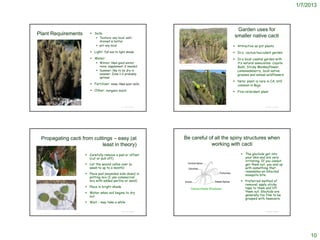
                                                                                                             Garden uses for
Plant Requirements       Soils:
                             Texture: any local; well-                                                     smaller native cacti
                              drained is better
                             pH: any local                                                                 Attractive as pot plants
                         Light: full sun to light shade                                                    In a cactus/succulent garden
                         Water:                                                                            In a local coastal garden with
                             Winter: likes good winter                                                      it’s natural associates: Coyote
                              rains; supplement if needed                                                    Bush, Sticky Monkeyflower,
                                                                 © 2007 Halleh Paymard


                             Summer: like to be dry in                                                      Lemonadeberry, local native
                              summer: Zone 1-2 probably                                                      grasses and annual wildflowers
                              optimal
                                                                                                            Note: plant is rare in CA, still
                         Fertilizer: none; likes poor soils                                                 common in Baja
                         Other: inorganic mulch                                                            Fire-retardant plant


                                                                 http://cactiguide.com/Bergerocactus.htm
                                               © Project SOUND                                                                   © Project SOUND


 Propagating cacti from cuttings – easy (at                           Be careful of all the spiny structures when
                            least in theory)                                      working with cacti
                      Carefully remove a pad or offset                                                          The glochids get into
                       (cut or pull off)                                                                          your skin and are very
                                                                                                                  irritating. If you cannot
                      Let the wound callus over (a                                                               get them out, you end up
                       week to up to a month)                                                                     with something that
                                                                                                                  resembles an infected
                      Place pad (wounded side down) in                                                           mosquito bite.
                       potting mix (I use commercial
                       mix with added perlite or sand)                                                           Preferred method of
                                                                                                                  removal: apply sticky
                      Place in bright shade                                                                      tape to them and lift
                      Water when soil begins to dry                                                              them out. Glochids are
                       out                                                                                        generally too fine to be
                                                                                                                  grasped with tweezers.
                      Wait – may take a while

                                               © Project SOUND                                                                   © Project SOUND


                                                                                                                                                        10
1/7/2013


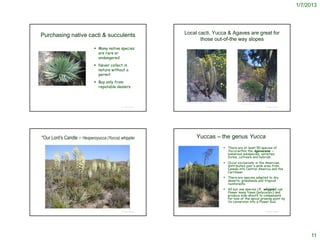
  Purchasing native cacti & succulents                                           Local cacti, Yucca & Agaves are great for
                                                                                        those out-of-the way slopes
                                           Many native species
                                            are rare or
                                            endangered
                                           Never collect in
                                            nature without a
                                            permit
                                           Buy only from
http://calplants.biz/yuccawhipplei.html
                                            reputable dealers


                                                                                           © 2006 Vince Scheidt
                                                                                                                                                              © 2006 Vince Scheidt

                                                        © Project SOUND                                                                                                              © Project SOUND


   *Our Lord’s Candle – Hesperoyucca (Yucca) whipplei                                                Yuccas – the genus Yucca
                                                                                                                                                    There are at least 50 species of
                                                                                                                                                     Yucca within the Agavaceae -
                                                                                                                                                     numerous subspecies, varieties,
                                                                                                                                                     forms, cultivars and hybrids.
                                                                                                                                                    Occur exclusively in the Americas,
                                                                                                                                                     distributed over a wide area from
                                                                                                                                                     Canada into Central America and the
                                                                                                                                                     Carribean
                                                                                                                                                    There are species adapted to dry
                                                                                                                                                     deserts, grasslands and tropical
                                                                                                                                                     rainforests.
                                                                                                                                                    All but one species (Y. whipplei) can
                                                                                                                                                     flower many times (polycarpic) and
                                                                                                                                                     produce side-shoots to compensate
                                                                                                                                                     for loss of the apical growing point by
                                                                                                                                                     its conversion into a flower bud.
                                                                          http://www.researchlearningcenter.com/bloom/species/Yucca_whipplei.htm
            © 2003 BonTerra Consulting
                                                        © Project SOUND                                                                                                              © Project SOUND


                                                                                                                                                                                                            11
1/7/2013


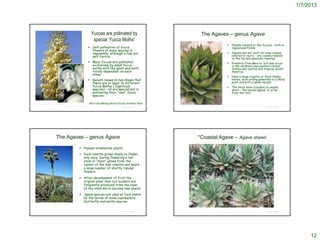
                                                                                          Yuccas are pollinated by                                                The Agaves – genus Agave
                                                                                           special ‘Yucca Moths’
                                                                                                                                                                                                         Closely related to the Yuccas – both in
                                                                                     Self pollination of Yucca                                                                                           Agavaceae Family
                                                                                      flowers of many species is
                                                                                      impossible, although a few are                                                                                     Agaves are not cacti (or even closely
                                                                                      self-fertile.                                                                                                       related to cacti) - are closely related
                                                                                                                                                                                                          to the lily and amaryllis families
                                                                                     Most Yuccas are pollinated                                                                                         Primarily from Mexico, but also occur
                                                                                      exclusively by small Yucca                                                                                          in the southern and western United
                                                                                      moths with the plant and moth                                                                                       States and central and tropical South
                                                                                      totally dependent on each                                                                                           America.
                                                                                      other.
                                                                                                                                                                                                         Have a large rosette of thick fleshy
                                                                                     Recent research has shown that                                                                                      leaves, each ending generally in a sharp
                                                                                      there are at least 16 different                                                                                     point and with a spiny margin;
                                                                                      Yucca Moths (Tegeticula                                                                                            The stout stem (caudex) is usually
                                                                                      species) - all are specialized in                                                                                   short - the leaves appear to arise
                                                                                      pollinating their "own" Yucca                                                                                       from the root.
                                                                                      species.

http://www.calflora.net/bloomingplants/chaparralyucca.html                           We’ll be talking about Yucca another time
                                                                                                                                 http://www.desert-tropicals.com/Plants/Agavaceae/Agave_shawii.html
                                                G.A. Cooper @ USDA-NRCS PLANTS Database                       © Project SOUND                                                                                                       © Project SOUND


                                      The Agaves – genus Agave                                                                                               *Coastal Agave – Agave shawii
                                                                         Popular ornamental plants.
                                                                         Each rosette grows slowly to flower
                                                                          only once. During flowering a tall
                                                                          stem or "mast" grows from the
                                                                          center of the leaf rosette and bears
                                                                          a large number of shortly tubular
                                                                          flowers.
                                                                         After development of fruit the
                                                                          original plant dies, but suckers are
                                                                          frequently produced from the base
                                                                          of the stem which become new plants.
                                                                         Agave species are used as food plants
                                                                          by the larvae of some Lepidoptera
                                                                          (butterfly and moth) species
     http://www.oceanoasis.org/fieldguide/agav-sha.html


                                                                                                                                                 © 2005 Vince Scheidt

                                                                                                              © Project SOUND                                                                                                       © Project SOUND


                                                                                                                                                                                                                                                           12
1/7/2013


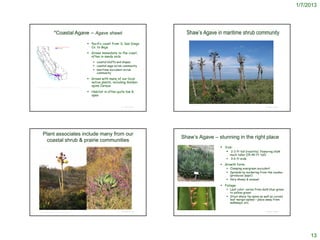
                           *Coastal Agave – Agave shawii                                                                      Shaw’s Agave in maritime shrub community
                                                                         Pacific coast from S. San Diego
                                                                          Co. to Baja
                                                                         Grows immediate to the coast,
                                                                          often in sandy soils
                                                                            coastal bluffs and slopes
                                                                            coastal sage scrub community
                                                                            maritime succulent scrub
                                                                             community

                                                                         Grows with many of our local
                                                                          native plants, including Golden-
http://ucjeps.berkeley.edu/cgi-bin/get_JM_treatment.pl?8349,8350,8352
                                                                          spine Cereus
                                                                         Habitat is often quite low &
                                                                          open

                                                                                                                                     © 2005 Vince Scheidt
                                                                                               © Project SOUND                                                                                                       © Project SOUND


        Plant associates include many from our
                                                                                                                     Shaw’s Agave – stunning in the right place
          coastal shrub & prairie communities
                                                                                                                                                                                   Size:
                                                                                                                                                                                      2-3 ft tall (rosette); flowering stalk
                                                                                                                                                                                          much taller (15-40 ft. tall)
                                                                                                                                                                                         3-6 ft wide

                                                                                                                                                                                   Growth form:
                                                                                                                                                                                       Clumping evergreen succulent
                                                                                                                                                                                       Spreads by suckering from the caudex
                                                                                                                                                                                        (produces ‘pups’)
                                                                                                                                                                                       Very showy & unusual
                                                                                                                 http://www.pitzer.edu/offices/arboretum/scott_lawn/desert.html

                                                                                                                                                                                   Foliage:
                                                                                                                                                                                       Leaf color: varies from dark blue-green
                                                                                                                                                                                        to yellow-green
                                                                                                                                                                                       Stout sharp tip-spine as well as curved
                                                                                                                                                                                        leaf margin spines – place away from
                                                                                                                                                                                        walkways, etc.
              © 2005 Vince Scheidt


                                                                                               © Project SOUND    © 2006 Steve Matson                                                                                © Project SOUND
    http://www.geographylists.com/sandiegoplants.html


                                                                                                                                                                                                                                            13
1/7/2013


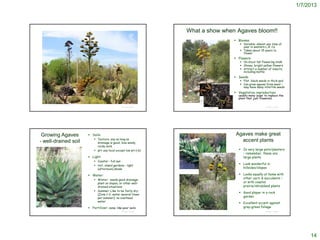
                                                                                                             What a show when Agaves bloom!!
                                                                                                                                                                                        Blooms:
                                                                                                                                                                                           Variable; almost any time of
                                                                                                                                                                                            year in western L.A. Co.
                                                                                                                                                                                           Takes about 15 years to
                                                                                                                                                                                            flower
                                                                                                                                                                                        Flowers:
                                                                                                                                                                                           On stout tall flowering stalk
                                                                                                                                                                                           Showy, bright yellow flowers
                                                                                                                                                                                           Attract a number of insects,
                                                                                                                                                                                            including moths
                                                                                                                                                                                        Seeds:
                                                                                                                                                                                           Flat, black seeds in thick pod
                                                                                                                                                                                           Can grow agaves from seed –
                                                                                                                                                                                            may have many infertile seeds
                                                                                                                                                                                        Vegetative reproduction:
                                                                                                                                                                                         usually many ‘pups’ to replace the
                                                                                                                                                                                         plant that just flowered.

 http://www.delange.org/AgaveCoastal/AgaveCoastal.htm
                                                                                © Project SOUND                                                                                                              © Project SOUND


 Growing Agaves                                          Soils:                                                                                                                        Agaves make great
                                                             Texture: any as long as
- well-drained soil                                           drainage is good; love sandy,
                                                                                                                                                                                          accent plants
                                                              rocky soils
                                                             pH: any local except low pH (<6)                                                                                             In very large pots/planters
                                                                                                                                                                                            – remember, these are
                                                         Light:                                                                                                                            large plants
                                                             Coastal – full sun
                                                             Hot, inland gardens – light
                                                                                                                                                                                           Look wonderful in
                                                              (afternoon) shade                                                                                                             hillsides/slopes
                                                                                                     http://www.delange.org/AgaveCoastal/AgaveCoastal.htm


                                                         Water:                                                                                                                           Looks equally at home with
                                                             Winter: needs good drainage;                                                                                                  other cacti & succulents –
                                                              plant on slopes, or other well-                                                                                               or with coastal
                                                              drained situations                                                                                                            prairie/shrubland plants
                                                             Summer: Like to be fairly dry
                                                                                                                                                                                           Good player in a rock
                                                              (Zone 1-2; water several times
                                                              per summer); no overhead                                                                                                      garden
                                                              water
                                                                                                                                                                                           Excellent accent against
                                                         Fertilizer: none; like poor soils                                                                                                 gray-green foliage
                                                                                © Project SOUND                                                                                                              © Project SOUND
                                                                                                  http://www.sbbg.org/index.cfm?fuseaction=livingcollections.plantDetail&plant_id=28


                                                                                                                                                                                                                                    14
1/7/2013


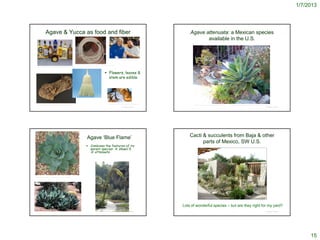
                   Agave & Yucca as food and fiber                                                                                                                                    Agave attenuata: a Mexican species
                                                                                                                                                                                             available in the U.S.


                                                                                                                                http://www.howka.com/scrapbook/ciba_2005/


                                                                          http://www.cowboyshowcase.com/glossary%20personalgear.htm
   http://media.photobucket.com/image/Tequila/ccerna/tequila.jpg


                                                                                                                      Flowers, leaves &
                                                                                                                       stem are edible


                                                                                                                           http://www.so-utah.com/feature/anasazi/homepage.html
   http://www.nps.gov/zion/historyculture/yucca-sandal.htm                                                                                                                              http://www.geographylists.com/sandiegoplants.html        http://www.cactusjungle.com/blog/2008/09/30/berkeley-succulent-garden-3/
                                                                                                                                                   © Project SOUND                                                                                                                                           © Project SOUND


                                                                                          Agave ‘Blue Flame’                                                                          Cacti & succulents from Baja & other
                                                                                                                                                                                            parts of Mexico, SW U.S.
                                                                                         Combines the features of its
                                                                                          parent species: A. shawii X
                                                                                               A. attenuata


http://www.smgrowers.com/products/plants/plantdisplay.asp?plant_id=2871


                                                                                                                                                                                                http://museum.utep.edu/chih/gardens/succulen/succulen.htm


                                                                                                                                                                                  Lots of wonderful species – but are they right for my yard?
                                                                                                       http://www.huntington.org/BotanicalDiv/ISI2005/isi/2005-06.html
                                                                                                                                                   © Project SOUND                                                                                                                                           © Project SOUND


                                                                                                                                                                                                                                                                                                                                    15
1/7/2013


  Using species from CA & SW desert regions                                                                                                                                             The same advice goes for
                                                                               Contrary to popular belief,                                                                            succulents from other places
                                                                                western L.A. county is not
                                                                                ‘a desert’                                                                                            Know as much as you can about
                                                                               Challenges for using desert                                                                            their requirements
                                                                                cacti/succulents:                                                                                     Be sure that you group
                                                                                   Soil must be well-drained                                                                          compatible plants – just because
                                                                                   Wet years and fog may kill                                                                         they are succulent doesn’t mean
                                                                                    the plants – fungal               http://www.gardeninggonewild.com/?p=3666                         they have the same requirements
                                                                                    diseases
                                                                                   Some species (from
                                                                                    Sonoran Desert – in south)
                                                                                    need a ‘summer monsoon’
                                                                                    period – you’ll have to give
                                                                                    them it
                                                                               Advice:
                                                                                   Learn as much as you can
                                                                                    about the requirements/
                                                                                    habitat of a species
                                                                                    before you purchase it
                                                                                   Be really careful in
http://www.nps.gov/cagr/forkids/the-sonoran-desert.htm
                                                                                    planning your©Water Zones
                                                                                                  Project SOUND
                                                                                                                                                                                              http://sdccs-oasis.blogspot.com/2008/02/bring-your-succulent-cuttings-your-old.html
                                                                                                                                                                                                                                                      © Project SOUND
http://gorp.away.com/gorp/resource/us_nm/top-national-monuments-7.html


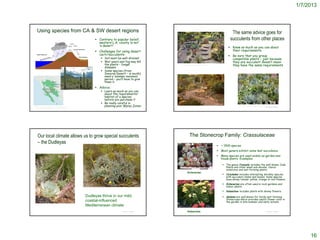
   Our local climate allows us to grow special succulents                                                                           The Stonecrop Family: Crassulaceae
   – the Dudleyas
                                                                                                                                                                               ~ 1500 species
                                                                                                                                                                               Most genera exhibit some leaf succulence
                                                                                                                                                                               Many species are used widely as garden and
                                                                                                                                                                                house plants Examples:

                                                                                                                                                                                  The genus Crassula includes the well-known Jade
                                                                                                                   http://www.southampton.bcss.org.uk/images/image145.jpg          Plants and other small sub-shrubs, choice
                                                                                                                                                                                   minatures and mat-forming plants.
                                                                                                                                 Echeverias
                                                                                                                                                                                  Cotyledon includes interesting shrubby species
                                                                                                                                                                                   with succulent stems and leaves. Some species
                                                                                                                                                                                   have showy tubular yellow, orange or red flowers.
                                                                                                                                                                                  Echeverias are often used in rock gardens and
                                                                                                                                                                                   indoor plants.
                                                                                                                                                                                  Kalanchoe includes plants with showy flowers.
                                                                         Dudleyas thrive in our mild,                                                                             Sedums are well known for hardy mat-forming
                                                                                                                                                                                   Stonecrops which provides useful flower color in
                                                                         coastal-influenced                                                                                        the garden in late summer and early autumn.
                                                                         Mediterranean climate
                                                                                                 © Project SOUND                 Kalanchoe                                                                                                            © Project SOUND


                                                                                                                                                                                                                                                                                         16
1/7/2013


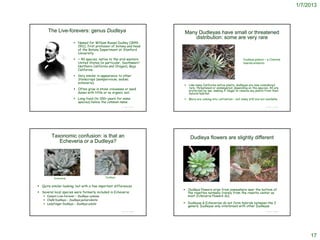
                         The Live-forevers: genus Dudleya                                                           Many Dudleyas have small or threatened
                                                                                                                        distribution: some are very rare
                                                                    Named for William Russel Dudley (1849-
                                                                     1911), first professor of botany and head
                                                                     of the Botany Department at Stanford
                                                                     University
                                                                    ~ 40 species; native to the arid western                                                    Dudleya greenii – a Channel
                                                                     United States (in particular, Southwest/                                                    Islands endemic
                                                                     Northern California and Oregon), Baja
                                                                     California.
                                                                    Very similar in appearance to other
                                                                     Stonecrops (sempervivum; sedum;
                                                                     echeveria).
                                                                                                                        Like many California native plants, dudleyas are now considered
http://commons.wikimedia.org/wiki/File:William_Rus
sell_Dudley_(1849-1911).jpg                                                                                         
                                                                    Often grow in stone crevasses or sand              rare, threatened or endangered, depending on the species. All are
                                                                                                                        protected by law, making it illegal to remove any plants from their
                                                                     dunes with little or no organic soil.              natural habitat.
                                                                    Long-lived (to 100+ years for some                More are coming into cultivation – but many still are not available
                                                                     species) hence the common name
                                                                                                  © Project SOUND                                                                 © Project SOUND


                                Taxonomic confusion: is that an                                                          Dudleya flowers are slightly different
                                   Echeveria or a Dudleya?


                    http://www.collectorscorner.com.au/Cacti/Echeveri
                    a%20main.htm

                                      Echeveria                                        Dudleya


     Quite similar-looking; but with a few important differences
                                                                                                                     Dudleya flowers arise from somewhere near the bottom of
     Several local species were formerly included in Echeveria:                                                      the rosettes normally (rarely from the rosette center as
        Canyon Live-forever – Dudleya cymosa                                                                         most Echeveria flowers do).
        Chalk Dudleya – Dudleya pulverulenta
        Ladyfinger Dudleya – Dudleya edulis                                                                         Dudleyas & Echeverias do not form hybrids between the 2
                                                                                                                      genera; Dudleyas only interbreed with other Dudleyas
                                                                                                  © Project SOUND                                                                 © Project SOUND


                                                                                                                                                                                                         17
1/7/2013


                                                                                                                    So…it’s recommended to NOT combine both in
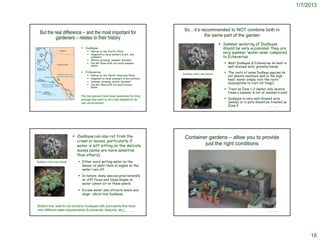
        But the real difference – and the most important for
                                                                                                                              the same part of the garden
                 gardeners – relates to their history
                                                                                                                                                                              Summer watering of Dudleyas
                                                                  Dudleyas                                                                                                    should be very occasional: they are
                                                                    Native to the ‘Pacific Plate’
                                                                    Adapted to rainy winters & hot, dry
                                                                                                                                                                               very summer ‘water-wise’ compared
                                                                     summers                                                                                                   to Echeverias
                                                                    Winter-growing; summer dormant
                                                                    Can kill them with too much summer                                                                                  Most Dudleyas & Echeverias do best in
                                                                     water                                                                                                                well-drained soils; gravelly/sandy
                                                                  Echeverias                                                                                                            The roots of some Dudleya species do
                                                                                                                 Dudleya virens ssp hassei
                                                                      Native to the ‘North American Plate’                                                                               not absorb moisture well in the high
                                                                      Adapted to rainy summers & dry winters                                                                             heat; water simply rots the roots
                                                                      Summer growing; winter dormant
                                                                      Can kill them with too much winter
                                                                                                                                                                                          (susceptible to root rot fungi).
                                                                       water
                                                                                                                                                                                         Treat as Zone 1-2 (water only several
                                                                                                                                                                                          times a summer & not at summer’s end)
                                                               The two genera have been separated for long
                                                               enough that each is very well adapted to its                                                                              Dudleyas in very well-drained soils
                                                               own environment                                                                                                            (sandy) or in pots should be treated as
                                                                                               © Project SOUND   http://www.smgrowers.com/products/plants/plantdisplay.as
                                                                                                                                                                                          Zone 2                    © Project SOUND
                                                                                                                 p?plant_id=538


                                                            Dudleyas can also rot from the                          Container gardens – allow you to provide
                                                             crown or leaves, particularly if
                                                             water is left sitting on the delicate                           just the right conditions
                                                             leaves (some are more sensitive
                                                             than others).
  Dudleya virens ssp hassei                                    Either avoid getting water on the
                                                                leaves, or plant them at angles so the
                                                                water runs off.
                                                               In nature, many species grow naturally
                                                                on cliff faces and steep slopes so
                                                                water cannot sit on these plants.

                                                               Excess water also attracts snails and
                                                                slugs – which love Dudleyas
http://www.smgrowers.com/products/plants/plantdisplay.as
p?plant_id=538


    Bottom line: best to not combine Dudleyas with succulents that have
    very different water requirements (Echeverias; Sedums; etc.) SOUND
                                                              © Project
                                                                                                                              http://slosson.ucdavis.edu/documents/2005-200610656.pdf
                                                                                                                                                                                                                    © Project SOUND


                                                                                                                                                                                                                                           18
1/7/2013


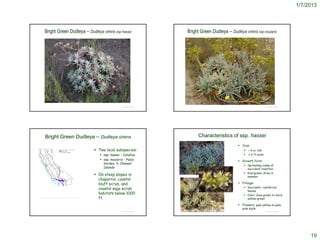
       Bright Green Dudleya – Dudleya virens ssp hassei                                                              Bright Green Dudleya – Dudleya virens ssp insularis


                                                                                          © Project SOUND                                                                            © Project SOUND


       Bright Green Dudleya – Dudleya virens                                                                                           Characteristics of ssp. hassei
                                                                                                                                                                Size:
                                                                         Two local subspecies:                                                                    < 6 in. tall
                                                                            ssp. hassei – Catalina                                                                   1-2 ft wide
                                                                            ssp. insularis – Palos                                                             Growth form:
                                                                             Verdes, S. Channel
                                                                                                                                                                    Spreading clump of
                                                                             Islands                                                                                 succulent rosettes
                                                                                                                                                                    Evergreen; dries in
                                                                         On steep slopes in                                                                         summer
                                                                          chaparral, coastal
                                                                          bluff scrub, and                                                                      Foliage:
                                                                                                                                                                    Succulent, cylindrical
                                                                          coastal sage scrub
                                                                                                                                                                     leaves
                                                                          habitats below 1000                                                                       Color: blue-green to more
http://ucjeps.berkeley.edu/cgi-bin/get_JM_treatment.pl?Dudleya+virens
                                                                          ft.                                                                                        yellow-green

                                                                                                                                                                Flowers: pale yellow on pale
                                                                                                                                                                  pink stalk
                                                                                          © Project SOUND                                                                            © Project SOUND
                                                                                                            http://commons.wikimedia.org/wiki/Dudleya_virens


                                                                                                                                                                                                            19
1/7/2013


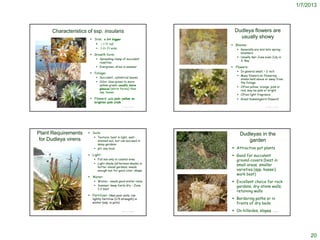
                        Characteristics of ssp. insularis                                                                                                       Dudleya flowers are
                                          Size: a bit bigger
                                                                                                                                                                  usually showy
                                             ~ 1 ft tall                                                                                                      Blooms:
                                                1-2+ ft wide                                                                                                     Generally are mid-late spring-
                                                                                                                                                                   bloomers
                                          Growth form:
                                                                                                                                                                  Usually Apr-June even July in
                                              Spreading clump of succulent
                                                                                                                                                                   S. Bay
                                               rosettes
                                              Evergreen; dries in summer                                                                                      Flowers:
                                                                                                                                                                  In general small; < ¾ inch
                                          Foliage:
                                                                                                                                                                  Many flowers on flowering
                                              Succulent, cylindrical leaves
                                                                                                                                                                   stems held above or away from
                                              Color: blue-green to more                                                                                           the foliage
                                               yellow-green; usually more
                                                                                                                                                                  Often yellow, orange, pink or
                                               glaucus (white farina) than
                                                                                                                                                                   red; may be pale or bright
                                               ssp. hassei
                                                                                                                                                                  Often light fragrance
                                          Flowers: pale pink-yellow on                                                                                           Great hummingbird flowers!
 © 2003 BonTerra Consulting                 brighter pink stalk
                                                                  © Project SOUND                                                                                                    © Project SOUND


Plant Requirements                       Soils:                                                                                                                   Dudleyas in the
                                             Texture: best in light, well-
 for Dudleya virens                           drained soil, but can succeed in                                                                                        garden
                                              many gardens
                                             pH: any local                                                                                                    Attractive pot plants
                                         Light:                                                                                                               Good for succulent
                                             Full sun only in coastal area                                                                                     ground-covers (best in
                                             Light shade (afternoon shade) in
                                              hotter inland gardens; needs
                                                                                                                                                                small areas; smaller
                                              enough sun for good color, shape      http://www.smgrowers.com/products/plants/plantdisplay.asp?plant_id=2987     varieties (spp. hassei)
                                                                                                                                                                work best)
                                         Water:
                                             Winter: needs good winter rains                                                                                  Excellent choice for rock
                                             Summer: keep fairly dry – Zone                                                                                    gardens, dry-stone walls,
                                              1-2 best
                                                                                                                                                                retaining walls
                                         Fertilizer: likes poor soils; can
                                           lightly fertilize (1/5 strength) in                                                                                 Bordering paths or in
                                           winter (esp. in pots)                                                                                                fronts of dry beds
© 2005 BonTerra Consulting                                        © Project SOUND                                                                              On hillsides, slopes © Project SOUND


                                                                                                                                                                                                            20
1/7/2013


   Growing Dudleyas in containers                                                                                Other considerations for growing Dudleyas
                                                                     Dudleyas grow well in pots and                                                                                      Bright light is integral to the proper
                                                                      make excellent outdoor                                                                                               growth of this genus.
                                                                      specimens in Mediterranean                                                                                             Plants grown in low-light will lose their
                                                                      climates.                                                                                                               color, grow tall and spindly and will
                                                                                                                                                                                              eventually die.
                                                                     Potting soil should be very well-
                                                                      draining; amend potting soils with                                                                                     Most Dudleyas make poor houseplants
                                                                      sharp sand and pumice to insure
                                                                      good drainage.                                                                                                      Most Dudleyas do best with moderate
                                                                                                                                                                                           temperatures - protect from
                                                                     Watering: treat as Zone 2;                                                                                           blistering afternoon heat, frosts
                                                                      monitor carefully in hot weather                                                                                     (particularly if in pots)
                                                                     Light: afternoon shade or bright                                                                                    Potting soil should be very well-
                                                                      shade best                                                                                                           draining; use a cactus mix or amend
   Dudleya farinosa
                                                                     Propagation: easiest by removing                                                                                     available soils with sharp sand and
                                                                      rooted offsets (pups), but can be                                                                                    pumice to insure good drainage.
                                                                      from seed
                                                                                          © Project SOUND                                                                                                               © Project SOUND


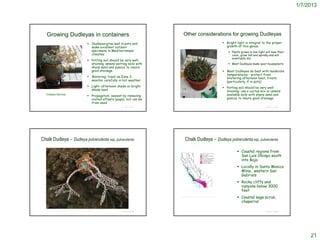
Chalk Dudleya – Dudleya pulverulenta ssp. pulverulenta                                                               Chalk Dudleya – Dudleya pulverulenta ssp. pulverulenta

                                                                                                                                                                                                   Coastal regions from
                                                                                                                                                                                                    San Luis Obispo south
                                                                                                                                                                                                    into Baja
                                                                                                                                                                                                   Locally in Santa Monica
                                                                                                                                                                                                    Mtns., western San
                                                                                                                                                                                                    Gabriels
                                                                                                                                                                                                   Rocky cliffs and
                                                                                                                                                                                                    canyons below 3000
                                                                                                                                                                                                    feet
                                                                                                            http://ucjeps.berkeley.edu/cgi-bin/get_JM_treatment.pl?3284,3295,3327,3329
                                                                                                                                                                                                   Coastal sage scrub,
                                                                                                                                                                                                    chaparral

   http://www.researchlearningcenter.com/bloom/species/Dudleya_pulverulenta.htm
                                                                                          © Project SOUND                                                                                                               © Project SOUND


                                                                                                                                                                                                                                               21
1/7/2013


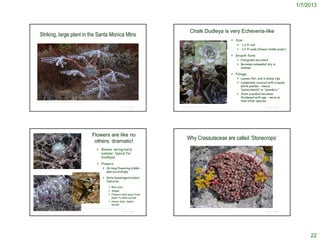
                                                                                                                                                                           Chalk Dudleya is very Echeveria-like
        Striking, large plant in the Santa Monica Mtns
                                                                                                                                                                                                                                                Size:
                                                                                                                                                                                                                                                   1-2 ft tall
                                                                                                                                                                                                                                                           1-2 ft wide (flower stalks wider)

                                                                                                                                                                                                                                                Growth form:
                                                                                                                                                                                                                                                         Evergreen succulent
                                                                                                                                                                                                                                                         Becomes somewhat dry in
                                                                                                                                                                                                                                                          summer

                                                                                                                                                                                                                                                Foliage:
                                                                                                                                                                                                                                                         Leaves flat, end in sharp tips
                                                                                                                                                                                                                                                         completely covered with a mealy
                                                                                                                                                                                                                                                          white powder - hence
                                                                                                                                                                                                                                                          "pulverulenta" or "powdery."
                                                                                                                                                                                                                                                         Stem (caudex) becomes
                                                                                                                                                                                                                                                          thickened with age – more so
        http://www.researchlearningcenter.com/bloom/species/Dudleya_pulverulenta.htm
                                                                                                                                                                                                                                                          than other species
                                                                                                                                                             http://www.wildflower.org/plants/result.php?id_plant=DUPU
                                                                                                                                           © Project SOUND                                                                                                                    © Project SOUND
                                                                                                                                                             http://www.anniesannuals.com/plants/plant_display.asp?prodid=1536&account=none


                                                                                            Flowers are like no
                                                                                             others: dramatic!
                                                                                                                                                                       Why Crassulaceae are called ‘Stonecrops’
                                                                                                    Blooms: spring/early
                                                                                                     summer; typical for
                                                                                                     Dudleyas

                                                                                                    Flowers:
                                                                                                              On long flowering stalks –
                                                                                                               plan accordingly
http://farm4.static.flickr.com/3003/2606066487_0aaaf1ed09.jpg?v=0


                                                                                                              Note hummingbird-plant
                                                                                                               features:
                                                                                                                       Red color;
                                                                                                                       Shape;
                                                                                                                       Flowers held away from
                                                                                                                        plant to allow access
                                                                                                                       Heavy duty, sweet
                                                                                                                        nectar
                                                                                http://www.laspilitas.com/garden/Anna%27s_Hummingbird_on_chalk_dudlea.jpg
                                                                                                                                                                              http://www.ubcbotanicalgarden.org/potd/2006/02/sedum_spathulifolium.php
http://www.timetotrack.com/jay/dudleyc5.htm                                                                                                © Project SOUND                                                                                                                    © Project SOUND


                                                                                                                                                                                                                                                                                                     22
1/7/2013


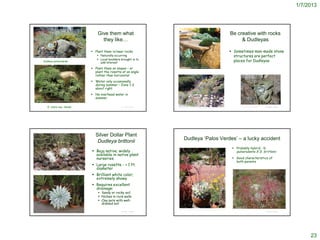
                                                                      Give them what                                                                                                 Be creative with rocks
                                                                        they like…                                                                                                        & Dudleyas

                                                                   Plant them in/near rocks                                                                                          Sometimes man-made stone
 http://www.flickr.com/photos/eastbaywilds/241664905/                 Naturally occurring                                                                                             structures are perfect
                                                                      Local boulders brought in to
                Dudleya pulverulenta
                                                                       add interest
                                                                                                                                                                                       places for Dudleyas
                                                                   Plant them on slopes – or
                                                                                                           http://img4.sunset.com/i/2009/04/dream-gardens-stone-seat-l.jpg


                                                                    plant the rosette at an angle
                                                                    rather than horizontal
                                                                   Water only occasionally
                                                                    during summer – Zone 1-2
                                                                    about right
                                                                   No overhead water in
                                                                    summer
    http://www.flickr.com/photos/93452909@N00/191287029/


                                                                                                                                                                                            http://www.marrsandersen.com/California-plants/California-
                      D. virens ssp. hassei                                           © Project SOUND
                                                                                                        http://www.flickr.com/photos/eastbaywilds/241665013/in/photostream/                 plants-Pages/Image28.html              © Project SOUND


                                                                    Silver Dollar Plant
                                                                                                                Dudleya ‘Palos Verdes’ – a lucky accident
                                                                     Dudleya brittonii
                                                                                                                                                                                       Probably hybrid : D.
                                                                   Baja native; widely                                                                                                 pulverulenta X D. brittonii
                                                                    available in native plant
                                                                    nurseries                                                                                                          Good characteristics of
                                                                                                                                                                                        both parents
                                                                   Large rosette - > 1 ft.
                                                                    diameter
http://www.hotgardens.net/succulent_cactus_gallery.htm

                                                                   Brilliant white color;
                                                                    extremely showy
                                                                   Requires excellent
                                                                    drainage:
                                                                       Sandy or rocky soil
                                                                       Niches in rock walls
                                                                       Clay pots with well-
                                                                        drained soil
                                                                                                           http://www.smgrowers.com/products/plants/plantdisplay.asp?plant_id=3232
                                                                                      © Project SOUND                                                                                                                             © Project SOUND
 http://image54.webshots.com/154/5/90/28/539959028nsjBLY_fs.jpg


                                                                                                                                                                                                                                                              23
1/7/2013


                                                                                                                                     Keeping Dudleyas healthy: summary
              Maintaining Dudleyas: fairly easy
                                                                                                                                      Plant in well-drained soils, at an angle
                                                               No pruning is necessary,                                              Water properly; depends on soils
                                                                although dudleya will benefit
                                                                from a beheading (stem                                                Promote good air circulation
                                                                cutting) if the plant becomes
                                                                old or tall and spindly.                                              Don’t stress the plants: heat, cold
                                                               You may want to remove any                                            Prevent & treat common problems:
                                                                leaves which have died. This                                                   Aphids & Mealy bugs: prevent Argentine ants from
                                                                will help to avoid rot and                                                      introducing mealybugs or aphids to your dudleyas -
                                                                bugs.                                                                           Mealybugs particularly attack roots
                                                               Avoid touching the healthy                                                     Snails & slugs: don’t over-water; remove
                                                                leaves - your body oils will                                                   Rabbits & deer: exclude from garden area
                                                                leave marks or remove farina.
                                                                                                                                      For greatest success in cultivation, choose species
                                                                                                                                       from your local area.
                                                                                                          © Project SOUND                                                                     © Project SOUND


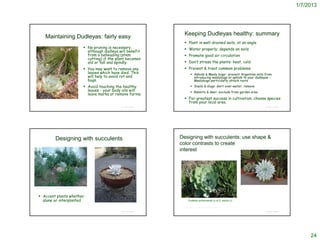
                             Designing with succulents                                                                             Designing with succulents: use shape &
                                                                                                                                   color contrasts to create
                                                                                                                                   interest


http://picasaweb.google.com/lh/photo/gXhU4_V-Hhg78Lwpg9OOZQ


     Accent plants whether
      alone or interplanted                                                                                                               Dudleya pulverulenta (l) & D. edulis (r)
                                                                     http://picasaweb.google.com/lh/photo/iiUK9e2RW16pM8msvsmB4g


                                                                                                                                     http://www.flickr.com/photos/72544341@N00/2310150657


                                                                                                          © Project SOUND                                                                     © Project SOUND


                                                                                                                                                                                                                     24
1/7/2013


           Containers, plants & mulch should complement
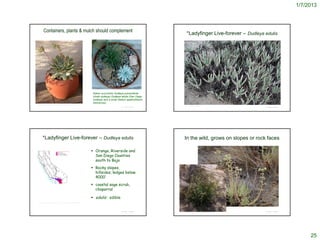
                                                                                                                                 *Ladyfinger Live-forever – Dudleya edulis


                                                                            Native succulents Dudleya pulverulenta
                                                                            (chalk dudleya) Dudleya edulis (San Diego
                                                                            dudleya) and a small Sedum spathulifolium
                                                                            (stonecrop)
http://lasmmcnps.org/images/Dudleya%20pulverulenta%202.JPG
                                                                                                                               © 2000 Salvatore Zimmitti
                                                                                                   © Project SOUND                                                                                                          © Project SOUND


         *Ladyfinger Live-forever – Dudleya edulis                                                                            In the wild, grows on slopes or rock faces

                                                                            Orange, Riverside and
                                                                             San Diego Counties
                                                                             south to Baja
                                                                            Rocky slopes,
                                                                             hillsides, ledges below
                                                                             4000’
                                                                            coastal sage scrub,
                                                                             chaparral

                                                                            edulis : edible
   http://ucjeps.berkeley.edu/cgi-bin/get_JM_treatment.pl?3284,3295,3319


                                                                                                                                          http://www.kenbowles.net/sdwildflowers/FamilyIndexes/Crassulaceae/FotoIndex.htm


                                                                                                   © Project SOUND                                                                                                          © Project SOUND
                                                                                                                        http://www.miriameaglemon.com/photogallery/Plants.htm


                                                                                                                                                                                                                                                   25
1/7/2013


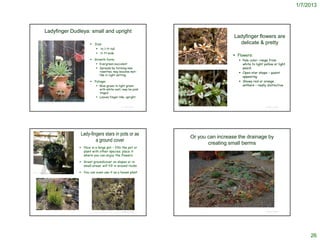
                  Ladyfinger Dudleya: small and upright
                                                                                                                                                                                                                                  Ladyfinger flowers are
                                                                Size:                                                                                                                                                              delicate & pretty
                                                                   to 1 ft tall
                                                                               1+ ft wide
                                                                                                                                                                                                                                   Flowers:
                                                                Growth form:                                                                                                                                                        Pale color- range from
                                                                          Evergreen succulent                                                   © 2005 Jasmine J. Watts                                                              white to light yellow or light
                                                                          Spreads by forming new                                                                                                                                     peach
                                                                           rosettes; may become mat-                                                                                                                                 Open star shape – quaint
                                                                           like in right setting
                                                                                                                                                                                                                                      appearing
                                                                Foliage:                                                                                                                                                            Showy red or orange
                                                                          Blue-green to light green                                                                                                                                  anthers – really distinctive
                                                                           with white cast; may be pink
                                                                           tinged
                                                                          Leaves finger-like, upright
         © 2009 Aaron Schusteff


                                                                                                                   © Project SOUND              http://www.kenbowles.net/sdwildflowers/FamilyIndexes/Crassulaceae/FotoIndex.htm                       © Project SOUND


                                                        Lady-fingers stars in pots or as
                                                                                                                                                                  Or you can increase the drainage by
                                                                a ground cover
                                                                                                                                                                         creating small berms
                                                         Nice in a large pot – fills the pot or
                                                          plant with other species; place it
                                                          where you can enjoy the flowers

                                                         Great groundcover on slopes or in
                                                          small areas; will fill in around rocks
http://www.flickr.com/photos/eastbaywilds/3526601427/    You can even use it as a house plant


                                                                                                                   © Project SOUND                                                                                                                    © Project SOUND
                                                              http://www.kenbowles.net/sdwildflowers/FamilyIndexes/Crassulaceae/FotoIndex.htm


                                                                                                                                                                                                                                                                             26
1/7/2013


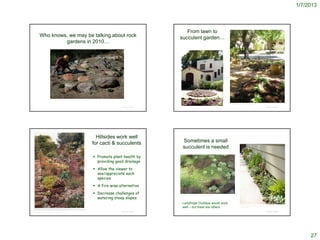
                                                                                                                              From lawn to
       Who knows, we may be talking about rock                                                                             succulent garden…
                gardens in 2010…


                                http://slosson.ucdavis.edu/documents/2005-200610656.pdf


                                                                                                                                                                                    http://www.indahbulan.com/tantenbaum.html

                                                                                                         © Project SOUND                                                                                                                      © Project SOUND


                                                                                            Hillsides work well
                                                                                          for cacti & succulents             Sometimes a small
                                                                                                                             succulent is needed
                                                                                           Promote plant health by
                                                                                            providing good drainage
                                                                                           Allow the viewer to
                                                                                            see/appreciate each
                                                                                            species
                                                                                           A fire-wise alternative
                                                                                           Decrease challenges of         http://www.hotgardens.net/succulent_cactus_gallery.htm

                                                                                            watering steep slopes
                                                                                                                            Ladyfinger Dudleya would work
                                                                                                                            well – but there are others
                                                                                                                                                                                                   http://www.apartmenttherapy.com/la/look/look-really-small-succulent-
                                                                                                                                                                                                   garden-050680


                                                                                                         © Project SOUND                                                                                                                      © Project SOUND
http://www.casperlandscape.com/22_view.html


                                                                                                                                                                                                                                                                               27
1/7/2013


                                                                                                                                                                          More small-sized Dudleyas from S. CA
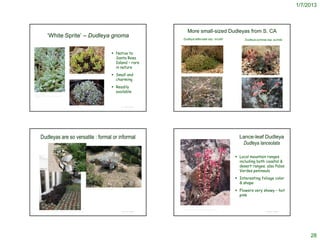
                     ‘White Sprite’ – Dudleya gnoma                                                                                                                Dudleya attenuata ssp. orcuttii                                    Dudleya cymosa ssp. pumila


                                                                                                                                         Native to
                                                                                                                                          Santa Rosa
                                                                                                                                          Island – rare
                                                                                                                                          in nature
                                                                                                                                                                 © 2006 Steve Matson

                                                                                                                                         Small and
                                                                                                                                                                                                                                    © 2006 Steve Matson
                                                                   http://commons.wikimedia.org/wiki/Dudleya_greenei


                                                                                                                                          charming
                                                                                                                                         Readily
                                                                                                                                          available
http://www.desert-
tropicals.com/Plants/Crassulaceae/Dudleya_gno
ma.html


                                                                                                                                                                 © 2006 Vince Scheidt
                                                                   http://www.yerbabuenanursery.com/viewplant.php?pid=1531                    © Project SOUND                                                                                             © Project SOUND


         Dudleyas are so versatile : formal or informal                                                                                                                                                                           Lance-leaf Dudleya
                                                                                                                                                                                                                                   Dudleya lanceolata

                                                                                                                                                                                                                                 Local mountain ranges
                                                                                                                                                                                                                                  including both coastal &
                                                                                                                                                                                                                                  desert ranges; also Palos
                                                                                                                                                                                                                                  Verdes peninsula
                                                                                                                                                                                                                                 Interesting foliage color
                                                                                                                                                                                                                                  & shape
                                                                                                                                                                                                                                 Flowers very showy – hot
                                                                                               http://kristamaxwell.com/garden/photos2.html


                                                                                                                                                                                                                                  pink

                                                                                                                                                                http://kristamaxwell.com/garden/photos2.html

                                                                                                                                                                 http://www.calflora.net/bloomingplants/lanceleafdudleya.html
       http://www.ecosalon.com/wp-content/uploads/2009/04/more-showcase-2009-023-341x455.jpg                                                  © Project SOUND                                                                                             © Project SOUND


                                                                                                                                                                                                                                                                                 28
1/7/2013


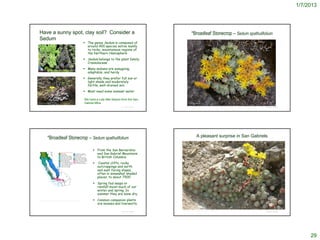
Have a sunny spot, clay soil? Consider a                                                                                          *Broadleaf Stonecrop – Sedum spathulifolium
Sedum
                                                                         The genus Sedum is composed of
                                                                          around 400 species native mainly
                                                                          to rocky, mountainous regions of
                                                                          the Northern Hemisphere
                                                                         Sedum belongs to the plant family
                                                                          Crassulaceae

http://www.villagegreenperennialnursery.com/images/sedums.jpg
                                                                         Many sedums are easygoing,
                                                                          adaptable, and hardy
                                                                         Generally they prefer full sun or
                                                                          light shade and moderately
                                                                          fertile, well-drained soil.
                                                                         Most need some summer water

                                                                        We have a cute little Sedum from the San
© 2008 Matt Below                                                       Gabriel Mtns                                         © 2003 Tim Sullivan


                                                                                                   © Project SOUND                                                             © Project SOUND


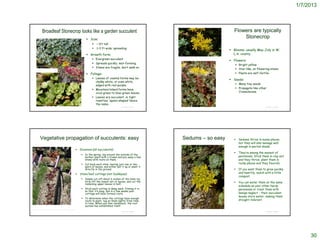
             *Broadleaf Stonecrop – Sedum spathulifolium                                                                                  A pleasant surprise in San Gabriels


                                                                               From the San Bernardino
                                                                                and San Gabriel Mountains
                                                                                to British Columbia
                                                                                  Coastal cliffs, rocky
                                                                                  outcroppings and north
                                                                                  and east facing slopes,
                                                                                  often in somewhat shaded
                                                                                  places, to about 7500’
                                                                               Spring fed seeps or
                                                                                rainfall moist much of our
                                                                                winter and spring. In
                                                                                summer they are bone dry.
http://ucjeps.berkeley.edu/cgi-bin/get_JM_treatment.pl?3284,3347,3366          Common companion plants
                                                                                are mosses and liverworts.
                                                                                                                     http://socalbutterflies.com/plants_html/sedum_spath.htm
                                                                                                   © Project SOUND                                                             © Project SOUND


                                                                                                                                                                                                      29
1/7/2013


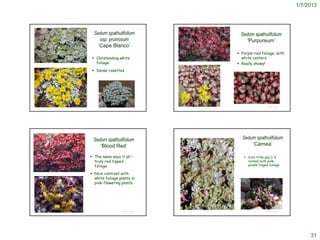
             Broadleaf Stonecrop looks like a garden succulent                                                                                                                 Flowers are typically
                                                                              Size:
                                                                                                                                                                                   Stonecrop
                                                                                 < 1ft tall
                                                                                     1-3 ft wide; spreading
                                                                                                                                                                             Blooms: usually May-July in W.
                                                                              Growth form:                                                                                   L.A. county.
                                                                                   Evergreen succulent
                                                                                                                               Gary A. Monroe @ USDA-NRCS PLANTS Database

                                                                                                                                                                             Flowers:
                                                                                   Spreads quickly; mat-forming
                                                                                                                                                                                Bright yellow
                                                                                   Stems are fragile; don’t walk on
      © 2007 Neal Kramer

                                                                                                                                                                                Star-like, on flowering stems
                                                                              Foliage:                                                                                         Plants are self-fertile
                                                                                   Leaves of coastal forms may be                                                           Seeds:
                                                                                    chalky white, or even white
                                                                                    edged with red-purple.                                                                      Many tiny seeds
                                                                                   Mountain/inland forms have                                                                  Propagate like other
                                                                                    vivid-green to blue-green leaves.                                                            Crassulaceae
                                                                                   Leaves are succulent, in tight
                                                                                    rosettes; ‘spoon-shaped’ hence
                                                                                    the name..
                                                                                                           © Project SOUND                                                                              © Project SOUND


          Vegetative propagation of succulents: easy                                                                             Sedums – so easy                                 Sedums thrive in sunny places,
                                                                                                                                                                                   but they will also manage well
                                                                                                                                                                                   enough in partial shade.
                                                                       Divisions (all succulents):
                                                                                                                                                                                  They’re among the easiest of
                                                                          In the spring, dig around the outside of the
                                                                           mother plant with a trowel and pry away a few                                                           perennials. Stick them in clay soil
                                                                           stems with roots on them.                                                                               and they thrive, plant them in
                                                                          Cut back each stem, leaving just one or two                                                             rocky places and they flourish.
                                                                           pairs of leaves, and either pot it up or plant it
                                                                           directly in the ground.                                                                                If you want them to grow quickly
                                                                       Stem/leaf cuttings (not Dudleyas):                                                                         and heartily, mulch with a little
                                                                                                                                                                                   compost.
                                                                          Simply cut off about 6 inches of the stem tip,
                                                                           strip off the lowest set of leaves, and cut the                                                        You can water them on the same
                                                                           remaining upper leaves in half.
                                                                                                                                                                                   schedule as your other hardy
                                                                          Stick each cutting in damp sand, firming it in                                                          perennials or treat them with
                                                                           so that it’s snug, and in a few weeks your
                                                                           cuttings will have formed roots.                                                                        benign neglect - their succulent
                                                                                                                                                                                   leaves store water, making them
                                                                          To determine when the cuttings have enough
                                                                           roots to plant, tug on them lightly from time                                                           drought-tolerant.
http://www.cactuscenter.com/Sedum%20reflexum.jpg
                                                                           to time. When you feel resistance, the root
                                                                           system has established itself.
                                                                                                                                 © 2007 Neal Kramer
http://www.flickr.com/photos/vsny/128010334/in/set-72057594106082534/
                                                                                                           © Project SOUND                                                                              © Project SOUND


                                                                                                                                                                                                                               30
1/7/2013


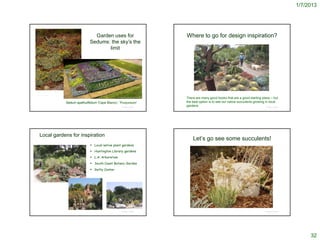
                                                                                                               Sedum spathulifolium                                                                                                              Sedum spathulifolium
                                                                                                                  ssp. pruinosum                                                                                                                   ‘Purpureum’
                                                                                                                 ‘Cape Blanco’
                                                                                                                                                                                                                                                Purple-red foliage, with
                                                                                                                Outstanding white                                                                                                               white centers
 http://www.rainyside.com/features/plant_gallery/nativeplants/Sedum_spathulifoliumCapeBlanco.html
                                                                                                                 foliage                       http://www.rainyside.com/features/plant_gallery/perennials/Sedum_spathulifoliumPurpureum.html
                                                                                                                                                                                                                                                Really showy!
                                                                                                                Dense rosettes


                                                                                                                             © Project SOUND                                                                                                                    © Project SOUND
https://appserver1.kwantlen.ca/apps/plantid/plantid.nsf/lookup/4572A7F6E488932B88256F020064A798?OpenDocument                                   http://www.findmeplants.co.uk/plant-sedum--spathulifolium-2064.aspx


                                                                                                               Sedum spathulifolium                                                                                                              Sedum spathulifolium
                                                                                                                  ‘Blood Red’                                                                                                                        ‘Carnea’

                                                                                                          The name says it all –                                                                                                                  Cute little guy (< 6
                                                                                                           truly red tipped                                                                                                                         inches) with pink-
                                                                                                           foliage                                                                                                                                  purple tinged foliage

                                                                                                          Nice contrast with
                                                                                                           white foliage plants or
                                                                                                           pink-flowering plants


                                                                                                                             © Project SOUND      http://www.forestfarm.com/product.php?id=4255                                                                 © Project SOUND


                                                                                                                                                                                                                                                                                       31
1/7/2013


                                                                    Garden uses for                                             Where to go for design inspiration?
                                                                  Sedums: the sky’s the
                                                                         limit


    © 2004, Ben Legler
                                                                                     http://www.succulent-plant.com/tufa.html
                                                                                                                                There are many good books that are a good starting place – but
                                                   Sedum spathulifolium 'Cape Blanco’, 'Purpureum'                              the best option is to see our native succulents growing in local
                                                                                            © Project SOUND
                                                                                                                                gardens                                                  © Project SOUND


        Local gardens for inspiration
                                                                                                                                     Let’s go see some succulents!
                                                                    Local native plant gardens
                                                                    Huntington Library gardens
                                                                    L.A. Arboretum
                                                                    South Coast Botanic Garden
                                                                    Getty Center


http://www.hotgardens.net/succulent_cactus_gallery.htm


                                                                                            © Project SOUND                                                                                   © Project SOUND


                                                                                                                                                                                                                     32

Native Succulents - notes

  • 1.
    1/7/2013 Out of theWilds and Into Your Garden Simply Succulent C.M. Vadheim and T. Drake CSUDH & Madrona Marsh Preserve Madrona Marsh Preserve Gardening with Western L.A. County Native Plants June 6 & 9, 2009 Project SOUND - 2009 © Project SOUND © Project SOUND It’s easy to fall in love with cacti & succulents This may (or may not) be your idea of heaven on earth http://www.dryscapes.eu/11.html http://www.cactus-mall.com/pictures/pic00024.jpg © Project SOUND © Project SOUND 1
  • 2.
    1/7/2013 But most of us have at least one place in our yards Succulents complement contemporary where cacti/succulents might be the best solution architecture... http://www.rbgsyd.nsw.gov.au/__data/assets/image/0006/73491/Succulent-Garden.jpg http://hotels.about.com/od/newmexico/ig/Sierra-Grande-Lodge/Cactus-Garden.htm http://home-and-garden.webshots.com/photo/1476610400079711680tHyVBV © Project SOUND © Project SOUND http://image61.webshots.com/161/0/69/53/520706953KNboGn_fs.jpg …and add interesting color & texture to Cacti & succulents can be valuable many types of gardens additions to water-wise gardens http://succulentplants.net/garden.htm http://paradiseenvironments.com/OutdoorLiving/outdoor_living.htm © Project SOUND © Project SOUND 2
  • 3.
    1/7/2013 Andcan be easy to grow, with minimal effort We already know that California (and Baja California) plants are special…  Our Mediterranean climate requires that plants adapt to summer drought.  One common adaptations is succulence. Modified tissues store large amounts of water, making the plant part appear fleshy, succulent, or swollen.  Species in various plant families and genera have independently evolved succulence as a mechanism for conserving water and survival in arid environments.  There are an estimated 10,000 succulent plant species throughout the world http://www.ci.poway.ca.us/Modules/ShowImage.aspx?imageid=1146 © Project SOUND © Project SOUND Several types of succulence: Most, but not all, succulent plants are from hot dry climates  Leaf Succulents: Leaves are almost entirely composed of water storage cells covered by a thin layer of green photosynthetic tissue. Examples: Stonecrop family - Aloe, Dudleya, Sedum, non-native Iceplants  Stem Succulents: Fleshy stems contain water storage cells overlaid by photosynthetic tissue. Leaves are almost or entirely absent, reducing surface area to prevent evaporative loss of water. Examples: most cacti, Euphorbias; Giant Coreopsis.  Root Succulents: Swollen fleshy roots store water underground away from the heat of the sun and hungry animals. Stems and leaves are often deciduous and shed during prolonged dry seasons. Salty Susan - Jaumea carnosa Pickleweed - Salicornia virginica Examples: Manroot (Marah), Abronia, . Combinations of the above types may occur where  Succulence developed for the same reason in more than one organ is used to store water. saltmarsh plants – to allow the plant to conserve Examples: Agave, Heliotropium curassavicum water (Seaside Heliotrope) © Project SOUND http://www.sanelijo.org/saltmarsh.html © Project SOUND 3
  • 4.
    1/7/2013 What is acactus (and how is it different Coastal S. CA has a unique plant from other succulents)? community : Southern Cactus Scrub  Cacti are a distinct plant family  Dominated by cacti and coastal sage scrub (Cactaceae). species.  They are plants of hot environments  Must be 20% or more cover of coastal prickly- pear (Opuntia littoralis) and/or Oracle cactus  They are perennial succulent plants with (Opuntia oricola). thick stems usually covered with spines. Spines are not all over the  In coastal areas, coastal cholla (Cylindropuntia/ surface but are borne in felty cushions Opuntia prolifera) may be a common called areoles.  Other common species CA Encelia, California  Sometimes mistakenly called leaves, the sagebrush, buckwheat, black sage (Salvia http://www.flickr.com/photos/liamkestrel/3383069515/ joints of prickly pears are flattened You can use the Cactus mellifera), and Mexican elderberry (Sambucus stems. True leaves, if not completely mexicana). Scrub community as absent, usually are very small and inspiration for your  The understory is frequently composed of inconspicuous and soon fall away. foothill needlegrass, bent grass (Agrostis spp.), garden and a variety of herbaceous forb species.  The more than 1500 different species of cacti are native to the  Occurs primarily on south-facing slopes on low foothills away from the immediate coast. Western Hemisphere, from Canada to Patagonia. © Project SOUND © Project SOUND The genus Optuntia Coastal Prickly-pear - Opuntia littoralis  Family: Cactaceae  Opuntia genus has two branches  Prickly Pears "Platyopuntia" (flat joints)  Chollas "Cylindropuntia" (rounded joints)  About three dozen species throughout the United States  Native to every state except Maine, Vermont and New Hampshire  Natural hybridization common  Lifespan <20 years (most short-lived of all cacti)  Main food producing cacti - both pads and fruit. © 2002 Lynn Watson © Project SOUND © Project SOUND 4
  • 5.
    1/7/2013 Chaparral Pricklypear – Opuntia oricola Yum – Pricklypears can be used in so many ways!  I’ll send out a http://farm3.static.flickr.com/2391/2383907636_378192341a.jpg?v=0 recipe sheet http://commons.wikimedia.org/wiki/Opuntia_oricola http://www.arizonagift.com/convention_mini_gifts.htm http://www.researchlearningcenter.com/bloom/species/Opuntia_oricola.htm © Project SOUND http://www.sacatomato.com/2008/06/cooking_with_diana_kennedy.html © Project SOUND Coastal Cholla – Cylindropuntia/Optuntia prolifera Cylindropuntia © 2004 Vince Scheidt http://commons.wikimedia.org/wiki/File:Opuntia4_filtered.jpg © Project SOUND © Project SOUND 5
  • 6.
    1/7/2013 Coastal Cholla – Cylindropuntia/Optuntia prolifera Coastal cacti depend on summer fogs  Pacific coast from southern California (USA) to central Baja California (Mexico)  Ocean bluffs, inland coastal sage flats, arid slopes below 600' near the coast, coastal sage scrub http://ucjeps.berkeley.edu/cgi-bin/get_JM_treatment.pl?2702,2726,2749  It’s name (prolifera) describes how it grows – with many offshoots Gary A. Monroe @ USDA-NRCS PLANTS Database © Project SOUND © Project SOUND Coastal Cholla is a medium-sized cactus But they really are quite drought tolerant  Size:  4-8 ft tall  to 8 ft wide  Growth form:  Tree-like or shrubby cactus  Extensive branching; branches are cylindrical  Branches blue-green when young; covered with darker bark when older  Foliage:  None that is permanent  Spines and glochids typical of http://www.researchlearningcenter.com/bloom/species/Opuntia_prolifera.htm Opuntia-type cacti © 2004 Vince Scheidt © Project SOUND © Project SOUND 6
  • 7.
    1/7/2013 Flowers are fantastic Cactus flowers: unique and showy  Blooms:  Showy, colorful petals – attract insect  Spring-summer pollinators;  Usually Apr-June or July  many different insects visit the flowers  Flowers open over several  bees are most common pollinators weeks  Sweet-scented (many)  Flowers:  Male (stamen) organs can move toward  Small (for cactus) – 1-2 inches the center of the flowers when touched  Magenta to dark (burgandy) red (thigmotropic).  Very bright & showy  Happens very quickly on a hot day  Seeds:  Explanation:  Often sterile – we’ll learn why  May force pollen onto the bodies of pollinators (bees) to assist in cross in a second pollination  ? Role in getting flowers pollinated quickly  Vegetative reproduction: so excess energy not spent in reproduction?  Most common means of  ? keeps non-pollinators from ‘stealing’ the http://www.calflora.net/bloomingplants/coastcholla.html reproduction; segments break pollen? http://www.researchlearningcenter.com/bloom/species/Opuntia_prolifera.htm off easily © Project SOUND http://www.timetotrack.com/jay/chollac2.htm © Project SOUND Opuntia fruits are often fleshy, brightly colored Growth requirements for  Soils:  Texture: well-drained soils;  Adapted for hot, dry local Opuntia-type Cacti sandy or gravelly/rocky the conditions best  Keep seed/embryo moist &  pH: any local, including alkali protected during seed development  Light:  Attract birds/animals once  Full sun in most gardens seed is ready to spread  Some afternoon shade fine in  Develop sweet flesh very hot gardens  Color becomes more dark- red/purple once seeds are  Water: fully developed  Winter: winter rains usually  This cholla has sterile seeds adequate  Sterile hybrid – probably  Summer: likes to be fairly dry between several species now found only in Mexico (C. (Zones 1 to 1-2; Zone 2 in pots) alcahes X C. cholla ) http://ucbglcs.blogspot.com/  Note: fruits are green – not  Fertilizer: none; likes poor soils red – and not particularly good to eat http://www.cactiguide.com/forum/viewtopic.php?t=6342  Other: use a rock mulch, if any © Project SOUND © Project SOUND http://www.sanpedrorivervalley.org/old_road_byway.htm 7
  • 8.
    1/7/2013 Garden uses for local Opuntia-type cacti Some people use  Good choice for coastal habitat gardens Opuntia-type cacti  Habitat for coastal cactus wren (rare)  Insects and hummingbirds drawn to for hedges flowers  Birds and mammals eat the fruits  Some mammals/lizards actually live http://www.backtonatives.org/nativelandscapes.htm http://www.cnr.vt.edu/DENDRO/dendrology/Syllabus2/factshee t.cfm?ID=792 in/near to cacti for protection  For their food value  In a cactus/desert style garden And they work pretty  In large planters/containers well  As accent plants in dry areas of the garden – placement is key  Excellent choice for hillsides  As a barrier or hedge plant © Project SOUND http://content.ci.pomona.ca.us/cdm4/item_viewer.php?CISOROOT=/Frasher&CISOPTR=6863&CISOBOX=1&REC=20 © Project SOUND http://www.researchlearningcenter.com/bloom/species/Opuntia_prolifera.htm You may have heard of ‘Jumping Chollas’ Golden-spined Cereus – Bergerocactus emoryi  Don’t not really jump.  The barbed spines allow them to seize the passer-by and "disarticulate readily" from the mother plant.  This allows the plant http://www.graci.com/photoday.htm to spread widely by vegetative propagation  Bottom line: consider garden placement of cacti carefully © 2006 Vince Scheidt © Project SOUND © Project SOUND http://home-and-garden.webshots.com/photo/1053071767036424719YtiPgK 8
  • 9.
    1/7/2013 Golden-spined Cereus – Bergerocactus emoryi In nature: Catalina Island  San Clemente Island, Santa Catalina Island, Coastal Orange Co., southern San Diego Co.  AKA ‘Goldensnake cactus’ http://ucjeps.berkeley.edu/cgi-bin/get_JM_treatment.pl?2702,2703,2704 © 2006 Vince Scheidt © Project SOUND © Project SOUND Characteristics of Golden-spined Cereus Flowers are showy  Size:  Blooms:  1-2 ft tall  Late spring – typical for coastal cacti  3-5+ ft wide; spreading  Usually Apr-Jul. in our area  Growth form:  Flowers:  Evergreen cactus  Lovely lemon yellow  Many upright, cylindrical stems  ~ 2” wide  Long bloom period – open  Foliage: over a period of time  No leaves  Showy indeed!  Fragile, glass-like spines - many  Fruits: red, globular, sweet; loved by birds, animals  Vegetative reproduction: yes © 2005 Dieter Wilken © 2007 John M. Taylor © Project SOUND © Project SOUND © 2007 John M. Taylor 9
  • 10.
    1/7/2013 Garden uses for Plant Requirements  Soils:  Texture: any local; well- smaller native cacti drained is better  pH: any local  Attractive as pot plants  Light: full sun to light shade  In a cactus/succulent garden  Water:  In a local coastal garden with  Winter: likes good winter it’s natural associates: Coyote rains; supplement if needed Bush, Sticky Monkeyflower, © 2007 Halleh Paymard  Summer: like to be dry in Lemonadeberry, local native summer: Zone 1-2 probably grasses and annual wildflowers optimal  Note: plant is rare in CA, still  Fertilizer: none; likes poor soils common in Baja  Other: inorganic mulch  Fire-retardant plant http://cactiguide.com/Bergerocactus.htm © Project SOUND © Project SOUND Propagating cacti from cuttings – easy (at Be careful of all the spiny structures when least in theory) working with cacti  Carefully remove a pad or offset  The glochids get into (cut or pull off) your skin and are very irritating. If you cannot  Let the wound callus over (a get them out, you end up week to up to a month) with something that resembles an infected  Place pad (wounded side down) in mosquito bite. potting mix (I use commercial mix with added perlite or sand)  Preferred method of removal: apply sticky  Place in bright shade tape to them and lift  Water when soil begins to dry them out. Glochids are out generally too fine to be grasped with tweezers.  Wait – may take a while © Project SOUND © Project SOUND 10
  • 11.
    1/7/2013 Purchasingnative cacti & succulents Local cacti, Yucca & Agaves are great for those out-of-the way slopes  Many native species are rare or endangered  Never collect in nature without a permit  Buy only from http://calplants.biz/yuccawhipplei.html reputable dealers © 2006 Vince Scheidt © 2006 Vince Scheidt © Project SOUND © Project SOUND *Our Lord’s Candle – Hesperoyucca (Yucca) whipplei Yuccas – the genus Yucca  There are at least 50 species of Yucca within the Agavaceae - numerous subspecies, varieties, forms, cultivars and hybrids.  Occur exclusively in the Americas, distributed over a wide area from Canada into Central America and the Carribean  There are species adapted to dry deserts, grasslands and tropical rainforests.  All but one species (Y. whipplei) can flower many times (polycarpic) and produce side-shoots to compensate for loss of the apical growing point by its conversion into a flower bud. http://www.researchlearningcenter.com/bloom/species/Yucca_whipplei.htm © 2003 BonTerra Consulting © Project SOUND © Project SOUND 11
  • 12.
    1/7/2013 Yuccas are pollinated by The Agaves – genus Agave special ‘Yucca Moths’  Closely related to the Yuccas – both in  Self pollination of Yucca Agavaceae Family flowers of many species is impossible, although a few are  Agaves are not cacti (or even closely self-fertile. related to cacti) - are closely related to the lily and amaryllis families  Most Yuccas are pollinated  Primarily from Mexico, but also occur exclusively by small Yucca in the southern and western United moths with the plant and moth States and central and tropical South totally dependent on each America. other.  Have a large rosette of thick fleshy  Recent research has shown that leaves, each ending generally in a sharp there are at least 16 different point and with a spiny margin; Yucca Moths (Tegeticula  The stout stem (caudex) is usually species) - all are specialized in short - the leaves appear to arise pollinating their "own" Yucca from the root. species. http://www.calflora.net/bloomingplants/chaparralyucca.html We’ll be talking about Yucca another time http://www.desert-tropicals.com/Plants/Agavaceae/Agave_shawii.html G.A. Cooper @ USDA-NRCS PLANTS Database © Project SOUND © Project SOUND The Agaves – genus Agave *Coastal Agave – Agave shawii  Popular ornamental plants.  Each rosette grows slowly to flower only once. During flowering a tall stem or "mast" grows from the center of the leaf rosette and bears a large number of shortly tubular flowers.  After development of fruit the original plant dies, but suckers are frequently produced from the base of the stem which become new plants.  Agave species are used as food plants by the larvae of some Lepidoptera (butterfly and moth) species http://www.oceanoasis.org/fieldguide/agav-sha.html © 2005 Vince Scheidt © Project SOUND © Project SOUND 12
  • 13.
    1/7/2013 *Coastal Agave – Agave shawii Shaw’s Agave in maritime shrub community  Pacific coast from S. San Diego Co. to Baja  Grows immediate to the coast, often in sandy soils  coastal bluffs and slopes  coastal sage scrub community  maritime succulent scrub community  Grows with many of our local native plants, including Golden- http://ucjeps.berkeley.edu/cgi-bin/get_JM_treatment.pl?8349,8350,8352 spine Cereus  Habitat is often quite low & open © 2005 Vince Scheidt © Project SOUND © Project SOUND Plant associates include many from our Shaw’s Agave – stunning in the right place coastal shrub & prairie communities  Size:  2-3 ft tall (rosette); flowering stalk much taller (15-40 ft. tall)  3-6 ft wide  Growth form:  Clumping evergreen succulent  Spreads by suckering from the caudex (produces ‘pups’)  Very showy & unusual http://www.pitzer.edu/offices/arboretum/scott_lawn/desert.html  Foliage:  Leaf color: varies from dark blue-green to yellow-green  Stout sharp tip-spine as well as curved leaf margin spines – place away from walkways, etc. © 2005 Vince Scheidt © Project SOUND © 2006 Steve Matson © Project SOUND http://www.geographylists.com/sandiegoplants.html 13
  • 14.
    1/7/2013 What a show when Agaves bloom!!  Blooms:  Variable; almost any time of year in western L.A. Co.  Takes about 15 years to flower  Flowers:  On stout tall flowering stalk  Showy, bright yellow flowers  Attract a number of insects, including moths  Seeds:  Flat, black seeds in thick pod  Can grow agaves from seed – may have many infertile seeds  Vegetative reproduction: usually many ‘pups’ to replace the plant that just flowered. http://www.delange.org/AgaveCoastal/AgaveCoastal.htm © Project SOUND © Project SOUND Growing Agaves  Soils: Agaves make great  Texture: any as long as - well-drained soil drainage is good; love sandy, accent plants rocky soils  pH: any local except low pH (<6)  In very large pots/planters – remember, these are  Light: large plants  Coastal – full sun  Hot, inland gardens – light  Look wonderful in (afternoon) shade hillsides/slopes http://www.delange.org/AgaveCoastal/AgaveCoastal.htm  Water:  Looks equally at home with  Winter: needs good drainage; other cacti & succulents – plant on slopes, or other well- or with coastal drained situations prairie/shrubland plants  Summer: Like to be fairly dry  Good player in a rock (Zone 1-2; water several times per summer); no overhead garden water  Excellent accent against  Fertilizer: none; like poor soils gray-green foliage © Project SOUND © Project SOUND http://www.sbbg.org/index.cfm?fuseaction=livingcollections.plantDetail&plant_id=28 14
  • 15.
    1/7/2013 Agave & Yucca as food and fiber Agave attenuata: a Mexican species available in the U.S. http://www.howka.com/scrapbook/ciba_2005/ http://www.cowboyshowcase.com/glossary%20personalgear.htm http://media.photobucket.com/image/Tequila/ccerna/tequila.jpg  Flowers, leaves & stem are edible http://www.so-utah.com/feature/anasazi/homepage.html http://www.nps.gov/zion/historyculture/yucca-sandal.htm http://www.geographylists.com/sandiegoplants.html http://www.cactusjungle.com/blog/2008/09/30/berkeley-succulent-garden-3/ © Project SOUND © Project SOUND Agave ‘Blue Flame’ Cacti & succulents from Baja & other parts of Mexico, SW U.S.  Combines the features of its parent species: A. shawii X A. attenuata http://www.smgrowers.com/products/plants/plantdisplay.asp?plant_id=2871 http://museum.utep.edu/chih/gardens/succulen/succulen.htm Lots of wonderful species – but are they right for my yard? http://www.huntington.org/BotanicalDiv/ISI2005/isi/2005-06.html © Project SOUND © Project SOUND 15
  • 16.
    1/7/2013 Usingspecies from CA & SW desert regions The same advice goes for  Contrary to popular belief, succulents from other places western L.A. county is not ‘a desert’  Know as much as you can about  Challenges for using desert their requirements cacti/succulents:  Be sure that you group  Soil must be well-drained compatible plants – just because  Wet years and fog may kill they are succulent doesn’t mean the plants – fungal http://www.gardeninggonewild.com/?p=3666 they have the same requirements diseases  Some species (from Sonoran Desert – in south) need a ‘summer monsoon’ period – you’ll have to give them it  Advice:  Learn as much as you can about the requirements/ habitat of a species before you purchase it  Be really careful in http://www.nps.gov/cagr/forkids/the-sonoran-desert.htm planning your©Water Zones Project SOUND http://sdccs-oasis.blogspot.com/2008/02/bring-your-succulent-cuttings-your-old.html © Project SOUND http://gorp.away.com/gorp/resource/us_nm/top-national-monuments-7.html Our local climate allows us to grow special succulents The Stonecrop Family: Crassulaceae – the Dudleyas  ~ 1500 species  Most genera exhibit some leaf succulence  Many species are used widely as garden and house plants Examples:  The genus Crassula includes the well-known Jade http://www.southampton.bcss.org.uk/images/image145.jpg Plants and other small sub-shrubs, choice minatures and mat-forming plants. Echeverias  Cotyledon includes interesting shrubby species with succulent stems and leaves. Some species have showy tubular yellow, orange or red flowers.  Echeverias are often used in rock gardens and indoor plants.  Kalanchoe includes plants with showy flowers. Dudleyas thrive in our mild,  Sedums are well known for hardy mat-forming Stonecrops which provides useful flower color in coastal-influenced the garden in late summer and early autumn. Mediterranean climate © Project SOUND Kalanchoe © Project SOUND 16
  • 17.
    1/7/2013 The Live-forevers: genus Dudleya Many Dudleyas have small or threatened distribution: some are very rare  Named for William Russel Dudley (1849- 1911), first professor of botany and head of the Botany Department at Stanford University  ~ 40 species; native to the arid western Dudleya greenii – a Channel United States (in particular, Southwest/ Islands endemic Northern California and Oregon), Baja California.  Very similar in appearance to other Stonecrops (sempervivum; sedum; echeveria). Like many California native plants, dudleyas are now considered http://commons.wikimedia.org/wiki/File:William_Rus sell_Dudley_(1849-1911).jpg   Often grow in stone crevasses or sand rare, threatened or endangered, depending on the species. All are protected by law, making it illegal to remove any plants from their dunes with little or no organic soil. natural habitat.  Long-lived (to 100+ years for some  More are coming into cultivation – but many still are not available species) hence the common name © Project SOUND © Project SOUND Taxonomic confusion: is that an Dudleya flowers are slightly different Echeveria or a Dudleya? http://www.collectorscorner.com.au/Cacti/Echeveri a%20main.htm Echeveria Dudleya  Quite similar-looking; but with a few important differences  Dudleya flowers arise from somewhere near the bottom of  Several local species were formerly included in Echeveria: the rosettes normally (rarely from the rosette center as  Canyon Live-forever – Dudleya cymosa most Echeveria flowers do).  Chalk Dudleya – Dudleya pulverulenta  Ladyfinger Dudleya – Dudleya edulis  Dudleyas & Echeverias do not form hybrids between the 2 genera; Dudleyas only interbreed with other Dudleyas © Project SOUND © Project SOUND 17
  • 18.
    1/7/2013 So…it’s recommended to NOT combine both in But the real difference – and the most important for the same part of the garden gardeners – relates to their history  Summer watering of Dudleyas  Dudleyas should be very occasional: they are  Native to the ‘Pacific Plate’  Adapted to rainy winters & hot, dry very summer ‘water-wise’ compared summers to Echeverias  Winter-growing; summer dormant  Can kill them with too much summer  Most Dudleyas & Echeverias do best in water well-drained soils; gravelly/sandy  Echeverias  The roots of some Dudleya species do Dudleya virens ssp hassei  Native to the ‘North American Plate’ not absorb moisture well in the high  Adapted to rainy summers & dry winters heat; water simply rots the roots  Summer growing; winter dormant  Can kill them with too much winter (susceptible to root rot fungi). water  Treat as Zone 1-2 (water only several times a summer & not at summer’s end) The two genera have been separated for long enough that each is very well adapted to its  Dudleyas in very well-drained soils own environment (sandy) or in pots should be treated as © Project SOUND http://www.smgrowers.com/products/plants/plantdisplay.as Zone 2 © Project SOUND p?plant_id=538  Dudleyas can also rot from the Container gardens – allow you to provide crown or leaves, particularly if water is left sitting on the delicate just the right conditions leaves (some are more sensitive than others). Dudleya virens ssp hassei  Either avoid getting water on the leaves, or plant them at angles so the water runs off.  In nature, many species grow naturally on cliff faces and steep slopes so water cannot sit on these plants.  Excess water also attracts snails and slugs – which love Dudleyas http://www.smgrowers.com/products/plants/plantdisplay.as p?plant_id=538 Bottom line: best to not combine Dudleyas with succulents that have very different water requirements (Echeverias; Sedums; etc.) SOUND © Project http://slosson.ucdavis.edu/documents/2005-200610656.pdf © Project SOUND 18
  • 19.
    1/7/2013 Bright Green Dudleya – Dudleya virens ssp hassei Bright Green Dudleya – Dudleya virens ssp insularis © Project SOUND © Project SOUND Bright Green Dudleya – Dudleya virens Characteristics of ssp. hassei  Size:  Two local subspecies:  < 6 in. tall  ssp. hassei – Catalina  1-2 ft wide  ssp. insularis – Palos  Growth form: Verdes, S. Channel  Spreading clump of Islands succulent rosettes  Evergreen; dries in  On steep slopes in summer chaparral, coastal bluff scrub, and  Foliage:  Succulent, cylindrical coastal sage scrub leaves habitats below 1000  Color: blue-green to more http://ucjeps.berkeley.edu/cgi-bin/get_JM_treatment.pl?Dudleya+virens ft. yellow-green  Flowers: pale yellow on pale pink stalk © Project SOUND © Project SOUND http://commons.wikimedia.org/wiki/Dudleya_virens 19
  • 20.
    1/7/2013 Characteristics of ssp. insularis Dudleya flowers are  Size: a bit bigger usually showy  ~ 1 ft tall  Blooms:  1-2+ ft wide  Generally are mid-late spring- bloomers  Growth form:  Usually Apr-June even July in  Spreading clump of succulent S. Bay rosettes  Evergreen; dries in summer  Flowers:  In general small; < ¾ inch  Foliage:  Many flowers on flowering  Succulent, cylindrical leaves stems held above or away from  Color: blue-green to more the foliage yellow-green; usually more  Often yellow, orange, pink or glaucus (white farina) than red; may be pale or bright ssp. hassei  Often light fragrance  Flowers: pale pink-yellow on  Great hummingbird flowers! © 2003 BonTerra Consulting brighter pink stalk © Project SOUND © Project SOUND Plant Requirements  Soils: Dudleyas in the  Texture: best in light, well- for Dudleya virens drained soil, but can succeed in garden many gardens  pH: any local  Attractive pot plants  Light:  Good for succulent  Full sun only in coastal area ground-covers (best in  Light shade (afternoon shade) in hotter inland gardens; needs small areas; smaller enough sun for good color, shape http://www.smgrowers.com/products/plants/plantdisplay.asp?plant_id=2987 varieties (spp. hassei) work best)  Water:  Winter: needs good winter rains  Excellent choice for rock  Summer: keep fairly dry – Zone gardens, dry-stone walls, 1-2 best retaining walls  Fertilizer: likes poor soils; can lightly fertilize (1/5 strength) in  Bordering paths or in winter (esp. in pots) fronts of dry beds © 2005 BonTerra Consulting © Project SOUND  On hillsides, slopes © Project SOUND 20
  • 21.
    1/7/2013 Growing Dudleyas in containers Other considerations for growing Dudleyas  Dudleyas grow well in pots and  Bright light is integral to the proper make excellent outdoor growth of this genus. specimens in Mediterranean  Plants grown in low-light will lose their climates. color, grow tall and spindly and will eventually die.  Potting soil should be very well- draining; amend potting soils with  Most Dudleyas make poor houseplants sharp sand and pumice to insure good drainage.  Most Dudleyas do best with moderate temperatures - protect from  Watering: treat as Zone 2; blistering afternoon heat, frosts monitor carefully in hot weather (particularly if in pots)  Light: afternoon shade or bright  Potting soil should be very well- shade best draining; use a cactus mix or amend Dudleya farinosa  Propagation: easiest by removing available soils with sharp sand and rooted offsets (pups), but can be pumice to insure good drainage. from seed © Project SOUND © Project SOUND Chalk Dudleya – Dudleya pulverulenta ssp. pulverulenta Chalk Dudleya – Dudleya pulverulenta ssp. pulverulenta  Coastal regions from San Luis Obispo south into Baja  Locally in Santa Monica Mtns., western San Gabriels  Rocky cliffs and canyons below 3000 feet http://ucjeps.berkeley.edu/cgi-bin/get_JM_treatment.pl?3284,3295,3327,3329  Coastal sage scrub, chaparral http://www.researchlearningcenter.com/bloom/species/Dudleya_pulverulenta.htm © Project SOUND © Project SOUND 21
  • 22.
    1/7/2013 Chalk Dudleya is very Echeveria-like Striking, large plant in the Santa Monica Mtns  Size:  1-2 ft tall  1-2 ft wide (flower stalks wider)  Growth form:  Evergreen succulent  Becomes somewhat dry in summer  Foliage:  Leaves flat, end in sharp tips  completely covered with a mealy white powder - hence "pulverulenta" or "powdery."  Stem (caudex) becomes thickened with age – more so http://www.researchlearningcenter.com/bloom/species/Dudleya_pulverulenta.htm than other species http://www.wildflower.org/plants/result.php?id_plant=DUPU © Project SOUND © Project SOUND http://www.anniesannuals.com/plants/plant_display.asp?prodid=1536&account=none Flowers are like no others: dramatic! Why Crassulaceae are called ‘Stonecrops’  Blooms: spring/early summer; typical for Dudleyas  Flowers:  On long flowering stalks – plan accordingly http://farm4.static.flickr.com/3003/2606066487_0aaaf1ed09.jpg?v=0  Note hummingbird-plant features:  Red color;  Shape;  Flowers held away from plant to allow access  Heavy duty, sweet nectar http://www.laspilitas.com/garden/Anna%27s_Hummingbird_on_chalk_dudlea.jpg http://www.ubcbotanicalgarden.org/potd/2006/02/sedum_spathulifolium.php http://www.timetotrack.com/jay/dudleyc5.htm © Project SOUND © Project SOUND 22
  • 23.
    1/7/2013 Give them what Be creative with rocks they like… & Dudleyas  Plant them in/near rocks  Sometimes man-made stone http://www.flickr.com/photos/eastbaywilds/241664905/  Naturally occurring structures are perfect  Local boulders brought in to Dudleya pulverulenta add interest places for Dudleyas  Plant them on slopes – or http://img4.sunset.com/i/2009/04/dream-gardens-stone-seat-l.jpg plant the rosette at an angle rather than horizontal  Water only occasionally during summer – Zone 1-2 about right  No overhead water in summer http://www.flickr.com/photos/93452909@N00/191287029/ http://www.marrsandersen.com/California-plants/California- D. virens ssp. hassei © Project SOUND http://www.flickr.com/photos/eastbaywilds/241665013/in/photostream/ plants-Pages/Image28.html © Project SOUND Silver Dollar Plant Dudleya ‘Palos Verdes’ – a lucky accident Dudleya brittonii  Probably hybrid : D.  Baja native; widely pulverulenta X D. brittonii available in native plant nurseries  Good characteristics of both parents  Large rosette - > 1 ft. diameter http://www.hotgardens.net/succulent_cactus_gallery.htm  Brilliant white color; extremely showy  Requires excellent drainage:  Sandy or rocky soil  Niches in rock walls  Clay pots with well- drained soil http://www.smgrowers.com/products/plants/plantdisplay.asp?plant_id=3232 © Project SOUND © Project SOUND http://image54.webshots.com/154/5/90/28/539959028nsjBLY_fs.jpg 23
  • 24.
    1/7/2013 Keeping Dudleyas healthy: summary Maintaining Dudleyas: fairly easy  Plant in well-drained soils, at an angle  No pruning is necessary,  Water properly; depends on soils although dudleya will benefit from a beheading (stem  Promote good air circulation cutting) if the plant becomes old or tall and spindly.  Don’t stress the plants: heat, cold  You may want to remove any  Prevent & treat common problems: leaves which have died. This  Aphids & Mealy bugs: prevent Argentine ants from will help to avoid rot and introducing mealybugs or aphids to your dudleyas - bugs. Mealybugs particularly attack roots  Avoid touching the healthy  Snails & slugs: don’t over-water; remove leaves - your body oils will  Rabbits & deer: exclude from garden area leave marks or remove farina.  For greatest success in cultivation, choose species from your local area. © Project SOUND © Project SOUND Designing with succulents Designing with succulents: use shape & color contrasts to create interest http://picasaweb.google.com/lh/photo/gXhU4_V-Hhg78Lwpg9OOZQ  Accent plants whether alone or interplanted Dudleya pulverulenta (l) & D. edulis (r) http://picasaweb.google.com/lh/photo/iiUK9e2RW16pM8msvsmB4g http://www.flickr.com/photos/72544341@N00/2310150657 © Project SOUND © Project SOUND 24
  • 25.
    1/7/2013 Containers, plants & mulch should complement *Ladyfinger Live-forever – Dudleya edulis Native succulents Dudleya pulverulenta (chalk dudleya) Dudleya edulis (San Diego dudleya) and a small Sedum spathulifolium (stonecrop) http://lasmmcnps.org/images/Dudleya%20pulverulenta%202.JPG © 2000 Salvatore Zimmitti © Project SOUND © Project SOUND *Ladyfinger Live-forever – Dudleya edulis In the wild, grows on slopes or rock faces  Orange, Riverside and San Diego Counties south to Baja  Rocky slopes, hillsides, ledges below 4000’  coastal sage scrub, chaparral  edulis : edible http://ucjeps.berkeley.edu/cgi-bin/get_JM_treatment.pl?3284,3295,3319 http://www.kenbowles.net/sdwildflowers/FamilyIndexes/Crassulaceae/FotoIndex.htm © Project SOUND © Project SOUND http://www.miriameaglemon.com/photogallery/Plants.htm 25
  • 26.
    1/7/2013 Ladyfinger Dudleya: small and upright Ladyfinger flowers are  Size: delicate & pretty  to 1 ft tall  1+ ft wide  Flowers:  Growth form:  Pale color- range from  Evergreen succulent © 2005 Jasmine J. Watts white to light yellow or light  Spreads by forming new peach rosettes; may become mat-  Open star shape – quaint like in right setting appearing  Foliage:  Showy red or orange  Blue-green to light green anthers – really distinctive with white cast; may be pink tinged  Leaves finger-like, upright © 2009 Aaron Schusteff © Project SOUND http://www.kenbowles.net/sdwildflowers/FamilyIndexes/Crassulaceae/FotoIndex.htm © Project SOUND Lady-fingers stars in pots or as Or you can increase the drainage by a ground cover creating small berms  Nice in a large pot – fills the pot or plant with other species; place it where you can enjoy the flowers  Great groundcover on slopes or in small areas; will fill in around rocks http://www.flickr.com/photos/eastbaywilds/3526601427/  You can even use it as a house plant © Project SOUND © Project SOUND http://www.kenbowles.net/sdwildflowers/FamilyIndexes/Crassulaceae/FotoIndex.htm 26
  • 27.
    1/7/2013 From lawn to Who knows, we may be talking about rock succulent garden… gardens in 2010… http://slosson.ucdavis.edu/documents/2005-200610656.pdf http://www.indahbulan.com/tantenbaum.html © Project SOUND © Project SOUND Hillsides work well for cacti & succulents Sometimes a small succulent is needed  Promote plant health by providing good drainage  Allow the viewer to see/appreciate each species  A fire-wise alternative  Decrease challenges of http://www.hotgardens.net/succulent_cactus_gallery.htm watering steep slopes Ladyfinger Dudleya would work well – but there are others http://www.apartmenttherapy.com/la/look/look-really-small-succulent- garden-050680 © Project SOUND © Project SOUND http://www.casperlandscape.com/22_view.html 27
  • 28.
    1/7/2013 More small-sized Dudleyas from S. CA ‘White Sprite’ – Dudleya gnoma Dudleya attenuata ssp. orcuttii Dudleya cymosa ssp. pumila  Native to Santa Rosa Island – rare in nature © 2006 Steve Matson  Small and © 2006 Steve Matson http://commons.wikimedia.org/wiki/Dudleya_greenei charming  Readily available http://www.desert- tropicals.com/Plants/Crassulaceae/Dudleya_gno ma.html © 2006 Vince Scheidt http://www.yerbabuenanursery.com/viewplant.php?pid=1531 © Project SOUND © Project SOUND Dudleyas are so versatile : formal or informal Lance-leaf Dudleya Dudleya lanceolata  Local mountain ranges including both coastal & desert ranges; also Palos Verdes peninsula  Interesting foliage color & shape  Flowers very showy – hot http://kristamaxwell.com/garden/photos2.html pink http://kristamaxwell.com/garden/photos2.html http://www.calflora.net/bloomingplants/lanceleafdudleya.html http://www.ecosalon.com/wp-content/uploads/2009/04/more-showcase-2009-023-341x455.jpg © Project SOUND © Project SOUND 28
  • 29.
    1/7/2013 Have a sunnyspot, clay soil? Consider a *Broadleaf Stonecrop – Sedum spathulifolium Sedum  The genus Sedum is composed of around 400 species native mainly to rocky, mountainous regions of the Northern Hemisphere  Sedum belongs to the plant family Crassulaceae http://www.villagegreenperennialnursery.com/images/sedums.jpg  Many sedums are easygoing, adaptable, and hardy  Generally they prefer full sun or light shade and moderately fertile, well-drained soil.  Most need some summer water We have a cute little Sedum from the San © 2008 Matt Below Gabriel Mtns © 2003 Tim Sullivan © Project SOUND © Project SOUND *Broadleaf Stonecrop – Sedum spathulifolium A pleasant surprise in San Gabriels  From the San Bernardino and San Gabriel Mountains to British Columbia  Coastal cliffs, rocky outcroppings and north and east facing slopes, often in somewhat shaded places, to about 7500’  Spring fed seeps or rainfall moist much of our winter and spring. In summer they are bone dry. http://ucjeps.berkeley.edu/cgi-bin/get_JM_treatment.pl?3284,3347,3366  Common companion plants are mosses and liverworts. http://socalbutterflies.com/plants_html/sedum_spath.htm © Project SOUND © Project SOUND 29
  • 30.
    1/7/2013 Broadleaf Stonecrop looks like a garden succulent Flowers are typically  Size: Stonecrop  < 1ft tall  1-3 ft wide; spreading  Blooms: usually May-July in W.  Growth form: L.A. county.  Evergreen succulent Gary A. Monroe @ USDA-NRCS PLANTS Database  Flowers:  Spreads quickly; mat-forming  Bright yellow  Stems are fragile; don’t walk on © 2007 Neal Kramer  Star-like, on flowering stems  Foliage:  Plants are self-fertile  Leaves of coastal forms may be  Seeds: chalky white, or even white edged with red-purple.  Many tiny seeds  Mountain/inland forms have  Propagate like other vivid-green to blue-green leaves. Crassulaceae  Leaves are succulent, in tight rosettes; ‘spoon-shaped’ hence the name.. © Project SOUND © Project SOUND Vegetative propagation of succulents: easy Sedums – so easy  Sedums thrive in sunny places, but they will also manage well enough in partial shade.  Divisions (all succulents):  They’re among the easiest of  In the spring, dig around the outside of the mother plant with a trowel and pry away a few perennials. Stick them in clay soil stems with roots on them. and they thrive, plant them in  Cut back each stem, leaving just one or two rocky places and they flourish. pairs of leaves, and either pot it up or plant it directly in the ground.  If you want them to grow quickly  Stem/leaf cuttings (not Dudleyas): and heartily, mulch with a little compost.  Simply cut off about 6 inches of the stem tip, strip off the lowest set of leaves, and cut the  You can water them on the same remaining upper leaves in half. schedule as your other hardy  Stick each cutting in damp sand, firming it in perennials or treat them with so that it’s snug, and in a few weeks your cuttings will have formed roots. benign neglect - their succulent leaves store water, making them  To determine when the cuttings have enough roots to plant, tug on them lightly from time drought-tolerant. http://www.cactuscenter.com/Sedum%20reflexum.jpg to time. When you feel resistance, the root system has established itself. © 2007 Neal Kramer http://www.flickr.com/photos/vsny/128010334/in/set-72057594106082534/ © Project SOUND © Project SOUND 30
  • 31.
    1/7/2013 Sedum spathulifolium Sedum spathulifolium ssp. pruinosum ‘Purpureum’ ‘Cape Blanco’  Purple-red foliage, with  Outstanding white white centers http://www.rainyside.com/features/plant_gallery/nativeplants/Sedum_spathulifoliumCapeBlanco.html foliage http://www.rainyside.com/features/plant_gallery/perennials/Sedum_spathulifoliumPurpureum.html  Really showy!  Dense rosettes © Project SOUND © Project SOUND https://appserver1.kwantlen.ca/apps/plantid/plantid.nsf/lookup/4572A7F6E488932B88256F020064A798?OpenDocument http://www.findmeplants.co.uk/plant-sedum--spathulifolium-2064.aspx Sedum spathulifolium Sedum spathulifolium ‘Blood Red’ ‘Carnea’  The name says it all –  Cute little guy (< 6 truly red tipped inches) with pink- foliage purple tinged foliage  Nice contrast with white foliage plants or pink-flowering plants © Project SOUND http://www.forestfarm.com/product.php?id=4255 © Project SOUND 31
  • 32.
    1/7/2013 Garden uses for Where to go for design inspiration? Sedums: the sky’s the limit © 2004, Ben Legler http://www.succulent-plant.com/tufa.html There are many good books that are a good starting place – but Sedum spathulifolium 'Cape Blanco’, 'Purpureum' the best option is to see our native succulents growing in local © Project SOUND gardens © Project SOUND Local gardens for inspiration Let’s go see some succulents!  Local native plant gardens  Huntington Library gardens  L.A. Arboretum  South Coast Botanic Garden  Getty Center http://www.hotgardens.net/succulent_cactus_gallery.htm © Project SOUND © Project SOUND 32