1/6/2013


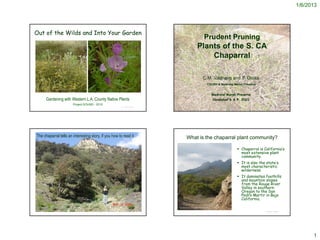
Out of the Wilds and Into Your Garden
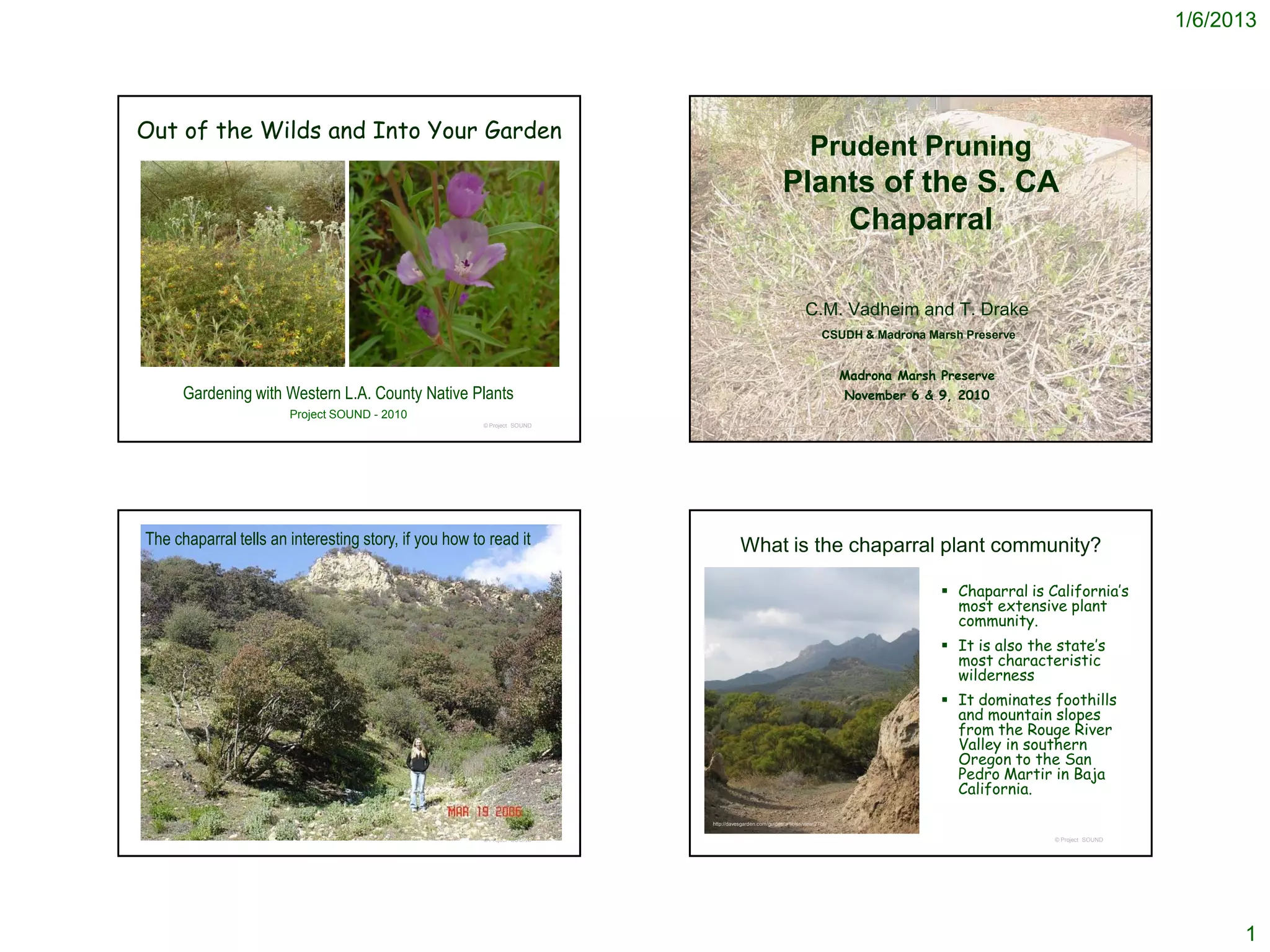
                                                                                                                  Prudent Pruning
                                                                                                      Plants of the S. CA
                                                                                                          Chaparral

                                                                                                                C.M. Vadheim and T. Drake
                                                                                                                       CSUDH & Madrona Marsh Preserve


                                                                                                                             Madrona Marsh Preserve
      Gardening with Western L.A. County Native Plants                                                                       November 6 & 9, 2010
                       Project SOUND - 2010
                                                       © Project SOUND                                                                                     © Project SOUND


The chaparral tells an interesting story, if you how to read it                     What is the chaparral plant community?

                                                                                                                                            Chaparral is California’s
                                                                                                                                             most extensive plant
                                                                                                                                             community.
                                                                                                                                            It is also the state’s
                                                                                                                                             most characteristic
                                                                                                                                             wilderness
                                                                                                                                            It dominates foothills
                                                                                                                                             and mountain slopes
                                                                                                                                             from the Rouge River
                                                                                                                                             Valley in southern
                                                                                                                                             Oregon to the San
                                                                                                                                             Pedro Martir in Baja
                                                                                                                                             California.

                                                                         http://davesgarden.com/guides/articles/view/2789/


                                                       © Project SOUND                                                                                     © Project SOUND


                                                                                                                                                                                   1
1/6/2013


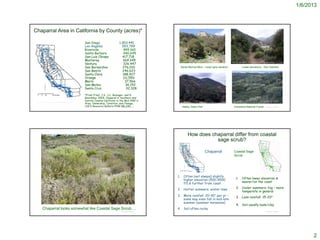
Chaparral Area in California by County (acres)*

                                                               San Diego                     1,003,441
                                                               Los Angeles                     553,789
                                                               Riverside                        499,160
                                                               Santa Barbara                    440,645
                                                               San Luis Obispo                 417,718
                                                               Monterey                         369,345                http://www.geo.arizona.edu/Antevs/biomes/ChaparalStaMonicaA.jpg

                                                               Ventura                          326,447
                                                                                                                                                                                         http://www.californiaherps.com/lizards/habitats/atstejnegerihabitatla508.jpg


                                                               San Bernardino                  276,010                Santa Monica Mtns - mostly higher elevations                                        Lower elevations - San Gabriels
                                                               San Benito                      246,623
                                                               Santa Clara                      188,427
                                                               Orange                           111,550
                                                               Marin                             37,566
                                                               San Mateo                          36,152
                                                               Santa Cruz                         32,328

                                                               *From Fried, J.S., C.L. Bosinger, and D.
                                                               Beardsley. 2004. Chaparal in Southern and
                                                               Central Coastal California in the Mid-1990's:
                                                               Area, Ownership, Condition, and Change.
 http://www.californiachaparral.com/awheresthechaparral.html                                                          http://www.californiachaparral.com/awheresthechaparral.html


                                                               USFS Resource Bulletin PNW-RB-240
                                                                                               © Project SOUND          Malibu State Park                                                   Cleveland National Forest                               © Project SOUND


                                                                                                                                 How does chaparral differ from coastal
                                                                                                                                            sage scrub?

                                                                                                                                                              Chaparral                     Coastal Sage
                                                                                                                                                                                            Scrub


                                                                                                                 1.       Often (not always) slightly
                                                                                                                          higher elevation (500-4500                                           1.         Often lower elevation &
                                                                                                                          ft) & further from coast                                                        nearer/on the coast

                                                                                                                 2. Hotter summers; winter lows                                                2. Cooler summers: fog – more
                                                                                                                                                                                                  temperate in general
                                                                                                                 3. More rainfall: 20-40” per yr –                                             3. Less rainfall: 15-20”
                                                                                                                    some may even fall in mid-late
                                                                                                                    summer (summer monsoons)
                                                                                                                                                                                               4. Soil usually loam/clay
         Chaparral looks somewhat like Coastal Sage Scrub….                                                      4. Soil often rocky
                                                                                               © Project SOUND                                                                                                                                      © Project SOUND


                                                                                                                                                                                                                                                                              2
1/6/2013


  How do chaparral/coastal sage scrub differ?                                                                                                                                                                      Why Sclerophyllous
                                                                                   Coastal Sage Scrub                                                                                                                   leaves?
         Chaparral
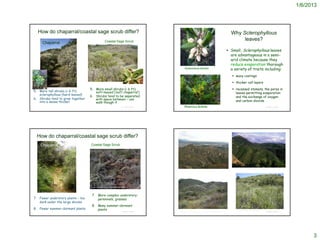
                                                                                                                                                                                                                  Small, Sclerophyllous leaves
                                                                                                                                                                                                                   are advantageous in a semi-
                                                                                                                                                                                                                   arid climate because they
                                                                                                                                                                                                                   reduce evaporation thorough
                                                                                                                                                Xyloccocus bicolor                                                 a variety of traits including:
                                                                                                                                                                                                                     waxy coatings

                                                                                                                                                                                                                     thicker cell layers

                                                       5. More small shrubs (< 6 ft);                                                                                                                                recessed stomata, the pores in
5. More tall shrubs (> 6 ft);                             soft-leaved (‘soft chaparral’)                                                                                                                              leaves permitting evaporation
   sclerophyllous (hard-leaved)                        6. Shrubs tend to be separated                                                                                                                                 and the exchange of oxygen
6. Shrubs tend to grow together                           with space between – can
   into a dense thicket                                   walk though it                                                                                                                                              and carbon dioxide
                                                                                                                        © Project SOUND         Rhamnus ilicifolia                                                                                                          © Project SOUND


  How do chaparral/coastal sage scrub differ?
      Chaparral                                        Coastal Sage Scrub


                                                                                                                                                                                                                     http://interwork.sdsu.edu/fire/resources/san-diego-habitats.htm


                                                       http://www.laspilitas.com/nature-of-california/communities/coastal-sage-scrub


   http://davesgarden.com/guides/articles/view/2789/

                                                         7. More complex understory:
7. Fewer understory plants – too                            perennials, grasses
   dark under the large shrubs
                                                         8. Many summer-dormant
8. Fewer summer-dormant plants                              plants                                                                                                                                                        http://www.soenyun.com/Blog/tag/exotics/
                                                                         © Project SOUND                                                  http://groups.ucanr.org/SAFE/Fire_in_Southern_California_Ecosystems/                                                              © Project SOUND


                                                                                                                                                                                                                                                                                                    3
1/6/2013


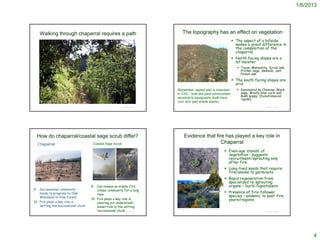
       Walking through chaparral requires a path                                                                                                   The topography has an effect on vegetation
                                                                                                                                                                                                                            The aspect of a hillside
                                                                                                                                                                                                                             makes a great difference in
                                                                                                                                                                                                                             the composition of the
                                                                                                                                                                                                                             chaparral.
                                                                                                                                                                                                                            North facing slopes are a
                                                                                                                                                                                                                             lot moister
                                                                                                                                                                                                                                Toyon, Manzanita, Scrub oak,
                                                                                                                                                                                                                                 Pitcher sage, Kekiella , and
                                                                                                                                                                                                                                 Poison oak.
                                                                                                                                                                                                                            The south facing slopes are
                                                                                                                                                                                                                             arid:
                                                                                                                                             Remember: aspect also is important                                                 Dominated by Chamise, Black
                                                                                                                                             in CSS – both are plant communities                                                 sage, Woolly blue curls and
                                                                                                                                                                                                                                 Bush poppy, (Dendromecon
                                                                                                                                             sensitive to topography (both have                                                  rigida).
            http://blogs.getty.edu/iris/
                                                                                                                                             ‘sun’ and ‘part-shade’ plants)
                                                                                                                           © Project SOUND                                                                                                       © Project SOUND


   How do chaparral/coastal sage scrub differ?                                                                                                       Evidence that fire has played a key role in
    Chaparral                                                                Coastal Sage Scrub                                                                       Chaparral
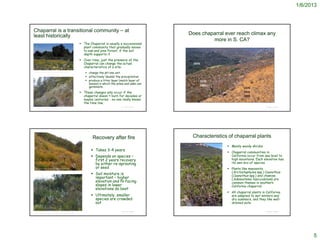
                                                                                                                                                                                                                         Even-age ‘stands’ of
                                                                                                                                                                                                                          vegetation – suggests
                                                                                                                                                                                                                          recruitment/sprouting only
                                                                                                                                                                                                                          after fire
                                                                                                                                                                                                                         Long-lived seeds that require
                                                                                                                                                                                                                          fire/smoke to germinate
                                                                                                                                                http://www.flickr.com/photos/52509763@N00/310103199/

                                                                             http://palosverdessource.com/tag/rancho-palos-verdes/
                                                                                                                                                                                                                         Rapid regeneration from
 http://www.desertmuseum.org/desert/habitats/chap/chapgallery.php?print=y                                                                                                                                                 specialized re-sprouting
                                                                            9. Can remain as stable CSS                                                                                                                   organs – ‘burls’/lignotubers
9. Successional community –                                                     climax community for a long
    tends to progress to Oak                                                                                                                                                                                             Presence of fire-follower
                                                                                time
    Woodland or Pine Forest                                                                                                                                                                                               species – endemic to post-fire
                                                                            10. Fire plays a key role in                                                                                                                  years/regions
10. Fire plays a key role in                                                    clearing out underbrush;
    ‘setting the successional clock’                                            lesser role in the setting
                                                                                ‘successional clock’ SOUND
                                                                                                                                             http://www.desertmuseum.org/desert/habitats/chap/chapgallery.php?print=y
                                                                                                 © Project                                                                                                                                       © Project SOUND


                                                                                                                                                                                                                                                                         4
1/6/2013


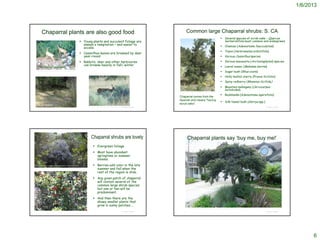
Chaparral is a transitional community – at
least historically                                                                                                                 Does chaparral ever reach climax any
                                                                                                                                            more in S. CA?
                                                                        The Chaparral is usually a successional
                                                                         plant community that gradually moves
                                                                         to oak and pine forest, if the soil
                                                                         depth supports it
                                                                        Over time, just the presence of the
                                                                         Chaparral can change the actual
                                                                         characteristics of a site:
http://picasaweb.google.com/guidesharon/Spring#5274932832288037602
                                                                           change the pH one unit
                                                                           effectively ‘double’ the precipitation
                                                                           produce a litter layer (mulch layer of
                                                                            leaves) in which the pines and oaks can
                                                                            germinate.
                                                                        These changes only occur if the
                                                                         chaparral doesn't burn for decades or
                                                                         maybe centuries - no one really knows
                                                                         the time line.
                                                                                                    © Project SOUND                                                                                      © Project SOUND
http://room42.wikispaces.com/Savanna+Climate


                                                                               Recovery after fire                                         Characteristics of chaparral plants
                                                                                                                                                                                Mainly woody shrubs
                                                                               Takes 3-4 years
                                                                                                                                                                                Chaparral communities in
                                                                               Depends on species –                                                                             California occur from sea level to
                                                                                first 2 years recovery                                                                           high mountains. Each elevation has
                                                                                by either re-sprouting                                                                           its own mix of species
 http://www.laspilitas.com/easy/easy_wildflower_picture.htm                     or seed                                                                                         Plants like manzanita
                                                                                                                                                                                 (Arctostaphylos spp.) Ceanothus
                                                                               Soil moisture is                                                                                 (Ceanothus spp.) and chamise
                                                                                important – higher                                                                               (Adenostema fasciculatum) are
                                                                                elevation and N-facing                                                                           common themes in southern
                                                                                slopes in lower                                                                                  California chaparral.
                                                                                elevations do best
                                                                                                                                                                                All chaparral plants in California
                                                                               Ultimately, smaller                                                                              are adapted to wet winters and
                                                                                species are crowded                                                                              dry summers, and they like well-
                                                                                out                                                                                              drained soils.
                                                                                                                      http://interwork.sdsu.edu/fire/resources/Chaparral.htm


                                                                                                    © Project SOUND                                                                                      © Project SOUND
http://www.laspilitas.com/nature-of-california/communities/chaparral


                                                                                                                                                                                                                                 5
1/6/2013


          Chaparral plants are also good food                                                                                                                    Common large Chaparral shrubs: S. CA
                                                                                                                                                                                                                          Several species of scrub oaks - Quercus
                                                                            Young plants and succulent foliage are                                                                                                        berberidifolia most common and widespread.
                                                                             always a temptation – and easier to                                                                                                          Chamise (Adenostoma fasciculatum)
                                                                             access
                                                                                                                                                                                                                          Toyon (Heteromeles arbutifolia)
                                                                            Ceanothus leaves are browsed by deer
                                                                             year-round                                                                                                                                   Various Ceanothus species
                                                                            Rabbits, deer and other herbivores                                                                                                           Various manzanita (Arctostaphylos) species
                                                                             can browse heavily in fall/ winter                                                                                                           Laurel sumac (Malosma laurina)
    Deer eating Ceanothus
   http://picasaweb.google.com/lh/photo/F7xecrsLEk2wFiIEETx41A
                                                                                                                                                                                                                          Sugar bush (Rhus ovata)
                                                                                                                                                                                                                          Holly-leafed cherry (Prunus ilicifolia)
                                                                                                                                                                                                                          Spiny redberry (Rhamnus ilicifolia)
                                                                                                                                                                                                                          Mountain mahogany (Cercocarpus
                                                                                                                                                                                                                           betuloides).
                                                                                                                                                                                                                          Redshanks (Adenostema sparsifolia)
                                                                                                                                                             Chaparral comes from the
                                                                                                                                                             Spanish and means "having
                                                                                                                                                                                                                          Silk-tassel bush (Garrya spp.)
   Brush Rabbit
                                                                                                                                                             scrub oaks".
                                                                                  http://www.bentler.us/eastern-washington/plants/shrubs/rabbit-brush.aspx
                                                                                                                                      © Project SOUND                                                                                                       © Project SOUND


                                                                                  Chaparral shrubs are lovely                                                     Chaparral plants say ‘buy me, buy me!’
                                                                                      Evergreen foliage
                                                                                      Most have abundant
                                                                                       springtime or summer
                                                                                       blooms.
http://dunncreekfarm.blogspot.com/2010/04/organic-farming-from-hell.html              Berries add color in the late
                                                                                       summer and fall when the
                                                                                       rest of the region is drab.
                                                                                      Any given patch of chaparral
                                                                                       will contain several of the
                                                                                       common large shrub species
                                                                                       but one or two will be
                                                                                       predominant.
                                                                                      And then there are the
                                                                                       showy smaller plants that
                                                                                       grow in sunny patches….
                                                                                                                                                                    http://jimmundy.name/garden_album/slides/Ceanothus_looking_toward_front_door.html

                                                                                                                                     © Project SOUND                                                                                                        © Project SOUND


                                                                                                                                                                                                                                                                                    6
1/6/2013


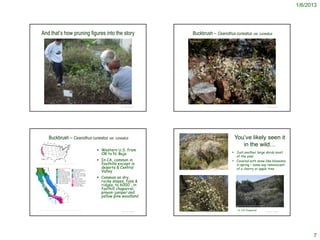
        And that’s how pruning figures into the story                                                                                       Buckbrush – Ceanothus cuneatus var. cuneatus


                                                                                                  © Project SOUND                                                                                                                                      © Project SOUND


                       Buckbrush – Ceanothus cuneatus var. cuneatus                                                                                                                              You’ve likely seen it
                                                                                                                                                                                                    in the wild…
                                                                                      Western U.S. from
                                                                                       OR to N. Baja                                                                                             Just another large shrub most
                                                                                                                                                                                                  of the year
                                                                                      In CA, common in                                                                                          Covered with snow-like blossoms
   http://oregonstate.edu/dept/botany/herbarium/projects/ceanothus/CeCu/index.html     foothills except in                                                                                        in spring – some say reminiscent
                                                                                       deserts & Central                                                                                          of a cherry or apple tree
                                                                                       Valley                       http://www.fs.fed.us/database/feis/plants/shrub/ceacun/all.html


                                                                                      Common on dry,
                                                                                       rocky slopes, fans &
                                                                                       ridges, to 6000', in
                                                                                       foothill chaparral,
                                                                                       pinyon-juniper and
                                                                                       yellow pine woodland

                                                                                                                                                                                                   http://www.flickr.com/photos/ericinsf/2409689371/


http://ucjeps.berkeley.edu/cgi-bin/get_JM_treatment.pl?6586,6589,6594,6595
                                                                                                  © Project SOUND
                                                                                                                                                                                                    N. CA Chaparral                                    © Project SOUND
                                                                                                                    http://www.tulipsinthewoods.com/wild-plants/buckbrush-ceanothus-cuneatus/


                                                                                                                                                                                                                                                                               7
1/6/2013


                                                                                                                                                                                                     Flowers: showy white
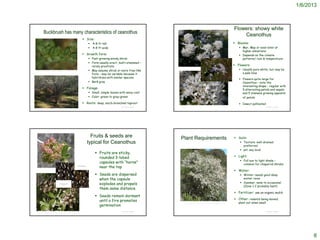
                  Buckbrush has many characteristics of ceanothus
                                                                                                                                                                                                         Ceanothus
                                                                             Size:
                                                                                  4-8 ft tall                                                                                                        Blooms:
                                                                                  4-8 ft wide                                                                                                           Mar.-May or even later at
                                                                                                                                                                                                          higher elevations
                                                                             Growth form:                                                                                                               Depends on the climate
                                                                                Fast-growing woody shrub                                                                                                 patterns/ rain & temperature
                                                                                Form usually erect, multi-stemmed –
                                                                                 rarely prostrate                                                                                                     Flowers:
   http://www.nwplants.com/business/catalog/shrubs.html#Cea_cun                 May assume shrub or more tree-like                                                                                      Usually pure white, but may be
                                                                                 form - may be variable because it                                                                                        a pale blue
                                                                                 hybridizes with similar species.
                                                                                                                                                                                                         Flowers quite large for
                                                                                Bark gray                                                                                                                Ceanothus – note the
                                                                                                                                                                                                          interesting shape - regular with
                                                                             Foliage:                                                                                                                    5 alternating petals and sepals
                                                                                Small, simple leaves with waxy coat                                                                                      and 5 stamens growing opposite
                                                                                Color: green to gray-green                                                                                                of petals
                                                                             Roots: deep, much-branched taproot                                                                                         Insect pollinated
                                                                                                       © Project SOUND                                                                                                        © Project SOUND

http://www.tulipsinthewoods.com/wild-plants/buckbrush-ceanothus-cuneatus/


                                                                                 Fruits & seeds are                      Plant Requirements                                                           Soils:
                                                                               typical for Ceanothus                                                                                                      Texture: well-drained
                                                                                                                                                                                                           preferred
                                                                                                                                                                                                          pH: any local
                                                                                       Fruits are sticky,
                                                                                        rounded 3-lobed                                                                                               Light:
                                                                                                                                                                                                          Full sun to light shade –
                                                                                        capsules with “horns”                                                                                              common for chaparral shrubs
                                                                                        near the top
                                                                                                                                                                                                      Water:
                                                                                       Seeds are dispersed                                                                                               Winter: needs good deep
                                                                                        when the capsule                                                                                                   winter rains
                                                                                        explodes and propels                                                                                              Summer: none to occasional
                                                                                                                                                                                                           (Zone 1-2 probably best)
                                                                                        them some distance.
                                                                                                                                                                                                      Fertilizer: use an organic mulch
                                                                                       Seeds remain dormant
                                                                                                                                                                                                      Other: resents being moved;
                                                                                        until a fire promotes                                                                                           plant out when small
                                                                                        germination
                                                                                                                          http://www.laspilitas.com/nature-of-california/plants/ceanothus-cuneatus


                                                                                                       © Project SOUND                                                                                                        © Project SOUND
     http://www.hazmac.biz/060410/060410CeanothusCuneatus.html


                                                                                                                                                                                                                                                      8
1/6/2013


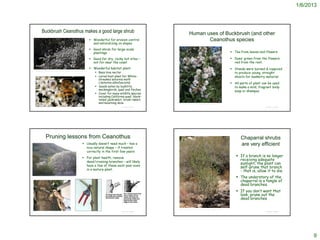
            Buckbrush Ceanothus makes a good large shrub                                                                                                          Human uses of Buckbrush (and other
                                                                                                       Wonderful for erosion control                                    Ceanothus species
                                                                                                        and naturalizing on slopes
                                                                                                       Good shrub for large-scale
                                                                                                        plantings                                                                                                                      Tea from leaves and flowers

                                                                                                       Good for dry, rocky hot sites –                                                                                                Dyes: green from the flowers;
                                                                                                        not for near the coast                                                                                                          red from the root.
                                                                                                       Wonderful habitat plant:                                                                                                       Stands were burned & coppiced
                                                                                                          Bees love nectar                                                                                                             to produce young, straight
http://natureshutterbug.com/wordpress/2010/02/17/a-different-kind-of-snowy-white-with-many-insects/


                                                                                                          Larval host plant for White-                                                                                                 shoots for basketry material
                                                                                                           streaked saturnia moth
                                                                                                           (Saturnia albofasciata)                                                                                                     All parts of plant can be used
                                                                                                          Seeds eaten by bushtits,                                                                                                     to make a mild, fragrant body
                                                                                                           mockingbirds, quail and finches
                                                                                                                                                                                                                                        soap or shampoo
                                                                                                          Cover for many wildlife species
                                                                                                           including California quail, black-
                                                                                                           tailed jackrabbit, brush rabbit,
                                                                                                           and mourning dove                     http://www.calfloranursery.com/pages_plants/pages_c/ceacun.html

                                                                                                                             © Project SOUND                                                                                                                 © Project SOUND


                    Pruning lessons from Ceanothus                                                                                                                                                                                          Chaparral shrubs
                                                                                                  Usually doesn’t need much – has a                                                                                                        are very efficient
                                                                                                   nice natural shape – if treated
                                                                                                   correctly in the first few years
                                                                                                  For plant health, remove
                                                                                                                                                                                                                                          If a branch is no longer
                                                                                                   dead/crossing branches – will likely
                                                                                                                                                                                                                                           receiving adequate
                                                                                                                                                                                                                                           sunlight, the plant can
                                                                                                   have a few of these each year even
                                                                                                                                                                                                                                           self-prune that branch
                                                                                                   in a mature plant.                                                                                                                      - that is, allow it to die.
http://outdoors.webshots.com/photo/1120298861053871638LibNcZ
                                                                                                                                                                                                                                          The understory of the
                                                                                                                                                                                                                                           chaparral is a tangle of
                                                                                                                                                                                                                                           dead branches.
                                                                                                                                                                                                                                          If you don’t want that
                                                                                                                                                                                                                                           look, prune out the
                                                                                                                                                                                                                                           dead branches

                                                                                                                                                http://www.researchlearningcenter.com/bloom/species/Ceanothus_cuneatus_cuneatus.htm
                                                                                                                             © Project SOUND                                                                                                                 © Project SOUND


                                                                                                                                                                                                                                                                                     9
1/6/2013


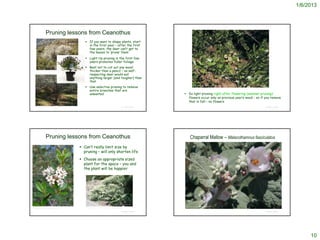
                         Pruning lessons from Ceanothus
                                                                                    If you want to shape plants, start
                                                                                     in the first year – after the first
                                                                                     few years, the deer can’t get to
                                                                                     the leaves to ‘prune’ them
                                                                                    Light tip pruning in the first few
                                                                                     years promotes fuller foliage
                                                                                    Best not to cut out any wood
        http://www.fs.fed.us/database/feis/plants/shrub/ceacun/all.html              thicker than a pencil – no self-
                                                                                     respecting deer would eat
                                                                                     anything larger (and tougher) than
                                                                                     that
                                                                                    Use selective pruning to remove
                                                                                                                                                                         http://www.researchlearningcenter.com/bloom/species/Ceanothus_cuneatus_cuneatus.htm


                                                                                     entire branches that are
                                                                                     unwanted                                                                 Do light pruning right after flowering (summer pruning):
                                                                                                                                                               flowers occur only on previous year’s wood - so if you remove
                                                                                                                                                               that in fall – no flowers
    http://www.tulipsinthewoods.com/wild-plants/buckbrush-ceanothus-cuneatus/                                                              © Project SOUND                                                                                                     © Project SOUND


                         Pruning lessons from Ceanothus                                                                                                             Chaparral Mallow – Malacothamnus fasciculatus
                                                                                 Can’t really limit size by
                                                                                  pruning – will only shorten life
                                                                                 Choose an appropriate sized
                                                                                  plant for the space – you and
                                                                                  the plant will be happier


                                                                                                                                                              http://blass.com.au/definitions/malacothamnus
                                                                                   http://www.stylelist.com/?sem=1&ncid=bannadusstyl00000026
http://www.calflora.net/bloomingplants/buckbrush.html

                                                                                                                                           © Project SOUND                                                                                                     © Project SOUND


                                                                                                                                                                                                                                                                                      10
1/6/2013


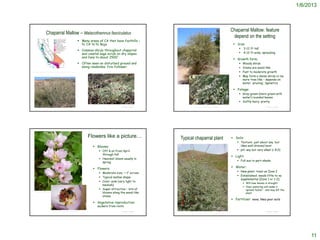
                                                                                                                                                                                                                            Chaparral Mallow: feature
                      Chaparral Mallow – Malacothamnus fasciculatus
                                                                                                                                                                                                                             depend on the setting
                                                                          Many areas of CA that have foothills –
                                                                           N. CA to N. Baja                                                                                                                                   Size:
                                                                                                                                                                                                                                    3-12 ft tall
                                                                          Common shrub throughout chaparral
                                                                           and coastal sage scrub on dry slopes                                                                                                                     4-12 ft wide; spreading
                                                                           and fans to about 2500‘
                                                                                                                                                                                                                              Growth form:
                                                                          Often seen on disturbed ground and                                                                                                                       Woody shrub
                                                                           along roadsides; fire-follower.                                                                                                                          Stems are wand-like
http://ucjeps.berkeley.edu/cgi-bin/get_JM_treatment.pl?5042,5073,5079                                                                                                                                                               Fast to moderate growth
                                                                                                                                                                                                                                    May form a dense shrub or be
                                                                                                                                                                                                                                     more tree-like – depends on
                                                                                                                                                                                                                                     water, ‘pruning’, ?genetics

                                                                                                                                                                                                                              Foliage:
                                                                                                                                                                                                                                  Gray-green (more green with
                                                                                                                                                                                                                                   water) rounded leaves
                                                                                                                                                                                                                                  Softly hairy; pretty
                                                                                http://www.sci.sdsu.edu/plants/sdpls/plants/Malacothamnus_fasciculatus.html
    http://teacher-us.com/young/prsnl_ed/field_photos.htm
                                                                                                                                      © Project SOUND               http://blass.com.au/definitions/malacothamnus                                      © Project SOUND


                                                                               Flowers like a picture…                                                        Typical chaparral plant                                        Soils:
                                                                                                                                                                                                                                 Texture: just about any, but
                                                                                       Blooms:                                                                                                                                   likes well-drained best
                                                                                                 Off & on from April                                                                                                            pH: any but very alkali (> 8.0)
                                                                                                  through fall
                                                                                                                                                                                                                             Light:
                                                                                                 Heaviest bloom usually in
                                                                                                                                                                                                                                 Full sun to part-shade
                                                                                                  spring

                                                                                       Flowers:                                                                                                                             Water:
                                                                                                                                                                                                                                 New plant: treat as Zone 2
                                                                                                 Moderate size; ~ 1” across
                                                                                                                                                                                                                                 Established: needs little to no
                                                                                                 Typical mallow shape
                                                                                                                                                                                                                                  supplemental (Zone 1 or 1-2);
                                                                                                 Color: pink (very light to
                                                                                                                                                                                                                                      Will lose leaves in drought
                                                                                                  medium)
                                                                                                                                                                                                                                      Over-watering will make it
                                                                                                 Super attractive – lots of                                                                                                           spread faster – and may kill the
    http://en.wikipedia.org/wiki/File:Malacothamnus_fasciculatus_2.jpg
                                                                                                  blooms along the wand-like                                                                                                           plant
                                                                                                  stems
                                                                                                                                                                                                                             Fertilizer: none; likes poor soils
                                                                                       Vegetative reproduction:
                                                                                             suckers from roots                                                                                     © 2005 Janell Hillman


                                http://bugguide.net/node/view/295204/bgimage                                                          © Project SOUND                                                                                                  © Project SOUND


                                                                                                                                                                                                                                                                               11
1/6/2013


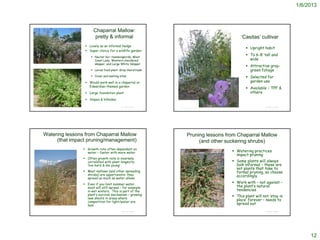
                                                                                Chaparral Mallow:
                                                                                 pretty & informal                                                                                                                       ‘Casitas’ cultivar
                                                                            Lovely as an informal hedge
                                                                                                                                                                                                                             Upright habit
                                                                            Super choice for a wildlife garden:
                                                                                Nectar for: Hummingbirds, West
                                                                                                                                                                                                                             To 6-8’ tall and
                                                                                 Coast Lady, Western checkered                                                                                                                wide
                                                                                 skipper, and Large White Skipper
                                                                                                                                                                                                                             Attractive gray-
 http://www.flickr.com/photos/mechanoid_dolly/4590614319/


                                                                                Larval food plant: Gray Hairstreak                                                                                                           green foliage
                                                                                Cover and nesting sites                                                                                                                     Selected for
                                                                            Would work well in a chaparral or                                                                                                                garden use
                                                                             Edwardian-themed garden
                                                                                                                                                                                                                             Available – TPF &
                                                                            Large foundation plant                                                                                                                           others
                                                                            Slopes & hillsides

                                                                                                    © Project SOUND                                                                                                                    © Project SOUND
http://commons.wikimedia.org/wiki/File:Malacothamnus_fasciculatus_1.jpg                                               http://www.theodorepayne.org/mediawiki/index.php?title=Malacothamnus_fasciculatus_'Casitas'


                   Watering lessons from Chaparral Mallow                                                                         Pruning lessons from Chaparral Mallow
                        (that impact pruning/management)                                                                               (and other suckering shrubs)
                                                                           Growth rate often dependent on
                                                                            water – faster with more water                                                                                                           Watering practices
                                                                                                                                                                                                                      impact pruning
                                                                           Often growth rate is inversely
                                                                            correlated with plant longevity:                                                                                                         Some plants will always
                                                                            ‘live hard & die young’                                                                                                                   look informal – these are
                                                                                                                                                                                                                      not plants that take to
                                                                           Most mallows (and other spreading                                                                                                         formal pruning, so choose
                                                                            shrubs) are opportunists: they                                                                                                            accordingly.
                                                                            spread as much as water allows
                                                                           Even if you limit summer water,
                                                                                                                                                                                                                     Work with – not against –
                                                                            most will still spread – for example                                                                                                      the plant’s natural
                                                                            in wet winters. This is part of the                                                                                                       tendencies
                                                                            plant’s survival mechanism – growing                                                                                                     This plant will not ‘stay in
                                                                            new shoots in areas where
                                                                            competition for light/water are
                                                                                                                                                                                                                      place’ forever – needs to
                                                                            less                                                                                                                                      spread out
         © 2009 Neal Kramer


                                                                                                    © Project SOUND                                                                                                                    © Project SOUND


                                                                                                                                                                                                                                                              12
1/6/2013


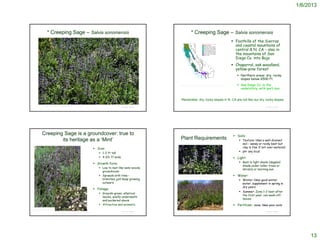
                               * Creeping Sage – Salvia sonomensis                                                                                                                * Creeping Sage – Salvia sonomensis
                                                                                                                                                                                                                                            Foothills of the Sierras
                                                                                                                                                                                                                                             and coastal mountains of
                                                                                                                                                                                                                                             central & N. CA – also in
                                                                                                                                                                                                                                             the mountains of San
                                                                                                                                                                                                                                             Diego Co. into Baja
                                                                                                                                                                                                                                            Chaparral, oak woodland,
                                                                                                                                                                                                                                             yellow-pine forest
                                                                                                                                                                                                                                               Northern areas: dry, rocky
                                                                                                                                                                                                                                                slopes below 6500 ft.
                                                                                                                                                                http://ucjeps.berkeley.edu/cgi-bin/get_JM_treatment.pl?Salvia+sonomensis       San Diego Co: in the
                                                                                                                                                                                                                                                understory, with part-sun


                                                                                                                                                                  Remember: dry, rocky slopes in N. CA are not like our dry, rocky slopes
                       J.S. Peterson @ USDA-NRCS PLANTS Database
                                                                                                                                          © Project SOUND                                                                                                           © Project SOUND


                    Creeping Sage is a groundcover: true to                                                                                                                                                                                  Soils:
                            its heritage as a ‘Mint’                                                                                                             Plant Requirements                                                              Texture: likes a well-drained
                                                                                                                                                                                                                                                  soil – sandy or rocky best but
                                                                                                                      Size:                                                                                                                      clay is fine if not over-watered
                                                                                                                         1-2 ft tall                                                                                                            pH: any local
                                                                                                                         4-10+ ft wide                                                                                                      Light:
                                                                                                                      Growth form:                                                                                                              Best in light shade (dappled
                                                                                                                                                                                                                                                  shade under taller trees or
                                                                                                                         Low to mat-like semi-woody                                                                                              shrubs) or morning sun.
                                                                                                                          groundcover
                                                                                                                         Spreads with time –                  J.S. Peterson @ USDA-NRCS PLANTS Database                                     Water:
                                                                                                                          branches just keep growing                                                                                             Winter: likes good winter
                                                                                                                          outward                                                                                                                 water; supplement in spring in
                                                                                                                                                                                                                                                  dry years
                                                                                                                      Foliage:
                                                                                                                                                                                                                                                 Summer: Zone 1-2 best after
                                                                                                                         Grayish-green, elliptical
                                                                                                                                                                                                                                                  the first year; can wash off
                                                                                                                          leaves, woolly underneath
                                                                                                                                                                                                                                                  leaves
                                                                                                                          and puckered above
                                                                                                                         Attractive and aromatic                                                                                            Fertilizer: none; likes poor soils
http://www.wildflower.org/plants/result.php
?id_plant=saso                                                                                                                            © Project SOUND   © 2004 Christopher L. Christie                                                                          © Project SOUND
                                              http://forums.gardenweb.com/forums/load/salvia/msg0502361430447.html


                                                                                                                                                                                                                                                                                           13
1/6/2013


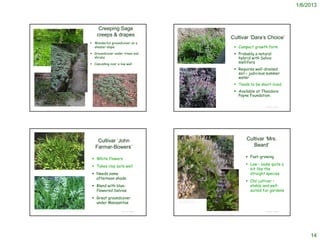
                                                                                                  Creeping Sage
                                                                                                 creeps & drapes
                                                                                                                                                                                                           Cultivar ‘Dara’s Choice’
                                                                                             Wonderful groundcover on a
                                                                                              shadier slope                                                                                                  Compact growth form
                                                                                             Groundcover under trees and                                                                                    Probably a natural
                                                                                              shrubs                                                                                                          hybrid with Salvia
                                                                                             Cascading over a low wall
                                                                                                                                                           http://ohric.ucdavis.edu/photos/ornament8.htm
                                                                                                                                                                                                              mellifera
                                                                                                                                                                                                             Requires well-drained
http://www.yerbabuenanursery.com/viewplant.php?pid=33


                                                                                                                                                                                                              soil – judicious summer
                                                                                                                                                                                                              water
                                                                                                                                                                                                             Tends to be short-lived
                                                                                                                                                                                                             Available at Theodore
                                                                                                                                                                                                              Payne Foundation.

 http://www.redding.com/photos/galleries/2008/apr/26/right-home/5302/
                                                                                                                                         © Project SOUND                                                                     © Project SOUND
                                     http://seedbyte.blogspot.com/2009_12_11_archive.html      http://www.yerbabuenanursery.com/viewplant.php?pid=33


                                                                                                Cultivar ‘John                                                                                                    Cultivar ‘Mrs.
                                                                                               Farmar-Bowers’                                                                                                        Beard’

                                                                                              White flowers                                                                                                       Fast-growing

                                                                                              Takes clay soils well                                                                                               Low – looks quite a
                                                                                                                                                                                                                    bit like the
                                                                                              Needs some                                                                                                           straight species
                                                                                               afternoon shade
                                                                                                                                                                                                                   Old cultivar –
                                                                                              Blend with blue-                                                                                                     stable and well-
                                                                                               flowered Salvias                                                                                                     suited for gardens
                                                                                              Great groundcover
                                                                                               under Manzanitas
                                                                                                                                                           http://www.laspilitas.com/nature-of-
                                                                                                                                                           california/plants/salvia-sonomensis-mrs-beard


 http://www.laspilitas.com/nature-of-california/plants/salvia-sonomensis-farmar-bower                                                    © Project SOUND                                                                     © Project SOUND


                                                                                                                                                                                                                                                    14
1/6/2013


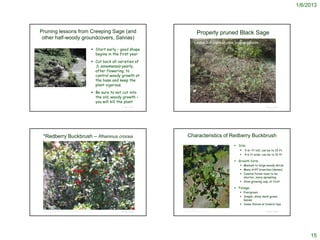
      Pruning lessons from Creeping Sage (and                                                                                               Properly pruned Black Sage
       other half-woody groundcovers, Salvias)
                                                                                                                                        Leave 3-4 pairs of new leaves/shoots
                                                                                      Start early – good shape
                                                                                       begins in the first year
                                                                                      Cut back all varieties of
                                                                                       S. sonomensis yearly,
                                                                                       after flowering, to
                                                                                       control woody growth at
                                                                                       the base and keep the
                                                                                       plant vigorous.
http://www.baynatives.com/plants/Salvia-sonomensis/


                                                                                      Be sure to not cut into
                                                                                       the old, woody growth –
                                                                                       you will kill the plant
                                                                                                      © Project SOUND                                                                      © Project SOUND


            *Redberry Buckbrush – Rhamnus crocea                                                                             Characteristics of Redberry Buckbrush
                                                                                                                                                                    Size:
                                                                                                                                                                       3-6+ ft tall; can be to 15 ft.
                                                                                                                                                                          4-6 ft wide; can be to 10 ft.

                                                                                                                                                                    Growth form:
                                                                                                                                                                        Medium to large woody shrub
                                                                                                                                                                        Many stiff branches (dense)
                                                                                                                                                                        Coastal forms tend to be
                                                                                                                                                                         shorter, more sprawling
                                                                                                                                                                        Slow-growing, esp. at first

                                                                                                                                                                    Foliage:
                                                                                                                                                                        Evergreen
                                                                                                                                                                        Simple, shiny dark-green
                                                                                                                                                                         leaves
                                                                                                                                                                        Some thorns at branch tips
            http://www.researchlearningcenter.org/bloom/species/Rhamnus_crocea.htm
                                                                                                                        © 2007 Neal Kramer
            http://biology.csusb.edu/PlantGuideFolder/RhamnusCrocea/RhamnusCroceaPage.htm             © Project SOUND   http://www.timetotrack.com/jay/redb3.htm                           © Project SOUND


                                                                                                                                                                                                                  15
1/6/2013


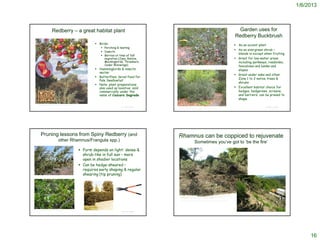
                              Redberry – a great habitat plant                                                                                                                                    Garden uses for
                                                                                                                                                                                                 Redberry Buckbrush
                                                                             Birds:                                                                                                              As an accent plant
                                                                                Perching & nesting
                                                                                                                                                                                                  As an evergreen shrub –
                                                                                Insects
                                                                                                                                                                                                   blends in except when fruiting.
                                                                                Berries at time of fall
                                                                                 migration (Jays, Robins,                                                                                         Great for low-water areas
                                                                                 Mockingbirds, Thrashers,                                                                                          including parkways, roadsides,
                                                                                 Cedar Waxwings)                                                                                                   fencelines and banks and
                                                                             Hummingbirds & insects:                                                                                              slopes
                                                                              nectar
                                                                                                                                                                                                  Great under oaks and other
                                                                             Butterflies: larval food for
                                                                                                                                                                                                   Zone 1 to 2 native trees &
                                                                              Pale Swallowtail
                                                                                                                                                                                                   shrubs
                                                                             Note: plant preparations
                                                                              also used as laxative; sold                                                                                         Excellent habitat choice for
                                                                              commercially under the                                                                                               hedges, hedgerows, screens,
                                                                              name of Cascara Sagrada                                                                                              and barriers; can be pruned to
                                                                                                                                                                                                   shape
     http://www.hazmac.biz/030714/030714RhamnusCroceaPoster.html
                                                                                             © Project SOUND                                                                                                         © Project SOUND
                                                                                                               http://www.yerbabuenanursery.com/online_album/0882.htm


          Pruning lessons from Spiny Redberry (and                                                             Rhamnus can be coppiced to rejuvenate
                                        other Rhamnus/Frangula spp.)                                                                    Sometimes you’ve got to ‘be the fire’
                                                                    Form depends on light: dense &
                                                                     shrub-like in full sun – more
                                                                     open in shadier locations
                                                                    Can be hedge-sheared –
                                                                     requires early shaping & regular
                                                                     shearing (tip pruning)


                                                                                                                  http://tmousecmouse.blogspot.com/2009/04/tree-work-2-chaparral-shape-up.html


http://caornamentalnativeplants.org/redberry.jpg
                                                                                             © Project SOUND                                                                                                         © Project SOUND


                                                                                                                                                                                                                                            16
1/6/2013


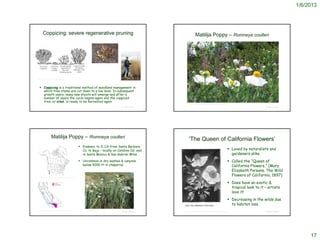
          Coppicing: severe regenerative pruning                                                                                                                               Matilija Poppy – Romneya coulteri


                                                                                           http://www.primitiveways.com/coppicing.html


 http://www.answers.com/topic/coppicing?cat=technology


    Coppicing is a traditional method of woodland management in
     which tree stems are cut down to a low level. In subsequent
     growth years, many new shoots will emerge and after a
     number of years the cycle begins again and the coppiced
     tree, or stool, is ready to be harvested again
                                                                                                                                                                 http://www.goldenwestcollege.edu/garden/plantofmonth/0510.html

                                                                                                                                         © Project SOUND                                                                                                               © Project SOUND


                           Matilija Poppy – Romneya coulteri                                                                                                     ‘The Queen of California Flowers’
                                                                             Endemic to S. CA from Santa Barbara
                                                                              Co. to Baja – locally on Catalina Isl. and                                                                                                                          Loved by naturalists and
                                                                              in Santa Monica & San Gabriel Mtns.                                                                                                                                  gardeners alike
                                                                             Uncommon in dry washes & canyons                                                                                                                                    Called the “Queen of
                                                                              below 4000 ft in chaparral                                                                                                                                           California Flowers,” (Mary
                                                                                                                                                                                                                                                   Elizabeth Parsons, The Wild
     http://www.efloras.org/florataxon.aspx?flora_id=1&taxon_id=220011716
                                                                                                                                                                                                                                                   Flowers of California, 1897)
                                                                                                                                                                                                                                                  Does have an exotic &
                                                                                                                                                                                                                                                   tropical look to it – artists
                                                                                                                                                                                                                                                   love it!
                                                                                                                                                                                                                                                  Decreasing in the wilds due
                                                                                                                                                                                                                                                   to habitat loss
http://ucjeps.berkeley.edu/cgi-bin/get_JM_treatment.pl?5547,5597,5598            © 2006 Ricky Grubb
                                                                                                                                         © Project SOUND   http://cartas.typepad.com/main/2010/05/matilija-poppy-romneya-coulteri-mythical-beauty.html                 © Project SOUND


                                                                                                                                                                                                                                                                                              17
1/6/2013


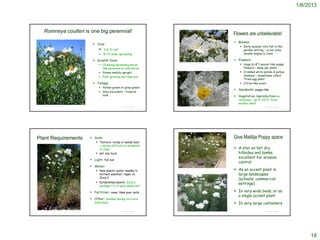
          Romneya coulteri is one big perennial!                                                                                                                               Flowers are unbelievable!
                                                                                                                                                                                Blooms:
                                                                     Size:
                                                                                                                                                                                   Early summer into fall in the
                                                                            3-8 ft tall                                                                                            garden setting – in our area
                                                                            8+ ft wide, spreading                                                                                  usually begins in June

                                                                     Growth form:                                                                                              Flowers:
                                                                         Clumping/spreading shrub-                                                                                Huge (6-8”) saucer-like poppy
                                                                                                             http://www.calfloranursery.com/pages_plants/pages_r/romcou.html


                                                                          like perennial or sub-shrub                                                                               flowers – many per plant
                                                                         Stems mostly upright                                                                                     Crinkled white petals & yellow
                                                                         Fast-growing and vigorous                                                                                 stamens – sometimes called
                                                                                                                                                                                    ‘fried egg plant’
                                                                     Foliage:                                                                                                     Citrus-like scent
                                                                         Yellow-green to gray-green
                                                                                                                                                                                Seedpods: poppy-like
                                                                         Very succulent – tropical
                                                                          look                                                                                                  Vegetative reproduction:via
                                                                                                                                                                                 rhizomes – up to 20 ft. from
                                                                                                                                                                                 mother plant
http://www.calfloranursery.com/pages_plants/pages_r/romcou.html
                                                                                           © Project SOUND                                                                                          © Project SOUND


Plant Requirements                                                 Soils:                                                                                                     Give Matilija Poppy space
                                                                       Texture: rocky or sandy best
                                                                        – can be difficult to establish
                                                                        in clays                                                                                                A star on hot dry
                                                                       pH: any local                                                                                            hillsides and banks;
                                                                                                                                                                                 excellent for erosion
                                                                   Light: full sun
                                                                                                                                                                                 control
                                                                   Water:
                                                                       New plants: water weekly in
                                                                                                             http://www.gardenology.org/wiki/Romneya                            As an accent plant in
                                                                        hottest weather; taper to                                                                                large landscapes
                                                                        Zone 2                                                                                                   (schools; commercial
                                                                       Established plants: Zone 1;
                                                                                                                                                                                 settings)
                                                                        perhaps 1-2 in very sandy soil

                                                                   Fertilizer: none; likes poor soils                                                                          In very wide beds; or as
                                                                                                                                                                                 a single accent plant
                                                                   Other: dislikes having its roots
                                                                     disturbed                                                                                                  In very large containers
 © 2003 Joseph Dougherty/ecology.org                                                       © Project SOUND                                                                                          © Project SOUND


                                                                                                                                                                                                                           18
1/6/2013


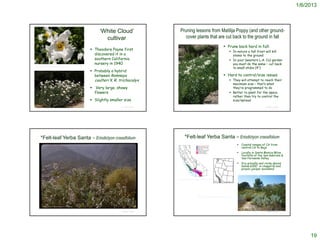
                                                                                                       ‘White Cloud’                     Pruning lessons from Matilija Poppy (and other ground-
                                                                                                         cultivar                           cover plants that are cut back to the ground in fall
                                                                                                                                                                                                                 Prune back hard in fall:
                                                                                                   Theodore Payne first                                                                                                   In nature a fall frost will kill
                                                                                                    discovered it in a                                                                                                      stems to the ground
                                                                                                    southern California                                                                                                    In your (western L.A. Co) garden
http://www.californianativeplants.com/index.php?option=com_content&view=article&catid=34:featur
                                                                                                    nursery in 1940                                                                                                         you must do the same – cut back
ed-plants&id=54:romneya-coulteri-white-cloud-matilija-poppy&Itemid=56
                                                                                                                                                                                                                            to small stubs (4”)
                                                                                                   Probably a hybrid
                                                                                                    between Romneya                                                                                              Hard to control/size issues
                                                                                                    coulteri X R. trichocalyx                                                                                              They will attempt to reach their
                                                                                                                                                                                                                            maximum size – that’s what
                                                                                                   Very large, showy                                                                                                       they’re programmed to do
                                                                                                    flowers                                                                                                                Better to plant for the space,
                                                                                                                                                                                                                            rather than try to control the
                                                                                                   Slightly smaller size                                                                                                   size/spread
                                                                                                                   © Project SOUND                                                                                                                    © Project SOUND


          *Felt-leaf Yerba Santa – Eriodictyon crassifolium                                                                                     *Felt-leaf Yerba Santa – Eriodictyon crassifolium
                                                                                                                                                                                                                                   Coastal ranges of CA from
                                                                                                                                                                                                                                    central CA to Baja
                                                                                                                                                                                                                                   Locally in Santa Monica Mtns,
                                                                                                                                                                                                                                    foothills of the San Gabriels &
                                                                                                                                                                                                                                    San Fernando Valley
                                                                                                                                                                                                                                   Dry gravelly and rocky places
                                                                                                                                                                                                                                    below 6000' in chaparral and
                                                                                                                                                                                                                                    pinyon-juniper woodland


                                                                                                                                     http://ucjeps.berkeley.edu/cgi-bin/get_JM_treatment.pl?4518,4525,4530


                                                                                                                                                                       http://www.swsbm.com/Maps/Eriodictyon_crassifolium.gif


             Charles Webber © California Academy of Sciences


                                                                                                                   © Project SOUND                                                                                                                    © Project SOUND


                                                                                                                                                                                                                                                                             19
1/6/2013


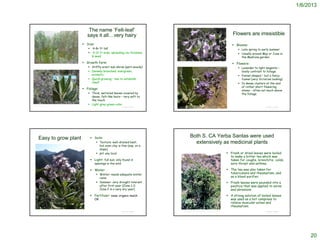
                              The name ‘Felt-leaf’
                             says it all…very hairy                                                                                                                  Flowers are irresistible
                           Size:                                                                                                                                    Blooms:
                                 4-8+ ft tall                                                                                                                           Late spring to early summer
                                 4-12 ft wide; spreading via rhizomes                                                                                                   Usually around May or June in
                                  & seed                                                                                                                                  the Madrona garden
                           Growth form:                                     http://commons.wikimedia.org/wiki/Category:Eriodictyon_crassifolium
                                                                                                                                                                     Flowers:
                              Stiffly erect sub-shrub (part-woody)                                                                                                      Lavender to light magenta –
                              Densely branched; evergreen;                                                                                                               lovely contrast to foliage
                               aromatic                                                                                                                                  Funnel-shaped – but a fancy
                              Quick-growing – has to establish                                                                                                           funnel (very Victorian looking)
                               itself                                                                                                                                    In dense clusters at the end
                                                                                                                                                                          of rather short flowering
                           Foliage:                                                                                                                                      stems – often not much above
                              Thick, serrated leaves covered by                                                                                                          the foliage
                               dense, felt-like hairs – very soft to
                               the touch
© 2009 Deborah Leonard
                              Light gray-green color
                                                           © Project SOUND    http://www.researchlearningcenter.com/bloom/species/Eriodictyon_crassifolium.htm                              © Project SOUND


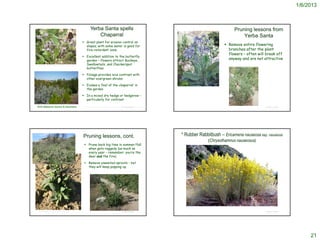
     Easy to grow plant           Soils:                                                            Both S. CA Yerba Santas were used
                                      Texture: well-drained best,                                     extensively as medicinal plants
                                       but even clay is fine (esp. on a
                                       slope)
                                      pH: any local                                                                                                              Fresh or dried leaves were boiled
                                                                                                                                                                   to make a bitter tea which was
                                  Light: full sun; only found in                                                                                                  taken for coughs, bronchitis, colds,
                                    openings in the wild                                                                                                           sore throat and asthma.

                                  Water:                                                                                                                         The tea was also taken for
                                      Winter: needs adequate winter                                                                                               tuberculosis and rheumatism, and
                                       rains                                                                                                                       as a blood purifier.
                                      Summer: very drought tolerant                                                                                              Fresh leaves were pounded into a
                                       after first year (Zone 1-2;                                                                                                 poultice that was applied to sores
                                       Zone 2 in a very dry year)                                                                                                  and abrasions.
                                  Fertilizer: none; organic mulch                                                                                                A strong solution of boiled leaves
                                    OK                                                                                                                             was used as a hot compress to
                                                                                                                                                                   relieve muscular aches and
                                                                                                                                                                   rheumatism.
  BonTerra Consulting
                                                           © Project SOUND             http://www.calflora.net/bloomingplants/thickleafyerbasanta.html                                      © Project SOUND


                                                                                                                                                                                                                   20
1/6/2013


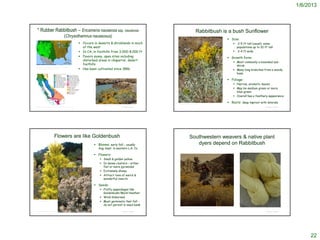
                                                                                                Yerba Santa spells                                                                                                                                                  Pruning lessons from
                                                                                                    Chaparral                                                                                                                                                           Yerba Santa
                                                                                  Great plant for erosion control on
                                                                                   slopes; with some water is good for                                                                                                                                          Remove entire flowering
                                                                                   fire-retardant zone                                                                                                                                                           branches after the plant
                                                                                                                                                                                                                                                                 flowers – often will break off
                                                                                  Excellent addition to the butterfly
                                                                                   garden – flowers attract Buckeye,
                                                                                                                                                                                                                                                                 anyway and are not attractive
http://www.laspilitas.com/nature-of-california/plants/eriodictyon-crassifolium     Swallowtails, and Checkerspot
                                                                                   butterflies

                                                                                  Foliage provides nice contrast with
                                                                                   other evergreen shrubs

                                                                                  Evokes a ‘feel of the chaparral’ in
                                                                                   the garden

                                                                                  In a mixed dry hedge or hedgerow –
                                                                                   particularly for contrast

 With Malosma laurina & baccharis                                                http://www.plantscomprehensive.com/regional-native-plants-particular-interest-eriodictyon-crassifolium-var-crassifolium-silver-felty-le
                                                                                                                                                                   © Project SOUND                                                                                                   © Project SOUND


                                                                                 Pruning lessons, cont.                                                                                                                    * Rubber Rabbitbush – Ericameria nauseosa ssp. nauseosa
                                                                                                                                                                                                                                                       (Chrysothamnus nauseosus)
                                                                                    Prune back big time in summer/fall
                                                                                     when gets raggedy (as much as
                                                                                     every year – remember: you’re the
                                                                                     deer and the fire)

                                                                                    Remove unwanted sprouts – but
                                                                                     they will keep popping up


                                                                                                                                                                                                                             © 2003 Michael Charters


    http://davesgarden.com/guides/pf/showimage/229114/                                                                                                               © Project SOUND                                                                                                 © Project SOUND


                                                                                                                                                                                                                                                                                                            21
1/6/2013


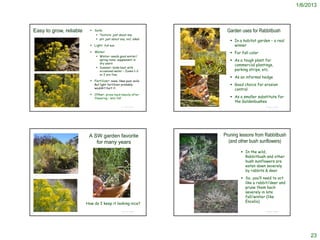
      * Rubber Rabbitbush – Ericameria nauseosa ssp. nauseosa                                                                                                                                  Rabbitbush is a bush Sunflower
                                                           (Chrysothamnus nauseosus)
                                                                                                                                                                                                                                      Size:
                                                                                   Occurs in deserts & shrublands in much                                                                                                                 2-5 ft tall (usual); some
                                                                                    of the west                                                                                                                                            populations up to 10 ft tall
                                                                                   In CA, in foothills from 3,000-8,000 ft                                                                                                               2-4 ft wide
                                                                                   Favors sunny, open sites including                                                                                                                Growth form:
                                                                                    disturbed areas in chaparral, desert
                                                                                                                                                                                                                                          Most commonly a mounded sub-
                                                                                    foothills                                                                                                                                              shrub
                                                                                   Has been cultivated since 1886
     http://www.swcoloradowildflowers.com/Yellow%20Enlarged%20Photo

                                                                                                                                                                                                                                          Many long branches from a woody
     %20Pages/chrysothamnus%20nauseosus.htm


                                                                                                                                                                                                                                           base

                                                                                                                                                                                                                                      Foliage:
                                                                                                                                                                                                                                          Narrow, aromatic leaves
                                                                                                                                                                                                                                          May be medium green or more
                                                                                                                                                                                                                                           blue-green
                                                                                                                                                                                                                                          Overall has a feathery appearance

                                                                                                                                                                    © 2005 Christopher L. Christie
                                                                                                                                                                                                                                      Roots: deep taproot with laterals
                                                                                                         http://en.wikipedia.org/wiki/Chrysothamnus_nauseosus
 http://ucjeps.berkeley.edu/cgi-bin/get_JM_treatment.pl?Chrysothamnus+nauseosus                                                                   © Project SOUND                                                                                                © Project SOUND


                                       Flowers are like Goldenbush                                                                                                                  Southwestern weavers & native plant
                                                                                                        Blooms: early fall - usually                                                  dyers depend on Rabbitbush
                                                                                                           Aug-Sept. in western L.A. Co.

                                                                                                        Flowers:
                                                                                                              Small & golden yellow
                                                                                                              In dense clusters – either
                                                                                                               flat or more pyramidal
                                                                                                              Extremely showy
                                                                                                              Attract tons of weird &
                                                                                                               wonderful insects

                                                                                                        Seeds:
                                                                                                              Fluffy appendages like
                                                                                                               Goldenbush/Mock Heather
                                                                                                              Wind disbursed
 © 2003 Michael Charters
                                                                                                              Must germinate that fall –
                                                                                                               do not persist in seed bank
                                                                                                                                                                       http://lyn.bengaltech.com/old/public/lynimages/nativef.html

http://www.swcoloradowildflowers.com/Yellow%20Enlarged%20Photo%20Pages/chrysothamnus%20nauseosus.htm                                              © Project SOUND                                                                                                © Project SOUND


                                                                                                                                                                                                                                                                                        22
1/6/2013


Easy to grow, reliable                                                    Soils:                                                                                                                     Garden uses for Rabbitbush
                                                                              Texture: just about any
                                                                              pH: just about any, incl. alkali
                                                                                                                                                                                                        In a habitat garden – a real
                                                                          Light: full sun                                                                                                               winner
                                                                          Water:                                                                                                                       For fall color
                                                                              Winter: needs good winter/
                                                                               spring rains; supplement in                                                                                              As a tough plant for
                                                                               dry years
                                                                                                                      http://www.laspilitas.com/nature-of-california/plants/chrysothamnus-nauseosus

                                                                                                                                                                                                         commercial plantings,
                                                                              Summer: looks best with
                                                                               occasional water – Zones 1-2                                                                                              parking strips, etc.
                                                                               or 2 are fine.
                                                                                                                                                                                                        As an informal hedge
                                                                          Fertilizer: none; likes poor soils.
                                                                            But light fertilizer probably                                                                                               Good choice for erosion
                                                                            wouldn’t hurt it.                                                                                                            control
                                                                          Other: prune back heavily after
                                                                            flowering – late fall                                                                                                       As a smaller substitute for
                                                                                                                                                                                                         the Goldenbushes
                                                                                                    © Project SOUND                                                                                                       © Project SOUND
                                                                                                                      http://bugguide.net/node/view/40653/bgimage


                                                                        A SW garden favorite                                                                                                 Pruning lessons from Rabbitbush
                                                                           for many years                                                                                                      (and other bush sunflowers)

                                                                                                                                                                                                              In the wild,
                                                                                                                                                                                                               Rabbitbush and other
                                                                                                                                                                                                               bush sunflowers are
                                                                                                                                                                                                               eaten down severely
                                                                                                                                                                                                               by rabbits & deer
                                                                                                                                                                                                              So…you’ll need to act
http://blog.laurelbusch.com/2009/10/31/going-native-in-nevada-think-
about-it.aspx?ref=rss


                                                                                                                                                                                                               like a rabbit/deer and
                                                                                                                                                                                                               prune them back
                                                                                                                                                                                                               severely in late
                                                                                                                                                                                                               fall/winter (like
                                                                                                                                                                                                               Encelia)
                                                                       How do I keep it looking nice?
                                                                                                    © Project SOUND                                                                                                       © Project SOUND


                                                                                                                                                                                                                                                 23
1/6/2013


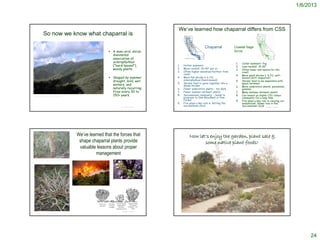
                                                                                                  We’ve learned how chaparral differs from CSS
               So now we know what chaparral is

                                                                                                                        Chaparral              Coastal Sage
                                                                         A semi-arid, shrub                                                   Scrub
                                                                          dominated
                                                                          association of
                                                                          sclerophyllous                                                        1.   Cooler summers: fog
                                                                          (“hard-leaved”),        1.   Hotter summers                           2.   Less rainfall: 15-20”
                                                                          woody plants            2.   More rainfall: 20-40” per yr             3.   Often lower and nearer/on the
                                                                                                  3.   Often higher elevation/further from           coast
                                                                                                       coast                                    4.   More small shrubs (< 6 ft); soft-
                                                                         Shaped by summer        4.   More tall shrubs (> 6 ft);                    leaved (‘soft chaparral’)
                                                                          drought, mild, wet           sclerophyllous (hard-leaved)             5.   Shrubs tend to be separated with
                                                                                                  5.   Shrubs tend to grow together into a           space between
                                                                          winters, and                 dense thicket                            6.   More understory plants: perennials,
                                                                          naturally recurring     6.   Fewer understory plants – too dark            grasses
                                                                          fires every 30 to       7.   Fewer summer-dormant plants              7.   Many summer-dormant plants
                                                                          150+ years.             8.   Successional community – tends to        8.   Can remain as stable CSS climax
                                                                                                       progress to Oak Woodland or Pine              community for a long time
http://en.wikipedia.org/wiki/File:Chaparral1.jpg


                                                                                                       Forest                                   9.   Fire plays a key role in clearing out
                                                                                                  9.   Fire plays a key role in ‘setting the         underbrush; lesser role in the
                                                                                © Project SOUND
                                                                                                       successional clock’                           ‘successional clock’ © Project SOUND


                                                       We’ve learned that the forces that                  Now let’s enjoy the garden, plant sale &
                                                        shape chaparral plants provide                            some native plant foods!
                                                        valuable lessons about proper
                                                                 management
http://www.flickr.com/photos/12978266@N00/3277102378


                                                                                © Project SOUND                                                                          © Project SOUND


                                                                                                                                                                                                  24

Prudent Pruning - Notes

  • 1.
    1/6/2013 Out of theWilds and Into Your Garden Prudent Pruning Plants of the S. CA Chaparral C.M. Vadheim and T. Drake CSUDH & Madrona Marsh Preserve Madrona Marsh Preserve Gardening with Western L.A. County Native Plants November 6 & 9, 2010 Project SOUND - 2010 © Project SOUND © Project SOUND The chaparral tells an interesting story, if you how to read it What is the chaparral plant community?  Chaparral is California’s most extensive plant community.  It is also the state’s most characteristic wilderness  It dominates foothills and mountain slopes from the Rouge River Valley in southern Oregon to the San Pedro Martir in Baja California. http://davesgarden.com/guides/articles/view/2789/ © Project SOUND © Project SOUND 1
  • 2.
    1/6/2013 Chaparral Area inCalifornia by County (acres)* San Diego 1,003,441 Los Angeles 553,789 Riverside 499,160 Santa Barbara 440,645 San Luis Obispo 417,718 Monterey 369,345 http://www.geo.arizona.edu/Antevs/biomes/ChaparalStaMonicaA.jpg Ventura 326,447 http://www.californiaherps.com/lizards/habitats/atstejnegerihabitatla508.jpg San Bernardino 276,010 Santa Monica Mtns - mostly higher elevations Lower elevations - San Gabriels San Benito 246,623 Santa Clara 188,427 Orange 111,550 Marin 37,566 San Mateo 36,152 Santa Cruz 32,328 *From Fried, J.S., C.L. Bosinger, and D. Beardsley. 2004. Chaparal in Southern and Central Coastal California in the Mid-1990's: Area, Ownership, Condition, and Change. http://www.californiachaparral.com/awheresthechaparral.html http://www.californiachaparral.com/awheresthechaparral.html USFS Resource Bulletin PNW-RB-240 © Project SOUND Malibu State Park Cleveland National Forest © Project SOUND How does chaparral differ from coastal sage scrub? Chaparral Coastal Sage Scrub 1. Often (not always) slightly higher elevation (500-4500 1. Often lower elevation & ft) & further from coast nearer/on the coast 2. Hotter summers; winter lows 2. Cooler summers: fog – more temperate in general 3. More rainfall: 20-40” per yr – 3. Less rainfall: 15-20” some may even fall in mid-late summer (summer monsoons) 4. Soil usually loam/clay Chaparral looks somewhat like Coastal Sage Scrub…. 4. Soil often rocky © Project SOUND © Project SOUND 2
  • 3.
    1/6/2013 Howdo chaparral/coastal sage scrub differ? Why Sclerophyllous Coastal Sage Scrub leaves? Chaparral  Small, Sclerophyllous leaves are advantageous in a semi- arid climate because they reduce evaporation thorough Xyloccocus bicolor a variety of traits including:  waxy coatings  thicker cell layers 5. More small shrubs (< 6 ft);  recessed stomata, the pores in 5. More tall shrubs (> 6 ft); soft-leaved (‘soft chaparral’) leaves permitting evaporation sclerophyllous (hard-leaved) 6. Shrubs tend to be separated and the exchange of oxygen 6. Shrubs tend to grow together with space between – can into a dense thicket walk though it and carbon dioxide © Project SOUND Rhamnus ilicifolia © Project SOUND How do chaparral/coastal sage scrub differ? Chaparral Coastal Sage Scrub http://interwork.sdsu.edu/fire/resources/san-diego-habitats.htm http://www.laspilitas.com/nature-of-california/communities/coastal-sage-scrub http://davesgarden.com/guides/articles/view/2789/ 7. More complex understory: 7. Fewer understory plants – too perennials, grasses dark under the large shrubs 8. Many summer-dormant 8. Fewer summer-dormant plants plants http://www.soenyun.com/Blog/tag/exotics/ © Project SOUND http://groups.ucanr.org/SAFE/Fire_in_Southern_California_Ecosystems/ © Project SOUND 3
  • 4.
    1/6/2013 Walking through chaparral requires a path The topography has an effect on vegetation  The aspect of a hillside makes a great difference in the composition of the chaparral.  North facing slopes are a lot moister  Toyon, Manzanita, Scrub oak, Pitcher sage, Kekiella , and Poison oak.  The south facing slopes are arid: Remember: aspect also is important  Dominated by Chamise, Black in CSS – both are plant communities sage, Woolly blue curls and Bush poppy, (Dendromecon sensitive to topography (both have rigida). http://blogs.getty.edu/iris/ ‘sun’ and ‘part-shade’ plants) © Project SOUND © Project SOUND How do chaparral/coastal sage scrub differ? Evidence that fire has played a key role in Chaparral Coastal Sage Scrub Chaparral  Even-age ‘stands’ of vegetation – suggests recruitment/sprouting only after fire  Long-lived seeds that require fire/smoke to germinate http://www.flickr.com/photos/52509763@N00/310103199/ http://palosverdessource.com/tag/rancho-palos-verdes/  Rapid regeneration from http://www.desertmuseum.org/desert/habitats/chap/chapgallery.php?print=y specialized re-sprouting 9. Can remain as stable CSS organs – ‘burls’/lignotubers 9. Successional community – climax community for a long tends to progress to Oak  Presence of fire-follower time Woodland or Pine Forest species – endemic to post-fire 10. Fire plays a key role in years/regions 10. Fire plays a key role in clearing out underbrush; ‘setting the successional clock’ lesser role in the setting ‘successional clock’ SOUND http://www.desertmuseum.org/desert/habitats/chap/chapgallery.php?print=y © Project © Project SOUND 4
  • 5.
    1/6/2013 Chaparral is atransitional community – at least historically Does chaparral ever reach climax any more in S. CA?  The Chaparral is usually a successional plant community that gradually moves to oak and pine forest, if the soil depth supports it  Over time, just the presence of the Chaparral can change the actual characteristics of a site: http://picasaweb.google.com/guidesharon/Spring#5274932832288037602  change the pH one unit  effectively ‘double’ the precipitation  produce a litter layer (mulch layer of leaves) in which the pines and oaks can germinate.  These changes only occur if the chaparral doesn't burn for decades or maybe centuries - no one really knows the time line. © Project SOUND © Project SOUND http://room42.wikispaces.com/Savanna+Climate Recovery after fire Characteristics of chaparral plants  Mainly woody shrubs  Takes 3-4 years  Chaparral communities in  Depends on species – California occur from sea level to first 2 years recovery high mountains. Each elevation has by either re-sprouting its own mix of species http://www.laspilitas.com/easy/easy_wildflower_picture.htm or seed  Plants like manzanita (Arctostaphylos spp.) Ceanothus  Soil moisture is (Ceanothus spp.) and chamise important – higher (Adenostema fasciculatum) are elevation and N-facing common themes in southern slopes in lower California chaparral. elevations do best  All chaparral plants in California  Ultimately, smaller are adapted to wet winters and species are crowded dry summers, and they like well- out drained soils. http://interwork.sdsu.edu/fire/resources/Chaparral.htm © Project SOUND © Project SOUND http://www.laspilitas.com/nature-of-california/communities/chaparral 5
  • 6.
    1/6/2013 Chaparral plants are also good food Common large Chaparral shrubs: S. CA  Several species of scrub oaks - Quercus  Young plants and succulent foliage are berberidifolia most common and widespread. always a temptation – and easier to  Chamise (Adenostoma fasciculatum) access  Toyon (Heteromeles arbutifolia)  Ceanothus leaves are browsed by deer year-round  Various Ceanothus species  Rabbits, deer and other herbivores  Various manzanita (Arctostaphylos) species can browse heavily in fall/ winter  Laurel sumac (Malosma laurina) Deer eating Ceanothus http://picasaweb.google.com/lh/photo/F7xecrsLEk2wFiIEETx41A  Sugar bush (Rhus ovata)  Holly-leafed cherry (Prunus ilicifolia)  Spiny redberry (Rhamnus ilicifolia)  Mountain mahogany (Cercocarpus betuloides).  Redshanks (Adenostema sparsifolia) Chaparral comes from the Spanish and means "having  Silk-tassel bush (Garrya spp.) Brush Rabbit scrub oaks". http://www.bentler.us/eastern-washington/plants/shrubs/rabbit-brush.aspx © Project SOUND © Project SOUND Chaparral shrubs are lovely Chaparral plants say ‘buy me, buy me!’  Evergreen foliage  Most have abundant springtime or summer blooms. http://dunncreekfarm.blogspot.com/2010/04/organic-farming-from-hell.html  Berries add color in the late summer and fall when the rest of the region is drab.  Any given patch of chaparral will contain several of the common large shrub species but one or two will be predominant.  And then there are the showy smaller plants that grow in sunny patches…. http://jimmundy.name/garden_album/slides/Ceanothus_looking_toward_front_door.html © Project SOUND © Project SOUND 6
  • 7.
    1/6/2013 And that’s how pruning figures into the story Buckbrush – Ceanothus cuneatus var. cuneatus © Project SOUND © Project SOUND Buckbrush – Ceanothus cuneatus var. cuneatus You’ve likely seen it in the wild…  Western U.S. from OR to N. Baja  Just another large shrub most of the year  In CA, common in  Covered with snow-like blossoms http://oregonstate.edu/dept/botany/herbarium/projects/ceanothus/CeCu/index.html foothills except in in spring – some say reminiscent deserts & Central of a cherry or apple tree Valley http://www.fs.fed.us/database/feis/plants/shrub/ceacun/all.html  Common on dry, rocky slopes, fans & ridges, to 6000', in foothill chaparral, pinyon-juniper and yellow pine woodland http://www.flickr.com/photos/ericinsf/2409689371/ http://ucjeps.berkeley.edu/cgi-bin/get_JM_treatment.pl?6586,6589,6594,6595 © Project SOUND N. CA Chaparral © Project SOUND http://www.tulipsinthewoods.com/wild-plants/buckbrush-ceanothus-cuneatus/ 7
  • 8.
    1/6/2013 Flowers: showy white Buckbrush has many characteristics of ceanothus Ceanothus  Size:  4-8 ft tall  Blooms:  4-8 ft wide  Mar.-May or even later at higher elevations  Growth form:  Depends on the climate  Fast-growing woody shrub patterns/ rain & temperature  Form usually erect, multi-stemmed – rarely prostrate  Flowers: http://www.nwplants.com/business/catalog/shrubs.html#Cea_cun  May assume shrub or more tree-like  Usually pure white, but may be form - may be variable because it a pale blue hybridizes with similar species.  Flowers quite large for  Bark gray Ceanothus – note the interesting shape - regular with  Foliage: 5 alternating petals and sepals  Small, simple leaves with waxy coat and 5 stamens growing opposite  Color: green to gray-green of petals  Roots: deep, much-branched taproot  Insect pollinated © Project SOUND © Project SOUND http://www.tulipsinthewoods.com/wild-plants/buckbrush-ceanothus-cuneatus/ Fruits & seeds are Plant Requirements  Soils: typical for Ceanothus  Texture: well-drained preferred  pH: any local  Fruits are sticky, rounded 3-lobed  Light:  Full sun to light shade – capsules with “horns” common for chaparral shrubs near the top  Water:  Seeds are dispersed  Winter: needs good deep when the capsule winter rains explodes and propels  Summer: none to occasional (Zone 1-2 probably best) them some distance.  Fertilizer: use an organic mulch  Seeds remain dormant  Other: resents being moved; until a fire promotes plant out when small germination http://www.laspilitas.com/nature-of-california/plants/ceanothus-cuneatus © Project SOUND © Project SOUND http://www.hazmac.biz/060410/060410CeanothusCuneatus.html 8
  • 9.
    1/6/2013 Buckbrush Ceanothus makes a good large shrub Human uses of Buckbrush (and other  Wonderful for erosion control Ceanothus species and naturalizing on slopes  Good shrub for large-scale plantings  Tea from leaves and flowers  Good for dry, rocky hot sites –  Dyes: green from the flowers; not for near the coast red from the root.  Wonderful habitat plant:  Stands were burned & coppiced  Bees love nectar to produce young, straight http://natureshutterbug.com/wordpress/2010/02/17/a-different-kind-of-snowy-white-with-many-insects/  Larval host plant for White- shoots for basketry material streaked saturnia moth (Saturnia albofasciata)  All parts of plant can be used  Seeds eaten by bushtits, to make a mild, fragrant body mockingbirds, quail and finches soap or shampoo  Cover for many wildlife species including California quail, black- tailed jackrabbit, brush rabbit, and mourning dove http://www.calfloranursery.com/pages_plants/pages_c/ceacun.html © Project SOUND © Project SOUND Pruning lessons from Ceanothus Chaparral shrubs  Usually doesn’t need much – has a are very efficient nice natural shape – if treated correctly in the first few years  For plant health, remove  If a branch is no longer dead/crossing branches – will likely receiving adequate sunlight, the plant can have a few of these each year even self-prune that branch in a mature plant. - that is, allow it to die. http://outdoors.webshots.com/photo/1120298861053871638LibNcZ  The understory of the chaparral is a tangle of dead branches.  If you don’t want that look, prune out the dead branches http://www.researchlearningcenter.com/bloom/species/Ceanothus_cuneatus_cuneatus.htm © Project SOUND © Project SOUND 9
  • 10.
    1/6/2013 Pruning lessons from Ceanothus  If you want to shape plants, start in the first year – after the first few years, the deer can’t get to the leaves to ‘prune’ them  Light tip pruning in the first few years promotes fuller foliage  Best not to cut out any wood http://www.fs.fed.us/database/feis/plants/shrub/ceacun/all.html thicker than a pencil – no self- respecting deer would eat anything larger (and tougher) than that  Use selective pruning to remove http://www.researchlearningcenter.com/bloom/species/Ceanothus_cuneatus_cuneatus.htm entire branches that are unwanted  Do light pruning right after flowering (summer pruning): flowers occur only on previous year’s wood - so if you remove that in fall – no flowers http://www.tulipsinthewoods.com/wild-plants/buckbrush-ceanothus-cuneatus/ © Project SOUND © Project SOUND Pruning lessons from Ceanothus Chaparral Mallow – Malacothamnus fasciculatus  Can’t really limit size by pruning – will only shorten life  Choose an appropriate sized plant for the space – you and the plant will be happier http://blass.com.au/definitions/malacothamnus http://www.stylelist.com/?sem=1&ncid=bannadusstyl00000026 http://www.calflora.net/bloomingplants/buckbrush.html © Project SOUND © Project SOUND 10
  • 11.
    1/6/2013 Chaparral Mallow: feature Chaparral Mallow – Malacothamnus fasciculatus depend on the setting  Many areas of CA that have foothills – N. CA to N. Baja  Size:  3-12 ft tall  Common shrub throughout chaparral and coastal sage scrub on dry slopes  4-12 ft wide; spreading and fans to about 2500‘  Growth form:  Often seen on disturbed ground and  Woody shrub along roadsides; fire-follower.  Stems are wand-like http://ucjeps.berkeley.edu/cgi-bin/get_JM_treatment.pl?5042,5073,5079  Fast to moderate growth  May form a dense shrub or be more tree-like – depends on water, ‘pruning’, ?genetics  Foliage:  Gray-green (more green with water) rounded leaves  Softly hairy; pretty http://www.sci.sdsu.edu/plants/sdpls/plants/Malacothamnus_fasciculatus.html http://teacher-us.com/young/prsnl_ed/field_photos.htm © Project SOUND http://blass.com.au/definitions/malacothamnus © Project SOUND Flowers like a picture… Typical chaparral plant  Soils:  Texture: just about any, but  Blooms: likes well-drained best  Off & on from April  pH: any but very alkali (> 8.0) through fall  Light:  Heaviest bloom usually in  Full sun to part-shade spring  Flowers:  Water:  New plant: treat as Zone 2  Moderate size; ~ 1” across  Established: needs little to no  Typical mallow shape supplemental (Zone 1 or 1-2);  Color: pink (very light to  Will lose leaves in drought medium)  Over-watering will make it  Super attractive – lots of spread faster – and may kill the http://en.wikipedia.org/wiki/File:Malacothamnus_fasciculatus_2.jpg blooms along the wand-like plant stems  Fertilizer: none; likes poor soils  Vegetative reproduction: suckers from roots © 2005 Janell Hillman http://bugguide.net/node/view/295204/bgimage © Project SOUND © Project SOUND 11
  • 12.
    1/6/2013 Chaparral Mallow: pretty & informal ‘Casitas’ cultivar  Lovely as an informal hedge  Upright habit  Super choice for a wildlife garden:  Nectar for: Hummingbirds, West  To 6-8’ tall and Coast Lady, Western checkered wide skipper, and Large White Skipper  Attractive gray- http://www.flickr.com/photos/mechanoid_dolly/4590614319/  Larval food plant: Gray Hairstreak green foliage  Cover and nesting sites  Selected for  Would work well in a chaparral or garden use Edwardian-themed garden  Available – TPF &  Large foundation plant others  Slopes & hillsides © Project SOUND © Project SOUND http://commons.wikimedia.org/wiki/File:Malacothamnus_fasciculatus_1.jpg http://www.theodorepayne.org/mediawiki/index.php?title=Malacothamnus_fasciculatus_'Casitas' Watering lessons from Chaparral Mallow Pruning lessons from Chaparral Mallow (that impact pruning/management) (and other suckering shrubs)  Growth rate often dependent on water – faster with more water  Watering practices impact pruning  Often growth rate is inversely correlated with plant longevity:  Some plants will always ‘live hard & die young’ look informal – these are not plants that take to  Most mallows (and other spreading formal pruning, so choose shrubs) are opportunists: they accordingly. spread as much as water allows  Even if you limit summer water,  Work with – not against – most will still spread – for example the plant’s natural in wet winters. This is part of the tendencies plant’s survival mechanism – growing  This plant will not ‘stay in new shoots in areas where competition for light/water are place’ forever – needs to less spread out © 2009 Neal Kramer © Project SOUND © Project SOUND 12
  • 13.
    1/6/2013 * Creeping Sage – Salvia sonomensis * Creeping Sage – Salvia sonomensis  Foothills of the Sierras and coastal mountains of central & N. CA – also in the mountains of San Diego Co. into Baja  Chaparral, oak woodland, yellow-pine forest  Northern areas: dry, rocky slopes below 6500 ft. http://ucjeps.berkeley.edu/cgi-bin/get_JM_treatment.pl?Salvia+sonomensis  San Diego Co: in the understory, with part-sun Remember: dry, rocky slopes in N. CA are not like our dry, rocky slopes J.S. Peterson @ USDA-NRCS PLANTS Database © Project SOUND © Project SOUND Creeping Sage is a groundcover: true to  Soils: its heritage as a ‘Mint’ Plant Requirements  Texture: likes a well-drained soil – sandy or rocky best but  Size: clay is fine if not over-watered  1-2 ft tall  pH: any local  4-10+ ft wide  Light:  Growth form:  Best in light shade (dappled shade under taller trees or  Low to mat-like semi-woody shrubs) or morning sun. groundcover  Spreads with time – J.S. Peterson @ USDA-NRCS PLANTS Database  Water: branches just keep growing  Winter: likes good winter outward water; supplement in spring in dry years  Foliage:  Summer: Zone 1-2 best after  Grayish-green, elliptical the first year; can wash off leaves, woolly underneath leaves and puckered above  Attractive and aromatic  Fertilizer: none; likes poor soils http://www.wildflower.org/plants/result.php ?id_plant=saso © Project SOUND © 2004 Christopher L. Christie © Project SOUND http://forums.gardenweb.com/forums/load/salvia/msg0502361430447.html 13
  • 14.
    1/6/2013 Creeping Sage creeps & drapes Cultivar ‘Dara’s Choice’  Wonderful groundcover on a shadier slope  Compact growth form  Groundcover under trees and  Probably a natural shrubs hybrid with Salvia  Cascading over a low wall http://ohric.ucdavis.edu/photos/ornament8.htm mellifera  Requires well-drained http://www.yerbabuenanursery.com/viewplant.php?pid=33 soil – judicious summer water  Tends to be short-lived  Available at Theodore Payne Foundation. http://www.redding.com/photos/galleries/2008/apr/26/right-home/5302/ © Project SOUND © Project SOUND http://seedbyte.blogspot.com/2009_12_11_archive.html http://www.yerbabuenanursery.com/viewplant.php?pid=33 Cultivar ‘John Cultivar ‘Mrs. Farmar-Bowers’ Beard’  White flowers  Fast-growing  Takes clay soils well  Low – looks quite a bit like the  Needs some straight species afternoon shade  Old cultivar –  Blend with blue- stable and well- flowered Salvias suited for gardens  Great groundcover under Manzanitas http://www.laspilitas.com/nature-of- california/plants/salvia-sonomensis-mrs-beard http://www.laspilitas.com/nature-of-california/plants/salvia-sonomensis-farmar-bower © Project SOUND © Project SOUND 14
  • 15.
    1/6/2013 Pruning lessons from Creeping Sage (and Properly pruned Black Sage other half-woody groundcovers, Salvias) Leave 3-4 pairs of new leaves/shoots  Start early – good shape begins in the first year  Cut back all varieties of S. sonomensis yearly, after flowering, to control woody growth at the base and keep the plant vigorous. http://www.baynatives.com/plants/Salvia-sonomensis/  Be sure to not cut into the old, woody growth – you will kill the plant © Project SOUND © Project SOUND *Redberry Buckbrush – Rhamnus crocea Characteristics of Redberry Buckbrush  Size:  3-6+ ft tall; can be to 15 ft.  4-6 ft wide; can be to 10 ft.  Growth form:  Medium to large woody shrub  Many stiff branches (dense)  Coastal forms tend to be shorter, more sprawling  Slow-growing, esp. at first  Foliage:  Evergreen  Simple, shiny dark-green leaves  Some thorns at branch tips http://www.researchlearningcenter.org/bloom/species/Rhamnus_crocea.htm © 2007 Neal Kramer http://biology.csusb.edu/PlantGuideFolder/RhamnusCrocea/RhamnusCroceaPage.htm © Project SOUND http://www.timetotrack.com/jay/redb3.htm © Project SOUND 15
  • 16.
    1/6/2013 Redberry – a great habitat plant Garden uses for Redberry Buckbrush  Birds:  As an accent plant  Perching & nesting  As an evergreen shrub –  Insects blends in except when fruiting.  Berries at time of fall migration (Jays, Robins,  Great for low-water areas Mockingbirds, Thrashers, including parkways, roadsides, Cedar Waxwings) fencelines and banks and  Hummingbirds & insects: slopes nectar  Great under oaks and other  Butterflies: larval food for Zone 1 to 2 native trees & Pale Swallowtail shrubs  Note: plant preparations also used as laxative; sold  Excellent habitat choice for commercially under the hedges, hedgerows, screens, name of Cascara Sagrada and barriers; can be pruned to shape http://www.hazmac.biz/030714/030714RhamnusCroceaPoster.html © Project SOUND © Project SOUND http://www.yerbabuenanursery.com/online_album/0882.htm Pruning lessons from Spiny Redberry (and Rhamnus can be coppiced to rejuvenate other Rhamnus/Frangula spp.) Sometimes you’ve got to ‘be the fire’  Form depends on light: dense & shrub-like in full sun – more open in shadier locations  Can be hedge-sheared – requires early shaping & regular shearing (tip pruning) http://tmousecmouse.blogspot.com/2009/04/tree-work-2-chaparral-shape-up.html http://caornamentalnativeplants.org/redberry.jpg © Project SOUND © Project SOUND 16
  • 17.
    1/6/2013 Coppicing: severe regenerative pruning Matilija Poppy – Romneya coulteri http://www.primitiveways.com/coppicing.html http://www.answers.com/topic/coppicing?cat=technology  Coppicing is a traditional method of woodland management in which tree stems are cut down to a low level. In subsequent growth years, many new shoots will emerge and after a number of years the cycle begins again and the coppiced tree, or stool, is ready to be harvested again http://www.goldenwestcollege.edu/garden/plantofmonth/0510.html © Project SOUND © Project SOUND Matilija Poppy – Romneya coulteri ‘The Queen of California Flowers’  Endemic to S. CA from Santa Barbara Co. to Baja – locally on Catalina Isl. and  Loved by naturalists and in Santa Monica & San Gabriel Mtns. gardeners alike  Uncommon in dry washes & canyons  Called the “Queen of below 4000 ft in chaparral California Flowers,” (Mary Elizabeth Parsons, The Wild http://www.efloras.org/florataxon.aspx?flora_id=1&taxon_id=220011716 Flowers of California, 1897)  Does have an exotic & tropical look to it – artists love it!  Decreasing in the wilds due to habitat loss http://ucjeps.berkeley.edu/cgi-bin/get_JM_treatment.pl?5547,5597,5598 © 2006 Ricky Grubb © Project SOUND http://cartas.typepad.com/main/2010/05/matilija-poppy-romneya-coulteri-mythical-beauty.html © Project SOUND 17
  • 18.
    1/6/2013 Romneya coulteri is one big perennial! Flowers are unbelievable!  Blooms:  Size:  Early summer into fall in the  3-8 ft tall garden setting – in our area  8+ ft wide, spreading usually begins in June  Growth form:  Flowers:  Clumping/spreading shrub-  Huge (6-8”) saucer-like poppy http://www.calfloranursery.com/pages_plants/pages_r/romcou.html like perennial or sub-shrub flowers – many per plant  Stems mostly upright  Crinkled white petals & yellow  Fast-growing and vigorous stamens – sometimes called ‘fried egg plant’  Foliage:  Citrus-like scent  Yellow-green to gray-green  Seedpods: poppy-like  Very succulent – tropical look  Vegetative reproduction:via rhizomes – up to 20 ft. from mother plant http://www.calfloranursery.com/pages_plants/pages_r/romcou.html © Project SOUND © Project SOUND Plant Requirements  Soils: Give Matilija Poppy space  Texture: rocky or sandy best – can be difficult to establish in clays  A star on hot dry  pH: any local hillsides and banks; excellent for erosion  Light: full sun control  Water:  New plants: water weekly in http://www.gardenology.org/wiki/Romneya  As an accent plant in hottest weather; taper to large landscapes Zone 2 (schools; commercial  Established plants: Zone 1; settings) perhaps 1-2 in very sandy soil  Fertilizer: none; likes poor soils  In very wide beds; or as a single accent plant  Other: dislikes having its roots disturbed  In very large containers © 2003 Joseph Dougherty/ecology.org © Project SOUND © Project SOUND 18
  • 19.
    1/6/2013 ‘White Cloud’ Pruning lessons from Matilija Poppy (and other ground- cultivar cover plants that are cut back to the ground in fall  Prune back hard in fall:  Theodore Payne first  In nature a fall frost will kill discovered it in a stems to the ground southern California  In your (western L.A. Co) garden http://www.californianativeplants.com/index.php?option=com_content&view=article&catid=34:featur nursery in 1940 you must do the same – cut back ed-plants&id=54:romneya-coulteri-white-cloud-matilija-poppy&Itemid=56 to small stubs (4”)  Probably a hybrid between Romneya  Hard to control/size issues coulteri X R. trichocalyx  They will attempt to reach their maximum size – that’s what  Very large, showy they’re programmed to do flowers  Better to plant for the space, rather than try to control the  Slightly smaller size size/spread © Project SOUND © Project SOUND *Felt-leaf Yerba Santa – Eriodictyon crassifolium *Felt-leaf Yerba Santa – Eriodictyon crassifolium  Coastal ranges of CA from central CA to Baja  Locally in Santa Monica Mtns, foothills of the San Gabriels & San Fernando Valley  Dry gravelly and rocky places below 6000' in chaparral and pinyon-juniper woodland http://ucjeps.berkeley.edu/cgi-bin/get_JM_treatment.pl?4518,4525,4530 http://www.swsbm.com/Maps/Eriodictyon_crassifolium.gif Charles Webber © California Academy of Sciences © Project SOUND © Project SOUND 19
  • 20.
    1/6/2013 The name ‘Felt-leaf’ says it all…very hairy Flowers are irresistible  Size:  Blooms:  4-8+ ft tall  Late spring to early summer  4-12 ft wide; spreading via rhizomes  Usually around May or June in & seed the Madrona garden  Growth form: http://commons.wikimedia.org/wiki/Category:Eriodictyon_crassifolium  Flowers:  Stiffly erect sub-shrub (part-woody)  Lavender to light magenta –  Densely branched; evergreen; lovely contrast to foliage aromatic  Funnel-shaped – but a fancy  Quick-growing – has to establish funnel (very Victorian looking) itself  In dense clusters at the end of rather short flowering  Foliage: stems – often not much above  Thick, serrated leaves covered by the foliage dense, felt-like hairs – very soft to the touch © 2009 Deborah Leonard  Light gray-green color © Project SOUND http://www.researchlearningcenter.com/bloom/species/Eriodictyon_crassifolium.htm © Project SOUND Easy to grow plant  Soils: Both S. CA Yerba Santas were used  Texture: well-drained best, extensively as medicinal plants but even clay is fine (esp. on a slope)  pH: any local  Fresh or dried leaves were boiled to make a bitter tea which was  Light: full sun; only found in taken for coughs, bronchitis, colds, openings in the wild sore throat and asthma.  Water:  The tea was also taken for  Winter: needs adequate winter tuberculosis and rheumatism, and rains as a blood purifier.  Summer: very drought tolerant  Fresh leaves were pounded into a after first year (Zone 1-2; poultice that was applied to sores Zone 2 in a very dry year) and abrasions.  Fertilizer: none; organic mulch  A strong solution of boiled leaves OK was used as a hot compress to relieve muscular aches and rheumatism. BonTerra Consulting © Project SOUND http://www.calflora.net/bloomingplants/thickleafyerbasanta.html © Project SOUND 20
  • 21.
    1/6/2013 Yerba Santa spells Pruning lessons from Chaparral Yerba Santa  Great plant for erosion control on slopes; with some water is good for  Remove entire flowering fire-retardant zone branches after the plant flowers – often will break off  Excellent addition to the butterfly garden – flowers attract Buckeye, anyway and are not attractive http://www.laspilitas.com/nature-of-california/plants/eriodictyon-crassifolium Swallowtails, and Checkerspot butterflies  Foliage provides nice contrast with other evergreen shrubs  Evokes a ‘feel of the chaparral’ in the garden  In a mixed dry hedge or hedgerow – particularly for contrast With Malosma laurina & baccharis http://www.plantscomprehensive.com/regional-native-plants-particular-interest-eriodictyon-crassifolium-var-crassifolium-silver-felty-le © Project SOUND © Project SOUND Pruning lessons, cont. * Rubber Rabbitbush – Ericameria nauseosa ssp. nauseosa (Chrysothamnus nauseosus)  Prune back big time in summer/fall when gets raggedy (as much as every year – remember: you’re the deer and the fire)  Remove unwanted sprouts – but they will keep popping up © 2003 Michael Charters http://davesgarden.com/guides/pf/showimage/229114/ © Project SOUND © Project SOUND 21
  • 22.
    1/6/2013 * Rubber Rabbitbush – Ericameria nauseosa ssp. nauseosa Rabbitbush is a bush Sunflower (Chrysothamnus nauseosus)  Size:  Occurs in deserts & shrublands in much  2-5 ft tall (usual); some of the west populations up to 10 ft tall  In CA, in foothills from 3,000-8,000 ft  2-4 ft wide  Favors sunny, open sites including  Growth form: disturbed areas in chaparral, desert  Most commonly a mounded sub- foothills shrub  Has been cultivated since 1886 http://www.swcoloradowildflowers.com/Yellow%20Enlarged%20Photo  Many long branches from a woody %20Pages/chrysothamnus%20nauseosus.htm base  Foliage:  Narrow, aromatic leaves  May be medium green or more blue-green  Overall has a feathery appearance © 2005 Christopher L. Christie  Roots: deep taproot with laterals http://en.wikipedia.org/wiki/Chrysothamnus_nauseosus http://ucjeps.berkeley.edu/cgi-bin/get_JM_treatment.pl?Chrysothamnus+nauseosus © Project SOUND © Project SOUND Flowers are like Goldenbush Southwestern weavers & native plant  Blooms: early fall - usually dyers depend on Rabbitbush Aug-Sept. in western L.A. Co.  Flowers:  Small & golden yellow  In dense clusters – either flat or more pyramidal  Extremely showy  Attract tons of weird & wonderful insects  Seeds:  Fluffy appendages like Goldenbush/Mock Heather  Wind disbursed © 2003 Michael Charters  Must germinate that fall – do not persist in seed bank http://lyn.bengaltech.com/old/public/lynimages/nativef.html http://www.swcoloradowildflowers.com/Yellow%20Enlarged%20Photo%20Pages/chrysothamnus%20nauseosus.htm © Project SOUND © Project SOUND 22
  • 23.
    1/6/2013 Easy to grow,reliable  Soils: Garden uses for Rabbitbush  Texture: just about any  pH: just about any, incl. alkali  In a habitat garden – a real  Light: full sun winner  Water:  For fall color  Winter: needs good winter/ spring rains; supplement in  As a tough plant for dry years http://www.laspilitas.com/nature-of-california/plants/chrysothamnus-nauseosus commercial plantings,  Summer: looks best with occasional water – Zones 1-2 parking strips, etc. or 2 are fine.  As an informal hedge  Fertilizer: none; likes poor soils. But light fertilizer probably  Good choice for erosion wouldn’t hurt it. control  Other: prune back heavily after flowering – late fall  As a smaller substitute for the Goldenbushes © Project SOUND © Project SOUND http://bugguide.net/node/view/40653/bgimage A SW garden favorite Pruning lessons from Rabbitbush for many years (and other bush sunflowers)  In the wild, Rabbitbush and other bush sunflowers are eaten down severely by rabbits & deer  So…you’ll need to act http://blog.laurelbusch.com/2009/10/31/going-native-in-nevada-think- about-it.aspx?ref=rss like a rabbit/deer and prune them back severely in late fall/winter (like Encelia) How do I keep it looking nice? © Project SOUND © Project SOUND 23
  • 24.
    1/6/2013 We’ve learned how chaparral differs from CSS So now we know what chaparral is Chaparral Coastal Sage  A semi-arid, shrub Scrub dominated association of sclerophyllous 1. Cooler summers: fog (“hard-leaved”), 1. Hotter summers 2. Less rainfall: 15-20” woody plants 2. More rainfall: 20-40” per yr 3. Often lower and nearer/on the 3. Often higher elevation/further from coast coast 4. More small shrubs (< 6 ft); soft-  Shaped by summer 4. More tall shrubs (> 6 ft); leaved (‘soft chaparral’) drought, mild, wet sclerophyllous (hard-leaved) 5. Shrubs tend to be separated with 5. Shrubs tend to grow together into a space between winters, and dense thicket 6. More understory plants: perennials, naturally recurring 6. Fewer understory plants – too dark grasses fires every 30 to 7. Fewer summer-dormant plants 7. Many summer-dormant plants 150+ years. 8. Successional community – tends to 8. Can remain as stable CSS climax progress to Oak Woodland or Pine community for a long time http://en.wikipedia.org/wiki/File:Chaparral1.jpg Forest 9. Fire plays a key role in clearing out 9. Fire plays a key role in ‘setting the underbrush; lesser role in the © Project SOUND successional clock’ ‘successional clock’ © Project SOUND We’ve learned that the forces that Now let’s enjoy the garden, plant sale & shape chaparral plants provide some native plant foods! valuable lessons about proper management http://www.flickr.com/photos/12978266@N00/3277102378 © Project SOUND © Project SOUND 24