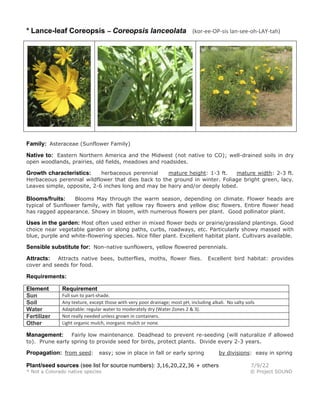
* Lance-leaf Coreopsis – Coreopsis lanceolata (kor-ee-OP-sis lan-see-oh-LAY-tah)
Family: Asteraceae (Sunflower Family)
Native to: Eastern Northern America and the Midwest (not native to CO); well-drained soils in dry
open woodlands, prairies, old fields, meadows and roadsides.
Growth characteristics: herbaceous perennial mature height: 1-3 ft. mature width: 2-3 ft.
Herbaceous perennial wildflower that dies back to the ground in winter. Foliage bright green, lacy.
Leaves simple, opposite, 2-6 inches long and may be hairy and/or deeply lobed.
Blooms/fruits: Blooms May through the warm season, depending on climate. Flower heads are
typical of Sunflower family, with flat yellow ray flowers and yellow disc flowers. Entire flower head
has ragged appearance. Showy in bloom, with numerous flowers per plant. Good pollinator plant.
Uses in the garden: Most often used either in mixed flower beds or prairie/grassland plantings. Good
choice near vegetable garden or along paths, curbs, roadways, etc. Particularly showy massed with
blue, purple and white-flowering species. Nice filler plant. Excellent habitat plant. Cultivars available.
Sensible substitute for: Non-native sunflowers, yellow flowered perennials.
Attracts: Attracts native bees, butterflies, moths, flower flies. Excellent bird habitat: provides
cover and seeds for food.
Requirements:
Element Requirement
Sun Full sun to part-shade.
Soil Any texture, except those with very poor drainage; most pH, including alkali. No salty soils
Water Adaptable: regular water to moderately dry (Water Zones 2 & 3).
Fertilizer Not really needed unless grown in containers.
Other Light organic mulch, inorganic mulch or none.
Management: Fairly low maintenance. Deadhead to prevent re-seeding (will naturalize if allowed
to). Prune early spring to provide seed for birds, protect plants. Divide every 2-3 years.
Propagation: from seed: easy; sow in place in fall or early spring by divisions: easy in spring
Plant/seed sources (see list for source numbers): 3,16,20,22,36 + others 7/9/22
* Not a Colorado native species © Project SOUND

Gardening Sheet - Coreopsis lanceolata

  • 1.
    * Lance-leaf Coreopsis– Coreopsis lanceolata (kor-ee-OP-sis lan-see-oh-LAY-tah) Family: Asteraceae (Sunflower Family) Native to: Eastern Northern America and the Midwest (not native to CO); well-drained soils in dry open woodlands, prairies, old fields, meadows and roadsides. Growth characteristics: herbaceous perennial mature height: 1-3 ft. mature width: 2-3 ft. Herbaceous perennial wildflower that dies back to the ground in winter. Foliage bright green, lacy. Leaves simple, opposite, 2-6 inches long and may be hairy and/or deeply lobed. Blooms/fruits: Blooms May through the warm season, depending on climate. Flower heads are typical of Sunflower family, with flat yellow ray flowers and yellow disc flowers. Entire flower head has ragged appearance. Showy in bloom, with numerous flowers per plant. Good pollinator plant. Uses in the garden: Most often used either in mixed flower beds or prairie/grassland plantings. Good choice near vegetable garden or along paths, curbs, roadways, etc. Particularly showy massed with blue, purple and white-flowering species. Nice filler plant. Excellent habitat plant. Cultivars available. Sensible substitute for: Non-native sunflowers, yellow flowered perennials. Attracts: Attracts native bees, butterflies, moths, flower flies. Excellent bird habitat: provides cover and seeds for food. Requirements: Element Requirement Sun Full sun to part-shade. Soil Any texture, except those with very poor drainage; most pH, including alkali. No salty soils Water Adaptable: regular water to moderately dry (Water Zones 2 & 3). Fertilizer Not really needed unless grown in containers. Other Light organic mulch, inorganic mulch or none. Management: Fairly low maintenance. Deadhead to prevent re-seeding (will naturalize if allowed to). Prune early spring to provide seed for birds, protect plants. Divide every 2-3 years. Propagation: from seed: easy; sow in place in fall or early spring by divisions: easy in spring Plant/seed sources (see list for source numbers): 3,16,20,22,36 + others 7/9/22 * Not a Colorado native species © Project SOUND