BETA LACTAM ANTIBIOTICS
Presented by-
Dr. himanshu gorawat
Demtal surgeon
CONTENTS
 INTRODUCTION
 CLASSIFICATION
 PENICILLINS
 SEMISYNTHETIC PENICILLINS
 CEPHALOSPORINS
 MONOBACTAMAAND CARBAPENEMS
INTRODUCTION
These are the antibiotics having a beta lactam
ring.
Most commonly used antibiotics.
CLASSIFICATION:
1.PENICILLINS
2.SEMISYNTHETIC PENICILLINS
3.CEPHALOSPORINS
OTHER NEWER ADDITIONSARE –
MONOBACTAMSAND CARBAPENEMS.
PENICILLINS
 Penicillin was discovered in 1929,but the trial
performed in 1940.
It is derived from a mould Penicillium notatum and was the
first antibiotic used.
CLASSIFICATION-
1.Naturally acting penicillins:Cryatalline penicillin(penicillin
G),Phenoxymethyl penicillin(penicillin v).
2.Semisynthetic penicillins:
a.Short acting,e.g.ampicillin amoxicillin, amoxicillin with
clavulinic acid,piperacillin and methacillin.
They are stable to gastric acids,make oral administration
reliable and are resistant to beta lactamase.
b.Long acting,e.g.procaine penicillin,procaine penicillin
fortified and benzathene penicillin.
Antibiotics of this group are:
(1)Penicillins
(2)Semisynthetic derivatives of penicillin
(3)Cephalosporins
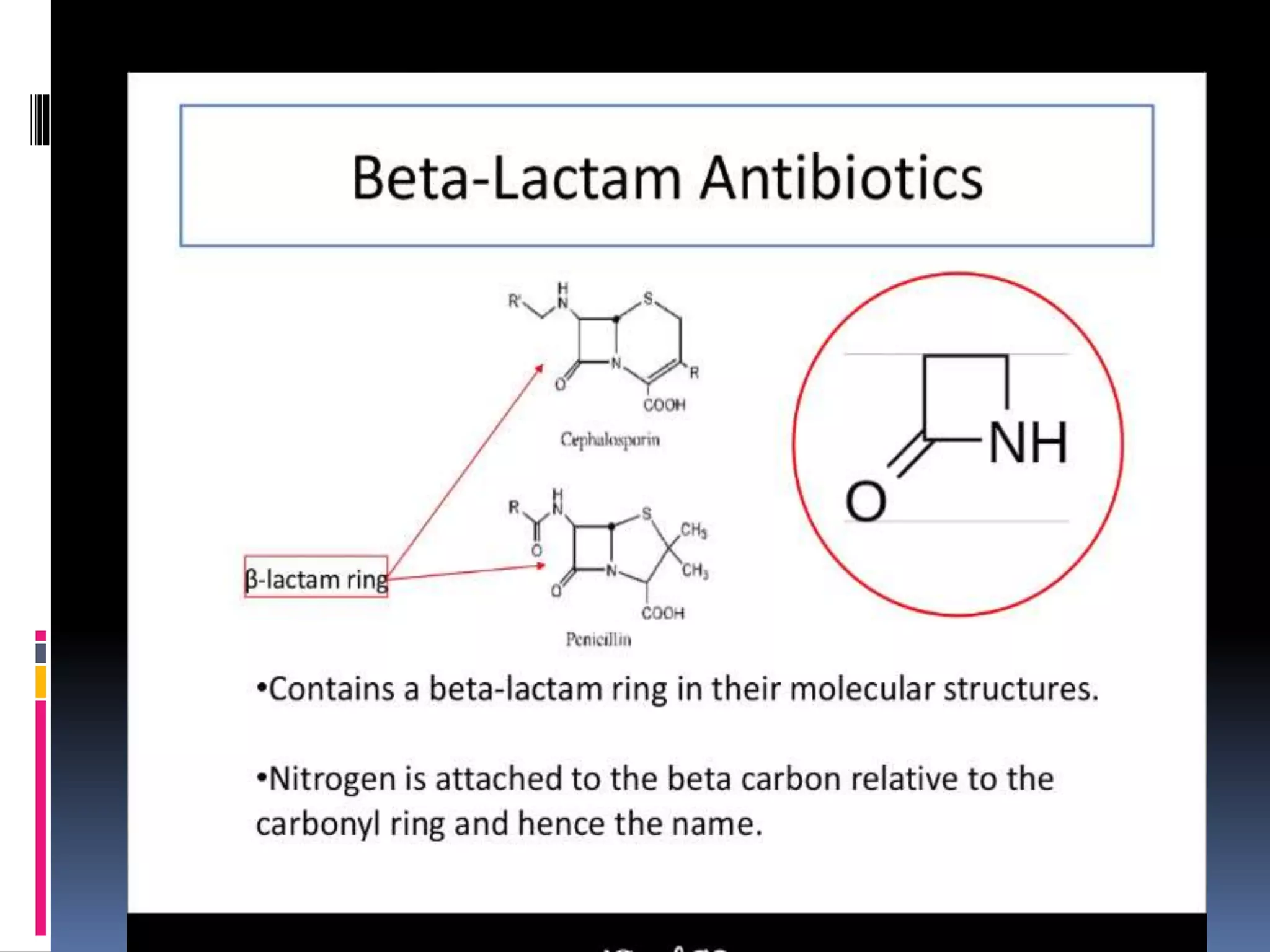
STRUCTURE:Molecular structure based on a nucleus of two
fused rings one of which is the beta-lactam ring.
ANTIBACTERIALACTIVITY:Beta lactam antibiotics act by
inhibiting cell wall synthesis of susceptible bacteria and are
effective mainly during the growth phase when cell walls
are being synthesised.
BACTERIAL RESISTANCE:Bacteria develop penicillinase
enzyme which destroys the beta lactam ring.
Cephalosporins are generally more resistant to the effect of
beta- lactamases.
TOXIC EFFECTS:The principle effect of BLA is allergy.
EXCRETION:Excreted unchanged through kidneys.
oo ADMINISTRATION-.Oral route is the safest and most
frequently used.IM injections are given in case of surgeries
which should be adequately equipped to deal with
emergencies.IV routes achieve much higher levels.
Amoxicillin and PenicillinV are well absorbed.
The oral administration is nit relaible ,following
administrations of atropine or atropine like substances used
in dentistry ,as premedication:;for either sedation or
general anesthesia .Under such circumstances parentral
route should be used.
LENGTH OF COURSE:Antibiotics should be continued for 4 to
5 days for preventing reinfection or eradicate the disease.
Amoxicillin is combined with clavulinic acid to broaden the
spectrum of amoxicillin because of resistance of some
bacteria lile species of staphylococci ,nonhemolytic
streptococci and some gram negative bacteria like E.coli
and hemophilus.
MECHANISM OF ACTION
MECHANISM-Inhibit the last step in the
peptidoglycan synthesis of the cell wall.
 Inhibition of transpeptidase
enzyme=activation of penicillon binding
protein=activation of autolysins.
 PHARMACOKINETICS- vary with the
preparation .
 Parentral-complete and rapid.
 Metabolized by liver and excretion is through
kidneys.
NOXACILLIN –biliary excretion.
THERAPEUTIC USES OF
PENICILLIN
 In treatment of streptococcal and non beta
lactamase producing staphylococcal
infections,pneumonia,gonorrhea,pneumococcal
meningitis ,SABE,urinary tract infections ,sinusitis
and skin infections
 Against gram –ve rods for treating
anthrax,gangrene,tetanus.
 Treating actinomycosis.
 Carbenicillin is employed to treat pseudonomonas
infection.
 Amoxicillin and PenicillinV are used to treat
odontogenic infections like dentoalveoar
abcess,NUG,Vincent angina.
 Penicillin is combined with other drugs to increase the drug
sensitivity:
 Penicillin+Gentamicin for bacterial endocarditis.
Amoxicillin is combined with clavulinic acid,Ampicillin with
cloxacillin and Amoxicillin with cloxacillin to extend
antibacterial spectrum to beta lactamase producing
bacteria
 Prophylactic use-Benzathine penicillin 1.2MU i.m every
4wks till the age of 18 or 5 yrs in case of rheumatic fever.
Surgical infection:Procaine penicillin 1MU with an
aminoglycoside i.m. 1hr before and 8-12 hrs after surgery.
 To prevent bacterial endocarditis.
DOSES
 Penicillin G :300-600mg (0.5-1MU)/6hi.m.
 Procaine penicillin :360mg (0.6MU)/12 to
24i.m.
 PenicillinV:130-250mg/6hr oral
 Ampicillin:250-500mg/6hr oral
 Amoxicillin:250-500mg/6hr oral
 Cloxacillin:250-500mg/6hr oral
 Oxacilin:500-1000mg/6hr oral
Side effects of penicillin
 Allergy which manifests in the form of skin
rashes,dermatitis,serum sickness .It can be controlled by
withdrawal of antibiotics and use of antihistaminics.
 Anaphylaxis characterized by coughing,tonic
spasms,cyanosis,weak puse rapid drop in blood
pressure,gasping.
 CONTRAINDICATIONS-There is no absolute safety of
penicillin and semisynthetic penicillin taken during
pregnancy.it should be employed only if the infection is by
susceptible organism.first choice is amoxicillin.
 Penicillin appears to be same as serum levels in breast milk
so PenicillinV is used.
 Penicillin renders action of oral contraceptives ;however it
has been reported that ampicillin is ineffective.
SEMISYNTHETIC PENICILLINS
 Semisynthetic penicillins are produced by chemically
combining specific side chains (in place of benzyl side chain
of PnG) or by incorporating specific precursors in the mould
cultures.
 CLASSIFICATION:
 1.Acid- resistant alternative to penicillin G-PenicillinV
 2.Penicillinase-resistant penicillins-Methicillin,cloxacillin.
 3.Extended spectrum penicillns-
 a.Aminopenicillins:Ampicillin,Amoxicillin
 b.Carboxy penicillins:Carbenicillin,Ticarcillin
 C.Ureidopenicillins:Piperacillin,Mezlocillin.
 Beta lactamase inhibitors: Clavulinic acid,Sulbactam
Tazobactam.
ACID-RESISTANT ALTERNATIVE TO
PENICILLIN -G
 PENICILLIN V
 USES:For treatment of streptococcal
pharyngitis,sinusitis,otitis media and minor
pneumococcal infections.
 DOSE:250-500mg(in adults),125-2560mg(in
children) given 6hrly.
 S/E-Hypersensitivity,fatal
anaphylaxis,diarrhoea,GI disturbances.At high
doses toxic effects lile hemolytic
anemias,encephalitis and nephritis may occur.
PENICILLIN RESISTANT PENICILLINS
 METHICILLIN
 It is highly resistant resistant to pemicillinase
but not acid resistant and has been largely
replaced by cloxacillin.
 CLOXACILLIN
 USES:Used against staphylococcal infections
but infrequently used in dentistry as these
infections are very rare in oral cavity.
EXTENDED SPECTRUM PENICILLNS
 1.AMINOPENICILLINS
 AMPICILLIN
 USES:Most commonly used in dentistry against anaerobic
bacteria responsible for infections.
 Also used in urinary tract infections,resp.tract infections
like bronchitis,sinusitis otitis media ,gonorrhoea,bacillary
dentistry,typhoid fever SABE,septicemias with gentamicin.
 DOSE:0.5-2mg oral/i.v./i.m. Deprnding on severity of
infection every 6hrs ;children 25-50mg/kg/day.
 S/E-Diarrhoea,rashes esp.in AIDS pts. ,should not be given
with the history of hypersensitivity to PnG.
oo 2.Carboxypenicillins
 CARBENICILLIN
 USES:Treatment of pseudonomal
infections,burns,urinary tract
infection,septicemia,orodental infections.
 DOSE:1-2g i.m.or 1-5g i.v. Evey 4-6hrs (as
sodium salt).
 TICARCILLIN
 More potent than carbenicillin .action same
as carbenicillin.
kk 3.Ureidopenicillins
 PIPERACILLIN
 USES:Used mainly in neutropenic patients
having serious gram –ve infections and in
burns.
 DOSE:100-150mg/kg/day in 3 divided
doses(max 16mg/day)i.m.or i.v.The i.v. Route
is preferred when >2g is to be injected.
BETA LACTAMASE INHIBITORS
 CLAVULINIC ACID
 USES:In skin and sift tissue infections,intraabdominal and
gynaecological sepsis,urinary,biliary and resp.tract
infections speially when empiric therapy is to given in
hospital acquired infections.
o Dental infections caused by beta lactamase producing
bacteria.
o Gonorrhoea(amoxicillin 3g+ clavulinic acid
0.5gm+probenicid 1g).
o DOSE:Amoxicillin 250mg+Clavulinic acid 125mg 1-2 tabs
6hrly.
o S/E-Candida stomatitis and rashes.
oo
 SULBACTAM
 USES:Against gonorrhoea’mixed aerobic –
anaerobic infections,tooth abscess,intra-
abdominal,gynaecological,surgical and skin
infections.
 DOSE:Ampicillin 1g+Sulbactam0.5g 1-2 vial deep
i.m.or i.v. injection 6hrly.
 S/E-Pain at the site of injection,rash and
diarrhoea, thrombophlebitis of injected vein.
 TAZOBACTAM
 Same action as sulbactam.
 DOSE:0.5g combined with piperacillin 4g i,v.
Over 30 min 8hrly.
CEPHALOSPORINS
 Cephalosporins have similar structure to
penicillin but have different source.
 Mode of action:They are bactericidal and act
by inhibiying the cell wall synthesis.it should
not be used with bacteriostatic agents like
tetracycline,erythromycin etc.which inhibit
protein synthesis.
CLASSIFICATION
 First generation :Effective against gram+ve cocci
except enterococci.they arealso effective against
E.coli Staph.aureus and Staph.epidermidis.
Examples:Cephalothin,Cephalexin,Cefadroxil,Cefazolin
.
 Second generation:Greater activity against gram+ve
cocci than first generation cepahalosporins.
 Examples:Cefotaxime and Cefotetan.
 Third generation:More effective against
Enterobacteriaceae including beta lactamase
producing strains.
 Examples:Ceftriaxone,Ceftazidime.
THERAPEUTIC USES OF
CEPHALOSPORINS
 Used in urinary tract infections,bronchitis and minor
infections.
 Second generation cephalosporins are used against
beta lactamase producing microbes and anaerobes.
 Third generation cephalosporins are used to treat
meningitis,resistant urinary tract infection and
penicillin resistant gonococci.
 These antibiotics have proved useful in preventing
infection at the time of biliary surgery,orthopedic
surgery on fracture and particularly heart surgery.
 Cephalexin is used in odontogenic infection.
DOSES
 a.For oral agents:0.25-0.5gm 6hrly.
 b.For parentral agents:0.5-1gm i,v, 6hrly ,can also be given
intramuscularly.
 c.For betalactamase resistant agents:0.5-1.0gm i.v. 6-8hrly.
 SIDE EFFECTS: Primary side effect is hypersensitivity.
 Blood dyscrasias(neutropenia,thrombocytopenia) and
nephritis.
 Suoerinfection with resistant staphylococci,enterococci
and candida on prolonged use.
MONOBACTAMS
 Other ring from its structure is missing.it
inhibits gram –ve enteric bacilli but nit the
gram+ve cocci.
 AZTREONAM
 Indicated in hospital acquired infections
originating from GI, biliary and urinary tracts.
No speciic indication in dentistry.
 DOSE:0.5-2g i.m. Or i.v. 6-12hrly.
CARBAPENAMS
 IMIPINEM
 USES:Effective against hospital acquired infections in
neutropenic and AIDS pts.
 DOSE:0.5gi.v. 6hrly.
 S/E-Seizures at high doses exceeding 4g/day
,diarrhoea,vomiting.
 MEROPENAM
 USES:In treating nosocomial infections like
septicemia,febrile neutropenia,intra-abdominal and
cephalosporin-resistant bacteria and can also be usefu for
treating severe orodental infections.
 DOSES:0.5-2g(10-40mg/kg) by slow i.v. Inj. 8hrly.
 S/E-Seizures but less likely to occur.
thank you

BETA LACTAM ANTIBIOTICS

  • 1.
    BETA LACTAM ANTIBIOTICS Presentedby- Dr. himanshu gorawat Demtal surgeon
  • 2.
    CONTENTS  INTRODUCTION  CLASSIFICATION PENICILLINS  SEMISYNTHETIC PENICILLINS  CEPHALOSPORINS  MONOBACTAMAAND CARBAPENEMS
  • 3.
    INTRODUCTION These are theantibiotics having a beta lactam ring. Most commonly used antibiotics. CLASSIFICATION: 1.PENICILLINS 2.SEMISYNTHETIC PENICILLINS 3.CEPHALOSPORINS OTHER NEWER ADDITIONSARE – MONOBACTAMSAND CARBAPENEMS.
  • 4.
    PENICILLINS  Penicillin wasdiscovered in 1929,but the trial performed in 1940. It is derived from a mould Penicillium notatum and was the first antibiotic used. CLASSIFICATION- 1.Naturally acting penicillins:Cryatalline penicillin(penicillin G),Phenoxymethyl penicillin(penicillin v). 2.Semisynthetic penicillins: a.Short acting,e.g.ampicillin amoxicillin, amoxicillin with clavulinic acid,piperacillin and methacillin. They are stable to gastric acids,make oral administration reliable and are resistant to beta lactamase. b.Long acting,e.g.procaine penicillin,procaine penicillin fortified and benzathene penicillin.
  • 6.
    Antibiotics of thisgroup are: (1)Penicillins (2)Semisynthetic derivatives of penicillin (3)Cephalosporins STRUCTURE:Molecular structure based on a nucleus of two fused rings one of which is the beta-lactam ring. ANTIBACTERIALACTIVITY:Beta lactam antibiotics act by inhibiting cell wall synthesis of susceptible bacteria and are effective mainly during the growth phase when cell walls are being synthesised. BACTERIAL RESISTANCE:Bacteria develop penicillinase enzyme which destroys the beta lactam ring. Cephalosporins are generally more resistant to the effect of beta- lactamases. TOXIC EFFECTS:The principle effect of BLA is allergy. EXCRETION:Excreted unchanged through kidneys.
  • 7.
    oo ADMINISTRATION-.Oral routeis the safest and most frequently used.IM injections are given in case of surgeries which should be adequately equipped to deal with emergencies.IV routes achieve much higher levels. Amoxicillin and PenicillinV are well absorbed. The oral administration is nit relaible ,following administrations of atropine or atropine like substances used in dentistry ,as premedication:;for either sedation or general anesthesia .Under such circumstances parentral route should be used. LENGTH OF COURSE:Antibiotics should be continued for 4 to 5 days for preventing reinfection or eradicate the disease. Amoxicillin is combined with clavulinic acid to broaden the spectrum of amoxicillin because of resistance of some bacteria lile species of staphylococci ,nonhemolytic streptococci and some gram negative bacteria like E.coli and hemophilus.
  • 9.
    MECHANISM OF ACTION MECHANISM-Inhibitthe last step in the peptidoglycan synthesis of the cell wall.  Inhibition of transpeptidase enzyme=activation of penicillon binding protein=activation of autolysins.  PHARMACOKINETICS- vary with the preparation .  Parentral-complete and rapid.  Metabolized by liver and excretion is through kidneys. NOXACILLIN –biliary excretion.
  • 10.
    THERAPEUTIC USES OF PENICILLIN In treatment of streptococcal and non beta lactamase producing staphylococcal infections,pneumonia,gonorrhea,pneumococcal meningitis ,SABE,urinary tract infections ,sinusitis and skin infections  Against gram –ve rods for treating anthrax,gangrene,tetanus.  Treating actinomycosis.  Carbenicillin is employed to treat pseudonomonas infection.  Amoxicillin and PenicillinV are used to treat odontogenic infections like dentoalveoar abcess,NUG,Vincent angina.
  • 11.
     Penicillin iscombined with other drugs to increase the drug sensitivity:  Penicillin+Gentamicin for bacterial endocarditis. Amoxicillin is combined with clavulinic acid,Ampicillin with cloxacillin and Amoxicillin with cloxacillin to extend antibacterial spectrum to beta lactamase producing bacteria  Prophylactic use-Benzathine penicillin 1.2MU i.m every 4wks till the age of 18 or 5 yrs in case of rheumatic fever. Surgical infection:Procaine penicillin 1MU with an aminoglycoside i.m. 1hr before and 8-12 hrs after surgery.  To prevent bacterial endocarditis.
  • 12.
    DOSES  Penicillin G:300-600mg (0.5-1MU)/6hi.m.  Procaine penicillin :360mg (0.6MU)/12 to 24i.m.  PenicillinV:130-250mg/6hr oral  Ampicillin:250-500mg/6hr oral  Amoxicillin:250-500mg/6hr oral  Cloxacillin:250-500mg/6hr oral  Oxacilin:500-1000mg/6hr oral
  • 13.
    Side effects ofpenicillin  Allergy which manifests in the form of skin rashes,dermatitis,serum sickness .It can be controlled by withdrawal of antibiotics and use of antihistaminics.  Anaphylaxis characterized by coughing,tonic spasms,cyanosis,weak puse rapid drop in blood pressure,gasping.  CONTRAINDICATIONS-There is no absolute safety of penicillin and semisynthetic penicillin taken during pregnancy.it should be employed only if the infection is by susceptible organism.first choice is amoxicillin.  Penicillin appears to be same as serum levels in breast milk so PenicillinV is used.  Penicillin renders action of oral contraceptives ;however it has been reported that ampicillin is ineffective.
  • 14.
    SEMISYNTHETIC PENICILLINS  Semisyntheticpenicillins are produced by chemically combining specific side chains (in place of benzyl side chain of PnG) or by incorporating specific precursors in the mould cultures.  CLASSIFICATION:  1.Acid- resistant alternative to penicillin G-PenicillinV  2.Penicillinase-resistant penicillins-Methicillin,cloxacillin.  3.Extended spectrum penicillns-  a.Aminopenicillins:Ampicillin,Amoxicillin  b.Carboxy penicillins:Carbenicillin,Ticarcillin  C.Ureidopenicillins:Piperacillin,Mezlocillin.  Beta lactamase inhibitors: Clavulinic acid,Sulbactam Tazobactam.
  • 15.
    ACID-RESISTANT ALTERNATIVE TO PENICILLIN-G  PENICILLIN V  USES:For treatment of streptococcal pharyngitis,sinusitis,otitis media and minor pneumococcal infections.  DOSE:250-500mg(in adults),125-2560mg(in children) given 6hrly.  S/E-Hypersensitivity,fatal anaphylaxis,diarrhoea,GI disturbances.At high doses toxic effects lile hemolytic anemias,encephalitis and nephritis may occur.
  • 16.
    PENICILLIN RESISTANT PENICILLINS METHICILLIN  It is highly resistant resistant to pemicillinase but not acid resistant and has been largely replaced by cloxacillin.  CLOXACILLIN  USES:Used against staphylococcal infections but infrequently used in dentistry as these infections are very rare in oral cavity.
  • 17.
    EXTENDED SPECTRUM PENICILLNS 1.AMINOPENICILLINS  AMPICILLIN  USES:Most commonly used in dentistry against anaerobic bacteria responsible for infections.  Also used in urinary tract infections,resp.tract infections like bronchitis,sinusitis otitis media ,gonorrhoea,bacillary dentistry,typhoid fever SABE,septicemias with gentamicin.  DOSE:0.5-2mg oral/i.v./i.m. Deprnding on severity of infection every 6hrs ;children 25-50mg/kg/day.  S/E-Diarrhoea,rashes esp.in AIDS pts. ,should not be given with the history of hypersensitivity to PnG.
  • 18.
    oo 2.Carboxypenicillins  CARBENICILLIN USES:Treatment of pseudonomal infections,burns,urinary tract infection,septicemia,orodental infections.  DOSE:1-2g i.m.or 1-5g i.v. Evey 4-6hrs (as sodium salt).  TICARCILLIN  More potent than carbenicillin .action same as carbenicillin.
  • 19.
    kk 3.Ureidopenicillins  PIPERACILLIN USES:Used mainly in neutropenic patients having serious gram –ve infections and in burns.  DOSE:100-150mg/kg/day in 3 divided doses(max 16mg/day)i.m.or i.v.The i.v. Route is preferred when >2g is to be injected.
  • 20.
    BETA LACTAMASE INHIBITORS CLAVULINIC ACID  USES:In skin and sift tissue infections,intraabdominal and gynaecological sepsis,urinary,biliary and resp.tract infections speially when empiric therapy is to given in hospital acquired infections. o Dental infections caused by beta lactamase producing bacteria. o Gonorrhoea(amoxicillin 3g+ clavulinic acid 0.5gm+probenicid 1g). o DOSE:Amoxicillin 250mg+Clavulinic acid 125mg 1-2 tabs 6hrly. o S/E-Candida stomatitis and rashes.
  • 21.
    oo  SULBACTAM  USES:Againstgonorrhoea’mixed aerobic – anaerobic infections,tooth abscess,intra- abdominal,gynaecological,surgical and skin infections.  DOSE:Ampicillin 1g+Sulbactam0.5g 1-2 vial deep i.m.or i.v. injection 6hrly.  S/E-Pain at the site of injection,rash and diarrhoea, thrombophlebitis of injected vein.  TAZOBACTAM  Same action as sulbactam.  DOSE:0.5g combined with piperacillin 4g i,v. Over 30 min 8hrly.
  • 22.
    CEPHALOSPORINS  Cephalosporins havesimilar structure to penicillin but have different source.  Mode of action:They are bactericidal and act by inhibiying the cell wall synthesis.it should not be used with bacteriostatic agents like tetracycline,erythromycin etc.which inhibit protein synthesis.
  • 23.
    CLASSIFICATION  First generation:Effective against gram+ve cocci except enterococci.they arealso effective against E.coli Staph.aureus and Staph.epidermidis. Examples:Cephalothin,Cephalexin,Cefadroxil,Cefazolin .  Second generation:Greater activity against gram+ve cocci than first generation cepahalosporins.  Examples:Cefotaxime and Cefotetan.  Third generation:More effective against Enterobacteriaceae including beta lactamase producing strains.  Examples:Ceftriaxone,Ceftazidime.
  • 24.
    THERAPEUTIC USES OF CEPHALOSPORINS Used in urinary tract infections,bronchitis and minor infections.  Second generation cephalosporins are used against beta lactamase producing microbes and anaerobes.  Third generation cephalosporins are used to treat meningitis,resistant urinary tract infection and penicillin resistant gonococci.  These antibiotics have proved useful in preventing infection at the time of biliary surgery,orthopedic surgery on fracture and particularly heart surgery.  Cephalexin is used in odontogenic infection.
  • 25.
    DOSES  a.For oralagents:0.25-0.5gm 6hrly.  b.For parentral agents:0.5-1gm i,v, 6hrly ,can also be given intramuscularly.  c.For betalactamase resistant agents:0.5-1.0gm i.v. 6-8hrly.  SIDE EFFECTS: Primary side effect is hypersensitivity.  Blood dyscrasias(neutropenia,thrombocytopenia) and nephritis.  Suoerinfection with resistant staphylococci,enterococci and candida on prolonged use.
  • 26.
    MONOBACTAMS  Other ringfrom its structure is missing.it inhibits gram –ve enteric bacilli but nit the gram+ve cocci.  AZTREONAM  Indicated in hospital acquired infections originating from GI, biliary and urinary tracts. No speciic indication in dentistry.  DOSE:0.5-2g i.m. Or i.v. 6-12hrly.
  • 27.
    CARBAPENAMS  IMIPINEM  USES:Effectiveagainst hospital acquired infections in neutropenic and AIDS pts.  DOSE:0.5gi.v. 6hrly.  S/E-Seizures at high doses exceeding 4g/day ,diarrhoea,vomiting.  MEROPENAM  USES:In treating nosocomial infections like septicemia,febrile neutropenia,intra-abdominal and cephalosporin-resistant bacteria and can also be usefu for treating severe orodental infections.  DOSES:0.5-2g(10-40mg/kg) by slow i.v. Inj. 8hrly.  S/E-Seizures but less likely to occur.
  • 28.