
BETA LACTAM
ANTIBIOTICS
Presented by
Grandhi Sandeep Ganesh
Dept. Of Pharmacology
Shri Vishnu College of Pharmacy (Autonomous)
Affiliated to Andhra Univ., Visakhapatnam; Approved by AICTE and PCI, New Delhi, and recognised by APSCHE
1
BETA LACTAM ANTIBIOTICS
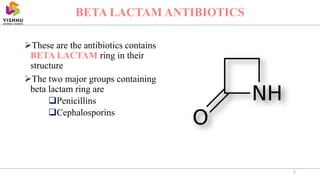
These are the antibiotics contains
BETA LACTAM ring in their
structure
The two major groups containing
beta lactam ring are
Penicillins
Cephalosporins
2
PENICILLINS
Penicillin was discovered by scientist Alexander Fleming
 penicillin is obtained from Penicillium notatum or P. chrysogenum
It was discovered in 1928
Penicillin was the first antibiotic to be used clinically in 1941
3
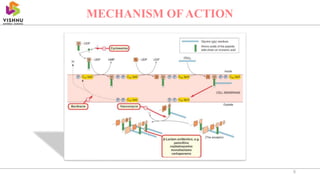
Interfere with synthesis of bacterial cell wall
Usually the bacterial cell wall is composed of peptidoglycan
N- acetylmuramic acid
N- acetylglucosamine
Peptidoglycan residues are linked together and UDP is split off
Final step is cleavage of terminal D-alanine of the peptide by transpeptidase,
process known as transpeptidation
This cross linking provides greater strength of bacterial cell wall
Beta lactams inhibit the transpeptidase so that cross linking does not take
place
This results in cell wall deficient forms are produced and lysis of bacteria
takes place
4
MECHANISM OF ACTION
MECHANISM OF ACTION
5
6
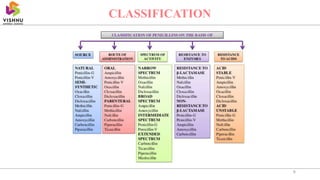
CLASSIFICATION
7
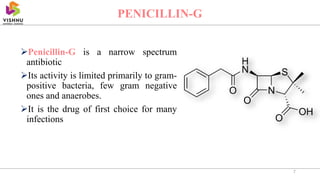
PENICILLIN-G
Penicillin-G is a narrow spectrum
antibiotic
Its activity is limited primarily to gram-
positive bacteria, few gram negative
ones and anaerobes.
It is the drug of first choice for many
infections
Local irritancy and direct toxicity: Pain at i.m. injection site, nausea
on oral ingestion
Toxicity to the brain may be manifested as mental confusion,
muscular twitching, convulsions and coma, when very large doses are
injected through i.v route
 Accidental i.v. injection of procaine penicillin produces CNS
stimulation, hallucinations and convulsions
Hypersensitivity: rash, itching, urticaria and fever. Wheezing,
angioneurotic edema, serum sickness and exfoliative dermatitis
8
ADVERSE EFFECTS
In rare cases,
Swelling of the tongue, throat and lips
Respiratory symptoms such as difficulty breathing, coughing, chest
tightness, wheezing
Light-headedness
9
ADVERSE EFFECTS
Semisynthetic penicillins are produced by chemically combining
specific side chains in place of benzyl side chain of PnG
The aim of producing semisynthetic penicillins has been to overcome
the shortcomings of PnG
 Poor oral efficacy.
Susceptibility to penicillinase.
 Narrow spectrum of activity.
Hypersensitivity reactions
10
SEMISYNTHETIC PENICILLINS
ACID-RESISTANT: Phenoxymethyl penicillin (Penicillin V)
It differs from PnG only in that it is acid stable. Oral absorption is better; peak
blood level is reached in 1 hour and plasma t½ is 30–60 min.
PENICILLINASE-RESISTANT PENICILLINS: Methicillin,
Cloxacillin, Dicloxacillin
These congeners have side chains that protect the β-lactam ring from attack by
staphylococcal penicillinase
11
SEMISYNTHETIC PENICILLINS
AMINOPENICILLINS: Ampicillin
It is active against all organisms sensitive to PnG. In addition, many
gram-negative bacilli, e.g. H. influenzae, E. coli, Proteus, Salmonella
Shigella and Helicobacter pylori are inhibited.
USES
Urinary tract infections
Respiratory tract infections
Meningitis
Gonorrhoea
12
EXTENDED SPECTRUM PENICILLINS
Carboxypenicillins: Carbenicillin
The special feature of this penicillin congener is its activity
against Pseudomonas aeruginosa and indole positive Proteus which are
not inhibited by PnG or aminopenicillins.
Ureidopenicillins: Piperacillin
This antipseudomonal penicillin is about 8 times more active than
carbenicillin. It has good activity against Klebsiella, It is frequently
employed for treating serious gram negative infections in
neutropenic/immunocompromised patients
13
EXTENDED SPECTRUM PENICILLINS
Beta-lactamase inhibitors can block the activity of beta-lactamase
enzymes and prevents the degradation of beta-lactam antibiotics
β-lactamases are a family of enzymes produced by many gram-
positive and gram-negative bacteria that inactivate β-lactam antibiotics
by opening the β-lactam ring
Clavulanic acid
Obtained from Streptomyces clavuligerus, it has a β-lactam ring
but no antibacterial activity of its own. It inhibits a wide variety of β-
lactamases produced by both gram-positive and gram-negative bacteria
14
BETA-LACTAMASE INHIBITORS
Bacterial meningitis : benzylpenicillin
Bone and joint infections : flucloxacillin
Skin and soft tissue infections : benzylpenicillin, flucloxacillin
Otitis media : amoxicillin
 Bronchitis : amoxicillin
Pneumonia : amoxicillin
Urinary tract infections :amoxicillin
Gonorrhea : amoxicillin
Syphilis : procaine benzylpenicillin
15
USES
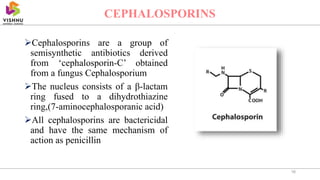
Cephalosporins are a group of
semisynthetic antibiotics derived
from ‘cephalosporin-C’ obtained
from a fungus Cephalosporium
The nucleus consists of a β-lactam
ring fused to a dihydrothiazine
ring,(7-aminocephalosporanic acid)
All cephalosporins are bactericidal
and have the same mechanism of
action as penicillin
16
CEPHALOSPORINS
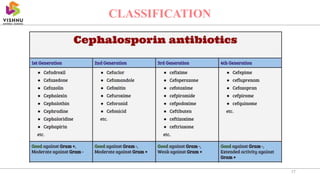
17
CLASSIFICATION
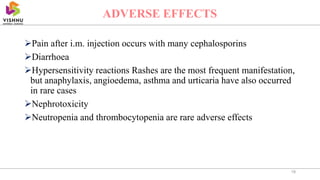
Pain after i.m. injection occurs with many cephalosporins
Diarrhoea
Hypersensitivity reactions Rashes are the most frequent manifestation,
but anaphylaxis, angioedema, asthma and urticaria have also occurred
in rare cases
Nephrotoxicity
Neutropenia and thrombocytopenia are rare adverse effects
18
ADVERSE EFFECTS
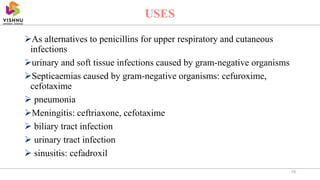
As alternatives to penicillins for upper respiratory and cutaneous
infections
urinary and soft tissue infections caused by gram-negative organisms
Septicaemias caused by gram-negative organisms: cefuroxime,
cefotaxime
 pneumonia
Meningitis: ceftriaxone, cefotaxime
 biliary tract infection
 urinary tract infection
 sinusitis: cefadroxil
19
USES
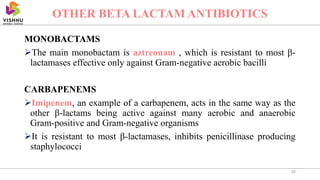
MONOBACTAMS
The main monobactam is aztreonam , which is resistant to most β-
lactamases effective only against Gram-negative aerobic bacilli
CARBAPENEMS
Imipenem, an example of a carbapenem, acts in the same way as the
other β-lactams being active against many aerobic and anaerobic
Gram-positive and Gram-negative organisms
It is resistant to most β-lactamases, inhibits penicillinase producing
staphylococci
20
OTHER BETA LACTAM ANTIBIOTICS
21
Thank
you
HAVE A COOL SUMMER

Beta lactam antibiotics

  • 1.
    BETA LACTAM ANTIBIOTICS Presented by GrandhiSandeep Ganesh Dept. Of Pharmacology Shri Vishnu College of Pharmacy (Autonomous) Affiliated to Andhra Univ., Visakhapatnam; Approved by AICTE and PCI, New Delhi, and recognised by APSCHE 1
  • 2.
    BETA LACTAM ANTIBIOTICS Theseare the antibiotics contains BETA LACTAM ring in their structure The two major groups containing beta lactam ring are Penicillins Cephalosporins 2
  • 3.
    PENICILLINS Penicillin was discoveredby scientist Alexander Fleming  penicillin is obtained from Penicillium notatum or P. chrysogenum It was discovered in 1928 Penicillin was the first antibiotic to be used clinically in 1941 3
  • 4.
    Interfere with synthesisof bacterial cell wall Usually the bacterial cell wall is composed of peptidoglycan N- acetylmuramic acid N- acetylglucosamine Peptidoglycan residues are linked together and UDP is split off Final step is cleavage of terminal D-alanine of the peptide by transpeptidase, process known as transpeptidation This cross linking provides greater strength of bacterial cell wall Beta lactams inhibit the transpeptidase so that cross linking does not take place This results in cell wall deficient forms are produced and lysis of bacteria takes place 4 MECHANISM OF ACTION
  • 5.
  • 6.
  • 7.
    7 PENICILLIN-G Penicillin-G is anarrow spectrum antibiotic Its activity is limited primarily to gram- positive bacteria, few gram negative ones and anaerobes. It is the drug of first choice for many infections
  • 8.
    Local irritancy anddirect toxicity: Pain at i.m. injection site, nausea on oral ingestion Toxicity to the brain may be manifested as mental confusion, muscular twitching, convulsions and coma, when very large doses are injected through i.v route  Accidental i.v. injection of procaine penicillin produces CNS stimulation, hallucinations and convulsions Hypersensitivity: rash, itching, urticaria and fever. Wheezing, angioneurotic edema, serum sickness and exfoliative dermatitis 8 ADVERSE EFFECTS
  • 9.
    In rare cases, Swellingof the tongue, throat and lips Respiratory symptoms such as difficulty breathing, coughing, chest tightness, wheezing Light-headedness 9 ADVERSE EFFECTS
  • 10.
    Semisynthetic penicillins areproduced by chemically combining specific side chains in place of benzyl side chain of PnG The aim of producing semisynthetic penicillins has been to overcome the shortcomings of PnG  Poor oral efficacy. Susceptibility to penicillinase.  Narrow spectrum of activity. Hypersensitivity reactions 10 SEMISYNTHETIC PENICILLINS
  • 11.
    ACID-RESISTANT: Phenoxymethyl penicillin(Penicillin V) It differs from PnG only in that it is acid stable. Oral absorption is better; peak blood level is reached in 1 hour and plasma t½ is 30–60 min. PENICILLINASE-RESISTANT PENICILLINS: Methicillin, Cloxacillin, Dicloxacillin These congeners have side chains that protect the β-lactam ring from attack by staphylococcal penicillinase 11 SEMISYNTHETIC PENICILLINS
  • 12.
    AMINOPENICILLINS: Ampicillin It isactive against all organisms sensitive to PnG. In addition, many gram-negative bacilli, e.g. H. influenzae, E. coli, Proteus, Salmonella Shigella and Helicobacter pylori are inhibited. USES Urinary tract infections Respiratory tract infections Meningitis Gonorrhoea 12 EXTENDED SPECTRUM PENICILLINS
  • 13.
    Carboxypenicillins: Carbenicillin The specialfeature of this penicillin congener is its activity against Pseudomonas aeruginosa and indole positive Proteus which are not inhibited by PnG or aminopenicillins. Ureidopenicillins: Piperacillin This antipseudomonal penicillin is about 8 times more active than carbenicillin. It has good activity against Klebsiella, It is frequently employed for treating serious gram negative infections in neutropenic/immunocompromised patients 13 EXTENDED SPECTRUM PENICILLINS
  • 14.
    Beta-lactamase inhibitors canblock the activity of beta-lactamase enzymes and prevents the degradation of beta-lactam antibiotics β-lactamases are a family of enzymes produced by many gram- positive and gram-negative bacteria that inactivate β-lactam antibiotics by opening the β-lactam ring Clavulanic acid Obtained from Streptomyces clavuligerus, it has a β-lactam ring but no antibacterial activity of its own. It inhibits a wide variety of β- lactamases produced by both gram-positive and gram-negative bacteria 14 BETA-LACTAMASE INHIBITORS
  • 15.
    Bacterial meningitis :benzylpenicillin Bone and joint infections : flucloxacillin Skin and soft tissue infections : benzylpenicillin, flucloxacillin Otitis media : amoxicillin  Bronchitis : amoxicillin Pneumonia : amoxicillin Urinary tract infections :amoxicillin Gonorrhea : amoxicillin Syphilis : procaine benzylpenicillin 15 USES
  • 16.
    Cephalosporins are agroup of semisynthetic antibiotics derived from ‘cephalosporin-C’ obtained from a fungus Cephalosporium The nucleus consists of a β-lactam ring fused to a dihydrothiazine ring,(7-aminocephalosporanic acid) All cephalosporins are bactericidal and have the same mechanism of action as penicillin 16 CEPHALOSPORINS
  • 17.
  • 18.
    Pain after i.m.injection occurs with many cephalosporins Diarrhoea Hypersensitivity reactions Rashes are the most frequent manifestation, but anaphylaxis, angioedema, asthma and urticaria have also occurred in rare cases Nephrotoxicity Neutropenia and thrombocytopenia are rare adverse effects 18 ADVERSE EFFECTS
  • 19.
    As alternatives topenicillins for upper respiratory and cutaneous infections urinary and soft tissue infections caused by gram-negative organisms Septicaemias caused by gram-negative organisms: cefuroxime, cefotaxime  pneumonia Meningitis: ceftriaxone, cefotaxime  biliary tract infection  urinary tract infection  sinusitis: cefadroxil 19 USES
  • 20.
    MONOBACTAMS The main monobactamis aztreonam , which is resistant to most β- lactamases effective only against Gram-negative aerobic bacilli CARBAPENEMS Imipenem, an example of a carbapenem, acts in the same way as the other β-lactams being active against many aerobic and anaerobic Gram-positive and Gram-negative organisms It is resistant to most β-lactamases, inhibits penicillinase producing staphylococci 20 OTHER BETA LACTAM ANTIBIOTICS
  • 21.