BETA-ADRENERGIC BLOCKERS
RECEPTORS
• A receptor is a specialized target
macromolecule that a drug binds to.
• There are mainly two types of receptors:
I. Cholinergic receptors
II. Adrenoreceptors
• Putting emphasis on the adrenoreceptors,
there are mainly two types of
adrenoreceptors in the sympathetic nervous
system and these include:
1. Beta receptors
2. Alpha receptors
ADRENORECEPTORS
• Adrenoreceptors (adrenergic receptors)
are G protein coupled receptors and
catecholamines like epinephrine and
norepinephrine bind to them.
• Binding of a ligand to these receptors
stimulates the sympathetic nervous
system leading to effects such as
increased heart rate, dilating pupils and
diversion of blood flow from non-essential
organs to skeletal muscles.
SYMPATHOMIMETICS AND
SYMPATHOLYTICS
• Sympathomimetics are adrenergic drugs
that stimulate adrenoreceptors
while
• sympatholytics are drugs that block or
inactivate adrenoreceptors.
BETA ADRENORECEPTORS
• These are adrenoreceptors that have a
strong response to
isoproterenol(catecholamine) and are less
sensitive to epinephrine and norepinephrine.
• The subclasses of beta adrenoreceptors
include:
A. Beta 1(have equal affinities for epinephrine
and norepinephrine)
B. Beta 2(have a higher affinity for epinephrine
than norepinephrine)
C. Beta 3(involved in lipolysis and main effects
are on the detrusor muscle of the bladder)
WHERE ARE BETA RECEPTORS FOUND
• The heart
• Skeletal muscles
• Bronchial areas
• Kidneys, Liver
β1 (found in the cardiac sarcolema)
β2 (mainly found in the bronchial and
vascular smooth muscles. BUT there are
however sizable populations of the β2-
adrenoceptors in the myocardium)
β3 (found on detrusor muscle, involved in
lipolysis)
WORK OF BETA ADRENORCEPTORS
• Beta 1 adrenoreceptors are involved in
cardiac stimulation (increase in heart rate
and contractility) while beta 2
adrenoreceptors are involved in
vasodilation, bronchodilation, relaxation of
the uterine smooth muscles.
BETA BLOCKERS
• All Beta blockers are those sympatholytic
agents that prevent the usual effects of
beta receptors by binding to them
reversibly or irreversibly and all beta
blockers are competitive antagonists.
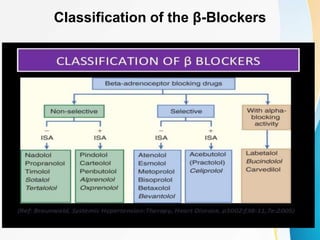
• Beta blockers are furtherly subdivided into:
 Cardioselective beta blockers
 Non-selective beta blockers
Classification of the β-Blockers
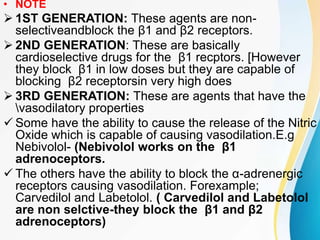
• NOTE
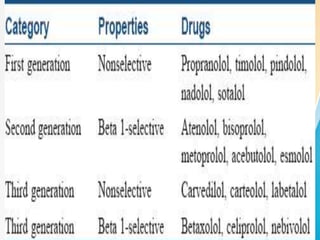
 1ST GENERATION: These agents are non-
selectiveandblock the β1 and β2 receptors.
 2ND GENERATION: These are basically
cardioselective drugs for the β1 recptors. [However
they block β1 in low doses but they are capable of
blocking β2 receptorsin very high does
 3RD GENERATION: These are agents that have the
vasodilatory properties
 Some have the ability to cause the release of the Nitric
Oxide which is capable of causing vasodilation.E.g
Nebivolol- (Nebivolol works on the β1
adrenoceptors.
 The others have the ability to block the α-adrenergic
receptors causing vasodilation. Forexample;
Carvedilol and Labetolol. ( Carvedilol and Labetolol
are non selctive-they block the β1 and β2
adrenoceptors)
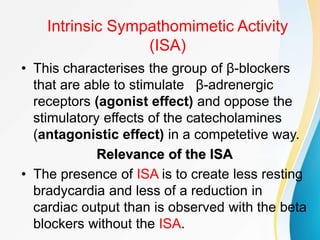
Intrinsic Sympathomimetic Activity
(ISA)
• This characterises the group of β-blockers
that are able to stimulate β-adrenergic
receptors (agonist effect) and oppose the
stimulatory effects of the catecholamines
(antagonistic effect) in a competetive way.
Relevance of the ISA
• The presence of ISA is to create less resting
bradycardia and less of a reduction in
cardiac output than is observed with the beta
blockers without the ISA.
CONTINUATION............
• In long term, partial beta agonists may produce
arterial vasodilation and increase arterial
compliance possibly leading to beneficial
effects in the treatment of hypertension
• Beta-blockers with ISA do not have adverse
effects on plasma lipoproteins during longterm
treatment
• Presence of the ISA could counteract the
upregulation of the beta-adrenoceptos often
observed in the beta blockers without ISA
MECHANISM OF ACTION OF BETA
BLOCKERS
• Beta blockers are competitive antagonists
that bind to the beta receptors and prevent
the binding of catecholamines (
epinephrine & norepinephrine).
• This prevents the normal sympathetic
effects in the body that could have been
brought about, such as; increase in heart
rate.
• Beta blockers are simply sympatholytic
drugs.
ACTION OF ALL BETA BLOCKERS
• The main function of all beta blockers is to lower
blood pressure in mild to moderate hypertension
(Don’t induce postural hypotension because alpha
receptors remain functional). Except for some beta
blockers have an effect on alphareceptor blockade.
• Beta blockers are useful in preventing reflex
tarchycardia that often results from treatment with
direct vasodilators.
• Beta blockers are useful in treating:
Hypertension
Angina
Myocardial infarction
Glaucoma( reducing the pressure in the eye,
decreasing formation of aqueous humor)
EXAMPLES OF BETA BLOCKERS
• ACEBUTOLOL
• ATENOLOL
• BETAXOLOL
• PROPRANOLOL
• BISOPROLOL
• ESMOLOL
• LABETALOL
• METOPROLOL
• NADOLOL
• PINDOLOL
• NEBIVOLOL
PROPRANOLOL
• It was the first beta blocker shown to be
effective in treating hypertension and
ischemic heart disease.
• It blocks both beta 1 and beta 2 receptors
with equal affinity. (non-selective)
MECHANISM OF ACTION OF
PROPRANOLOL
• Its efficacy in treating hypertension results
from non-selective beta blockade.
• It decreases blood pressure primarily as a
result of a decrease in cardiac output.
Other beta blockers may decrease cardiac
output or peripheral resistance to various
degrees.
• It inhibits the stimulation of renin
production by catecholamines(mediated
by beta 1 receptors)
CONTINUATION…..
• Non-selective blockade of beta receptors
prevents beta 2 mediated vasodilation in
skeletal muscles increasing peripheral
resistance.
• Decrease in cardiac output leads to
decreased blood pressure(reflex
peripheral vasoconstriction )
BRONCHOCONSTRICTION
• Contraction of bronchial smooth muscles
and that’s why patients with asthma,
chronic obstructive pulmonary disease are
not given these blockers.
• The bronchoconstriction is due to the
blockade on the β2 receptors that are
mainly found in the in the brochioles
DISTURBANCES IN GLUCOSE
METABOLISM
• NOTE:
• Epinephrine (adrenaline) has a potent effect
of causing glycogenolysis in the liver
[releasing large quantties of glucose in
blood]
• BUT porpanolol (an adrenoceptor blocker)
causes decreased glycogenolysis and
consequent glucagon secretion occurs.
• When given to a patient receiving insulin,
monitor to prevent hypoglycemia.
DRUG INTERACTION WITH
ISOPROTERENOLOL
• Non-selective blockers including
propranolol block actions of isoproterenol
(or isoprenaline) on cardiovascular system.
• Isoproterenol won’t cause cardiac
stimulation (beta 1 receptors).
• Isoprenaline is an adrenoceptor agonist,
a medication used for treatment of ;
bradycardia (slow heart rate) and transient
hesrt blocks.
THERAPEUTIC USES OF PROPRANOLOL
• It doesn’t lower blood pressure in people
with normal blood pressure.
• It does so in hypertensive people(
Decrease in cardiac output, inhibition of
renin release by the kidneys)
• Used to treat migraines(lipophilic and
blocks adrenaline)
• used in the treatment of cardiac arrythmias
PHARMACOKINETICS
• Propranolol is almost completely absorbed
and is taken orally.
• Only 25 percent reaches circulation
• Volume of distribution is large
• Easily crosses blood brain barrier
• Extensively metabolized.
ADVERSE EFFECTS
• Bronchoconstriction(death by asphyxiation
for asthma patients)
• Metabolic disturbances
• Sexual impairment
• Cardiac arrhythmias
CNS EFFECTS
• Depression
• Dizziness
• Lethargy
• Fatigue
• weakness
DRUG INTERACTIONS
• Some drugs inhibit metabolism of propranolol
and these include:
1. Cimetidine
2. Fluoxetine
• Some drugs stimulate metabolism of
propranolol decreasing its effects and these
include:
A. Phenytoin
B. rifampin
CONTINUATION........
• Beta blockers may interact with a large
number of commonly prescribed drugs
including:
• Antianginal drugs
• Inotropic drugs
• Anti-arrhythmics
NADOLOL, CARTEOLOL AND TIMOLOL
• These are non-selective and are more
potent than propranolol.
• Nadolol has a longer duration of action
while timolol is used to treat glaucoma by
decreasing production of aqueous humor.
LABETOLOL AND CARVEDILOL
• These are non-selective beta blockers and
also block alpha 1 receptors.
• They also have vasodilating effects(
increase peripheral vasodilation
decreasing blood pressure)
• Good for hypertensive patients for whom
increased peripheral vascular resistance is
undesirable.
THERAPEUTIC USES
• Used to treat pregnancy induced
hypertension.
• Block sympathetic stimulation of the heart
that causes worsening of heart failure.
SIDE EFFECTS
• Dizziness(alpha 1 blockage)
• Orthostatic hypotension (for those β-
blockers that have alpha receptor
blockade)
ACEBUTOLOL AND PINDOLOL
• Antagonists with partial agonist activities
• Acebutolol( beta 1 selective) and
pindolol(non- selective)
• These weakly stimulate beta 1 and beta 2
receptors.
• They have intrinsic sympathomimetic activity
• Stimulate the beta receptor that they are
bound to but inhibit stimulation by the more
potent endogenous catecholamines
• Result is decreased effect on cardiac output
and rate
THERAPEUTIC USE
• Hypertensive patients with moderate
bradycardia because a further decrease in
heart rate is less pronounced with these
drugs.
• Not used for stable angina arrythmia.
SIDE EFFECTS
• Dizziness
• Lightheadedness
• Drowsiness
• Blurred vision
• weakness
• Headaches
• Cold hands
GENERAL SIDE EFFECTS OF BETA
BLOCKERS
Beta blockers, Verapamil and diltiazem are
considered a cause of AV block.
The β-blockers may decrease libido and
cause erectile dysfunction.
The β-blockers may cause bradycardia,
hypotension,
CNS side effects such as fatigue, lethargy,
and insomnia
CONTRA-INDICATIONS OF BETA
BLOCKERS
• symptomatic Beta blockers are
contraindicated in patients with;
 bradycardia,
 AV block,
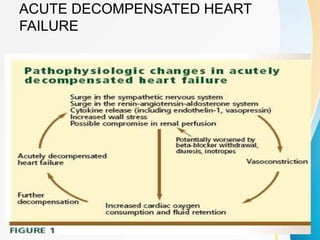
 decompensated heart failure,
 and asthma (The nonselective β-blockers,
such as propranolol and nadolol, are
contraindicated in patients with asthma due
to their blockade of β2-mediated
bronchodilation)
ACUTE DECOMPENSATED HEART
FAILURE
CAUTION
• β-blockers should NOT be withdrawn
abruptly as rebound effects may
precipitate the dangerous arrythmias
worsening angina or MI
THANK YOU

Beta adrenoceptor blockers

  • 1.
  • 2.
    RECEPTORS • A receptoris a specialized target macromolecule that a drug binds to. • There are mainly two types of receptors: I. Cholinergic receptors II. Adrenoreceptors • Putting emphasis on the adrenoreceptors, there are mainly two types of adrenoreceptors in the sympathetic nervous system and these include: 1. Beta receptors 2. Alpha receptors
  • 3.
    ADRENORECEPTORS • Adrenoreceptors (adrenergicreceptors) are G protein coupled receptors and catecholamines like epinephrine and norepinephrine bind to them. • Binding of a ligand to these receptors stimulates the sympathetic nervous system leading to effects such as increased heart rate, dilating pupils and diversion of blood flow from non-essential organs to skeletal muscles.
  • 4.
    SYMPATHOMIMETICS AND SYMPATHOLYTICS • Sympathomimeticsare adrenergic drugs that stimulate adrenoreceptors while • sympatholytics are drugs that block or inactivate adrenoreceptors.
  • 5.
    BETA ADRENORECEPTORS • Theseare adrenoreceptors that have a strong response to isoproterenol(catecholamine) and are less sensitive to epinephrine and norepinephrine. • The subclasses of beta adrenoreceptors include: A. Beta 1(have equal affinities for epinephrine and norepinephrine) B. Beta 2(have a higher affinity for epinephrine than norepinephrine) C. Beta 3(involved in lipolysis and main effects are on the detrusor muscle of the bladder)
  • 6.
    WHERE ARE BETARECEPTORS FOUND • The heart • Skeletal muscles • Bronchial areas • Kidneys, Liver β1 (found in the cardiac sarcolema) β2 (mainly found in the bronchial and vascular smooth muscles. BUT there are however sizable populations of the β2- adrenoceptors in the myocardium) β3 (found on detrusor muscle, involved in lipolysis)
  • 7.
    WORK OF BETAADRENORCEPTORS • Beta 1 adrenoreceptors are involved in cardiac stimulation (increase in heart rate and contractility) while beta 2 adrenoreceptors are involved in vasodilation, bronchodilation, relaxation of the uterine smooth muscles.
  • 8.
    BETA BLOCKERS • AllBeta blockers are those sympatholytic agents that prevent the usual effects of beta receptors by binding to them reversibly or irreversibly and all beta blockers are competitive antagonists. • Beta blockers are furtherly subdivided into:  Cardioselective beta blockers  Non-selective beta blockers
  • 9.
  • 10.
    • NOTE  1STGENERATION: These agents are non- selectiveandblock the β1 and β2 receptors.  2ND GENERATION: These are basically cardioselective drugs for the β1 recptors. [However they block β1 in low doses but they are capable of blocking β2 receptorsin very high does  3RD GENERATION: These are agents that have the vasodilatory properties  Some have the ability to cause the release of the Nitric Oxide which is capable of causing vasodilation.E.g Nebivolol- (Nebivolol works on the β1 adrenoceptors.  The others have the ability to block the α-adrenergic receptors causing vasodilation. Forexample; Carvedilol and Labetolol. ( Carvedilol and Labetolol are non selctive-they block the β1 and β2 adrenoceptors)
  • 12.
    Intrinsic Sympathomimetic Activity (ISA) •This characterises the group of β-blockers that are able to stimulate β-adrenergic receptors (agonist effect) and oppose the stimulatory effects of the catecholamines (antagonistic effect) in a competetive way. Relevance of the ISA • The presence of ISA is to create less resting bradycardia and less of a reduction in cardiac output than is observed with the beta blockers without the ISA.
  • 13.
    CONTINUATION............ • In longterm, partial beta agonists may produce arterial vasodilation and increase arterial compliance possibly leading to beneficial effects in the treatment of hypertension • Beta-blockers with ISA do not have adverse effects on plasma lipoproteins during longterm treatment • Presence of the ISA could counteract the upregulation of the beta-adrenoceptos often observed in the beta blockers without ISA
  • 14.
    MECHANISM OF ACTIONOF BETA BLOCKERS • Beta blockers are competitive antagonists that bind to the beta receptors and prevent the binding of catecholamines ( epinephrine & norepinephrine). • This prevents the normal sympathetic effects in the body that could have been brought about, such as; increase in heart rate. • Beta blockers are simply sympatholytic drugs.
  • 15.
    ACTION OF ALLBETA BLOCKERS • The main function of all beta blockers is to lower blood pressure in mild to moderate hypertension (Don’t induce postural hypotension because alpha receptors remain functional). Except for some beta blockers have an effect on alphareceptor blockade. • Beta blockers are useful in preventing reflex tarchycardia that often results from treatment with direct vasodilators. • Beta blockers are useful in treating: Hypertension Angina Myocardial infarction Glaucoma( reducing the pressure in the eye, decreasing formation of aqueous humor)
  • 16.
    EXAMPLES OF BETABLOCKERS • ACEBUTOLOL • ATENOLOL • BETAXOLOL • PROPRANOLOL • BISOPROLOL • ESMOLOL • LABETALOL • METOPROLOL • NADOLOL • PINDOLOL • NEBIVOLOL
  • 17.
    PROPRANOLOL • It wasthe first beta blocker shown to be effective in treating hypertension and ischemic heart disease. • It blocks both beta 1 and beta 2 receptors with equal affinity. (non-selective)
  • 18.
    MECHANISM OF ACTIONOF PROPRANOLOL • Its efficacy in treating hypertension results from non-selective beta blockade. • It decreases blood pressure primarily as a result of a decrease in cardiac output. Other beta blockers may decrease cardiac output or peripheral resistance to various degrees. • It inhibits the stimulation of renin production by catecholamines(mediated by beta 1 receptors)
  • 19.
    CONTINUATION….. • Non-selective blockadeof beta receptors prevents beta 2 mediated vasodilation in skeletal muscles increasing peripheral resistance. • Decrease in cardiac output leads to decreased blood pressure(reflex peripheral vasoconstriction )
  • 20.
    BRONCHOCONSTRICTION • Contraction ofbronchial smooth muscles and that’s why patients with asthma, chronic obstructive pulmonary disease are not given these blockers. • The bronchoconstriction is due to the blockade on the β2 receptors that are mainly found in the in the brochioles
  • 21.
    DISTURBANCES IN GLUCOSE METABOLISM •NOTE: • Epinephrine (adrenaline) has a potent effect of causing glycogenolysis in the liver [releasing large quantties of glucose in blood] • BUT porpanolol (an adrenoceptor blocker) causes decreased glycogenolysis and consequent glucagon secretion occurs. • When given to a patient receiving insulin, monitor to prevent hypoglycemia.
  • 22.
    DRUG INTERACTION WITH ISOPROTERENOLOL •Non-selective blockers including propranolol block actions of isoproterenol (or isoprenaline) on cardiovascular system. • Isoproterenol won’t cause cardiac stimulation (beta 1 receptors). • Isoprenaline is an adrenoceptor agonist, a medication used for treatment of ; bradycardia (slow heart rate) and transient hesrt blocks.
  • 23.
    THERAPEUTIC USES OFPROPRANOLOL • It doesn’t lower blood pressure in people with normal blood pressure. • It does so in hypertensive people( Decrease in cardiac output, inhibition of renin release by the kidneys) • Used to treat migraines(lipophilic and blocks adrenaline) • used in the treatment of cardiac arrythmias
  • 24.
    PHARMACOKINETICS • Propranolol isalmost completely absorbed and is taken orally. • Only 25 percent reaches circulation • Volume of distribution is large • Easily crosses blood brain barrier • Extensively metabolized.
  • 25.
    ADVERSE EFFECTS • Bronchoconstriction(deathby asphyxiation for asthma patients) • Metabolic disturbances • Sexual impairment • Cardiac arrhythmias
  • 26.
    CNS EFFECTS • Depression •Dizziness • Lethargy • Fatigue • weakness
  • 27.
    DRUG INTERACTIONS • Somedrugs inhibit metabolism of propranolol and these include: 1. Cimetidine 2. Fluoxetine • Some drugs stimulate metabolism of propranolol decreasing its effects and these include: A. Phenytoin B. rifampin
  • 28.
    CONTINUATION........ • Beta blockersmay interact with a large number of commonly prescribed drugs including: • Antianginal drugs • Inotropic drugs • Anti-arrhythmics
  • 29.
    NADOLOL, CARTEOLOL ANDTIMOLOL • These are non-selective and are more potent than propranolol. • Nadolol has a longer duration of action while timolol is used to treat glaucoma by decreasing production of aqueous humor.
  • 30.
    LABETOLOL AND CARVEDILOL •These are non-selective beta blockers and also block alpha 1 receptors. • They also have vasodilating effects( increase peripheral vasodilation decreasing blood pressure) • Good for hypertensive patients for whom increased peripheral vascular resistance is undesirable.
  • 31.
    THERAPEUTIC USES • Usedto treat pregnancy induced hypertension. • Block sympathetic stimulation of the heart that causes worsening of heart failure.
  • 32.
    SIDE EFFECTS • Dizziness(alpha1 blockage) • Orthostatic hypotension (for those β- blockers that have alpha receptor blockade)
  • 33.
    ACEBUTOLOL AND PINDOLOL •Antagonists with partial agonist activities • Acebutolol( beta 1 selective) and pindolol(non- selective) • These weakly stimulate beta 1 and beta 2 receptors. • They have intrinsic sympathomimetic activity • Stimulate the beta receptor that they are bound to but inhibit stimulation by the more potent endogenous catecholamines • Result is decreased effect on cardiac output and rate
  • 34.
    THERAPEUTIC USE • Hypertensivepatients with moderate bradycardia because a further decrease in heart rate is less pronounced with these drugs. • Not used for stable angina arrythmia.
  • 35.
    SIDE EFFECTS • Dizziness •Lightheadedness • Drowsiness • Blurred vision • weakness • Headaches • Cold hands
  • 36.
    GENERAL SIDE EFFECTSOF BETA BLOCKERS Beta blockers, Verapamil and diltiazem are considered a cause of AV block. The β-blockers may decrease libido and cause erectile dysfunction. The β-blockers may cause bradycardia, hypotension, CNS side effects such as fatigue, lethargy, and insomnia
  • 37.
    CONTRA-INDICATIONS OF BETA BLOCKERS •symptomatic Beta blockers are contraindicated in patients with;  bradycardia,  AV block,  decompensated heart failure,  and asthma (The nonselective β-blockers, such as propranolol and nadolol, are contraindicated in patients with asthma due to their blockade of β2-mediated bronchodilation)
  • 38.
  • 39.
    CAUTION • β-blockers shouldNOT be withdrawn abruptly as rebound effects may precipitate the dangerous arrythmias worsening angina or MI
  • 40.