Best practices in
infrastructure
Adithya A
17011BA001
JNAFAU SPA
Subject- Infrastructure Workshop
E Waste-Sangareddy
 Sangareddy municipality is the first ULB to sign a MOU
with sanshodhan, e- wasteexchange.com; a company
authorized by MA&UD TS to collect, process and dispose
of electronic waste generated in the ULB safely.
 Few bins are placed at known places for disposing
electronic waste. Sanshodhan separates all and sends to
respective recycling units. A telephone number has been
provided to the citizens for collecting e waste.
 The Municipality initiated few “Electronic Waste safe
disposal Campaigns” in the town and collected Electronic
Waste i.e., Old Televisions,
Remotes, Coolers etc.
 Created the awareness to
not litter waste containing
harmful metals like lead and
cadmium.
Services
• Circular Economy Standard E-
Waste Management - RE-
CIRCULATETM
• Guidance and implementation of
"Zero Waste Management"
• Assistance For Extended Producer
Responsibility (EPR) (policy)
Compliance
• E-Waste Inventorization
• Capacity Building & Advisory
Services
Ensure the safe end
of life of e-waste
Ease out policy
compliance
Enable maintenance
of records
Enable businesses to
practice effective
waste management
for social good
Ease out the filing
annual returns
Biogas plant at compost yard – Sircilla
 First Bio-gas treatment plant by the Sircilla
Municipality has come up at compost yard which is
located 6 km far from town with an area of 16.25
Acres.
 Market, hotel, kitchen and animal waste can be used
for preparing bio-gas .
 Gas can be used for heating, lighting, and cooking.
 Effluent can be used for fertilizer.
 Capacity- 3 cubic meters.
 Total cost of the project is- 0.75 Lakhs.
BIO-chest unit at market
 To make better use of organic waste produced from
vegetable markets in the core area of the town,
Sircilla Municipality is planning to place Bio-chest
units, with capacity of 300-500 kg which can
convert both dry and wet waste into compost within
20-30days.
 This facility would reduce the burden of shifting
the organic waste to dumping yards.
 Ex: Input of 10 tons of organic waste during the
cycle, would generate more than 3 tons of compost.
 Total Cost of the project is 10 Lakhs.
Biogas is a gas mixture which is generated when organic compounds
are fermented in the absence of air (anaerobic fermentation). This
gas mixture is mainly made of carbon dioxide (CO2) and methane
(CH4).
Process
• Organic matter such as manure (human or
animal) is mashed up with water and introduced
at the inlet, and used to feed the plant.
• The process of anaerobic fermentation will
then take place in the large tank (biogas
reactor), to generate biological gas (biogas).
• It will also produce a substrate (called
digestate) rich in nutrients which can be used
as organic fertilizer or fish feed.
Gaps in Existing
MSW Management
System in Sircilla
Segregation at
Source
Existing system
65% segregation at
source into wet
and dry waste
Proposed system
the waste shall be
segregated and stored
at the source in three
separate streams
namely bio-
degradable, non-
biodegradable and
domestic hazardous
waste in suitable bins.
Primary Collection
of Waste
Existing system
94% door to door
collection system
covering complete
wards in 2 days
Proposed system
there should be door to
door collection of
segregated solid waste
from all households
including slums and
informal settlements,
commercial,
institutional and other
non-residential
premises.
Secondary
Storage of
Waste
Existing system
There are no such
dumping points or
bins located in the
town
Proposed system
Separate colored bins
with proper distinction
at the secondary
storage location for
biodegradable and
non biodegradable
and recyclable/
combustible wastes.
Service Level benchmarks
Secondary transportation of waste
Existing system
Solid waste is transported in open three wheelers and
tractors
Proposed system
the waste transportation vehicles must be covered at all times and the loaded waste should not exceed the
capacity of the waste transportation vehicles.
Processing and disposal of waste
Existing system there is no preprocessing of wet waste and indiscriminately disposed off in open dumpsites.
Proposed system
biodegradable waste shall be processed and converted into compost; recyclables shall be segregated and stored separately
to be processed by recyclers; construction waste to be segregated and used for filling low lying areas and only remaining
waste shall be dumped into engineered landfill facility without creating nuisance or hazard to public health or safety, such as
breeding of rodents and insects and contamination of groundwater.
COST OF THE PROPOSED SYSTEM
Operation & Maintenance Cost (O&M) of the
Proposed System
Revenue Generation from Households
Capital Cost of the Proposed System
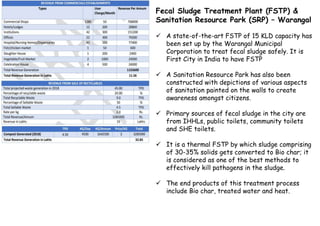
Fecal Sludge Treatment Plant (FSTP) &
Sanitation Resource Park (SRP) – Warangal
 A state-of-the-art FSTP of 15 KLD capacity has
been set up by the Warangal Municipal
Corporation to treat fecal sludge safely. It is
First City in India to have FSTP
 A Sanitation Resource Park has also been
constructed with depictions of various aspects
of sanitation painted on the walls to create
awareness amongst citizens.
 Primary sources of fecal sludge in the city are
from IHHLs, public toilets, community toilets
and SHE toilets.
 It is a thermal FSTP by which sludge comprising
of 30-35% solids gets converted to Bio char; it
is considered as one of the best methods to
effectively kill pathogens in the sludge.
 The end products of this treatment process
include Bio char, treated water and heat.
 Bio char can be sold to local vendors
and farmers to be used in plantations
and agriculture.
 The treated water can be used for
park maintenance and the heat is
transferred back into the plant to
support pasteurization, drying of
sludge etc
Technology adopted
Fecal Sludge Treatment Plant (FSTP) works based
on Thermal Technology
FSTP converts Septage in to Bio char
Thermal Energy Generation in Pyrolizer and it’s
reuse (in Pasteurization & Drying of Sludge)
Treatment process overview Project costing and source of funding
Fecal Sludge Treatment Plant (FSTP) – Rs. 1.20
Crores
From Govt Side :
• Free (1) acre Land provided (within a week)
• Approach Road to FSTP
• Power Supply Infrastructure
Mode of Operation : BOFT
Capital and operational expenditure
Windrow Composting – Jalpally
 The municipality has taken up Organic Waste Composting by collecting
the wet waste from vegetable markets and dry leaves from parks and
streets across the town.
 This composting process is very simple with no capital investment,
treating approximately 1.5-2 tons of waste every day generating 2-3
tons of compost every month.
 There are currently 91 Public Health laborers under the Sanitary
Inspector dedicatedly working on this.
 This initiative has greatly reduced the burden on the ULB to collect and
transport the waste to dumpsite outside the ULB limits.
 The compost is currently being sold to nurseries,
other ULBs and residents at Rs. 5 per kg.
 The municipality also conducted several awareness
campaigns for households to produce compost at
household level.
DWRC Center- Kompally
 DWRC Center in Kompally Municipality is recently
established which is located in Dulapally Dumping
yard with an area extent of 1.00 Ac.
 Two shed are constructed, one shed for house old
segregated dry waste collection with 6
compartments like 1. Pet Bottles 2. Color plastic 3.
White Plastic 4. Card Board 5. Paper waste and
6.Glasses. and second shed for commercial mixed
dry waste processing.
 One Bailing machine procured for plastic waste
bailing.
 At present daily 800 to 1000 kgs of Dry waste is
being handled in the DRCC.
 Daily organic waste is collected from weekly
vegetable markets and converted into windrow
compost and also liquid compost is collected.
 One Organic shredding machine procured for
shredding of daily collected vegetable market
waste.
Cost of plastic bailing machine- Rs 125000
for 18 ton capacity
Cost of organic vegetable waste shredding
machine- Rs 27500 for capacity of 25 kg/hr
Bio-Methanation Plant- Warangal
 About 800 kg of waste from vegetable market,
fish market and slaughter house is collected
through hydraulic auto tipper twice everyday and
sent to the Bio Methanation plant where it is
shredded and fed to the plant along with 1000
liters of water and cow dung.
 Vermi-composting sheds are constructed at the
Bio-methanation plant.
 1 TPD Bio-Methanation plant generates about 80
m3 gas and 50 kg manure via Vermi-composting.
 12 KW of energy generated through the plant is
used to light nearby street lights and adjacent
children’s park.
Dry Resource Collection Centre
 25 DRCCs are set up in Warangal city with about
12-15 tri-cycles run by public health workers,
attached to each DRCC. Each tricycle usually
collects waste from 3,500-4,500 households.
 The collected dry waste is weighed by digital scale
and further segregated into various categories of
waste which shall then be transported to the
recycling park for recycling.
Underground Bin systems
 Installed in December 2017, the advantage of
underground dustbins is that they improve the aesthetics
of a city and free up surface space for other uses.
 Once the underground bin is full, it will be lifted out by
specially designed vehicles and emptied by opening the
bottom flap. This helps faster collection with minimum
physical contact with the waste.
 The Underground Bin System is
constructed in such a way, that it
should be able to carry two bins of
1100 liters capacity each, for
Separate collection of wet and dry
waste. 6 such underground bins are
set up in Warangal city.
Smart Roads in NDMC
 Special features including sensor-based smart
parking systems, landscaping, vertical gardens,
cycle tracks, street furniture, plazas or
eateries, pelican crossing and 3D zebra
crossings will be added alongside the road.
 The roads like K.G. Marg, Barakhamba Road,
Sansad Marg, Janpath, Abdul Kalam Road, BKS
Marg and Maulana Azad Roads will be taken up
under the smart road project having provisions
like modern kiosks, street furniture, parking
facilities, electric poles and sitting plaza.
 The CCTV cameras on these poles will be equipped to revolve 360
degrees and will be able to capture footage of up to the range of
100 meters.
 The installation of these poles will also be at prominent markets
such as Sarojini Nagar, Bengali Market, Netaji Nagar, BK Dutt
Colony, Bengali Market, and Gole Market.
 Cost of 5 poles is Rs 300000
Warm LED Street Lights:
 Warm white LED street lights and parking lot lights—with a CCT of
3000K or less—are a much better option for public outdoor areas.
They emit a much smaller portion of blue light—which is unnoticeable
to the eye—and are currently the best options available for street
lighting.
 This is an important project which will
result in better illumination of the roads
for better safety while ensuring energy
efficiency and savings of more than 15MW
of peak demand.
Smart Poles:
 New Delhi Municipal Corporation (NDMC) has
installed 55 energy saving smart poles in the
Connaught place in Delhi.
 The poles boast of air sensors, energy-saving LED
lighting and Wi-Fi connectivity. Lights of these
poles would automatically be dimmed for saving
energy during non-peak traffic hours.
 NDMC installed Smart Poles with ‘panic button’
near the gates of 43 school buildings, 16 metro
stations, and other sensitive spots.
Best Practices In Water Management By NITI Aayog
Irrigation water management
Mission
Kakatiya-
Telangana
interventio
n
aimed at
restoring
minor
irrigation
sources of
water like
ponds and
tanks.
enhance the
development of Minor
Irrigation infrastructure,
strengthening
community based
irrigation management
in a decentralized
manner and to adopt a
comprehensive program
for restoration of tanks
and sources of water to
effectively utilize 265
TM of water allocated
for minor irrigation
sector under Godavari
and Krishna river Basins.
Steps like tank
de-siltation,
restoration of
the feeder
channels, re-
sectioning of
irrigation
channels,
repair of bund,
weir and
sluice, raising
of FTL (Full
Tank Level)
wherever
required were
carried out.
Achievement
s
helped in
making
water
available
and
accessible
to small
and
medium
farmers in
particular
and
benefitted
other
farmers as
well.
helped in
increasing
the water
retention
capacity of
the sources
and also
helped in
improving
the on-farm
moisture
retention
capacity.
Measures
like mixing
of the slit
on farm
land
preparation
reduced
the use of
chemical
fertilizers
and also
improved
the land
water
retention
capacity.
increase in
plantation
of palm
trees on
the slopes
also added
to the
income
generation
for the
rural
people.
Takeaways
Public
participat
ion will
lead to
ownershi
p and
help in
long-term
sustainabi
lity of the
interventi
ons.
Restoration
and
maintenanc
e of water
resources
should be a
continual
process and
local people
should be
trained to
manage
their
resources.
Adaptive
Water
Management
in Mandli,
Rajasthan
Intervention
main source of water for the village was a pond called the
Gawai Talaab which has the capacity of 2,869 cubic meter.
Owing it to its small catchment area and improper
construction, the pond would become dry and women had
to collect water from far.
Once the pond was sufficiently enlarged, the villagers decided to
help neighboring village communities to obtain water from it using
a ‘coupon system’ at a charge of INR 100 for a 4000 liter tanker.
This money is used for regular maintenance of the catchment by
renovation of water channels and tree plantation to improve
water inflow.
The pond has since been able to provide water even in drought
years and has greatly solved drinking water crisis in the area.
Achievement
Expansion of capacity of Gawai Talab from
2869 to 5218 CuM and that of Narsingh Nasa
from 2308 to 26601 CuM
13 villages benefited through this intervention by
sourcing water through tankers. The Jal Sabha has
achieved a sustainable financial source for regular
maintenance of the talaab through coupon system.
Takeaway
Investment in building robust and
sustainable community systems and
institutions positively impact round the year
availability of water
Emergence of community
participation along with
enhancement of leadership
skills and self-confidence.
DRINKING WATER MANAGEMENT
Mazhapolima Initiative -
Thrissur District, Kerala
Intervention
In the rainy season, the
rooftop rain water is led
through pipes with sand
filter at the end, to open
dug well to replenish the
aquifer
Achievement
Abundance of drinking
water free from
nitrates, iron content
and reduced salinity is
now available for the
community
20,000 well recharging
units were established
and over 1, 00,000
people have benefitted
Money which was earlier
spent on obtaining
drinking water through
tankers is now spent on
building self-sustaining
rooftop rainwater
harvesting structures
Takeaway
Community based
consciousness will
make great strides in
confronting water
stress in the country
Urban water management
Nagpur Orange City
Water Project
Intervention
To
overcome
losses,
the NMC
with
funding
under
JnNURM
replaced
canal
water
supply
with
pipelines
treatme
nt
capacity
at
Kanhan
River
was
increase
d to 240
MLD
from
120
MLD
The model
follows a PPP
framework
wherein Asset
Ownership lies
with the NMC,
operations are
looked after by
a private
consortium and
investment is
done by
Government of
India and Govt.
of Maharashtra
with ULB share
by private at
116 crores
Achievements
OCWPL
has taken
over water
supply and
replaced
85000 out
of 321,000
connectio
ns along
450 km of
the
pipeline
coverage
Service
delivery
issues being
tackled
through
infrastructu
re
augmentati
on and
increase in
capacity of
Elevated
Service
Reservoirs
24x7
water
supply has
ensured
better
standards
of living
for Nagpur
residents
Takeaways
PPPs hep
ULBs in
governance
by separating
monitoring
and
regulation
from service
provision and
bringing in
technical and
managerial
know-how
along with
proper
implementati
on.
Maximum
liability,
full
accountabi
lity and
wholesom
e planning
ensures
greater
availability
of water,
minimal
losses and
consumer
satisfactio
n.
Traditional water management
Phad -
Maharashtra
Phad
one of the best example of
community-managed
irrigation system
this practice is followed on three
rivers in the Tapi basin - Panjhra,
Mosam and Aram.
Phad means a block of land used for
irrigation purpose. In village one
command area usually has 3-5 Phads.
The Phad receives water from the Bandhara (A
check dam) and is diverted through the canal or
Pat. The excess water is diverted back to the
main river through Sandwa (the waste weir)
Achievements
The phad system of irrigation is entirely
managed by the community. It has its own
controlling organization
All the important functions like choice of crops to be
grown, water distributions (watering), maintenance
of water distribution system etc.; are managed by
the committee
Takeaways
Small quantities of water flowing in the streams
which would have otherwise gone as waste, is
utilized for irrigation to the maximum possible
extent
As the canal system in this case extends
over a short length, the seepage and
evaporation losses are less.
The area irrigated being small and
close to the source, irrigation can be
carried out with ease.
The initial and maintenance costs
of system are low.
INDUSTRIAL WATER MANAGEMENT
Use of TecTalis Process to Reduce
Water Consumption Implementing
agency: Bajaj Auto Ltd., Aurangabad
Intervention
Phosphating process is used
for coating on vehicle body for
corrosion resistance, lubricity,
or as foundation for further
painting applications. Process
involves pre degreasing, water
rinse, surface activation and
post phosphating involving
water rinse and passivation, It
operates at bath temperature
of 50 deg.centigrate. The
process of phosphating
generates hazardous sludge
and also has high water
consumption used in rinsing.
The new TecTalis process
is a nanotechnology
involving zirconium oxide
coating (zirconisation)
instead of conventional
phosphate and is called
as green process. The
process is free of heavy
metals such as nickel,
zinc and manganese.
Tectalis process does not
involve presurface
activation and post
passivation and operates
at ambient temperature.
Achievements
The
changeover
from
phosphating
to TecTalis
process has
helped in
reducing
water
consumption
from 50
m3/day to
1m3/day,
with annual
water saving
of 14700 m3
Electricity
consumption is
reduced from
61KW/hr to 30
KW/hr as
process has
reduced steps
and also
operates in
ambient
temperature
LPG
consumpt
ion has
been
reduced
to 250
kg/day
from 330
kg/day
thus
giving
annual
saving of
29000 kg
The
implementa
tion of
TecTalis
process
helped to
minimize
heavy metal
load,
wastewater
treatment,
phosphate
sludge and
hence is
greener
process
Takeawa
y
Innovative
alternative
process which
is
environmental
friendly is the
need of the
hour and need
to be
continually
captured and
positively
implemented
in Industries
Watershed management
Public transport comparison
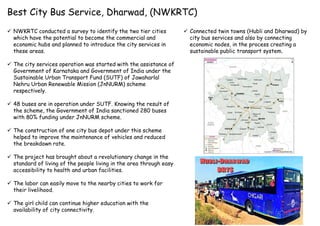
Best City Bus Service, Dharwad, (NWKRTC)
 NWKRTC conducted a survey to identify the two tier cities
which have the potential to become the commercial and
economic hubs and planned to introduce the city services in
these areas.
 The city services operation was started with the assistance of
Government of Karnataka and Government of India under the
Sustainable Urban Transport Fund (SUTF) of Jawaharlal
Nehru Urban Renewable Mission (JnNURM) scheme
respectively.
 48 buses are in operation under SUTF. Knowing the result of
the scheme, the Government of India sanctioned 280 buses
with 80% funding under JnNURM scheme.
 The construction of one city bus depot under this scheme
helped to improve the maintenance of vehicles and reduced
the breakdown rate.
 The project has brought about a revolutionary change in the
standard of living of the people living in the area through easy
accessibility to health and urban facilities.
 The labor can easily move to the nearby cities to work for
their livelihood.
 The girl child can continue higher education with the
availability of city connectivity.
 Connected twin towns (Hubli and Dharwad) by
city bus services and also by connecting
economic nodes, in the process creating a
sustainable public transport system.

Best practices in infrastructure

  • 1.
    Best practices in infrastructure AdithyaA 17011BA001 JNAFAU SPA Subject- Infrastructure Workshop
  • 2.
    E Waste-Sangareddy  Sangareddymunicipality is the first ULB to sign a MOU with sanshodhan, e- wasteexchange.com; a company authorized by MA&UD TS to collect, process and dispose of electronic waste generated in the ULB safely.  Few bins are placed at known places for disposing electronic waste. Sanshodhan separates all and sends to respective recycling units. A telephone number has been provided to the citizens for collecting e waste.  The Municipality initiated few “Electronic Waste safe disposal Campaigns” in the town and collected Electronic Waste i.e., Old Televisions, Remotes, Coolers etc.  Created the awareness to not litter waste containing harmful metals like lead and cadmium. Services • Circular Economy Standard E- Waste Management - RE- CIRCULATETM • Guidance and implementation of "Zero Waste Management" • Assistance For Extended Producer Responsibility (EPR) (policy) Compliance • E-Waste Inventorization • Capacity Building & Advisory Services Ensure the safe end of life of e-waste Ease out policy compliance Enable maintenance of records Enable businesses to practice effective waste management for social good Ease out the filing annual returns
  • 3.
    Biogas plant atcompost yard – Sircilla  First Bio-gas treatment plant by the Sircilla Municipality has come up at compost yard which is located 6 km far from town with an area of 16.25 Acres.  Market, hotel, kitchen and animal waste can be used for preparing bio-gas .  Gas can be used for heating, lighting, and cooking.  Effluent can be used for fertilizer.  Capacity- 3 cubic meters.  Total cost of the project is- 0.75 Lakhs. BIO-chest unit at market  To make better use of organic waste produced from vegetable markets in the core area of the town, Sircilla Municipality is planning to place Bio-chest units, with capacity of 300-500 kg which can convert both dry and wet waste into compost within 20-30days.  This facility would reduce the burden of shifting the organic waste to dumping yards.  Ex: Input of 10 tons of organic waste during the cycle, would generate more than 3 tons of compost.  Total Cost of the project is 10 Lakhs. Biogas is a gas mixture which is generated when organic compounds are fermented in the absence of air (anaerobic fermentation). This gas mixture is mainly made of carbon dioxide (CO2) and methane (CH4). Process • Organic matter such as manure (human or animal) is mashed up with water and introduced at the inlet, and used to feed the plant. • The process of anaerobic fermentation will then take place in the large tank (biogas reactor), to generate biological gas (biogas). • It will also produce a substrate (called digestate) rich in nutrients which can be used as organic fertilizer or fish feed.
  • 4.
    Gaps in Existing MSWManagement System in Sircilla Segregation at Source Existing system 65% segregation at source into wet and dry waste Proposed system the waste shall be segregated and stored at the source in three separate streams namely bio- degradable, non- biodegradable and domestic hazardous waste in suitable bins. Primary Collection of Waste Existing system 94% door to door collection system covering complete wards in 2 days Proposed system there should be door to door collection of segregated solid waste from all households including slums and informal settlements, commercial, institutional and other non-residential premises. Secondary Storage of Waste Existing system There are no such dumping points or bins located in the town Proposed system Separate colored bins with proper distinction at the secondary storage location for biodegradable and non biodegradable and recyclable/ combustible wastes.
  • 5.
    Service Level benchmarks Secondarytransportation of waste Existing system Solid waste is transported in open three wheelers and tractors Proposed system the waste transportation vehicles must be covered at all times and the loaded waste should not exceed the capacity of the waste transportation vehicles. Processing and disposal of waste Existing system there is no preprocessing of wet waste and indiscriminately disposed off in open dumpsites. Proposed system biodegradable waste shall be processed and converted into compost; recyclables shall be segregated and stored separately to be processed by recyclers; construction waste to be segregated and used for filling low lying areas and only remaining waste shall be dumped into engineered landfill facility without creating nuisance or hazard to public health or safety, such as breeding of rodents and insects and contamination of groundwater.
  • 7.
    COST OF THEPROPOSED SYSTEM Operation & Maintenance Cost (O&M) of the Proposed System Revenue Generation from Households Capital Cost of the Proposed System
  • 8.
    Fecal Sludge TreatmentPlant (FSTP) & Sanitation Resource Park (SRP) – Warangal  A state-of-the-art FSTP of 15 KLD capacity has been set up by the Warangal Municipal Corporation to treat fecal sludge safely. It is First City in India to have FSTP  A Sanitation Resource Park has also been constructed with depictions of various aspects of sanitation painted on the walls to create awareness amongst citizens.  Primary sources of fecal sludge in the city are from IHHLs, public toilets, community toilets and SHE toilets.  It is a thermal FSTP by which sludge comprising of 30-35% solids gets converted to Bio char; it is considered as one of the best methods to effectively kill pathogens in the sludge.  The end products of this treatment process include Bio char, treated water and heat.
  • 9.
     Bio charcan be sold to local vendors and farmers to be used in plantations and agriculture.  The treated water can be used for park maintenance and the heat is transferred back into the plant to support pasteurization, drying of sludge etc Technology adopted Fecal Sludge Treatment Plant (FSTP) works based on Thermal Technology FSTP converts Septage in to Bio char Thermal Energy Generation in Pyrolizer and it’s reuse (in Pasteurization & Drying of Sludge)
  • 10.
    Treatment process overviewProject costing and source of funding Fecal Sludge Treatment Plant (FSTP) – Rs. 1.20 Crores From Govt Side : • Free (1) acre Land provided (within a week) • Approach Road to FSTP • Power Supply Infrastructure Mode of Operation : BOFT Capital and operational expenditure
  • 11.
    Windrow Composting –Jalpally  The municipality has taken up Organic Waste Composting by collecting the wet waste from vegetable markets and dry leaves from parks and streets across the town.  This composting process is very simple with no capital investment, treating approximately 1.5-2 tons of waste every day generating 2-3 tons of compost every month.  There are currently 91 Public Health laborers under the Sanitary Inspector dedicatedly working on this.  This initiative has greatly reduced the burden on the ULB to collect and transport the waste to dumpsite outside the ULB limits.  The compost is currently being sold to nurseries, other ULBs and residents at Rs. 5 per kg.  The municipality also conducted several awareness campaigns for households to produce compost at household level.
  • 12.
    DWRC Center- Kompally DWRC Center in Kompally Municipality is recently established which is located in Dulapally Dumping yard with an area extent of 1.00 Ac.  Two shed are constructed, one shed for house old segregated dry waste collection with 6 compartments like 1. Pet Bottles 2. Color plastic 3. White Plastic 4. Card Board 5. Paper waste and 6.Glasses. and second shed for commercial mixed dry waste processing.  One Bailing machine procured for plastic waste bailing.  At present daily 800 to 1000 kgs of Dry waste is being handled in the DRCC.  Daily organic waste is collected from weekly vegetable markets and converted into windrow compost and also liquid compost is collected.  One Organic shredding machine procured for shredding of daily collected vegetable market waste. Cost of plastic bailing machine- Rs 125000 for 18 ton capacity Cost of organic vegetable waste shredding machine- Rs 27500 for capacity of 25 kg/hr
  • 13.
    Bio-Methanation Plant- Warangal About 800 kg of waste from vegetable market, fish market and slaughter house is collected through hydraulic auto tipper twice everyday and sent to the Bio Methanation plant where it is shredded and fed to the plant along with 1000 liters of water and cow dung.  Vermi-composting sheds are constructed at the Bio-methanation plant.  1 TPD Bio-Methanation plant generates about 80 m3 gas and 50 kg manure via Vermi-composting.  12 KW of energy generated through the plant is used to light nearby street lights and adjacent children’s park. Dry Resource Collection Centre  25 DRCCs are set up in Warangal city with about 12-15 tri-cycles run by public health workers, attached to each DRCC. Each tricycle usually collects waste from 3,500-4,500 households.  The collected dry waste is weighed by digital scale and further segregated into various categories of waste which shall then be transported to the recycling park for recycling. Underground Bin systems  Installed in December 2017, the advantage of underground dustbins is that they improve the aesthetics of a city and free up surface space for other uses.  Once the underground bin is full, it will be lifted out by specially designed vehicles and emptied by opening the bottom flap. This helps faster collection with minimum physical contact with the waste.  The Underground Bin System is constructed in such a way, that it should be able to carry two bins of 1100 liters capacity each, for Separate collection of wet and dry waste. 6 such underground bins are set up in Warangal city.
  • 14.
    Smart Roads inNDMC  Special features including sensor-based smart parking systems, landscaping, vertical gardens, cycle tracks, street furniture, plazas or eateries, pelican crossing and 3D zebra crossings will be added alongside the road.  The roads like K.G. Marg, Barakhamba Road, Sansad Marg, Janpath, Abdul Kalam Road, BKS Marg and Maulana Azad Roads will be taken up under the smart road project having provisions like modern kiosks, street furniture, parking facilities, electric poles and sitting plaza.  The CCTV cameras on these poles will be equipped to revolve 360 degrees and will be able to capture footage of up to the range of 100 meters.  The installation of these poles will also be at prominent markets such as Sarojini Nagar, Bengali Market, Netaji Nagar, BK Dutt Colony, Bengali Market, and Gole Market.  Cost of 5 poles is Rs 300000 Warm LED Street Lights:  Warm white LED street lights and parking lot lights—with a CCT of 3000K or less—are a much better option for public outdoor areas. They emit a much smaller portion of blue light—which is unnoticeable to the eye—and are currently the best options available for street lighting.  This is an important project which will result in better illumination of the roads for better safety while ensuring energy efficiency and savings of more than 15MW of peak demand. Smart Poles:  New Delhi Municipal Corporation (NDMC) has installed 55 energy saving smart poles in the Connaught place in Delhi.  The poles boast of air sensors, energy-saving LED lighting and Wi-Fi connectivity. Lights of these poles would automatically be dimmed for saving energy during non-peak traffic hours.  NDMC installed Smart Poles with ‘panic button’ near the gates of 43 school buildings, 16 metro stations, and other sensitive spots.
  • 15.
    Best Practices InWater Management By NITI Aayog Irrigation water management Mission Kakatiya- Telangana interventio n aimed at restoring minor irrigation sources of water like ponds and tanks. enhance the development of Minor Irrigation infrastructure, strengthening community based irrigation management in a decentralized manner and to adopt a comprehensive program for restoration of tanks and sources of water to effectively utilize 265 TM of water allocated for minor irrigation sector under Godavari and Krishna river Basins. Steps like tank de-siltation, restoration of the feeder channels, re- sectioning of irrigation channels, repair of bund, weir and sluice, raising of FTL (Full Tank Level) wherever required were carried out. Achievement s helped in making water available and accessible to small and medium farmers in particular and benefitted other farmers as well. helped in increasing the water retention capacity of the sources and also helped in improving the on-farm moisture retention capacity. Measures like mixing of the slit on farm land preparation reduced the use of chemical fertilizers and also improved the land water retention capacity. increase in plantation of palm trees on the slopes also added to the income generation for the rural people. Takeaways Public participat ion will lead to ownershi p and help in long-term sustainabi lity of the interventi ons. Restoration and maintenanc e of water resources should be a continual process and local people should be trained to manage their resources.
  • 18.
    Adaptive Water Management in Mandli, Rajasthan Intervention main sourceof water for the village was a pond called the Gawai Talaab which has the capacity of 2,869 cubic meter. Owing it to its small catchment area and improper construction, the pond would become dry and women had to collect water from far. Once the pond was sufficiently enlarged, the villagers decided to help neighboring village communities to obtain water from it using a ‘coupon system’ at a charge of INR 100 for a 4000 liter tanker. This money is used for regular maintenance of the catchment by renovation of water channels and tree plantation to improve water inflow. The pond has since been able to provide water even in drought years and has greatly solved drinking water crisis in the area. Achievement Expansion of capacity of Gawai Talab from 2869 to 5218 CuM and that of Narsingh Nasa from 2308 to 26601 CuM 13 villages benefited through this intervention by sourcing water through tankers. The Jal Sabha has achieved a sustainable financial source for regular maintenance of the talaab through coupon system. Takeaway Investment in building robust and sustainable community systems and institutions positively impact round the year availability of water Emergence of community participation along with enhancement of leadership skills and self-confidence. DRINKING WATER MANAGEMENT
  • 19.
    Mazhapolima Initiative - ThrissurDistrict, Kerala Intervention In the rainy season, the rooftop rain water is led through pipes with sand filter at the end, to open dug well to replenish the aquifer Achievement Abundance of drinking water free from nitrates, iron content and reduced salinity is now available for the community 20,000 well recharging units were established and over 1, 00,000 people have benefitted Money which was earlier spent on obtaining drinking water through tankers is now spent on building self-sustaining rooftop rainwater harvesting structures Takeaway Community based consciousness will make great strides in confronting water stress in the country
  • 20.
    Urban water management NagpurOrange City Water Project Intervention To overcome losses, the NMC with funding under JnNURM replaced canal water supply with pipelines treatme nt capacity at Kanhan River was increase d to 240 MLD from 120 MLD The model follows a PPP framework wherein Asset Ownership lies with the NMC, operations are looked after by a private consortium and investment is done by Government of India and Govt. of Maharashtra with ULB share by private at 116 crores Achievements OCWPL has taken over water supply and replaced 85000 out of 321,000 connectio ns along 450 km of the pipeline coverage Service delivery issues being tackled through infrastructu re augmentati on and increase in capacity of Elevated Service Reservoirs 24x7 water supply has ensured better standards of living for Nagpur residents Takeaways PPPs hep ULBs in governance by separating monitoring and regulation from service provision and bringing in technical and managerial know-how along with proper implementati on. Maximum liability, full accountabi lity and wholesom e planning ensures greater availability of water, minimal losses and consumer satisfactio n.
  • 21.
    Traditional water management Phad- Maharashtra Phad one of the best example of community-managed irrigation system this practice is followed on three rivers in the Tapi basin - Panjhra, Mosam and Aram. Phad means a block of land used for irrigation purpose. In village one command area usually has 3-5 Phads. The Phad receives water from the Bandhara (A check dam) and is diverted through the canal or Pat. The excess water is diverted back to the main river through Sandwa (the waste weir) Achievements The phad system of irrigation is entirely managed by the community. It has its own controlling organization All the important functions like choice of crops to be grown, water distributions (watering), maintenance of water distribution system etc.; are managed by the committee Takeaways Small quantities of water flowing in the streams which would have otherwise gone as waste, is utilized for irrigation to the maximum possible extent As the canal system in this case extends over a short length, the seepage and evaporation losses are less. The area irrigated being small and close to the source, irrigation can be carried out with ease. The initial and maintenance costs of system are low.
  • 23.
    INDUSTRIAL WATER MANAGEMENT Useof TecTalis Process to Reduce Water Consumption Implementing agency: Bajaj Auto Ltd., Aurangabad Intervention Phosphating process is used for coating on vehicle body for corrosion resistance, lubricity, or as foundation for further painting applications. Process involves pre degreasing, water rinse, surface activation and post phosphating involving water rinse and passivation, It operates at bath temperature of 50 deg.centigrate. The process of phosphating generates hazardous sludge and also has high water consumption used in rinsing. The new TecTalis process is a nanotechnology involving zirconium oxide coating (zirconisation) instead of conventional phosphate and is called as green process. The process is free of heavy metals such as nickel, zinc and manganese. Tectalis process does not involve presurface activation and post passivation and operates at ambient temperature. Achievements The changeover from phosphating to TecTalis process has helped in reducing water consumption from 50 m3/day to 1m3/day, with annual water saving of 14700 m3 Electricity consumption is reduced from 61KW/hr to 30 KW/hr as process has reduced steps and also operates in ambient temperature LPG consumpt ion has been reduced to 250 kg/day from 330 kg/day thus giving annual saving of 29000 kg The implementa tion of TecTalis process helped to minimize heavy metal load, wastewater treatment, phosphate sludge and hence is greener process Takeawa y Innovative alternative process which is environmental friendly is the need of the hour and need to be continually captured and positively implemented in Industries
  • 24.
  • 25.
  • 27.
    Best City BusService, Dharwad, (NWKRTC)  NWKRTC conducted a survey to identify the two tier cities which have the potential to become the commercial and economic hubs and planned to introduce the city services in these areas.  The city services operation was started with the assistance of Government of Karnataka and Government of India under the Sustainable Urban Transport Fund (SUTF) of Jawaharlal Nehru Urban Renewable Mission (JnNURM) scheme respectively.  48 buses are in operation under SUTF. Knowing the result of the scheme, the Government of India sanctioned 280 buses with 80% funding under JnNURM scheme.  The construction of one city bus depot under this scheme helped to improve the maintenance of vehicles and reduced the breakdown rate.  The project has brought about a revolutionary change in the standard of living of the people living in the area through easy accessibility to health and urban facilities.  The labor can easily move to the nearby cities to work for their livelihood.  The girl child can continue higher education with the availability of city connectivity.  Connected twin towns (Hubli and Dharwad) by city bus services and also by connecting economic nodes, in the process creating a sustainable public transport system.