Contents
STATUTORY PROCESSFOR PLANNED DEVELOPMENT OF TOWNS AND CITIES
MODEL REGIONAL AND TOWN PLANNING AND DEVELOPMENT LAW,1985
STATUS OF TOWN AND COUNTRY PLANNING ACTS AND MASTER PLANS
74th Constitution Amendment Act and its Implication on the Statutory process in Town
and Country Planning- When and from what was UDPFI formed
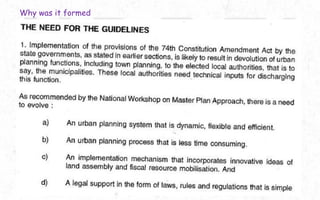
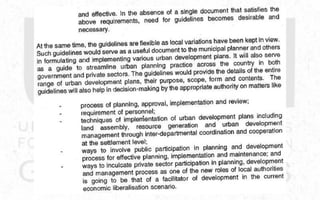
Why was it formed
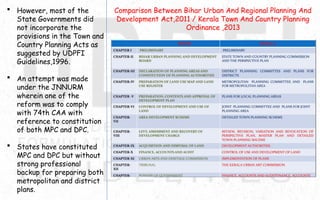
Comparison Between Bihar Urban And Regional Planning And Development Act,2011 /
Kerala Town And Country Planning Ordinance ,2013
REVISION OF URDPFI GUIDELINES
3.
STATUTORY PROCESS FORPLANNED DEVELOPMENT OF TOWNS
AND CITIES
Statutory process of master plan formulation in India was inspired by the
erstwhile comprehensive planning system envisaged under the Town and
Country Planning Act, 1947 of United Kingdom.
As most of the Town Improvement Trust Acts then in force in various states
did not contain provisions for preparation of Master Plans, a need was felt to
have a Comprehensive Town and Country Planning Act on the lines of U.K
Accordingly, Central Town and Country Planning Organization or TCPO
drafted the Model Town and Regional Planning and Development Law in 1962,
which formed the basis for various States to enact Town and Country
Planning Acts, with modifications to suit local conditions.
4.
MODEL REGIONAL ANDTOWN PLANNING AND DEVELOPMENT LAW,1985
This model Law was revised by TCPO in year 1985 as “Model Regional and Town Planning and
Development Law” to enact a comprehensive urban and regional planning legislation in all the
States and UT’s.
BROAD PROVISIONS
Constitution of State Regional and Town Planning Board by the State Government for
the purpose of advising on the delineation of the region for the planned development,
Directing the preparation of metropolitan, regional and area plans by the metropolitan,
regional and area planning and development authorities.
Setting up of metropolitan, regional and area planning and development authorities for
different urban and rural areas within the State to undertake preparation of
development plans and to
enforce and implement them,
Coordinating the planning and implementation of physical development programs
5.
Model Law provided3 steps for the administration of this law:
a) Preparation of existing land use map,
b) Preparation of an outline development plan and comprehensive development
plan and their enforcement, and
c) Preparation of detailed schemes of development or redevelopment as
envisaged in the plans and their implementation.
STATUS OF TOWN AND COUNTRY PLANNING ACTS AND MASTER PLANS
Based on the Model Regional and Town Planning and Development
Law,1985 ,many states enacted their Town and Country Acts.
However , states like Haryana, Rajasthan and UT of Chandigarh, Lakshadweep
do not have Town and Country Planning Acts. Jharkhand, Chhattisgarh and
Uttarakhand have adopted the parent state’s T&CP Acts
Out of 7933 Towns ,about 2032 towns have Master Plans(1483 notified +549
under preparation )
6.
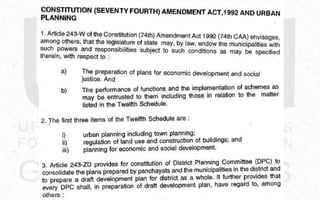
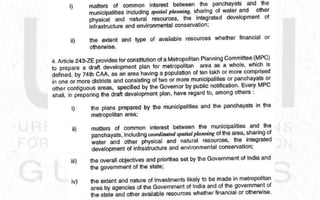
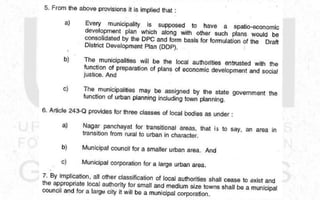
74th
Constitution Amendment Actand its Implication on the Statutory process in
Town and Country Planning- When and from what was UDPFI formed
During 1995, the National Workshop on Master Plan Approach: Its Efficacies
and Alternatives was held which examined the entire process of urban
development planning and implementation
When- As a recommendation of above workshop, the first national level
planning guidelines ‘Urban Development Plans Formulation and Implementation’,
(UDPFI) were framed in 1996 by Institute of Town Planners, India in
consonance with the provisions of 74th
CAA. It provided a framework for plan
preparation and implementation process.
From what- Part 2 contained suggested changes required in Model Regional
and Town Planning and Development Law (Volume 2A) and modifications in
Town Planning Acts of Maharashtra {Volume 2B) and Gujarat (Volume 2C).
The objective of the Volume 2 A and B was to guide the State governments to
incorporate the provision especially of preparation for Metropolitan and
District Plan.
However, mostof the
State Governments did
not incorporate the
provisions in the Town and
Country Planning Acts as
suggested by UDPFI
Guidelines,1996.
An attempt was made
under the JNNURM
wherein one of the
reform was to comply
with 74th CAA with
reference to constitution
of both MPC and DPC.
States have constituted
MPC and DPC but without
strong professional
backup for preparing both
metropolitan and district
plans.
Comparison Between Bihar Urban And Regional Planning And
Development Act,2011 / Kerala Town And Country Planning
Ordinance ,2013
10.
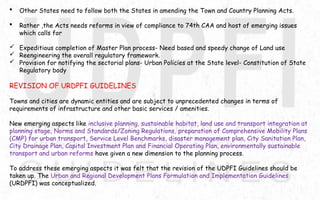
Other Statesneed to follow both the States in amending the Town and Country Planning Acts.
Rather ,the Acts needs reforms in view of compliance to 74th CAA and host of emerging issues
which calls for
Expeditious completion of Master Plan process- Need based and speedy change of Land use
Reengineering the overall regulatory framework.
Provision for notifying the sectorial plans- Urban Policies at the State level- Constitution of State
Regulatory body
REVISION OF URDPFI GUIDELINES
Towns and cities are dynamic entities and are subject to unprecedented changes in terms of
requirements of infrastructure and other basic services / amenities.
New emerging aspects like inclusive planning, sustainable habitat, land use and transport integration at
planning stage, Norms and Standards/Zoning Regulations, preparation of Comprehensive Mobility Plans
(CMP) for urban transport, Service Level Benchmarks, disaster management plan, City Sanitation Plan,
City Drainage Plan, Capital Investment Plan and Financial Operating Plan, environmentally sustainable
transport and urban reforms have given a new dimension to the planning process.
To address these emerging aspects it was felt that the revision of the UDPFI Guidelines should be
taken up. The Urban and Regional Development Plans Formulation and Implementation Guidelines
(URDPFI) was conceptualized.
14.
References
TOWN PLANNINGAND DEVELOPMENT LAWS:EVOLUTION AND CURRENT
AMENDMENTS
by J.KSHIRSAGAR CHIEF PLANNER & R.SRINIVAS TOWN AND COUNTRY PLANNER
TCPO MINISTRYOF URBAN DEVELOPMENT GOVERNMENT OF INDIA
UDPFI Guidelines August 1996