Redevelopment 2
Contents
Sustainable Urban Conservation....................................................................................................4
World Heritage Convention (Protection of World Cultural and Natural Heritage).............................. 4
Important Cultural Protection Treaties and Other International Charters/Agreements ..................... 5
Venice Charter,1964- International Charterforthe ConservationandRestorationof Monuments
and Sites ..................................................................................................................................5
International council on monuments and sites(ICOMOS)............................................................ 5
International Centreforthe Studyof the PreservationandRestorationof Culturalproperty
(ICCROM) .................................................................................................................................5
Florence Charter, 1981.............................................................................................................. 5
Washington Charter, 1987.........................................................................................................5
The AustraliaICOMOSCharter(the Burra Charter) for the Conservationof Placesof Cultural
Significance .............................................................................................................................. 5
ICOMOS New Zealand: Charter for the Conservation of Places of Cultural Heritage Value ............. 6
Indian Legislations for protection of heritage ................................................................................. 6
Legislations............................................................................................................................... 6
Urban Obsolescence..................................................................................................................... 7
Urban Blight/Urban decay............................................................................................................. 7
Urban Redevelopment.................................................................................................................. 7
Adaptive reuse............................................................................................................................. 8
Regeneration (regenerationin UK) ................................................................................................ 8
Revitalization (revitalization in US).................................................................................................8
Reconstruction............................................................................................................................. 9
Urban clearance........................................................................................................................... 9
Preservation............................................................................................................................... 10
Urban Renewal........................................................................................................................... 10
Reasons for Urban renewal ..................................................................................................... 10
Process of Urban Renewal....................................................................................................... 11
Importance of Urban renewal.................................................................................................. 11
Disadvantages of urban renewal.............................................................................................. 11
Urban Renewal – JNNURM...................................................................................................... 11
JNNURMMission.................................................................................................................... 12
Conclusion.............................................................................................................................. 12
Planning for Inner city................................................................................................................. 13
Alternative strategies for Redevelopment and Regeneration..................................................... 13
Redevelopment 3
Alternative 1- Modification in Built-up:................................................................................. 13
Alternative 2- In-situ Development:...................................................................................... 14
Aspects of Revival................................................................................................................... 14
Heritage/ Religious/ Tourism city................................................................................................. 15
Aspects of preservation, conservation & promotion.................................................................. 15
Urban Conservation through Urban Planning............................................................................... 17
Definition of urban conservation ............................................................................................. 17
What is built heritage?............................................................................................................ 17
Why conservation at all?......................................................................................................... 17
Urban Conservation by means of master plan and other policy documents................................ 18
Land use proposals for Urban Conservation.............................................................................. 18
Floor area ratio and Density .................................................................................................... 18
Traffic & road widening........................................................................................................... 18
Street lines and setbacks......................................................................................................... 19
Pedestrianization.................................................................................................................... 19
Development control rules and design control.......................................................................... 19
Brownfield Development ............................................................................................................ 20
New remediation technologies................................................................................................ 21
Benefits of Brownfield Development........................................................................................ 21
Controversial issues................................................................................................................ 21
Greenfield Development............................................................................................................. 22
Types of Greenfield Land......................................................................................................... 23
Categories of Greenfield Land.................................................................................................. 23
Different types of projects that use Greenfieldland.................................................................. 23
Choosing a Greenfield Land for Development........................................................................... 23
Sustainable Greenfield Development....................................................................................... 24
Greenfield Development – An Inevitable Choice....................................................................... 24
References................................................................................................................................. 25
Redevelopment 4
Sustainable Urban Conservation
 Urban conservation of heritage sites in cities contributes largely towards upgrading
environmental quality, thus serving as a fundamental catalyst for change.
 International cultural organizations such as the United Nations Educational,
Scientific and Cultural Organization (UNESCO), the International Centre for
the Study of the Preservation and Restoration of Cultural Property (ICCROM)
and the International Commission on Monuments and Sites (ICOMOS) are
focused on these issues.
 Bernard Feilden (1982) identified seven degrees of intervention arguing that the
minimum the intervention the better the conservation. These terms are prevention of
decay, preservation, consolidation, restoration, rehabilitation, reproduction and
reconstruction.
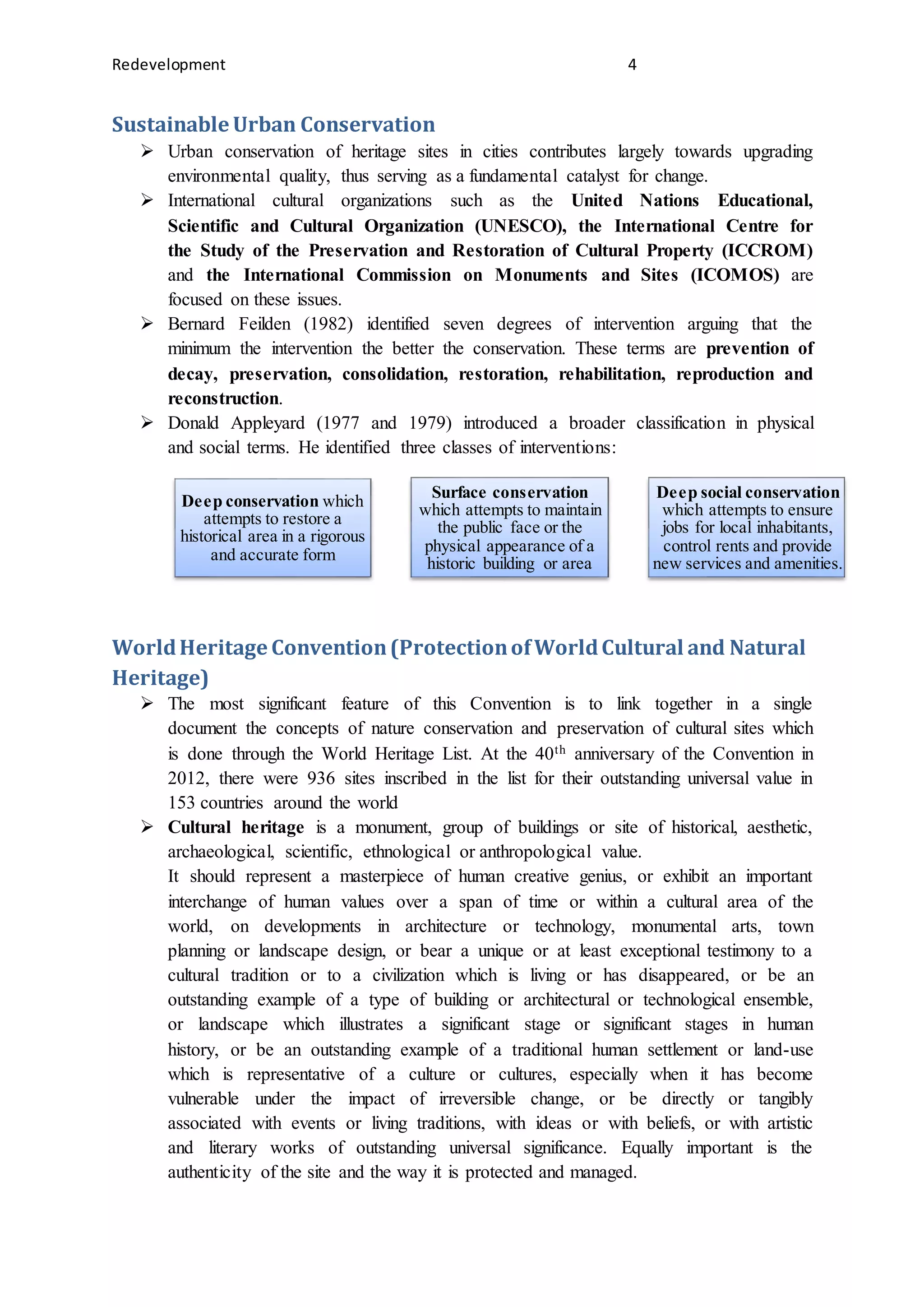
 Donald Appleyard (1977 and 1979) introduced a broader classification in physical
and social terms. He identified three classes of interventions:
WorldHeritage Convention(ProtectionofWorldCultural and Natural
Heritage)
 The most significant feature of this Convention is to link together in a single
document the concepts of nature conservation and preservation of cultural sites which
is done through the World Heritage List. At the 40th anniversary of the Convention in
2012, there were 936 sites inscribed in the list for their outstanding universal value in
153 countries around the world
 Cultural heritage is a monument, group of buildings or site of historical, aesthetic,
archaeological, scientific, ethnological or anthropological value.
It should represent a masterpiece of human creative genius, or exhibit an important
interchange of human values over a span of time or within a cultural area of the
world, on developments in architecture or technology, monumental arts, town
planning or landscape design, or bear a unique or at least exceptional testimony to a
cultural tradition or to a civilization which is living or has disappeared, or be an
outstanding example of a type of building or architectural or technological ensemble,
or landscape which illustrates a significant stage or significant stages in human
history, or be an outstanding example of a traditional human settlement or land-use
which is representative of a culture or cultures, especially when it has become
vulnerable under the impact of irreversible change, or be directly or tangibly
associated with events or living traditions, with ideas or with beliefs, or with artistic
and literary works of outstanding universal significance. Equally important is the
authenticity of the site and the way it is protected and managed.
Deep conservation which
attempts to restore a
historical area in a rigorous
and accurate form
Surface conservation
which attempts to maintain
the public face or the
physical appearance of a
historic building or area
Deep social conservation
which attempts to ensure
jobs for local inhabitants,
control rents and provide
new services and amenities.
Redevelopment 5
 Natural heritage designates outstanding physical, biological and geological features;
habitats of threatened plants or animal species and areas of value on scientific or
aesthetic grounds or from the point of view of conservation.
Natural properties should be outstanding examples representing major stages of the
earth’s history, including the record of life, significant ongoing geological processes
in the development of landforms, or significant geomorphic or physiographic features
or be outstanding examples representing significant ongoing ecological and biological
processes in the evolution and development of terrestrial, fresh water, coastal and
marine ecosystems and communities of plants and animals, contain superlative natural
phenomena or areas of exceptional natural beauty and aesthetic importance, or contain
the most important and significant natural habitats for in situ conservation of
biological diversity, including those containing threatened species of outstanding
universal value from the point of view of science or conservation.
Important Cultural ProtectionTreaties andOther International
Charters/Agreements
Venice Charter, 1964- International Charter for the Conservation and
Restoration of Monuments and Sites
 It codifies internationally accepted standards of conservation practice relating to
architecture and sites
International council on monuments and sites (ICOMOS)
 ICOMOS is an International forum of experts sharing knowledge to conserve and
protect cultural heritage sites
 ICOMOS was founded in 1965 as a result of the Venice Charter of 1964, and offers
advice to UNESCO on World Heritage Sites
International Centre for the Study of the Preservation and Restoration of
Cultural property (ICCROM)
 Intergovernmental organization dedicated to the preservation of cultural heritage
worldwide through training, information, research, cooperation and advocacy
programs
Florence Charter, 1981
 It sets forth the principles and guidelines for the preservation of historic gardens
Washington Charter, 1987
 Establishes the principles and guidelines for the protection and conservation of
historic towns and urban areas
The Australia ICOMOS Charter (the Burra Charter) for the Conservation of
Places of Cultural Significance
 It identifies three levels of repair for heritage structures:
Redevelopment 6
ICOMOS New Zealand: Charter for the Conservation of Places of Cultural
Heritage Value
Indian Legislations for protectionofheritage
 The Archaeological Survey of India (ASI), under the Ministry of Culture, is the
premier organization for the archaeological researches, protection of the cultural
heritage of the nation and maintenance of ancient monuments, archaeological sites
and remains of national importance.
Legislations
 The Ancient Monuments and Archaeological Sites and Remains Act (AMASR)
were enacted in 1958. This Act provides for the preservation of ancient and historical
monuments and archaeological sites and remains of national importance, for the
regulation of archaeological excavations and for the protection of sculptures, carvings
and other like objects.
 All ancient and historical monuments which have been declared by the AMASR Act,
1958 or by section 126 of the States Reorganization Act, 1956 to be of national
importance shall be deemed to be protected monuments
 If the Central government apprehends that a protected monument is in danger of being
destroyed, injured, misused, or allowed to fall into decay, it may acquire the protected
monument under the provisions of RFCTLARR Act 2013 as if the maintenance of
the protected monument were a public purpose.
 Prohibited area means an area near or adjoining a protected monument which the
Central Government has, by notification in the Official Gazette, declared to be a
prohibited area for purposes of mining operation or construction or both. It is declared
up to 100 meters from the protected limits. Any construction in the prohibited area
shall be punishable with imprisonment not exceeding two years or with fine which
may extend to one lakh rupees or both.
 Regulated area means an area near or adjoining a protected monument which the
central Government has, by notification in the official gazette, declared to be a
regulated area, for purpose of mining operation or construction or both. It is declared
further beyond the protected limits up to 200 meters in all directions. Any
construction in the regulated area without the previous permission of the competent
authority shall be punishable with imprisonment not exceeding two years or with fine
which may extend to one lakh rupees or both.
Preservation- Maintaining
a place in its existing state
and preventing further
deterioration
Restoration- Returning a
place to a known earlier state
by removing accretions or by
reassembling existing
elements without the
introduction of new material
Reconstruction- Returning
a place to a known earlier
state and is distinguished
from restoration by the
introduction of new material
Redevelopment 7
Urban Obsolescence
 Rate of physical deterioration in cities which render housing, commercial buildings,
industries, other structures, districts and parts of city obsolete or a stage when they
have outlived their average life or have passed beyond their intended use
Urban Blight/Urbandecay
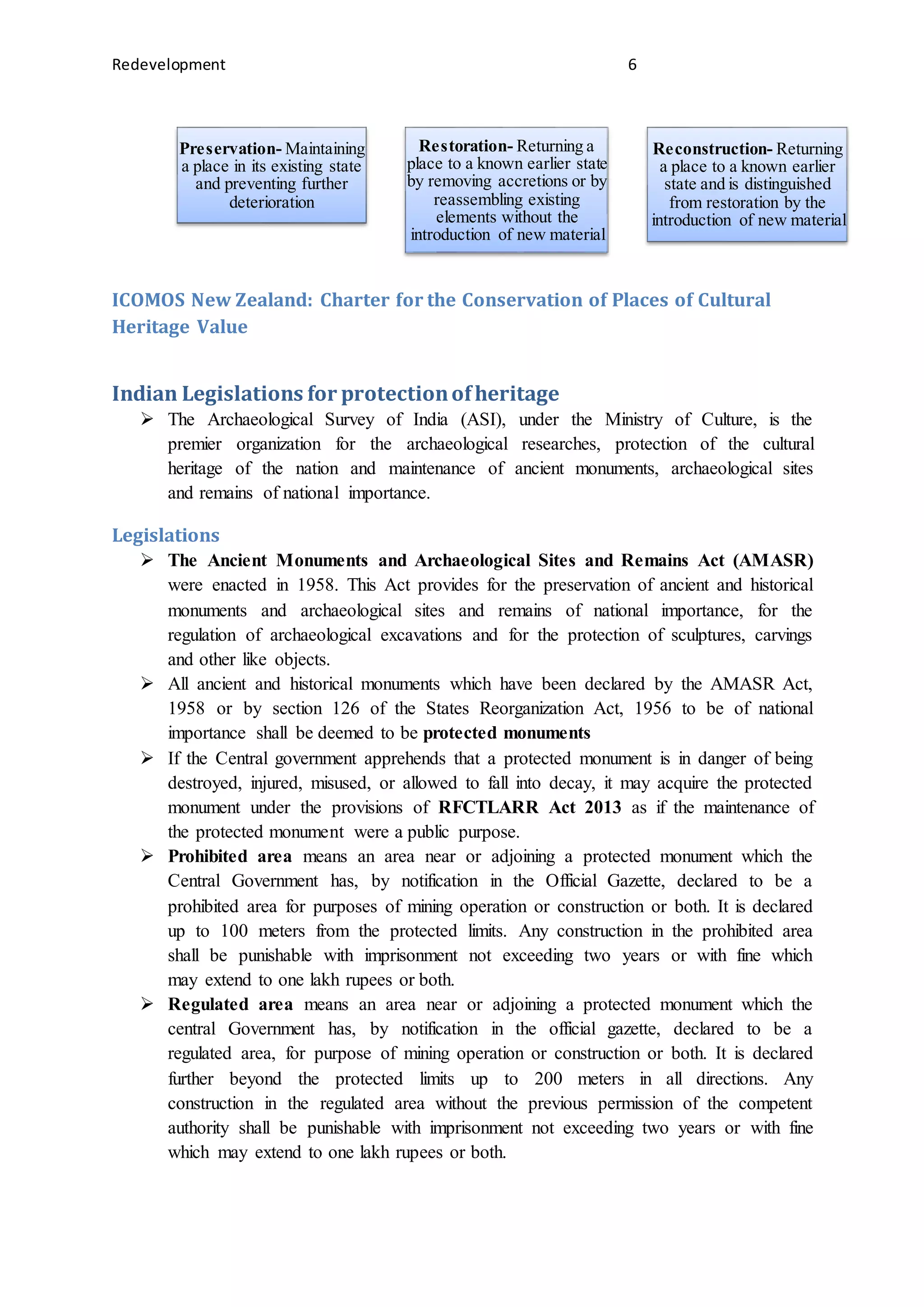
 It is the process whereby a previously functioning city, or part of a city, falls into
disrepair and decrepitude. It is the critical stage of such decay
Urban Redevelopment
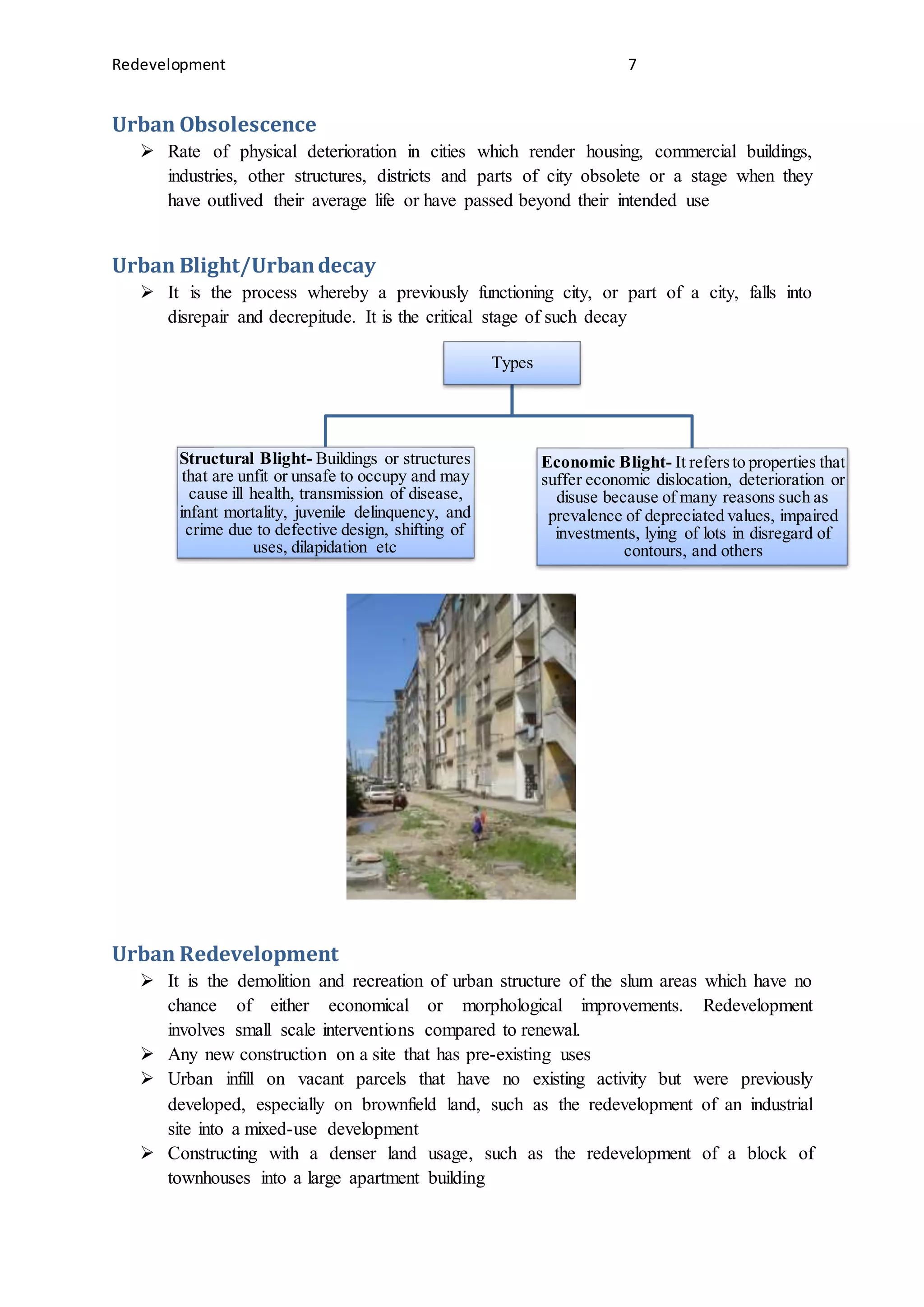
 It is the demolition and recreation of urban structure of the slum areas which have no
chance of either economical or morphological improvements. Redevelopment
involves small scale interventions compared to renewal.
 Any new construction on a site that has pre-existing uses
 Urban infill on vacant parcels that have no existing activity but were previously
developed, especially on brownfield land, such as the redevelopment of an industrial
site into a mixed-use development
 Constructing with a denser land usage, such as the redevelopment of a block of
townhouses into a large apartment building
Types
Structural Blight- Buildings or structures
that are unfit or unsafe to occupy and may
cause ill health, transmission of disease,
infant mortality, juvenile delinquency, and
crime due to defective design, shifting of
uses, dilapidation etc
Economic Blight- It refersto properties that
suffer economic dislocation, deterioration or
disuse because of many reasons such as
prevalence of depreciated values, impaired
investments, lying of lots in disregard of
contours, and others
Redevelopment 8
Adaptive reuse
 It is the process of reusing an old site or building for a purpose other than which it
was built or designed for, such as an industrial mill into housing lofts. Along with
brownfield reclamation, adaptive reuse is seen by many as a key factor in land
conservation and the reduction of urban sprawl. It can be regarded as a compromise
between historic preservation and demolition.
Regeneration(regenerationinUK)
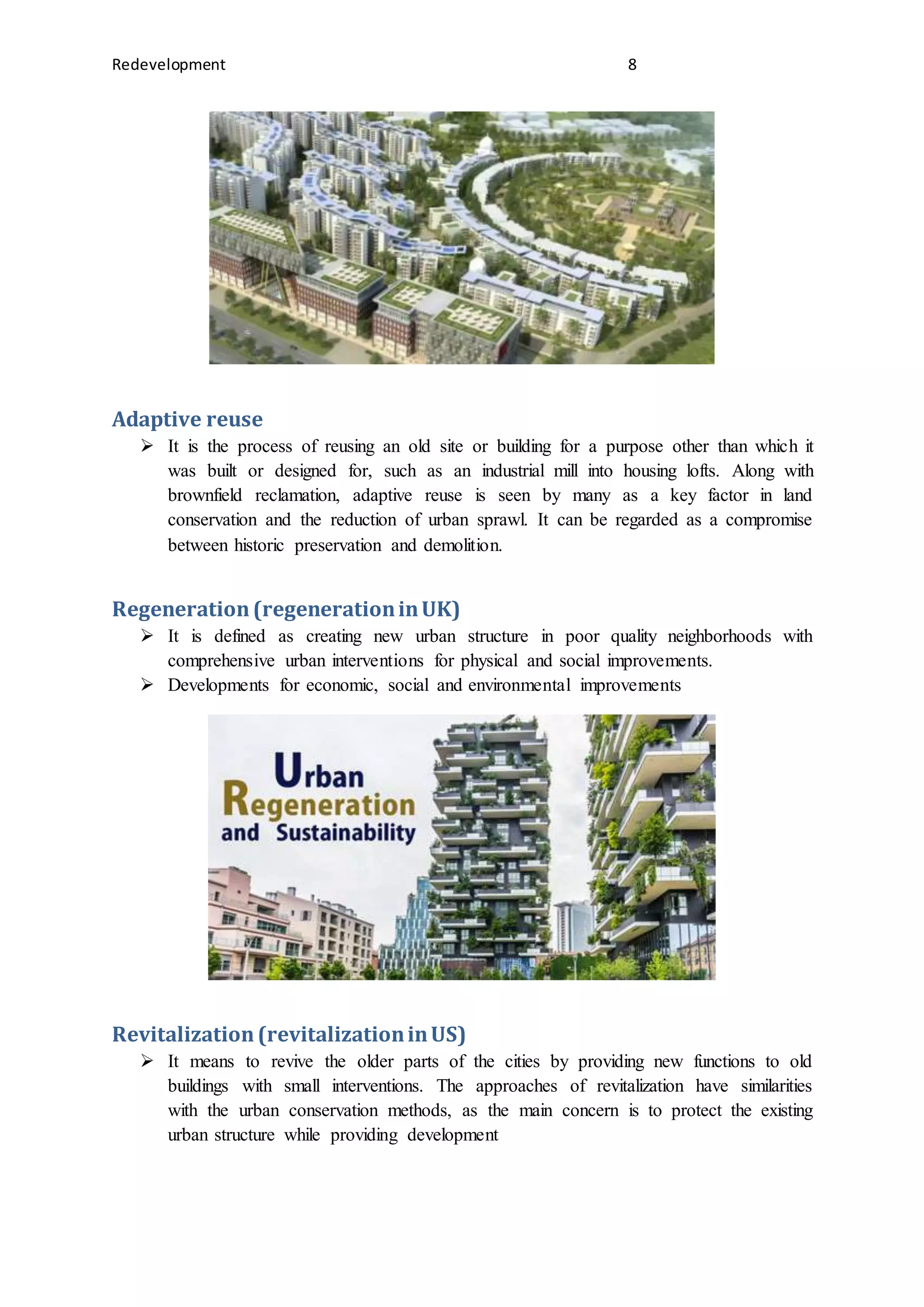
 It is defined as creating new urban structure in poor quality neighborhoods with
comprehensive urban interventions for physical and social improvements.
 Developments for economic, social and environmental improvements
Revitalization(revitalizationinUS)
 It means to revive the older parts of the cities by providing new functions to old
buildings with small interventions. The approaches of revitalization have similarities
with the urban conservation methods, as the main concern is to protect the existing
urban structure while providing development
Redevelopment 9
Reconstruction
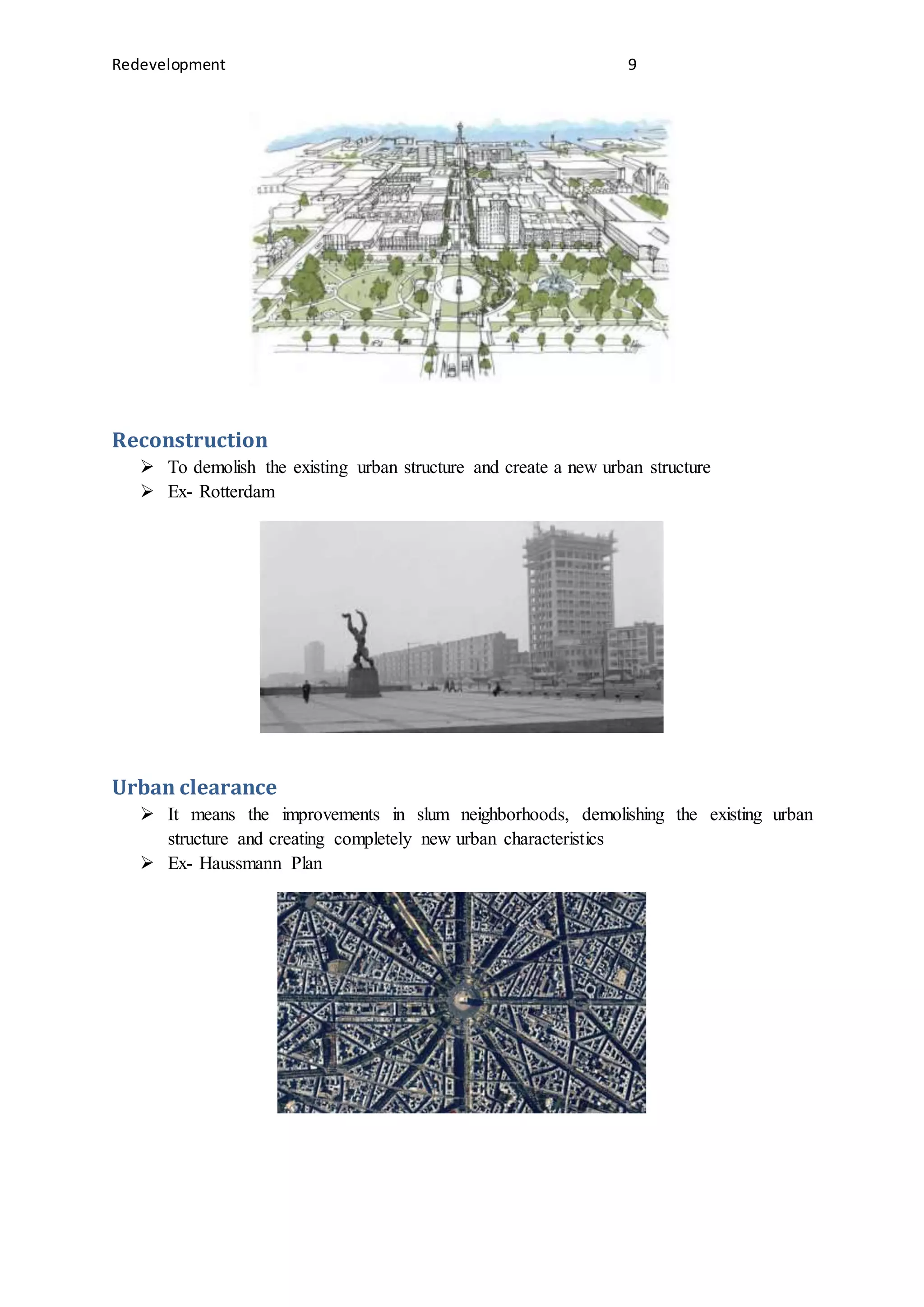
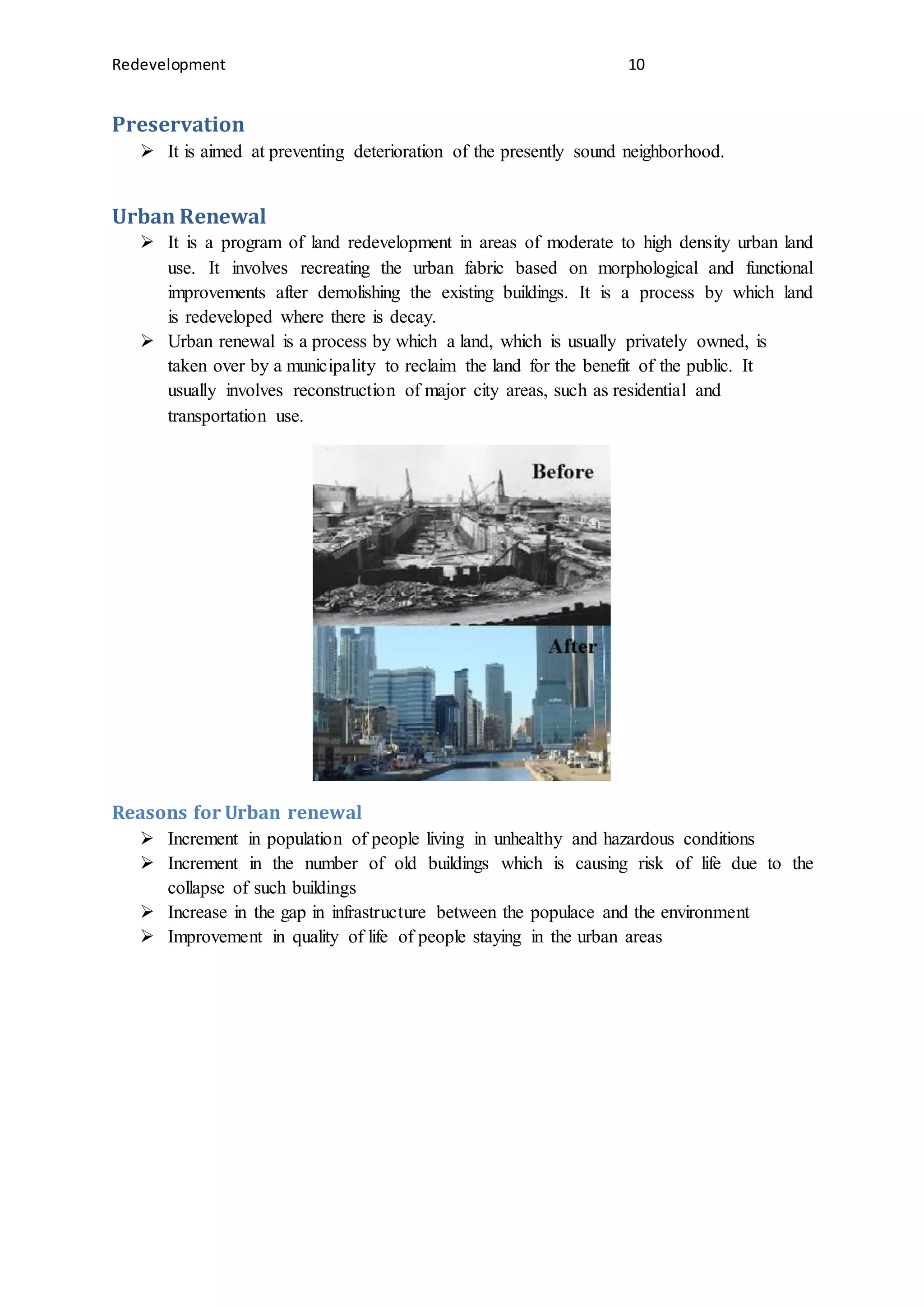
 To demolish the existing urban structure and create a new urban structure
 Ex- Rotterdam
Urban clearance
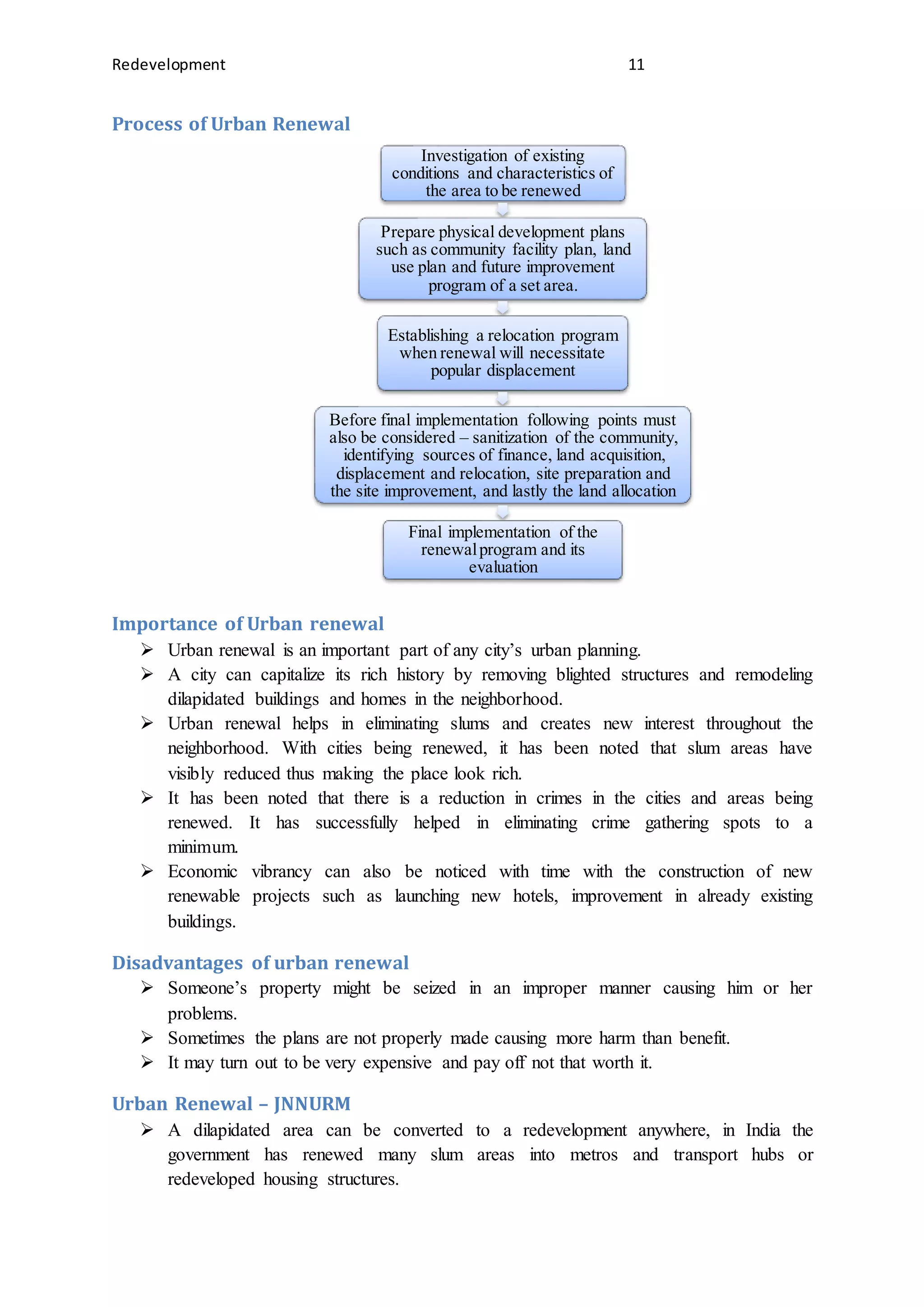
 It means the improvements in slum neighborhoods, demolishing the existing urban
structure and creating completely new urban characteristics
 Ex- Haussmann Plan
Redevelopment 10
Preservation
 It is aimed at preventing deterioration of the presently sound neighborhood.
Urban Renewal
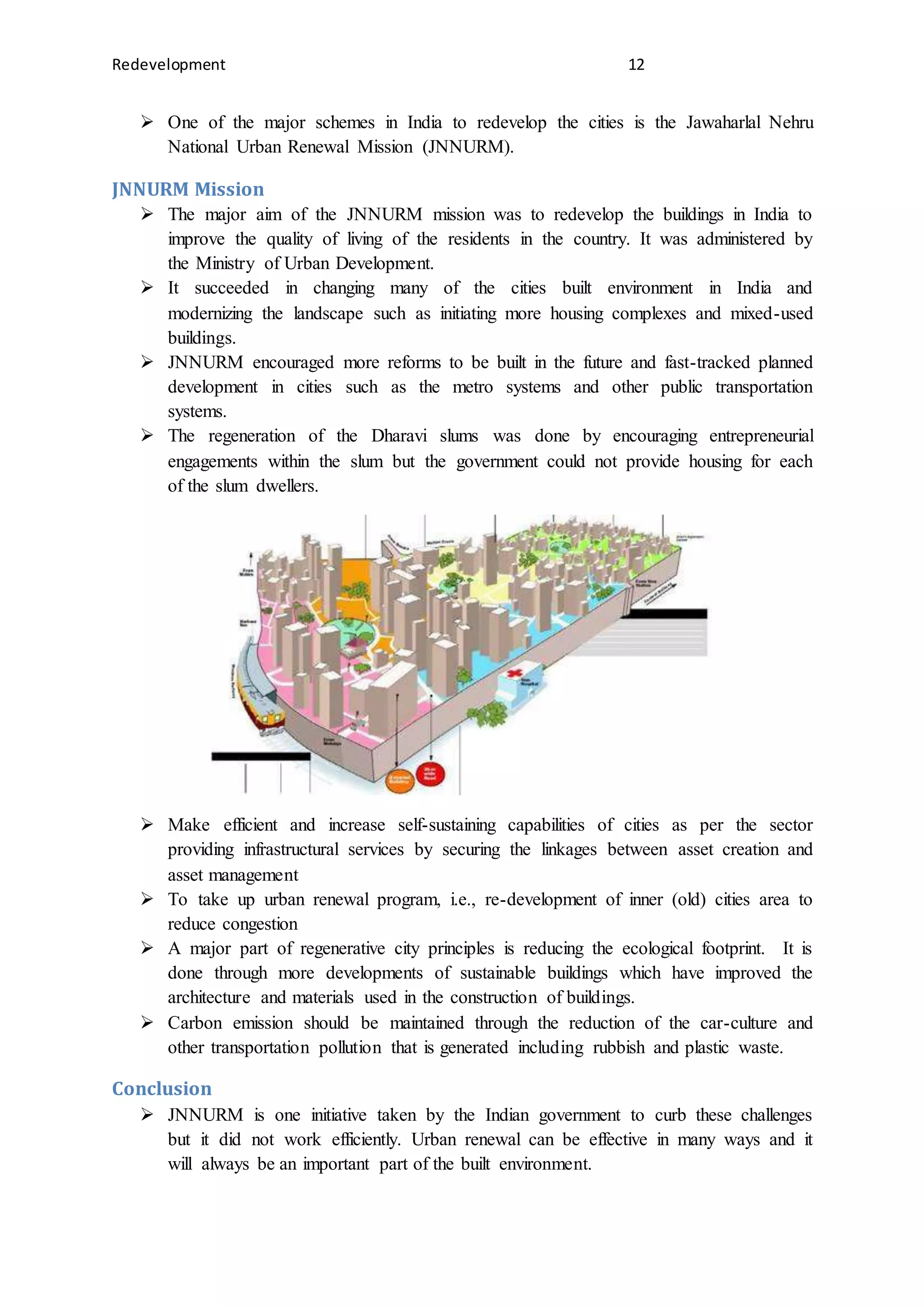
 It is a program of land redevelopment in areas of moderate to high density urban land
use. It involves recreating the urban fabric based on morphological and functional
improvements after demolishing the existing buildings. It is a process by which land
is redeveloped where there is decay.
 Urban renewal is a process by which a land, which is usually privately owned, is
taken over by a municipality to reclaim the land for the benefit of the public. It
usually involves reconstruction of major city areas, such as residential and
transportation use.
Reasons for Urban renewal
 Increment in population of people living in unhealthy and hazardous conditions
 Increment in the number of old buildings which is causing risk of life due to the
collapse of such buildings
 Increase in the gap in infrastructure between the populace and the environment
 Improvement in quality of life of people staying in the urban areas
Redevelopment 11
Process of Urban Renewal
Importance of Urban renewal
 Urban renewal is an important part of any city’s urban planning.
 A city can capitalize its rich history by removing blighted structures and remodeling
dilapidated buildings and homes in the neighborhood.
 Urban renewal helps in eliminating slums and creates new interest throughout the
neighborhood. With cities being renewed, it has been noted that slum areas have
visibly reduced thus making the place look rich.
 It has been noted that there is a reduction in crimes in the cities and areas being
renewed. It has successfully helped in eliminating crime gathering spots to a
minimum.
 Economic vibrancy can also be noticed with time with the construction of new
renewable projects such as launching new hotels, improvement in already existing
buildings.
Disadvantages of urban renewal
 Someone’s property might be seized in an improper manner causing him or her
problems.
 Sometimes the plans are not properly made causing more harm than benefit.
 It may turn out to be very expensive and pay off not that worth it.
Urban Renewal – JNNURM
 A dilapidated area can be converted to a redevelopment anywhere, in India the
government has renewed many slum areas into metros and transport hubs or
redeveloped housing structures.
Investigation of existing
conditions and characteristics of
the area to be renewed
Prepare physical development plans
such as community facility plan, land
use plan and future improvement
program of a set area.
Establishing a relocation program
when renewal will necessitate
popular displacement
Before final implementation following points must
also be considered – sanitization of the community,
identifying sources of finance, land acquisition,
displacement and relocation, site preparation and
the site improvement, and lastly the land allocation
Final implementation of the
renewalprogram and its
evaluation
Redevelopment 12
 One of the major schemes in India to redevelop the cities is the Jawaharlal Nehru
National Urban Renewal Mission (JNNURM).
JNNURM Mission
 The major aim of the JNNURM mission was to redevelop the buildings in India to
improve the quality of living of the residents in the country. It was administered by
the Ministry of Urban Development.
 It succeeded in changing many of the cities built environment in India and
modernizing the landscape such as initiating more housing complexes and mixed-used
buildings.
 JNNURM encouraged more reforms to be built in the future and fast-tracked planned
development in cities such as the metro systems and other public transportation
systems.
 The regeneration of the Dharavi slums was done by encouraging entrepreneurial
engagements within the slum but the government could not provide housing for each
of the slum dwellers.
 Make efficient and increase self-sustaining capabilities of cities as per the sector
providing infrastructural services by securing the linkages between asset creation and
asset management
 To take up urban renewal program, i.e., re-development of inner (old) cities area to
reduce congestion
 A major part of regenerative city principles is reducing the ecological footprint. It is
done through more developments of sustainable buildings which have improved the
architecture and materials used in the construction of buildings.
 Carbon emission should be maintained through the reduction of the car-culture and
other transportation pollution that is generated including rubbish and plastic waste.
Conclusion
 JNNURM is one initiative taken by the Indian government to curb these challenges
but it did not work efficiently. Urban renewal can be effective in many ways and it
will always be an important part of the built environment.
Redevelopment 13
 India is at its nascent stage towards implementing renewal, but there has been a lot of
progress that has been made in the past few decades. Concepts of architecture and
planning will be important in this sector and will continue to grow.
Planning for Inner city
Alternative strategies for Redevelopment and Regeneration
 The redevelopment strategy is to cover the key aspect i.e. positive growth for the city
to be a livable area and also as a work space. Therefore in most of the Indian inner
cities, mixed land use is to be recognized as permissible and thereafter organized, as
the city is planned on the concept of work & live with inherited benefit of reduced
travel trips. To achieve this, regeneration is to be a part of the redevelopment,
including socio‐ economic development, maintaining and encouraging
commercial lifeline of the inner city for its revival.
Alternative1-ModificationinBuilt-up:
 The residential built up is adjusted with the plot size and height from urban renewal
point of view. The building density is redefined, usually by increasing the permissible
FAR/FSI as permissible by the available infrastructure. It allows the market forces to
reconstruct and redevelop the core city areas. The urban local authority may provide
supporting infrastructure through betterment levy or charges. This tool of
redevelopment is in practice in major cities like, Hyderabad and in some parts
of the old Delhi (Shahajahanabad). Abutting road width, plot sizes, accessibility
and land use regulates the increased building height.
 To improve the morphology of the core city, increase in unit size of the
residential plots is also often necessary, especially where very small units are
present. Higher FSI, for medium size plots, marginally will lead to amalgamation of
small and very small plots by market forces. This will improve the urban design
and density of residential areas. Amalgamation of plots is to be carried out in lines
with regulations, which is to be defined based on the study of the area by the
local authority.
 The redevelopment project of east Kidwai Nagar, New Delhi is among the first
initiatives as a vision project of Ministry of Urban Development
Redevelopment 14
Alternative2-In-situ Development:
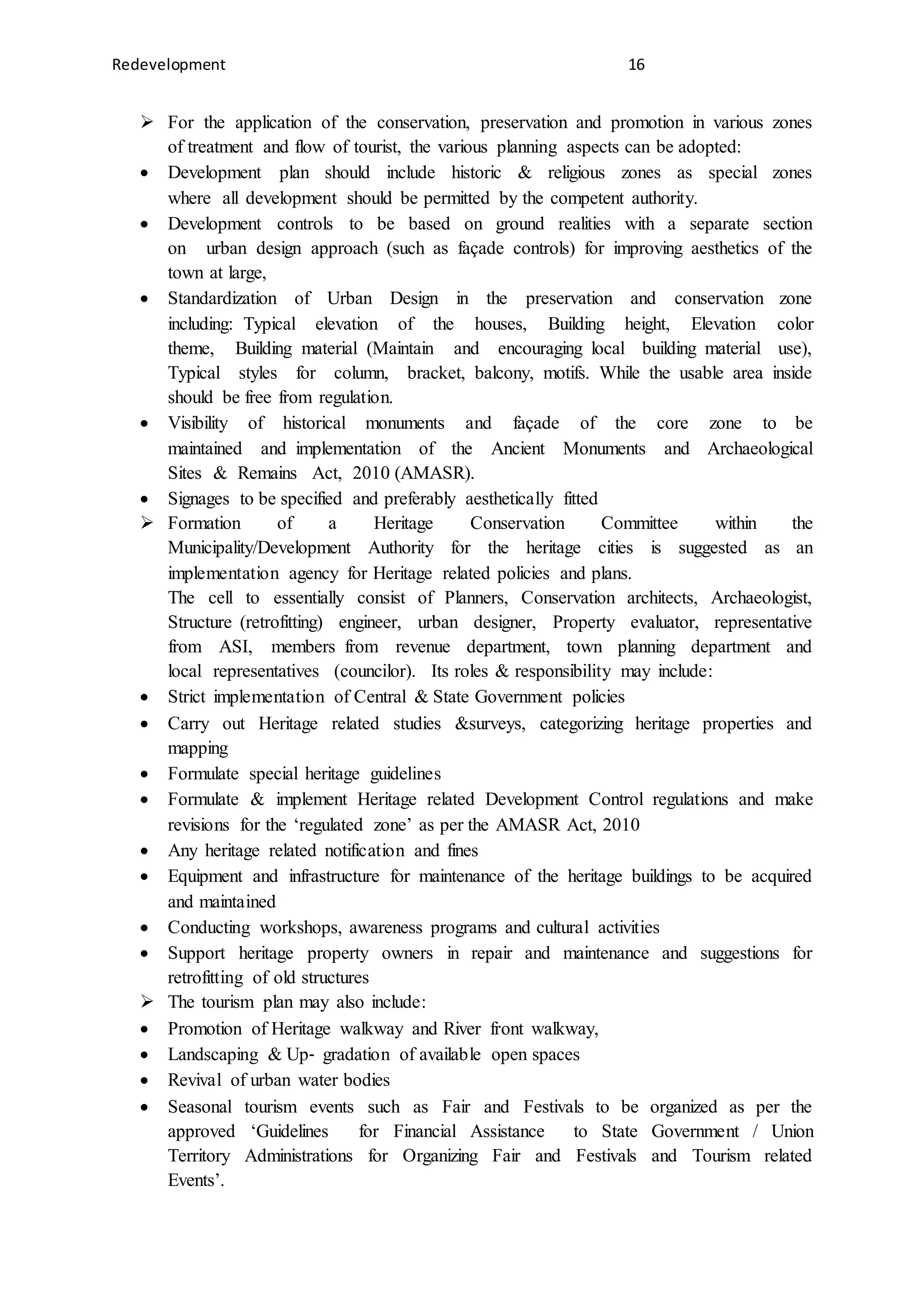
 In‐ situ development maintains the height and the building foot print, by carefully
using Transferable Development Rights (TDR). This alternative is used where the
redevelopment strategy is to maintain and encourage the heritage of the city and
its housing morphology, as in the case of Ahmedabad, where Tradable
Development Rights are provided for the notified Structures, Buildings and
Precincts in the form of Tradable Right Certificate by competent authority.
 The authority controls other activities such as:
 The Permissible Uses for the Heritage Areas and other buildings on the basis of its
plot size and floor.
 Amalgamation and/or Sub‐ division to not be permitted in the Zone,
 The owners of the heritage structures and buildings are required to conserve
the following original aspects of their Buildings:
All Façades
Building Footprint
Character of Open Spaces such as courtyards, khadki, streets, etc
 The in‐ situ development also does not encourage road widening until necessary, as it
aims to preserve the building façade. In case if it is not feasible to provide the
required parking within the existing building as per Regulations, the Competent
Authority may recover fees for deficit parking to develop on‐ street parking/parking
lots/parking structures as a part of Parking Management Plan.
 The concept of Accommodation Reservation may be introduced for social
infrastructure whereby for the provision of essential public facilities to be handed
over to the local body / government, the owner of property is given full permissible
FAR on the component of public facility.
Aspects of Revival
 While planning, planners face the problems associated with road levels, lying of new
pipelines, parking in residential areas, decongestion, fire safety issues, requirement of
Redevelopment 15
road widening and lose of heritage façade, provision of land for social infrastructure
and sometimes re‐ planning underground infrastructure. Core city revival is based on
conservation, promotion and solution. These can be:
 Out‐ Shifting of polluting, noxious and hazardous trades / industries and de‐
limitation of non-residential non‐ compatible activity with priority,
 To decongest the inner city, proposal can be to develop counter centers in the
form of Integrated Freight Complexes at the peripheral location or new industrial
area,
 Iconic developments along the historically valuable areas and if space allows ‐
encourage city level recreational areas to create a pull factor towards the old city,
 A new set of development controls for Mixed Use, enhanced FAR and TDR
applicability. Mixed use to be maintained with regulations on the road width, plot
sizes and density,
 Conservation and restoration of historical buildings, provisions for FAR and Tax
incentives for those who have to maintain the architectural controls,
 Revival of cities by alternative public transport system technically modified for
the road network and as per the trip generation,
 For parking, multi‐ level parking is one of the solutions for identified residential
pedestrian,
 In case of new development or redevelopment, stilt parking to be mandatory,
 Adding street furniture can enhance street design. This is to facilitate public space for
community interaction and promote pedestrian movement,
 In congested and bottle neck areas, solutions such as one ways and multi‐ level
parking to be adopted,
 Alternative solutions of use of smaller fire hydrants for very narrow roads for the fire
safety,
 To meet the social infrastructure requirement, reducing space norms up to 50‐ 60% in
case of space non‐ availability in the core city. In order to compensate for the
shortfall in various types and levels of facilities in the existing built‐ up area, such
facilities may be provided in contiguous / proximity to sectors of new development.
 Multi‐ functional uses should be proposed to encourage optimum utilization of
existing built‐ up infrastructure.
 ULBs to initiate developing database of the buildings, with attributes such as
its age, height, heritage value, revenue collection and other points as desirable.
Heritage/ Religious/Tourism city
Aspects of preservation, conservation & promotion
 Special attention to be paid while planning for religious settlements along the
river fronts and water bodies, where emphasis is to be laid on conservation of water
bodies, reduction of pollution (due to incompatible activities), improper solid
waste management and no alteration of the watershed system of the area.
Redevelopment 16
 For the application of the conservation, preservation and promotion in various zones
of treatment and flow of tourist, the various planning aspects can be adopted:
 Development plan should include historic & religious zones as special zones
where all development should be permitted by the competent authority.
 Development controls to be based on ground realities with a separate section
on urban design approach (such as façade controls) for improving aesthetics of the
town at large,
 Standardization of Urban Design in the preservation and conservation zone
including: Typical elevation of the houses, Building height, Elevation color
theme, Building material (Maintain and encouraging local building material use),
Typical styles for column, bracket, balcony, motifs. While the usable area inside
should be free from regulation.
 Visibility of historical monuments and façade of the core zone to be
maintained and implementation of the Ancient Monuments and Archaeological
Sites & Remains Act, 2010 (AMASR).
 Signages to be specified and preferably aesthetically fitted
 Formation of a Heritage Conservation Committee within the
Municipality/Development Authority for the heritage cities is suggested as an
implementation agency for Heritage related policies and plans.
The cell to essentially consist of Planners, Conservation architects, Archaeologist,
Structure (retrofitting) engineer, urban designer, Property evaluator, representative
from ASI, members from revenue department, town planning department and
local representatives (councilor). Its roles & responsibility may include:
 Strict implementation of Central & State Government policies
 Carry out Heritage related studies &surveys, categorizing heritage properties and
mapping
 Formulate special heritage guidelines
 Formulate & implement Heritage related Development Control regulations and make
revisions for the ‘regulated zone’ as per the AMASR Act, 2010
 Any heritage related notification and fines
 Equipment and infrastructure for maintenance of the heritage buildings to be acquired
and maintained
 Conducting workshops, awareness programs and cultural activities
 Support heritage property owners in repair and maintenance and suggestions for
retrofitting of old structures
 The tourism plan may also include:
 Promotion of Heritage walkway and River front walkway,
 Landscaping & Up‐ gradation of available open spaces
 Revival of urban water bodies
 Seasonal tourism events such as Fair and Festivals to be organized as per the
approved ‘Guidelines for Financial Assistance to State Government / Union
Territory Administrations for Organizing Fair and Festivals and Tourism related
Events’.
Redevelopment 17
 Alternative modes of transportation to be encouraged in the tourism plan. Key
nodes on transportation networks to have Tourist Information Centre/kiosk
 Marketing strategies of the tourism destinations to be well‐ defined including
generating revenue to the local population, apart from employment generation
estimations. Employment generation by tourism industry as direct and indirect
suggested for hotel industry (per room) by the Tourism Policy is:
Direct employment: 2 persons
Indirect employment: 3 persons
Urban ConservationthroughUrbanPlanning
Definition of urban conservation
 According to the national trust of Australia NSW, Urban conservation seeks to retain
that part of urban environment whose character is important to the national or local
heritage. It also seeks to enhance that environmental character by ensuring that the
siting, the size and design of any development is complementary to it.
 The basic function of any conservation program is to identify and retain those
essential features contributing to the character of any area, and to ensure that any new
development or redevelopment is in sympathy with, and contributes to, the character
of that area.
What is built heritage?
 It has come to realization that simply protecting monuments is not enough, there
needs to be conservation and beautification of surrounding areas. With this also
comes the realization that just an area of buildings can hold character hence
conservation need not be only for outstanding structures and their areas.
 Human dimensions of scale are also important to town planners to bring to urban life.
By retaining socio-economic character of traditional areas people can go on living
even though they may be renovated. Conservation is therefore putting people first and
that not just old buildings for preservation and renewal. Hence it is the aim of
conservation to preserve the best of the past and to provide a framework for the new.
Why conservation at all?
 Profound psychological need of human beings for permanence
 Realization that old buildings often do their jobs better than new ones.
 We cannot afford to demolish buildings which still have plenty of life in them. Older
buildings generally are more efficient in energy conservation than new ones due to
dependence on natural light and ventilation
 Rehabilitation or conversion of old building is also labor intensive.
 Many older buildings are superior in materials, craftsmanship and aesthetic form to a
great number of contemporary buildings.
Redevelopment 18
Urban Conservation by means of master plan and other policy documents
 The master plan or any concerned development plan for a city must be reviewed to
assess its effect on the conservation needs of the city. It must reflect and respect the
form of old cities and must explicitly recognize the social needs of communities in old
quarters.
 An important constituent of all master plans is a proposed Land use map, according to
which all future development must take place. The starting point for urban
conservation is that this map must recognize the existence of buildings and areas to be
protected must be clearly delineated on the map.
 Once a special reservation is made on the statutory land-use map by locating the
historic building, the permission granting agency will need to take note that the
particular building is different from other buildings.
Land use proposals for Urban Conservation
 Reservation of buildings and declaration of areas will mean that the owners of private
buildings maybe subjected to conditions that may affect their interest in the property.
While compensation and compulsory acquisition will be an action of the last resort
under detailed legislation, it is important that land-use control and zoning provide
some facilities and incentives to the owners to make things easier for them.
 The historic buildings, already marked as special reservations, must enjoy a special
status with reference to permissible use. If the owner is willing to retain the building
instead of pressing for demolition or redevelopment he may be allowed to utilize it for
a more profitable use which may be offices of other commercial use. Such
concessions do not defeat the very purpose of conservation.
Floor area ratio and Density
 Even though every master plan in the 60’s and 70’s spoke of decongesting the center,
the density stipulations on the proposed land-use map in effect achieved just the
opposite goal by fixing a higher FAR and density for central core areas and a lower
FAR for areas from the center. This policy needs to be reversed as it is in conflict with
all the stated master plan objectives.
 In a conservation area or an area in the proximity of major monuments, rather than
impose arbitrary or piecemeal restrictions on individual owners, it makes better sense
to reduce the FAR and height limits uniformly, so that no individual owner is put at
disadvantage in realizing the value of his property.
 The designation of conservation areas with a low FAR would create a sense of
stability that would encourage property owners to invest in repair and upkeep, which
they are inhibited from doing if there is hope of a future when speculative
redevelopment would prove to be more profitable.
Traffic & road widening
 A choice has to be made whether to manage traffic to suit the traditional road pattern
or restructure the old city to suit the needs of traffic.
Redevelopment 19
 In most one-walled cities the city walls have already disappeared in order to make
room for ‘free flow of traffic’. Further damage was caused to the traditional fabric of
historic towns by massive road widening and beautification schemes.
 Land uses that are likely to generate heavy traffic should be reserved for areas other
than historic areas or old quarters. For this reason, the penetration of heavy traffic
generating activities into heritage areas should be restricted by firm enforcement of
the development plan.
 The environmental impact of the construction of new roads or widening of roads
needs very careful assessment. Apart from destroying tree-cover and damaging the
streetscape with which people identify closely, road widening is generally achieved
by acquiring the frontage of private properties in return for additional FAR on the
same plot. This is utilized for increasing the build-up area on the plot, which generates
more traffic.
 The cumulative effect is to defeat the purpose of road-widening and gravely
undermine the quality of life in quarters which were originally adapted to lower traffic
flows.
Street lines and setbacks
 The road widening only causes the increase of traffic in these historic areas. The
setback of 5 meters is aesthetically deficient and is a disaster for the tight urban
character of old quarters. Setback regulations should therefore be revoked at the
earliest in all three categories of heritage areas:
Pedestrianization
 Pedestrianization schemes in shopping areas have been immensely popular world-
wide. They require particular attention in creating an atmosphere satisfying to
pedestrians through the provision of street furniture, pavement cafes, public
telephones, drinking water fountains, display cases and the like.
Development control rules and design control
 The requirements of development control (DC) rules in all categories of heritage areas
will have to be studied and reviewed introducing rigidity or flexibility as dictating the
urban conservation requirements .e.g. – FAR may have to be uniformly reduced in an
already existing inner city area, on the other hand setback regulations may have to be
waived to permit a reserved building under reconstruction.
Controlled areas: The area
within a 100 m radius of
protected archaeological
monuments and listed local
monuments
Conservation areas: Areas
which may contain a
number of listed buildings,
useful housing stock and a
townscape worthy of
preservation
Design zones: Areas where
the overall character, scale
and quality need to be
maintained, but where a
large degree of new
developed may take place
Redevelopment 20
BrownfieldDevelopment
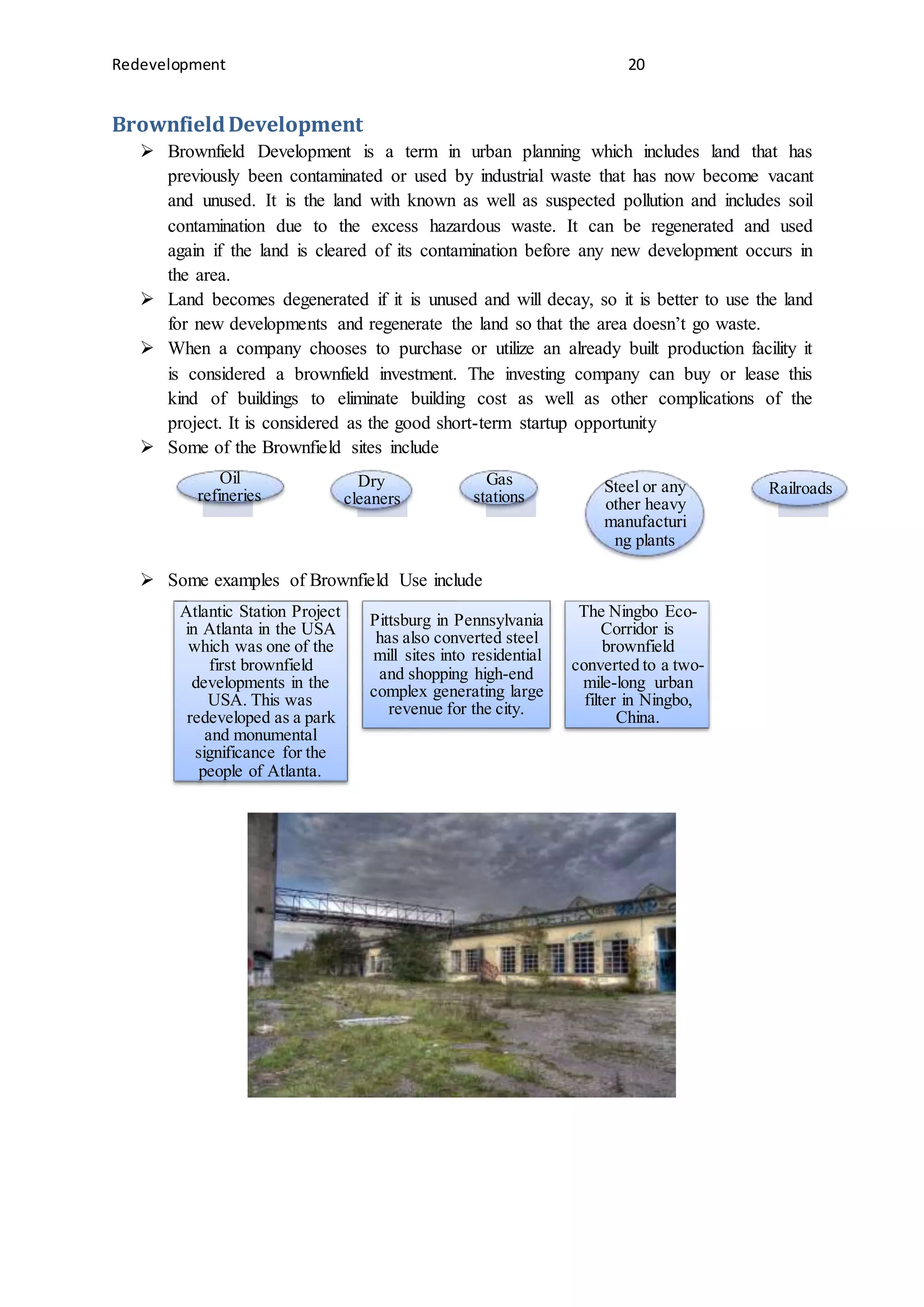
 Brownfield Development is a term in urban planning which includes land that has
previously been contaminated or used by industrial waste that has now become vacant
and unused. It is the land with known as well as suspected pollution and includes soil
contamination due to the excess hazardous waste. It can be regenerated and used
again if the land is cleared of its contamination before any new development occurs in
the area.
 Land becomes degenerated if it is unused and will decay, so it is better to use the land
for new developments and regenerate the land so that the area doesn’t go waste.
 When a company chooses to purchase or utilize an already built production facility it
is considered a brownfield investment. The investing company can buy or lease this
kind of buildings to eliminate building cost as well as other complications of the
project. It is considered as the good short-term startup opportunity
 Some of the Brownfield sites include
 Some examples of Brownfield Use include
Oil
refineries
Dry
cleaners
Gas
stations
Steel or any
other heavy
manufacturi
ng plants
Railroads
Atlantic Station Project
in Atlanta in the USA
which was one of the
first brownfield
developments in the
USA. This was
redeveloped as a park
and monumental
significance for the
people of Atlanta.
Pittsburg in Pennsylvania
has also converted steel
mill sites into residential
and shopping high-end
complex generating large
revenue for the city.
The Ningbo Eco-
Corridor is
brownfield
converted to a two-
mile-long urban
filter in Ningbo,
China.
Redevelopment 21
New remediation technologies
Benefits of Brownfield Development
 The redevelopment of the brownfields offers ultimate benefits to a community that
includes an increased tax base and revenue for governments, utilization of old or
existing infrastructure, removal of blight, the creation of new jobs based on EPA. This
has been very beneficial for local residents and municipalities alike as they develop
public spaces for general use.
 Land contamination could be avoided and put to use through redevelopment of the
area.
 Reduces soil and water contamination
 Preserves historical landmarks
 Recovers desirable locations
 Eliminates vandalism
 Revives older urban communities
 Beautifies urban landscapes
 The redevelopment of the brownfield also locates new development for the better use.
 The brownfield development also preserves Greenfield land.
 The start-up costs are less than others and the time devoted to construction also
reduces. Existing infrastructure reduces the workload and would also save time, effort
as well as cost when it comes to employment.
 Cleaning up in brownfields is not only generating huge profits in the future but also
combines environmental benefits as well as social improvement. Due to these factors
most of the planners, local stakeholders, as well as developers, also join to improve
their communities.
 Brownfields lands are located in urban, rural as well as suburban areas thus it can help
clean up cities, at the same time grow suburbs to develop green spaces.
 Existing environmental licenses available
 Existing council approvals available
 Suitable for modifications
Controversial issues
 Getting the necessary permissions and legal issues surrounding brownfield
development is seen as a setback to most developers.
 Building on brownfield land also requires technical skills and valuation and
sometimes even after remediation, contamination might still persist in addition to
environmental pollution.
 Cost of clearing the land – The immense cost for cleaning the brownfield land to
safety standards is difficult and not something most developers would be interested in
Bioremediation is one of the popular
concepts that use the natural processes of
enzymes, indigenous bacteria,fungi etc
that help to destroy as well as neutralize
toxins and other contaminants.
Phytoremediation utilizes plants to store
contaminants but some kinds of
contaminants like heavy metals can be
harvested.
Redevelopment 22
investing because the cost of the land after cleaning the contamination might be less
than what it actually took for the total cost of the land. This can also postpone the
redevelopment processes
 Waste regeneration – It is thought that if the waste generated by contamination is not
cleared in advance, then the residents of the area might be affected by the previous
use of the land. This indicates that the regeneration process needs to be well thought
and strictly generated so that it doesn’t affect the new use of the land.
Greenfield Development
 Greenfield development is a term often used for land that has not been used before for
any human activity like agriculture or real estate development. These open fields
evolve on their own volition and are often sprawling expanses of land near cities and
in the countryside.
 Greenfield land is available in urban areas as well as rural areas. The land between
towns and cities all over the world which is unused and characterized by grass, barren
lands, and wild growth of vegetation and open fields is Greenfield land. This is the
land on earth that is untouched by human beings and exists in its natural habitat.
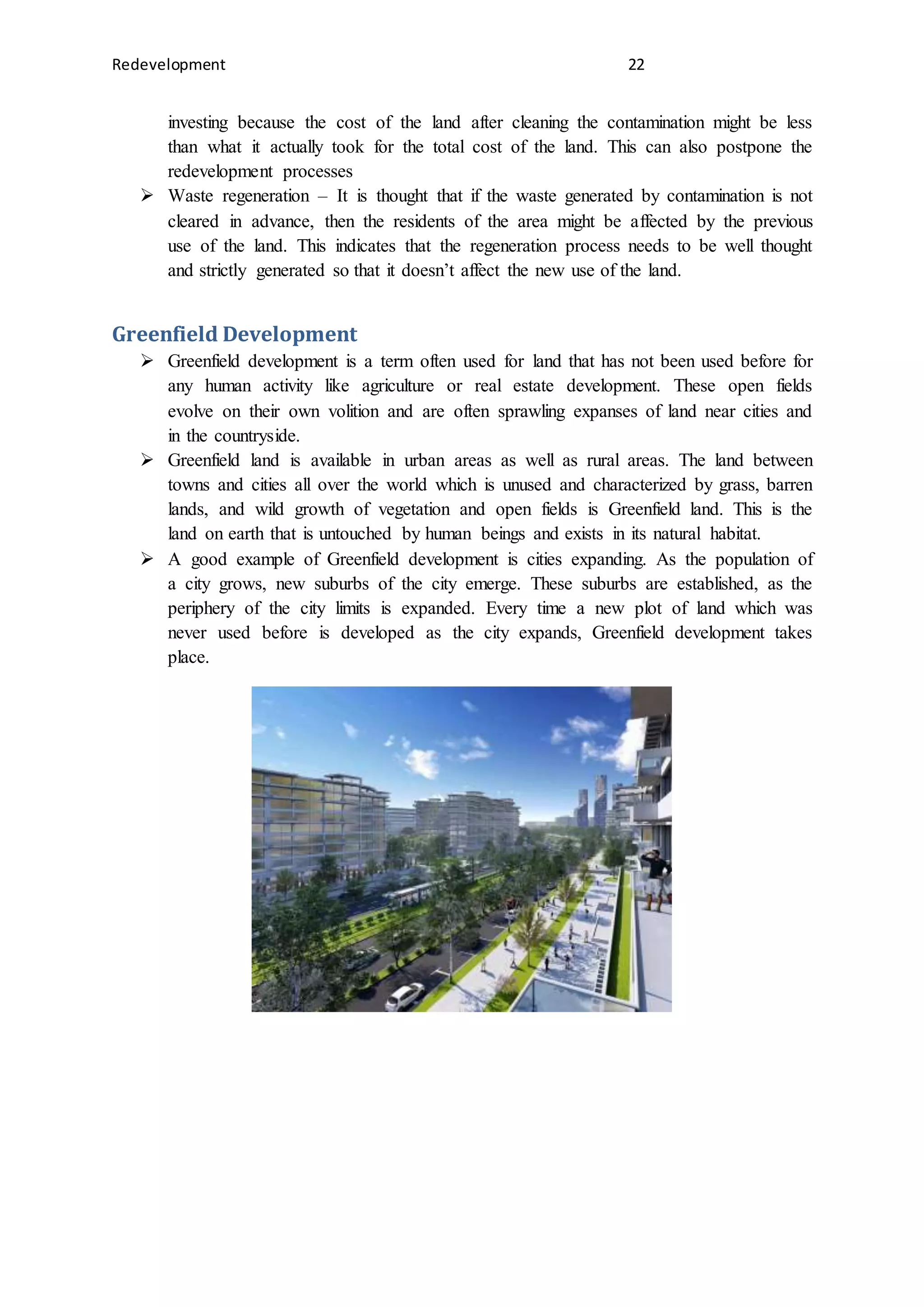
 A good example of Greenfield development is cities expanding. As the population of
a city grows, new suburbs of the city emerge. These suburbs are established, as the
periphery of the city limits is expanded. Every time a new plot of land which was
never used before is developed as the city expands, Greenfield development takes
place.
Redevelopment 23
Types of Greenfield Land
Categories of Greenfield Land
Different types of projects that use Greenfield land
Choosing a Greenfield Land for Development
 The following are some of the criteria that developers need to consider while
choosing a Greenfield site:
 Proximity to roads and transport facilities and also proximity to other developed areas
like towns and cities.
 Type of project is a very important aspect of choosing a Greenfield land. For example,
a residential project needs land in and around the city whereas a factory can be a little
away on the outskirts of a city.
 Soil surveys, surveys of existing drainage and sewer facilities are important aspects of
scoping out a land for future development. Without the knowledge of the type of soil
Open fields which lie
between cities and towns or
in suburban areas.
Unfenced open fields
which often have wild
natural vegetation
growing unchecked
and as per the climate
of the region.
In dry areas,barren
fields which are not
used for
construction or any
agricultural
activities
Restricted closed
properties with no
development often owned
by the government.
Private property with
or without fencing
(land) bought by the
owner and not used for
any purpose or kept for
future use
Rural land with a very
small population in
neighboring areas and
poor accessibility.
There are very few
livability factors
available at these types
of lands and generally,
the value for the
development of these
properties is low.
Urban land
that has
previously not
been used for
any purpose.
This type of
land has high
value to
developers.
Semi-urban
land on the
outskirts of
towns and
cities which
has a good
accessibility
and potential
to develop
Barren lands
with few natural
resources readily
available like
water and
vegetation and
difficult climatic
condition.
Greenfield land
which cannot be
used because
there are natural
resources like
forests,trees,
lakes and other
environmental
factors that need
to be conserved
on the land.
commer
cial real
estate
housing building
plants and
factories or
manufactur
ing units
local
park
solar panels,
windmills,
and other
renewable
energy
projects
Redevelopment 24
and the type of land available on the property, buying the property for developmental
purposes is not advisable.
 Development is not possible without access to services and so they are a factor while
selecting a Greenfield development project land.
 Before buying a Greenfield site necessary permissions need to be taken from local
authorities to get the permission to develop a Greenfield site. Buyers need to check all
the legalities regarding the land and check if there have not been any encroachments
or any other claims on the property.
 A site visit is an important aspect of buying the land. The land should be clear on any
encroachment and also should not be contaminated in any way.
Sustainable Greenfield Development
Sustainable Greenfield development is the development of land which is not in use without
destruction of the natural habitat and environment of the region.
 One of the main problems facing Greenfield development is environmental
protection. Climate change and environmental destruction caused by human activity is
a serious problem around the world today and a major concern in environmental
education.
 Many Greenfield land areas are protected all over the world by the government and
developers do not get clearances or permissions to develop these lands for human
consumptions.
 Destruction of forest lands or destruction of natural habitats of wildlife and plants is
restricted in many areas. There are designated wildlife lands where plant species and
animal species have a protected habitat and this type of land cannot be used for
Greenfield development. Also, various types of environmental pollution need to be
taken care of.
 Forest reserves, wildlife sanctuaries, city parks, national parks, water reserves, hills,
mountains, forests, the land around rivers and lake areas are protected and these are
not allowed for Greenfield development.
 As environmental protection becomes more and more important every year, there are
more and more Greenfield sites which are protected from environmental factors.
Greenfield Development – An Inevitable Choice
 Greenfield development is done in a sustainable way in the 21st century in most areas
as there are strict government rules as to how the land has to be developed. The
government generally ensures the protection of the natural habitat of plants and
animals and only gives permissions for Greenfield development after all the rules are
properly followed by the developer.
 Greenfield generally contains no significant amount of toxic materials rather it
develops projects without creating harm.
Redevelopment 25
References
 Urban design material
 Information from planning tank website
https://planningtank.com/
 URDPFI Guidelines 2014 Volume 1

Various Methods of Redevelopment

  • 2.
    Redevelopment 2 Contents Sustainable UrbanConservation....................................................................................................4 World Heritage Convention (Protection of World Cultural and Natural Heritage).............................. 4 Important Cultural Protection Treaties and Other International Charters/Agreements ..................... 5 Venice Charter,1964- International Charterforthe ConservationandRestorationof Monuments and Sites ..................................................................................................................................5 International council on monuments and sites(ICOMOS)............................................................ 5 International Centreforthe Studyof the PreservationandRestorationof Culturalproperty (ICCROM) .................................................................................................................................5 Florence Charter, 1981.............................................................................................................. 5 Washington Charter, 1987.........................................................................................................5 The AustraliaICOMOSCharter(the Burra Charter) for the Conservationof Placesof Cultural Significance .............................................................................................................................. 5 ICOMOS New Zealand: Charter for the Conservation of Places of Cultural Heritage Value ............. 6 Indian Legislations for protection of heritage ................................................................................. 6 Legislations............................................................................................................................... 6 Urban Obsolescence..................................................................................................................... 7 Urban Blight/Urban decay............................................................................................................. 7 Urban Redevelopment.................................................................................................................. 7 Adaptive reuse............................................................................................................................. 8 Regeneration (regenerationin UK) ................................................................................................ 8 Revitalization (revitalization in US).................................................................................................8 Reconstruction............................................................................................................................. 9 Urban clearance........................................................................................................................... 9 Preservation............................................................................................................................... 10 Urban Renewal........................................................................................................................... 10 Reasons for Urban renewal ..................................................................................................... 10 Process of Urban Renewal....................................................................................................... 11 Importance of Urban renewal.................................................................................................. 11 Disadvantages of urban renewal.............................................................................................. 11 Urban Renewal – JNNURM...................................................................................................... 11 JNNURMMission.................................................................................................................... 12 Conclusion.............................................................................................................................. 12 Planning for Inner city................................................................................................................. 13 Alternative strategies for Redevelopment and Regeneration..................................................... 13
  • 3.
    Redevelopment 3 Alternative 1-Modification in Built-up:................................................................................. 13 Alternative 2- In-situ Development:...................................................................................... 14 Aspects of Revival................................................................................................................... 14 Heritage/ Religious/ Tourism city................................................................................................. 15 Aspects of preservation, conservation & promotion.................................................................. 15 Urban Conservation through Urban Planning............................................................................... 17 Definition of urban conservation ............................................................................................. 17 What is built heritage?............................................................................................................ 17 Why conservation at all?......................................................................................................... 17 Urban Conservation by means of master plan and other policy documents................................ 18 Land use proposals for Urban Conservation.............................................................................. 18 Floor area ratio and Density .................................................................................................... 18 Traffic & road widening........................................................................................................... 18 Street lines and setbacks......................................................................................................... 19 Pedestrianization.................................................................................................................... 19 Development control rules and design control.......................................................................... 19 Brownfield Development ............................................................................................................ 20 New remediation technologies................................................................................................ 21 Benefits of Brownfield Development........................................................................................ 21 Controversial issues................................................................................................................ 21 Greenfield Development............................................................................................................. 22 Types of Greenfield Land......................................................................................................... 23 Categories of Greenfield Land.................................................................................................. 23 Different types of projects that use Greenfieldland.................................................................. 23 Choosing a Greenfield Land for Development........................................................................... 23 Sustainable Greenfield Development....................................................................................... 24 Greenfield Development – An Inevitable Choice....................................................................... 24 References................................................................................................................................. 25
  • 4.
    Redevelopment 4 Sustainable UrbanConservation  Urban conservation of heritage sites in cities contributes largely towards upgrading environmental quality, thus serving as a fundamental catalyst for change.  International cultural organizations such as the United Nations Educational, Scientific and Cultural Organization (UNESCO), the International Centre for the Study of the Preservation and Restoration of Cultural Property (ICCROM) and the International Commission on Monuments and Sites (ICOMOS) are focused on these issues.  Bernard Feilden (1982) identified seven degrees of intervention arguing that the minimum the intervention the better the conservation. These terms are prevention of decay, preservation, consolidation, restoration, rehabilitation, reproduction and reconstruction.  Donald Appleyard (1977 and 1979) introduced a broader classification in physical and social terms. He identified three classes of interventions: WorldHeritage Convention(ProtectionofWorldCultural and Natural Heritage)  The most significant feature of this Convention is to link together in a single document the concepts of nature conservation and preservation of cultural sites which is done through the World Heritage List. At the 40th anniversary of the Convention in 2012, there were 936 sites inscribed in the list for their outstanding universal value in 153 countries around the world  Cultural heritage is a monument, group of buildings or site of historical, aesthetic, archaeological, scientific, ethnological or anthropological value. It should represent a masterpiece of human creative genius, or exhibit an important interchange of human values over a span of time or within a cultural area of the world, on developments in architecture or technology, monumental arts, town planning or landscape design, or bear a unique or at least exceptional testimony to a cultural tradition or to a civilization which is living or has disappeared, or be an outstanding example of a type of building or architectural or technological ensemble, or landscape which illustrates a significant stage or significant stages in human history, or be an outstanding example of a traditional human settlement or land-use which is representative of a culture or cultures, especially when it has become vulnerable under the impact of irreversible change, or be directly or tangibly associated with events or living traditions, with ideas or with beliefs, or with artistic and literary works of outstanding universal significance. Equally important is the authenticity of the site and the way it is protected and managed. Deep conservation which attempts to restore a historical area in a rigorous and accurate form Surface conservation which attempts to maintain the public face or the physical appearance of a historic building or area Deep social conservation which attempts to ensure jobs for local inhabitants, control rents and provide new services and amenities.
  • 5.
    Redevelopment 5  Naturalheritage designates outstanding physical, biological and geological features; habitats of threatened plants or animal species and areas of value on scientific or aesthetic grounds or from the point of view of conservation. Natural properties should be outstanding examples representing major stages of the earth’s history, including the record of life, significant ongoing geological processes in the development of landforms, or significant geomorphic or physiographic features or be outstanding examples representing significant ongoing ecological and biological processes in the evolution and development of terrestrial, fresh water, coastal and marine ecosystems and communities of plants and animals, contain superlative natural phenomena or areas of exceptional natural beauty and aesthetic importance, or contain the most important and significant natural habitats for in situ conservation of biological diversity, including those containing threatened species of outstanding universal value from the point of view of science or conservation. Important Cultural ProtectionTreaties andOther International Charters/Agreements Venice Charter, 1964- International Charter for the Conservation and Restoration of Monuments and Sites  It codifies internationally accepted standards of conservation practice relating to architecture and sites International council on monuments and sites (ICOMOS)  ICOMOS is an International forum of experts sharing knowledge to conserve and protect cultural heritage sites  ICOMOS was founded in 1965 as a result of the Venice Charter of 1964, and offers advice to UNESCO on World Heritage Sites International Centre for the Study of the Preservation and Restoration of Cultural property (ICCROM)  Intergovernmental organization dedicated to the preservation of cultural heritage worldwide through training, information, research, cooperation and advocacy programs Florence Charter, 1981  It sets forth the principles and guidelines for the preservation of historic gardens Washington Charter, 1987  Establishes the principles and guidelines for the protection and conservation of historic towns and urban areas The Australia ICOMOS Charter (the Burra Charter) for the Conservation of Places of Cultural Significance  It identifies three levels of repair for heritage structures:
  • 6.
    Redevelopment 6 ICOMOS NewZealand: Charter for the Conservation of Places of Cultural Heritage Value Indian Legislations for protectionofheritage  The Archaeological Survey of India (ASI), under the Ministry of Culture, is the premier organization for the archaeological researches, protection of the cultural heritage of the nation and maintenance of ancient monuments, archaeological sites and remains of national importance. Legislations  The Ancient Monuments and Archaeological Sites and Remains Act (AMASR) were enacted in 1958. This Act provides for the preservation of ancient and historical monuments and archaeological sites and remains of national importance, for the regulation of archaeological excavations and for the protection of sculptures, carvings and other like objects.  All ancient and historical monuments which have been declared by the AMASR Act, 1958 or by section 126 of the States Reorganization Act, 1956 to be of national importance shall be deemed to be protected monuments  If the Central government apprehends that a protected monument is in danger of being destroyed, injured, misused, or allowed to fall into decay, it may acquire the protected monument under the provisions of RFCTLARR Act 2013 as if the maintenance of the protected monument were a public purpose.  Prohibited area means an area near or adjoining a protected monument which the Central Government has, by notification in the Official Gazette, declared to be a prohibited area for purposes of mining operation or construction or both. It is declared up to 100 meters from the protected limits. Any construction in the prohibited area shall be punishable with imprisonment not exceeding two years or with fine which may extend to one lakh rupees or both.  Regulated area means an area near or adjoining a protected monument which the central Government has, by notification in the official gazette, declared to be a regulated area, for purpose of mining operation or construction or both. It is declared further beyond the protected limits up to 200 meters in all directions. Any construction in the regulated area without the previous permission of the competent authority shall be punishable with imprisonment not exceeding two years or with fine which may extend to one lakh rupees or both. Preservation- Maintaining a place in its existing state and preventing further deterioration Restoration- Returning a place to a known earlier state by removing accretions or by reassembling existing elements without the introduction of new material Reconstruction- Returning a place to a known earlier state and is distinguished from restoration by the introduction of new material
  • 7.
    Redevelopment 7 Urban Obsolescence Rate of physical deterioration in cities which render housing, commercial buildings, industries, other structures, districts and parts of city obsolete or a stage when they have outlived their average life or have passed beyond their intended use Urban Blight/Urbandecay  It is the process whereby a previously functioning city, or part of a city, falls into disrepair and decrepitude. It is the critical stage of such decay Urban Redevelopment  It is the demolition and recreation of urban structure of the slum areas which have no chance of either economical or morphological improvements. Redevelopment involves small scale interventions compared to renewal.  Any new construction on a site that has pre-existing uses  Urban infill on vacant parcels that have no existing activity but were previously developed, especially on brownfield land, such as the redevelopment of an industrial site into a mixed-use development  Constructing with a denser land usage, such as the redevelopment of a block of townhouses into a large apartment building Types Structural Blight- Buildings or structures that are unfit or unsafe to occupy and may cause ill health, transmission of disease, infant mortality, juvenile delinquency, and crime due to defective design, shifting of uses, dilapidation etc Economic Blight- It refersto properties that suffer economic dislocation, deterioration or disuse because of many reasons such as prevalence of depreciated values, impaired investments, lying of lots in disregard of contours, and others
  • 8.
    Redevelopment 8 Adaptive reuse It is the process of reusing an old site or building for a purpose other than which it was built or designed for, such as an industrial mill into housing lofts. Along with brownfield reclamation, adaptive reuse is seen by many as a key factor in land conservation and the reduction of urban sprawl. It can be regarded as a compromise between historic preservation and demolition. Regeneration(regenerationinUK)  It is defined as creating new urban structure in poor quality neighborhoods with comprehensive urban interventions for physical and social improvements.  Developments for economic, social and environmental improvements Revitalization(revitalizationinUS)  It means to revive the older parts of the cities by providing new functions to old buildings with small interventions. The approaches of revitalization have similarities with the urban conservation methods, as the main concern is to protect the existing urban structure while providing development
  • 9.
    Redevelopment 9 Reconstruction  Todemolish the existing urban structure and create a new urban structure  Ex- Rotterdam Urban clearance  It means the improvements in slum neighborhoods, demolishing the existing urban structure and creating completely new urban characteristics  Ex- Haussmann Plan
  • 10.
    Redevelopment 10 Preservation  Itis aimed at preventing deterioration of the presently sound neighborhood. Urban Renewal  It is a program of land redevelopment in areas of moderate to high density urban land use. It involves recreating the urban fabric based on morphological and functional improvements after demolishing the existing buildings. It is a process by which land is redeveloped where there is decay.  Urban renewal is a process by which a land, which is usually privately owned, is taken over by a municipality to reclaim the land for the benefit of the public. It usually involves reconstruction of major city areas, such as residential and transportation use. Reasons for Urban renewal  Increment in population of people living in unhealthy and hazardous conditions  Increment in the number of old buildings which is causing risk of life due to the collapse of such buildings  Increase in the gap in infrastructure between the populace and the environment  Improvement in quality of life of people staying in the urban areas
  • 11.
    Redevelopment 11 Process ofUrban Renewal Importance of Urban renewal  Urban renewal is an important part of any city’s urban planning.  A city can capitalize its rich history by removing blighted structures and remodeling dilapidated buildings and homes in the neighborhood.  Urban renewal helps in eliminating slums and creates new interest throughout the neighborhood. With cities being renewed, it has been noted that slum areas have visibly reduced thus making the place look rich.  It has been noted that there is a reduction in crimes in the cities and areas being renewed. It has successfully helped in eliminating crime gathering spots to a minimum.  Economic vibrancy can also be noticed with time with the construction of new renewable projects such as launching new hotels, improvement in already existing buildings. Disadvantages of urban renewal  Someone’s property might be seized in an improper manner causing him or her problems.  Sometimes the plans are not properly made causing more harm than benefit.  It may turn out to be very expensive and pay off not that worth it. Urban Renewal – JNNURM  A dilapidated area can be converted to a redevelopment anywhere, in India the government has renewed many slum areas into metros and transport hubs or redeveloped housing structures. Investigation of existing conditions and characteristics of the area to be renewed Prepare physical development plans such as community facility plan, land use plan and future improvement program of a set area. Establishing a relocation program when renewal will necessitate popular displacement Before final implementation following points must also be considered – sanitization of the community, identifying sources of finance, land acquisition, displacement and relocation, site preparation and the site improvement, and lastly the land allocation Final implementation of the renewalprogram and its evaluation
  • 12.
    Redevelopment 12  Oneof the major schemes in India to redevelop the cities is the Jawaharlal Nehru National Urban Renewal Mission (JNNURM). JNNURM Mission  The major aim of the JNNURM mission was to redevelop the buildings in India to improve the quality of living of the residents in the country. It was administered by the Ministry of Urban Development.  It succeeded in changing many of the cities built environment in India and modernizing the landscape such as initiating more housing complexes and mixed-used buildings.  JNNURM encouraged more reforms to be built in the future and fast-tracked planned development in cities such as the metro systems and other public transportation systems.  The regeneration of the Dharavi slums was done by encouraging entrepreneurial engagements within the slum but the government could not provide housing for each of the slum dwellers.  Make efficient and increase self-sustaining capabilities of cities as per the sector providing infrastructural services by securing the linkages between asset creation and asset management  To take up urban renewal program, i.e., re-development of inner (old) cities area to reduce congestion  A major part of regenerative city principles is reducing the ecological footprint. It is done through more developments of sustainable buildings which have improved the architecture and materials used in the construction of buildings.  Carbon emission should be maintained through the reduction of the car-culture and other transportation pollution that is generated including rubbish and plastic waste. Conclusion  JNNURM is one initiative taken by the Indian government to curb these challenges but it did not work efficiently. Urban renewal can be effective in many ways and it will always be an important part of the built environment.
  • 13.
    Redevelopment 13  Indiais at its nascent stage towards implementing renewal, but there has been a lot of progress that has been made in the past few decades. Concepts of architecture and planning will be important in this sector and will continue to grow. Planning for Inner city Alternative strategies for Redevelopment and Regeneration  The redevelopment strategy is to cover the key aspect i.e. positive growth for the city to be a livable area and also as a work space. Therefore in most of the Indian inner cities, mixed land use is to be recognized as permissible and thereafter organized, as the city is planned on the concept of work & live with inherited benefit of reduced travel trips. To achieve this, regeneration is to be a part of the redevelopment, including socio‐ economic development, maintaining and encouraging commercial lifeline of the inner city for its revival. Alternative1-ModificationinBuilt-up:  The residential built up is adjusted with the plot size and height from urban renewal point of view. The building density is redefined, usually by increasing the permissible FAR/FSI as permissible by the available infrastructure. It allows the market forces to reconstruct and redevelop the core city areas. The urban local authority may provide supporting infrastructure through betterment levy or charges. This tool of redevelopment is in practice in major cities like, Hyderabad and in some parts of the old Delhi (Shahajahanabad). Abutting road width, plot sizes, accessibility and land use regulates the increased building height.  To improve the morphology of the core city, increase in unit size of the residential plots is also often necessary, especially where very small units are present. Higher FSI, for medium size plots, marginally will lead to amalgamation of small and very small plots by market forces. This will improve the urban design and density of residential areas. Amalgamation of plots is to be carried out in lines with regulations, which is to be defined based on the study of the area by the local authority.  The redevelopment project of east Kidwai Nagar, New Delhi is among the first initiatives as a vision project of Ministry of Urban Development
  • 14.
    Redevelopment 14 Alternative2-In-situ Development: In‐ situ development maintains the height and the building foot print, by carefully using Transferable Development Rights (TDR). This alternative is used where the redevelopment strategy is to maintain and encourage the heritage of the city and its housing morphology, as in the case of Ahmedabad, where Tradable Development Rights are provided for the notified Structures, Buildings and Precincts in the form of Tradable Right Certificate by competent authority.  The authority controls other activities such as:  The Permissible Uses for the Heritage Areas and other buildings on the basis of its plot size and floor.  Amalgamation and/or Sub‐ division to not be permitted in the Zone,  The owners of the heritage structures and buildings are required to conserve the following original aspects of their Buildings: All Façades Building Footprint Character of Open Spaces such as courtyards, khadki, streets, etc  The in‐ situ development also does not encourage road widening until necessary, as it aims to preserve the building façade. In case if it is not feasible to provide the required parking within the existing building as per Regulations, the Competent Authority may recover fees for deficit parking to develop on‐ street parking/parking lots/parking structures as a part of Parking Management Plan.  The concept of Accommodation Reservation may be introduced for social infrastructure whereby for the provision of essential public facilities to be handed over to the local body / government, the owner of property is given full permissible FAR on the component of public facility. Aspects of Revival  While planning, planners face the problems associated with road levels, lying of new pipelines, parking in residential areas, decongestion, fire safety issues, requirement of
  • 15.
    Redevelopment 15 road wideningand lose of heritage façade, provision of land for social infrastructure and sometimes re‐ planning underground infrastructure. Core city revival is based on conservation, promotion and solution. These can be:  Out‐ Shifting of polluting, noxious and hazardous trades / industries and de‐ limitation of non-residential non‐ compatible activity with priority,  To decongest the inner city, proposal can be to develop counter centers in the form of Integrated Freight Complexes at the peripheral location or new industrial area,  Iconic developments along the historically valuable areas and if space allows ‐ encourage city level recreational areas to create a pull factor towards the old city,  A new set of development controls for Mixed Use, enhanced FAR and TDR applicability. Mixed use to be maintained with regulations on the road width, plot sizes and density,  Conservation and restoration of historical buildings, provisions for FAR and Tax incentives for those who have to maintain the architectural controls,  Revival of cities by alternative public transport system technically modified for the road network and as per the trip generation,  For parking, multi‐ level parking is one of the solutions for identified residential pedestrian,  In case of new development or redevelopment, stilt parking to be mandatory,  Adding street furniture can enhance street design. This is to facilitate public space for community interaction and promote pedestrian movement,  In congested and bottle neck areas, solutions such as one ways and multi‐ level parking to be adopted,  Alternative solutions of use of smaller fire hydrants for very narrow roads for the fire safety,  To meet the social infrastructure requirement, reducing space norms up to 50‐ 60% in case of space non‐ availability in the core city. In order to compensate for the shortfall in various types and levels of facilities in the existing built‐ up area, such facilities may be provided in contiguous / proximity to sectors of new development.  Multi‐ functional uses should be proposed to encourage optimum utilization of existing built‐ up infrastructure.  ULBs to initiate developing database of the buildings, with attributes such as its age, height, heritage value, revenue collection and other points as desirable. Heritage/ Religious/Tourism city Aspects of preservation, conservation & promotion  Special attention to be paid while planning for religious settlements along the river fronts and water bodies, where emphasis is to be laid on conservation of water bodies, reduction of pollution (due to incompatible activities), improper solid waste management and no alteration of the watershed system of the area.
  • 16.
    Redevelopment 16  Forthe application of the conservation, preservation and promotion in various zones of treatment and flow of tourist, the various planning aspects can be adopted:  Development plan should include historic & religious zones as special zones where all development should be permitted by the competent authority.  Development controls to be based on ground realities with a separate section on urban design approach (such as façade controls) for improving aesthetics of the town at large,  Standardization of Urban Design in the preservation and conservation zone including: Typical elevation of the houses, Building height, Elevation color theme, Building material (Maintain and encouraging local building material use), Typical styles for column, bracket, balcony, motifs. While the usable area inside should be free from regulation.  Visibility of historical monuments and façade of the core zone to be maintained and implementation of the Ancient Monuments and Archaeological Sites & Remains Act, 2010 (AMASR).  Signages to be specified and preferably aesthetically fitted  Formation of a Heritage Conservation Committee within the Municipality/Development Authority for the heritage cities is suggested as an implementation agency for Heritage related policies and plans. The cell to essentially consist of Planners, Conservation architects, Archaeologist, Structure (retrofitting) engineer, urban designer, Property evaluator, representative from ASI, members from revenue department, town planning department and local representatives (councilor). Its roles & responsibility may include:  Strict implementation of Central & State Government policies  Carry out Heritage related studies &surveys, categorizing heritage properties and mapping  Formulate special heritage guidelines  Formulate & implement Heritage related Development Control regulations and make revisions for the ‘regulated zone’ as per the AMASR Act, 2010  Any heritage related notification and fines  Equipment and infrastructure for maintenance of the heritage buildings to be acquired and maintained  Conducting workshops, awareness programs and cultural activities  Support heritage property owners in repair and maintenance and suggestions for retrofitting of old structures  The tourism plan may also include:  Promotion of Heritage walkway and River front walkway,  Landscaping & Up‐ gradation of available open spaces  Revival of urban water bodies  Seasonal tourism events such as Fair and Festivals to be organized as per the approved ‘Guidelines for Financial Assistance to State Government / Union Territory Administrations for Organizing Fair and Festivals and Tourism related Events’.
  • 17.
    Redevelopment 17  Alternativemodes of transportation to be encouraged in the tourism plan. Key nodes on transportation networks to have Tourist Information Centre/kiosk  Marketing strategies of the tourism destinations to be well‐ defined including generating revenue to the local population, apart from employment generation estimations. Employment generation by tourism industry as direct and indirect suggested for hotel industry (per room) by the Tourism Policy is: Direct employment: 2 persons Indirect employment: 3 persons Urban ConservationthroughUrbanPlanning Definition of urban conservation  According to the national trust of Australia NSW, Urban conservation seeks to retain that part of urban environment whose character is important to the national or local heritage. It also seeks to enhance that environmental character by ensuring that the siting, the size and design of any development is complementary to it.  The basic function of any conservation program is to identify and retain those essential features contributing to the character of any area, and to ensure that any new development or redevelopment is in sympathy with, and contributes to, the character of that area. What is built heritage?  It has come to realization that simply protecting monuments is not enough, there needs to be conservation and beautification of surrounding areas. With this also comes the realization that just an area of buildings can hold character hence conservation need not be only for outstanding structures and their areas.  Human dimensions of scale are also important to town planners to bring to urban life. By retaining socio-economic character of traditional areas people can go on living even though they may be renovated. Conservation is therefore putting people first and that not just old buildings for preservation and renewal. Hence it is the aim of conservation to preserve the best of the past and to provide a framework for the new. Why conservation at all?  Profound psychological need of human beings for permanence  Realization that old buildings often do their jobs better than new ones.  We cannot afford to demolish buildings which still have plenty of life in them. Older buildings generally are more efficient in energy conservation than new ones due to dependence on natural light and ventilation  Rehabilitation or conversion of old building is also labor intensive.  Many older buildings are superior in materials, craftsmanship and aesthetic form to a great number of contemporary buildings.
  • 18.
    Redevelopment 18 Urban Conservationby means of master plan and other policy documents  The master plan or any concerned development plan for a city must be reviewed to assess its effect on the conservation needs of the city. It must reflect and respect the form of old cities and must explicitly recognize the social needs of communities in old quarters.  An important constituent of all master plans is a proposed Land use map, according to which all future development must take place. The starting point for urban conservation is that this map must recognize the existence of buildings and areas to be protected must be clearly delineated on the map.  Once a special reservation is made on the statutory land-use map by locating the historic building, the permission granting agency will need to take note that the particular building is different from other buildings. Land use proposals for Urban Conservation  Reservation of buildings and declaration of areas will mean that the owners of private buildings maybe subjected to conditions that may affect their interest in the property. While compensation and compulsory acquisition will be an action of the last resort under detailed legislation, it is important that land-use control and zoning provide some facilities and incentives to the owners to make things easier for them.  The historic buildings, already marked as special reservations, must enjoy a special status with reference to permissible use. If the owner is willing to retain the building instead of pressing for demolition or redevelopment he may be allowed to utilize it for a more profitable use which may be offices of other commercial use. Such concessions do not defeat the very purpose of conservation. Floor area ratio and Density  Even though every master plan in the 60’s and 70’s spoke of decongesting the center, the density stipulations on the proposed land-use map in effect achieved just the opposite goal by fixing a higher FAR and density for central core areas and a lower FAR for areas from the center. This policy needs to be reversed as it is in conflict with all the stated master plan objectives.  In a conservation area or an area in the proximity of major monuments, rather than impose arbitrary or piecemeal restrictions on individual owners, it makes better sense to reduce the FAR and height limits uniformly, so that no individual owner is put at disadvantage in realizing the value of his property.  The designation of conservation areas with a low FAR would create a sense of stability that would encourage property owners to invest in repair and upkeep, which they are inhibited from doing if there is hope of a future when speculative redevelopment would prove to be more profitable. Traffic & road widening  A choice has to be made whether to manage traffic to suit the traditional road pattern or restructure the old city to suit the needs of traffic.
  • 19.
    Redevelopment 19  Inmost one-walled cities the city walls have already disappeared in order to make room for ‘free flow of traffic’. Further damage was caused to the traditional fabric of historic towns by massive road widening and beautification schemes.  Land uses that are likely to generate heavy traffic should be reserved for areas other than historic areas or old quarters. For this reason, the penetration of heavy traffic generating activities into heritage areas should be restricted by firm enforcement of the development plan.  The environmental impact of the construction of new roads or widening of roads needs very careful assessment. Apart from destroying tree-cover and damaging the streetscape with which people identify closely, road widening is generally achieved by acquiring the frontage of private properties in return for additional FAR on the same plot. This is utilized for increasing the build-up area on the plot, which generates more traffic.  The cumulative effect is to defeat the purpose of road-widening and gravely undermine the quality of life in quarters which were originally adapted to lower traffic flows. Street lines and setbacks  The road widening only causes the increase of traffic in these historic areas. The setback of 5 meters is aesthetically deficient and is a disaster for the tight urban character of old quarters. Setback regulations should therefore be revoked at the earliest in all three categories of heritage areas: Pedestrianization  Pedestrianization schemes in shopping areas have been immensely popular world- wide. They require particular attention in creating an atmosphere satisfying to pedestrians through the provision of street furniture, pavement cafes, public telephones, drinking water fountains, display cases and the like. Development control rules and design control  The requirements of development control (DC) rules in all categories of heritage areas will have to be studied and reviewed introducing rigidity or flexibility as dictating the urban conservation requirements .e.g. – FAR may have to be uniformly reduced in an already existing inner city area, on the other hand setback regulations may have to be waived to permit a reserved building under reconstruction. Controlled areas: The area within a 100 m radius of protected archaeological monuments and listed local monuments Conservation areas: Areas which may contain a number of listed buildings, useful housing stock and a townscape worthy of preservation Design zones: Areas where the overall character, scale and quality need to be maintained, but where a large degree of new developed may take place
  • 20.
    Redevelopment 20 BrownfieldDevelopment  BrownfieldDevelopment is a term in urban planning which includes land that has previously been contaminated or used by industrial waste that has now become vacant and unused. It is the land with known as well as suspected pollution and includes soil contamination due to the excess hazardous waste. It can be regenerated and used again if the land is cleared of its contamination before any new development occurs in the area.  Land becomes degenerated if it is unused and will decay, so it is better to use the land for new developments and regenerate the land so that the area doesn’t go waste.  When a company chooses to purchase or utilize an already built production facility it is considered a brownfield investment. The investing company can buy or lease this kind of buildings to eliminate building cost as well as other complications of the project. It is considered as the good short-term startup opportunity  Some of the Brownfield sites include  Some examples of Brownfield Use include Oil refineries Dry cleaners Gas stations Steel or any other heavy manufacturi ng plants Railroads Atlantic Station Project in Atlanta in the USA which was one of the first brownfield developments in the USA. This was redeveloped as a park and monumental significance for the people of Atlanta. Pittsburg in Pennsylvania has also converted steel mill sites into residential and shopping high-end complex generating large revenue for the city. The Ningbo Eco- Corridor is brownfield converted to a two- mile-long urban filter in Ningbo, China.
  • 21.
    Redevelopment 21 New remediationtechnologies Benefits of Brownfield Development  The redevelopment of the brownfields offers ultimate benefits to a community that includes an increased tax base and revenue for governments, utilization of old or existing infrastructure, removal of blight, the creation of new jobs based on EPA. This has been very beneficial for local residents and municipalities alike as they develop public spaces for general use.  Land contamination could be avoided and put to use through redevelopment of the area.  Reduces soil and water contamination  Preserves historical landmarks  Recovers desirable locations  Eliminates vandalism  Revives older urban communities  Beautifies urban landscapes  The redevelopment of the brownfield also locates new development for the better use.  The brownfield development also preserves Greenfield land.  The start-up costs are less than others and the time devoted to construction also reduces. Existing infrastructure reduces the workload and would also save time, effort as well as cost when it comes to employment.  Cleaning up in brownfields is not only generating huge profits in the future but also combines environmental benefits as well as social improvement. Due to these factors most of the planners, local stakeholders, as well as developers, also join to improve their communities.  Brownfields lands are located in urban, rural as well as suburban areas thus it can help clean up cities, at the same time grow suburbs to develop green spaces.  Existing environmental licenses available  Existing council approvals available  Suitable for modifications Controversial issues  Getting the necessary permissions and legal issues surrounding brownfield development is seen as a setback to most developers.  Building on brownfield land also requires technical skills and valuation and sometimes even after remediation, contamination might still persist in addition to environmental pollution.  Cost of clearing the land – The immense cost for cleaning the brownfield land to safety standards is difficult and not something most developers would be interested in Bioremediation is one of the popular concepts that use the natural processes of enzymes, indigenous bacteria,fungi etc that help to destroy as well as neutralize toxins and other contaminants. Phytoremediation utilizes plants to store contaminants but some kinds of contaminants like heavy metals can be harvested.
  • 22.
    Redevelopment 22 investing becausethe cost of the land after cleaning the contamination might be less than what it actually took for the total cost of the land. This can also postpone the redevelopment processes  Waste regeneration – It is thought that if the waste generated by contamination is not cleared in advance, then the residents of the area might be affected by the previous use of the land. This indicates that the regeneration process needs to be well thought and strictly generated so that it doesn’t affect the new use of the land. Greenfield Development  Greenfield development is a term often used for land that has not been used before for any human activity like agriculture or real estate development. These open fields evolve on their own volition and are often sprawling expanses of land near cities and in the countryside.  Greenfield land is available in urban areas as well as rural areas. The land between towns and cities all over the world which is unused and characterized by grass, barren lands, and wild growth of vegetation and open fields is Greenfield land. This is the land on earth that is untouched by human beings and exists in its natural habitat.  A good example of Greenfield development is cities expanding. As the population of a city grows, new suburbs of the city emerge. These suburbs are established, as the periphery of the city limits is expanded. Every time a new plot of land which was never used before is developed as the city expands, Greenfield development takes place.
  • 23.
    Redevelopment 23 Types ofGreenfield Land Categories of Greenfield Land Different types of projects that use Greenfield land Choosing a Greenfield Land for Development  The following are some of the criteria that developers need to consider while choosing a Greenfield site:  Proximity to roads and transport facilities and also proximity to other developed areas like towns and cities.  Type of project is a very important aspect of choosing a Greenfield land. For example, a residential project needs land in and around the city whereas a factory can be a little away on the outskirts of a city.  Soil surveys, surveys of existing drainage and sewer facilities are important aspects of scoping out a land for future development. Without the knowledge of the type of soil Open fields which lie between cities and towns or in suburban areas. Unfenced open fields which often have wild natural vegetation growing unchecked and as per the climate of the region. In dry areas,barren fields which are not used for construction or any agricultural activities Restricted closed properties with no development often owned by the government. Private property with or without fencing (land) bought by the owner and not used for any purpose or kept for future use Rural land with a very small population in neighboring areas and poor accessibility. There are very few livability factors available at these types of lands and generally, the value for the development of these properties is low. Urban land that has previously not been used for any purpose. This type of land has high value to developers. Semi-urban land on the outskirts of towns and cities which has a good accessibility and potential to develop Barren lands with few natural resources readily available like water and vegetation and difficult climatic condition. Greenfield land which cannot be used because there are natural resources like forests,trees, lakes and other environmental factors that need to be conserved on the land. commer cial real estate housing building plants and factories or manufactur ing units local park solar panels, windmills, and other renewable energy projects
  • 24.
    Redevelopment 24 and thetype of land available on the property, buying the property for developmental purposes is not advisable.  Development is not possible without access to services and so they are a factor while selecting a Greenfield development project land.  Before buying a Greenfield site necessary permissions need to be taken from local authorities to get the permission to develop a Greenfield site. Buyers need to check all the legalities regarding the land and check if there have not been any encroachments or any other claims on the property.  A site visit is an important aspect of buying the land. The land should be clear on any encroachment and also should not be contaminated in any way. Sustainable Greenfield Development Sustainable Greenfield development is the development of land which is not in use without destruction of the natural habitat and environment of the region.  One of the main problems facing Greenfield development is environmental protection. Climate change and environmental destruction caused by human activity is a serious problem around the world today and a major concern in environmental education.  Many Greenfield land areas are protected all over the world by the government and developers do not get clearances or permissions to develop these lands for human consumptions.  Destruction of forest lands or destruction of natural habitats of wildlife and plants is restricted in many areas. There are designated wildlife lands where plant species and animal species have a protected habitat and this type of land cannot be used for Greenfield development. Also, various types of environmental pollution need to be taken care of.  Forest reserves, wildlife sanctuaries, city parks, national parks, water reserves, hills, mountains, forests, the land around rivers and lake areas are protected and these are not allowed for Greenfield development.  As environmental protection becomes more and more important every year, there are more and more Greenfield sites which are protected from environmental factors. Greenfield Development – An Inevitable Choice  Greenfield development is done in a sustainable way in the 21st century in most areas as there are strict government rules as to how the land has to be developed. The government generally ensures the protection of the natural habitat of plants and animals and only gives permissions for Greenfield development after all the rules are properly followed by the developer.  Greenfield generally contains no significant amount of toxic materials rather it develops projects without creating harm.
  • 25.
    Redevelopment 25 References  Urbandesign material  Information from planning tank website https://planningtank.com/  URDPFI Guidelines 2014 Volume 1