SAMRUD
ENTERPRISES
SAMRUDDHI ENTERPRISES
In present day’s waste of bottles, woods, papers increasing like
anything. So we took this opportunity to recycle the all above waste products.
By using waste bottles we recycle them into attractive bed or table
lamps, flower cases etc. and by waste paper we recycle into craft articles like
hats, pen stand, mobile stands, and show pieces. Finally by using woods we
recycle it into glass stands, key bunches, wrist bands etc.
Our total investment is Rs22, 05,000 our firm is located at outskirt of bijapur city
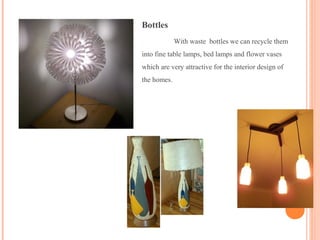
Bottles
With waste bottles we can recycle them
into fine table lamps, bed lamps and flower vases
which are very attractive for the interior design of
the homes.
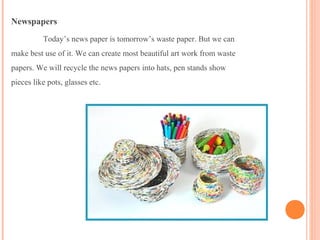
Newspapers
Today’s news paper is tomorrow’s waste paper. But we can
make best use of it. We can create most beautiful art work from waste
papers. We will recycle the news papers into hats, pen stands show
pieces like pots, glasses etc.
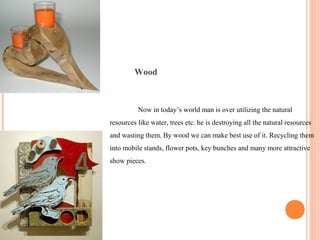
Wood
Now in today’s world man is over utilizing the natural
resources like water, trees etc. he is destroying all the natural resources
and wasting them. By wood we can make best use of it. Recycling them
into mobile stands, flower pots, key bunches and many more attractive
show pieces.
Products
 Pen stand
Mobile stands
 Show pieces
Glass stands
 Key bunches
Wrist bands
Hats
Flower cases, etc
Competition:
Our stiff competitors are NGOs. There are two NGOs in bijapur city which are giving lot
of employment opportunity for village people.
Competitive positioning:
Presently NGOs are holding their market position very strongly. We will sure that we will
give a strong competition to them and we will come in a strong position within upcoming
period.
Target customer:
 House holders
 Students
 Kids
Marketing strategy
The cost of the product is reasonable compared to other products as it is recycled.
The exhibition of the products can be kept during various occasions.
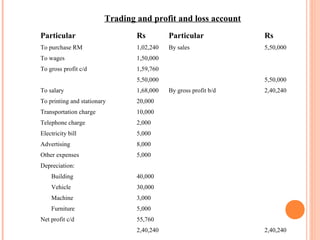
Particular Rs Particular Rs
To purchase RM 1,02,240 By sales 5,50,000
To wages 1,50,000
To gross profit c/d 1,59,760
5,50,000 5,50,000
To salary 1,68,000 By gross profit b/d 2,40,240
To printing and stationary 20,000
Transportation charge 10,000
Telephone charge 2,000
Electricity bill 5,000
Advertising 8,000
Other expenses 5,000
Depreciation:
Building 40,000
Vehicle 30,000
Machine 3,000
Furniture 5,000
Net profit c/d 55,760
2,40,240 2,40,240
Trading and profit and loss account
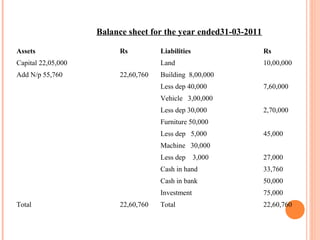
Assets Rs Liabilities Rs
Capital 22,05,000 Land 10,00,000
Add N/p 55,760 22,60,760 Building 8,00,000
Less dep 40,000 7,60,000
Vehicle 3,00,000
Less dep 30,000 2,70,000
Furniture 50,000
Less dep 5,000 45,000
Machine 30,000
Less dep 3,000 27,000
Cash in hand 33,760
Cash in bank 50,000
Investment 75,000
Total 22,60,760 Total 22,60,760
Balance sheet for the year ended31-03-2011
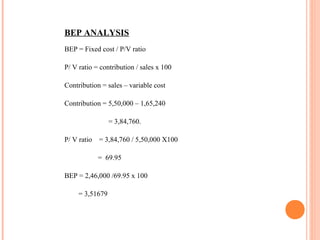
BEP ANALYSIS
BEP = Fixed cost / P/V ratio
P/ V ratio = contribution / sales x 100
Contribution = sales – variable cost
Contribution = 5,50,000 – 1,65,240
= 3,84,760.
P/ V ratio = 3,84,760 / 5,50,000 X100
= 69.95
BEP = 2,46,000 /69.95 x 100
= 3,51679
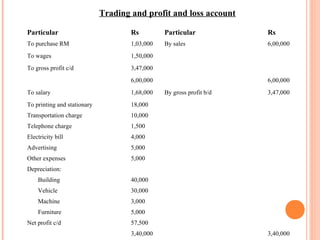
Particular Rs Particular Rs
To purchase RM 1,03,000 By sales 6,00,000
To wages 1,50,000
To gross profit c/d 3,47,000
6,00,000 6,00,000
To salary 1,68,000 By gross profit b/d 3,47,000
To printing and stationary 18,000
Transportation charge 10,000
Telephone charge 1,500
Electricity bill 4,000
Advertising 5,000
Other expenses 5,000
Depreciation:
Building 40,000
Vehicle 30,000
Machine 3,000
Furniture 5,000
Net profit c/d 57,500
3,40,000 3,40,000
Trading and profit and loss account
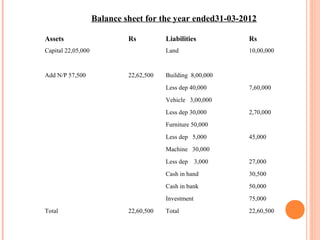
Assets Rs Liabilities Rs
Capital 22,05,000 Land 10,00,000
Add N/P 57,500 22,62,500 Building 8,00,000
Less dep 40,000 7,60,000
Vehicle 3,00,000
Less dep 30,000 2,70,000
Furniture 50,000
Less dep 5,000 45,000
Machine 30,000
Less dep 3,000 27,000
Cash in hand 30,500
Cash in bank 50,000
Investment 75,000
Total 22,60,500 Total 22,60,500
Balance sheet for the year ended31-03-2012
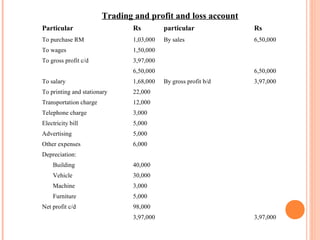
Particular Rs particular Rs
To purchase RM 1,03,000 By sales 6,50,000
To wages 1,50,000
To gross profit c/d 3,97,000
6,50,000 6,50,000
To salary 1,68,000 By gross profit b/d 3,97,000
To printing and stationary 22,000
Transportation charge 12,000
Telephone charge 3,000
Electricity bill 5,000
Advertising 5,000
Other expenses 6,000
Depreciation:
Building 40,000
Vehicle 30,000
Machine 3,000
Furniture 5,000
Net profit c/d 98,000
3,97,000 3,97,000
Trading and profit and loss account
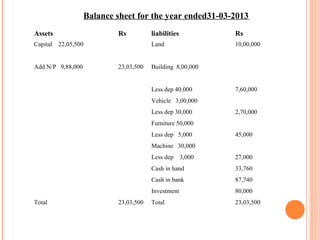
Assets Rs liabilities Rs
Capital 22,05,500 Land 10,00,000
Add N/P 9,88,000 23,03,500 Building 8,00,000
Less dep 40,000 7,60,000
Vehicle 3,00,000
Less dep 30,000 2,70,000
Furniture 50,000
Less dep 5,000 45,000
Machine 30,000
Less dep 3,000 27,000
Cash in hand 33,760
Cash in bank 87,740
Investment 80,000
Total 23,03,500 Total 23,03,500
Balance sheet for the year ended31-03-2013
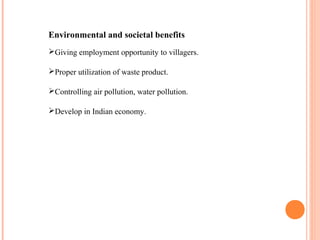
Environmental and societal benefits
Giving employment opportunity to villagers.
Proper utilization of waste product.
Controlling air pollution, water pollution.
Develop in Indian economy.
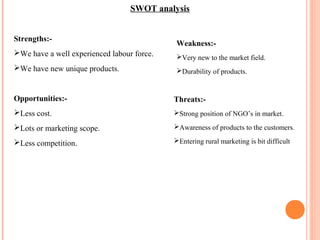
SWOT analysis
Strengths:-
We have a well experienced labour force.
We have new unique products.
Opportunities:-
Less cost.
Lots or marketing scope.
Less competition.
Weakness:-
Very new to the market field.
Durability of products.
Threats:-
Strong position of NGO’s in market.
Awareness of products to the customers.
Entering rural marketing is bit difficult
Conclusion
Waste products like papers, bottles are recycled into objective or attractive
materials and they are using in a proper way. And giving employment opportunity specially
for villagers.
By using these waste materials we can maintain clean and reduce the diseases.
THANK YOU

Best Out Of Waste

  • 1.
  • 2.
    SAMRUDDHI ENTERPRISES In presentday’s waste of bottles, woods, papers increasing like anything. So we took this opportunity to recycle the all above waste products. By using waste bottles we recycle them into attractive bed or table lamps, flower cases etc. and by waste paper we recycle into craft articles like hats, pen stand, mobile stands, and show pieces. Finally by using woods we recycle it into glass stands, key bunches, wrist bands etc. Our total investment is Rs22, 05,000 our firm is located at outskirt of bijapur city
  • 3.
    Bottles With waste bottleswe can recycle them into fine table lamps, bed lamps and flower vases which are very attractive for the interior design of the homes.
  • 4.
    Newspapers Today’s news paperis tomorrow’s waste paper. But we can make best use of it. We can create most beautiful art work from waste papers. We will recycle the news papers into hats, pen stands show pieces like pots, glasses etc.
  • 5.
    Wood Now in today’sworld man is over utilizing the natural resources like water, trees etc. he is destroying all the natural resources and wasting them. By wood we can make best use of it. Recycling them into mobile stands, flower pots, key bunches and many more attractive show pieces.
  • 6.
    Products  Pen stand Mobilestands  Show pieces Glass stands  Key bunches Wrist bands Hats Flower cases, etc Competition: Our stiff competitors are NGOs. There are two NGOs in bijapur city which are giving lot of employment opportunity for village people. Competitive positioning: Presently NGOs are holding their market position very strongly. We will sure that we will give a strong competition to them and we will come in a strong position within upcoming period.
  • 7.
    Target customer:  Householders  Students  Kids Marketing strategy The cost of the product is reasonable compared to other products as it is recycled. The exhibition of the products can be kept during various occasions.
  • 8.
    Particular Rs ParticularRs To purchase RM 1,02,240 By sales 5,50,000 To wages 1,50,000 To gross profit c/d 1,59,760 5,50,000 5,50,000 To salary 1,68,000 By gross profit b/d 2,40,240 To printing and stationary 20,000 Transportation charge 10,000 Telephone charge 2,000 Electricity bill 5,000 Advertising 8,000 Other expenses 5,000 Depreciation: Building 40,000 Vehicle 30,000 Machine 3,000 Furniture 5,000 Net profit c/d 55,760 2,40,240 2,40,240 Trading and profit and loss account
  • 9.
    Assets Rs LiabilitiesRs Capital 22,05,000 Land 10,00,000 Add N/p 55,760 22,60,760 Building 8,00,000 Less dep 40,000 7,60,000 Vehicle 3,00,000 Less dep 30,000 2,70,000 Furniture 50,000 Less dep 5,000 45,000 Machine 30,000 Less dep 3,000 27,000 Cash in hand 33,760 Cash in bank 50,000 Investment 75,000 Total 22,60,760 Total 22,60,760 Balance sheet for the year ended31-03-2011
  • 10.
    BEP ANALYSIS BEP =Fixed cost / P/V ratio P/ V ratio = contribution / sales x 100 Contribution = sales – variable cost Contribution = 5,50,000 – 1,65,240 = 3,84,760. P/ V ratio = 3,84,760 / 5,50,000 X100 = 69.95 BEP = 2,46,000 /69.95 x 100 = 3,51679
  • 11.
    Particular Rs ParticularRs To purchase RM 1,03,000 By sales 6,00,000 To wages 1,50,000 To gross profit c/d 3,47,000 6,00,000 6,00,000 To salary 1,68,000 By gross profit b/d 3,47,000 To printing and stationary 18,000 Transportation charge 10,000 Telephone charge 1,500 Electricity bill 4,000 Advertising 5,000 Other expenses 5,000 Depreciation: Building 40,000 Vehicle 30,000 Machine 3,000 Furniture 5,000 Net profit c/d 57,500 3,40,000 3,40,000 Trading and profit and loss account
  • 12.
    Assets Rs LiabilitiesRs Capital 22,05,000 Land 10,00,000 Add N/P 57,500 22,62,500 Building 8,00,000 Less dep 40,000 7,60,000 Vehicle 3,00,000 Less dep 30,000 2,70,000 Furniture 50,000 Less dep 5,000 45,000 Machine 30,000 Less dep 3,000 27,000 Cash in hand 30,500 Cash in bank 50,000 Investment 75,000 Total 22,60,500 Total 22,60,500 Balance sheet for the year ended31-03-2012
  • 13.
    Particular Rs particularRs To purchase RM 1,03,000 By sales 6,50,000 To wages 1,50,000 To gross profit c/d 3,97,000 6,50,000 6,50,000 To salary 1,68,000 By gross profit b/d 3,97,000 To printing and stationary 22,000 Transportation charge 12,000 Telephone charge 3,000 Electricity bill 5,000 Advertising 5,000 Other expenses 6,000 Depreciation: Building 40,000 Vehicle 30,000 Machine 3,000 Furniture 5,000 Net profit c/d 98,000 3,97,000 3,97,000 Trading and profit and loss account
  • 14.
    Assets Rs liabilitiesRs Capital 22,05,500 Land 10,00,000 Add N/P 9,88,000 23,03,500 Building 8,00,000 Less dep 40,000 7,60,000 Vehicle 3,00,000 Less dep 30,000 2,70,000 Furniture 50,000 Less dep 5,000 45,000 Machine 30,000 Less dep 3,000 27,000 Cash in hand 33,760 Cash in bank 87,740 Investment 80,000 Total 23,03,500 Total 23,03,500 Balance sheet for the year ended31-03-2013
  • 15.
    Environmental and societalbenefits Giving employment opportunity to villagers. Proper utilization of waste product. Controlling air pollution, water pollution. Develop in Indian economy.
  • 16.
    SWOT analysis Strengths:- We havea well experienced labour force. We have new unique products. Opportunities:- Less cost. Lots or marketing scope. Less competition. Weakness:- Very new to the market field. Durability of products. Threats:- Strong position of NGO’s in market. Awareness of products to the customers. Entering rural marketing is bit difficult
  • 17.
    Conclusion Waste products likepapers, bottles are recycled into objective or attractive materials and they are using in a proper way. And giving employment opportunity specially for villagers. By using these waste materials we can maintain clean and reduce the diseases.
  • 18.