




©Anuswedha Ananthan
Anuswedha Ananthan
Assistant Professor
Department of Microbiology
Justice Basheer Ahmed Sayeed College for Women
Chennai
©Anuswedha Ananthan
©Anuswedha Ananthan
TAXONOMY
CLASSIFICATION
NOMENCLATURE
IDENTIFICATION
©Anuswedha Ananthan
CLASSIFICATION- PRINCIPLES
 CHARACTERISTICS USED IN
CLASSIFICATION
 1. CLASSICAL/PHENOTYPIC
 Morphological,chemical
composition,cultural,physiological &
metabolic,antigenic,pathogenicity,ecological
characteristics.
2. MOLECULAR/GENOTYPIC
comparison of proteins, NA base
composition,NA hybridisation,NA sequencing
©Anuswedha Ananthan
CLASSIFICATION SYSTEMS
INTUITIVE METHOD
NATURAL CLASSIFICATION
PHENETIC CLASSIFICATION
PHYLETIC/PHYLOGENETIC
CLASSIFICATION
©Anuswedha Ananthan
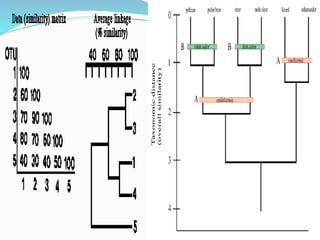
NUMERICAL TAXONOMY
 Five steps involved in numerical taxonomy
 1. Selection of strains
 2. Selection of tests
 3. Coding and arranging of test results in
 a format suitable for analysis by computer
 4. Computer analysis
 5. Preservation and interpretation of results
©Anuswedha Ananthan
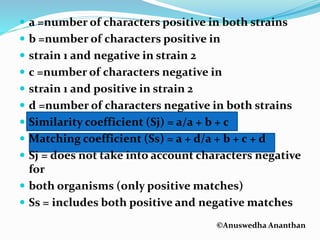
 a =number of characters positive in both strains
 b =number of characters positive in
 strain 1 and negative in strain 2
 c =number of characters negative in
 strain 1 and positive in strain 2
 d =number of characters negative in both strains
 Similarity coefficient (Sj) = a/a + b + c
 Matching coefficient (Ss) = a + d/a + b + c + d
 Sj = does not take into account characters negative
for
 both organisms (only positive matches)
 Ss = includes both positive and negative matches
©Anuswedha Ananthan
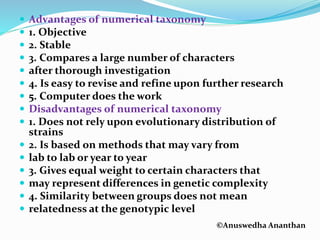
 Advantages of numerical taxonomy
 1. Objective
 2. Stable
 3. Compares a large number of characters
 after thorough investigation
 4. Is easy to revise and refine upon further research
 5. Computer does the work
 Disadvantages of numerical taxonomy
 1. Does not rely upon evolutionary distribution of
strains
 2. Is based on methods that may vary from
 lab to lab or year to year
 3. Gives equal weight to certain characters that
 may represent differences in genetic complexity
 4. Similarity between groups does not mean
 relatedness at the genotypic level
©Anuswedha Ananthan
©Anuswedha Ananthan
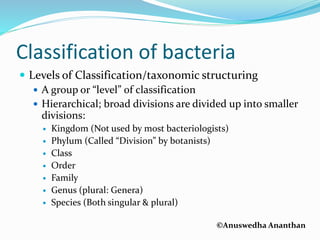
Classification of bacteria
 Levels of Classification/taxonomic structuring
 A group or “level” of classification
 Hierarchical; broad divisions are divided up into smaller
divisions:
 Kingdom (Not used by most bacteriologists)
 Phylum (Called “Division” by botanists)
 Class
 Order
 Family
 Genus (plural: Genera)
 Species (Both singular & plural)
©Anuswedha Ananthan
Definition of “Species
 The “basic unit” of taxonomy, representing a specific,
recognized type of organism
 For sexually reproducing organisms, a fundamental
definition of “species” has been reproductive compatibility
 This definition fails for many microbial species (including
bacteria), because they do not reproduce sexually
 Classic definition: A collection of microbial strains that share
many properties and differ significantly from other groups of
strains
 Species are identified by comparison with known “type
strains”: well-characterized pure cultures; references for the
identification of unknowns
 There are several collections of type strains, including the
American Type Culture Collection (ATCC)
©Anuswedha Ananthan
 Strain:
 A population of microbes descended from a
single individual or pure culture
 Different strains represent genetic variability
within a species
 Biovars: Strains that differ in biochemical or
physiological differences
 Morphovars: Strains that vary in morphology
 Serovars: Stains that vary in their antigenic
properties
©Anuswedha Ananthan
 Bergey’s Manual
 DavidBergey in 1923.
 2 books-
 1.Bergey’s Manual of DeterminativeBacteriology-
culturedbacteria-9th ed
 2. 1.Bergey’s Manual of Systematic Bacteriology-all known
bacteria-2nd edition
©Anuswedha Ananthan
Bergey’s manual of Systematic Bacteriology
 1st edition:
 Classification based on phenetic system
 Prokaryotes divided into 4 volumes
 1. G-ve bacteria of general, medical or industrial
importance
 2. G+ve bacteria other than actinomycetes
 3. G-ve bacteria with distinctive
properties,cyanobacteria & archaea
 4.Actinomycetes
©Anuswedha Ananthan
 2nd edition:Classification based on phylogenetic
relationships;5 vol
VOLUME ORGANISMS DESCRIBED
1. The Archaea & deeply branching &
phototrophic bacteria
Includes archaea, cyanobacteria, green
sulfur & non-sulfur bacteria, deinococci
7 other branching forms
2. The Proteobacteria All proteobacteria
3.The Low G+C gram +ve bacteria G+C% below 50-55%-Clostridia,
bacilli,Streptococci,staphylococci,mycopl
asma
4. The High G+C gram +ve bacteria G+C% above 50-
55%,corynebacteria,Mycobacteria,Nocard
ia,Actinomycetes
5. The Planctomycetes, Spirochaetes,
Fibrobacteres,Bacterioides &
Fusobacteria
Different G-ve bacteria,
Chlamydias,spirochaetes
©Anuswedha Ananthan
BERGEY’S MANUAL OF DETERMINATIVE BACTERIOLOGY
 4 Major categories
 1. G-ve eubacteria that have cell walls
 2. G+ve eubacteria that have cell walls
 3. Eubacteria lacking cell walls
 4. The Archaebacteria.
 35 different groups
©Anuswedha Ananthan
NOMENCLATURE
 BINOMIAL NOMENCLATURE
 1.Genus/Generic name
 2. Species name/Specific epithet
 Common/coloquial name
 Purpose: 1. for international communication
 2. to prevent any confusion by
using vernacular names.
©Anuswedha Ananthan
INDENTIFICATION
Few characteristics listed to identify
only that isolate and no other.
Characteristics chosen must be easy to
determine
IDENTIFICATION methods
1. identification keys
2. identification tables
©Anuswedha Ananthan

Classification of bacteria

  • 1.
    ©Anuswedha Ananthan Anuswedha Ananthan AssistantProfessor Department of Microbiology Justice Basheer Ahmed Sayeed College for Women Chennai
  • 2.
  • 3.
  • 4.
    ©Anuswedha Ananthan CLASSIFICATION- PRINCIPLES CHARACTERISTICS USED IN CLASSIFICATION  1. CLASSICAL/PHENOTYPIC  Morphological,chemical composition,cultural,physiological & metabolic,antigenic,pathogenicity,ecological characteristics. 2. MOLECULAR/GENOTYPIC comparison of proteins, NA base composition,NA hybridisation,NA sequencing
  • 5.
    ©Anuswedha Ananthan CLASSIFICATION SYSTEMS INTUITIVEMETHOD NATURAL CLASSIFICATION PHENETIC CLASSIFICATION PHYLETIC/PHYLOGENETIC CLASSIFICATION
  • 6.
    ©Anuswedha Ananthan NUMERICAL TAXONOMY Five steps involved in numerical taxonomy  1. Selection of strains  2. Selection of tests  3. Coding and arranging of test results in  a format suitable for analysis by computer  4. Computer analysis  5. Preservation and interpretation of results
  • 7.
    ©Anuswedha Ananthan  a=number of characters positive in both strains  b =number of characters positive in  strain 1 and negative in strain 2  c =number of characters negative in  strain 1 and positive in strain 2  d =number of characters negative in both strains  Similarity coefficient (Sj) = a/a + b + c  Matching coefficient (Ss) = a + d/a + b + c + d  Sj = does not take into account characters negative for  both organisms (only positive matches)  Ss = includes both positive and negative matches
  • 8.
    ©Anuswedha Ananthan  Advantagesof numerical taxonomy  1. Objective  2. Stable  3. Compares a large number of characters  after thorough investigation  4. Is easy to revise and refine upon further research  5. Computer does the work  Disadvantages of numerical taxonomy  1. Does not rely upon evolutionary distribution of strains  2. Is based on methods that may vary from  lab to lab or year to year  3. Gives equal weight to certain characters that  may represent differences in genetic complexity  4. Similarity between groups does not mean  relatedness at the genotypic level
  • 9.
  • 10.
    ©Anuswedha Ananthan Classification ofbacteria  Levels of Classification/taxonomic structuring  A group or “level” of classification  Hierarchical; broad divisions are divided up into smaller divisions:  Kingdom (Not used by most bacteriologists)  Phylum (Called “Division” by botanists)  Class  Order  Family  Genus (plural: Genera)  Species (Both singular & plural)
  • 11.
    ©Anuswedha Ananthan Definition of“Species  The “basic unit” of taxonomy, representing a specific, recognized type of organism  For sexually reproducing organisms, a fundamental definition of “species” has been reproductive compatibility  This definition fails for many microbial species (including bacteria), because they do not reproduce sexually  Classic definition: A collection of microbial strains that share many properties and differ significantly from other groups of strains  Species are identified by comparison with known “type strains”: well-characterized pure cultures; references for the identification of unknowns  There are several collections of type strains, including the American Type Culture Collection (ATCC)
  • 12.
    ©Anuswedha Ananthan  Strain: A population of microbes descended from a single individual or pure culture  Different strains represent genetic variability within a species  Biovars: Strains that differ in biochemical or physiological differences  Morphovars: Strains that vary in morphology  Serovars: Stains that vary in their antigenic properties
  • 13.
    ©Anuswedha Ananthan  Bergey’sManual  DavidBergey in 1923.  2 books-  1.Bergey’s Manual of DeterminativeBacteriology- culturedbacteria-9th ed  2. 1.Bergey’s Manual of Systematic Bacteriology-all known bacteria-2nd edition
  • 14.
    ©Anuswedha Ananthan Bergey’s manualof Systematic Bacteriology  1st edition:  Classification based on phenetic system  Prokaryotes divided into 4 volumes  1. G-ve bacteria of general, medical or industrial importance  2. G+ve bacteria other than actinomycetes  3. G-ve bacteria with distinctive properties,cyanobacteria & archaea  4.Actinomycetes
  • 15.
    ©Anuswedha Ananthan  2ndedition:Classification based on phylogenetic relationships;5 vol VOLUME ORGANISMS DESCRIBED 1. The Archaea & deeply branching & phototrophic bacteria Includes archaea, cyanobacteria, green sulfur & non-sulfur bacteria, deinococci 7 other branching forms 2. The Proteobacteria All proteobacteria 3.The Low G+C gram +ve bacteria G+C% below 50-55%-Clostridia, bacilli,Streptococci,staphylococci,mycopl asma 4. The High G+C gram +ve bacteria G+C% above 50- 55%,corynebacteria,Mycobacteria,Nocard ia,Actinomycetes 5. The Planctomycetes, Spirochaetes, Fibrobacteres,Bacterioides & Fusobacteria Different G-ve bacteria, Chlamydias,spirochaetes
  • 16.
    ©Anuswedha Ananthan BERGEY’S MANUALOF DETERMINATIVE BACTERIOLOGY  4 Major categories  1. G-ve eubacteria that have cell walls  2. G+ve eubacteria that have cell walls  3. Eubacteria lacking cell walls  4. The Archaebacteria.  35 different groups
  • 17.
    ©Anuswedha Ananthan NOMENCLATURE  BINOMIALNOMENCLATURE  1.Genus/Generic name  2. Species name/Specific epithet  Common/coloquial name  Purpose: 1. for international communication  2. to prevent any confusion by using vernacular names.
  • 18.
    ©Anuswedha Ananthan INDENTIFICATION Few characteristicslisted to identify only that isolate and no other. Characteristics chosen must be easy to determine IDENTIFICATION methods 1. identification keys 2. identification tables
  • 19.