Birth & Being a Newborn
Birth Birth Hormones Corticotrophic-releasing Hormone A stress hormone. It triggers the release of other hormones. Oxytocin An attachment hormone. Begins uterine contractions. Endorphins Pleasure hormones. Help in some of the pain. Epinephrine & Norepinephrine The catecholamines. They activate the sympathetic nervous system. Prolactin Involved in submission or surrender. Triggers the ability to breastfeed.
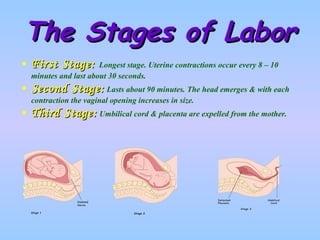
The Stages of Labor First Stage:  Longest stage. Uterine contractions occur every 8 – 10 minutes and last about 30 seconds. Second Stage:   Lasts about 90 minutes. The head emerges & with each contraction the vaginal opening increases in size. Third Stage:  Umbilical cord & placenta are expelled from the mother.
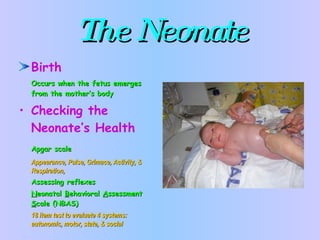
The Neonate Birth Occurs when the fetus emerges from the mother’s body Checking the Neonate’s Health Apgar scale Appearance, Pulse, Grimace, Activity, & Respiration, Assessing reflexes N eonatal  B ehavioral  A ssessment  S cale (NBAS) 18 item test to evaluate 4 systems: autonomic, motor, state, & social
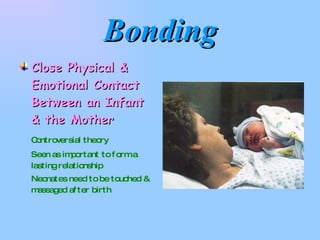
Bonding Close Physical & Emotional Contact Between an Infant & the Mother Controversial theory Seen as important to form a lasting relationship Neonates need to be touched & massaged after birth
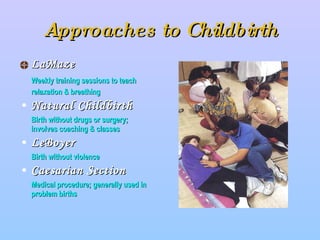
Approaches to Childbirth LaMaze Weekly training sessions to teach relaxation & breathing Natural Childbirth Birth without drugs or surgery; involves coaching & classes LeBoyer Birth without violence Caesarian Section Medical procedure; generally used in problem births
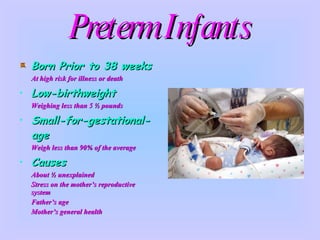
Preterm Infants Born Prior to 38 weeks At high risk for illness or death Low-birthweight Weighing less than 5 ½ pounds Small-for-gestational-age Weigh less than 90% of the average Causes About ½ unexplained Stress on the mother’s reproductive system Father’s age Mother’s general health
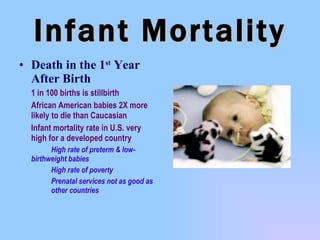
Infant Mortality Death in the 1 st  Year After Birth 1 in 100 births is stillbirth African American babies 2X more likely to die than Caucasian Infant mortality rate in U.S. very high for a developed country High rate of preterm & low- birthweight babies High rate of poverty Prenatal services not as good as  other countries
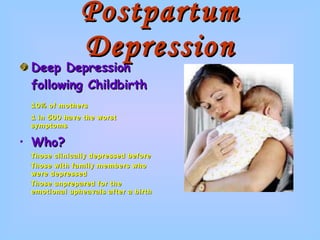
Postpartum Depression Deep Depression following Childbirth 10% of mothers 1 in 500 have the worst symptoms Who? Those clinically depressed before Those with family members who were depressed Those unprepared for the emotional upheavals after a birth
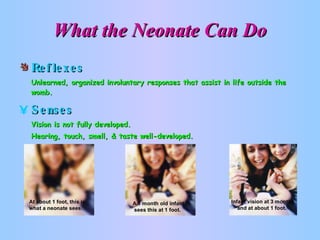
What the Neonate Can Do Reflexes Unlearned, organized involuntary responses that assist in life outside the womb. Senses Vision is not fully developed.  Hearing, touch, smell, & taste well-developed.
What the Neonate Can Do Learning Capabilities Classical Conditioning Is operating from birth Operant Conditioning Acting deliberately on the environment Crying brings attention Habituation A decrease in response to a stimulus Linked to physical & cognitive maturation Present at birth & becomes more pronounced over the 1 st  12 weeks Responding to Others Imitation Infants imitate others’ expressions This is the foundation for social interaction States of Arousal Regularization of sleep/wakefulness cycles With caregivers seeking to assist in the regularization of cycles social interaction is promoted Speech by the caregivers aids social interaction

Neonatal

  • 1.
    Birth & Beinga Newborn
  • 2.
    Birth Birth HormonesCorticotrophic-releasing Hormone A stress hormone. It triggers the release of other hormones. Oxytocin An attachment hormone. Begins uterine contractions. Endorphins Pleasure hormones. Help in some of the pain. Epinephrine & Norepinephrine The catecholamines. They activate the sympathetic nervous system. Prolactin Involved in submission or surrender. Triggers the ability to breastfeed.
  • 3.
    The Stages ofLabor First Stage: Longest stage. Uterine contractions occur every 8 – 10 minutes and last about 30 seconds. Second Stage: Lasts about 90 minutes. The head emerges & with each contraction the vaginal opening increases in size. Third Stage: Umbilical cord & placenta are expelled from the mother.
  • 4.
    The Neonate BirthOccurs when the fetus emerges from the mother’s body Checking the Neonate’s Health Apgar scale Appearance, Pulse, Grimace, Activity, & Respiration, Assessing reflexes N eonatal B ehavioral A ssessment S cale (NBAS) 18 item test to evaluate 4 systems: autonomic, motor, state, & social
  • 5.
    Bonding Close Physical& Emotional Contact Between an Infant & the Mother Controversial theory Seen as important to form a lasting relationship Neonates need to be touched & massaged after birth
  • 6.
    Approaches to ChildbirthLaMaze Weekly training sessions to teach relaxation & breathing Natural Childbirth Birth without drugs or surgery; involves coaching & classes LeBoyer Birth without violence Caesarian Section Medical procedure; generally used in problem births
  • 7.
    Preterm Infants BornPrior to 38 weeks At high risk for illness or death Low-birthweight Weighing less than 5 ½ pounds Small-for-gestational-age Weigh less than 90% of the average Causes About ½ unexplained Stress on the mother’s reproductive system Father’s age Mother’s general health
  • 8.
    Infant Mortality Deathin the 1 st Year After Birth 1 in 100 births is stillbirth African American babies 2X more likely to die than Caucasian Infant mortality rate in U.S. very high for a developed country High rate of preterm & low- birthweight babies High rate of poverty Prenatal services not as good as other countries
  • 9.
    Postpartum Depression DeepDepression following Childbirth 10% of mothers 1 in 500 have the worst symptoms Who? Those clinically depressed before Those with family members who were depressed Those unprepared for the emotional upheavals after a birth
  • 10.
    What the NeonateCan Do Reflexes Unlearned, organized involuntary responses that assist in life outside the womb. Senses Vision is not fully developed. Hearing, touch, smell, & taste well-developed.
  • 11.
    What the NeonateCan Do Learning Capabilities Classical Conditioning Is operating from birth Operant Conditioning Acting deliberately on the environment Crying brings attention Habituation A decrease in response to a stimulus Linked to physical & cognitive maturation Present at birth & becomes more pronounced over the 1 st 12 weeks Responding to Others Imitation Infants imitate others’ expressions This is the foundation for social interaction States of Arousal Regularization of sleep/wakefulness cycles With caregivers seeking to assist in the regularization of cycles social interaction is promoted Speech by the caregivers aids social interaction