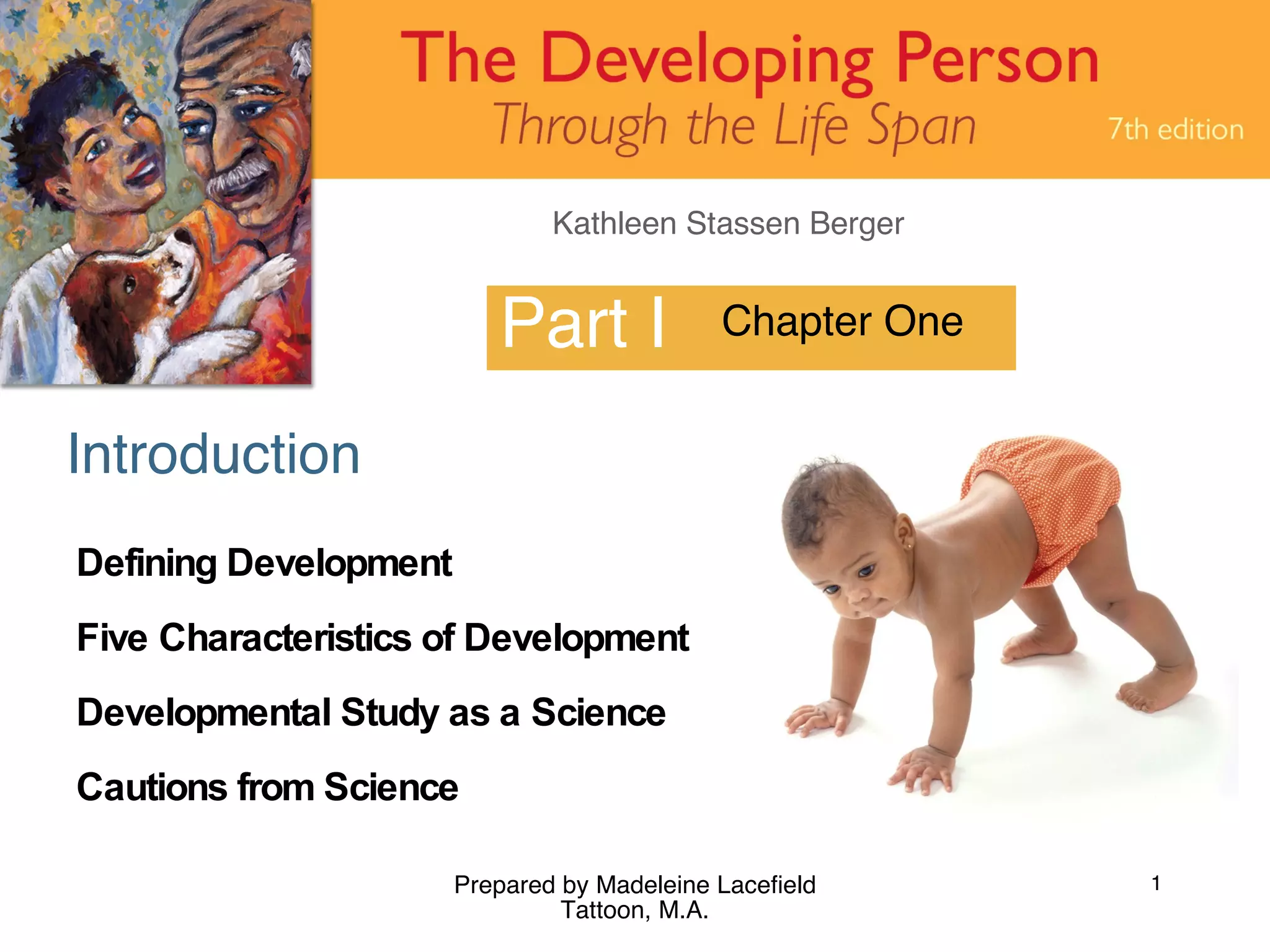
Part I Introduction Prepared by Madeleine Lacefield Tattoon, M.A. Chapter One Defining Development Five Characteristics of Development Developmental Study as a Science Cautions from Science
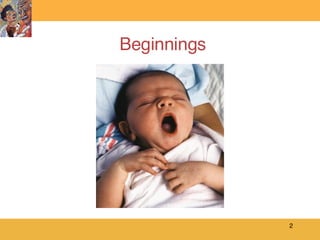
Beginnings
Introduction What will happen to the baby just born, or to the schoolchild trying to make a friend, or to the emerging adult wondering how to pay for college, or to the elder contemplating retirement? Why should you care?
Defining Development The  science of human development  seeks to understand how and why people—all kinds of people, everywhere—change or remain the same over time.  There are 3 crucial elements.
1. Science developmental study is a  science …. theories data analysis critical thinking sound methodology
2. Diversity studying  all kinds of people young and old rich and poor every ethnicity, background sexual orientation
3. Connections Between Change and Time Changing or remaining the same over time transformations consistencies of human life beginning to end understanding each segment of life
Dynamic Systems Theory stresses the fluctuations and transitions the dynamic synthesis of multiple levels of analysis the interaction between people and within each person parent and child prenatal and postnatal life between ages 2 and 102
Bioecological Systems Urie Bronfenbrenner  a leader in understanding  ecological systems approach  he believed that developmentalists need to examine all systems surrounding the development of each person microsysems exosystems macrosystems
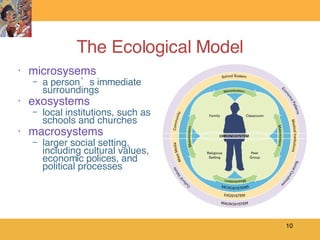
The Ecological Model microsysems a person’s immediate surroundings exosystems local institutions, such as schools and churches macrosystems larger social setting, including cultural values, economic polices, and political processes
Five Characteristics of Development “… developmentalists are acutely aware of the reciprocal connections between one moment in life and another… leading to  five principles  that are useful for understanding any age of human life…”
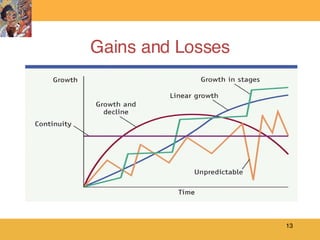
1. Multidirectional changes in direction; development is dynamic, not static each fraction of a second years are analyzed, revealing unexpected twist and turns
Gains and Losses
The Butterfly Effect the power of a small change all change may have a large effect every change affects a dynamic system a tiny event could have an enormous impact, not that is always does opposite can occur… large changes can affect people in contradictory ways (i.e., lottery jackpots)
2. Multicontextual “… humans develop in dozens of contexts that profoundly affect their development…” physical surroundings family patterns Social context historical socioeconomic
The Historical Context corhort people born within a few years of one another these people are affected by the same values events technologies culture
The Socioeconomic Context socioeconomic status (SES) “ social class” more than money occupation education place of residence includes advantages and disadvantages Question: does low SES cause damage in infancy or in late adulthood?
3. Multicultural “… culture affects each human at every moment… culture is so pervasive, people rarely notice their culture while they are immersed in it…”
Deciding What to Do Each Moment culture the patterns of behavior that are passed from one generation to the next groups have their own culture values customs clothes dwellings cuisine assumptions people are influenced by more than one culture
Ethnicity, Race, and Income ethnic groups share certain attributes ancestral heritage national origin religion culture language ethnic categories arise from history, sociology, and psychology,  not from biology
Ethnicity, Race, and Income race used to categorize groups of people  based on appearance 95% of the genetic differences between one person and another occur within, not between, supposed racial groups race is misleading as a biological category race = social construction an idea created by society perceived racial differences lead to discrimination  affect cognition
Ethnicity, Race, and Income social construction SES (socioeconomic status)  a form of income or wealth overlaps with ethnicity and race national history and SES affect culture, development
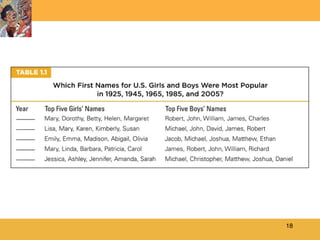
Issues and Applications “ My Name Wasn’t Mary”
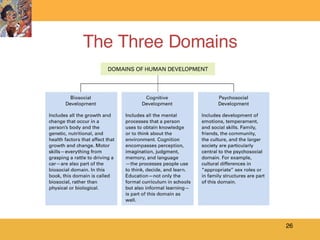
4. Multidisciplinary “… a broad array of disciplines and cross-cutting topics… each person develops simultaneously in body, mind, and spirit…” Development is divided into three domains;  biosocial cognitive psychosocial
The Three Domains
Mirror Neurons reflected brain cells observed actions mirror the intentions, sensations, and emotions of those around implications of Mirror-Neuron Research possible cultural transmission or social organization
5. Plasticity denotes two complementary aspects of development human traits can be molded yet maintaining durability of identity culture and upbringing affect both aspects of plasticity Genes and other biological influences provides hope and realism hope = changes is possible realism = each developing person must build on what has come before
Developmental Study as a Science based on  objective  evidence laden with  subjective  perceptions making developmental science challenging
Steps of the Science Method to avoid distortions of unexamined opinions and to control the biases of personal experience ask a question developing a hypothesis test the hypothesis draw conclusions Make the finding available Replication
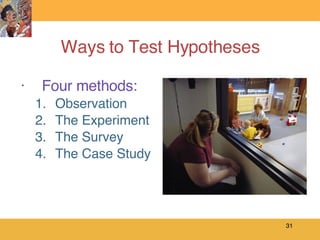
Ways to Test Hypotheses Four methods: Observation The Experiment The Survey The Case Study
Observation record behavior systematically and objectively occur in a naturalistic setting tries to be unobtrusive can occur in a laboratory or in searches of archival data
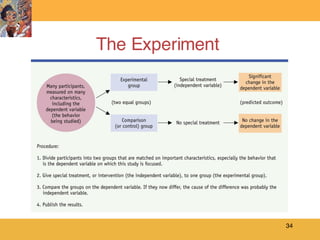
The Experiment  used to establish cause a particular treatment to expose to a specific condition notes whether their behavior changes independent   variable  = imposed treatment or special condition dependent   variable  = specific behavior being studied experimental group : is given a particular treatment control group:  does not get the treatment
The Experiment
The Survey Information is collected from a large number of people by:  interview questionnaire some other means wording and the questions can influence answers
The Case Study intensive study of one individual or situation asking about past history current thinking future plans can provide unanticipated insight
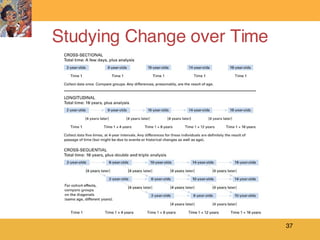
Studying Change over Time
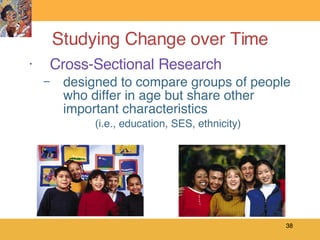
Studying Change over Time Cross-Sectional Research designed to compare groups of people who differ in age but share other important characteristics  (i.e., education, SES, ethnicity)
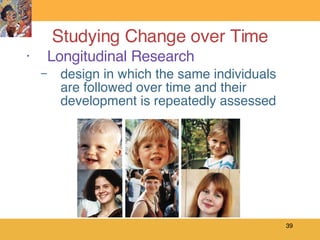
Studying Change over Time Longitudinal Research design in which the same individuals are followed over time and their development is repeatedly assessed
Studying Change over Time Cross-Sequential Research designed to first study several groups of different ages and then follow those groups over the years
Caution from Science developmental scientists also discover changes that are not beneficial television, divorce, shift work, automobiles.
Caution from Science Correlation and Causation can be confusing a  correlation  indicates the degree of relationship between two variables. a  correlation  is positive if both variables tend to increase or decrease together a  correlation  is negative if one variables tends to increase when the other decreases a  correlation  is zero if no connection is evident
Caution from Science Quantity and Quality a second caution concerns how much scientists should rely on data produced quantitative research : provides data that can be expressed with numbers  qualitative research  contains descriptions of conditions, and participants’ ideas
Caution from Science Ethics in Research Caution for all scientists is to ensure that research meets ethical standards “ code of ethics” A set of moral principles that members of a profession or group are expected to follow
Caution from Science Protection of Research Participants Researcher must ensure that participation is voluntary, confidential, and harmless
Caution from Science What should we Study? Consider the most important ethical concern:  “ Are scientists studying issues that are crucial to human development?”

Psych 41Ch 1

  • 1.
    Part I IntroductionPrepared by Madeleine Lacefield Tattoon, M.A. Chapter One Defining Development Five Characteristics of Development Developmental Study as a Science Cautions from Science
  • 2.
  • 3.
    Introduction What willhappen to the baby just born, or to the schoolchild trying to make a friend, or to the emerging adult wondering how to pay for college, or to the elder contemplating retirement? Why should you care?
  • 4.
    Defining Development The science of human development seeks to understand how and why people—all kinds of people, everywhere—change or remain the same over time. There are 3 crucial elements.
  • 5.
    1. Science developmentalstudy is a science …. theories data analysis critical thinking sound methodology
  • 6.
    2. Diversity studying all kinds of people young and old rich and poor every ethnicity, background sexual orientation
  • 7.
    3. Connections BetweenChange and Time Changing or remaining the same over time transformations consistencies of human life beginning to end understanding each segment of life
  • 8.
    Dynamic Systems Theorystresses the fluctuations and transitions the dynamic synthesis of multiple levels of analysis the interaction between people and within each person parent and child prenatal and postnatal life between ages 2 and 102
  • 9.
    Bioecological Systems UrieBronfenbrenner a leader in understanding ecological systems approach he believed that developmentalists need to examine all systems surrounding the development of each person microsysems exosystems macrosystems
  • 10.
    The Ecological Modelmicrosysems a person’s immediate surroundings exosystems local institutions, such as schools and churches macrosystems larger social setting, including cultural values, economic polices, and political processes
  • 11.
    Five Characteristics ofDevelopment “… developmentalists are acutely aware of the reciprocal connections between one moment in life and another… leading to five principles that are useful for understanding any age of human life…”
  • 12.
    1. Multidirectional changesin direction; development is dynamic, not static each fraction of a second years are analyzed, revealing unexpected twist and turns
  • 13.
  • 14.
    The Butterfly Effectthe power of a small change all change may have a large effect every change affects a dynamic system a tiny event could have an enormous impact, not that is always does opposite can occur… large changes can affect people in contradictory ways (i.e., lottery jackpots)
  • 15.
    2. Multicontextual “…humans develop in dozens of contexts that profoundly affect their development…” physical surroundings family patterns Social context historical socioeconomic
  • 16.
    The Historical Contextcorhort people born within a few years of one another these people are affected by the same values events technologies culture
  • 17.
    The Socioeconomic Contextsocioeconomic status (SES) “ social class” more than money occupation education place of residence includes advantages and disadvantages Question: does low SES cause damage in infancy or in late adulthood?
  • 19.
    3. Multicultural “…culture affects each human at every moment… culture is so pervasive, people rarely notice their culture while they are immersed in it…”
  • 20.
    Deciding What toDo Each Moment culture the patterns of behavior that are passed from one generation to the next groups have their own culture values customs clothes dwellings cuisine assumptions people are influenced by more than one culture
  • 21.
    Ethnicity, Race, andIncome ethnic groups share certain attributes ancestral heritage national origin religion culture language ethnic categories arise from history, sociology, and psychology, not from biology
  • 22.
    Ethnicity, Race, andIncome race used to categorize groups of people based on appearance 95% of the genetic differences between one person and another occur within, not between, supposed racial groups race is misleading as a biological category race = social construction an idea created by society perceived racial differences lead to discrimination affect cognition
  • 23.
    Ethnicity, Race, andIncome social construction SES (socioeconomic status) a form of income or wealth overlaps with ethnicity and race national history and SES affect culture, development
  • 24.
    Issues and Applications“ My Name Wasn’t Mary”
  • 25.
    4. Multidisciplinary “…a broad array of disciplines and cross-cutting topics… each person develops simultaneously in body, mind, and spirit…” Development is divided into three domains; biosocial cognitive psychosocial
  • 26.
  • 27.
    Mirror Neurons reflectedbrain cells observed actions mirror the intentions, sensations, and emotions of those around implications of Mirror-Neuron Research possible cultural transmission or social organization
  • 28.
    5. Plasticity denotestwo complementary aspects of development human traits can be molded yet maintaining durability of identity culture and upbringing affect both aspects of plasticity Genes and other biological influences provides hope and realism hope = changes is possible realism = each developing person must build on what has come before
  • 29.
    Developmental Study asa Science based on objective evidence laden with subjective perceptions making developmental science challenging
  • 30.
    Steps of theScience Method to avoid distortions of unexamined opinions and to control the biases of personal experience ask a question developing a hypothesis test the hypothesis draw conclusions Make the finding available Replication
  • 31.
    Ways to TestHypotheses Four methods: Observation The Experiment The Survey The Case Study
  • 32.
    Observation record behaviorsystematically and objectively occur in a naturalistic setting tries to be unobtrusive can occur in a laboratory or in searches of archival data
  • 33.
    The Experiment used to establish cause a particular treatment to expose to a specific condition notes whether their behavior changes independent variable = imposed treatment or special condition dependent variable = specific behavior being studied experimental group : is given a particular treatment control group: does not get the treatment
  • 34.
  • 35.
    The Survey Informationis collected from a large number of people by: interview questionnaire some other means wording and the questions can influence answers
  • 36.
    The Case Studyintensive study of one individual or situation asking about past history current thinking future plans can provide unanticipated insight
  • 37.
  • 38.
    Studying Change overTime Cross-Sectional Research designed to compare groups of people who differ in age but share other important characteristics (i.e., education, SES, ethnicity)
  • 39.
    Studying Change overTime Longitudinal Research design in which the same individuals are followed over time and their development is repeatedly assessed
  • 40.
    Studying Change overTime Cross-Sequential Research designed to first study several groups of different ages and then follow those groups over the years
  • 41.
    Caution from Sciencedevelopmental scientists also discover changes that are not beneficial television, divorce, shift work, automobiles.
  • 42.
    Caution from ScienceCorrelation and Causation can be confusing a correlation indicates the degree of relationship between two variables. a correlation is positive if both variables tend to increase or decrease together a correlation is negative if one variables tends to increase when the other decreases a correlation is zero if no connection is evident
  • 43.
    Caution from ScienceQuantity and Quality a second caution concerns how much scientists should rely on data produced quantitative research : provides data that can be expressed with numbers qualitative research contains descriptions of conditions, and participants’ ideas
  • 44.
    Caution from ScienceEthics in Research Caution for all scientists is to ensure that research meets ethical standards “ code of ethics” A set of moral principles that members of a profession or group are expected to follow
  • 45.
    Caution from ScienceProtection of Research Participants Researcher must ensure that participation is voluntary, confidential, and harmless
  • 46.
    Caution from ScienceWhat should we Study? Consider the most important ethical concern: “ Are scientists studying issues that are crucial to human development?”