HUMAN
DEVELOPMENT
LEARNING
CORNER
Development
 Development is the pattern of progressive,
orderly, and predictable changes that begin at
conception and continue throughout life.
Development mostly involves changes — both
growth and decline, as observed during old age.
 Development is influenced by an interplay of
biological, cognitive, and socio-emotional
processes.
 Development due to genes inherited from parents,
such as in height and weight, brain, heart, and
lungs development, etc. all point towards the role
of biological processes
 The role of cognitive processes in development
relate to mental activities associated with the
processes of knowing, and experiencing, such as
thought, perception, attention, problem solving, etc
 Socio-emotional processes that influence
development refer to changes in an individual’s
interactions with other people, changes in
emotions, and in personality. A child’s hug to
her/his mother, a young girl’s affectionate gesture
to her/his sibling, or an adolescent’s sorrow at
losing a match are all reflections of socio-
emotional processes deeply involved in human
development
 These processes influence changes in the
Life-Span Perspective on
Development
 The study of development according to the Life-Span Perspective (LSP)
includes the following assumptions :
 1. Development is lifelong, i.e. it takes place across all age gr oups starting
from conception to old age. It includes both gains and losses, which interact
in dynamic (change in one aspect goes with changes in others) ways
throughout the life-span.
 2. The various processes of human development, i.e. biological, cognitive,
and socio-emotional are interwoven in the development of a person
throughout the life-span.
 3. Development is multi-directional. Some dimensions or components of a
given dimension of development may increase, while others show
decrement. For example, the experiences of adults may make them wiser
and guide their decisions. However, with an increase in age, one’s
performance is likely to decrease on tasks requiring speed, such as
running.
 4. Development is highly plastic, i.e. within person, modifiability is found in
psychological development, though plasticity varies among individuals. This
means skills and abilities can be improved or developed throughout the life-
span.
 Development is influenced by historical conditions. For example, the
experiences of 20-year olds who lived through the freedom struggle
in India would be very different from the experiences of 20 year olds
of today. The career orientation of school students today is very
different from those students who were in schools 50 years ago.
 6. Development is the concern of a number of disciplines. Different
disciplines like psychology, anthropology, sociology, and neuro-
sciences study human development, each trying to provide answers
to development throughout the life-span.
 7. An individual responds and acts on contexts, which include what
was inherited, the physical environment, social, historical, and
cultural contexts. For example, the life events in everyone’s life are
not the same, such as, death of a parent, accident, earthquake, etc.,
affect the course of one’s life as also the positive influences such as
winning an award or getting a good job. People keep on changing
with changing contexts.
FACTORS INFLUENCING
DEVELOPMENT
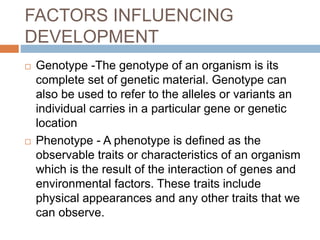
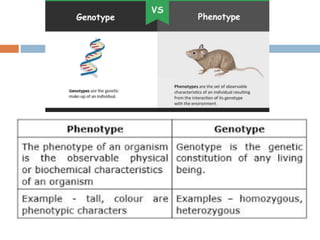
 Genotype -The genotype of an organism is its
complete set of genetic material. Genotype can
also be used to refer to the alleles or variants an
individual carries in a particular gene or genetic
location
 Phenotype - A phenotype is defined as the
observable traits or characteristics of an organism
which is the result of the interaction of genes and
environmental factors. These traits include
physical appearances and any other traits that we
can observe.
CONTEXT OF
DEVELOPMENT
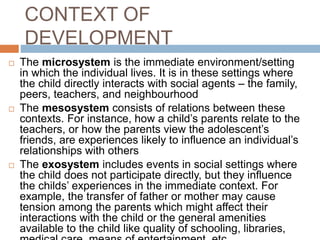
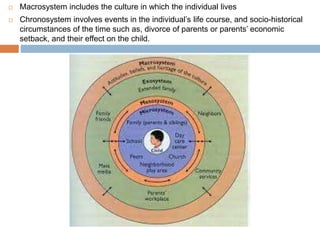
 The microsystem is the immediate environment/setting
in which the individual lives. It is in these settings where
the child directly interacts with social agents – the family,
peers, teachers, and neighbourhood
 The mesosystem consists of relations between these
contexts. For instance, how a child’s parents relate to the
teachers, or how the parents view the adolescent’s
friends, are experiences likely to influence an individual’s
relationships with others
 The exosystem includes events in social settings where
the child does not participate directly, but they influence
the childs’ experiences in the immediate context. For
example, the transfer of father or mother may cause
tension among the parents which might affect their
interactions with the child or the general amenities
available to the child like quality of schooling, libraries,
 Macrosystem includes the culture in which the individual lives
 Chronosystem involves events in the individual’s life course, and socio-historical
circumstances of the time such as, divorce of parents or parents’ economic
setback, and their effect on the child.
Developmental Stages
 Human life proceeds through different stages
 Developmental tasks refer to a physical or
cognitive skill that a person must accomplish
during a particular age period to continue
development. A developmental task for infants
is walking, which is followed by the
development of a sense of autonomy in the
toddler period.
Prenatal stage
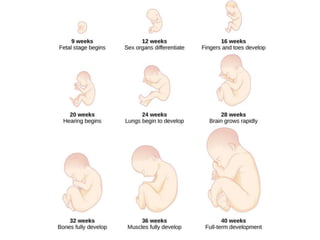
 The period from conception to birth is known as the prenatal period.
Typically, it lasts for about 40 weeks
 Prenatal development is also affected by maternal characteristics,
which include mother’s age, nutrition, and emotional state. Disease
or infection carried by the mother can adversely affect prenatal
development. For example, rubella (German measles), genital
herpes, and Human Immunodeficiency Virus (HIV) are believed to
cause genetic problems in the newborn. Another source of threat to
prenatal development is teratogens - environmental agents
that cause deviations in normal development that can lead to
serious abnormalities or death. Common teratogens include drugs,
infections, radiations, and pollution. Intake of drugs (marijuana,
heroin, cocaine, etc.), alcohol, tobacco, etc. by women during
pregnancy may have harmful effects on the foetus and increase the
frequency of congenital abnormalities. Radiations (such as X-rays),
and certain chemicals near industrial areas can cause permanent
change in the genes. Environmental pollutants and toxic wastes like
carbon monoxide, mercury and lead are also sources of danger to
the unborn child.
Infancy
 The newborns in their first week of life are able to
indicate what direction a sound is coming from, can
distinguish their mother’s voice from the voices of
other women, and can imitate simple gestures like
tongue protrusion and mouth opening
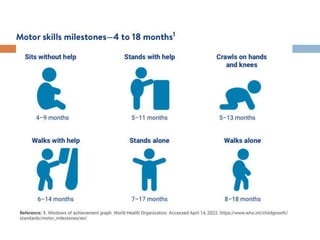
 Motor Development : The newborn’s movements are
governed by reflexes — which are automatic, built-in
responses to stimuli. They are genetically-carried
survival mechanisms, and are the building blocks for
subsequent motor development. Before the newborns
have had the opportunity to learn, reflexes act as
adaptive mechanisms. Some reflexes present in the
newborn — coughing, blinking, and yawning persist
throughout their lives. Others disappear as the brain
functions mature and voluntary control over behaviour
starts developing
Sensory Abilities
 In simple terms, sensation can be defined as
what the sensory organs do. In psychology,
sensation is defined as the process of the
sensory organs transforming physical energy
into neurological impulses the brain interprets
as the five senses of vision, smell, taste,
touch, and hearing.
Cognitive Development
 Jean Piaget stressed that children actively construct their
understanding of the world. Information does not simply enter their
minds from the environment. As children grow, additional information is
acquired and they adapt their thinking to include new ideas, as this
improves their understanding of the world. Piaget believed that a
child’s mind passes through a series of stages of thought from infancy
to adolescence. Each stage is characterised by a distinct way of
thinking and is age related.
 According to Piaget, children at this stage do not go beyond their
immediate sensory experience, i.e. lack object permanence — the
awareness that the objects continue to exist when not perceived.
Gradually by 8 months of age the child starts pursuing the object
partially covered in her/his presence.
 The basis of verbal communication seems to be present in infants.
Vocalisation begins with the infant’s babbling, sometime between 3 to
6 months of age
 Socio-emotional Development : Babies from birth are social creatures.
An infant starts preferring familiar faces and responds to parent’s
presence by cooing and gurgling. They become more mobile by 6 to 8
months of age and start showing a preference for their mother’s
company. When frightened by a new face or when separated from their
mother, they cry or show distress. On being reunited with the parent or
caregiver they reciprocate with smiles or hugs. The close emotional
bond of affection that develop between infants and their parents
(caregivers) is called attachment.
Harlow Experiment
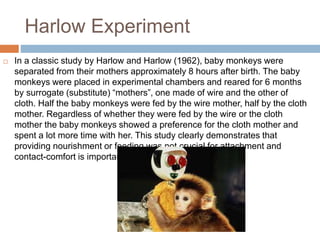
 In a classic study by Harlow and Harlow (1962), baby monkeys were
separated from their mothers approximately 8 hours after birth. The baby
monkeys were placed in experimental chambers and reared for 6 months
by surrogate (substitute) “mothers”, one made of wire and the other of
cloth. Half the baby monkeys were fed by the wire mother, half by the cloth
mother. Regardless of whether they were fed by the wire or the cloth
mother the baby monkeys showed a preference for the cloth mother and
spent a lot more time with her. This study clearly demonstrates that
providing nourishment or feeding was not crucial for attachment and
contact-comfort is important.
CHILDHOOD
 The child develops physically, gains height and weight, learns to walk,
runs, jumps, and plays with a ball.
 The child also begins to acquire the concepts of good and bad, i.e.
develops a sense of morality. During childhood, children have
increased physical capacities, can perform tasks independently, can
set goals, and meet adult expectations. The increasing maturation of
the brain along with opportunities to experience the world, contribute to
development of children’s cognitive abilities
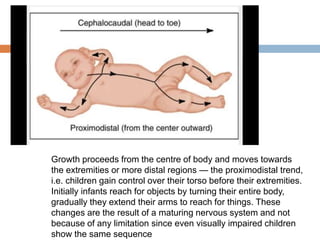
 Physical Development - Cephalocaudal means head to toe. As such,
the cephalocaudal principle refers to the general pattern of
development seen in the earliest years of postnatal development
specifically ranging from infancy into toddlerhood. The cephalocaudal
principle applies to both physical and functional development.
Growth proceeds from the centre of body and moves towards
the extremities or more distal regions — the proximodistal trend,
i.e. children gain control over their torso before their extremities.
Initially infants reach for objects by turning their entire body,
gradually they extend their arms to reach for things. These
changes are the result of a maturing nervous system and not
because of any limitation since even visually impaired children
show the same sequence
 Motor Development : Gross motor skills during the early childhood years
involve the use of arms and legs, and moving around with confidence and
more purposefully in the environment. Fine motor skills — finger dexterity
and eye-hand coordination — improve substantially during early childhood.
During these years the child’s preference for left or right hand also develops.
The major accomplishments in gross and fine motor skills during early
childhood years.
 Cognitive Development
Cognitive development in early childhood focuses on Piaget’s stage of
preoperational thought. The child gains the ability to mentally represent an
object that is not physically present.
A salient feature of preoperational thought is egocentrism (selffocus), i.e.
children see the world only in terms of their own selves and are not able to
appreciate others’ point of view. Children because of egocentrism, engage
in animism - thinking that all things are living, like oneself. They attribute life-
like qualities to inanimate objects. For example, if a child while running slips
on the road, s/he might show animism by saying “road hurt me”.
Another feature of thought during preoperational stage is characterised by
children having a tendency for centration, i.e. focusing on a single
characteristic or feature for understanding an event. For example, a child
may insist on drinking a “big glass” of juice, preferring a tall narrow glass to
a short broad one, even though both might be holding the same amount of
juice
Socio-emotional Development
 The important dimensions of children’s socio-emotional development are the
self, gender and moral development.
 According to Erikson, the way parents respond to their self-initiated activities
leads to developing a sense of initiative or sense of guilt. For example, giving
freedom and opportunities for play like cycling, running, skating, etc. and
answering children’s questions will create a sense of support for the initiative
taken. In contrast, if they are made to feel that their questions are useless, and
games played by them are stupid, the children are likely to develop feelings of
guilt over self-initiated activities, which may persist through the children’s
later life also. Selfunderstanding in early childhood is limited to defining
oneself through physical characteristics: I am tall, she has black hair, I am a
girl, etc. During middle and late childhood, the child is likely to define oneself
through internal characteristics such as, “I am smart and I am popular” or “I feel
proud when teachers assign me responsibility in school”.
Moral Development
 Another important aspect of the child’s development is
learning to differentiate between the rightness or wrongness
of human acts. The way children come to distinguish right
from wrong, to feel guilty, to put themselves in other people’s
position, and to help others when they are in trouble, are all
components of moral development. Just as children pass
through the various stages of cognitive development,
according to Lawrence Kohlberg, they pass through the
various stages of moral development, which are age related.
Kohlberg interviewed children in which they were presented
with stories in which the characters face moral dilemmas.
Children were asked what the characters in the dilemma
should do, and why. According to him, children approach
thinking about right and wrong differently at different ages.
The young child, i.e. before 9 years of age, thinks in terms of
external authority.
Adolescence
 Adolescence is commonly defined as the stage of life that begins at the
onset of puberty, when sexual maturity, or the ability to reproduce is
attained.
 Physical Development : Puberty or sexual maturity marks the end of
childhood and signifies the beginning of adolescence, which is
characterised by dramatic physical changes in both, growth rate, and
sexual characteristics. However, puberty is not a sudden event, but is part
of a gradual process. The hormones released during puberty result in the
development of primary and secondary sexual characteristics. The primary
sex characteristics include those directly related to reproduction and the
secondary sex characteristics include features or signs of achieving sexual
maturity. Pubertal changes in boys are marked by acceleration in growth,
facial hair, and changes in voice. In girls, rapid growth in height usually
begins about two years before menarche, the onset of menstruation. The
growth spurt generally begins at the age of 12 or 13 for boys and at the age
of 10 or 11 for girls. It is normal to have variations in the pubertal sequence.
For example, among two boys (or two girls) of same chronological age, one
may complete pubertal sequence before the other has begun it
 Cognitive Developmental Changes : Adolescents’
thought becomes more abstract, logical, and idealistic;
they become more capable of examining their own
thoughts, others’ thoughts, and what others are
thinking about them. Adolescents’ developing ability to
reason gives them a new level of cognitive and social
awareness. Piaget believed that formal operational
thought appears between the age of 11 and 15.
During this stage adolescent thinking expands beyond
actual concrete experiences and they begin to think
more in abstract terms and reason about them. In
addition to being abstract, adolescent thought is also
idealistic. Adolescents begin to think about ideal
characteristics for themselves and others and
compare themselves and others with these ideal
standards
 Hypothetical deductive reasoning is the ability to
think scientifically through generating predictions,
or hypotheses, about the world to answer
questions. Piaget stated that “hypothetical-
deductive reasoning” becomes important during
the formal operational stage.
 Adolescents also develop a special kind of
egocentrism. According to David Elkind, imaginary
audience and personal fable are two components
of adolescents’ egocentrism
 Identity is who you are and what your values,
commitments and beliefs are
Adulthood
 An adult is generally defined as someone who is responsible, mature, self-supporting,
and well integrated into society. There is a variation in developing these attributes, which
suggests that there is a shift in timing when an individual becomes an adult or assumes
adult roles. Some people take up jobs along with their college studies or may get married
and not pursue their studies. In early adulthood, two major tasks are, exploring the
possibilities for adult living and developing a stable life structure. The twenties represent
the novice phase of adult development. Gradually, a transition from dependence to
independence should occur. This could be marked by an image of the kind of life the
young person wants, especially in terms of marriage and a career. Career and Work :
Earning a living, choosing an occupation, and developing a career are important themes
for people in their twenties and thirties. Entering work life is a challenging event in
anyone’s life. There are apprehensions regarding different adjustments, proving one’s
competence, performance, dealing with competition, and coping with expectations both
of the employers and oneself. It is also the beginning of new roles and responsibilities.
Developing and evaluating a career becomes an important task of adulthood. Marriage,
Parenthood, and Family : The adjustments that young adults have to make when
entering a marriage relate to knowing the other person if not known earlier, coping with
each other’s likes, dislikes, tastes, and choices. If both the partners are working,
adjustments are required regarding sharing and performing roles and responsibilities at
home.
Old age
 Retirement from active vocational life is quite significant.
Some people perceive retirement as a negative change. They
consider it as a separation from an important source of
satisfaction and self-esteem. Others view it as a shift in life
with more time to pursue their own interests. It is seen that
older adults who show openness to new experiences, more
striving and achievementoriented behaviour prefer to keep
busy and are better adjusted. Older adults also need to adjust
to changes in the family structure and new roles (grand
parenting) that have to be learnt. Children usually are busy in
their careers and families and may set up independent
homes. Older adults may depend on their children for
financial support and to overcome their loneliness (after
children have moved out). This might trigger-off feelings of
hopelessness and depression in some people.

Human Development.pptx

  • 1.
  • 2.
    Development  Development isthe pattern of progressive, orderly, and predictable changes that begin at conception and continue throughout life. Development mostly involves changes — both growth and decline, as observed during old age.  Development is influenced by an interplay of biological, cognitive, and socio-emotional processes.  Development due to genes inherited from parents, such as in height and weight, brain, heart, and lungs development, etc. all point towards the role of biological processes
  • 3.
     The roleof cognitive processes in development relate to mental activities associated with the processes of knowing, and experiencing, such as thought, perception, attention, problem solving, etc  Socio-emotional processes that influence development refer to changes in an individual’s interactions with other people, changes in emotions, and in personality. A child’s hug to her/his mother, a young girl’s affectionate gesture to her/his sibling, or an adolescent’s sorrow at losing a match are all reflections of socio- emotional processes deeply involved in human development  These processes influence changes in the
  • 4.
    Life-Span Perspective on Development The study of development according to the Life-Span Perspective (LSP) includes the following assumptions :  1. Development is lifelong, i.e. it takes place across all age gr oups starting from conception to old age. It includes both gains and losses, which interact in dynamic (change in one aspect goes with changes in others) ways throughout the life-span.  2. The various processes of human development, i.e. biological, cognitive, and socio-emotional are interwoven in the development of a person throughout the life-span.  3. Development is multi-directional. Some dimensions or components of a given dimension of development may increase, while others show decrement. For example, the experiences of adults may make them wiser and guide their decisions. However, with an increase in age, one’s performance is likely to decrease on tasks requiring speed, such as running.  4. Development is highly plastic, i.e. within person, modifiability is found in psychological development, though plasticity varies among individuals. This means skills and abilities can be improved or developed throughout the life- span.
  • 5.
     Development isinfluenced by historical conditions. For example, the experiences of 20-year olds who lived through the freedom struggle in India would be very different from the experiences of 20 year olds of today. The career orientation of school students today is very different from those students who were in schools 50 years ago.  6. Development is the concern of a number of disciplines. Different disciplines like psychology, anthropology, sociology, and neuro- sciences study human development, each trying to provide answers to development throughout the life-span.  7. An individual responds and acts on contexts, which include what was inherited, the physical environment, social, historical, and cultural contexts. For example, the life events in everyone’s life are not the same, such as, death of a parent, accident, earthquake, etc., affect the course of one’s life as also the positive influences such as winning an award or getting a good job. People keep on changing with changing contexts.
  • 6.
    FACTORS INFLUENCING DEVELOPMENT  Genotype-The genotype of an organism is its complete set of genetic material. Genotype can also be used to refer to the alleles or variants an individual carries in a particular gene or genetic location  Phenotype - A phenotype is defined as the observable traits or characteristics of an organism which is the result of the interaction of genes and environmental factors. These traits include physical appearances and any other traits that we can observe.
  • 8.
    CONTEXT OF DEVELOPMENT  Themicrosystem is the immediate environment/setting in which the individual lives. It is in these settings where the child directly interacts with social agents – the family, peers, teachers, and neighbourhood  The mesosystem consists of relations between these contexts. For instance, how a child’s parents relate to the teachers, or how the parents view the adolescent’s friends, are experiences likely to influence an individual’s relationships with others  The exosystem includes events in social settings where the child does not participate directly, but they influence the childs’ experiences in the immediate context. For example, the transfer of father or mother may cause tension among the parents which might affect their interactions with the child or the general amenities available to the child like quality of schooling, libraries,
  • 9.
     Macrosystem includesthe culture in which the individual lives  Chronosystem involves events in the individual’s life course, and socio-historical circumstances of the time such as, divorce of parents or parents’ economic setback, and their effect on the child.
  • 10.
    Developmental Stages  Humanlife proceeds through different stages  Developmental tasks refer to a physical or cognitive skill that a person must accomplish during a particular age period to continue development. A developmental task for infants is walking, which is followed by the development of a sense of autonomy in the toddler period.
  • 12.
    Prenatal stage  Theperiod from conception to birth is known as the prenatal period. Typically, it lasts for about 40 weeks  Prenatal development is also affected by maternal characteristics, which include mother’s age, nutrition, and emotional state. Disease or infection carried by the mother can adversely affect prenatal development. For example, rubella (German measles), genital herpes, and Human Immunodeficiency Virus (HIV) are believed to cause genetic problems in the newborn. Another source of threat to prenatal development is teratogens - environmental agents that cause deviations in normal development that can lead to serious abnormalities or death. Common teratogens include drugs, infections, radiations, and pollution. Intake of drugs (marijuana, heroin, cocaine, etc.), alcohol, tobacco, etc. by women during pregnancy may have harmful effects on the foetus and increase the frequency of congenital abnormalities. Radiations (such as X-rays), and certain chemicals near industrial areas can cause permanent change in the genes. Environmental pollutants and toxic wastes like carbon monoxide, mercury and lead are also sources of danger to the unborn child.
  • 13.
    Infancy  The newbornsin their first week of life are able to indicate what direction a sound is coming from, can distinguish their mother’s voice from the voices of other women, and can imitate simple gestures like tongue protrusion and mouth opening  Motor Development : The newborn’s movements are governed by reflexes — which are automatic, built-in responses to stimuli. They are genetically-carried survival mechanisms, and are the building blocks for subsequent motor development. Before the newborns have had the opportunity to learn, reflexes act as adaptive mechanisms. Some reflexes present in the newborn — coughing, blinking, and yawning persist throughout their lives. Others disappear as the brain functions mature and voluntary control over behaviour starts developing
  • 15.
    Sensory Abilities  Insimple terms, sensation can be defined as what the sensory organs do. In psychology, sensation is defined as the process of the sensory organs transforming physical energy into neurological impulses the brain interprets as the five senses of vision, smell, taste, touch, and hearing.
  • 16.
    Cognitive Development  JeanPiaget stressed that children actively construct their understanding of the world. Information does not simply enter their minds from the environment. As children grow, additional information is acquired and they adapt their thinking to include new ideas, as this improves their understanding of the world. Piaget believed that a child’s mind passes through a series of stages of thought from infancy to adolescence. Each stage is characterised by a distinct way of thinking and is age related.  According to Piaget, children at this stage do not go beyond their immediate sensory experience, i.e. lack object permanence — the awareness that the objects continue to exist when not perceived. Gradually by 8 months of age the child starts pursuing the object partially covered in her/his presence.  The basis of verbal communication seems to be present in infants. Vocalisation begins with the infant’s babbling, sometime between 3 to 6 months of age
  • 17.
     Socio-emotional Development: Babies from birth are social creatures. An infant starts preferring familiar faces and responds to parent’s presence by cooing and gurgling. They become more mobile by 6 to 8 months of age and start showing a preference for their mother’s company. When frightened by a new face or when separated from their mother, they cry or show distress. On being reunited with the parent or caregiver they reciprocate with smiles or hugs. The close emotional bond of affection that develop between infants and their parents (caregivers) is called attachment.
  • 18.
    Harlow Experiment  Ina classic study by Harlow and Harlow (1962), baby monkeys were separated from their mothers approximately 8 hours after birth. The baby monkeys were placed in experimental chambers and reared for 6 months by surrogate (substitute) “mothers”, one made of wire and the other of cloth. Half the baby monkeys were fed by the wire mother, half by the cloth mother. Regardless of whether they were fed by the wire or the cloth mother the baby monkeys showed a preference for the cloth mother and spent a lot more time with her. This study clearly demonstrates that providing nourishment or feeding was not crucial for attachment and contact-comfort is important.
  • 19.
    CHILDHOOD  The childdevelops physically, gains height and weight, learns to walk, runs, jumps, and plays with a ball.  The child also begins to acquire the concepts of good and bad, i.e. develops a sense of morality. During childhood, children have increased physical capacities, can perform tasks independently, can set goals, and meet adult expectations. The increasing maturation of the brain along with opportunities to experience the world, contribute to development of children’s cognitive abilities  Physical Development - Cephalocaudal means head to toe. As such, the cephalocaudal principle refers to the general pattern of development seen in the earliest years of postnatal development specifically ranging from infancy into toddlerhood. The cephalocaudal principle applies to both physical and functional development.
  • 20.
    Growth proceeds fromthe centre of body and moves towards the extremities or more distal regions — the proximodistal trend, i.e. children gain control over their torso before their extremities. Initially infants reach for objects by turning their entire body, gradually they extend their arms to reach for things. These changes are the result of a maturing nervous system and not because of any limitation since even visually impaired children show the same sequence
  • 21.
     Motor Development: Gross motor skills during the early childhood years involve the use of arms and legs, and moving around with confidence and more purposefully in the environment. Fine motor skills — finger dexterity and eye-hand coordination — improve substantially during early childhood. During these years the child’s preference for left or right hand also develops. The major accomplishments in gross and fine motor skills during early childhood years.  Cognitive Development Cognitive development in early childhood focuses on Piaget’s stage of preoperational thought. The child gains the ability to mentally represent an object that is not physically present. A salient feature of preoperational thought is egocentrism (selffocus), i.e. children see the world only in terms of their own selves and are not able to appreciate others’ point of view. Children because of egocentrism, engage in animism - thinking that all things are living, like oneself. They attribute life- like qualities to inanimate objects. For example, if a child while running slips on the road, s/he might show animism by saying “road hurt me”. Another feature of thought during preoperational stage is characterised by children having a tendency for centration, i.e. focusing on a single characteristic or feature for understanding an event. For example, a child may insist on drinking a “big glass” of juice, preferring a tall narrow glass to a short broad one, even though both might be holding the same amount of juice
  • 22.
    Socio-emotional Development  Theimportant dimensions of children’s socio-emotional development are the self, gender and moral development.  According to Erikson, the way parents respond to their self-initiated activities leads to developing a sense of initiative or sense of guilt. For example, giving freedom and opportunities for play like cycling, running, skating, etc. and answering children’s questions will create a sense of support for the initiative taken. In contrast, if they are made to feel that their questions are useless, and games played by them are stupid, the children are likely to develop feelings of guilt over self-initiated activities, which may persist through the children’s later life also. Selfunderstanding in early childhood is limited to defining oneself through physical characteristics: I am tall, she has black hair, I am a girl, etc. During middle and late childhood, the child is likely to define oneself through internal characteristics such as, “I am smart and I am popular” or “I feel proud when teachers assign me responsibility in school”.
  • 23.
    Moral Development  Anotherimportant aspect of the child’s development is learning to differentiate between the rightness or wrongness of human acts. The way children come to distinguish right from wrong, to feel guilty, to put themselves in other people’s position, and to help others when they are in trouble, are all components of moral development. Just as children pass through the various stages of cognitive development, according to Lawrence Kohlberg, they pass through the various stages of moral development, which are age related. Kohlberg interviewed children in which they were presented with stories in which the characters face moral dilemmas. Children were asked what the characters in the dilemma should do, and why. According to him, children approach thinking about right and wrong differently at different ages. The young child, i.e. before 9 years of age, thinks in terms of external authority.
  • 24.
    Adolescence  Adolescence iscommonly defined as the stage of life that begins at the onset of puberty, when sexual maturity, or the ability to reproduce is attained.  Physical Development : Puberty or sexual maturity marks the end of childhood and signifies the beginning of adolescence, which is characterised by dramatic physical changes in both, growth rate, and sexual characteristics. However, puberty is not a sudden event, but is part of a gradual process. The hormones released during puberty result in the development of primary and secondary sexual characteristics. The primary sex characteristics include those directly related to reproduction and the secondary sex characteristics include features or signs of achieving sexual maturity. Pubertal changes in boys are marked by acceleration in growth, facial hair, and changes in voice. In girls, rapid growth in height usually begins about two years before menarche, the onset of menstruation. The growth spurt generally begins at the age of 12 or 13 for boys and at the age of 10 or 11 for girls. It is normal to have variations in the pubertal sequence. For example, among two boys (or two girls) of same chronological age, one may complete pubertal sequence before the other has begun it
  • 25.
     Cognitive DevelopmentalChanges : Adolescents’ thought becomes more abstract, logical, and idealistic; they become more capable of examining their own thoughts, others’ thoughts, and what others are thinking about them. Adolescents’ developing ability to reason gives them a new level of cognitive and social awareness. Piaget believed that formal operational thought appears between the age of 11 and 15. During this stage adolescent thinking expands beyond actual concrete experiences and they begin to think more in abstract terms and reason about them. In addition to being abstract, adolescent thought is also idealistic. Adolescents begin to think about ideal characteristics for themselves and others and compare themselves and others with these ideal standards
  • 26.
     Hypothetical deductivereasoning is the ability to think scientifically through generating predictions, or hypotheses, about the world to answer questions. Piaget stated that “hypothetical- deductive reasoning” becomes important during the formal operational stage.  Adolescents also develop a special kind of egocentrism. According to David Elkind, imaginary audience and personal fable are two components of adolescents’ egocentrism  Identity is who you are and what your values, commitments and beliefs are
  • 27.
    Adulthood  An adultis generally defined as someone who is responsible, mature, self-supporting, and well integrated into society. There is a variation in developing these attributes, which suggests that there is a shift in timing when an individual becomes an adult or assumes adult roles. Some people take up jobs along with their college studies or may get married and not pursue their studies. In early adulthood, two major tasks are, exploring the possibilities for adult living and developing a stable life structure. The twenties represent the novice phase of adult development. Gradually, a transition from dependence to independence should occur. This could be marked by an image of the kind of life the young person wants, especially in terms of marriage and a career. Career and Work : Earning a living, choosing an occupation, and developing a career are important themes for people in their twenties and thirties. Entering work life is a challenging event in anyone’s life. There are apprehensions regarding different adjustments, proving one’s competence, performance, dealing with competition, and coping with expectations both of the employers and oneself. It is also the beginning of new roles and responsibilities. Developing and evaluating a career becomes an important task of adulthood. Marriage, Parenthood, and Family : The adjustments that young adults have to make when entering a marriage relate to knowing the other person if not known earlier, coping with each other’s likes, dislikes, tastes, and choices. If both the partners are working, adjustments are required regarding sharing and performing roles and responsibilities at home.
  • 28.
    Old age  Retirementfrom active vocational life is quite significant. Some people perceive retirement as a negative change. They consider it as a separation from an important source of satisfaction and self-esteem. Others view it as a shift in life with more time to pursue their own interests. It is seen that older adults who show openness to new experiences, more striving and achievementoriented behaviour prefer to keep busy and are better adjusted. Older adults also need to adjust to changes in the family structure and new roles (grand parenting) that have to be learnt. Children usually are busy in their careers and families and may set up independent homes. Older adults may depend on their children for financial support and to overcome their loneliness (after children have moved out). This might trigger-off feelings of hopelessness and depression in some people.