Chapter 1:
Basic Concepts and Methods
In This Chapter
 Introduction to Human Development
 Key Issues in the Study of Human
Development
 Research Methods and Designs
An Introduction to Human
Development
Human Development: Scientific study of
age-related changes in:
• Behavior
• Thinking
• Emotion
• Personality
An entire lifespan!
Philosophical Roots
Original Sin
Augustine of Hippo
 Humans are born selfish and must seek
spiritual rebirth.
Developmental Outcomes
 Individuals struggle to overcome immoral
actions.
Philosophical and Scientific Roots
Innate Goodness
Jean-Jacques Rousseau
• Emphasis on children and basic
goodness of human nature
• Nurturance and protection needed
Developmental Outcomes
• Children’s environment interferes or
encourages
Philosophical and Scientific Roots
The Blank Slate
John Locke
• Empiricism
• Children as passive recipients of
environmental experiences
Developmental Outcomes
• Individual differences due to
experience
Early Scientific Theories
Charles Darwin
First organized study of human development
Evolution
 Interplay of genetics and environmental
adaptation
Baby biographies
 Detailed records of his own children’s
early years
Early Scientific Theories
First scientific study of child development
G. Stanley Hall
 Psychologist
 Emphasis on norms or average ages
at which developmental milestones
occur
 Coined “storm and stress”
(adolescence)
The Lifespan Perspective
Overview
Important changes occur in each period of
development.
Children and adults experience major life
passages.
Increased longevity
Early Scientific Theories
Systematic description of children across
domains, particularly in the first five years
of life
Arnold Gesell
 Maturation occurs “naturally” from
genetically programmed sequence.
 Used movie cameras, one-way mirrors
The Lifespan Perspective
Paul Baltes
• Multi-contextual nature of development
• Plasticity and adaptability at all ages
• Interdisciplinary perspective and research
• With age, strategies used to maximize gain
and compensate for losses
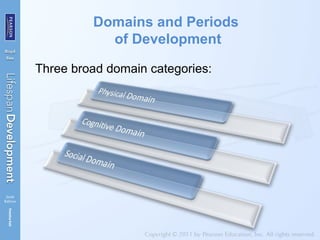
Domains and Periods
of Development
Three broad domain categories:
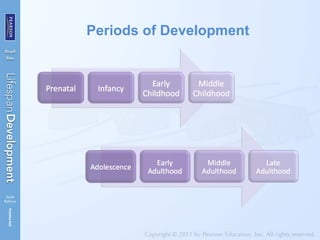
Periods of Development
Stop and Think!
What marks the end of each of
these periods of development?
How do you know?
Key Issues in the Study of Human
Development
Nature versus Nurture
Nature
 Inborn propensities; biological influences
 Inborn biases
Nurture
 Learning from environmental experiences
 Internal models of experience
Continuity versus Discontinuity
Continuity = Quantitative change in
amount or degree
Discontinuity = Qualitative, step-like
change
What are the advantages and
disadvantages of each kind of
change?
Another Way to Look at It!
If development consists only of additions,
the concept of stages is not needed.
If development involves reorganization or
emergence strategies, quality, or skills,
than stages are useful.
Three Kinds of Change
Qualitative Changes in Kind or Type
Normative age-graded universal changes
 Social clock or age norms
Normative history-graded changes
 Cohort or generational effects
Non-normative changes
 Unique, unshared changes or individual
differences
Contexts of Development
Vulnerability and Resilience
 Vulnerabilities and protective factors interact
with a child’s environment.
 Environments cause differential effects.
 Resilient children gain support from optimal
environments.
Contexts of Development
Gender
Gender matters.
 Influences individual development
 Interaction between characteristics and
environment influences and is influenced by
gender.
Contexts of Development
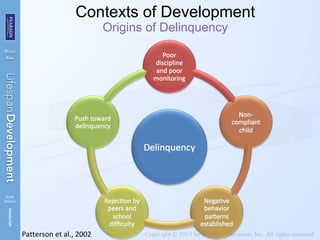
Origins of Delinquency
Patterson et al., 2002
Contexts of Development
Individual differences related to timing
 Critical period
 Sensitive period
 On-time events
 Off-time events
 Atypical development
 “Double Whammy”
Now that you have heard several issues, which
do you think are more important in
understanding development—nature issues
or nurture issues? Why?
What part of the life span interests you the
most? What issues would you like to learn
about the most?
Questions To PonderQuestions To PonderQuestions To PonderQuestions To Ponder
Research Methods and Designs
Are theories and hypotheses the same?
 Theories
 Predictions or hypotheses
The Goals of Developmental Science
 Describe development
 Explain development
 Predict developmental event
 Influence some developmental
outcome
Descriptive Methods
Variables: characteristics that vary across
people
Relationship: when two or more variables
vary together
Can you think of two variables we could
study to learn about our class?
Descriptive Methods
Naturalistic Observations
Descriptive methods: ways to identify
relationship
• People observed in their normal
environments
• Potential observer biases
• Limited generalizability
• Time consuming
Descriptive Methods
Case Studies and Laboratory
Observations
Case Studies
 In-depth examination of a single
individual
Laboratory Observations
 Controlled setting for study
Descriptive Methods
Surveys, Interviews and Questionnaires
Two broad survey areas:
 Questionnaires
 Interviews
Methods
 Questions asked; answers recorded
 Samples used
Correlations
Correlations
 Describe the strength of the relationship
between two variables
Positive correlation
 High scores on one variable usually
accompany high scores on the other.
Negative correlation
 Scores on two variables move in opposite
directions.
Limitations of Correlations
Correlation is NOT causality.
• Correlations measure the level or degree
of covariation between two variables.
• They do not prove causal relationships.
Experimental Designs
 Test causal hypotheses.
 Randomly assign participants to different
treatment and control groups.
 Experimental (treatment) group
 Control group
Experimental Designs
Variables
Independent variable or “cause”
Dependent variable or “effect”
 The dependent variable depends on
the “cause.”
Quasi-experiments
 Participants not randomly assigned
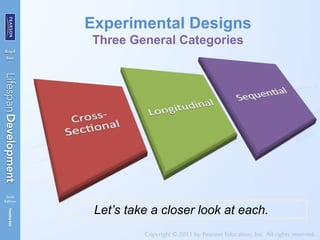
Experimental Designs
Three General Categories
Let’s take a closer look at each.
Designs to Study Age-Related
Changes
Cross-Sectional Designs
 People studied from different age groups at
same time point
 Can indicate possible age differences or
age changes
 But age-related differences may become
confused with cohort or generational
effects.
Birth Cohort or Generational Effects
 Different generations have unique
experiences.
 Cohort and generational effects can
become entangled.
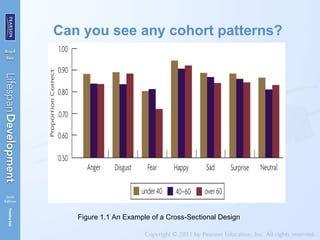
Can you see any cohort patterns?
Figure 1.1 An Example of a Cross-Sectional Design
Designs to Study Age-Related
Changes
Longitudinal Designs
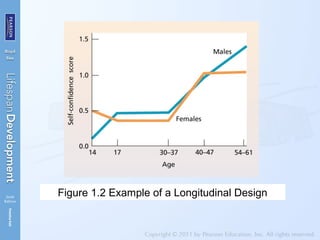
 Same individuals studied over a period of
time
 Individual consistencies and
inconsistencies can be observed.
 Net change assessed over time in the
same people.
Longitudinal Designs:
Some Problems
 Practice or testing affect
 Study attrition
Figure 1.2 Example of a Longitudinal Design
Designs to Study Age-Related
Changes
Sequential Designs
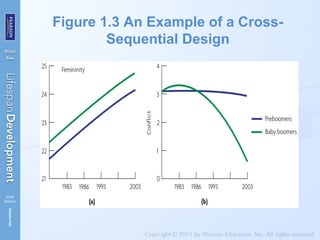
 Combined groups from at least two cohorts
followed in a longitudinal study
 Comparison of cohorts while incorporating
some degree of individual differences
 Both aging AND cohort effects are possible.
Figure 1.3 An Example of a Cross-
Sequential Design
Cross-Cultural Research
Ethnographies
 In-depth descriptions of single culture or
context
 May compare two or more cultures or
subcultures
 Can provide both descriptive and interpretive
information
Cross-Cultural Research
Benefits
Cross-cultural Studies
• Search for universal and unique
developmental changes
• Demonstrate degree of environmental
variation within human development
Research Ethics
Ethics: broad ethical principles for responsible
conduct of research and use of any
outcomes resulting from research
In Research:
 Protection of animal rights and human
subjects
 Universities, government, and organizations
often have Institutional Review Boards
(IRBs).
Research Ethics
 Protection from harm
 Informed consent
 Confidentiality
 Knowledge of result
 Deception

Boyd ppt ch1_f

  • 1.
  • 2.
    In This Chapter Introduction to Human Development  Key Issues in the Study of Human Development  Research Methods and Designs
  • 3.
    An Introduction toHuman Development Human Development: Scientific study of age-related changes in: • Behavior • Thinking • Emotion • Personality An entire lifespan!
  • 4.
    Philosophical Roots Original Sin Augustineof Hippo  Humans are born selfish and must seek spiritual rebirth. Developmental Outcomes  Individuals struggle to overcome immoral actions.
  • 5.
    Philosophical and ScientificRoots Innate Goodness Jean-Jacques Rousseau • Emphasis on children and basic goodness of human nature • Nurturance and protection needed Developmental Outcomes • Children’s environment interferes or encourages
  • 6.
    Philosophical and ScientificRoots The Blank Slate John Locke • Empiricism • Children as passive recipients of environmental experiences Developmental Outcomes • Individual differences due to experience
  • 7.
    Early Scientific Theories CharlesDarwin First organized study of human development Evolution  Interplay of genetics and environmental adaptation Baby biographies  Detailed records of his own children’s early years
  • 8.
    Early Scientific Theories Firstscientific study of child development G. Stanley Hall  Psychologist  Emphasis on norms or average ages at which developmental milestones occur  Coined “storm and stress” (adolescence)
  • 9.
    The Lifespan Perspective Overview Importantchanges occur in each period of development. Children and adults experience major life passages. Increased longevity
  • 10.
    Early Scientific Theories Systematicdescription of children across domains, particularly in the first five years of life Arnold Gesell  Maturation occurs “naturally” from genetically programmed sequence.  Used movie cameras, one-way mirrors
  • 11.
    The Lifespan Perspective PaulBaltes • Multi-contextual nature of development • Plasticity and adaptability at all ages • Interdisciplinary perspective and research • With age, strategies used to maximize gain and compensate for losses
  • 12.
    Domains and Periods ofDevelopment Three broad domain categories:
  • 13.
  • 14.
    Stop and Think! Whatmarks the end of each of these periods of development? How do you know?
  • 15.
    Key Issues inthe Study of Human Development Nature versus Nurture Nature  Inborn propensities; biological influences  Inborn biases Nurture  Learning from environmental experiences  Internal models of experience
  • 16.
    Continuity versus Discontinuity Continuity= Quantitative change in amount or degree Discontinuity = Qualitative, step-like change What are the advantages and disadvantages of each kind of change?
  • 17.
    Another Way toLook at It! If development consists only of additions, the concept of stages is not needed. If development involves reorganization or emergence strategies, quality, or skills, than stages are useful.
  • 18.
    Three Kinds ofChange Qualitative Changes in Kind or Type Normative age-graded universal changes  Social clock or age norms Normative history-graded changes  Cohort or generational effects Non-normative changes  Unique, unshared changes or individual differences
  • 19.
    Contexts of Development Vulnerabilityand Resilience  Vulnerabilities and protective factors interact with a child’s environment.  Environments cause differential effects.  Resilient children gain support from optimal environments.
  • 20.
    Contexts of Development Gender Gendermatters.  Influences individual development  Interaction between characteristics and environment influences and is influenced by gender.
  • 21.
    Contexts of Development Originsof Delinquency Patterson et al., 2002
  • 22.
    Contexts of Development Individualdifferences related to timing  Critical period  Sensitive period  On-time events  Off-time events  Atypical development  “Double Whammy”
  • 23.
    Now that youhave heard several issues, which do you think are more important in understanding development—nature issues or nurture issues? Why? What part of the life span interests you the most? What issues would you like to learn about the most? Questions To PonderQuestions To PonderQuestions To PonderQuestions To Ponder
  • 24.
    Research Methods andDesigns Are theories and hypotheses the same?  Theories  Predictions or hypotheses
  • 25.
    The Goals ofDevelopmental Science  Describe development  Explain development  Predict developmental event  Influence some developmental outcome
  • 26.
    Descriptive Methods Variables: characteristicsthat vary across people Relationship: when two or more variables vary together Can you think of two variables we could study to learn about our class?
  • 27.
    Descriptive Methods Naturalistic Observations Descriptivemethods: ways to identify relationship • People observed in their normal environments • Potential observer biases • Limited generalizability • Time consuming
  • 28.
    Descriptive Methods Case Studiesand Laboratory Observations Case Studies  In-depth examination of a single individual Laboratory Observations  Controlled setting for study
  • 29.
    Descriptive Methods Surveys, Interviewsand Questionnaires Two broad survey areas:  Questionnaires  Interviews Methods  Questions asked; answers recorded  Samples used
  • 30.
    Correlations Correlations  Describe thestrength of the relationship between two variables Positive correlation  High scores on one variable usually accompany high scores on the other. Negative correlation  Scores on two variables move in opposite directions.
  • 31.
    Limitations of Correlations Correlationis NOT causality. • Correlations measure the level or degree of covariation between two variables. • They do not prove causal relationships.
  • 32.
    Experimental Designs  Testcausal hypotheses.  Randomly assign participants to different treatment and control groups.  Experimental (treatment) group  Control group
  • 33.
    Experimental Designs Variables Independent variableor “cause” Dependent variable or “effect”  The dependent variable depends on the “cause.” Quasi-experiments  Participants not randomly assigned
  • 34.
    Experimental Designs Three GeneralCategories Let’s take a closer look at each.
  • 35.
    Designs to StudyAge-Related Changes Cross-Sectional Designs  People studied from different age groups at same time point  Can indicate possible age differences or age changes  But age-related differences may become confused with cohort or generational effects.
  • 36.
    Birth Cohort orGenerational Effects  Different generations have unique experiences.  Cohort and generational effects can become entangled.
  • 37.
    Can you seeany cohort patterns? Figure 1.1 An Example of a Cross-Sectional Design
  • 38.
    Designs to StudyAge-Related Changes Longitudinal Designs  Same individuals studied over a period of time  Individual consistencies and inconsistencies can be observed.  Net change assessed over time in the same people.
  • 39.
    Longitudinal Designs: Some Problems Practice or testing affect  Study attrition
  • 40.
    Figure 1.2 Exampleof a Longitudinal Design
  • 41.
    Designs to StudyAge-Related Changes Sequential Designs  Combined groups from at least two cohorts followed in a longitudinal study  Comparison of cohorts while incorporating some degree of individual differences  Both aging AND cohort effects are possible.
  • 42.
    Figure 1.3 AnExample of a Cross- Sequential Design
  • 43.
    Cross-Cultural Research Ethnographies  In-depthdescriptions of single culture or context  May compare two or more cultures or subcultures  Can provide both descriptive and interpretive information
  • 44.
    Cross-Cultural Research Benefits Cross-cultural Studies •Search for universal and unique developmental changes • Demonstrate degree of environmental variation within human development
  • 45.
    Research Ethics Ethics: broadethical principles for responsible conduct of research and use of any outcomes resulting from research In Research:  Protection of animal rights and human subjects  Universities, government, and organizations often have Institutional Review Boards (IRBs).
  • 46.
    Research Ethics  Protectionfrom harm  Informed consent  Confidentiality  Knowledge of result  Deception

Editor's Notes

  • #5 The Christian notion of original sin teaches that children are born with a selfish nature and must be spiritually reborn.
  • #6 French philosopher Jean-Jacques Rousseau also believed in the idea of interaction between internal and external forces, but he claimed that all human beings are naturally good and seek out experiences that help them grow. For Rousseau, the goal of human development was to achieve one’s inborn potential. Deprivation leads to frustration and anger.
  • #7 John Locke insisted that at birth the mind is a blank slate—in Latin, a tabula rasa. All knowledge, he argued, is created by experience.
  • #8 Darwin’s baby biographies; the concept of developmental stages
  • #9 Hall: “Contents of children’s minds on entering school” (1891)
  • #10 Children and adults experience major life passages. Parenthood Retirement Paul Baltes—capacity for positive change—plasticity; positive aspects of advanced age; development of strategies to maximize gains and compensate for losses
  • #11 Hall: “Contents of children’s minds on entering school” (1891);
  • #12 As we age, use strategies to maximize gain and compensate for losses. Emphasis on positive aspects of advancing age
  • #13 Using domain classifications helps to organize discussions of human development. Physical: change in size, shape, characteristics of body; change is how individuals sense and perceive world Cognitive: change in thinking, memory, problem-solving, and other intellectual skills; examination of individual differences among children and adults related to intradomain variables Social: relationship of individual with others; individual development in social skills, personality, and individual beliefs about others
  • #16 Nature versus nurture, also referred to as heredity versus environment or nativism versus empiricism. Picture of John Watson, early behaviorist who exemplifies the nurture arguments As Watson put it, Give me a dozen healthy infants, well-formed, and my own specified world to bring them up in and I’ll guarantee to take any one at random and train him to become any type of specialist I might select—doctor, lawyer, merchant, chief, and yes, even beggar-man and thief, regardless of his talents, penchants, abilities, vocations, and the race of his ancestors. (1930, p. 104)
  • #17 Development involves reorganization. Qualitative changes in kind or type Emergence of wholly new strategies, qualities, or skills (qualitative change) Stage theories Qualitatively distinct periods of development
  • #18 Development involves reorganization. Qualitative changes in kind or type Emergence of wholly new strategies, qualities, or skills (qualitative change) Stage theories Qualitatively distinct periods of development
  • #19 Group-specific changes are shared by all individuals in a particular group (such as a culture) with its own system of customs, values, attitudes, laws, moral guidelines and ways of living. Historical context examines which historical forces shape the similarities and differences that affect each generation. Individual differences include genetics; timing and critical periods; on-time and off-time events; atypical development.
  • #20 The same environment can affect different children differently. Effect depends on the qualities a child brings to interactions.
  • #23 Ask: Can you provide examples? Critical period Sensitive period On-time events When most members of a society experience events such as marriage Off-time events Atypical development Mental retardation, psychopathology
  • #24 These questions would be good for general discussion, use with small groups, or writing assignments.  As writing assignments, students who are given choices to write about display more intrinsic motivation. Students can write about one or more questions per chapter and writings can be kept in a journal for collections at later times in the semester rather than on a daily or weekly basis.  They may also serve as part of participation grades in the class.
  • #25 Theories: sets of statements that propose general principles of development Hypothesis: an educated guess that is testable by data collection
  • #26 Describe development State what happens. Explain development Why events and changes occur Predict developmental events Predictions/hypotheses produced by useful theories Influence some developmental outcomes For example: memory declines
  • #27 Variable EXAMPLE: years of age One variable can relate to another variable. EXAMPLE: years of age and memory decline
  • #28 Observe people in their normal environments; includes schools or assisted living facilities
  • #29 Case Studies In-depth examination of a single individual Useful in making decisions about individuals Frequently basis of important hypotheses about unusual developmental events
  • #30 Ask people questions and record their answers. Use samples Subsets of a total collection (population) of people People’s answers may be affected by perceived social desirability.
  • #31 Correlations range from -1.00 to +1.00. Describe the strength of the relationship between two variables A “0” means two variables are not related. Positive correlation High scores on one variable usually accompany high scores on the other: Better-educated people generally have higher family incomes. Negative correlation Scores on the two variables move in opposite directions: Better-educated people are less likely to smoke cigarettes
  • #32 A large correlation between two variables does NOT mean one variable caused the other.
  • #33 Randomly assign participants to different treatment and control groups. The experimental group gets a treatment the experimenter thinks will produce a particular effect. The control group gets no treatment or neutral treatment.
  • #34 Quasi-experiments Participants not randomly assigned For example, children in daycare programs may be compared with children kept at home.
  • #35 Quasi-experiments Participants not randomly assigned For example, children in daycare programs may be compared with children kept at home.
  • #36 Cross-sectional research very useful because it is relatively quick to do. It can indicate possible age differences or age changes. But age-related differences may become confused with cohort or generational effects. Cohort: age-related differences due to grouping by age
  • #37 Different generations can have unique experiences. Your generation grew up with computers. 100 years ago, people didn’t have radio. Your great-grandparents may have lived through World War II or the Great Depression of the 1930s. When (and where) you were born could affect nutrition, sleeping arrangements, or your age at marriage. In cross-sectional studies or “one-shots,” cohort and aging effects may become entangled.
  • #38 In this study, researchers compared the ability to recognize various kinds of facial expression across young adult, middle-aged adult, and older adult groups.
  • #39 Some studies last for several years. The Berkeley/Oakland Growth Study continued for several decades.
  • #40 “Practice” or “testing” effects can occur when people are repeatedly studied. Study “attrition” People die, move away, stop participating. Better-educated, healthier people more often remain in the study. This can create biases in studying aging.
  • #41 Cohort: age-related differences due to grouping by age.
  • #42 Sequential designs allow for comparison of cohorts while incorporating some degree of individual differences. Age-group comparisons provide the same kind of information as a cross-sectional study would. Comparisons of the scores or behaviors of participants in each group to their own scores or behaviors at an earlier testing point provide longitudinal evidence at the same time. Sequential designs also allow for comparisons of cohorts.
  • #44 May compare two or more cultures or subcultures; perhaps particular age or ethnic groups
  • #45 Cross-cultural studies search for universal and unique developmental changes. Hope to improve people’s lives EXAMPLE: Encourage more cooperation by learning from collectivist cultures.
  • #46 Universities, government, and organizations often have Institutional Review Boards (IRBs). Often called “Human Subjects Committees.” Special attention paid to studies of children, pregnant women, and individuals with learning or other disabilities
  • #47 Protection from harm: We protect participants from harm. Informed Consent: Participants learn possible risks and benefits of the study; ability to withdraw without retribution. Confidentiality: Research data is kept confidential. Knowledge of Result: Participants are given information about results. Deception: Any deception is explained to participants after data are collected.