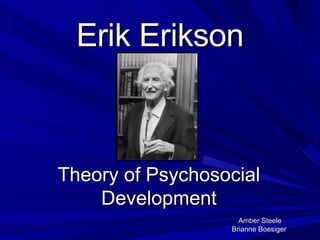
Erik Erikson Amber Steele Brianne Boesiger  Theory of Psychosocial Development
Erik Erikson 1902 - 1994
Timeline- The Early Years 1902- Born in Frankfurt, Germany 1911- Is adopted by step-father Theodor Homburger  1919- Begins travels throughout Europe
Timeline- Young Adulthood 1927- Becomes teacher at Hietzing School in Vienna 1928- Studies child psychology with Anna Freud 1930- Marries Joan Serson, a dance teacher at the school
Timeline- Career 1933- Emigrates to US 1939- Becomes US citizen 1960- Begins teaching at Harvard
Erikson’s Psychosocial Theory 8 Stages of man  Each stage includes: Significant relationship Psychosocial crisis Potential positive or negative outcome  Disagreement on ages of stages, even among contemporaries
The Eight Stages Stage 1- Infancy 0-1½ years Maternal persons Trust vs. Mistrust +  Hope, drive - Sensory distortion, withdrawal Stage 2- Early Childhood - 1- 3 years - Parental persons -  Autonomy vs. Shame and Doubt + Will power, self control   - Impulsivity, compulsivity
The Eight Stages Stage 3- Pre-school 3-6 years Family  Initiative vs. Guilt +  Purpose, direction Ruthless, inhibition  Stage 4- School child 6-12 years Neighborhood, school, family Industry vs. inferiority +  Competence, initiation Narrow character, low motivation
The Eight Stages Stage 5- Adolescent 12-20 years Peer group  Identity vs. role confusion +  Self certainty, fidelity Withdrawal, fanaticism Experimentation of different roles to find one most  suitable or comfortable Assimilating morals learned as a child to ethnics needed as adults (ChildStudy.net) “ Who am I?”
The Eight Stages Stage 6- Young adulthood Friends, co-workers, sexual partners Intimacy vs. isolation Stage 7- Middle adulthood Family (partner, children),  community Generosity vs. self absorption Stage 8- Late adulthood Society, the world community Integrity vs. despair
Application of Erikson’s Theory Stage 4 (school age) Hands on projects Increasing influence Encourage sense of accomplishment and self worth Finding the natural talents of individuals Stressing the importance of individual success
Application of Erikson’s Theory Stage 5 (adolescence)  Seek leadership/ inspiration Understanding of distractions Not belittling adolescence ideals Experimentation requires acceptance  Sense of sameness Encouragement of natural individual talents
Critics Doubted his academic integrity Questioned the stage theory as opposed to continuous development Said that his theory is more applicable to boys than to girls Complain that more attention is paid to infancy and childhood than to adult life
Questions What about those adults who rediscover themselves and develop a different understanding of their lives due to life's changes and experiences?  Is it possible for an individual to change throughout life? How can his theory be applicable to the changing environment of today?
References  http:// www.alanchapman.com/erik_erikson_psychosocial_theory.htm   http:// www.childdevelopmentinfo.com/development/erickson.shtml   http://childstudy.net/erikson.php http://webspace.ship.edu/cgboer/erikson.html http://www.nndb.com/people/151/000097857/ http://www.nytimes.com/books/99/08/22/specials/erikson-obit.html http://www.phillwebb.net/History/TwentiethCentury/Continental/Psychoanalysis/Erikson/Erickson.htm http://www.nytimes.com/books/99/08/22/specials/erikson.html http ://education.stateuniversity.com/pages/1960/Erikson-Erik-1902-1994.html Educational Psychology: Theory and Practice

Erik Erikson

  • 1.
    Erik Erikson AmberSteele Brianne Boesiger Theory of Psychosocial Development
  • 2.
  • 3.
    Timeline- The EarlyYears 1902- Born in Frankfurt, Germany 1911- Is adopted by step-father Theodor Homburger 1919- Begins travels throughout Europe
  • 4.
    Timeline- Young Adulthood1927- Becomes teacher at Hietzing School in Vienna 1928- Studies child psychology with Anna Freud 1930- Marries Joan Serson, a dance teacher at the school
  • 5.
    Timeline- Career 1933-Emigrates to US 1939- Becomes US citizen 1960- Begins teaching at Harvard
  • 6.
    Erikson’s Psychosocial Theory8 Stages of man Each stage includes: Significant relationship Psychosocial crisis Potential positive or negative outcome Disagreement on ages of stages, even among contemporaries
  • 7.
    The Eight StagesStage 1- Infancy 0-1½ years Maternal persons Trust vs. Mistrust + Hope, drive - Sensory distortion, withdrawal Stage 2- Early Childhood - 1- 3 years - Parental persons - Autonomy vs. Shame and Doubt + Will power, self control - Impulsivity, compulsivity
  • 8.
    The Eight StagesStage 3- Pre-school 3-6 years Family Initiative vs. Guilt + Purpose, direction Ruthless, inhibition Stage 4- School child 6-12 years Neighborhood, school, family Industry vs. inferiority + Competence, initiation Narrow character, low motivation
  • 9.
    The Eight StagesStage 5- Adolescent 12-20 years Peer group Identity vs. role confusion + Self certainty, fidelity Withdrawal, fanaticism Experimentation of different roles to find one most suitable or comfortable Assimilating morals learned as a child to ethnics needed as adults (ChildStudy.net) “ Who am I?”
  • 10.
    The Eight StagesStage 6- Young adulthood Friends, co-workers, sexual partners Intimacy vs. isolation Stage 7- Middle adulthood Family (partner, children), community Generosity vs. self absorption Stage 8- Late adulthood Society, the world community Integrity vs. despair
  • 11.
    Application of Erikson’sTheory Stage 4 (school age) Hands on projects Increasing influence Encourage sense of accomplishment and self worth Finding the natural talents of individuals Stressing the importance of individual success
  • 12.
    Application of Erikson’sTheory Stage 5 (adolescence) Seek leadership/ inspiration Understanding of distractions Not belittling adolescence ideals Experimentation requires acceptance Sense of sameness Encouragement of natural individual talents
  • 13.
    Critics Doubted hisacademic integrity Questioned the stage theory as opposed to continuous development Said that his theory is more applicable to boys than to girls Complain that more attention is paid to infancy and childhood than to adult life
  • 14.
    Questions What aboutthose adults who rediscover themselves and develop a different understanding of their lives due to life's changes and experiences? Is it possible for an individual to change throughout life? How can his theory be applicable to the changing environment of today?
  • 15.
    References http://www.alanchapman.com/erik_erikson_psychosocial_theory.htm http:// www.childdevelopmentinfo.com/development/erickson.shtml http://childstudy.net/erikson.php http://webspace.ship.edu/cgboer/erikson.html http://www.nndb.com/people/151/000097857/ http://www.nytimes.com/books/99/08/22/specials/erikson-obit.html http://www.phillwebb.net/History/TwentiethCentury/Continental/Psychoanalysis/Erikson/Erickson.htm http://www.nytimes.com/books/99/08/22/specials/erikson.html http ://education.stateuniversity.com/pages/1960/Erikson-Erik-1902-1994.html Educational Psychology: Theory and Practice