Benign Prostate Hypertrophy
(BPH)
Introduction
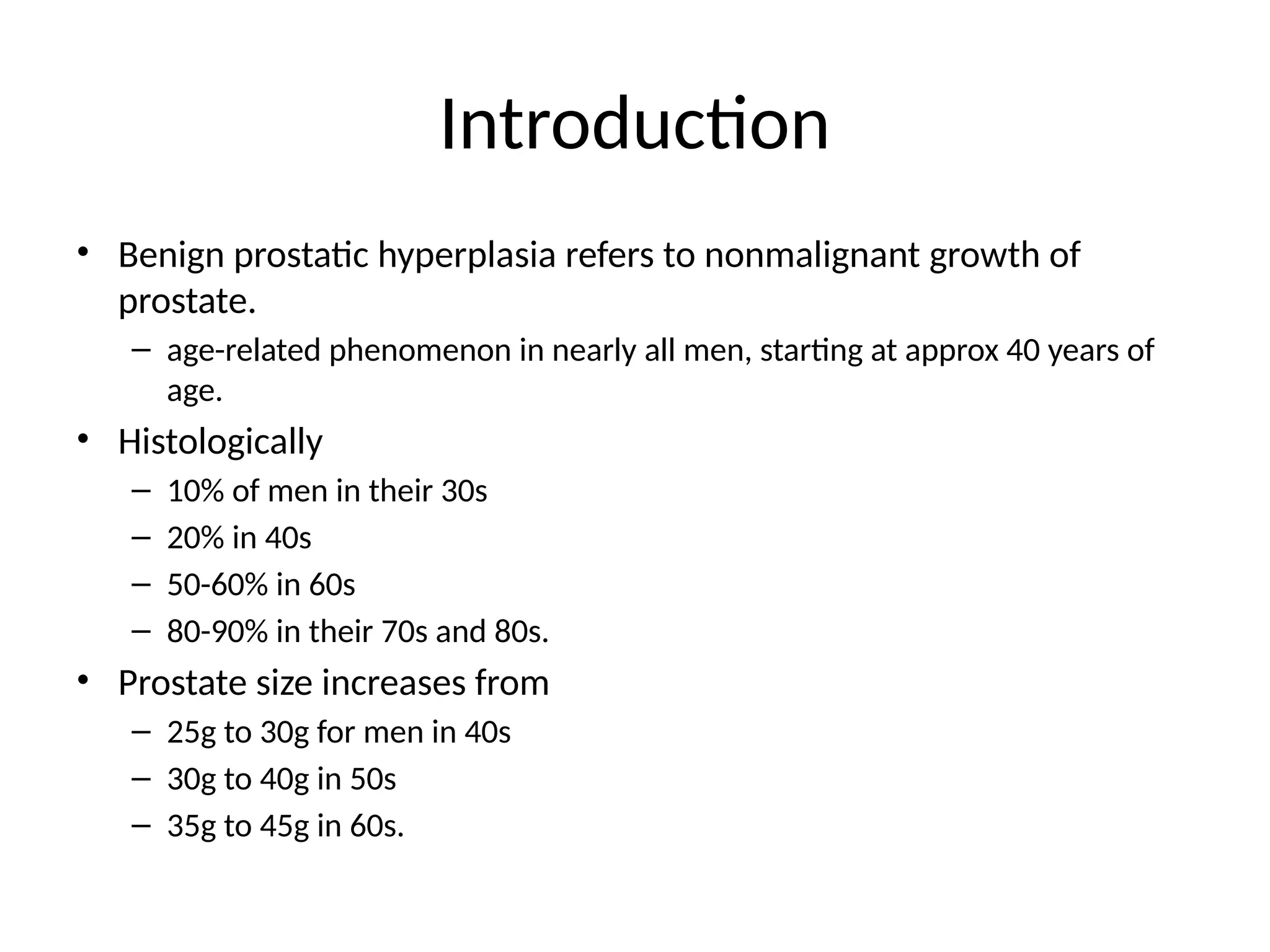
• Benign prostatic hyperplasia refers to nonmalignant growth of
prostate.
– age-related phenomenon in nearly all men, starting at approx 40 years of
age.
• Histologically
– 10% of men in their 30s
– 20% in 40s
– 50-60% in 60s
– 80-90% in their 70s and 80s.
• Prostate size increases from
– 25g to 30g for men in 40s
– 30g to 40g in 50s
– 35g to 45g in 60s.
Introduction
• However, many men with histological BPH may
never develop symptoms, which is when
treatment is sought.
• Etiology
– poorly understood despite decades of intense
research
– hyperplasia thought to be stimulated by
dihydrotestosterone (DHT)
• Additional risk factors: positive family history
Symptoms
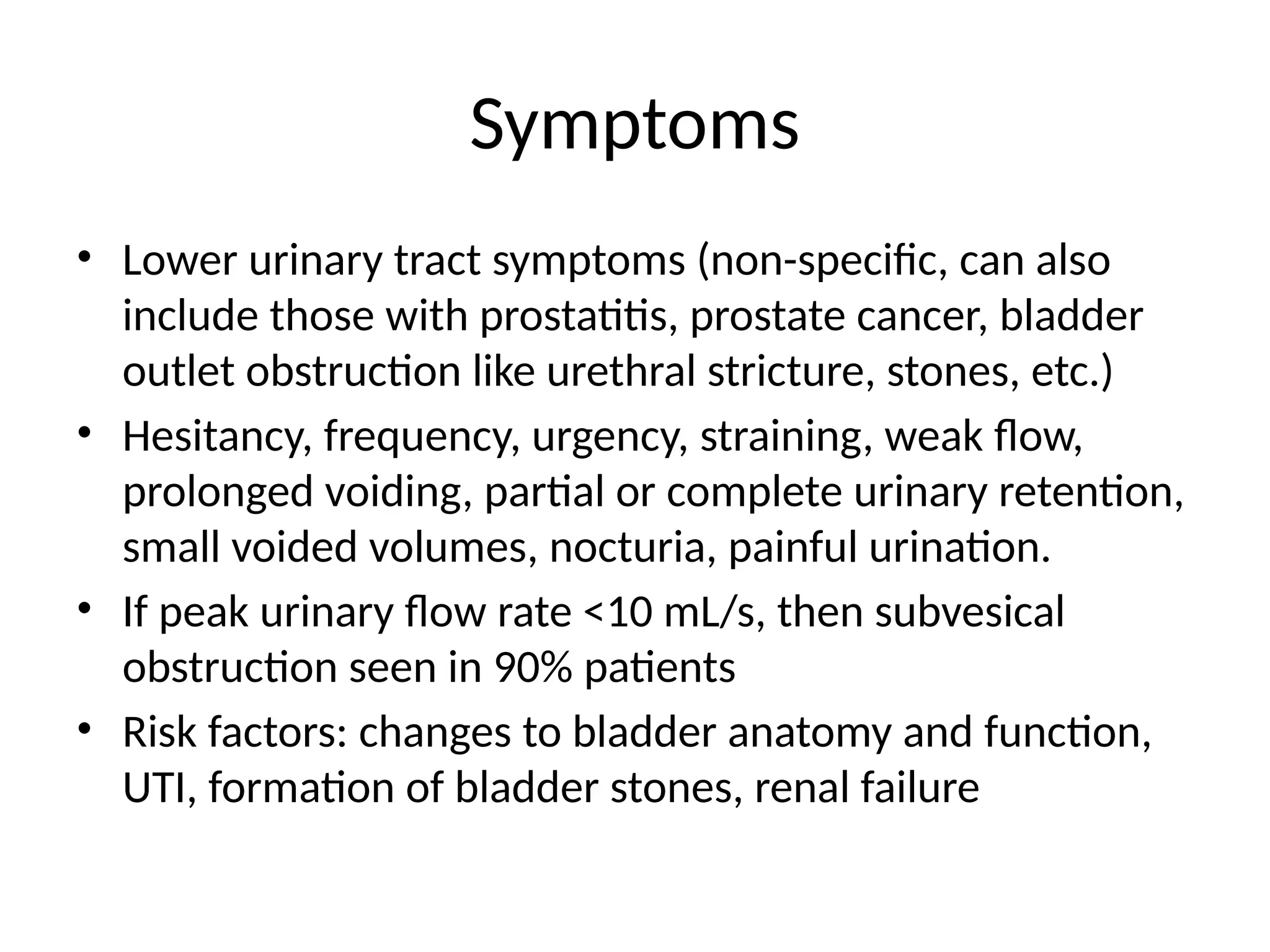
• Lower urinary tract symptoms (non-specific, can also
include those with prostatitis, prostate cancer, bladder
outlet obstruction like urethral stricture, stones, etc.)
• Hesitancy, frequency, urgency, straining, weak flow,
prolonged voiding, partial or complete urinary retention,
small voided volumes, nocturia, painful urination.
• If peak urinary flow rate <10 mL/s, then subvesical
obstruction seen in 90% patients
• Risk factors: changes to bladder anatomy and function,
UTI, formation of bladder stones, renal failure
Diagnosis
• Careful history and physical examination including
DRE
• DRE notoriously unreliable in assessing size, in
fact, shown to underestimate size of prostate
• Still important because some men found to have
prostate cancer based on DRE
• UA, serum Cr. PSA depending on patient’s life
expectancy and circumstances.
– PSA is an individualized decision to be made with
patient and physician
Diagnosis
• Further evaluate with AUA Symptom Score, or International
Prostate Symptom Score (IPSS)—7 questions each on severity
scale of 0-5: frequency, nocturia, weak urinary stream,
hesitancy, intermittence, incomplete emptying, and urgency.
• If score <8, mildly symptomatic and recommend yearly
reevaluation
• If 8-35, may consider additional tests if history confounded by
neurological diseases, prior failed BPH therapy, and those
considering surgery.
• Optional tests:
– Urinary flow rate <10 mL/s highly suggestive of outlet obstruction
– Postvoid residual urine measurement with transabdominal
ultrasound or in-and-out catheterization.
Management
• If no obstruction and limited discomfort, do
not need to treat!!
Non-pharmacological Management
• Non-pharmacological Management
• · Mild symptoms or limited discomfort?
• o Watchful waiting and annual evaluation
• o Lifestyle Modifications
• § Avoid fluids prior to bedtime or going out
• § Reduce caffeine and alcohol
• § Scheduled urination at least once every 3 hours.
• § Double voiding: after urinating, wait and try to
urinate again.
Pharmacological Treatment
• Alpha-1-adrenergic antagonists
– Relax smooth muscle in the bladder neck, prostate capsule, and prostatic urethra
– Immediate relief!
– Examples
• Terazosin, Doxazosin
– Initiate at bedtime (hypotension)
• Tamsulosin, Alfuzosin
– Lower potential to cause hypotension, syncope
– Minor differences in the adverse events profiles, equal clinical effectiveness
– Major Side Effects
• HYPOTENSION!
• Ejaculatory Dysfunction (particularly Tamsulosin)
• Interaction with phosphodiesterase-5 inhibitors
– Potentiated effects of hypotension
– Separate doses by at least 4 hours
Pharmacological Treatment
• 5-alpha-reductase inhibitors
– Reduces the size of the prostate gland
– Prevents conversion testosteroneàdihydrotestosterone (DHT)
– ~ 6 to 12 months before prostate size is sufficiently reduced to improve
symptoms!!
– Indefinite treatment, as discontinuation may lead to symptom relapse.
– Examples
• Finasteride (initiated and maintained at 5 mg once daily)
• Dutasteride
– Side Effects
• Sexual dysfunction
• Decrease PSA
– Take into account during interpretation
Pharmacological Treatment
• Anticholinergics
– monotherapy for patients with predominately
irritated symptoms related to overactive bladder
– Frequency, urgency, incontinence
– Examples
• Oxybutynin, Tolterodine
– Side Effects
• Extensive!
• Dry mouth, blurred vision, tachycardia, constipation etc
Pharmacological Treatment
• Combination therapy
– Severe symptoms without maximal response to
maximal monotherapy
– Alpha 1 and anticholinergics
– Alpha 1 and reductase inhibitors
If still fails?
• If all else fails: Surgery or Minimally Invasive
Surgical Therapies
– Many surgical/interventional options
– MIST
• Transurethral needle ablation (TUNA), transurethral microwave
therapy (TUMT), Transurethral Electroevaporation of The
Prostate TUVP
– Surgery
• Open Prostatectomy
– Endoscope
• Transurethral Incision of the Prostatce (TURP)
Management
• When to get Urology involved?
– Bladder Obstruction syndrome
– Men <45 years old
– Presence of hematuria in the absence of infection
– Abnormality on prostate exam (nodule,
induration, or asymmetry)
– Men with incontinence
– Severe symptoms
References
• Roehrborn CG. Benign prostatic hyperplasia:
an overview. Rev Urol. 2005;7 Suppl 9:S3-S14.
• McVary KT, Roehrborn CG, Avins AL, et al.
Update on AUA guideline on the management
of benign prostatic hyperplasia. J Urol. 2011
May;185(5):1793-803. doi:
10.1016/j.juro.2011.01.074. Epub 2011 Mar
21.

Benign -_- Prostate-_- Hypertrophy .pptx

  • 1.
  • 2.
    Introduction • Benign prostatichyperplasia refers to nonmalignant growth of prostate. – age-related phenomenon in nearly all men, starting at approx 40 years of age. • Histologically – 10% of men in their 30s – 20% in 40s – 50-60% in 60s – 80-90% in their 70s and 80s. • Prostate size increases from – 25g to 30g for men in 40s – 30g to 40g in 50s – 35g to 45g in 60s.
  • 3.
    Introduction • However, manymen with histological BPH may never develop symptoms, which is when treatment is sought. • Etiology – poorly understood despite decades of intense research – hyperplasia thought to be stimulated by dihydrotestosterone (DHT) • Additional risk factors: positive family history
  • 4.
    Symptoms • Lower urinarytract symptoms (non-specific, can also include those with prostatitis, prostate cancer, bladder outlet obstruction like urethral stricture, stones, etc.) • Hesitancy, frequency, urgency, straining, weak flow, prolonged voiding, partial or complete urinary retention, small voided volumes, nocturia, painful urination. • If peak urinary flow rate <10 mL/s, then subvesical obstruction seen in 90% patients • Risk factors: changes to bladder anatomy and function, UTI, formation of bladder stones, renal failure
  • 5.
    Diagnosis • Careful historyand physical examination including DRE • DRE notoriously unreliable in assessing size, in fact, shown to underestimate size of prostate • Still important because some men found to have prostate cancer based on DRE • UA, serum Cr. PSA depending on patient’s life expectancy and circumstances. – PSA is an individualized decision to be made with patient and physician
  • 6.
    Diagnosis • Further evaluatewith AUA Symptom Score, or International Prostate Symptom Score (IPSS)—7 questions each on severity scale of 0-5: frequency, nocturia, weak urinary stream, hesitancy, intermittence, incomplete emptying, and urgency. • If score <8, mildly symptomatic and recommend yearly reevaluation • If 8-35, may consider additional tests if history confounded by neurological diseases, prior failed BPH therapy, and those considering surgery. • Optional tests: – Urinary flow rate <10 mL/s highly suggestive of outlet obstruction – Postvoid residual urine measurement with transabdominal ultrasound or in-and-out catheterization.
  • 8.
    Management • If noobstruction and limited discomfort, do not need to treat!!
  • 9.
    Non-pharmacological Management • Non-pharmacologicalManagement • · Mild symptoms or limited discomfort? • o Watchful waiting and annual evaluation • o Lifestyle Modifications • § Avoid fluids prior to bedtime or going out • § Reduce caffeine and alcohol • § Scheduled urination at least once every 3 hours. • § Double voiding: after urinating, wait and try to urinate again.
  • 10.
    Pharmacological Treatment • Alpha-1-adrenergicantagonists – Relax smooth muscle in the bladder neck, prostate capsule, and prostatic urethra – Immediate relief! – Examples • Terazosin, Doxazosin – Initiate at bedtime (hypotension) • Tamsulosin, Alfuzosin – Lower potential to cause hypotension, syncope – Minor differences in the adverse events profiles, equal clinical effectiveness – Major Side Effects • HYPOTENSION! • Ejaculatory Dysfunction (particularly Tamsulosin) • Interaction with phosphodiesterase-5 inhibitors – Potentiated effects of hypotension – Separate doses by at least 4 hours
  • 11.
    Pharmacological Treatment • 5-alpha-reductaseinhibitors – Reduces the size of the prostate gland – Prevents conversion testosteroneàdihydrotestosterone (DHT) – ~ 6 to 12 months before prostate size is sufficiently reduced to improve symptoms!! – Indefinite treatment, as discontinuation may lead to symptom relapse. – Examples • Finasteride (initiated and maintained at 5 mg once daily) • Dutasteride – Side Effects • Sexual dysfunction • Decrease PSA – Take into account during interpretation
  • 12.
    Pharmacological Treatment • Anticholinergics –monotherapy for patients with predominately irritated symptoms related to overactive bladder – Frequency, urgency, incontinence – Examples • Oxybutynin, Tolterodine – Side Effects • Extensive! • Dry mouth, blurred vision, tachycardia, constipation etc
  • 13.
    Pharmacological Treatment • Combinationtherapy – Severe symptoms without maximal response to maximal monotherapy – Alpha 1 and anticholinergics – Alpha 1 and reductase inhibitors
  • 14.
    If still fails? •If all else fails: Surgery or Minimally Invasive Surgical Therapies – Many surgical/interventional options – MIST • Transurethral needle ablation (TUNA), transurethral microwave therapy (TUMT), Transurethral Electroevaporation of The Prostate TUVP – Surgery • Open Prostatectomy – Endoscope • Transurethral Incision of the Prostatce (TURP)
  • 15.
    Management • When toget Urology involved? – Bladder Obstruction syndrome – Men <45 years old – Presence of hematuria in the absence of infection – Abnormality on prostate exam (nodule, induration, or asymmetry) – Men with incontinence – Severe symptoms
  • 17.
    References • Roehrborn CG.Benign prostatic hyperplasia: an overview. Rev Urol. 2005;7 Suppl 9:S3-S14. • McVary KT, Roehrborn CG, Avins AL, et al. Update on AUA guideline on the management of benign prostatic hyperplasia. J Urol. 2011 May;185(5):1793-803. doi: 10.1016/j.juro.2011.01.074. Epub 2011 Mar 21.