Benefits of Open Access to
Early Career Researchers
Nancy Pontika, PhD
CORE
Open University
Email: nancy.pontika[at]open.ac.uk
Twitter: @nancypontika
Universita Degli Studi Di Trieste, 7 July 2015
What is publishing?
• Process of making information available to the general
public. “Publish or perish”
• Traditionally, this is achieved by engaging with a
publisher – resulting in the publication of a journal
article, book chapter or book.
• Using a publisher is still the most common way of
disseminating the results of research.
• Universities also offer means of making research
available – (e.g. Open Access Repositories)
• There are means of ‘self-publishing’.
Publishing process
• A manuscript is submitted to the publisher (pre-print)
• Reviewed internally by editorial staff
• Peer reviewed - normally externally, by one or more expert
academics (post-print)
• Academic publishers conduct external, independent peer-
review, which lends authority and prestige
• Production – of the final PDF/Print Copy (publisher’s final version)
• Publication of the paper
Using a publisher – considerations
• Which publication would you be publishing in? Is it well respected?
• What publications do staff and students read? What do(n’t) they
like about them? Opinions can be based on personal taste.
• Does the journal have an Impact Factor or other indicator of
prestige?
• What are the acceptance rates? Are you being realistic about where
you are pitching your article?
• What is the nature of the agreement you have to sign with them?
Will you be able to retain any rights?
• Is it a commercial publisher or a society publisher? Or both?
• Do you need to obtain permissions for 3rd party copyright? Your
publisher should guide you on this.
How does publishing work?
• A manuscript is submitted to the publisher
• Reviewed internally
• Peer reviewed - normally externally
• Production – of the final PDF/Print Copy
• Publication of the paper
Publishing qualities
REGISTRATION CERTIFICATION AWARENESS ARCHIVING
Intellectual
Property
Research validity
certification
Research
accessibility
assurance
Research Output
preservation for
future use
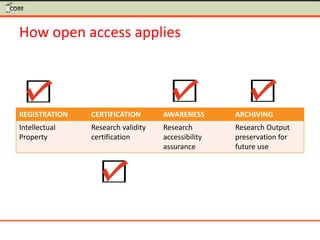
How open access applies
REGISTRATION CERTIFICATION AWARENESS ARCHIVING
Intellectual
Property
Research validity
certification
Research
accessibility
assurance
Research Output
preservation for
future use
Research
Idea
Receives
funding
Research
Conduction
Publication
Research Cycle
Who conducts research?
How much does it cost to access it?
Eventually who can really access it?
What can I do as an
early career
researcher to show my
research work to the
world?
It is not as difficult as you may think…
• Publish in open access journals
• Deposit (self-archive) into a repository
(institutional or disciplinary/subject)
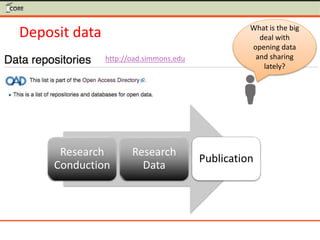
• Deposit your data in a data repository
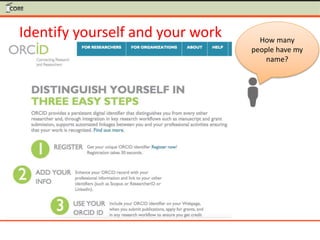
• Identify yourself and your work
• Use social media to create a research societal
impact
Publish in open access journals But doesn’t it
cost authors a
lot of money to
publish in open
access journals!
Source: http://www.slideshare.net/rossmounce/oa4-ecr
Cost – free
Fee waivers
Low cost – high quality
Publish in open access journals What about
predatory
journals?
Source: http://www.slideshare.net/rossmounce/oa4-ecr
Deposit into a repository Where can I
find one? Who
can help me
locate them?
Universita Degli Studi Di Trieste Institutional Repository
Disciplinary Repositories – http://oad.simmons.edu
Deposit data
http://oad.simmons.edu
Research
Conduction
Research
Data
Publication
What is the big
deal with
opening data
and sharing
lately?
Identify yourself and your work How many
people have my
name?
Use social media Like Twitter,
Facebook,
Blogs? Is this
acceptable for
researchers?
Your
research
project
I open my
research
data
I publish in
open access
journals
I deposit in
open
repositories
I use social
media to
share it with
the world
Grazie!
Domande?

Benefits of Open Access to Early Career Researchers

  • 1.
    Benefits of OpenAccess to Early Career Researchers Nancy Pontika, PhD CORE Open University Email: nancy.pontika[at]open.ac.uk Twitter: @nancypontika Universita Degli Studi Di Trieste, 7 July 2015
  • 2.
    What is publishing? •Process of making information available to the general public. “Publish or perish” • Traditionally, this is achieved by engaging with a publisher – resulting in the publication of a journal article, book chapter or book. • Using a publisher is still the most common way of disseminating the results of research. • Universities also offer means of making research available – (e.g. Open Access Repositories) • There are means of ‘self-publishing’.
  • 3.
    Publishing process • Amanuscript is submitted to the publisher (pre-print) • Reviewed internally by editorial staff • Peer reviewed - normally externally, by one or more expert academics (post-print) • Academic publishers conduct external, independent peer- review, which lends authority and prestige • Production – of the final PDF/Print Copy (publisher’s final version) • Publication of the paper
  • 4.
    Using a publisher– considerations • Which publication would you be publishing in? Is it well respected? • What publications do staff and students read? What do(n’t) they like about them? Opinions can be based on personal taste. • Does the journal have an Impact Factor or other indicator of prestige? • What are the acceptance rates? Are you being realistic about where you are pitching your article? • What is the nature of the agreement you have to sign with them? Will you be able to retain any rights? • Is it a commercial publisher or a society publisher? Or both? • Do you need to obtain permissions for 3rd party copyright? Your publisher should guide you on this.
  • 5.
    How does publishingwork? • A manuscript is submitted to the publisher • Reviewed internally • Peer reviewed - normally externally • Production – of the final PDF/Print Copy • Publication of the paper
  • 6.
    Publishing qualities REGISTRATION CERTIFICATIONAWARENESS ARCHIVING Intellectual Property Research validity certification Research accessibility assurance Research Output preservation for future use
  • 7.
    How open accessapplies REGISTRATION CERTIFICATION AWARENESS ARCHIVING Intellectual Property Research validity certification Research accessibility assurance Research Output preservation for future use
  • 8.
  • 9.
  • 10.
    How much doesit cost to access it?
  • 11.
    Eventually who canreally access it?
  • 12.
    What can Ido as an early career researcher to show my research work to the world?
  • 14.
    It is notas difficult as you may think… • Publish in open access journals • Deposit (self-archive) into a repository (institutional or disciplinary/subject) • Deposit your data in a data repository • Identify yourself and your work • Use social media to create a research societal impact
  • 15.
    Publish in openaccess journals But doesn’t it cost authors a lot of money to publish in open access journals! Source: http://www.slideshare.net/rossmounce/oa4-ecr Cost – free Fee waivers Low cost – high quality
  • 16.
    Publish in openaccess journals What about predatory journals? Source: http://www.slideshare.net/rossmounce/oa4-ecr
  • 17.
    Deposit into arepository Where can I find one? Who can help me locate them? Universita Degli Studi Di Trieste Institutional Repository Disciplinary Repositories – http://oad.simmons.edu
  • 18.
  • 19.
    Identify yourself andyour work How many people have my name?
  • 20.
    Use social mediaLike Twitter, Facebook, Blogs? Is this acceptable for researchers? Your research project I open my research data I publish in open access journals I deposit in open repositories I use social media to share it with the world
  • 21.