Roger Watson PhD FRCN FAAN
Editor-in-Chief, JAN
Editor, Nursing Open
@jadvnursing
2
Why do journals need to be reputable?
Reputable:
• having a good reputation and able to be trusted
Reputation:
• the opinion that people in general have about someone or
something, or how much respect or admiration someone or
something receives, based on past behaviour or character
• Cambridge dictionary
3
Indicators of reputation
• The publisher
• The editorial board
• The processes
• Indexing
4
The publisher
• Are they well established?
• Are their journals indexed?
5
The editorial board
• The editor/editor-in-chief
• Editors and associate editors
• The editorial board membership
6
The processes
• Peer review
• Ethics procedures
• Open access
• Open science
Digital object identifier (doi)
The Digital Object Identifier (DOI®) System is for identifying
content objects in the digital environment. DOI® names are
assigned to any entity for use on digital networks.
They are used to provide current information, including
where they (or information about them) can be found on the
Internet. Information about a digital object may change over
time, including where to find it, but its DOI name will not
change.
http://www.doi.org/
Enhancing the QUAlity and
Transparency Of health Research
13
17
Indexing
• PubMed
• Medline
• Clarivate
• Scopus
• CINAHL
Clarivate journal selection
process
•Basic publishing standards
•Editorial content
•International focus
•Citation analysis
Clarivate journal selection
process
Publishing standards
•Peer review
•Acknowledgments
•Ethical publishing practices
•Publishing format
•Timeliness
•International editorial conventions
•Full text English
Clarivate journal selection
process
Editorial content
•determine if the content of the journal
under evaluation will enrich the
database or if the topic is already
adequately addressed in existing
coverage.
Clarivate journal selection
process
International focus
•‘international diversity among the
journal’s contributing authors, editors,
and editorial advisory board
members…’
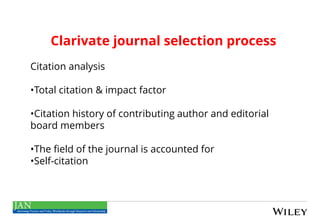
Clarivate journal selection process
Citation analysis
•Total citation & impact factor
•Citation history of contributing author and editorial
board members
•The field of the journal is accounted for
•Self-citation
25
Specific ethical issues in publication
• Duplication
• Plagiarism
• Falsification
• Fabrication
• Authorship
• Conflicts of interest
26
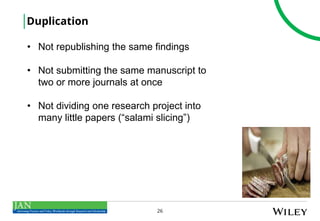
Duplication
• Not republishing the same findings
• Not submitting the same manuscript to
two or more journals at once
• Not dividing one research project into
many little papers (“salami slicing”)
27
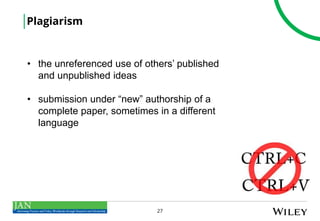
Plagiarism
• the unreferenced use of others’ published
and unpublished ideas
• submission under “new” authorship of a
complete paper, sometimes in a different
language
28
Falsification
• Falsification is manipulating research
materials, equipment, or processes or
changing or omitting data or results
such that the research is not
accurately represented in the research
record.
(Wikipedia)
29
Falsification – examples
• Ignoring outliers
• Not admitting that some data are
missing
• Post hoc analyses that are not
admitted
• Not including data on side effects
in a clinical trial
30
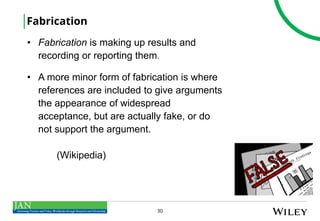
Fabrication
• Fabrication is making up results and
recording or reporting them.
• A more minor form of fabrication is where
references are included to give arguments
the appearance of widespread
acceptance, but are actually fake, or do
not support the argument.
(Wikipedia)
32
Who can be an author?
The list of authors should accurately illustrate who
contributed to the work and how. All those listed as authors
should qualify for authorship according to the following
criteria:
33
Who can be an author?
1. Have made substantial contributions to conception and design, or
acquisition of data, or analysis and interpretation of data;
2. Been involved in drafting the manuscript or revising it critically for
important intellectual content;
3. Given final approval of the version to be published. Each author should
have participated sufficiently in the work to take public responsibility for
appropriate portions of the content; and
4. Agreed to be accountable for all aspects of the work in ensuring that
questions related to the accuracy or integrity of any part of the work
are appropriately investigated and resolved.
34
Acknowledgments
• Contributions from anyone who does not meet the criteria for authorship
should be listed, with permission from the contributor, in an
Acknowledgments section (for example, to recognize contributions from
people who provided technical help, collation of data, writing assistance,
acquisition of funding, or a department chairperson who provided general
support).
• Prior to submitting the article all authors should agree on the order in
which their names will be listed in the manuscript.
35
Best practice in authorship
• Consult and adhere to ICMJE guidance
• Discuss the order of authorship at beginning of the project
• Document everything in writing
• All authors take responsibility for content
36
Conflicts of interest
A conflict of interest can occur when you (or your employer
or sponsor) have a financial, commercial, legal, or
professional relationship with other organizations, or with the
people working with them, that could influence your research.
Full disclosure is required when you submit your paper to a
journal.
Author Services, Taylor & Francis
37
Conflicts of interest – examples
• Financial relationships
• Personal relationships
• Professional relationships
• Political affiliations
• Religious affiliations
• - anything that may give someone the impression that your
research or your decisions (eg as an editor) are biased
r.watson@hull.ac.uk
0000-0001-8040-7625
@rwatson1955

Developing a reputable nursing journal

  • 1.
    Roger Watson PhDFRCN FAAN Editor-in-Chief, JAN Editor, Nursing Open @jadvnursing
  • 2.
    2 Why do journalsneed to be reputable? Reputable: • having a good reputation and able to be trusted Reputation: • the opinion that people in general have about someone or something, or how much respect or admiration someone or something receives, based on past behaviour or character • Cambridge dictionary
  • 3.
    3 Indicators of reputation •The publisher • The editorial board • The processes • Indexing
  • 4.
    4 The publisher • Arethey well established? • Are their journals indexed?
  • 5.
    5 The editorial board •The editor/editor-in-chief • Editors and associate editors • The editorial board membership
  • 6.
    6 The processes • Peerreview • Ethics procedures • Open access • Open science
  • 8.
    Digital object identifier(doi) The Digital Object Identifier (DOI®) System is for identifying content objects in the digital environment. DOI® names are assigned to any entity for use on digital networks. They are used to provide current information, including where they (or information about them) can be found on the Internet. Information about a digital object may change over time, including where to find it, but its DOI name will not change. http://www.doi.org/
  • 11.
    Enhancing the QUAlityand Transparency Of health Research
  • 13.
  • 17.
    17 Indexing • PubMed • Medline •Clarivate • Scopus • CINAHL
  • 18.
    Clarivate journal selection process •Basicpublishing standards •Editorial content •International focus •Citation analysis
  • 20.
    Clarivate journal selection process Publishingstandards •Peer review •Acknowledgments •Ethical publishing practices •Publishing format •Timeliness •International editorial conventions •Full text English
  • 21.
    Clarivate journal selection process Editorialcontent •determine if the content of the journal under evaluation will enrich the database or if the topic is already adequately addressed in existing coverage.
  • 22.
    Clarivate journal selection process Internationalfocus •‘international diversity among the journal’s contributing authors, editors, and editorial advisory board members…’
  • 23.
    Clarivate journal selectionprocess Citation analysis •Total citation & impact factor •Citation history of contributing author and editorial board members •The field of the journal is accounted for •Self-citation
  • 25.
    25 Specific ethical issuesin publication • Duplication • Plagiarism • Falsification • Fabrication • Authorship • Conflicts of interest
  • 26.
    26 Duplication • Not republishingthe same findings • Not submitting the same manuscript to two or more journals at once • Not dividing one research project into many little papers (“salami slicing”)
  • 27.
    27 Plagiarism • the unreferenceduse of others’ published and unpublished ideas • submission under “new” authorship of a complete paper, sometimes in a different language
  • 28.
    28 Falsification • Falsification ismanipulating research materials, equipment, or processes or changing or omitting data or results such that the research is not accurately represented in the research record. (Wikipedia)
  • 29.
    29 Falsification – examples •Ignoring outliers • Not admitting that some data are missing • Post hoc analyses that are not admitted • Not including data on side effects in a clinical trial
  • 30.
    30 Fabrication • Fabrication ismaking up results and recording or reporting them. • A more minor form of fabrication is where references are included to give arguments the appearance of widespread acceptance, but are actually fake, or do not support the argument. (Wikipedia)
  • 32.
    32 Who can bean author? The list of authors should accurately illustrate who contributed to the work and how. All those listed as authors should qualify for authorship according to the following criteria:
  • 33.
    33 Who can bean author? 1. Have made substantial contributions to conception and design, or acquisition of data, or analysis and interpretation of data; 2. Been involved in drafting the manuscript or revising it critically for important intellectual content; 3. Given final approval of the version to be published. Each author should have participated sufficiently in the work to take public responsibility for appropriate portions of the content; and 4. Agreed to be accountable for all aspects of the work in ensuring that questions related to the accuracy or integrity of any part of the work are appropriately investigated and resolved.
  • 34.
    34 Acknowledgments • Contributions fromanyone who does not meet the criteria for authorship should be listed, with permission from the contributor, in an Acknowledgments section (for example, to recognize contributions from people who provided technical help, collation of data, writing assistance, acquisition of funding, or a department chairperson who provided general support). • Prior to submitting the article all authors should agree on the order in which their names will be listed in the manuscript.
  • 35.
    35 Best practice inauthorship • Consult and adhere to ICMJE guidance • Discuss the order of authorship at beginning of the project • Document everything in writing • All authors take responsibility for content
  • 36.
    36 Conflicts of interest Aconflict of interest can occur when you (or your employer or sponsor) have a financial, commercial, legal, or professional relationship with other organizations, or with the people working with them, that could influence your research. Full disclosure is required when you submit your paper to a journal. Author Services, Taylor & Francis
  • 37.
    37 Conflicts of interest– examples • Financial relationships • Personal relationships • Professional relationships • Political affiliations • Religious affiliations • - anything that may give someone the impression that your research or your decisions (eg as an editor) are biased
  • 39.