HEFCE Open Access Policy
Dr. Nancy Pontika
CORE (COnnecting REpositories)
Knowledge Media institute
The Open University
United Kingdom
@nancypontika
Higher Education Funding Council for England (HEFCE)
Total HEFCE grant available for the 2015 – 2016 academic
year is £3,971 million
18.5%
39.2%
35.7%
Research Excellence Framework (REF)
Excellence – Impact – Implementation
● Quality Research Outputs – 65%
● Impact – 20%
● Research Environment – 15%
Horizon2020: Maximise impact with Open Access and
Open Data
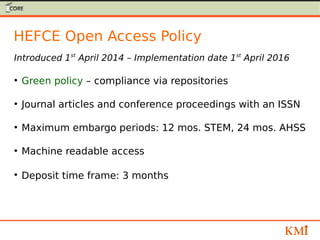
HEFCE Open Access Policy
Introduced 1st
April 2014 – Implementation date 1st
April 2016
●
Green policy – compliance via repositories
●
Journal articles and conference proceedings with an ISSN
●
Maximum embargo periods: 12 mos. STEM, 24 mos. AHSS
●
Machine readable access
●
Deposit time frame: 3 months
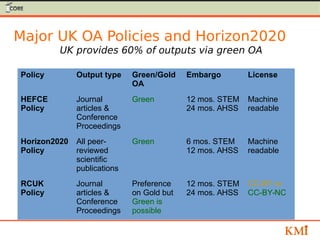
Major UK OA Policies and Horizon2020
UK provides 60% of outputs via green OA
Policy Output type Green/Gold
OA
Embargo License
HEFCE
Policy
Journal
articles &
Conference
Proceedings
Green 12 mos. STEM
24 mos. AHSS
Machine
readable
Horizon2020
Policy
All peer-
reviewed
scientific
publications
Green 6 mos. STEM
12 mos. AHSS
Machine
readable
RCUK
Policy
Journal
articles &
Conference
Proceedings
Preference
on Gold but
Green is
possible
12 mos. STEM
24 mos. AHSS
CC-BY or
CC-BY-NC
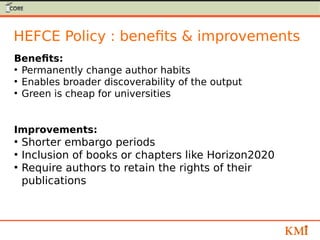
HEFCE Policy : benefits & improvements
Benefits:
●
Permanently change author habits
●
Enables broader discoverability of the output
●
Green is cheap for universities
Improvements:
●
Shorter embargo periods
●
Inclusion of books or chapters like Horizon2020
●
Require authors to retain the rights of their
publications
Thank you!
Reusing and Reproducing
Open Access Content
Dr. Nancy Pontika
CORE (COnnecting REpositories)
Knowledge Media institute
The Open University
United Kingdom
@nancypontika
What does “research reusability” mean?
Ascertaining scientific results!
●
Availability of the scientific method
●
Allows research reproduction
●
Enables transparency in research
methodology
●
Saves money and time for researchers and universities
●
Increases impact of the research work
What can be made reusable?
Everything that could possibly be useful!
●
Laboratory notebooks/diaries
●
Methodology details
●
Experiment results
●
Software code
●
Equipment details
●
Ground theory of the experiment
●
Application details, i.e. background modelling
●
Mathematical proofs
Guidelines to enable Open Science
●
Code
●
Data
●
Documentation
●
Workflow
12/85
Reusability tools
Discovering Content Services
●
CORE – metadata and full-text harvesting of open access
research outputs and API
●
OpenDOAR – open access repositories around the world
●
Jisc Publications Router – metadata and full-text from journals
and subject repositories
●
Directory of Open Access Journals – lists worldwide open
access journals
●
SHERPA RoMEO – copyright and archiving policies
●
SHERPA Juliet - research funders' open access policies
Thank you!

Reusing Open Access content & HEFCE policy on Open Access

  • 1.
    HEFCE Open AccessPolicy Dr. Nancy Pontika CORE (COnnecting REpositories) Knowledge Media institute The Open University United Kingdom @nancypontika
  • 2.
    Higher Education FundingCouncil for England (HEFCE) Total HEFCE grant available for the 2015 – 2016 academic year is £3,971 million 18.5% 39.2% 35.7%
  • 3.
    Research Excellence Framework(REF) Excellence – Impact – Implementation ● Quality Research Outputs – 65% ● Impact – 20% ● Research Environment – 15% Horizon2020: Maximise impact with Open Access and Open Data
  • 4.
    HEFCE Open AccessPolicy Introduced 1st April 2014 – Implementation date 1st April 2016 ● Green policy – compliance via repositories ● Journal articles and conference proceedings with an ISSN ● Maximum embargo periods: 12 mos. STEM, 24 mos. AHSS ● Machine readable access ● Deposit time frame: 3 months
  • 5.
    Major UK OAPolicies and Horizon2020 UK provides 60% of outputs via green OA Policy Output type Green/Gold OA Embargo License HEFCE Policy Journal articles & Conference Proceedings Green 12 mos. STEM 24 mos. AHSS Machine readable Horizon2020 Policy All peer- reviewed scientific publications Green 6 mos. STEM 12 mos. AHSS Machine readable RCUK Policy Journal articles & Conference Proceedings Preference on Gold but Green is possible 12 mos. STEM 24 mos. AHSS CC-BY or CC-BY-NC
  • 6.
    HEFCE Policy :benefits & improvements Benefits: ● Permanently change author habits ● Enables broader discoverability of the output ● Green is cheap for universities Improvements: ● Shorter embargo periods ● Inclusion of books or chapters like Horizon2020 ● Require authors to retain the rights of their publications
  • 7.
  • 8.
    Reusing and Reproducing OpenAccess Content Dr. Nancy Pontika CORE (COnnecting REpositories) Knowledge Media institute The Open University United Kingdom @nancypontika
  • 9.
    What does “researchreusability” mean? Ascertaining scientific results! ● Availability of the scientific method ● Allows research reproduction ● Enables transparency in research methodology ● Saves money and time for researchers and universities ● Increases impact of the research work
  • 10.
    What can bemade reusable? Everything that could possibly be useful! ● Laboratory notebooks/diaries ● Methodology details ● Experiment results ● Software code ● Equipment details ● Ground theory of the experiment ● Application details, i.e. background modelling ● Mathematical proofs
  • 11.
    Guidelines to enableOpen Science ● Code ● Data ● Documentation ● Workflow
  • 12.
  • 13.
    Discovering Content Services ● CORE– metadata and full-text harvesting of open access research outputs and API ● OpenDOAR – open access repositories around the world ● Jisc Publications Router – metadata and full-text from journals and subject repositories ● Directory of Open Access Journals – lists worldwide open access journals ● SHERPA RoMEO – copyright and archiving policies ● SHERPA Juliet - research funders' open access policies
  • 14.