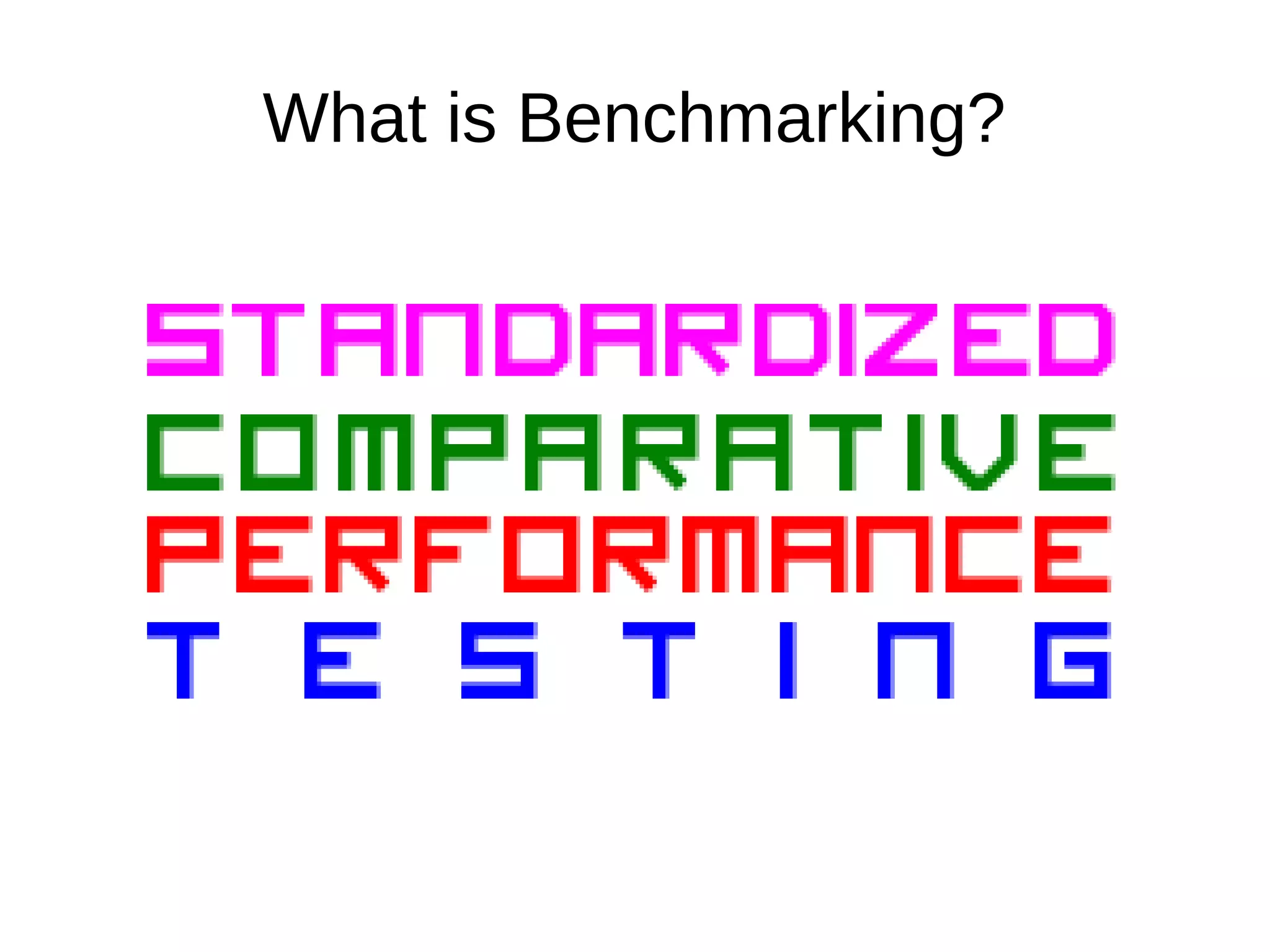
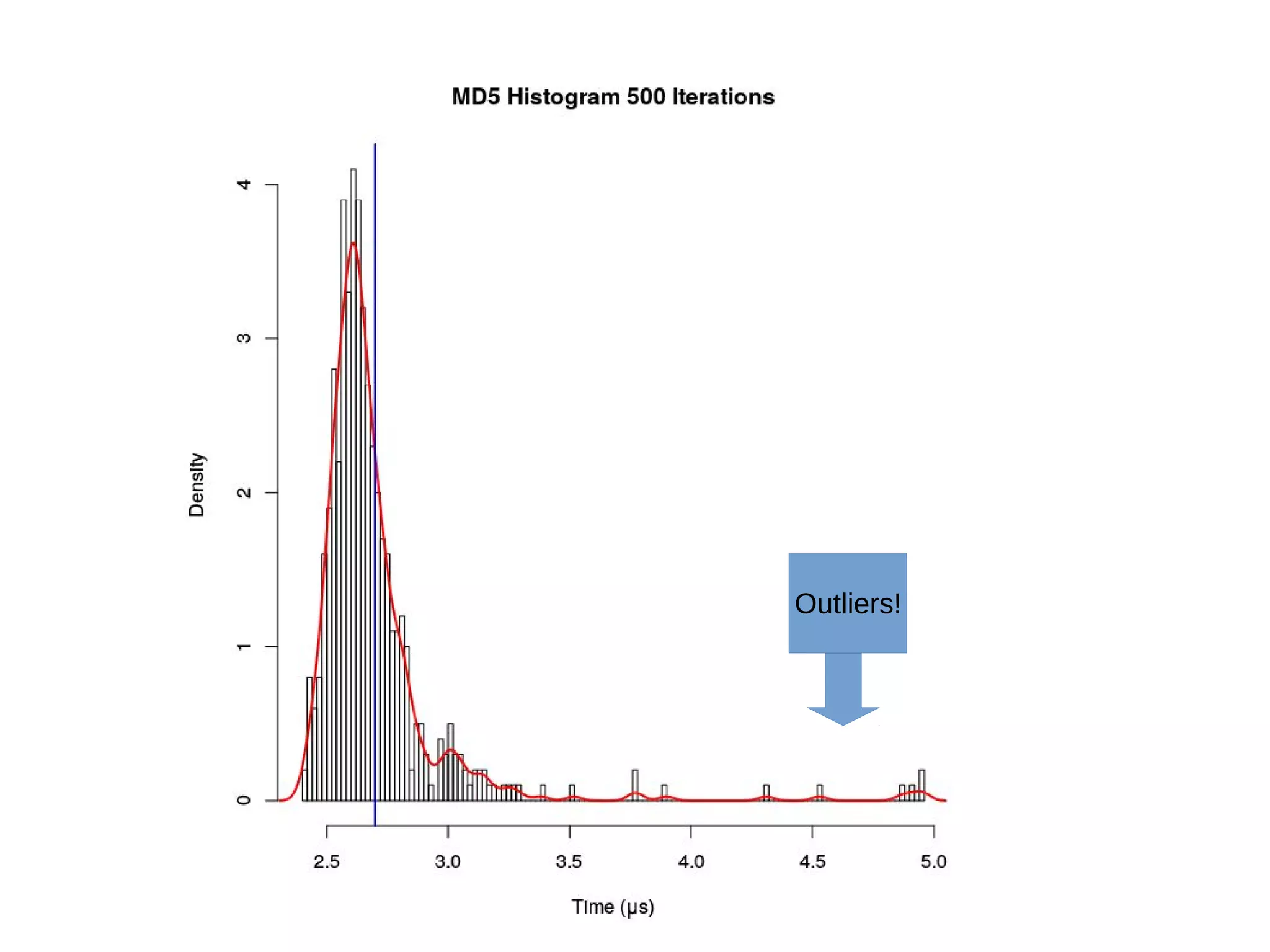
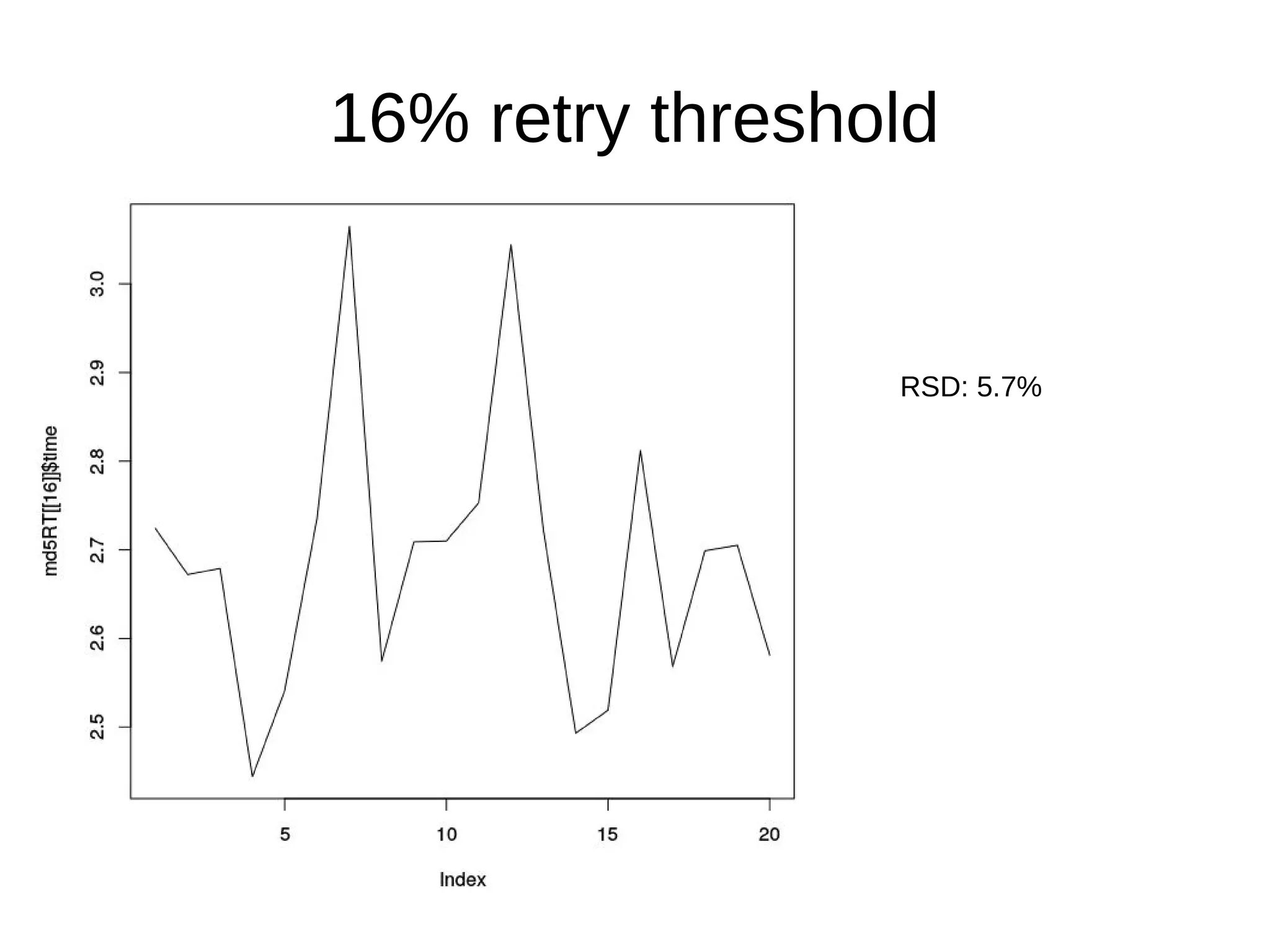
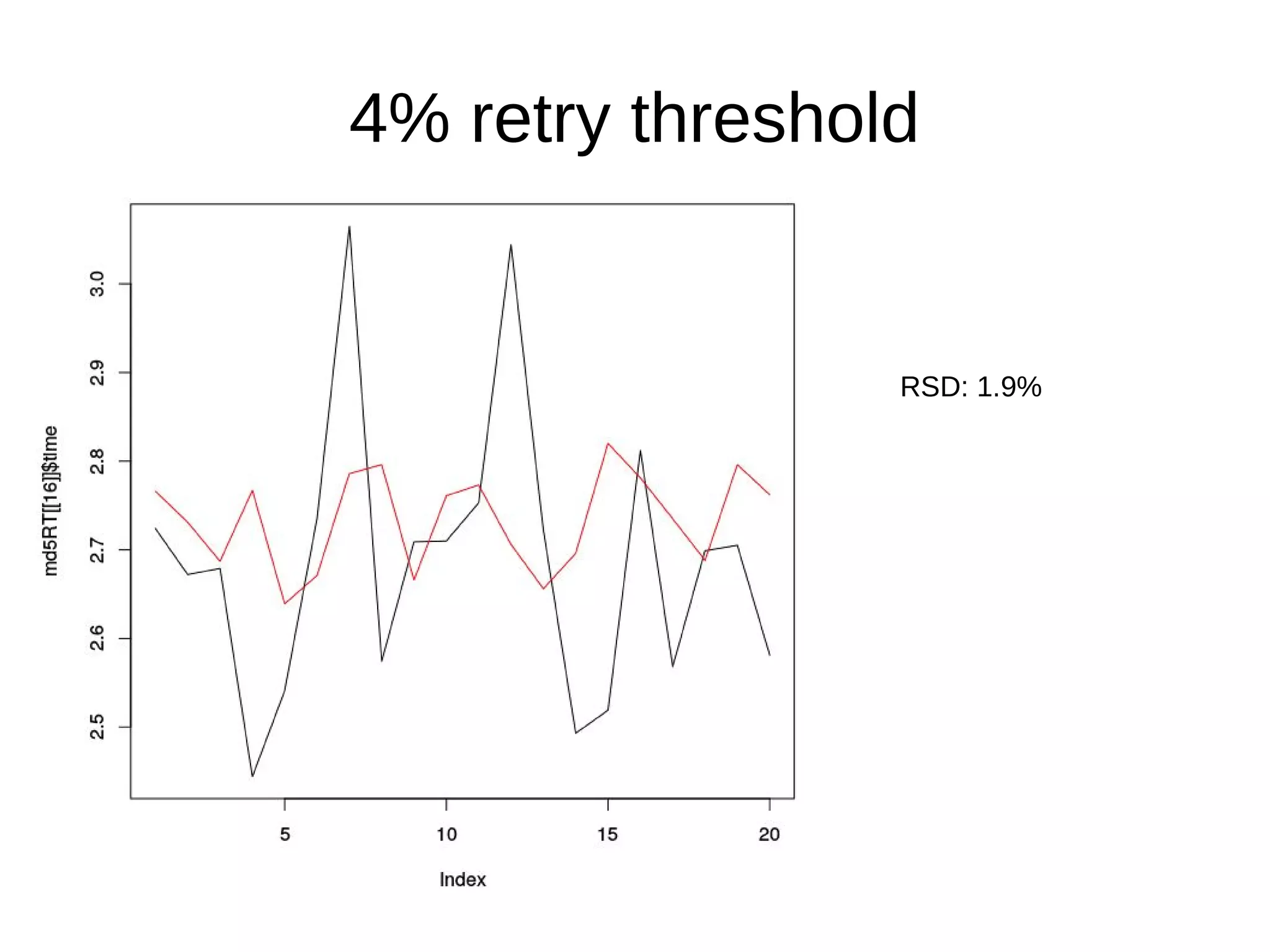
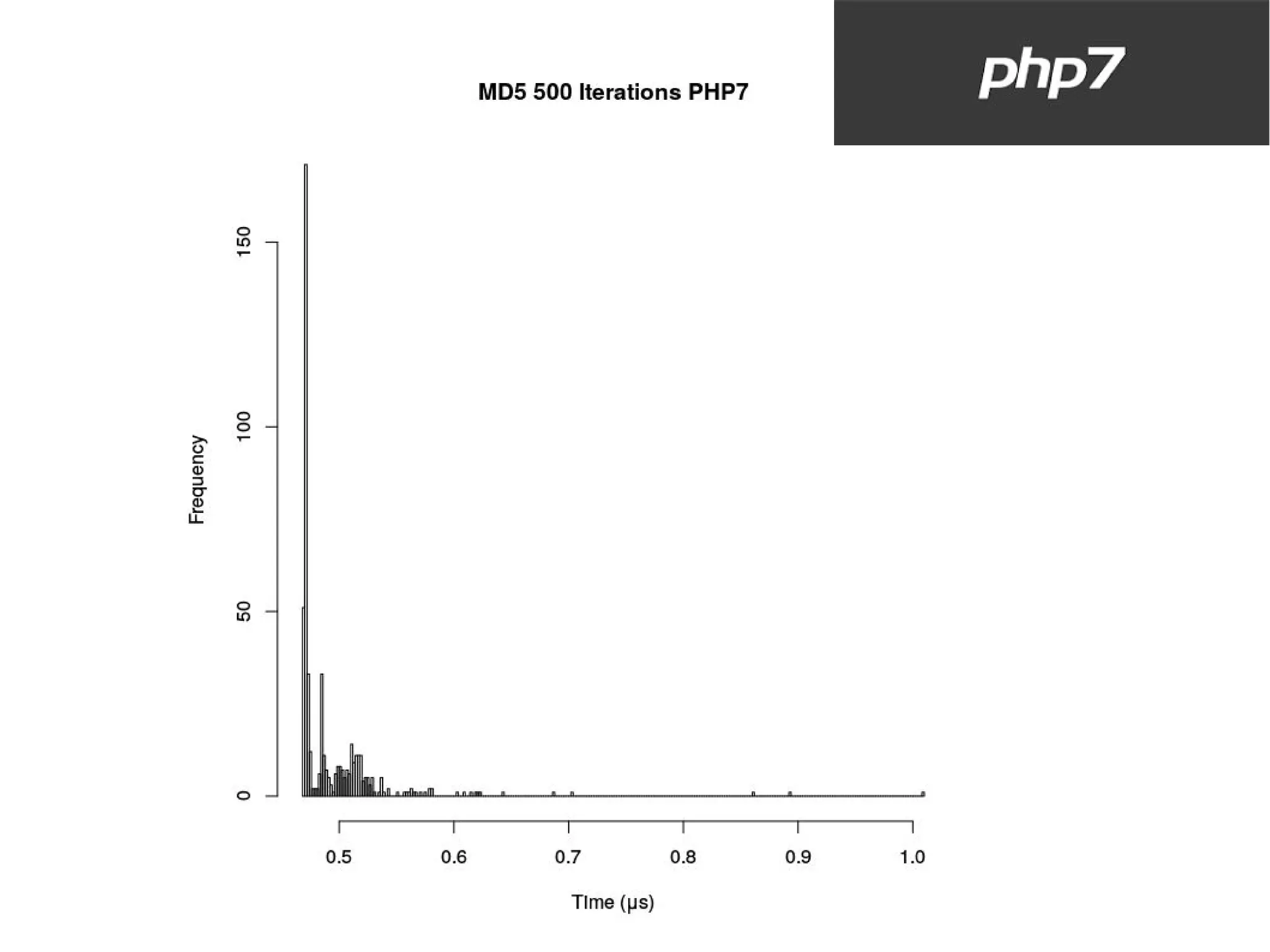
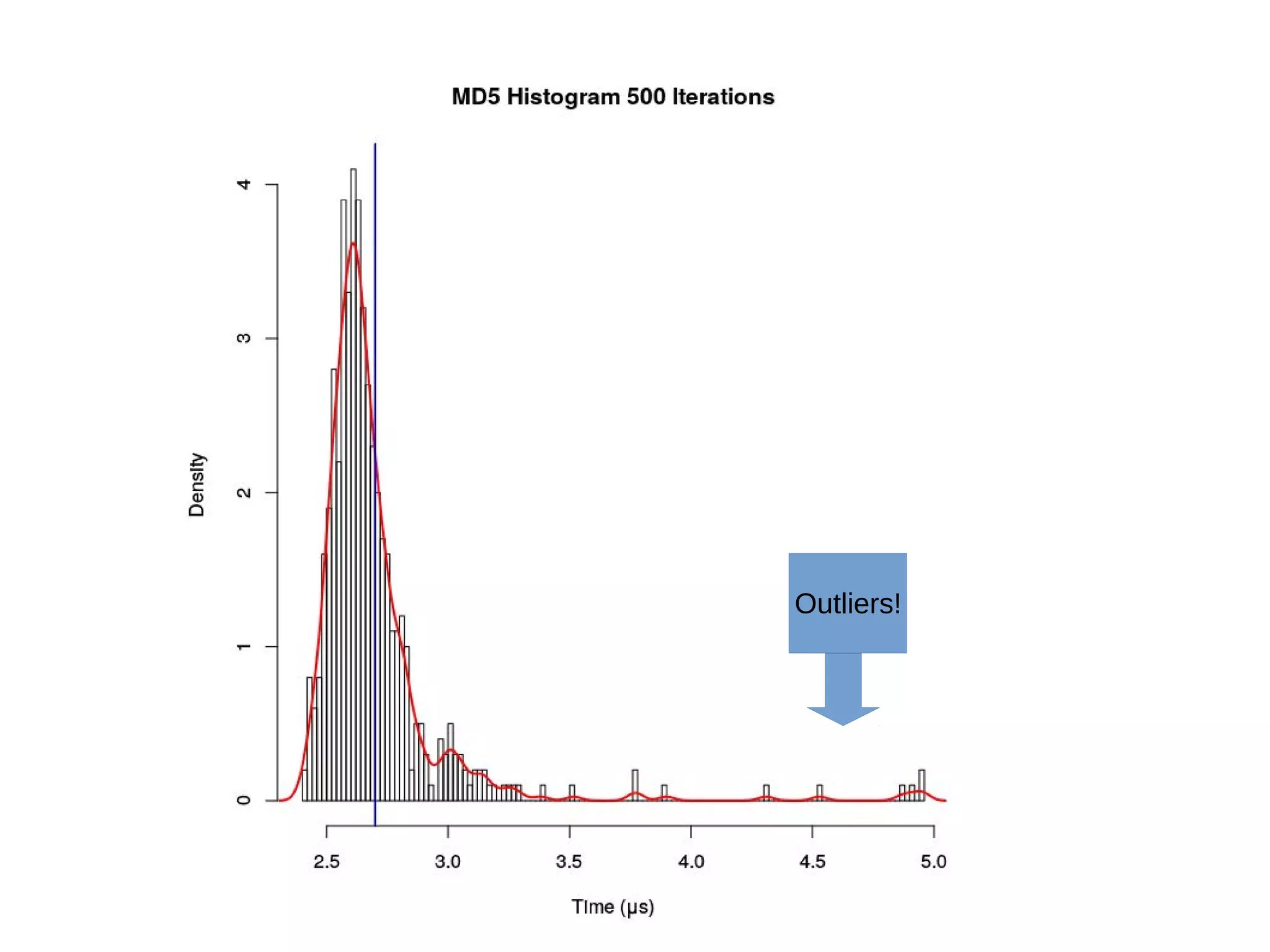
Benchmarking is used to measure and compare the performance of code or systems. It involves running standardized tests multiple times to obtain time measurements. PHPBench is a framework for benchmarking PHP code that executes benchmarks in iterations with many revolutions to stabilize results. It performs statistical analysis on the time measurements and can store results. Benchmarking aims to minimize variability through techniques like increasing revolutions, reducing outliers via thresholds, and enforcing consensus through margins of error.
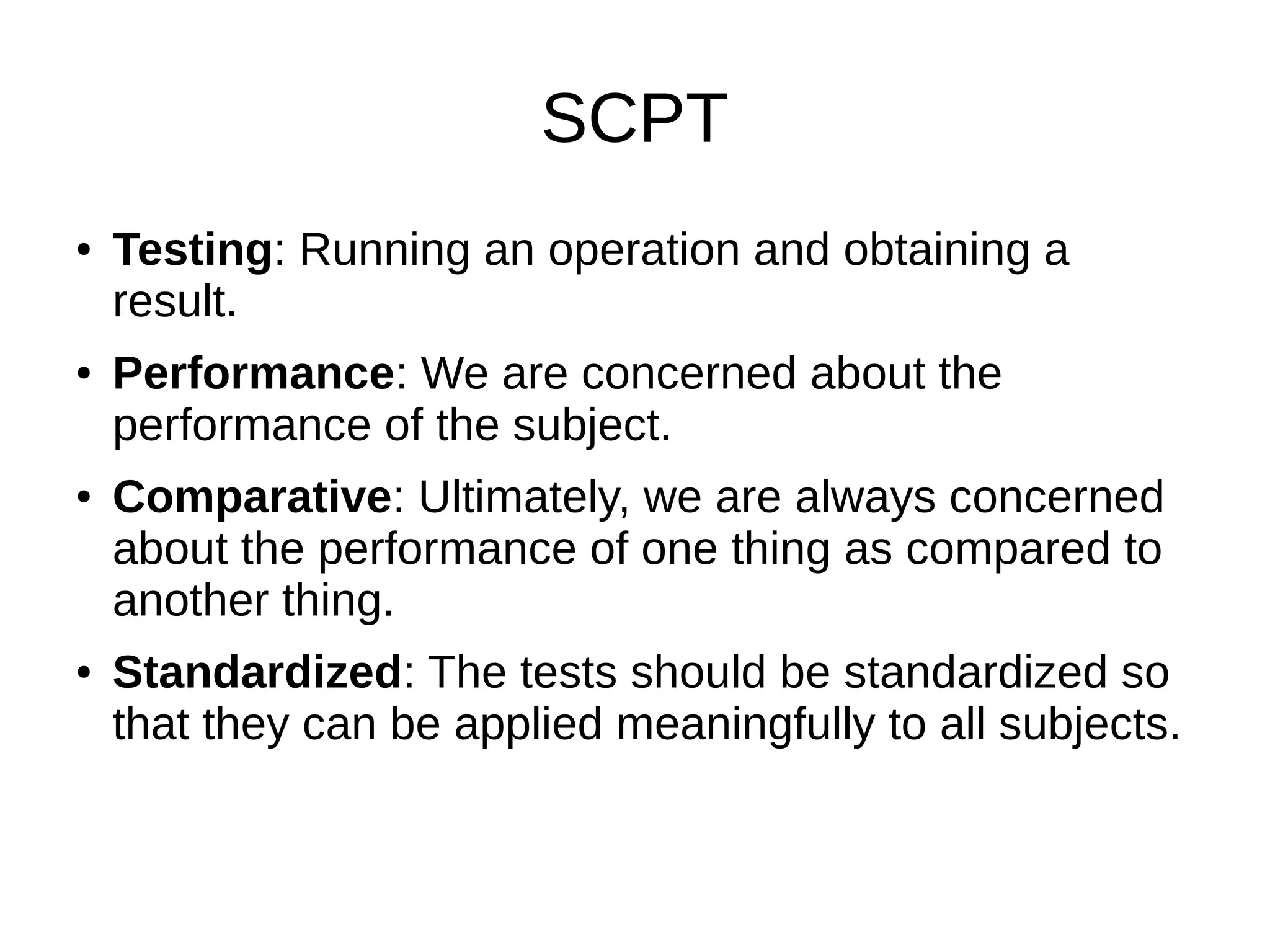
SCPT
● Testing: Runningan operation and obtaining a
result.
● Performance: We are concerned about the
performance of the subject.
● Comparative: Ultimately, we are always concerned
about the performance of one thing as compared to
another thing.
● Standardized: The tests should be standardized so
that they can be applied meaningfully to all subjects.
5.
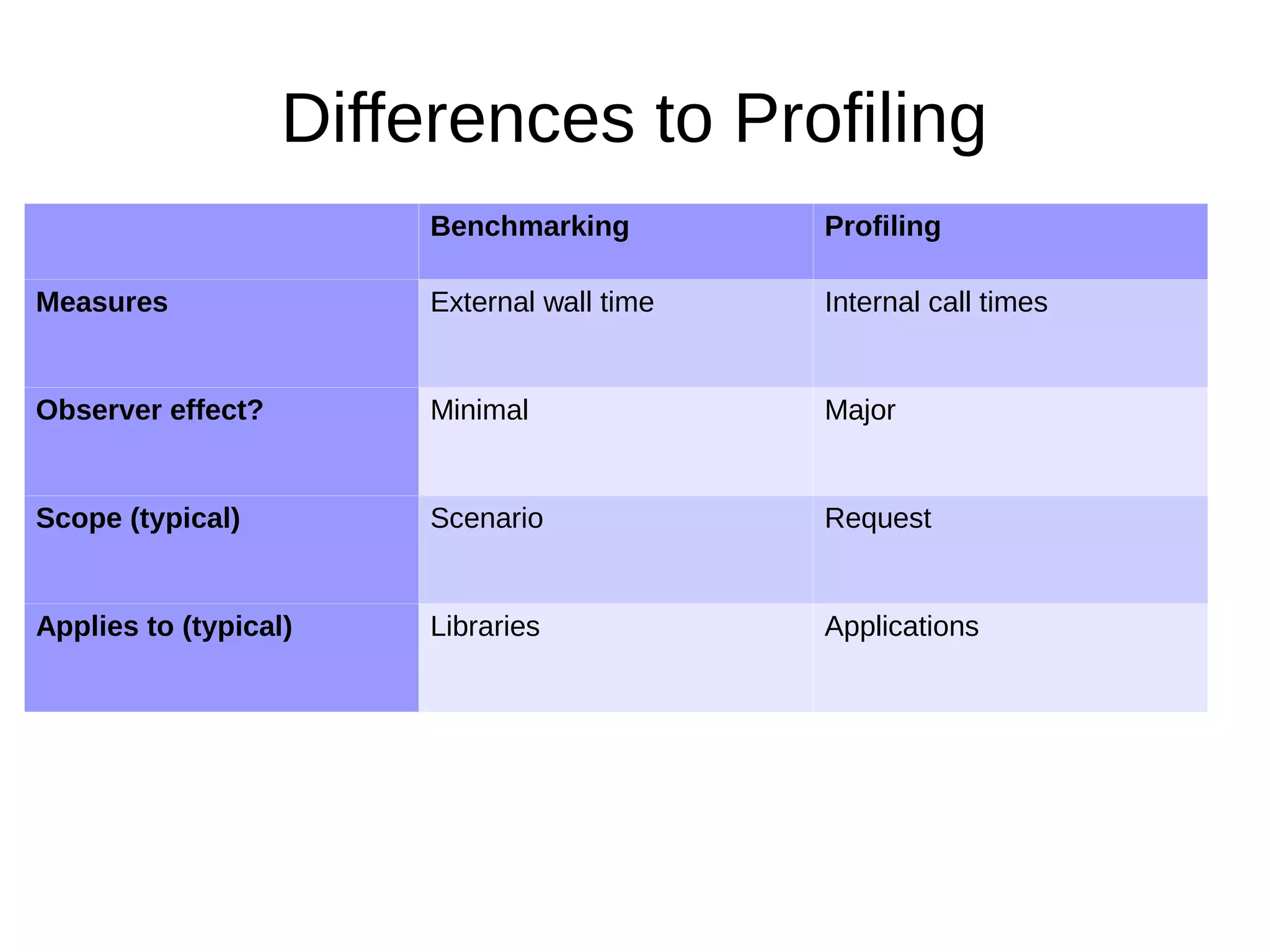
Differences to Profiling
BenchmarkingProfiling
Measures External wall time Internal call times
Observer effect? Minimal Major
Scope (typical) Scenario Request
Applies to (typical) Libraries Applications
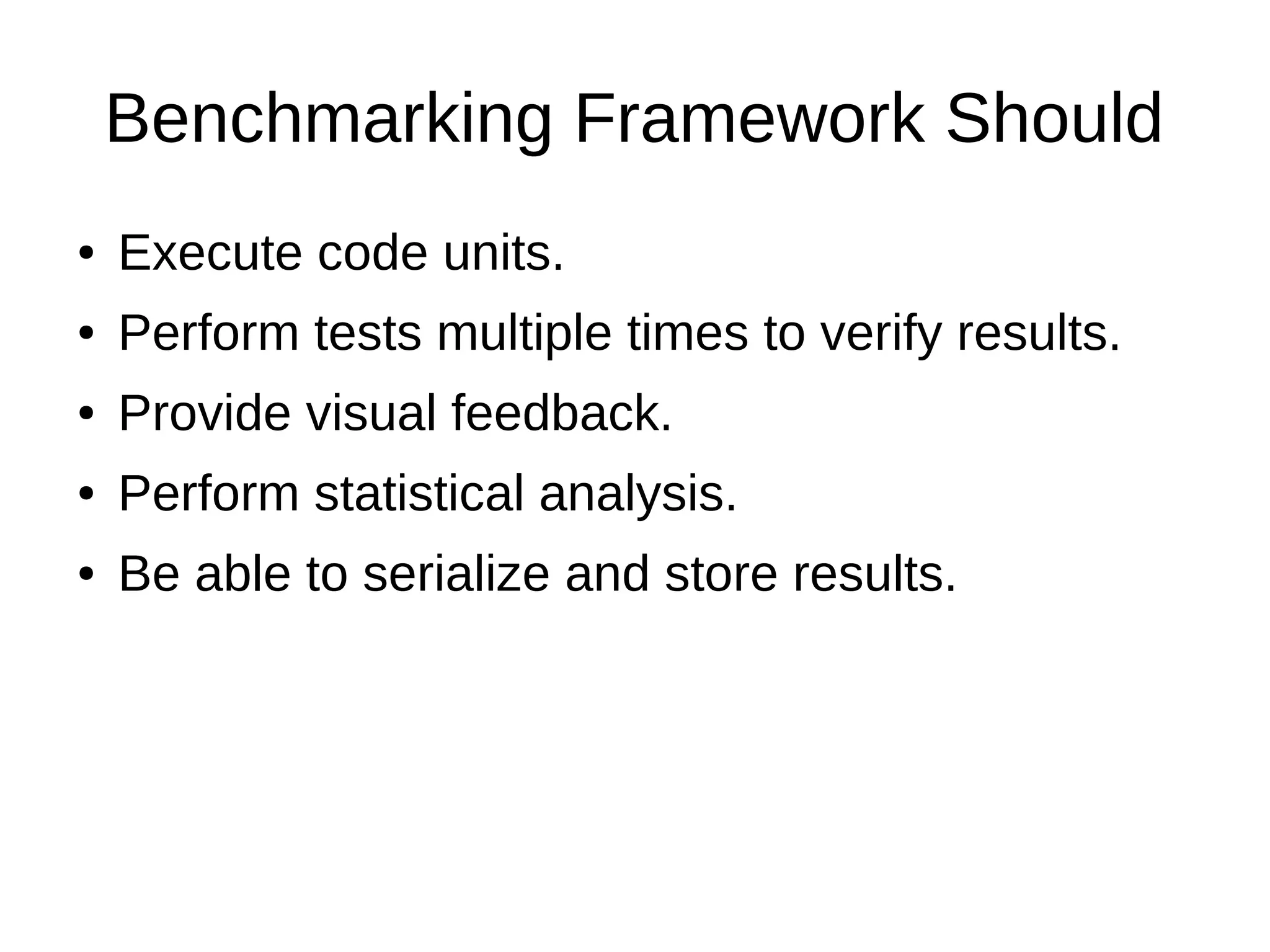
Benchmarking Framework Should
●Execute code units.
● Perform tests multiple times to verify results.
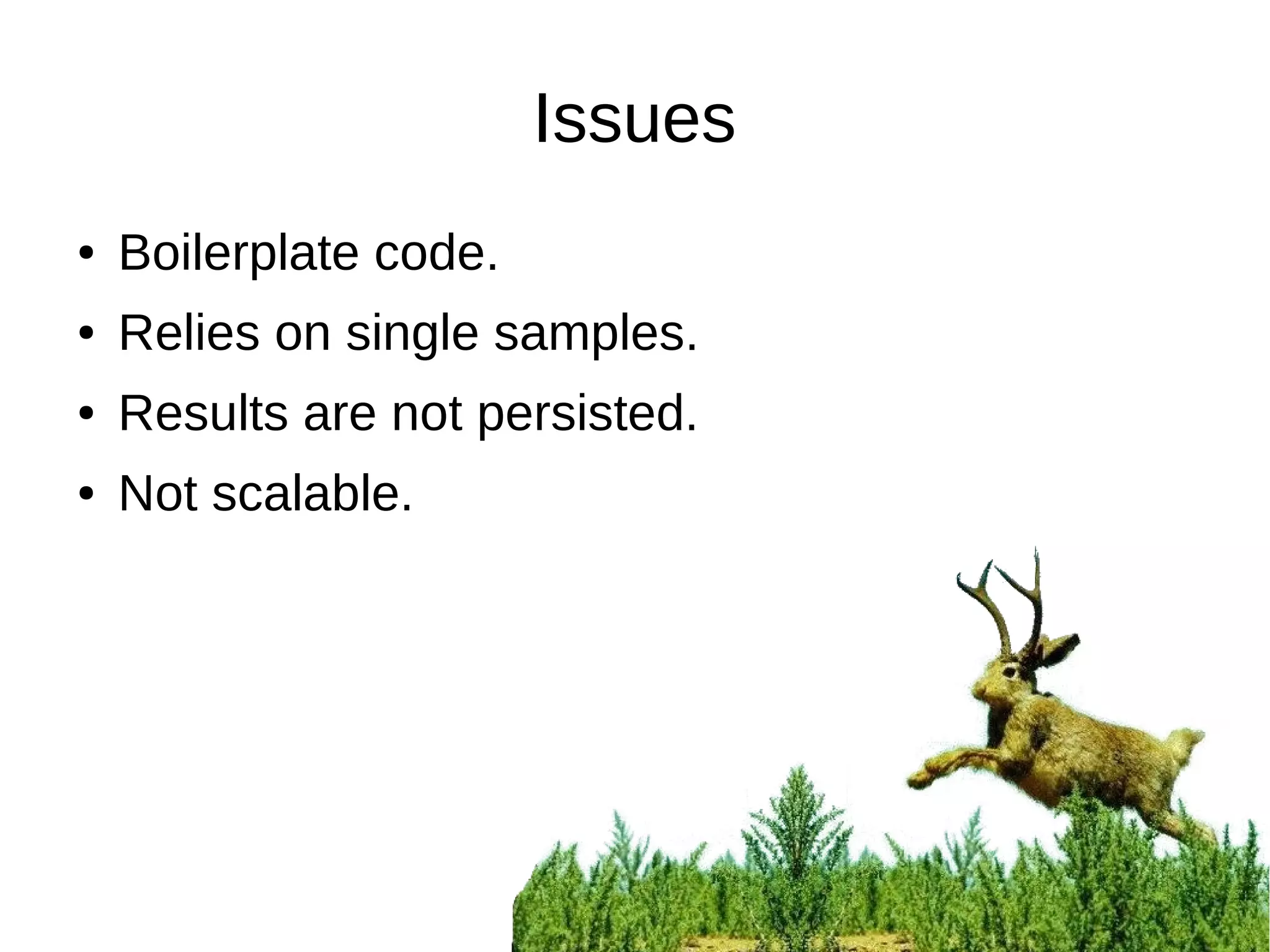
● Provide visual feedback.
● Perform statistical analysis.
● Be able to serialize and store results.
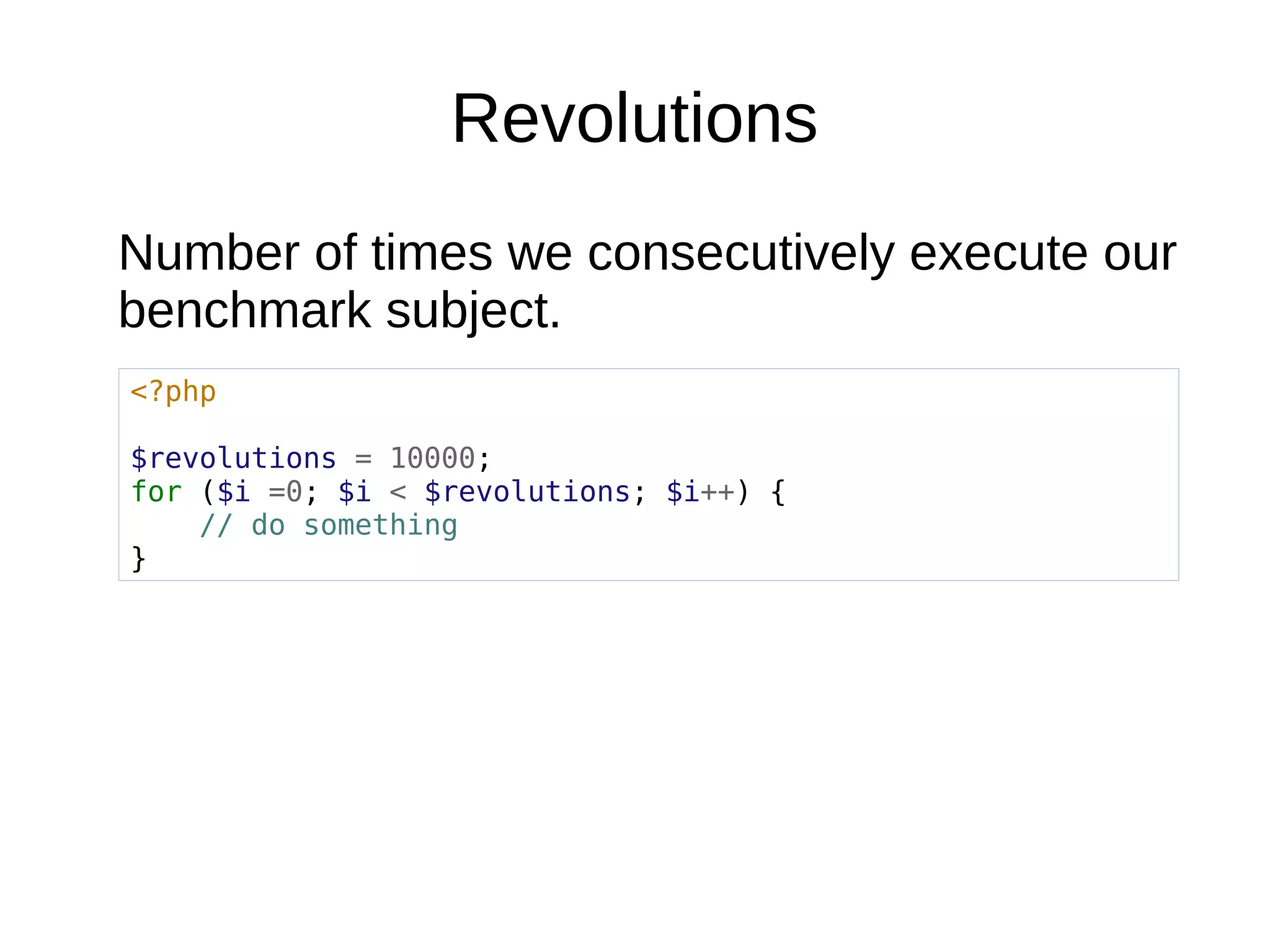
Revolutions
Number of timeswe consecutively execute our
benchmark subject.
<?php
$revolutions = 10000;
for ($i =0; $i < $revolutions; $i++) {
// do something
}
11.
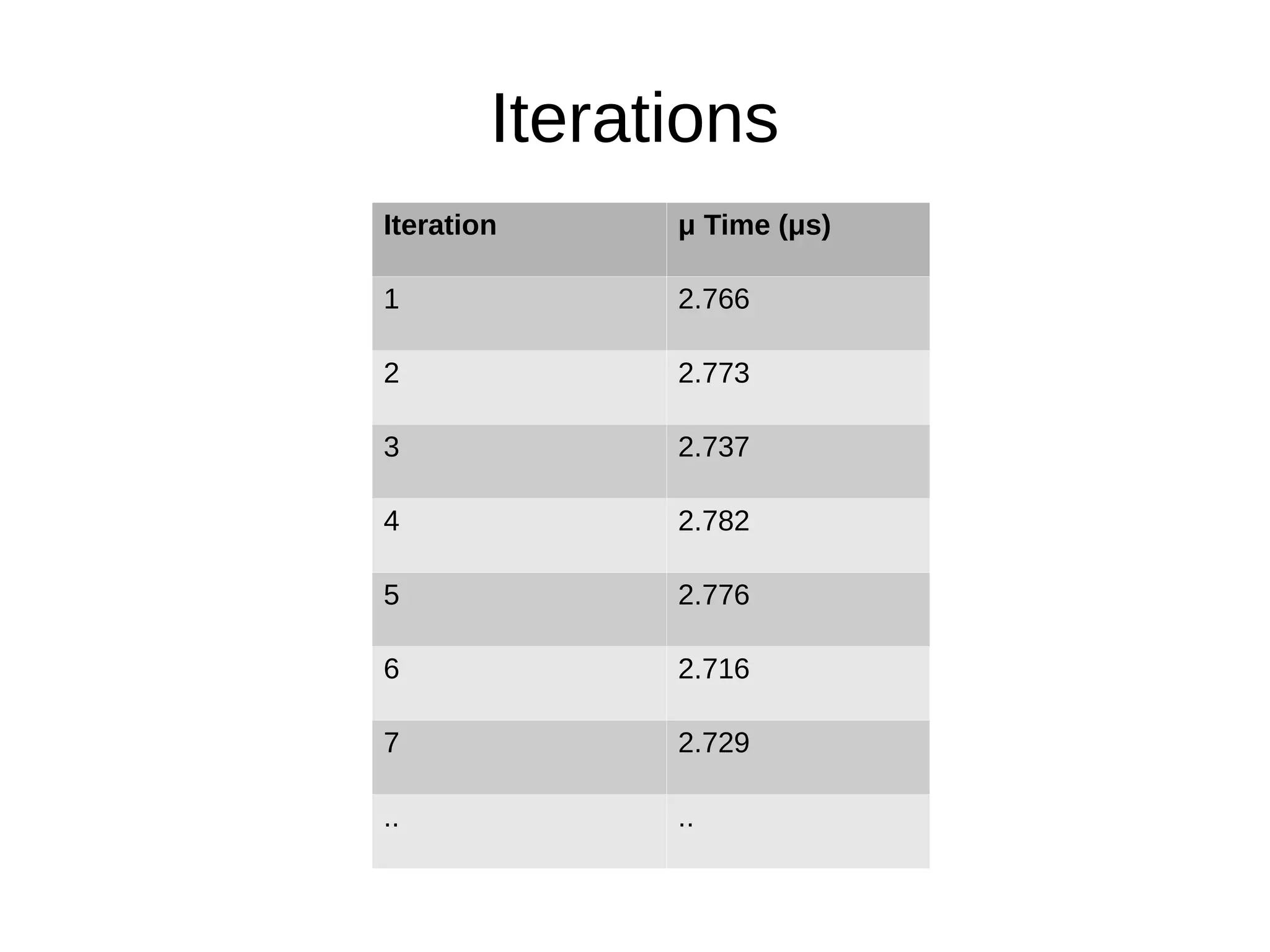
Iterations
Each iteration recordsthe time taken to execute
the revolutions.
<?php
$iterations = 100;
$revolutions = 10000;
$results = [];
for ($iteration = 0; $iteration < $iterations; $iteration++) {
$startTime = microtime(true);
for ($rev = 0; $rev < $revolultions; $rev++) {
// do something
}
$time = microtime(true) - $startTime;
$times[] = $time;
}
illustrative example
12.
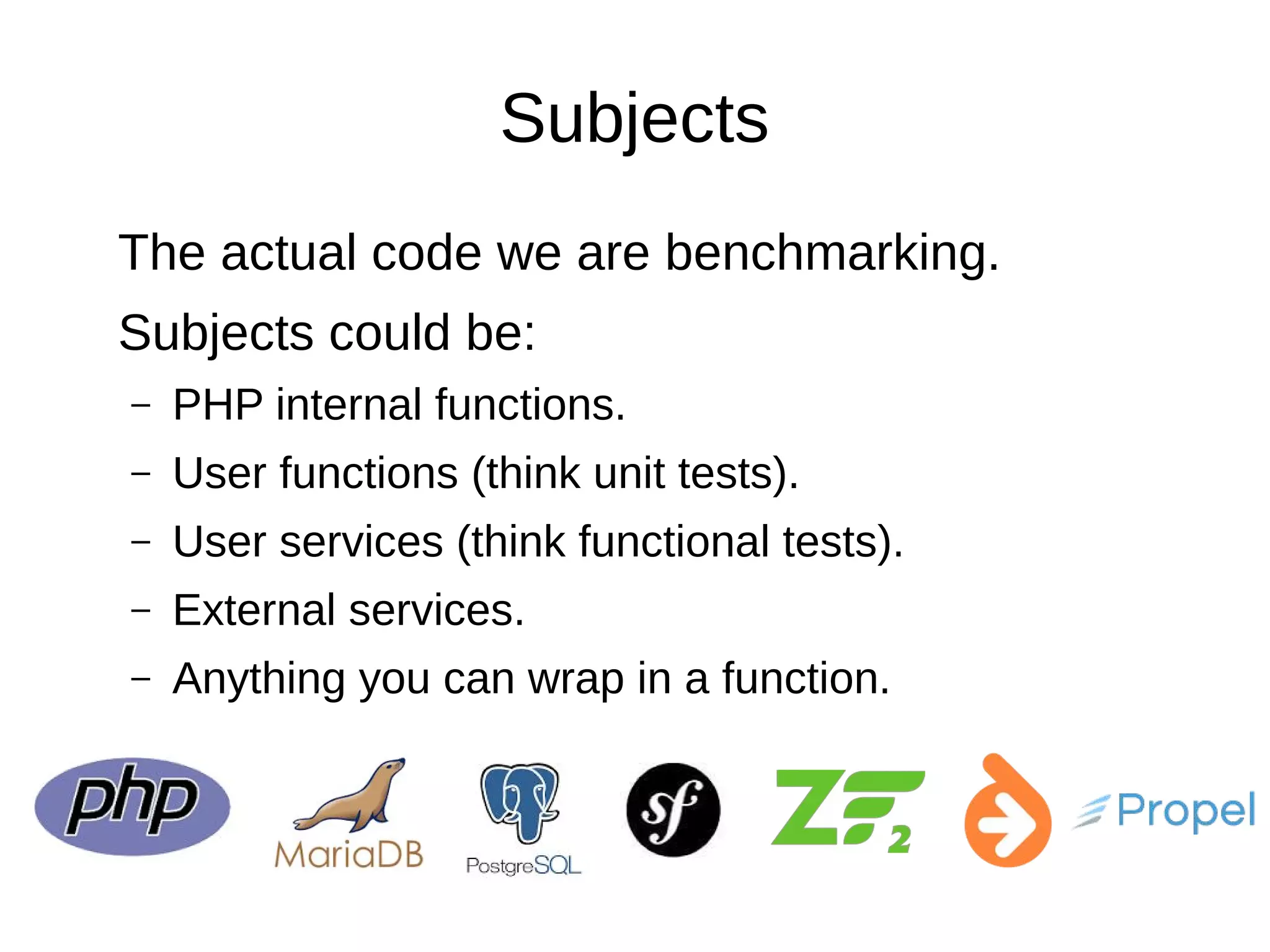
Subjects
The actual codewe are benchmarking.
Subjects could be:
– PHP internal functions.
– User functions (think unit tests).
– User services (think functional tests).
– External services.
– Anything you can wrap in a function.
Benchmarking with PHPBench
PHPBenchis a command line based
benchmarking tool similar to PHPUniut.
$ phpbench
phpbench version 0.10.0-dev
Usage:
command [options] [arguments]
...
Available commands:
help Displays help for a command
list Lists commands
report Generate a report from an XML file
run Run benchmarks
15.
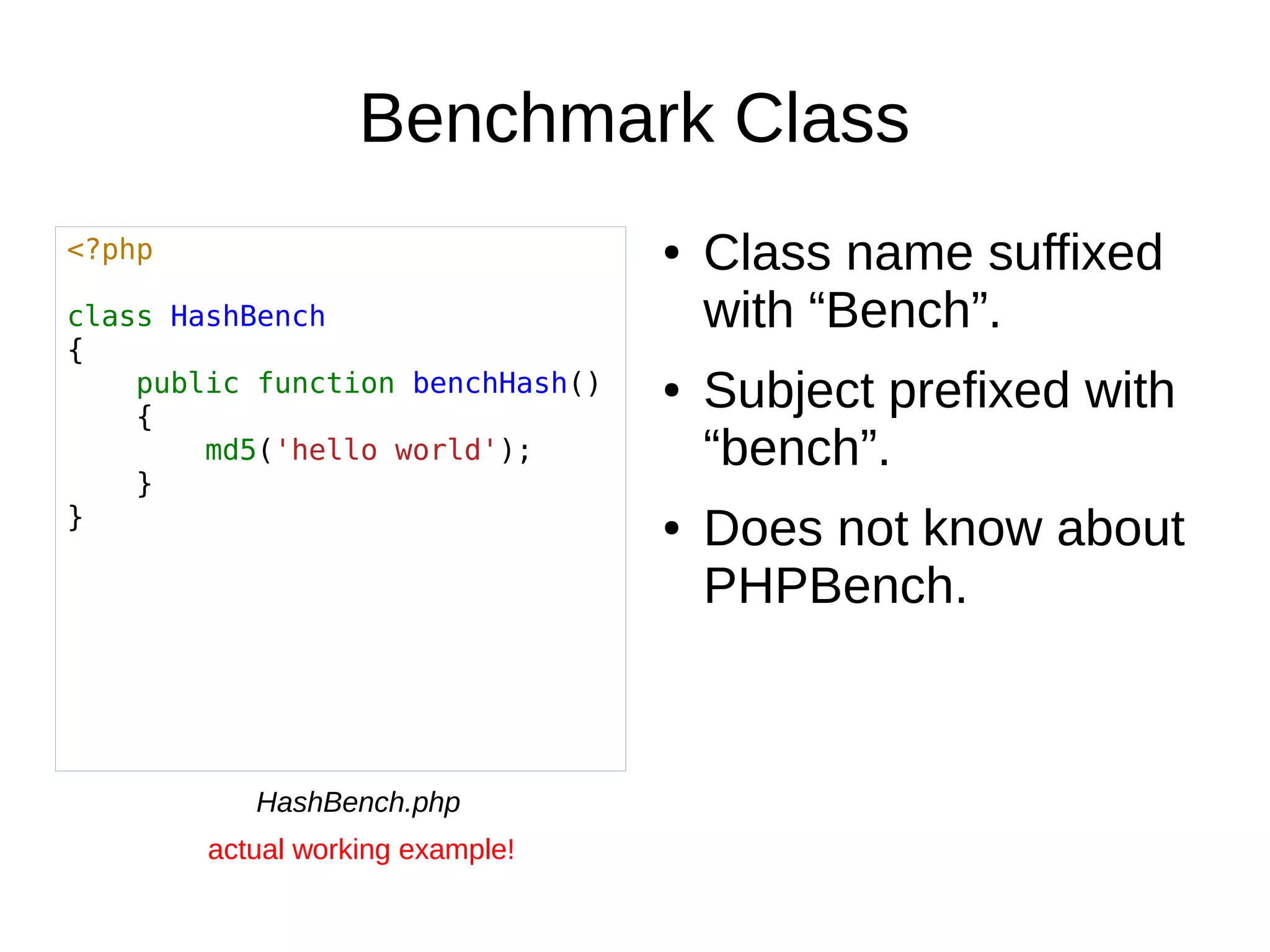
Benchmark Class
● Classname suffixed
with “Bench”.
● Subject prefixed with
“bench”.
● Does not know about
PHPBench.
<?php
class HashBench
{
public function benchHash()
{
md5('hello world');
}
}
HashBench.php
actual working example!
16.
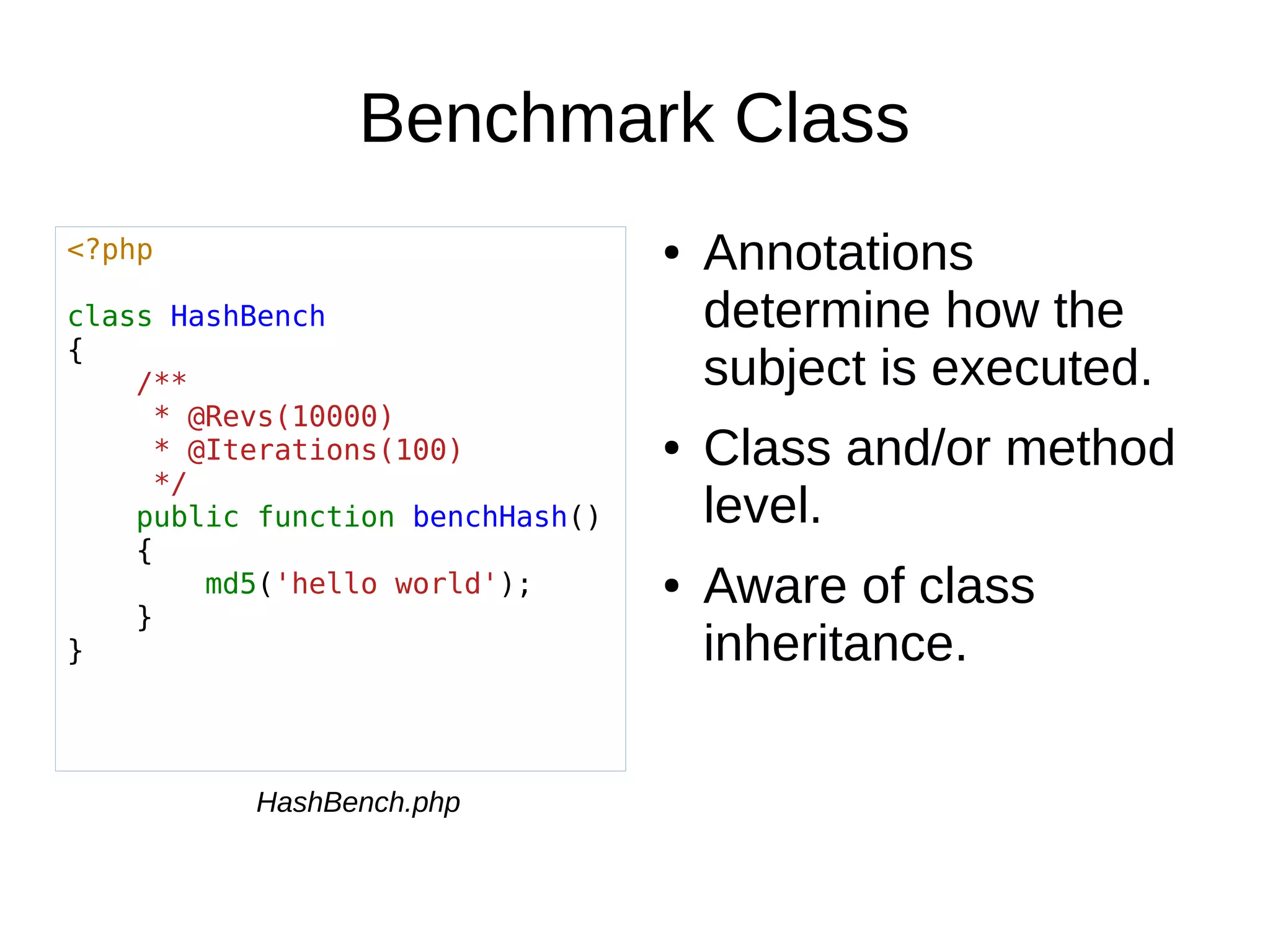
Benchmark Class
● Annotations
determinehow the
subject is executed.
● Class and/or method
level.
● Aware of class
inheritance.
<?php
class HashBench
{
/**
* @Revs(10000)
* @Iterations(100)
*/
public function benchHash()
{
md5('hello world');
}
}
HashBench.php
17.
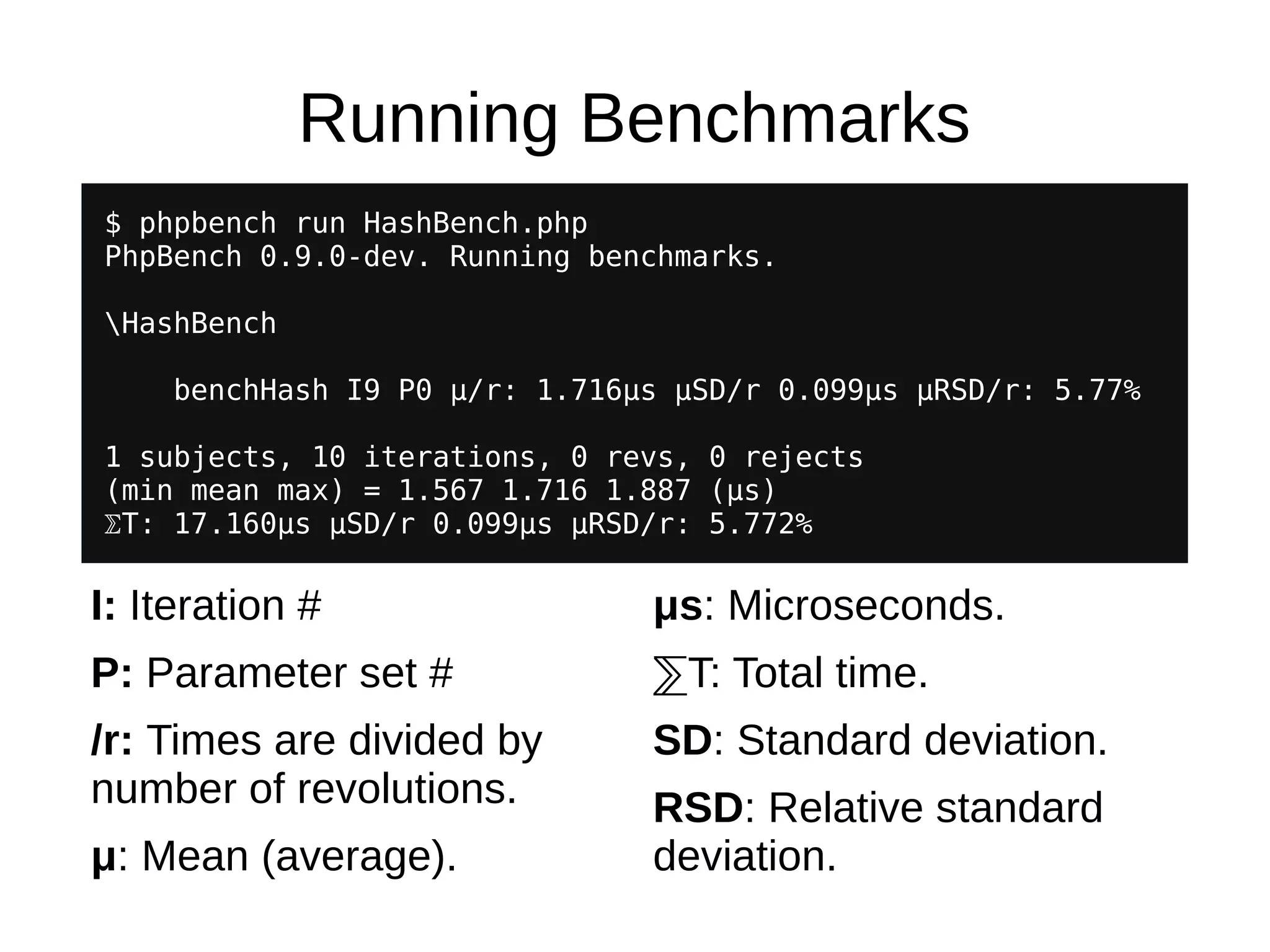
Running Benchmarks
$ phpbenchrun HashBench.php
PhpBench 0.9.0-dev. Running benchmarks.
HashBench
benchHash I9 P0 μ/r: 1.716μs μSD/r 0.099μs μRSD/r: 5.77%
1 subjects, 10 iterations, 0 revs, 0 rejects
(min mean max) = 1.567 1.716 1.887 (μs)
⅀T: 17.160μs μSD/r 0.099μs μRSD/r: 5.772%
I: Iteration #
P: Parameter set #
/r: Times are divided by
number of revolutions.
μ: Mean (average).
μs: Microseconds.
⅀T: Total time.
SD: Standard deviation.
RSD: Relative standard
deviation.
18.
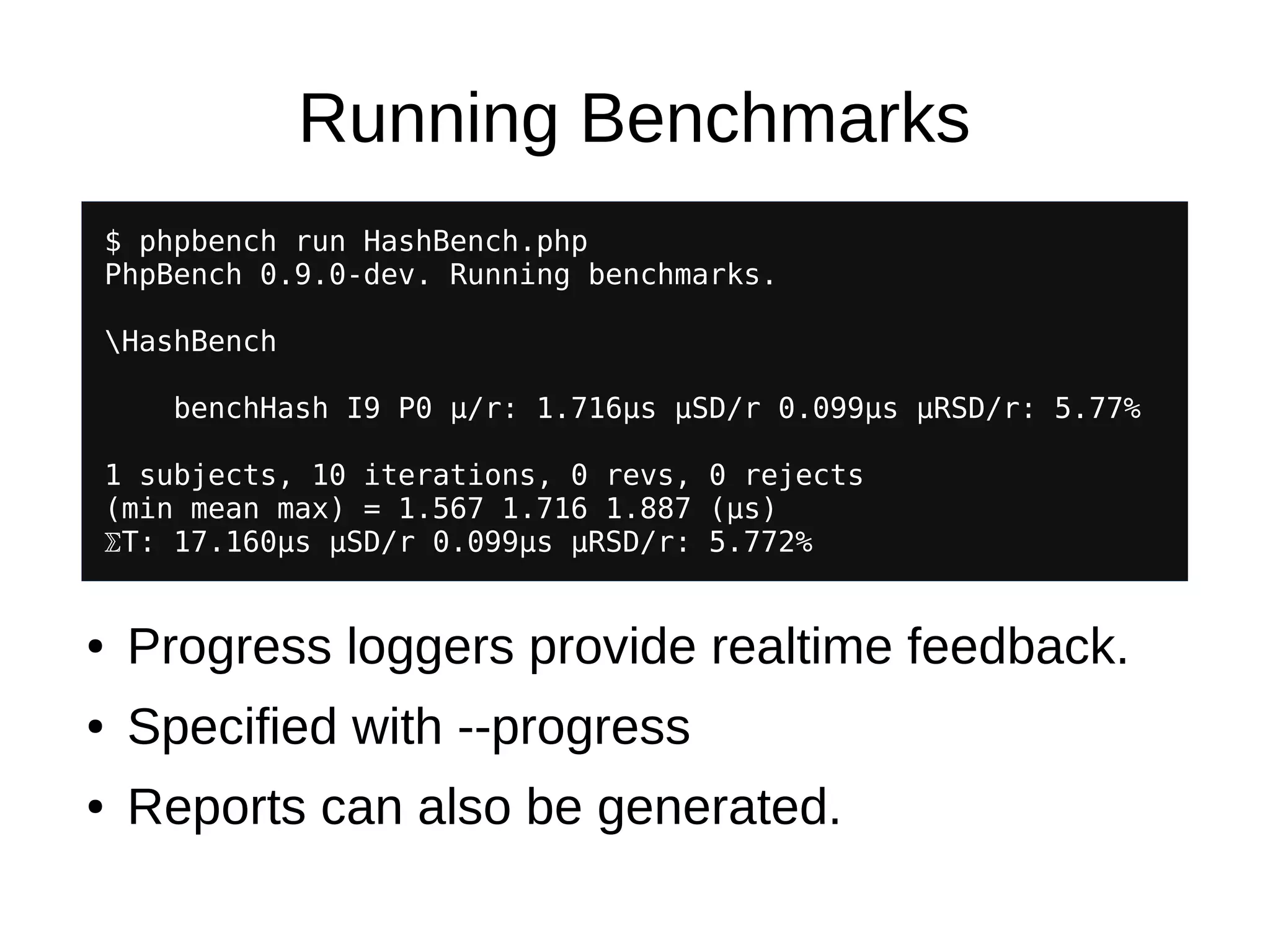
Running Benchmarks
$ phpbenchrun HashBench.php
PhpBench 0.9.0-dev. Running benchmarks.
HashBench
benchHash I9 P0 μ/r: 1.716μs μSD/r 0.099μs μRSD/r: 5.77%
1 subjects, 10 iterations, 0 revs, 0 rejects
(min mean max) = 1.567 1.716 1.887 (μs)
⅀T: 17.160μs μSD/r 0.099μs μRSD/r: 5.772%
● Progress loggers provide realtime feedback.
● Specified with --progress
● Reports can also be generated.
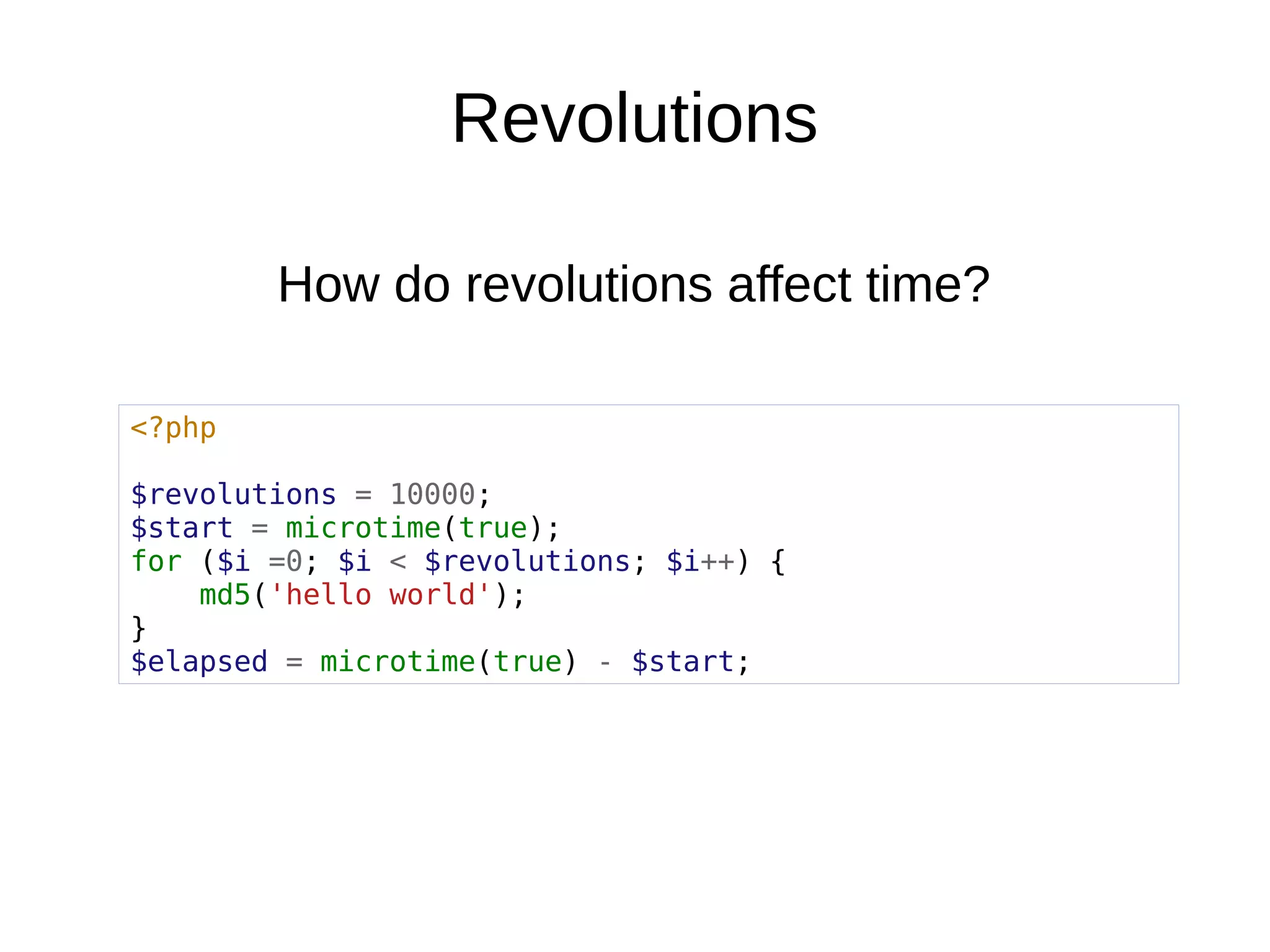
Revolutions
<?php
$revolutions = 10000;
$start= microtime(true);
for ($i =0; $i < $revolutions; $i++) {
md5('hello world');
}
$elapsed = microtime(true) - $start;
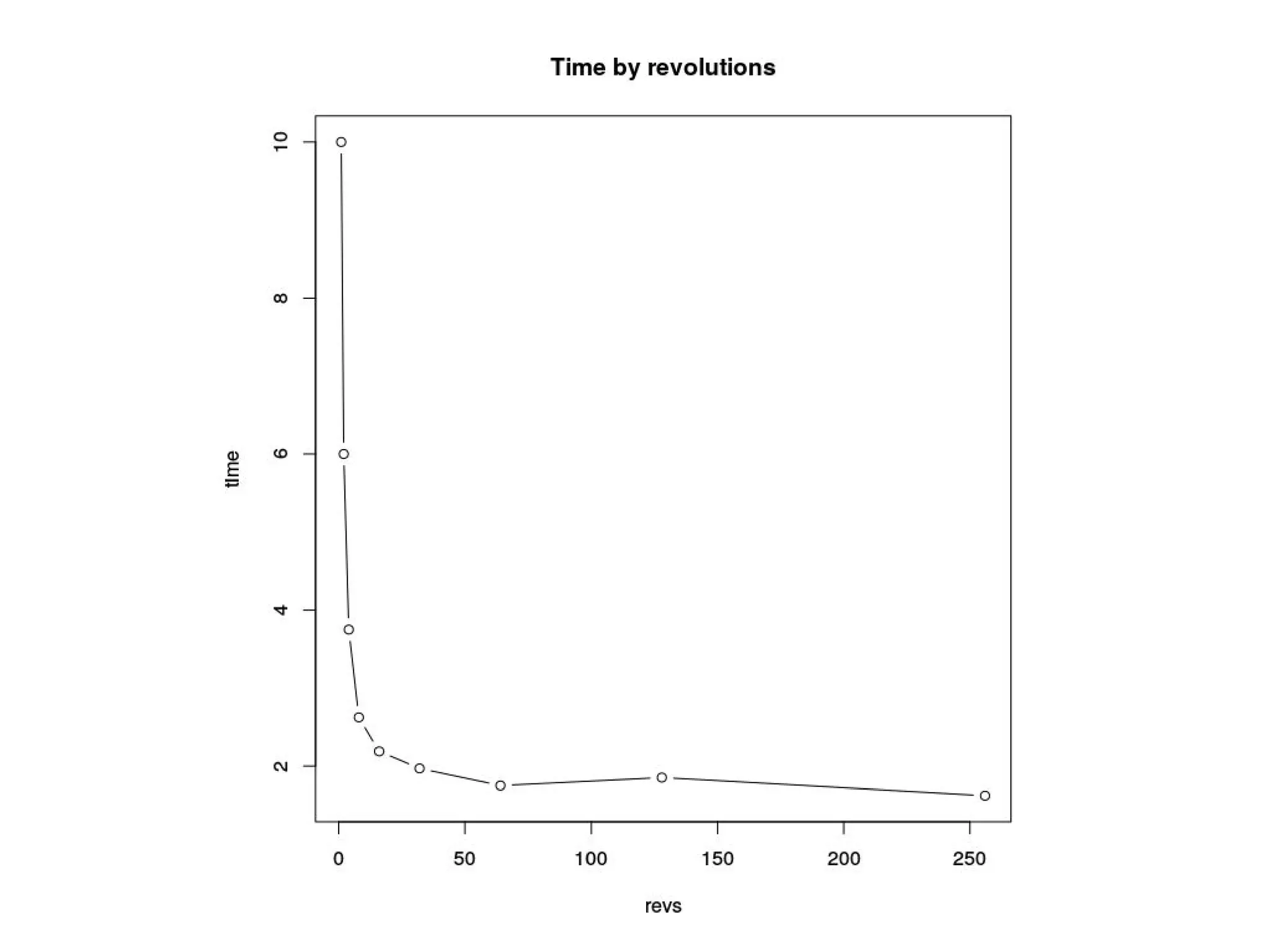
How do revolutions affect time?
21.
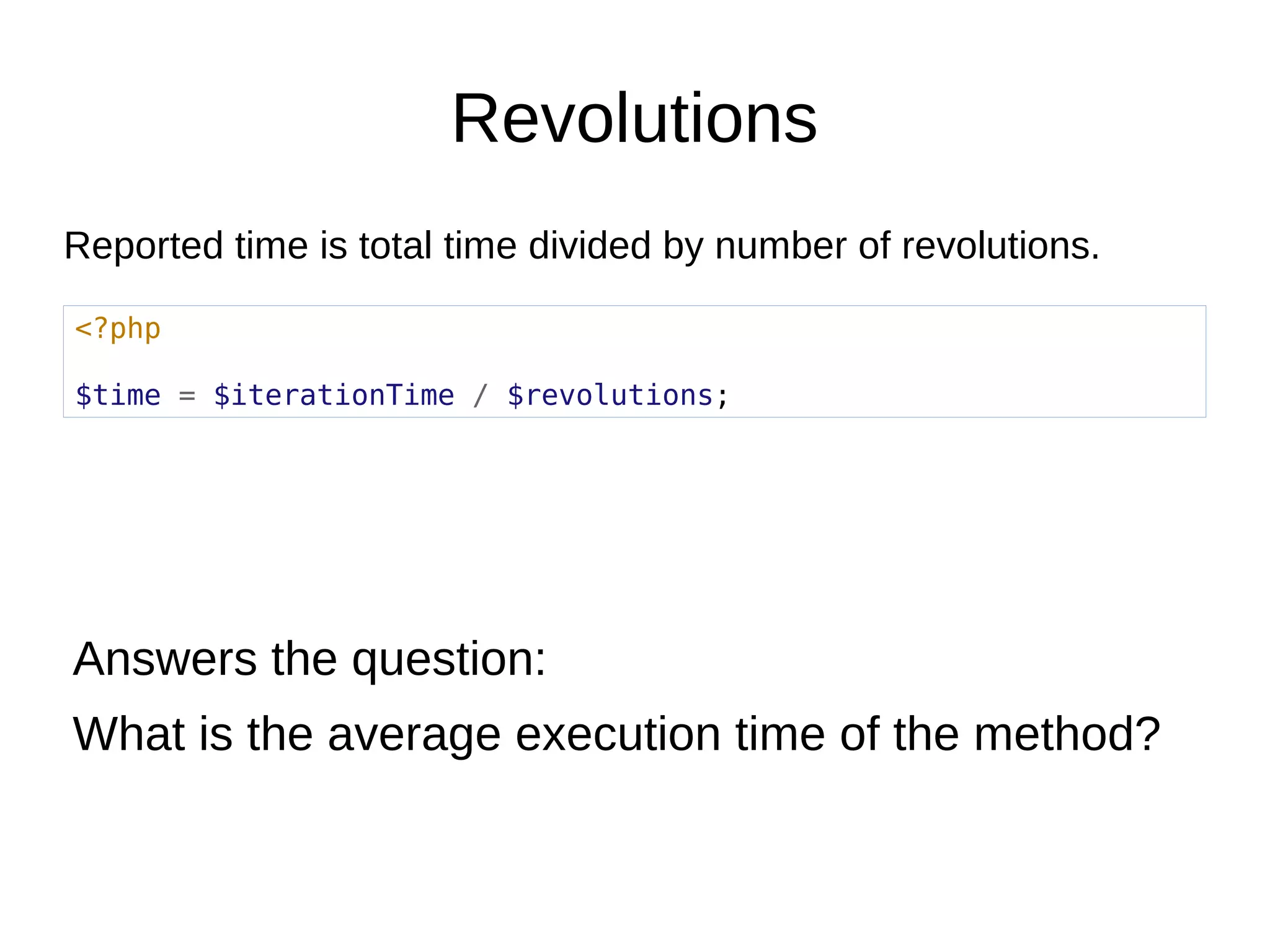
Revolutions
<?php
$time = $iterationTime/ $revolutions;
Reported time is total time divided by number of revolutions.
Answers the question:
What is the average execution time of the method?
22.
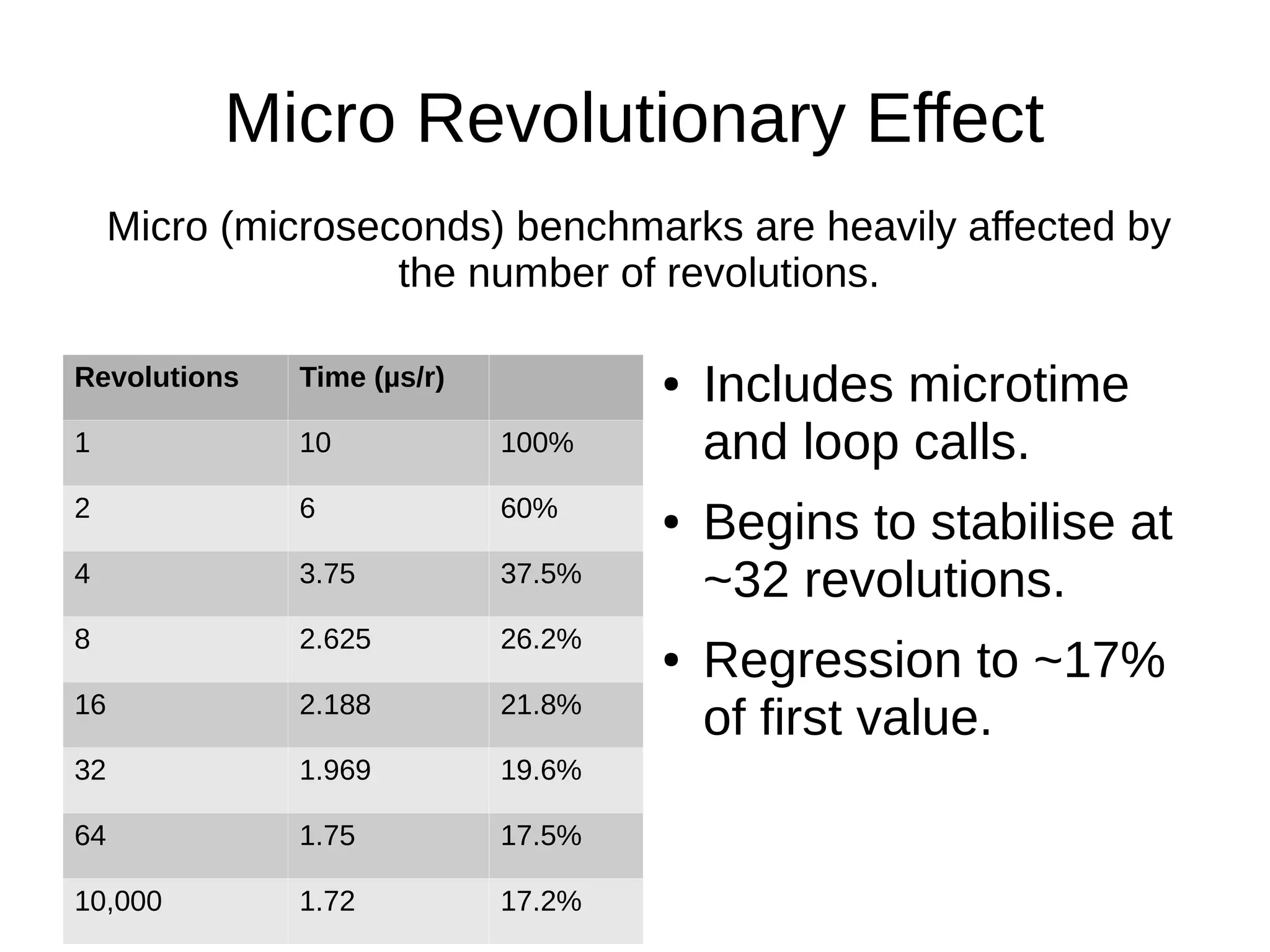
Revolutions Time (µs/r)
110 100%
2 6 60%
4 3.75 37.5%
8 2.625 26.2%
16 2.188 21.8%
32 1.969 19.6%
64 1.75 17.5%
10,000 1.72 17.2%
Micro Revolutionary Effect
● Includes microtime
and loop calls.
● Begins to stabilise at
~32 revolutions.
● Regression to ~17%
of first value.
Micro (microseconds) benchmarks are heavily affected by
the number of revolutions.
24.
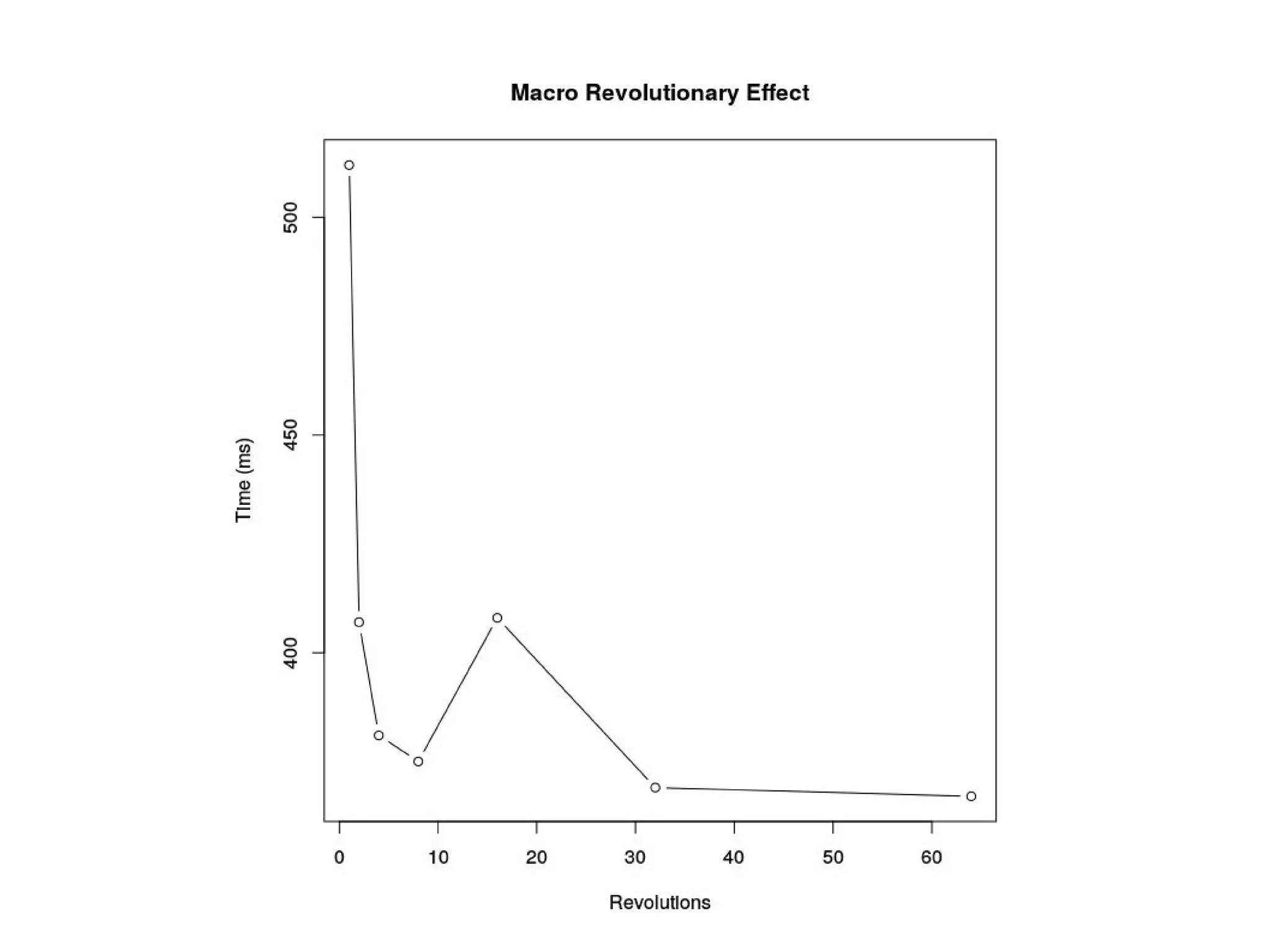
Revolutions Time (ms/r)
1512 100%
2 407 79%
4 381 74%
8 375 73%
16 408 79%
32 369 72%
64 367 71%
Macro Revolutionary Effect
● Warmup factor
(autoload cache, etc)
● Earlier stabilisation.
● Regression to 71% of
first value.
Macro (milliseconds, seconds) benchmarks less affected.
26.
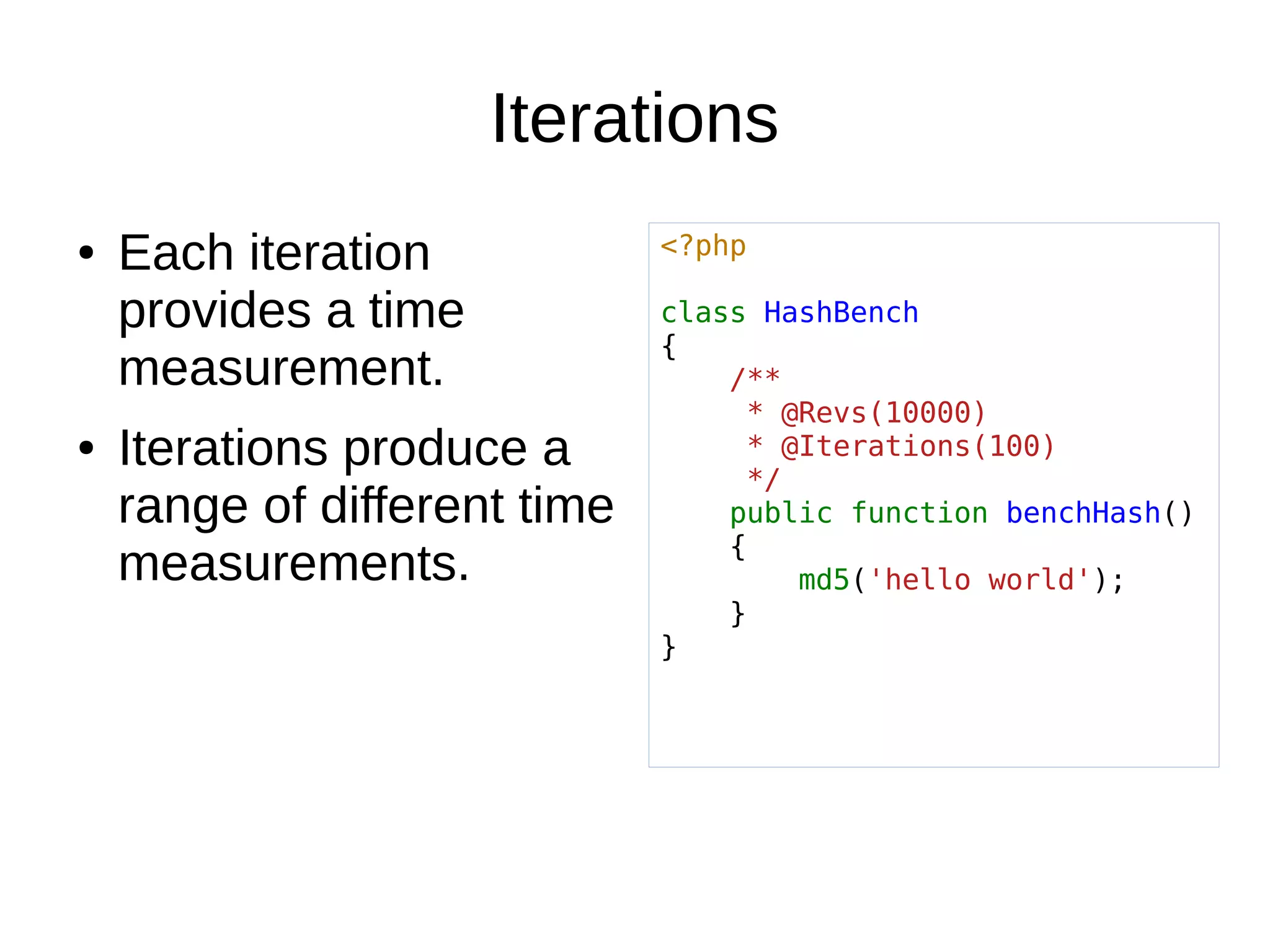
Iterations
<?php
class HashBench
{
/**
* @Revs(10000)
*@Iterations(100)
*/
public function benchHash()
{
md5('hello world');
}
}
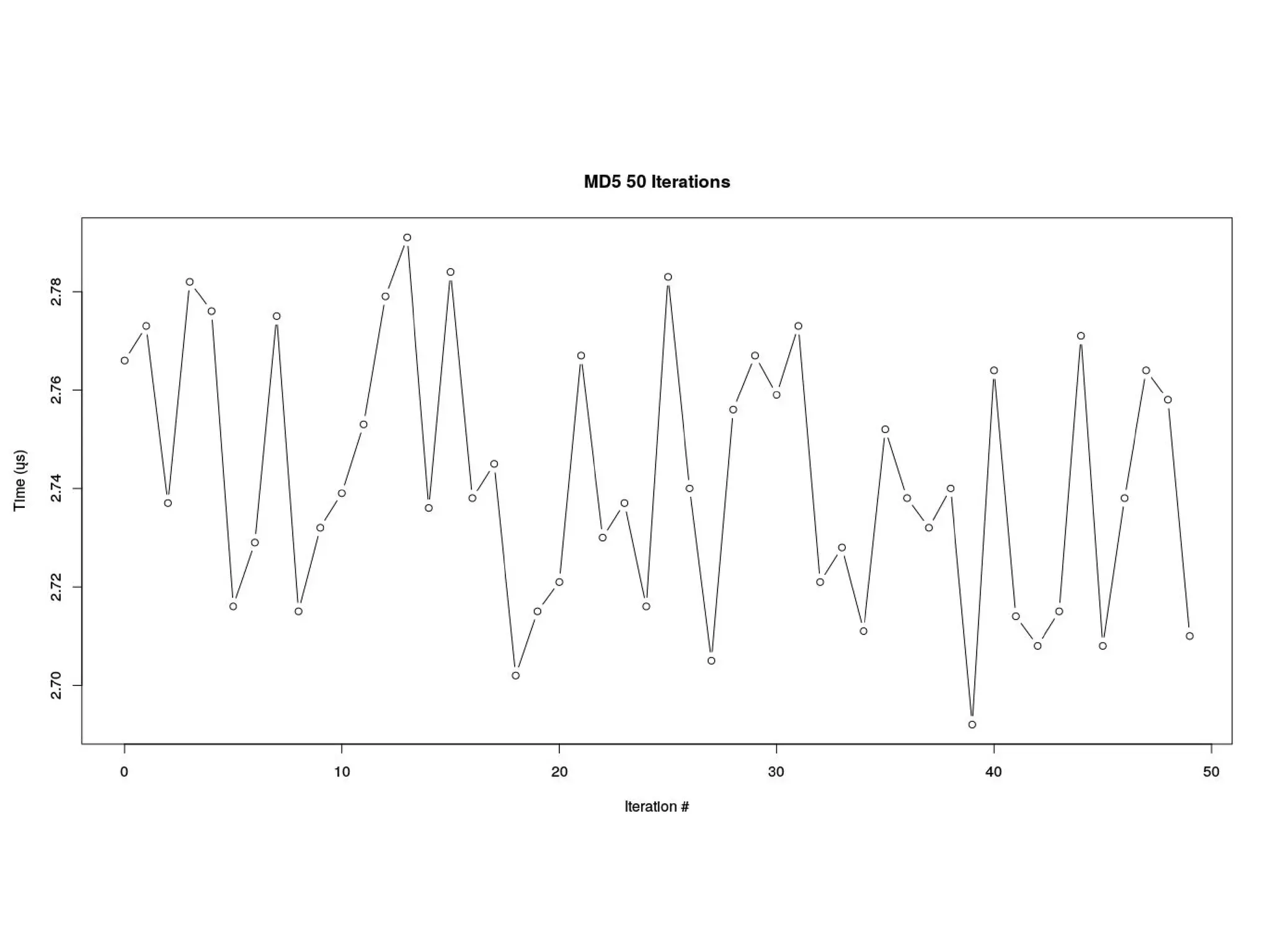
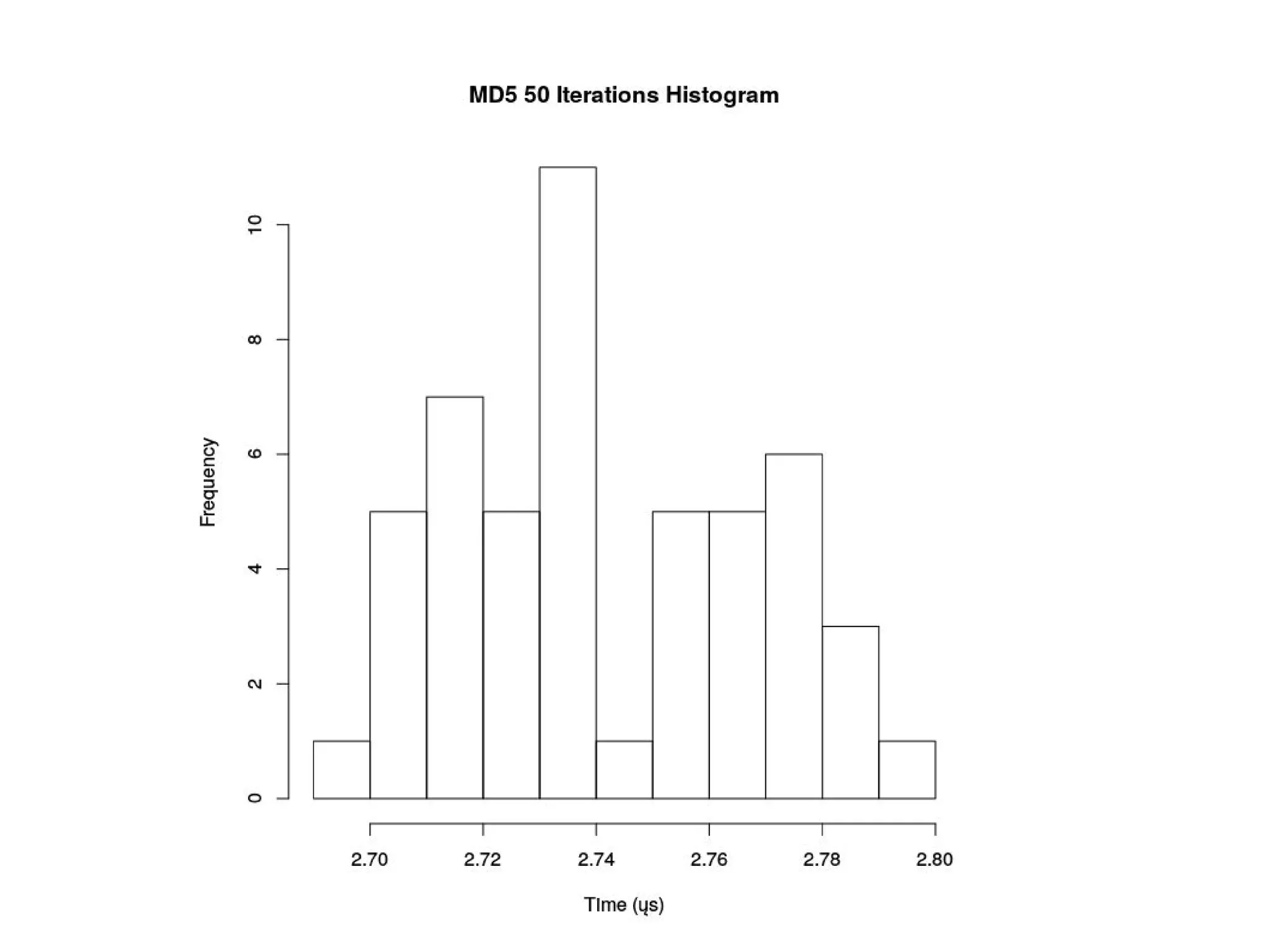
● Each iteration
provides a time
measurement.
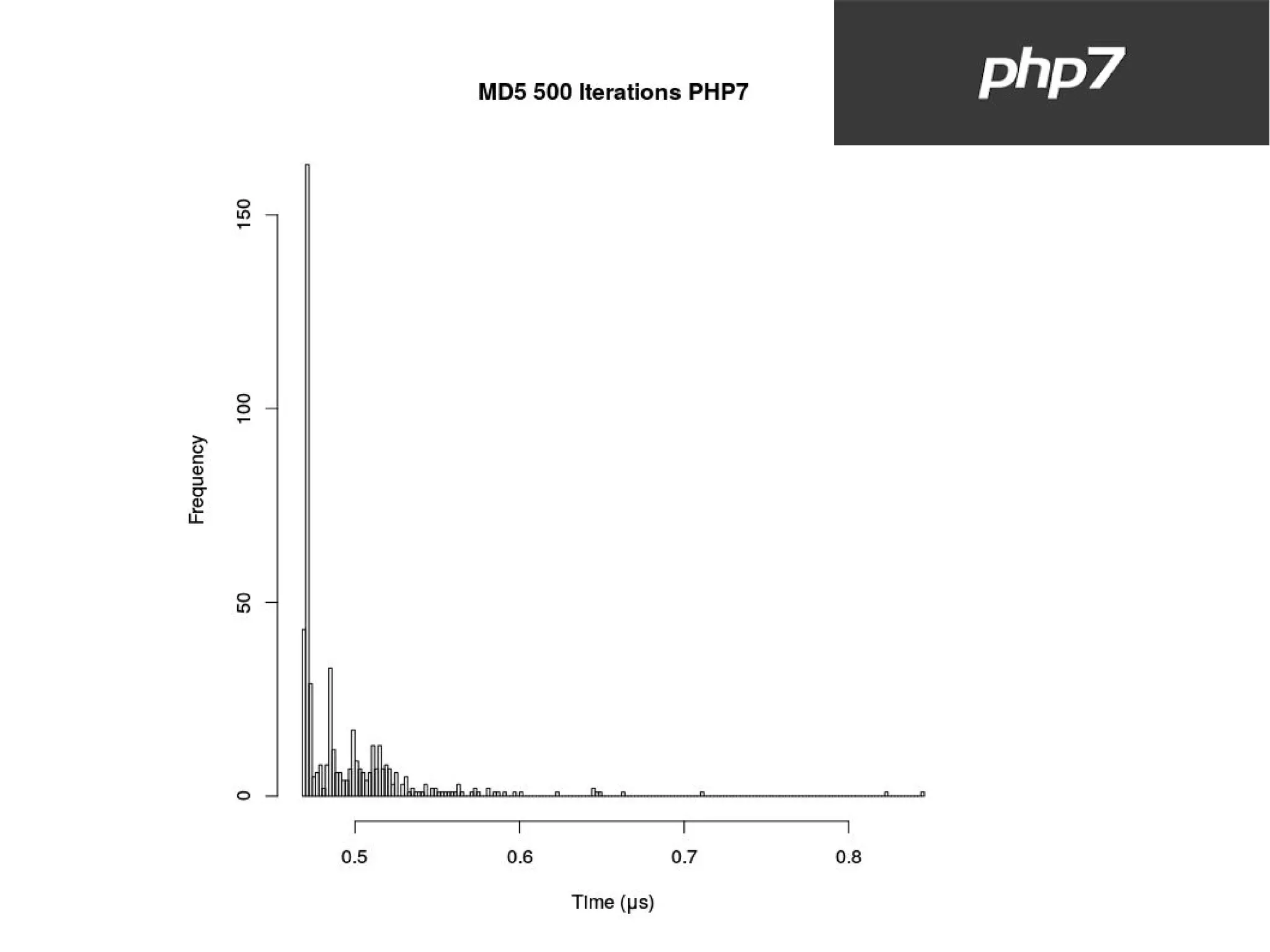
● Iterations produce a
range of different time
measurements.
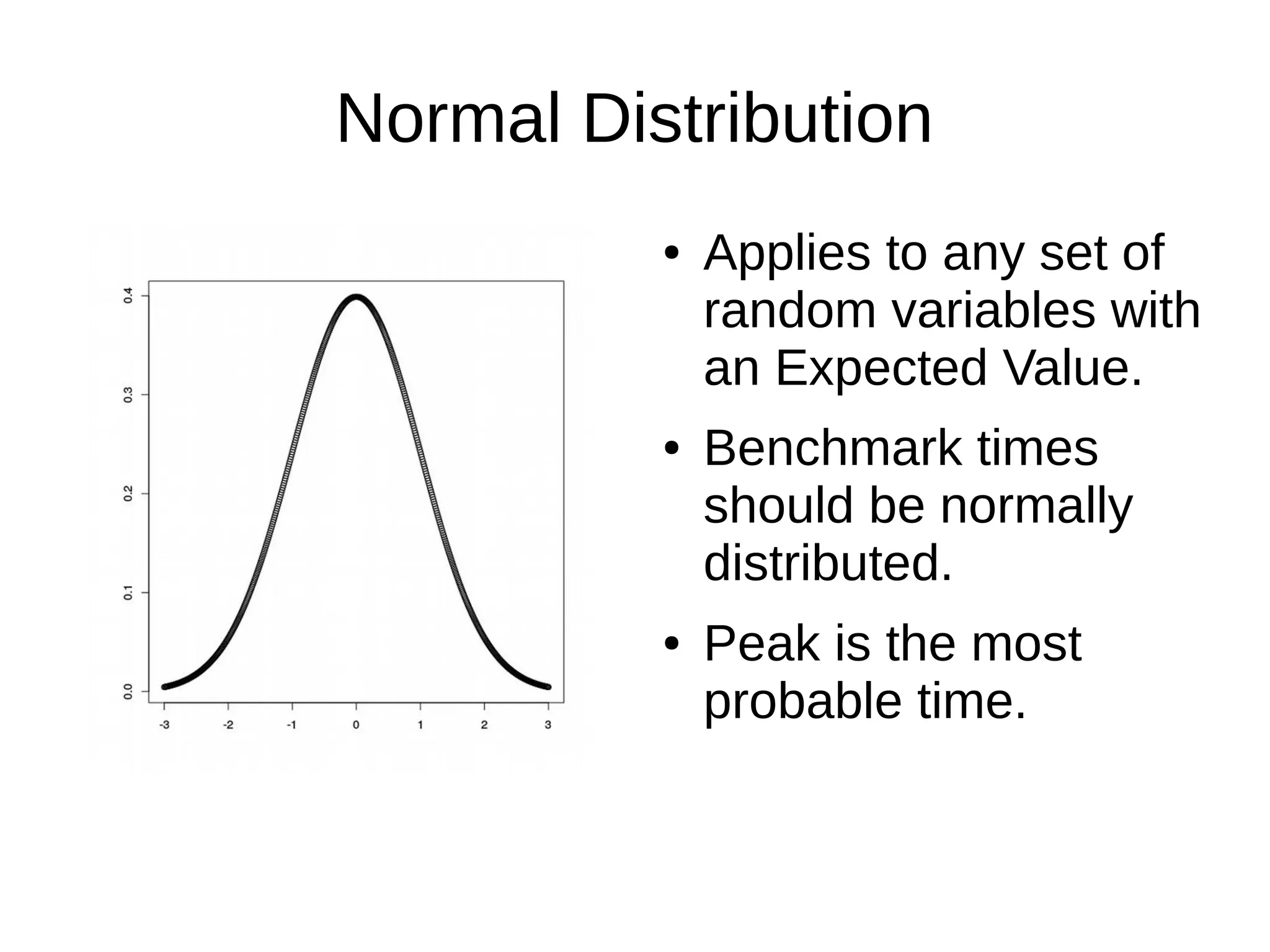
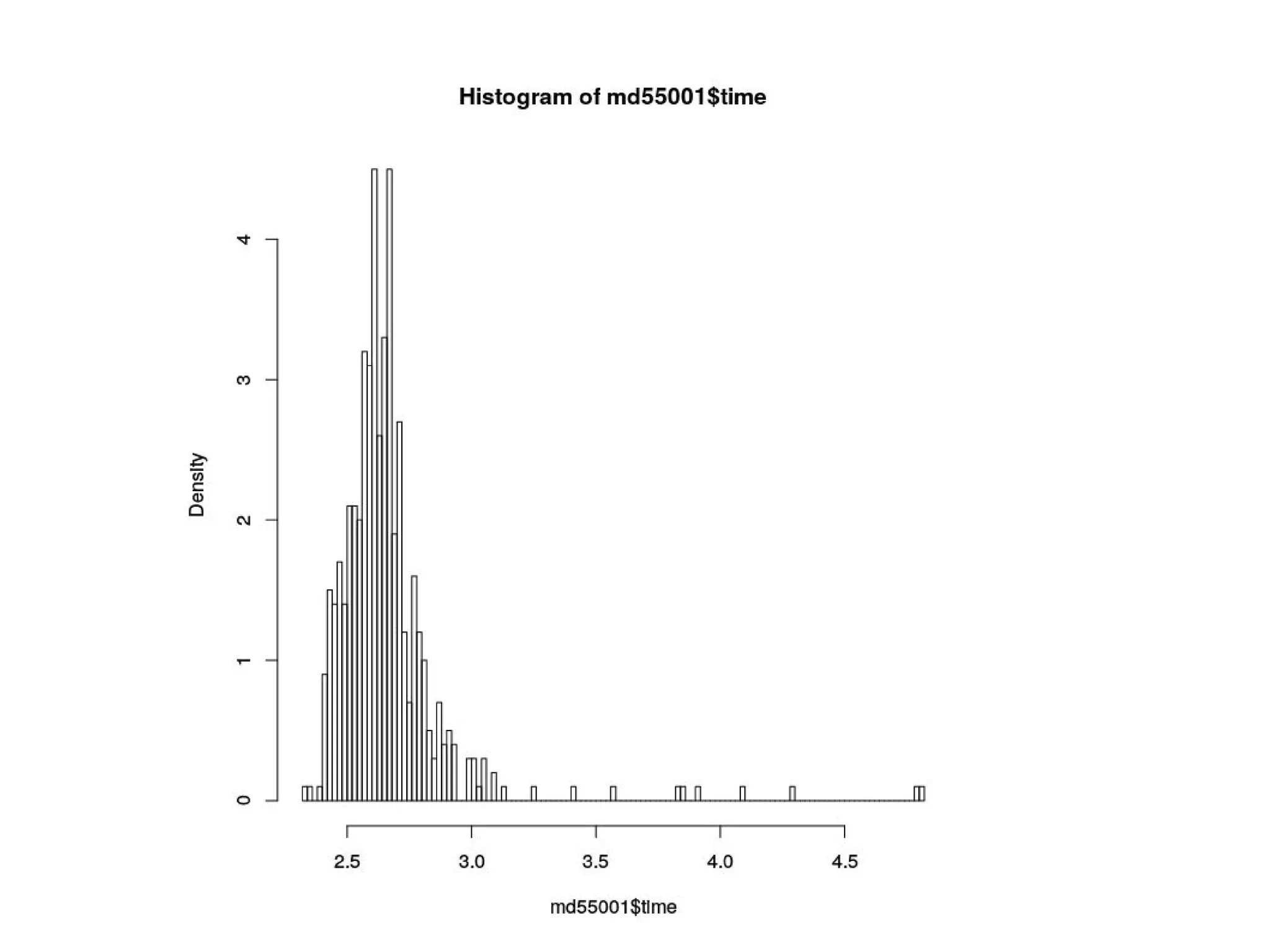
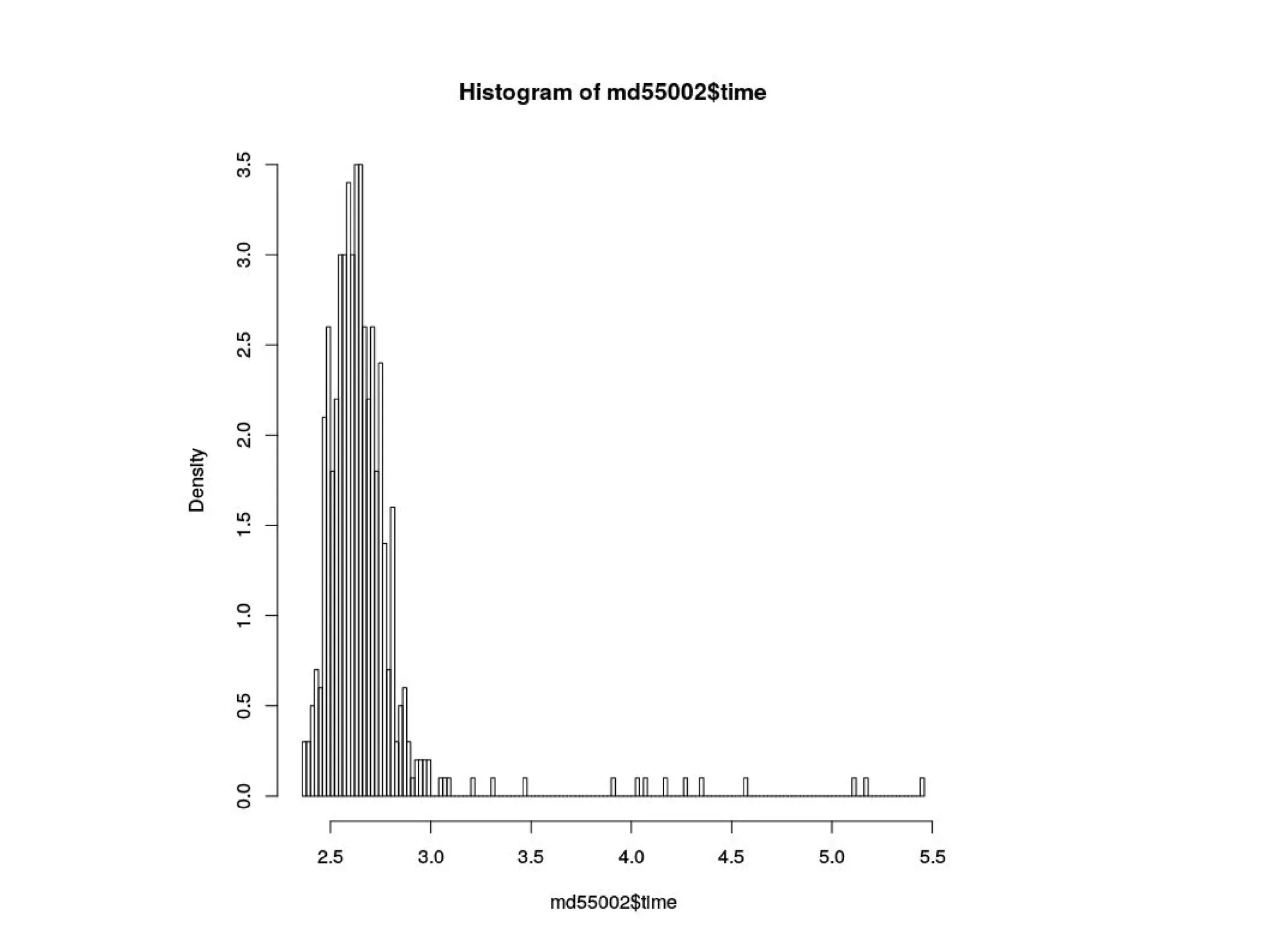
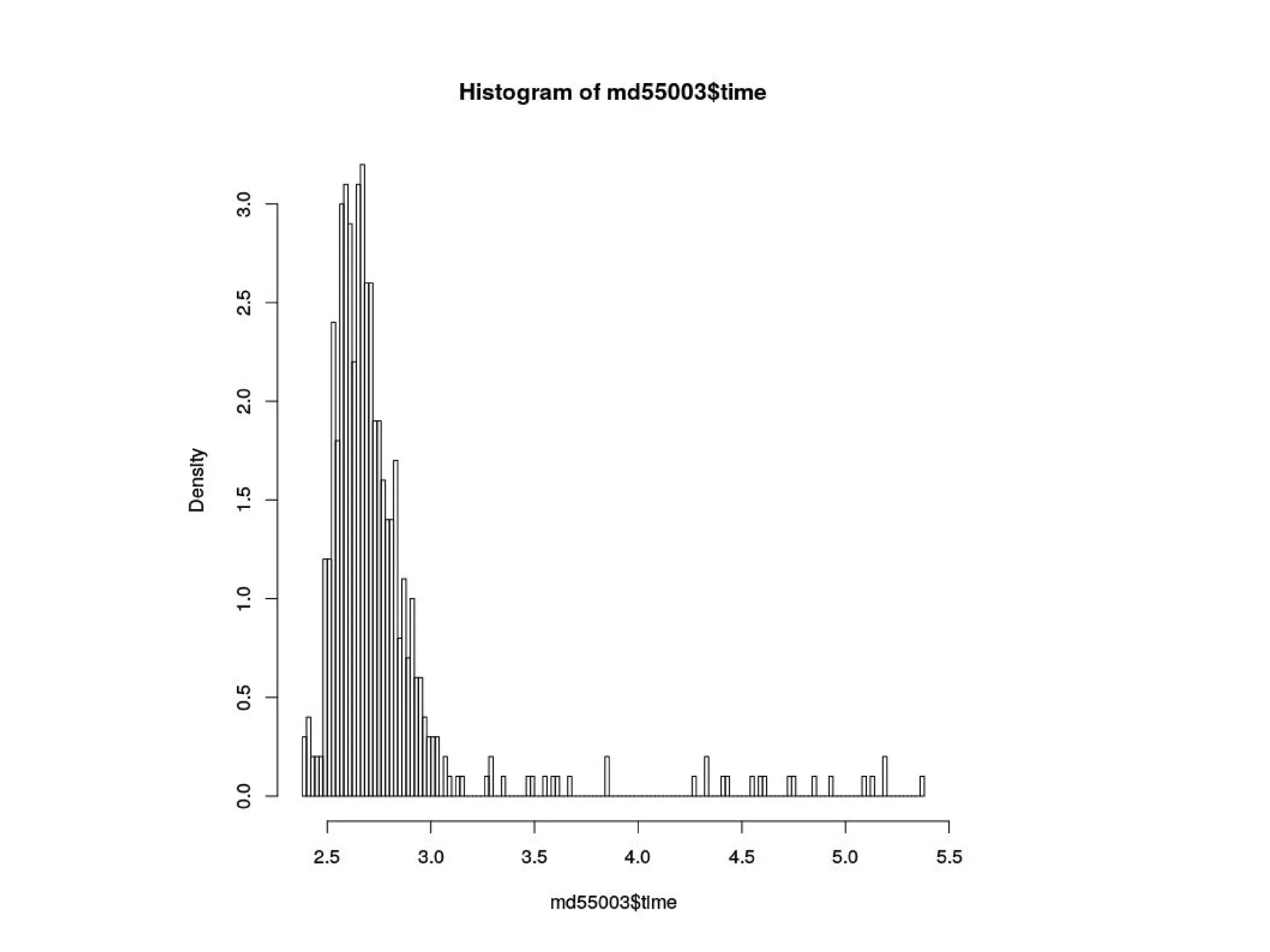
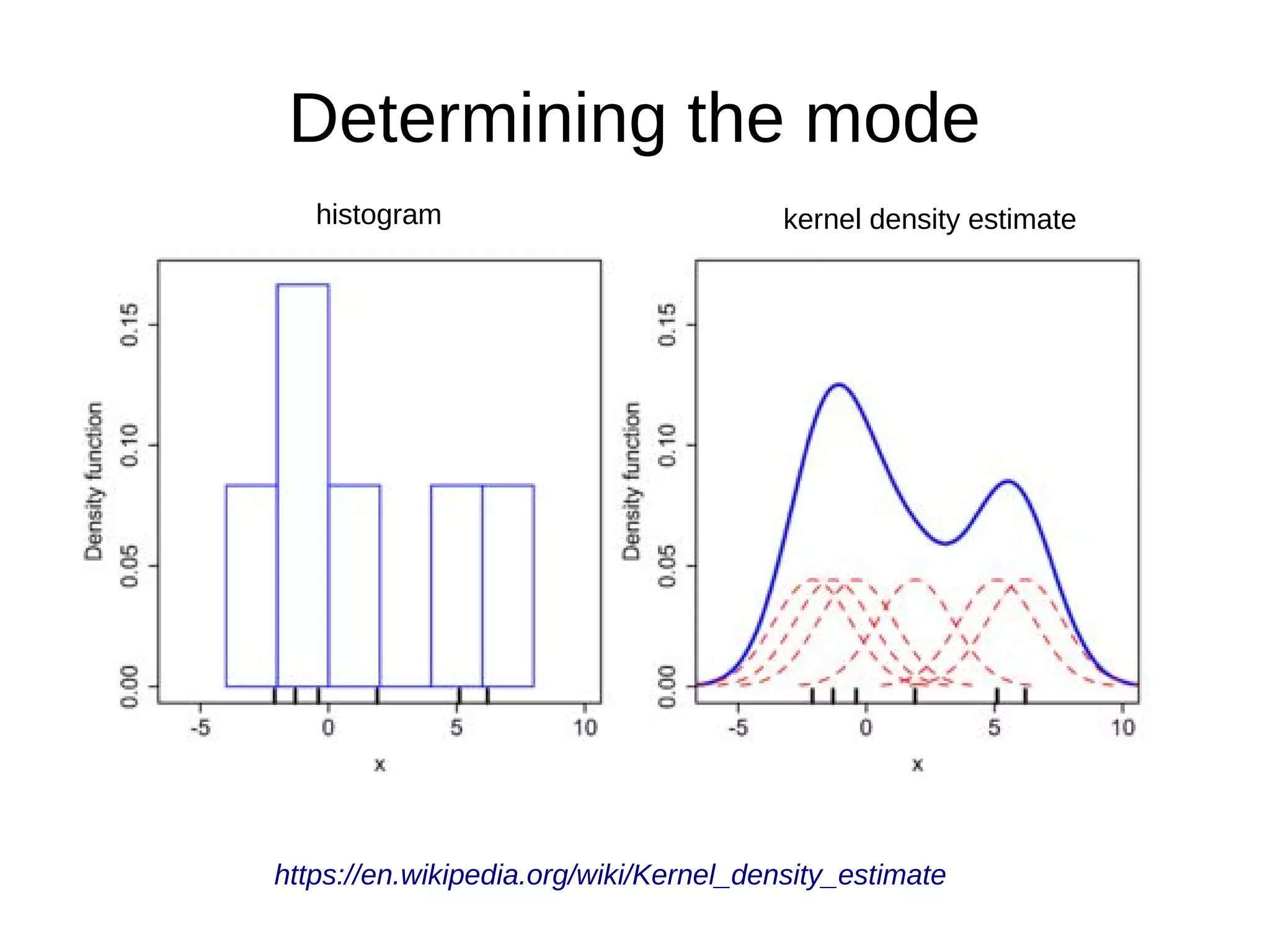
Normal Distribution
● Appliesto any set of
random variables with
an Expected Value.
● Benchmark times
should be normally
distributed.
● Peak is the most
probable time.
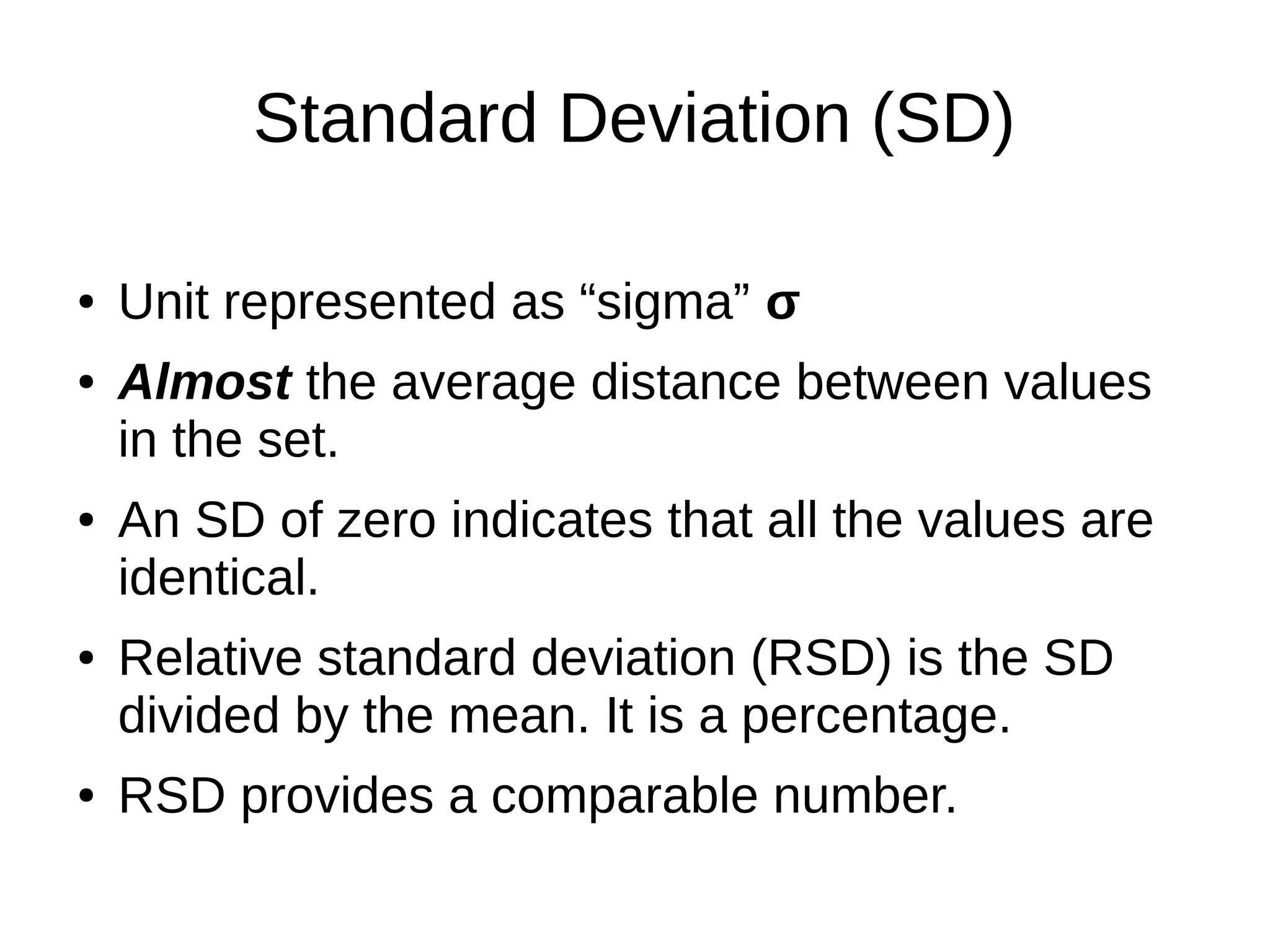
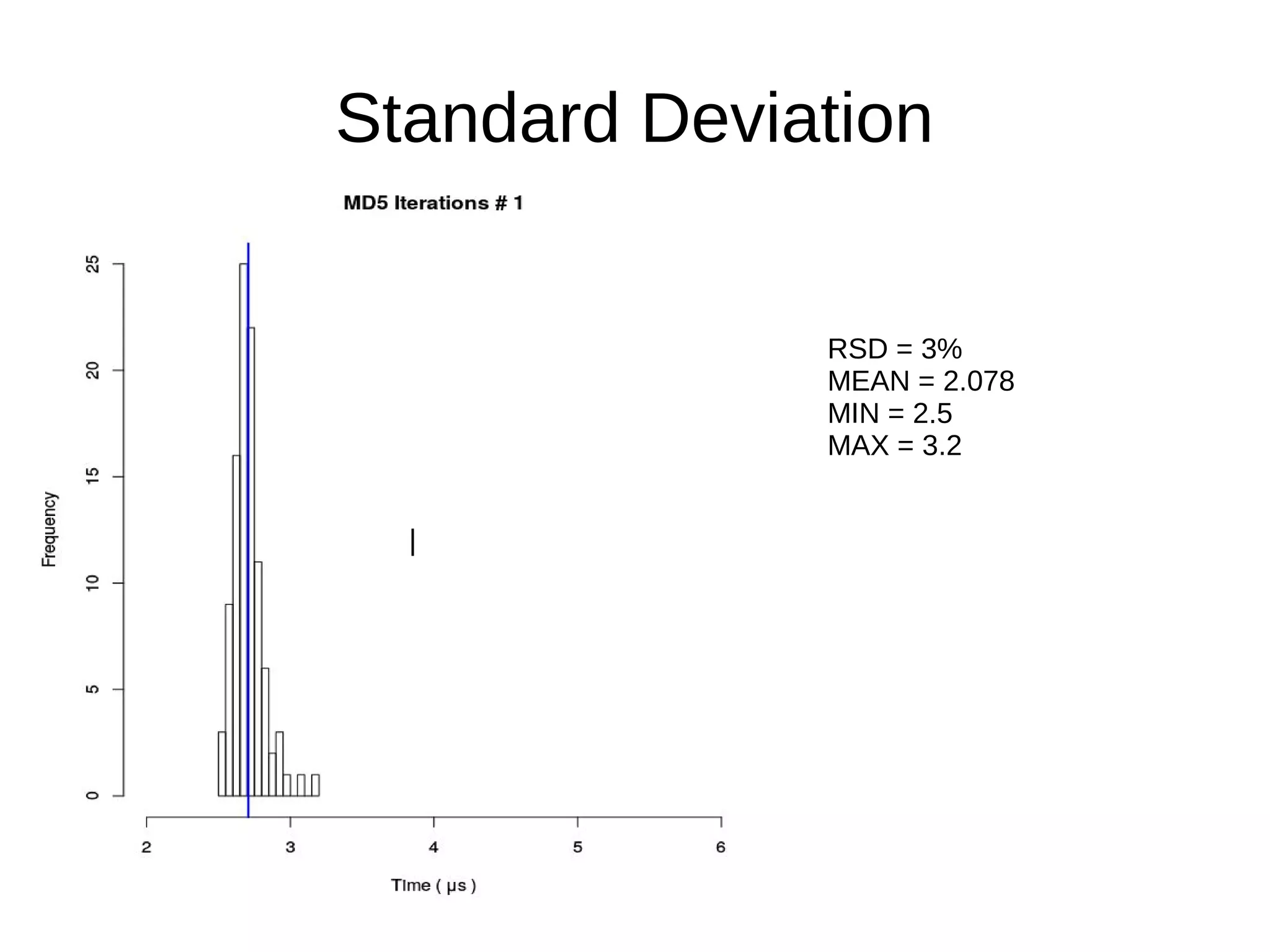
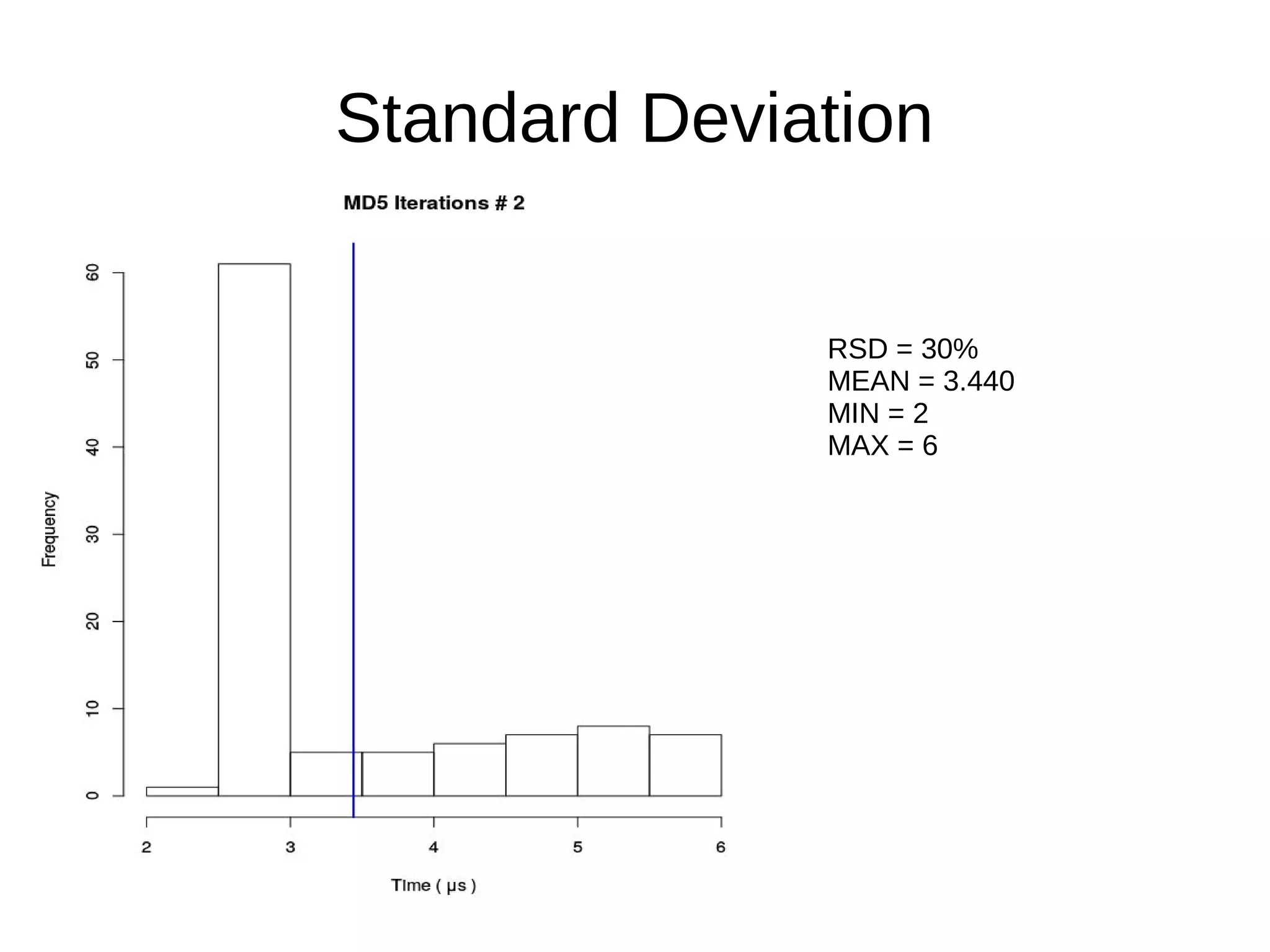
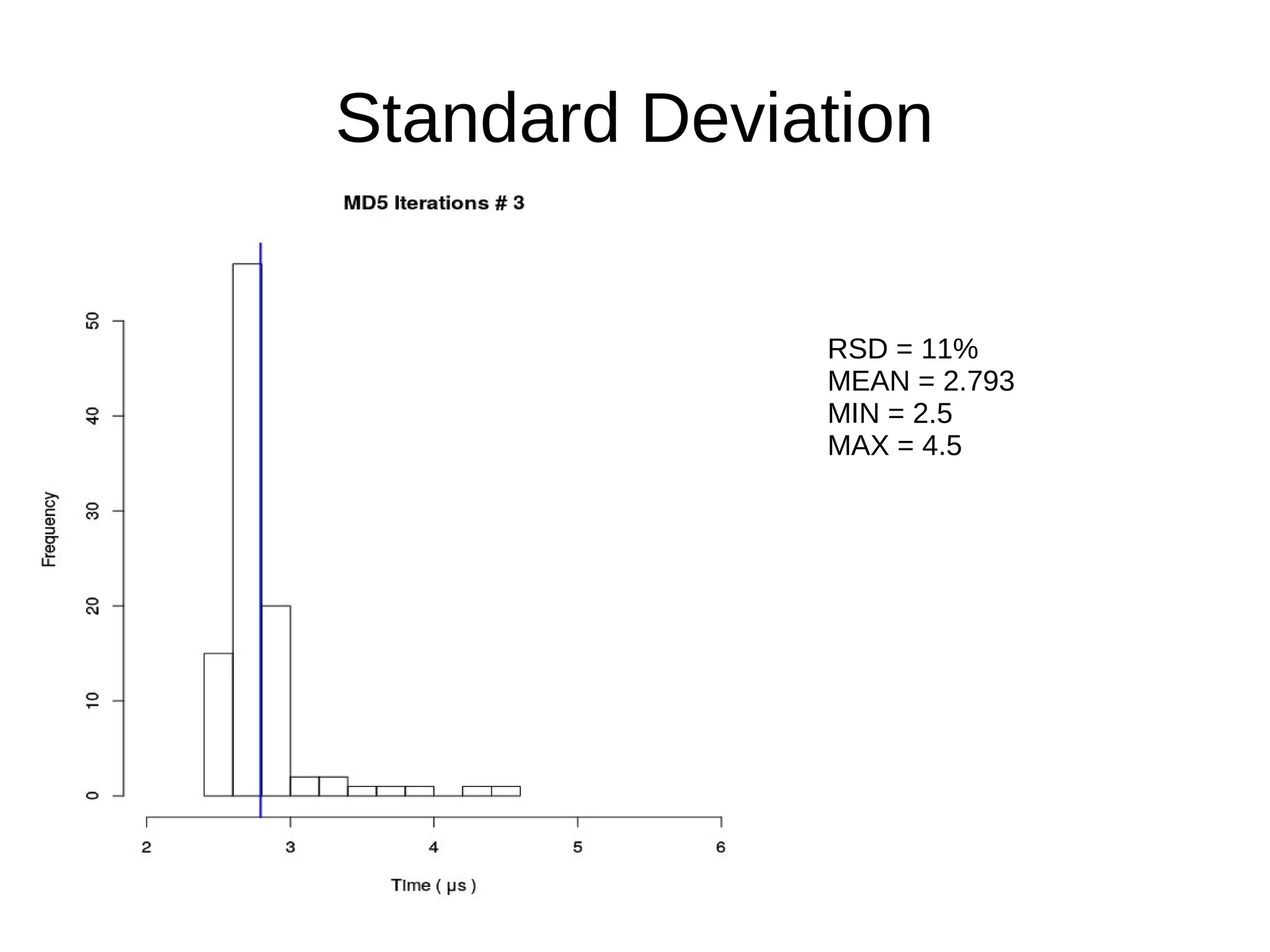
Standard Deviation (SD)
●Unit represented as “sigma” σ
● Almost the average distance between values
in the set.
● An SD of zero indicates that all the values are
identical.
● Relative standard deviation (RSD) is the SD
divided by the mean. It is a percentage.
● RSD provides a comparable number.
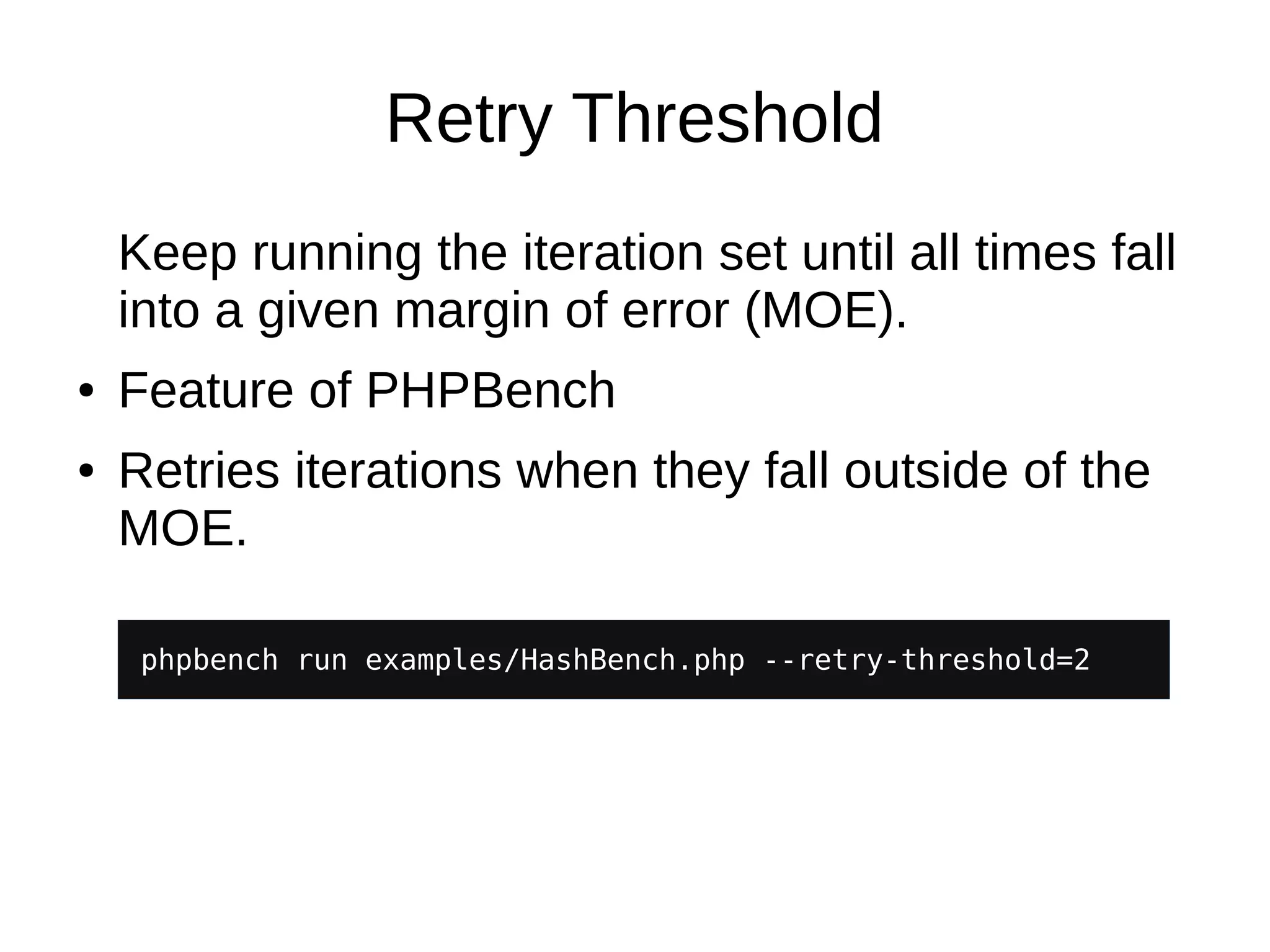
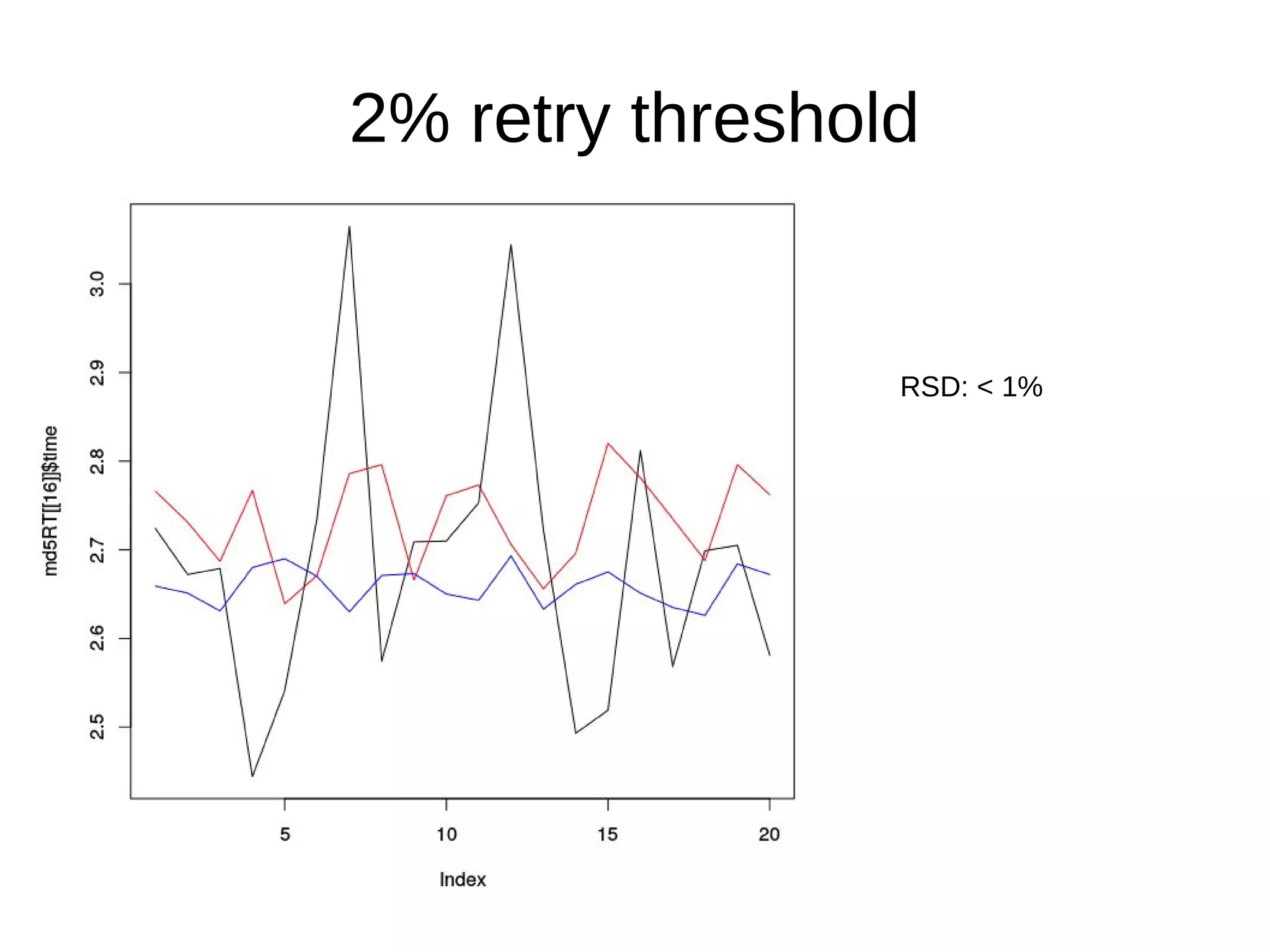
Retry Threshold
Keep runningthe iteration set until all times fall
into a given margin of error (MOE).
● Feature of PHPBench
● Retries iterations when they fall outside of the
MOE.
phpbench run examples/HashBench.php --retry-threshold=2
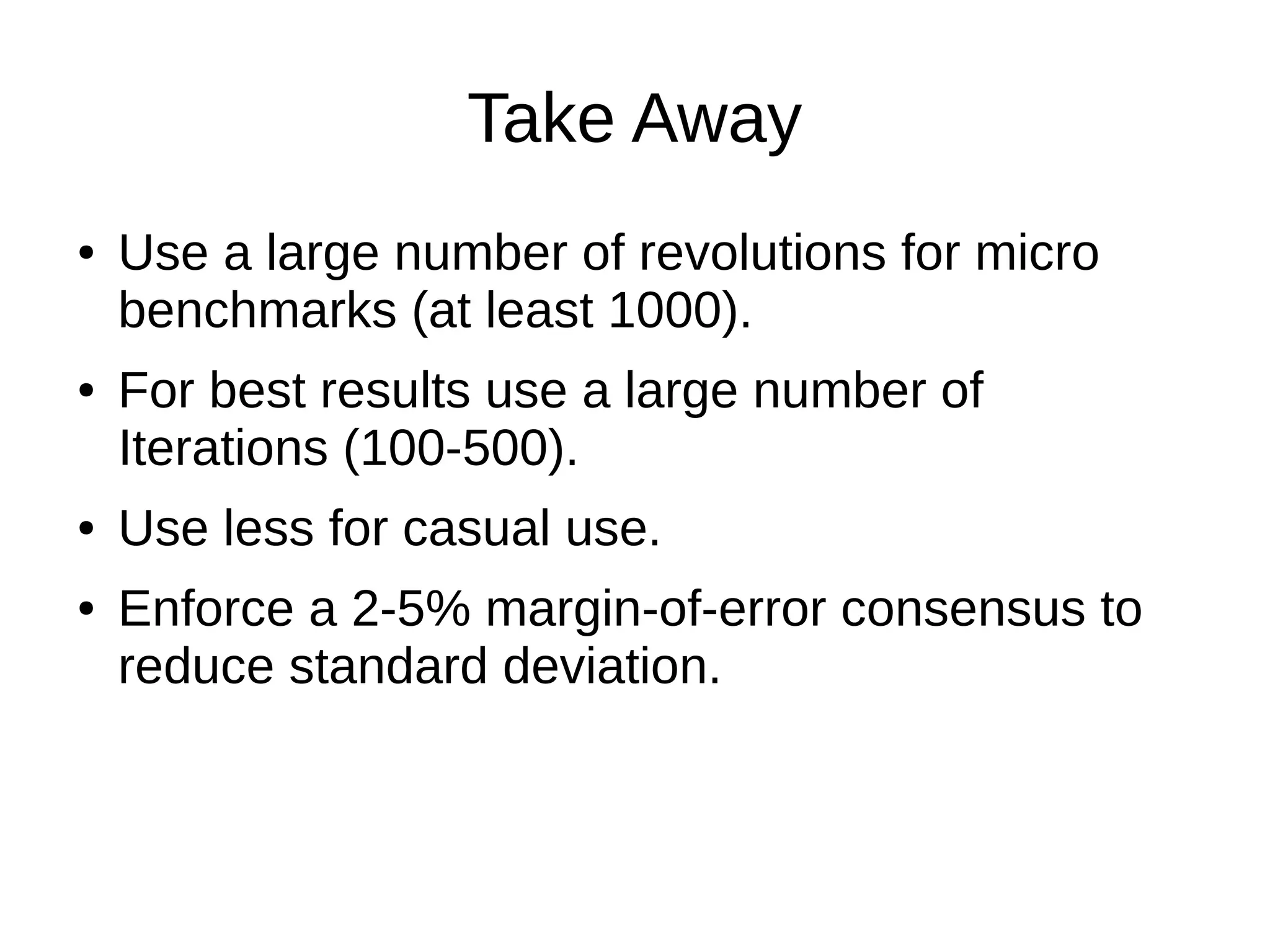
Take Away
● Usea large number of revolutions for micro
benchmarks (at least 1000).
● For best results use a large number of
Iterations (100-500).
● Use less for casual use.
● Enforce a 2-5% margin-of-error consensus to
reduce standard deviation.
Things we shouldtake with us
● Wall time: Total (external) time taken.
● CPU time: CPU time taken.
● Microsecond: 1,000,000th of a second
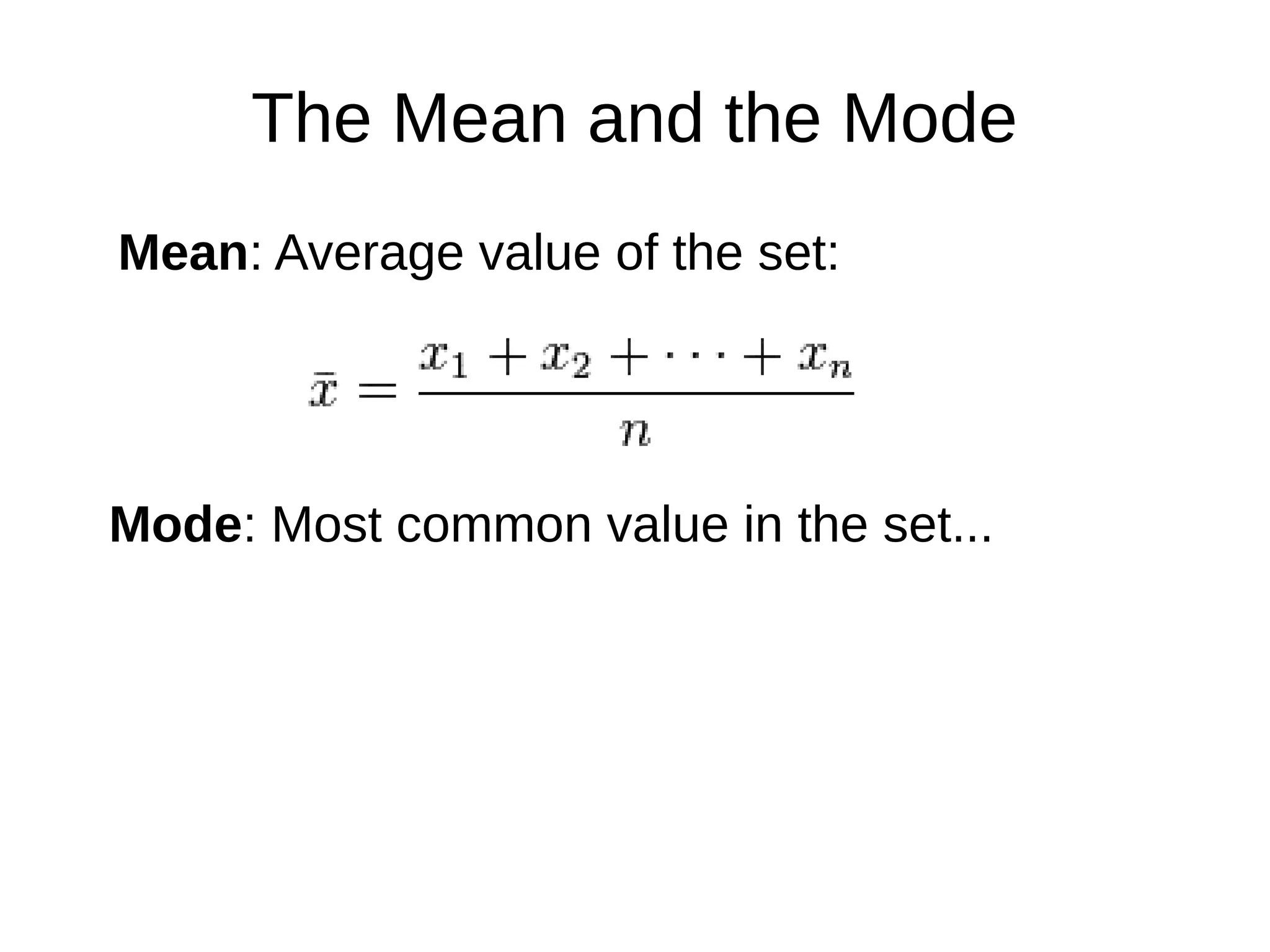
● Mean: Average of a set of numbers.
● Standard Deviation (SD): Average deviation from the
mean between samples (kind of), often represented as
sigma (σ).
● Relative SD: As above but expressed as a percentage
(dimensionless quantity).
![Benchmarking Script
<?php
$a = array();
$start = microtime( true );
for ($i = 0; $i < 10000; ++$i) {
isset($a['key']);
}
$total_time = microtime( true ) - $start;
echo "Total time: ", number_format($total_time, 6), PHP_EOL;
$start = microtime( true );
for ($i = 0; $i < 10000; ++$i) {
in_array('key', $a);
}
$total_time = microtime( true ) - $start;
echo "Total time: ", number_format($total_time, 6), PHP_EOL;
http://stackoverflow.com/questions/13483219/what-is-faster-in-array-or-isset
found in the wild](https://image.slidesharecdn.com/benchmarking-phpsw2-160116125328/75/Benchmarking-and-PHPBench-6-2048.jpg)
![Iterations
Each iteration records the time taken to execute
the revolutions.
<?php
$iterations = 100;
$revolutions = 10000;
$results = [];
for ($iteration = 0; $iteration < $iterations; $iteration++) {
$startTime = microtime(true);
for ($rev = 0; $rev < $revolultions; $rev++) {
// do something
}
$time = microtime(true) - $startTime;
$times[] = $time;
}
illustrative example](https://image.slidesharecdn.com/benchmarking-phpsw2-160116125328/75/Benchmarking-and-PHPBench-11-2048.jpg)
![Subjects
<?php
isset($a['b']);
<?php
$pdoConnection->query(“SELECT * FROM foo”);
<?php
$container->get('some.service');
<?php
$guzzle->get('https://github.com/phpbench/phpbench');
Algorithms
External services
User libraries
HTTP](https://image.slidesharecdn.com/benchmarking-phpsw2-160116125328/75/Benchmarking-and-PHPBench-13-2048.jpg)
![Benchmarking with PHPBench
PHPBench is a command line based
benchmarking tool similar to PHPUniut.
$ phpbench
phpbench version 0.10.0-dev
Usage:
command [options] [arguments]
...
Available commands:
help Displays help for a command
list Lists commands
report Generate a report from an XML file
run Run benchmarks](https://image.slidesharecdn.com/benchmarking-phpsw2-160116125328/75/Benchmarking-and-PHPBench-14-2048.jpg)







![Vibe Coding vs. Spec-Driven Development [Free Meetup]](https://cdn.slidesharecdn.com/ss_thumbnails/vibecodingvsspecdrivendevelopment-251209105622-43f455e7-thumbnail.jpg?width=640&height=640&fit=bounds)


