Framework and
Application Benchmarking
         Paul M. Jones
        PhpBenelux 2011

            @pmjones
       http://joind.in/2498
Overview
• Benchmarking methodology, results,
  and interpretation
 • Server/application
 • Single frameworks
 • Framework comparisons
• Resource usage prediction
• Engineering analysis
Read These


• “Free to Choose”, Friedman
• “Pleasure of Finding Things Out”, Feynman
• “Fooled By Randomness”, Taleb
About Me
• Dev, Sr Dev, Team Lead,
  Architect, VP Eng

• PHP since 1999

• Savant template system

• PEAR Group member

• http://paul-m-jones.com

• @pmjones
Full Disclosure

• Solar framework

• Zend framework

  • Zend_Db*,
    Zend_View

• “Rigor and integrity”

• Google Code, now
  Github
Part 1:
In General
Profiling vs
            Benchmarking

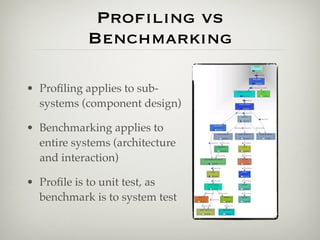
• Profiling applies to sub-
  systems (component design)

• Benchmarking applies to
  entire systems (architecture
  and interaction)

• Profile is to unit test, as
  benchmark is to system test
Benchmarking Subjects
• CPU                      • Programmer
                             productivity
• RAM
                           • Time to initial
• Disk access                implementation
• Database access          • Time to add new
• Network access             major feature

• Requests/second          • Time to fix bugs

          -- numeric measurement --
           -- control for variables --
Why Bother With
          Benchmarking?


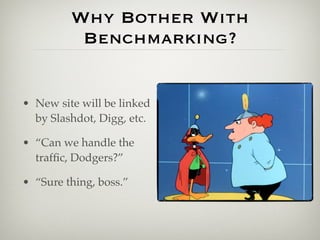
• New site will be linked
  by Slashdot, Digg, etc.

• “Can we handle the
  traffic, Dodgers?”

• “Sure thing, boss.”
Why Bother With
            Benchmarking?


• “...(time to load-test.)”

• How many req/sec
  expected?

• Load-tested, optimized
  in a hurry, balanced
Know Your Limitations
• What limits are imposed,
  and where?

• Where to spend effort
  when optimizing?

• Profiling your app will not
  help with non-app limits

• Profiling does not tell you
  req/sec
The Stack


• Web server
• Framework (foundation)
• Application
Part 2:
Getting Started
Methodology


• Refining and reporting since 2007
• Benchmark the basic system
• Add a component, benchmark again
• Track responsiveness at each point
Tools
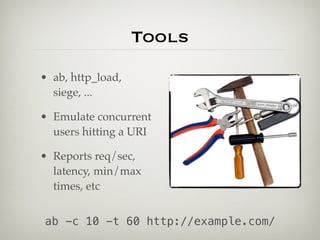
• ab, http_load,
  siege, ...

• Emulate concurrent
  users hitting a URI

• Reports req/sec,
  latency, min/max
  times, etc


ab -c 10 -t 60 http://example.com/
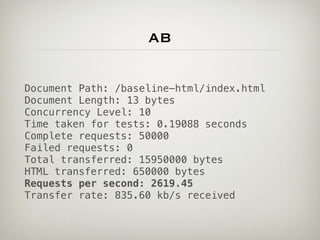
ab

Document Path: /baseline-html/index.html
Document Length: 13 bytes
Concurrency Level: 10
Time taken for tests: 0.19088 seconds
Complete requests: 50000
Failed requests: 0
Total transferred: 15950000 bytes
HTML transferred: 650000 bytes
Requests per second: 2619.45
Transfer rate: 835.60 kb/s received
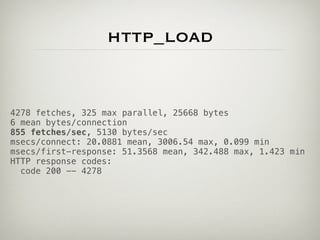
http_load


4278 fetches, 325 max parallel, 25668 bytes
6 mean bytes/connection
855 fetches/sec, 5130 bytes/sec
msecs/connect: 20.0881 mean, 3006.54 max, 0.099 min
msecs/first-response: 51.3568 mean, 342.488 max, 1.423 min
HTTP response codes:
  code 200 -- 4278
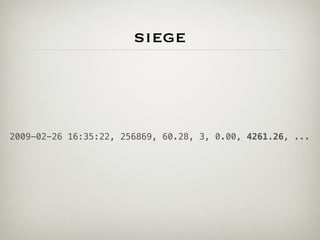
siege


2009-02-26 16:35:22, 256869, 60.28, 3, 0.00, 4261.26, ...
Combined Tooling

• Each tool (ab, http_load, siege) has different
  options, params, and target specifications
• http://github.com/pmjones/php-framework-
  benchmarks


./bench/(ab|http_load|siege) target/all.ini
Benchmark Subject


• Run against a test installation
• As similar to production as possible
• Hardware, OS, server, PHP installation
• No database, no application code
Control for
     Known Variables


• Network latency (use localhost)
• Server processes (turn everything off)
Outer Limits Of
          Responsiveness
• Amazon EC2 “Large”
  instance, 64-Bit Ubuntu
  10.04 (Alestic)

• Apache 2.2 (stock install)

• PHP 5.3.3, APC, Suhosin
  (stock install)

• “index.html” and
  “index.php”
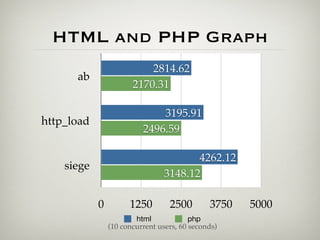
HTML and PHP Graph
                           2814.62
      ab
                       2170.31

                              3195.91
http_load
                          2496.59

                                       4262.12
    siege
                                3148.12

            0         1250        2500        3750   5000
                        html             php
                (10 concurrent users, 60 seconds)
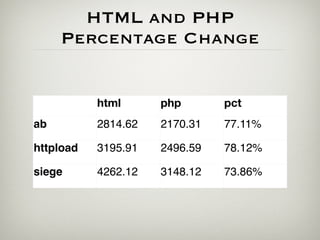
HTML and PHP
     Percentage Change


           html      php       pct
ab         2814.62   2170.31   77.11%

httpload   3195.91   2496.59   78.12%

siege      4262.12   3148.12   73.86%
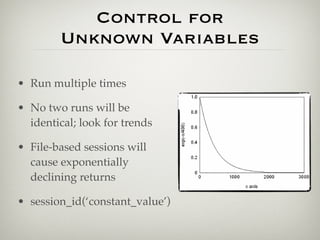
Control for
        Unknown Variables

• Run multiple times

• No two runs will be
  identical; look for trends

• File-based sessions will
  cause exponentially
  declining returns

• session_id(‘constant_value’)
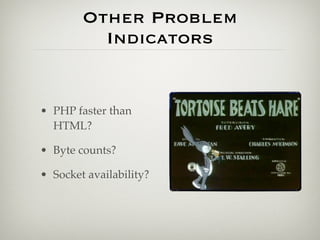
Other Problem
          Indicators


• PHP faster than
  HTML?

• Byte counts?

• Socket availability?
Benchmarking as
  Resource Prediction
• About resource planning, not
  speed (per se)

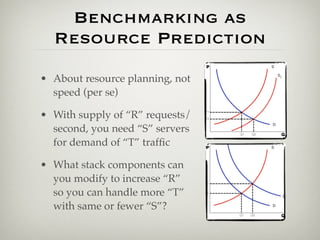
• With supply of “R” requests/
  second, you need “S” servers
  for demand of “T” traffic

• What stack components can
  you modify to increase “R”
  so you can handle more “T”
  with same or fewer “S”?
Part 3:
Single Frameworks
Single-Framework
      Methodology
• Minimal, not full, application
• Sane config
• No action code
• No view layout or helpers
• Static view text
• No caching
• No database
Framework (Foundation)
    Benchmarking
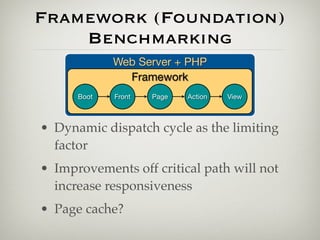
             Web Server + PHP
               Framework
      Boot   Front   Page   Action   View


• Dynamic dispatch cycle as the limiting
  factor
• Improvements off critical path will not
  increase responsiveness
• Page cache?
Single-Framework
             Analysis


• Now you know how
  much you need to
  improve

• Work on the critical path

• Iterative benchmarking
Benchmarking as
       Engineering Aid
• Every architecture
  decision has a cost

• Compare benchmark
  stats between versions

• Are added features
  are worth req/sec
  cost?

• (Thanks, Laura
  Thomson.)
Part 3:
 Multiple
Frameworks
Multiple-Framework
          Comparison

• Examine responsiveness
  in context of other systems

• Compare architecture
  costs between systems

• Use the same minimal app
  to remove variability in
  application code
Compare Like With Like
• Frameworks to be compared
  should be reasonably similar
  in “style” or “class”

• PHP5, design patterns, front
  & page controllers, controller
  & view separation, plugins or
  extensions, no globals

• Cake, Lithium, Solar,
  Symfony, Yii, Zend

• CI, Kohana
Multiple-Framework
   Methodology (1/2)

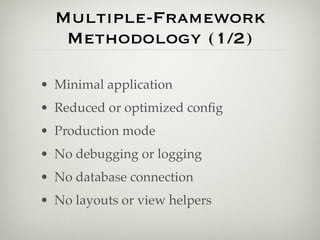
• Minimal application
• Reduced or optimized config
• Production mode
• No debugging or logging
• No database connection
• No layouts or view helpers
Multiple-Framework
   Methodology (2/2)

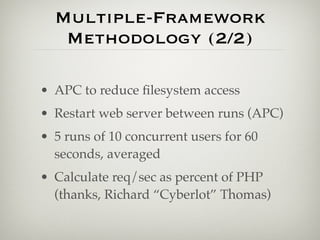
• APC to reduce filesystem access
• Restart web server between runs (APC)
• 5 runs of 10 concurrent users for 60
  seconds, averaged
• Calculate req/sec as percent of PHP
  (thanks, Richard “Cyberlot” Thomas)
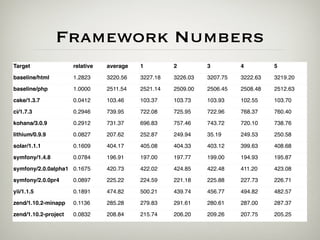
Framework Numbers
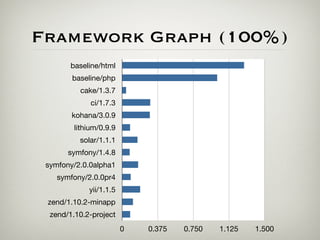
Target                relative   average   1         2         3         4         5

baseline/html         1.2823     3220.56   3227.18   3226.03   3207.75   3222.63   3219.20

baseline/php          1.0000     2511.54   2521.14   2509.00   2506.45   2508.48   2512.63

cake/1.3.7            0.0412     103.46    103.37    103.73    103.93    102.55    103.70

ci/1.7.3              0.2946     739.95    722.08    725.95    722.96    768.37    760.40

kohana/3.0.9          0.2912     731.37    696.83    757.46    743.72    720.10    738.76

lithium/0.9.9         0.0827     207.62    252.87    249.94    35.19     249.53    250.58

solar/1.1.1           0.1609     404.17    405.08    404.33    403.12    399.63    408.68

symfony/1.4.8         0.0784     196.91    197.00    197.77    199.00    194.93    195.87

symfony/2.0.0alpha1 0.1675       420.73    422.02    424.85    422.48    411.20    423.08

symfony/2.0.0pr4      0.0897     225.22    224.59    221.18    225.88    227.73    226.71

yii/1.1.5             0.1891     474.82    500.21    439.74    456.77    494.82    482.57

zend/1.10.2-minapp    0.1136     285.28    279.83    291.61    280.61    287.00    287.37

zend/1.10.2-project   0.0832     208.84    215.74    206.20    209.26    207.75    205.25
Framework Graph (100%)
        baseline/html
        baseline/php
          cake/1.3.7
              ci/1.7.3
        kohana/3.0.9
         lithium/0.9.9
          solar/1.1.1
       symfony/1.4.8
 symfony/2.0.0alpha1
    symfony/2.0.0pr4
             yii/1.1.5
 zend/1.10.2-minapp
  zend/1.10.2-project
                         0   0.375   0.750   1.125   1.500
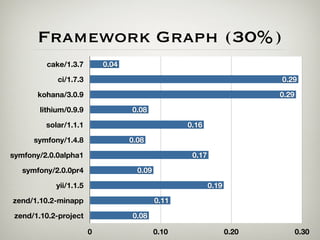
Framework Graph (30%)
          cake/1.3.7        0.04

             ci/1.7.3                                                    0.29

       kohana/3.0.9                                                      0.29

        lithium/0.9.9              0.08

         solar/1.1.1                               0.16

      symfony/1.4.8                0.08

symfony/2.0.0alpha1                                 0.17

   symfony/2.0.0pr4                  0.09

            yii/1.1.5                                      0.19

zend/1.10.2-minapp                          0.11

 zend/1.10.2-project               0.08

                        0                   0.10                  0.20          0.30
What Does This Mean?
• Both more and less than you think it
  might
• Speed is not the only consideration
  • Features, intangibles
  • Unlikely to change minds of devotees
• Even the slowest is still pretty fast
• Each AJAX call is one request
Failure Modes
• Apache/Lighty, APC/XCache, mod_php/
  fcgid
• EC2 load fluctuation between/during runs
• Order of testing
• Different concurrency or duration
• Added features and app code will reduce
  dynamic response ... but curve is
  unknown.
Links
• http://github.com/pmjones/php-framework-benchmarks
• http://code.google.com/p/web-framework-benchmarks
• “New Year’s Benchmarks”:
  http://paul-m-jones/archives/238
• “Do All Frameworks Suck?”:
  http://www.laurathomson.com/2007/07/do-all-
  framewor.html
• Google: "cargo cult science"
• Questions?
• Comments?
• Criticism?
• http://joind.in/2498
Objections


• “Highly profiled.”
• “‘Hello world’ is unrealistic.”
• “Not optimized for ‘hello world.’”
• “Faster for ‘real world’ applications.”
Avoid Frameworks?
• If framework code is only at 4-30% of max
  PHP, should we not use frameworks?
• “Slow” relative to what?
• Compare like with like, and proposed systems
  to existing systems.
• You will use a framework, even if you write it
  yourself.
• The good comes not from the code or the
  features, but process standardization.
Thanks!

Framework and Application Benchmarking

  • 1.
    Framework and Application Benchmarking Paul M. Jones PhpBenelux 2011 @pmjones http://joind.in/2498
  • 2.
    Overview • Benchmarking methodology,results, and interpretation • Server/application • Single frameworks • Framework comparisons • Resource usage prediction • Engineering analysis
  • 3.
    Read These • “Freeto Choose”, Friedman • “Pleasure of Finding Things Out”, Feynman • “Fooled By Randomness”, Taleb
  • 4.
    About Me • Dev,Sr Dev, Team Lead, Architect, VP Eng • PHP since 1999 • Savant template system • PEAR Group member • http://paul-m-jones.com • @pmjones
  • 5.
    Full Disclosure • Solarframework • Zend framework • Zend_Db*, Zend_View • “Rigor and integrity” • Google Code, now Github
  • 6.
  • 7.
    Profiling vs Benchmarking • Profiling applies to sub- systems (component design) • Benchmarking applies to entire systems (architecture and interaction) • Profile is to unit test, as benchmark is to system test
  • 8.
    Benchmarking Subjects • CPU • Programmer productivity • RAM • Time to initial • Disk access implementation • Database access • Time to add new • Network access major feature • Requests/second • Time to fix bugs -- numeric measurement -- -- control for variables --
  • 9.
    Why Bother With Benchmarking? • New site will be linked by Slashdot, Digg, etc. • “Can we handle the traffic, Dodgers?” • “Sure thing, boss.”
  • 10.
    Why Bother With Benchmarking? • “...(time to load-test.)” • How many req/sec expected? • Load-tested, optimized in a hurry, balanced
  • 11.
    Know Your Limitations •What limits are imposed, and where? • Where to spend effort when optimizing? • Profiling your app will not help with non-app limits • Profiling does not tell you req/sec
  • 12.
    The Stack • Webserver • Framework (foundation) • Application
  • 13.
  • 14.
    Methodology • Refining andreporting since 2007 • Benchmark the basic system • Add a component, benchmark again • Track responsiveness at each point
  • 15.
    Tools • ab, http_load, siege, ... • Emulate concurrent users hitting a URI • Reports req/sec, latency, min/max times, etc ab -c 10 -t 60 http://example.com/
  • 16.
    ab Document Path: /baseline-html/index.html DocumentLength: 13 bytes Concurrency Level: 10 Time taken for tests: 0.19088 seconds Complete requests: 50000 Failed requests: 0 Total transferred: 15950000 bytes HTML transferred: 650000 bytes Requests per second: 2619.45 Transfer rate: 835.60 kb/s received
  • 17.
    http_load 4278 fetches, 325max parallel, 25668 bytes 6 mean bytes/connection 855 fetches/sec, 5130 bytes/sec msecs/connect: 20.0881 mean, 3006.54 max, 0.099 min msecs/first-response: 51.3568 mean, 342.488 max, 1.423 min HTTP response codes: code 200 -- 4278
  • 18.
    siege 2009-02-26 16:35:22, 256869,60.28, 3, 0.00, 4261.26, ...
  • 19.
    Combined Tooling • Eachtool (ab, http_load, siege) has different options, params, and target specifications • http://github.com/pmjones/php-framework- benchmarks ./bench/(ab|http_load|siege) target/all.ini
  • 20.
    Benchmark Subject • Runagainst a test installation • As similar to production as possible • Hardware, OS, server, PHP installation • No database, no application code
  • 21.
    Control for Known Variables • Network latency (use localhost) • Server processes (turn everything off)
  • 22.
    Outer Limits Of Responsiveness • Amazon EC2 “Large” instance, 64-Bit Ubuntu 10.04 (Alestic) • Apache 2.2 (stock install) • PHP 5.3.3, APC, Suhosin (stock install) • “index.html” and “index.php”
  • 23.
    HTML and PHPGraph 2814.62 ab 2170.31 3195.91 http_load 2496.59 4262.12 siege 3148.12 0 1250 2500 3750 5000 html php (10 concurrent users, 60 seconds)
  • 24.
    HTML and PHP Percentage Change html php pct ab 2814.62 2170.31 77.11% httpload 3195.91 2496.59 78.12% siege 4262.12 3148.12 73.86%
  • 25.
    Control for Unknown Variables • Run multiple times • No two runs will be identical; look for trends • File-based sessions will cause exponentially declining returns • session_id(‘constant_value’)
  • 26.
    Other Problem Indicators • PHP faster than HTML? • Byte counts? • Socket availability?
  • 27.
    Benchmarking as Resource Prediction • About resource planning, not speed (per se) • With supply of “R” requests/ second, you need “S” servers for demand of “T” traffic • What stack components can you modify to increase “R” so you can handle more “T” with same or fewer “S”?
  • 28.
  • 29.
    Single-Framework Methodology • Minimal, not full, application • Sane config • No action code • No view layout or helpers • Static view text • No caching • No database
  • 30.
    Framework (Foundation) Benchmarking Web Server + PHP Framework Boot Front Page Action View • Dynamic dispatch cycle as the limiting factor • Improvements off critical path will not increase responsiveness • Page cache?
  • 31.
    Single-Framework Analysis • Now you know how much you need to improve • Work on the critical path • Iterative benchmarking
  • 32.
    Benchmarking as Engineering Aid • Every architecture decision has a cost • Compare benchmark stats between versions • Are added features are worth req/sec cost? • (Thanks, Laura Thomson.)
  • 33.
  • 34.
    Multiple-Framework Comparison • Examine responsiveness in context of other systems • Compare architecture costs between systems • Use the same minimal app to remove variability in application code
  • 35.
    Compare Like WithLike • Frameworks to be compared should be reasonably similar in “style” or “class” • PHP5, design patterns, front & page controllers, controller & view separation, plugins or extensions, no globals • Cake, Lithium, Solar, Symfony, Yii, Zend • CI, Kohana
  • 36.
    Multiple-Framework Methodology (1/2) • Minimal application • Reduced or optimized config • Production mode • No debugging or logging • No database connection • No layouts or view helpers
  • 37.
    Multiple-Framework Methodology (2/2) • APC to reduce filesystem access • Restart web server between runs (APC) • 5 runs of 10 concurrent users for 60 seconds, averaged • Calculate req/sec as percent of PHP (thanks, Richard “Cyberlot” Thomas)
  • 38.
    Framework Numbers Target relative average 1 2 3 4 5 baseline/html 1.2823 3220.56 3227.18 3226.03 3207.75 3222.63 3219.20 baseline/php 1.0000 2511.54 2521.14 2509.00 2506.45 2508.48 2512.63 cake/1.3.7 0.0412 103.46 103.37 103.73 103.93 102.55 103.70 ci/1.7.3 0.2946 739.95 722.08 725.95 722.96 768.37 760.40 kohana/3.0.9 0.2912 731.37 696.83 757.46 743.72 720.10 738.76 lithium/0.9.9 0.0827 207.62 252.87 249.94 35.19 249.53 250.58 solar/1.1.1 0.1609 404.17 405.08 404.33 403.12 399.63 408.68 symfony/1.4.8 0.0784 196.91 197.00 197.77 199.00 194.93 195.87 symfony/2.0.0alpha1 0.1675 420.73 422.02 424.85 422.48 411.20 423.08 symfony/2.0.0pr4 0.0897 225.22 224.59 221.18 225.88 227.73 226.71 yii/1.1.5 0.1891 474.82 500.21 439.74 456.77 494.82 482.57 zend/1.10.2-minapp 0.1136 285.28 279.83 291.61 280.61 287.00 287.37 zend/1.10.2-project 0.0832 208.84 215.74 206.20 209.26 207.75 205.25
  • 39.
    Framework Graph (100%) baseline/html baseline/php cake/1.3.7 ci/1.7.3 kohana/3.0.9 lithium/0.9.9 solar/1.1.1 symfony/1.4.8 symfony/2.0.0alpha1 symfony/2.0.0pr4 yii/1.1.5 zend/1.10.2-minapp zend/1.10.2-project 0 0.375 0.750 1.125 1.500
  • 40.
    Framework Graph (30%) cake/1.3.7 0.04 ci/1.7.3 0.29 kohana/3.0.9 0.29 lithium/0.9.9 0.08 solar/1.1.1 0.16 symfony/1.4.8 0.08 symfony/2.0.0alpha1 0.17 symfony/2.0.0pr4 0.09 yii/1.1.5 0.19 zend/1.10.2-minapp 0.11 zend/1.10.2-project 0.08 0 0.10 0.20 0.30
  • 41.
    What Does ThisMean? • Both more and less than you think it might • Speed is not the only consideration • Features, intangibles • Unlikely to change minds of devotees • Even the slowest is still pretty fast • Each AJAX call is one request
  • 42.
    Failure Modes • Apache/Lighty,APC/XCache, mod_php/ fcgid • EC2 load fluctuation between/during runs • Order of testing • Different concurrency or duration • Added features and app code will reduce dynamic response ... but curve is unknown.
  • 43.
    Links • http://github.com/pmjones/php-framework-benchmarks • http://code.google.com/p/web-framework-benchmarks •“New Year’s Benchmarks”: http://paul-m-jones/archives/238 • “Do All Frameworks Suck?”: http://www.laurathomson.com/2007/07/do-all- framewor.html • Google: "cargo cult science"
  • 44.
    • Questions? • Comments? •Criticism? • http://joind.in/2498
  • 45.
    Objections • “Highly profiled.” •“‘Hello world’ is unrealistic.” • “Not optimized for ‘hello world.’” • “Faster for ‘real world’ applications.”
  • 46.
    Avoid Frameworks? • Ifframework code is only at 4-30% of max PHP, should we not use frameworks? • “Slow” relative to what? • Compare like with like, and proposed systems to existing systems. • You will use a framework, even if you write it yourself. • The good comes not from the code or the features, but process standardization.
  • 47.