







Faculty of Graduates Study
Post Graduate Diploma In Business Management – 2013
Marketing Management
Assignment
Group-01
M.S.Nimendra - 2013/PGDBM/081
N.A.Niroshan – 2013/PGDBM/082
S.Sathees – 2013/PGBDM/064
W.G.G.Yasoma – 2013/PGDBM/031
Sunimal de Silva – 2013/PGDBM/083
Ajith Kumara – 2013/PGDBM/065
Introduction of the Study
 Benchmarking is the process of comparing
one's business processes and performance
metrics to industry bests and/or best practices
from other industries.
Why are others better ?
How are others better ?
What can we learn ?
How can we catch up ?
How can we become the best in our sector ?
Benchmarking is
Making Best Practices Your Daily
Practice.
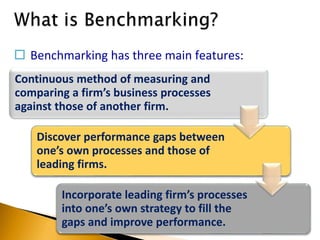
Continuous method of measuring and
comparing a firm’s business processes
against those of another firm.
Discover performance gaps between
one’s own processes and those of
leading firms.
Incorporate leading firm’s processes
into one’s own strategy to fill the
gaps and improve performance.
 Benchmarking has three main features:
History of Benchmarking
 The term benchmarking was first used by
cobblers to measure people's feet for shoes.
They would place someone's foot on a "bench"
and mark it out to make the pattern for the
shoes.
 Traditionally, the organizations used to enhance
their products and performance by focusing on
their internal functional activities (Kolarik, 1995).
The organization, for example, may use
techniques such as Quality Function Deployment
to achieve their customer satisfaction.
 However, these traditional performance
improvement trends seem not to be sufficient
for the highly competitive markets (Juran, 1993).
A significant technique facilitating improvement
of organizational performance at a competitive
environment is benchmarking. (Juran, 1993).
 Benchmarking was originally defined by
D.T. Kearns, the CEO of Xerox Corporation,
in 1981 as the continuous process of
measuring products, services, and practices
against the toughest competitors or non-
competitors who is the leader in their
industry (Kolarik, 1995).
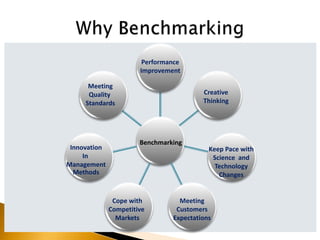
Why Benchmarking ?
.
.
.
.
Cope with
Competitive
Markets
Keep Pace with
Science and
Technology
Changes
Innovation
In
Management
Methods
Meeting
Quality
Standards
Performance
Improvement
Creative
Thinking
Meeting
Customers
Expectations
Benchmarking
 A benchmark is an organization recognized for
its exemplary operational performance.
 There are many benchmarks in the world
including:
Toyota for
Scandinavian Airlines for
Motorola for
Intel for
Honda for
Processes
Design
Training
Service
Rapid product development
Benchmark
Benchmarking
When Benchmarking a System,
Adapt What You Find,
Don’t Just Copy It
Benchmarking ≠ Copying
19
 “Best Practice” studies
◦ Studies and lists of what works best
 Cooperative Benchmarking
◦ Measurement of key production functions, input,
output and outcomes
 Competitive Benchmarking
 Study & measurement of a competitor
Industry Group Measurements
◦ Measurement of various aspects of operation for
comparison
20
 Learn from others experience & practices
 Allows examination of present processes
 Ideas change & improvement
 Implementation / changes more likely
 Overall industry improvement
21
 What is best for someone else may not suit
you
 Poorly defined benchmarks may lead to
wasted effort and meaningless results.
 Incorrect comparisons
 Reluctance to share information
Gap Analysis
 For decades Benchmarking had set its
sights on what there BEST COMPETITION
was doing
 In the last two decades it broadened its
sight to BEST WORLD CLASS ORGANIZATION
what does they do
 MILESTONE –
◦ TOTAL CUSTOMER SATISFACTION
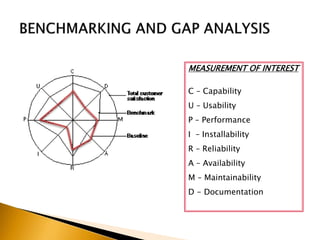
MEASUREMENT OF INTEREST
C – Capability
U – Usability
P – Performance
I – Installability
R – Reliability
A – Availability
M – Maintainability
D - Documentation
If customers are: They will feel:
Because you have met
their:
And they will be:
Very satisfied
Delighted
Dreams
Your advocate
Enthused Loyal
Satisfied
Excited Expectations Retained/fulfilled
Contented Wishes Interested
Ambivalent Indifferent
Wants
Attentive
Needs
Dissatisfied
Concerned Minimum requirements Questioning
Upset Bare essentials Looking around
Very dissatisfied
Angry Worst fears Gone
Hostile Nightmares Your enemies
Local Example
VS
VS
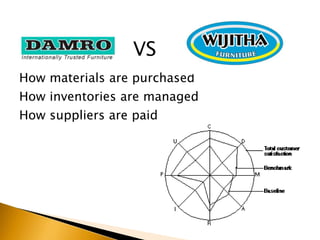
How materials are purchased
How inventories are managed
How suppliers are paid
VS
How employees are trained
How fast new products get to the market
How quality is managed
Recommendations
for
Wijitha
Conclusion
In Benchmarking The Key is to
“Adapt not Adopt” – Professor Deming
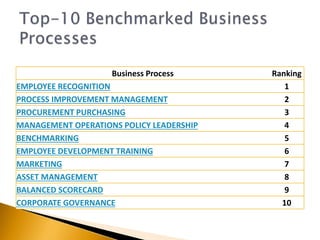
Business Process Ranking
EMPLOYEE RECOGNITION 1
PROCESS IMPROVEMENT MANAGEMENT 2
PROCUREMENT PURCHASING 3
MANAGEMENT OPERATIONS POLICY LEADERSHIP 4
BENCHMARKING 5
EMPLOYEE DEVELOPMENT TRAINING 6
MARKETING 7
ASSET MANAGEMENT 8
BALANCED SCORECARD 9
CORPORATE GOVERNANCE 10
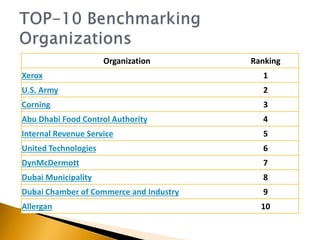
Organization Ranking
Xerox 1
U.S. Army 2
Corning 3
Abu Dhabi Food Control Authority 4
Internal Revenue Service 5
United Technologies 6
DynMcDermott 7
Dubai Municipality 8
Dubai Chamber of Commerce and Industry 9
Allergan 10
Any Questions?
Thank You
Give
Benchmarking a
Chance -
It’s Worth It.

benchmarking

  • 1.
    Faculty of GraduatesStudy Post Graduate Diploma In Business Management – 2013 Marketing Management Assignment Group-01 M.S.Nimendra - 2013/PGDBM/081 N.A.Niroshan – 2013/PGDBM/082 S.Sathees – 2013/PGBDM/064 W.G.G.Yasoma – 2013/PGDBM/031 Sunimal de Silva – 2013/PGDBM/083 Ajith Kumara – 2013/PGDBM/065
  • 2.
  • 4.
     Benchmarking isthe process of comparing one's business processes and performance metrics to industry bests and/or best practices from other industries. Why are others better ? How are others better ? What can we learn ? How can we catch up ? How can we become the best in our sector ?
  • 5.
    Benchmarking is Making BestPractices Your Daily Practice.
  • 6.
    Continuous method ofmeasuring and comparing a firm’s business processes against those of another firm. Discover performance gaps between one’s own processes and those of leading firms. Incorporate leading firm’s processes into one’s own strategy to fill the gaps and improve performance.  Benchmarking has three main features:
  • 9.
  • 10.
    History of Benchmarking The term benchmarking was first used by cobblers to measure people's feet for shoes. They would place someone's foot on a "bench" and mark it out to make the pattern for the shoes.
  • 11.
     Traditionally, theorganizations used to enhance their products and performance by focusing on their internal functional activities (Kolarik, 1995). The organization, for example, may use techniques such as Quality Function Deployment to achieve their customer satisfaction.
  • 12.
     However, thesetraditional performance improvement trends seem not to be sufficient for the highly competitive markets (Juran, 1993). A significant technique facilitating improvement of organizational performance at a competitive environment is benchmarking. (Juran, 1993).
  • 13.
     Benchmarking wasoriginally defined by D.T. Kearns, the CEO of Xerox Corporation, in 1981 as the continuous process of measuring products, services, and practices against the toughest competitors or non- competitors who is the leader in their industry (Kolarik, 1995).
  • 14.
  • 15.
    . . . . Cope with Competitive Markets Keep Pacewith Science and Technology Changes Innovation In Management Methods Meeting Quality Standards Performance Improvement Creative Thinking Meeting Customers Expectations Benchmarking
  • 16.
     A benchmarkis an organization recognized for its exemplary operational performance.  There are many benchmarks in the world including: Toyota for Scandinavian Airlines for Motorola for Intel for Honda for Processes Design Training Service Rapid product development Benchmark
  • 17.
  • 18.
    When Benchmarking aSystem, Adapt What You Find, Don’t Just Copy It Benchmarking ≠ Copying
  • 19.
    19  “Best Practice”studies ◦ Studies and lists of what works best  Cooperative Benchmarking ◦ Measurement of key production functions, input, output and outcomes  Competitive Benchmarking  Study & measurement of a competitor Industry Group Measurements ◦ Measurement of various aspects of operation for comparison
  • 20.
    20  Learn fromothers experience & practices  Allows examination of present processes  Ideas change & improvement  Implementation / changes more likely  Overall industry improvement
  • 21.
    21  What isbest for someone else may not suit you  Poorly defined benchmarks may lead to wasted effort and meaningless results.  Incorrect comparisons  Reluctance to share information
  • 22.
  • 23.
     For decadesBenchmarking had set its sights on what there BEST COMPETITION was doing  In the last two decades it broadened its sight to BEST WORLD CLASS ORGANIZATION what does they do  MILESTONE – ◦ TOTAL CUSTOMER SATISFACTION
  • 24.
    MEASUREMENT OF INTEREST C– Capability U – Usability P – Performance I – Installability R – Reliability A – Availability M – Maintainability D - Documentation
  • 25.
    If customers are:They will feel: Because you have met their: And they will be: Very satisfied Delighted Dreams Your advocate Enthused Loyal Satisfied Excited Expectations Retained/fulfilled Contented Wishes Interested Ambivalent Indifferent Wants Attentive Needs Dissatisfied Concerned Minimum requirements Questioning Upset Bare essentials Looking around Very dissatisfied Angry Worst fears Gone Hostile Nightmares Your enemies
  • 26.
  • 27.
  • 28.
    VS How materials arepurchased How inventories are managed How suppliers are paid
  • 29.
    VS How employees aretrained How fast new products get to the market How quality is managed
  • 30.
  • 31.
  • 32.
    In Benchmarking TheKey is to “Adapt not Adopt” – Professor Deming
  • 35.
    Business Process Ranking EMPLOYEERECOGNITION 1 PROCESS IMPROVEMENT MANAGEMENT 2 PROCUREMENT PURCHASING 3 MANAGEMENT OPERATIONS POLICY LEADERSHIP 4 BENCHMARKING 5 EMPLOYEE DEVELOPMENT TRAINING 6 MARKETING 7 ASSET MANAGEMENT 8 BALANCED SCORECARD 9 CORPORATE GOVERNANCE 10
  • 36.
    Organization Ranking Xerox 1 U.S.Army 2 Corning 3 Abu Dhabi Food Control Authority 4 Internal Revenue Service 5 United Technologies 6 DynMcDermott 7 Dubai Municipality 8 Dubai Chamber of Commerce and Industry 9 Allergan 10
  • 38.
  • 39.