by : HEMLATA R. MORE
ASSISTANT PROFESSOR
QUALITY ASSURANCE
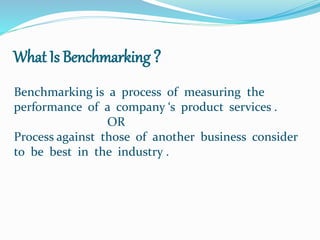
What Is Benchmarking ?
Benchmarking is a process of measuring the
performance of a company ‘s product services .
OR
Process against those of another business consider
to be best in the industry .
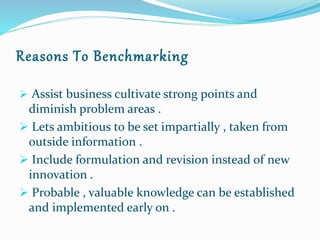
Reasons To Benchmarking
 Assist business cultivate strong points and
diminish problem areas .
 Lets ambitious to be set impartially , taken from
outside information .
 Include formulation and revision instead of new
innovation .
 Probable , valuable knowledge can be established
and implemented early on .
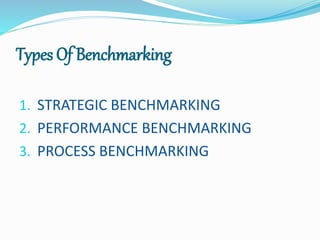
Types Of Benchmarking
1. STRATEGIC BENCHMARKING
2. PERFORMANCE BENCHMARKING
3. PROCESS BENCHMARKING
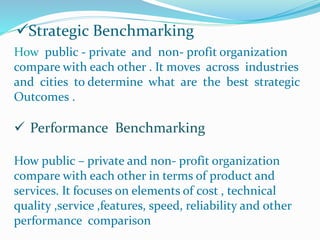
Strategic Benchmarking
How public - private and non- profit organization
compare with each other . It moves across industries
and cities to determine what are the best strategic
Outcomes .
 Performance Benchmarking
How public – private and non- profit organization
compare with each other in terms of product and
services. It focuses on elements of cost , technical
quality ,service ,features, speed, reliability and other
performance comparison
 process benchmarking
How public –private and non – profit organization
compare through the identification Of the
most effective operating practices from many
Organization that perform Similar work
process .
Process of benchmarking
1. Planning :
• Determine the purpose and scope of the project
• Select the process to be benchmarked
• Choose the team
• Define the scope
• Develop flow chart for the process
• Established process measures
• Identify benchmarking partners
Process of benchmarking
1. Planning :
• Determine the purpose and scope of the project
• Select the process to be benchmarked
• Choose the team
• Define the scope
• Develop flow chart for the process
• Established process measures
• Identify benchmarking partners
2. Collecting data :
• conduct background research to gain through
understanding on the process and partnering
organization.
• Use questionaries to gather information necessary for
benchmarking.
• Conduct site visits if additional information is needed.
• Conduct interviews if more details information id
needed.
3. Analysis
• analyze quantitative data of partnering organization and your
organization
• determine the performance gap .
4. Improving practices
• Report findings and brief management
• Develop an improvement implementation plan
• implement process improvement
• monitor performance measurement and track progress
• recalibrate the process as needed
Limitation of benchmarking
A major limitation of benchmarking is that
with the helps organization in measuring
the efficiency of their operational matrices .
If remains inadequate to measure overall
efficiency.
Advantages of benchmarking
 Help to identify gap between the organization
 Helps organization compare themselves against
successful companies
 It enables organization to learn from others
 It helps create a need for change
THANK YOU !

BENCHMARKING pptx

  • 1.
    by : HEMLATAR. MORE ASSISTANT PROFESSOR QUALITY ASSURANCE
  • 2.
    What Is Benchmarking? Benchmarking is a process of measuring the performance of a company ‘s product services . OR Process against those of another business consider to be best in the industry .
  • 3.
    Reasons To Benchmarking Assist business cultivate strong points and diminish problem areas .  Lets ambitious to be set impartially , taken from outside information .  Include formulation and revision instead of new innovation .  Probable , valuable knowledge can be established and implemented early on .
  • 4.
    Types Of Benchmarking 1.STRATEGIC BENCHMARKING 2. PERFORMANCE BENCHMARKING 3. PROCESS BENCHMARKING
  • 5.
    Strategic Benchmarking How public- private and non- profit organization compare with each other . It moves across industries and cities to determine what are the best strategic Outcomes .  Performance Benchmarking How public – private and non- profit organization compare with each other in terms of product and services. It focuses on elements of cost , technical quality ,service ,features, speed, reliability and other performance comparison
  • 6.
     process benchmarking Howpublic –private and non – profit organization compare through the identification Of the most effective operating practices from many Organization that perform Similar work process .
  • 7.
    Process of benchmarking 1.Planning : • Determine the purpose and scope of the project • Select the process to be benchmarked • Choose the team • Define the scope • Develop flow chart for the process • Established process measures • Identify benchmarking partners
  • 8.
    Process of benchmarking 1.Planning : • Determine the purpose and scope of the project • Select the process to be benchmarked • Choose the team • Define the scope • Develop flow chart for the process • Established process measures • Identify benchmarking partners
  • 9.
    2. Collecting data: • conduct background research to gain through understanding on the process and partnering organization. • Use questionaries to gather information necessary for benchmarking. • Conduct site visits if additional information is needed. • Conduct interviews if more details information id needed.
  • 10.
    3. Analysis • analyzequantitative data of partnering organization and your organization • determine the performance gap . 4. Improving practices • Report findings and brief management • Develop an improvement implementation plan • implement process improvement • monitor performance measurement and track progress • recalibrate the process as needed
  • 11.
    Limitation of benchmarking Amajor limitation of benchmarking is that with the helps organization in measuring the efficiency of their operational matrices . If remains inadequate to measure overall efficiency.
  • 12.
    Advantages of benchmarking Help to identify gap between the organization  Helps organization compare themselves against successful companies  It enables organization to learn from others  It helps create a need for change
  • 13.