BEHAVIOURAL SCIENCE &
PATIENT MOTIVATION
GUIDED BY : DR.PREETI DHAWAN(READER)
DEPT. OF PREVENTIVE & PEDIATRIC DENTISTRY
DR.RAVNEET ARORA(SENIOR LECTURER)
DEPT OF ORAL MEDICINE & RADIOLOGY

BY : ADITI SINGH (P.G I YEAR)
DEPT.OF PREVENTIVE & PEDIATRIC DENTISTRY
THE “KHAN”DAAN..
CONTENTS
Introduction
Behaviour theories
The child patient
The adolescent patie nt
The adult patient
The geriatric patient
God’s people
Patient motivation
Conclusion
Bibliography
BEHAVIOR
It is defined as any change observed in the
functioning of an organism.
BEHAVIORAL SCIENCE
It is the science which deals with the observation
of behavioral habits of man and lower animals in
various physical and social environment.
Behavioral dentistry is an interdisciplinary
science which needs to be learned,
practiced and reinforced in the context of
clinical care and within the community oral
health care delivery system.
BEHAVIOR DEVELOPMENT
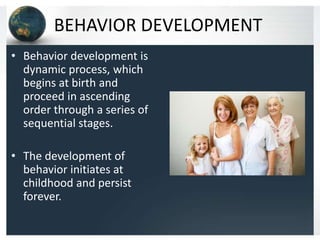
• Behavior development is
dynamic process, which
begins at birth and
proceed in ascending
order through a series of
sequential stages.
• The development of
behavior initiates at
childhood and persist
forever.
BEHAVIORAL THEORIES
• CLASSICAL CONDITIONING
• OPERANT CONDITIONING
• SOCIAL LEARNING THEORY
• HIERARCHY OF NEEDS
CLASSICAL CONDITIONING
• PAVLOV(1927)
• The conditioning is the
relation between the
conditioned stimulus and
the unconditioned
stimulus.
OPERANT CONDITIONING
• SKINNER (1938)
• Individual response is changed as a result of
reinforcement or extinction of previous responses.
• The consequence of behaviour itself acts as a stimulus
and affects future behaviour.
SOCIAL LEARNING THEORY
Albert Bandura, "Social
learning theory approaches
the explanation of human
behavior in terms of a
continuous reciprocal
interaction between cognitive,
behavioral, and environmental
determinants" (Social Learning
Theory, 1977).
THE CHILD PATIENT
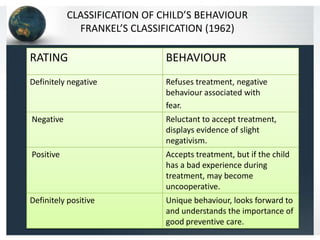
CLASSIFICATION OF CHILD’S BEHAVIOUR
FRANKEL’S CLASSIFICATION (1962)

RATING

BEHAVIOUR

Definitely negative

Refuses treatment, negative
behaviour associated with
fear.

Negative

Reluctant to accept treatment,
displays evidence of slight
negativism.

Positive

Accepts treatment, but if the child
has a bad experience during
treatment, may become
uncooperative.

Definitely positive

Unique behaviour, looks forward to
and understands the importance of
good preventive care.
FACTORS WHICH AFFECT CHILD’S
BEHAVIOR IN DENTAL OFFICE
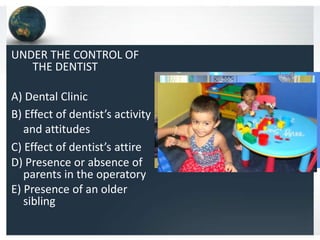
UNDER THE CONTROL OF
THE DENTIST
A) Dental Clinic
B) Effect of dentist’s activity
and attitudes
C) Effect of dentist’s attire
D) Presence or absence of
parents in the operatory
E) Presence of an older
sibling
OUT OF CONTROL OF THE DENTIST
 Growth & Development
 Nutritional factors
 Past medical and dental
experiences
 School environment
 Socio-economic status
UNDER THE CONTROL OF PARENTS
1) Home environment
2) Family development and
peer influences
3) Maternal Behavior
BEHAVIOR MANAGEMENT
Behavior management : is defined as the means by
which the dental health team effectively and
efficiently performs dental treatment and thereby
instills a positive dental attitude. (Wright 1975)
Behavior shaping: is the procedure which slowly
develops behavior by reinforcing a successive
approximation of the desired behavior until the
desired behavior comes into being.
THE CLASSIFICATION..
• Non pharmacological
(Psychological approach)

• Pharmacological
Non-pharmacological methods
1.

Communication

2. Behaviour shaping ( modification)
a) Desensitization
b) Modelling
c) Contingency management
3.Behaviour management
COMMUNICATIVE MANAGEMENT
TYPES OF COMMUNICATION:
a) Verbal communication is by speech
b) Nonverbal (multisensory communication)
c) Both using verbal and non-verbal
HOW TO COMMUNICATE?
• Compliment him about his
appearance.
• Communication should be
from a single source.
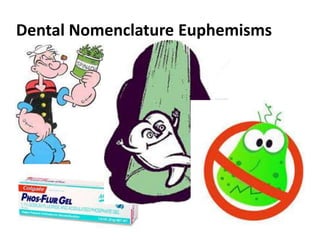
USE OF EUPHEMISMS:
• Euphemisms are substitute
words,which can be used
in the presence of children
Dental Nomenclature Euphemisms
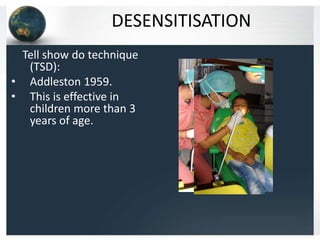
DESENSITISATION
Tell show do technique
(TSD):
• Addleston 1959.
• This is effective in
children more than 3
years of age.
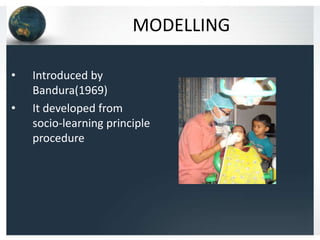
MODELLING
•
•

Introduced by
Bandura(1969)
It developed from
socio-learning principle
procedure
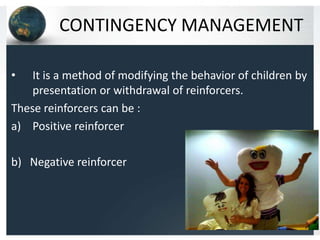
CONTINGENCY MANAGEMENT
•

It is a method of modifying the behavior of children by
presentation or withdrawal of reinforcers.
These reinforcers can be :
a) Positive reinforcer
b) Negative reinforcer
BEHAVIOR MANAGEMENT
Aversive conditioning :
• It is used for definitive negative behaviour child.
• Two common methods used in the clinical
practice are HOME and physical restraints:
HOME
HOME (Hand over Mouth
exercise)
Introduced by
Evangeline Jordan 1920.
b) Physical restraints (Kelly
1976).
- Active

- Passive
THE ADOLESCENT…
THE ADOLESCENT
• Adolescents – young
people between the ages
of 10 and 19 years – are
often thought of as a
healthy group( WHO 2012)
THE MANAGEMENT..
Is insecure and unable to cope with many Be kind and understanding
situations
Have varied interest

Determine what these are and encourage
discussion on these issues.considerable
rapport can be gained through discussion
when handle properly

Tend to reject adult authority

Responsive to empathetic guidance.
Be firm but kind; display authority in
clinical matters,but do not be
authoritarian

Preoccupied with health matters in
general and appearance in particular.

Use these concerns as mechanism for
motivating the type of behavior
conducive to enhancing rapport and
improving oral health
Often regress to childlike behavior in
clinic.

this age group is particularly sensitive to
being treated as a child.
Be extremely careful not to cause the
patient obvious embarrassment.

Tend to worry about many circumstances;
conditions in home, parent, school, social
injustice, peer relationship

Clinician should encourage conversation
to develop a better rapport.

Nutritional factors

Clinician should motivate patient toward
adequate nutritional intake and proper
dietary practice from perspectives of
obesity and oral health.
THE ADULT PATIENT
DENTAL PATIENT’S FEARS
• Fear from pain &
treatment procedure
• Fear from unknown
• Fear from past dental
history
• Fear from the financial
cost
• Fear from treatment
outcomes
HEALTH BELIEF MODEL
• WHO IS BETTER???
DURYODHAN
ARJUN
THE VICIOUS CIRCLE..
CHAIRSIDE TECHNIQUES FOR
BEHAVIOUR CHANGE
• NON RELAXATION BASED TECHNIQUES
COMMUNICATION
LISTENING
DISTRACTION

• QUASI RELAXATION BASED TECHNIQUES
GUIDED IMAGERY

• RELAXATION BASED TECHNIQUES
COGNITIVE COMPONENT
SOMATIC COMPONENT
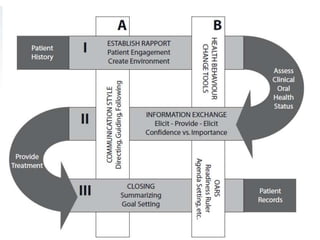
COMMUNICATION FOR HEALTH
BEHAVIOUR CHANGE
• Patient Clinician Relationship
“FIRST IMPRESSION IS THE LAST IMPRESSION”
VERBAL EXCHANGE
Styles of communication(Rollnick et al 2007):
•
1.Directing(most common)
•
2.Following
•
3.Guiding (OARS)
OARS
THE ART OF LISTENING
“Apparently the act of
attending carefully to
another person is a difficult
task for most
people.”
—Carl Rogers
HOW TO LISTEN
• have a calm manner
• say reassuring things
• take seriously what the
patient has to say
• tell the patient what is to
be done
• encourage the patient to
ask questions
“An inability to listen will be
judged harshly.”
—Stanley Weiss
NON VERBAL EXHANGE
• EYE CONTACT

• FACIAL EXPRESSIONS
• VOCAL CHARACTERISTICS

• BODY LANGUAGE
DISTRACTION
PHYSICAL

PSYCHOLOGICAL
QUASI RELAXATION TECHNIQUES
Helen Lindquist Bonny (1921 –
May 25, 2010)
Music therapist Kenneth
Bruscia defined Guided
Imagery and Music as
“All forms of music-imaging in
an expanded state of
consciousness, including not
only the specific individual
and group forms that Bonny
developed, but also all
variations and modifications
in those forms created by her
followers."
TO SUM IT ALL UP …
THE GERIATRIC PATIENT
 What happens in the

mouth is often a
reflection of what
happens in the body.
 Oral Health as been
linked to diabetes, heart
disease, stroke, and
pneumonia.

5
9

 Research also links

Periodontal disease, a
chronic inflammatory
disease to
cardiovascular disease,
diabetes, Alzheimer's
and other diseases


(Journal of Periodontology Aug 2008
Supplemental Issue)
GERIATRIC PSYCHOLOGY
(MM HOUSE)
PHILOSOPHICAL :
• well motivated
• realizes his part in the success of the treatment.
• Cooperative and adjustable.
• They are rational, sensible, calm and composed
even in difficult situations.
EXACTING (critical):
• Methodical and precise
• He likes each step of the procedure explained in
detail.
• Proposes alternative treatment
MANAGEMENT: Extra care, efforts and especially
patience is required.
The physician must listen to there demands but not
give in, especially if they are unresonable.
INDIFFERENT PATIENT
Lacks motivation
Usually not interested in treatment
Tries to find faults in the treatment
Tend not to cooperate or follow instruction
MANAGEMENT: Difficult to manage
An attempt is made to educate the patient
and improve his interest
HYSTERICAL PATIENT
• Easily excited
• Highly apprehensive
• Rarely cooperate with the treatment
• Tend to have unfounded complaints and
unrealistic expectation.
MANAGEMENT: require lot of time and effort.
Often medical consultation or professional
help is required.
SKEPTICAL PATIENT
• Had bad result with previous treatment
• Doubtful if their problem can be solved
• psychological disturbance from some recent
personal tragedy.
MANAGEMENT
Genuine kindness, care and sympathy should be
offered.
More time and attention to detail should be given.
These patient can be made into excellent patient if
handle properly.
M M HOUSE REVISITED
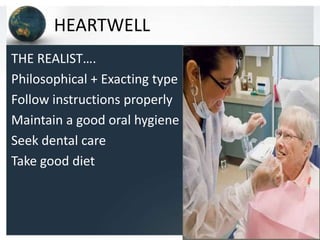
HEARTWELL
THE REALIST….
Philosophical + Exacting type
Follow instructions properly
Maintain a good oral hygiene
Seek dental care
Take good diet
• THE RESENTERS…
Indifferent + Hysterical type
Second childhood stage..
Will NOT listen to instructions properly
Negligent in oral care
Rarely seek dental care
MANAGEMENT : Palliative treatment
• THE RESIGNED…
Variable emotional & systemic status
Passive submission
MANAGEMENT : Definitive or palliative
MANAGEMENT OF ANXIOUS
GERIATRIC PATIENT
STATUS

PREOPERATIVE

MANAGEMENT

ORAL SEDATION

BEHAVIORAL

1. ANSWERING PATIENT’S
QUESTIONS
2. REASSURANCE

PHARMACOLOGICAL

EFFECTIVE LOCAL ANESTHESIA
ORAL SEDATION

BEHAVIOURAL

INSTRUCTION TO PATIENT
DESCRIPTION OF
COMPLICATIONS

PHARMACOLOGICAL

POSTOPERATIVE

1. EFFECTIVE
COMMUNICATION
2. MAKE THE PATIENT RELAX
3. EXPLAIN THE PROCEDURE

PHARMACOLOGICAL
OPERATIVE

BEHAVIORAL

ANALGESICS, ADJUNCTIVE
MEDICATIONS

Zwetchkenbaum S et al Prosthodontic considerations for older patient. The Dental clinics of North America
1997;41:817-46
THE 5A’s …
•
•
•
•
•

Assess
Advise.
Agree
Assist
Arrange Follow
up
• “Before meeting the
mouth of the patient, we
must meet the mind of
the patient”- DeVan
• The Golden Handshake..
• The Schizophrenic patient
• Patient having
Alzheimer’s disease
A WORD OF CAUTION…
EXTREMELY STRESSED OUT
PATIENTS
SATISFIED WEARER OF OLD
DENTURES
GERIATRIC PATIENTS WHO
DO NOT WANT DENTURES

THE GERIATRIC
PROSTHODONTIC PATIENT
• Prefer short morning
appointments
• Avoid exagerrated
treatment options
• Consider partial
transitional denture ,
over dentures etc.
GOD’S PEOPLE…
• They form one of the more neglected population
as far as oral health care is concerned
• They need special considerations & strategies
beyond those required for other people
THE HINDRANCES…
• INFORMATION OBSTACLE
• PHYSICAL OBSTACLE

• BEHAVIORAL OBSTACLE
• ORGANIZATIONAL OBSTACLE
PYRAMID TRAINING MODULE..
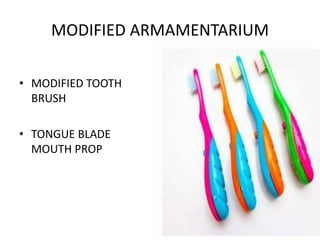
MODIFIED ARMAMENTARIUM
• MODIFIED TOOTH
BRUSH
• TONGUE BLADE
MOUTH PROP
BEHAVIOR SUPPORT
• STRUCTURING THE ENVIRONMENT
• INVOLVING THE INDIVIDUAL

• EDUCATING THE CAREGIVER
PATIENT
MOTIVATION
MOTIVATIONAL INTERVIEWING

“ a client- centred, directive method for enhancing
intrinsic motivation to change by exploring and
resolving ambivalence ” (Rollnick and Miller 1995 )
STRATEGY
PRINCIPLE
SPIRIT
IN THE DENTAL OPERATORY..
• AIM IS TO …
(1) assess motives,

(2) raise awareness,
(3) support a change.
Modus operandi..
• Health history form
(objective)
• Open ended
questions
• Raise awareness
Vs
Giving information
Support a change
• Encouraging patient
problem solving
• offering a set of
strategies or options
• planning steps for the
change.
THE CHANGE TALK..
• ELLICIT – PROVIDE –
ELLICIT
• ROLL WITH RESISTANCE

• A BRIEF INTERVENTION
OUTSIDE THE DENTAL OFFICE
• DENTAL HEALTH CAMPS
1. COMMUNITY LEVEL HEALTH PROGRAMMES
2.SCHOOL ORAL HEALTH PROGRAMMES
3.HEALTH AWARENESS CAMPAIGNS
COMMUNITY DENTAL HEALTH
CAMPS
THE SATELLITE
CLINIC
COMMUNITY DENTAL CAMPS
SCHOOL DENTAL HEALTH
CAMPS
HEALTH AWARENESS CAMPS
FINALLY…
REFERENCES
• Ralphe E McDonald ,Avery R D, Dean J A ;Dentistry for the child
and Adolescent;8Ed Mosby;2004
• Mostofsky I D, Fortune Farida; Behavioral Dentistry;2Ed;Wiley
BlackWell;2012
• Glanz K, Rimer B, Vishwanath K;Health Behavior & Health
Education Theory, Research & Practice;4Ed;Jossey-Bass;2008
• Ramseier C, Suvan J;Health Behavioral Change in Dental
Practice; 1Ed;Wiley-Blackwell;2010
• Tandon ShobhaTextbook of Pedodntics;2Ed Paras Medical;2009
• Ernest R. Hilgard ;Introduction to psychology; 6Ed;Mosby
• Charles M heartwell ;Syllabus of complete dentures
• Module 4. Behaviour Modification ;UNESCO ;February 2000
• Diana M Gardnier;Psychosocial behaviour pattern for
adolescence- dental clinics of north america; vol-50 (17-32)
• David Kohllo;Child & adolescence psychology ; journal of clinical
psychology ; vol 13; (47-53)
• Ripa & Barenier;Management of dental behavior in children
• Busschots G Milzman B Dental patients with neurologic &
psychiatric concerns. The Dental Clinics of North
America.1999;43:471-83
• Laxman Rao Polsani,AjayKumar G,Githanjali M, Anjana
Raut;Geriatric Psychology & Prosthodontic Patient;IJOPRD,AprilJune 2011;1(1):1-5
• Thomas A. Cavalieri, DO;Managing pain in Geriatric Patient; J
Am Osteopath Assoc. 2007;107(suppl 4):ES10-ES16
• Gamer S,Tuch R,Garcia L T;M. M. House mental classification
revisited: Intersection of particular patient types and particular
dentist’s needs; J Prosthet Dent 2003;89:297-302.
• Freeman R;Strategies for motivating the noncompliant patient;British Dental Journal; Vol
187(6)1999-307
• Anne E, Halvari M,Halvari H, Bjørnebekk G, Deci L E;
Motivation and anxiety for dental treatment: Testing
a self-determination theory model of oral self-care
behaviour and dental clinic attendance; Motiv
Emot;2010(34):15–33
• Anne E, Halvari M,Halvari H, Bjørnebekk G, Deci L
E;Motivation for Dental Home Care:Testing a SelfDetermination Theory Mode; Journal of Applied
Social Psychology,:2012;42(1)1–39.
 behavioural sciences & Patient motivation

behavioural sciences & Patient motivation

  • 1.
    BEHAVIOURAL SCIENCE & PATIENTMOTIVATION GUIDED BY : DR.PREETI DHAWAN(READER) DEPT. OF PREVENTIVE & PEDIATRIC DENTISTRY DR.RAVNEET ARORA(SENIOR LECTURER) DEPT OF ORAL MEDICINE & RADIOLOGY BY : ADITI SINGH (P.G I YEAR) DEPT.OF PREVENTIVE & PEDIATRIC DENTISTRY
  • 2.
  • 3.
    CONTENTS Introduction Behaviour theories The childpatient The adolescent patie nt The adult patient The geriatric patient God’s people Patient motivation Conclusion Bibliography
  • 4.
    BEHAVIOR It is definedas any change observed in the functioning of an organism.
  • 5.
    BEHAVIORAL SCIENCE It isthe science which deals with the observation of behavioral habits of man and lower animals in various physical and social environment.
  • 6.
    Behavioral dentistry isan interdisciplinary science which needs to be learned, practiced and reinforced in the context of clinical care and within the community oral health care delivery system.
  • 7.
    BEHAVIOR DEVELOPMENT • Behaviordevelopment is dynamic process, which begins at birth and proceed in ascending order through a series of sequential stages. • The development of behavior initiates at childhood and persist forever.
  • 8.
    BEHAVIORAL THEORIES • CLASSICALCONDITIONING • OPERANT CONDITIONING • SOCIAL LEARNING THEORY • HIERARCHY OF NEEDS
  • 9.
    CLASSICAL CONDITIONING • PAVLOV(1927) •The conditioning is the relation between the conditioned stimulus and the unconditioned stimulus.
  • 10.
    OPERANT CONDITIONING • SKINNER(1938) • Individual response is changed as a result of reinforcement or extinction of previous responses. • The consequence of behaviour itself acts as a stimulus and affects future behaviour.
  • 11.
    SOCIAL LEARNING THEORY AlbertBandura, "Social learning theory approaches the explanation of human behavior in terms of a continuous reciprocal interaction between cognitive, behavioral, and environmental determinants" (Social Learning Theory, 1977).
  • 13.
  • 14.
    CLASSIFICATION OF CHILD’SBEHAVIOUR FRANKEL’S CLASSIFICATION (1962) RATING BEHAVIOUR Definitely negative Refuses treatment, negative behaviour associated with fear. Negative Reluctant to accept treatment, displays evidence of slight negativism. Positive Accepts treatment, but if the child has a bad experience during treatment, may become uncooperative. Definitely positive Unique behaviour, looks forward to and understands the importance of good preventive care.
  • 15.
    FACTORS WHICH AFFECTCHILD’S BEHAVIOR IN DENTAL OFFICE
  • 16.
    UNDER THE CONTROLOF THE DENTIST A) Dental Clinic B) Effect of dentist’s activity and attitudes C) Effect of dentist’s attire D) Presence or absence of parents in the operatory E) Presence of an older sibling
  • 17.
    OUT OF CONTROLOF THE DENTIST  Growth & Development  Nutritional factors  Past medical and dental experiences  School environment  Socio-economic status
  • 18.
    UNDER THE CONTROLOF PARENTS 1) Home environment 2) Family development and peer influences 3) Maternal Behavior
  • 19.
    BEHAVIOR MANAGEMENT Behavior management: is defined as the means by which the dental health team effectively and efficiently performs dental treatment and thereby instills a positive dental attitude. (Wright 1975) Behavior shaping: is the procedure which slowly develops behavior by reinforcing a successive approximation of the desired behavior until the desired behavior comes into being.
  • 20.
    THE CLASSIFICATION.. • Nonpharmacological (Psychological approach) • Pharmacological
  • 21.
    Non-pharmacological methods 1. Communication 2. Behaviourshaping ( modification) a) Desensitization b) Modelling c) Contingency management 3.Behaviour management
  • 22.
    COMMUNICATIVE MANAGEMENT TYPES OFCOMMUNICATION: a) Verbal communication is by speech b) Nonverbal (multisensory communication) c) Both using verbal and non-verbal
  • 23.
    HOW TO COMMUNICATE? •Compliment him about his appearance. • Communication should be from a single source. USE OF EUPHEMISMS: • Euphemisms are substitute words,which can be used in the presence of children
  • 24.
  • 25.
    DESENSITISATION Tell show dotechnique (TSD): • Addleston 1959. • This is effective in children more than 3 years of age.
  • 26.
    MODELLING • • Introduced by Bandura(1969) It developedfrom socio-learning principle procedure
  • 27.
    CONTINGENCY MANAGEMENT • It isa method of modifying the behavior of children by presentation or withdrawal of reinforcers. These reinforcers can be : a) Positive reinforcer b) Negative reinforcer
  • 28.
  • 29.
    Aversive conditioning : •It is used for definitive negative behaviour child. • Two common methods used in the clinical practice are HOME and physical restraints:
  • 30.
    HOME HOME (Hand overMouth exercise) Introduced by Evangeline Jordan 1920.
  • 31.
    b) Physical restraints(Kelly 1976). - Active - Passive
  • 32.
  • 33.
    THE ADOLESCENT • Adolescents– young people between the ages of 10 and 19 years – are often thought of as a healthy group( WHO 2012)
  • 34.
    THE MANAGEMENT.. Is insecureand unable to cope with many Be kind and understanding situations Have varied interest Determine what these are and encourage discussion on these issues.considerable rapport can be gained through discussion when handle properly Tend to reject adult authority Responsive to empathetic guidance. Be firm but kind; display authority in clinical matters,but do not be authoritarian Preoccupied with health matters in general and appearance in particular. Use these concerns as mechanism for motivating the type of behavior conducive to enhancing rapport and improving oral health
  • 35.
    Often regress tochildlike behavior in clinic. this age group is particularly sensitive to being treated as a child. Be extremely careful not to cause the patient obvious embarrassment. Tend to worry about many circumstances; conditions in home, parent, school, social injustice, peer relationship Clinician should encourage conversation to develop a better rapport. Nutritional factors Clinician should motivate patient toward adequate nutritional intake and proper dietary practice from perspectives of obesity and oral health.
  • 36.
  • 38.
    DENTAL PATIENT’S FEARS •Fear from pain & treatment procedure • Fear from unknown • Fear from past dental history • Fear from the financial cost • Fear from treatment outcomes
  • 39.
  • 40.
    • WHO ISBETTER??? DURYODHAN ARJUN
  • 42.
  • 43.
    CHAIRSIDE TECHNIQUES FOR BEHAVIOURCHANGE • NON RELAXATION BASED TECHNIQUES COMMUNICATION LISTENING DISTRACTION • QUASI RELAXATION BASED TECHNIQUES GUIDED IMAGERY • RELAXATION BASED TECHNIQUES COGNITIVE COMPONENT SOMATIC COMPONENT
  • 44.
    COMMUNICATION FOR HEALTH BEHAVIOURCHANGE • Patient Clinician Relationship “FIRST IMPRESSION IS THE LAST IMPRESSION”
  • 45.
    VERBAL EXCHANGE Styles ofcommunication(Rollnick et al 2007): • 1.Directing(most common) • 2.Following • 3.Guiding (OARS)
  • 46.
  • 47.
    THE ART OFLISTENING “Apparently the act of attending carefully to another person is a difficult task for most people.” —Carl Rogers
  • 48.
    HOW TO LISTEN •have a calm manner • say reassuring things • take seriously what the patient has to say • tell the patient what is to be done • encourage the patient to ask questions
  • 49.
    “An inability tolisten will be judged harshly.” —Stanley Weiss
  • 50.
    NON VERBAL EXHANGE •EYE CONTACT • FACIAL EXPRESSIONS
  • 51.
  • 52.
  • 53.
    QUASI RELAXATION TECHNIQUES HelenLindquist Bonny (1921 – May 25, 2010) Music therapist Kenneth Bruscia defined Guided Imagery and Music as “All forms of music-imaging in an expanded state of consciousness, including not only the specific individual and group forms that Bonny developed, but also all variations and modifications in those forms created by her followers."
  • 55.
    TO SUM ITALL UP …
  • 57.
  • 59.
     What happensin the mouth is often a reflection of what happens in the body.  Oral Health as been linked to diabetes, heart disease, stroke, and pneumonia. 5 9  Research also links Periodontal disease, a chronic inflammatory disease to cardiovascular disease, diabetes, Alzheimer's and other diseases  (Journal of Periodontology Aug 2008 Supplemental Issue)
  • 60.
    GERIATRIC PSYCHOLOGY (MM HOUSE) PHILOSOPHICAL: • well motivated • realizes his part in the success of the treatment. • Cooperative and adjustable. • They are rational, sensible, calm and composed even in difficult situations.
  • 61.
    EXACTING (critical): • Methodicaland precise • He likes each step of the procedure explained in detail. • Proposes alternative treatment MANAGEMENT: Extra care, efforts and especially patience is required. The physician must listen to there demands but not give in, especially if they are unresonable.
  • 62.
    INDIFFERENT PATIENT Lacks motivation Usuallynot interested in treatment Tries to find faults in the treatment Tend not to cooperate or follow instruction MANAGEMENT: Difficult to manage An attempt is made to educate the patient and improve his interest
  • 63.
    HYSTERICAL PATIENT • Easilyexcited • Highly apprehensive • Rarely cooperate with the treatment • Tend to have unfounded complaints and unrealistic expectation. MANAGEMENT: require lot of time and effort. Often medical consultation or professional help is required.
  • 64.
    SKEPTICAL PATIENT • Hadbad result with previous treatment • Doubtful if their problem can be solved • psychological disturbance from some recent personal tragedy. MANAGEMENT Genuine kindness, care and sympathy should be offered. More time and attention to detail should be given. These patient can be made into excellent patient if handle properly.
  • 65.
    M M HOUSEREVISITED
  • 66.
    HEARTWELL THE REALIST…. Philosophical +Exacting type Follow instructions properly Maintain a good oral hygiene Seek dental care Take good diet
  • 67.
    • THE RESENTERS… Indifferent+ Hysterical type Second childhood stage.. Will NOT listen to instructions properly Negligent in oral care Rarely seek dental care MANAGEMENT : Palliative treatment
  • 68.
    • THE RESIGNED… Variableemotional & systemic status Passive submission MANAGEMENT : Definitive or palliative
  • 69.
  • 70.
    STATUS PREOPERATIVE MANAGEMENT ORAL SEDATION BEHAVIORAL 1. ANSWERINGPATIENT’S QUESTIONS 2. REASSURANCE PHARMACOLOGICAL EFFECTIVE LOCAL ANESTHESIA ORAL SEDATION BEHAVIOURAL INSTRUCTION TO PATIENT DESCRIPTION OF COMPLICATIONS PHARMACOLOGICAL POSTOPERATIVE 1. EFFECTIVE COMMUNICATION 2. MAKE THE PATIENT RELAX 3. EXPLAIN THE PROCEDURE PHARMACOLOGICAL OPERATIVE BEHAVIORAL ANALGESICS, ADJUNCTIVE MEDICATIONS Zwetchkenbaum S et al Prosthodontic considerations for older patient. The Dental clinics of North America 1997;41:817-46
  • 71.
  • 72.
    • “Before meetingthe mouth of the patient, we must meet the mind of the patient”- DeVan • The Golden Handshake.. • The Schizophrenic patient • Patient having Alzheimer’s disease
  • 73.
    A WORD OFCAUTION… EXTREMELY STRESSED OUT PATIENTS SATISFIED WEARER OF OLD DENTURES GERIATRIC PATIENTS WHO DO NOT WANT DENTURES THE GERIATRIC PROSTHODONTIC PATIENT
  • 74.
    • Prefer shortmorning appointments • Avoid exagerrated treatment options • Consider partial transitional denture , over dentures etc.
  • 75.
  • 76.
    • They formone of the more neglected population as far as oral health care is concerned • They need special considerations & strategies beyond those required for other people
  • 77.
    THE HINDRANCES… • INFORMATIONOBSTACLE • PHYSICAL OBSTACLE • BEHAVIORAL OBSTACLE • ORGANIZATIONAL OBSTACLE
  • 78.
  • 79.
    MODIFIED ARMAMENTARIUM • MODIFIEDTOOTH BRUSH • TONGUE BLADE MOUTH PROP
  • 80.
    BEHAVIOR SUPPORT • STRUCTURINGTHE ENVIRONMENT • INVOLVING THE INDIVIDUAL • EDUCATING THE CAREGIVER
  • 81.
  • 82.
    MOTIVATIONAL INTERVIEWING “ aclient- centred, directive method for enhancing intrinsic motivation to change by exploring and resolving ambivalence ” (Rollnick and Miller 1995 )
  • 83.
  • 84.
    IN THE DENTALOPERATORY.. • AIM IS TO … (1) assess motives, (2) raise awareness, (3) support a change.
  • 85.
    Modus operandi.. • Healthhistory form (objective) • Open ended questions
  • 86.
  • 87.
    Support a change •Encouraging patient problem solving • offering a set of strategies or options • planning steps for the change.
  • 88.
    THE CHANGE TALK.. •ELLICIT – PROVIDE – ELLICIT • ROLL WITH RESISTANCE • A BRIEF INTERVENTION
  • 89.
    OUTSIDE THE DENTALOFFICE • DENTAL HEALTH CAMPS 1. COMMUNITY LEVEL HEALTH PROGRAMMES 2.SCHOOL ORAL HEALTH PROGRAMMES 3.HEALTH AWARENESS CAMPAIGNS
  • 90.
  • 91.
  • 92.
  • 93.
  • 94.
  • 95.
  • 97.
    REFERENCES • Ralphe EMcDonald ,Avery R D, Dean J A ;Dentistry for the child and Adolescent;8Ed Mosby;2004 • Mostofsky I D, Fortune Farida; Behavioral Dentistry;2Ed;Wiley BlackWell;2012 • Glanz K, Rimer B, Vishwanath K;Health Behavior & Health Education Theory, Research & Practice;4Ed;Jossey-Bass;2008 • Ramseier C, Suvan J;Health Behavioral Change in Dental Practice; 1Ed;Wiley-Blackwell;2010 • Tandon ShobhaTextbook of Pedodntics;2Ed Paras Medical;2009 • Ernest R. Hilgard ;Introduction to psychology; 6Ed;Mosby • Charles M heartwell ;Syllabus of complete dentures • Module 4. Behaviour Modification ;UNESCO ;February 2000
  • 98.
    • Diana MGardnier;Psychosocial behaviour pattern for adolescence- dental clinics of north america; vol-50 (17-32) • David Kohllo;Child & adolescence psychology ; journal of clinical psychology ; vol 13; (47-53) • Ripa & Barenier;Management of dental behavior in children • Busschots G Milzman B Dental patients with neurologic & psychiatric concerns. The Dental Clinics of North America.1999;43:471-83 • Laxman Rao Polsani,AjayKumar G,Githanjali M, Anjana Raut;Geriatric Psychology & Prosthodontic Patient;IJOPRD,AprilJune 2011;1(1):1-5 • Thomas A. Cavalieri, DO;Managing pain in Geriatric Patient; J Am Osteopath Assoc. 2007;107(suppl 4):ES10-ES16 • Gamer S,Tuch R,Garcia L T;M. M. House mental classification revisited: Intersection of particular patient types and particular dentist’s needs; J Prosthet Dent 2003;89:297-302.
  • 99.
    • Freeman R;Strategiesfor motivating the noncompliant patient;British Dental Journal; Vol 187(6)1999-307 • Anne E, Halvari M,Halvari H, Bjørnebekk G, Deci L E; Motivation and anxiety for dental treatment: Testing a self-determination theory model of oral self-care behaviour and dental clinic attendance; Motiv Emot;2010(34):15–33 • Anne E, Halvari M,Halvari H, Bjørnebekk G, Deci L E;Motivation for Dental Home Care:Testing a SelfDetermination Theory Mode; Journal of Applied Social Psychology,:2012;42(1)1–39.

Editor's Notes

  • #2 Custom animation effects: faded zoom entrance and exit(Basic)To reproduce the picture effects on this slide, do the following:On the Home tab, in the Slides group, click Layout, and then click Blank. On the Insert tab, in the Illustrations group, click Picture. In the Insert Picture dialog box, select a picture, and then click Insert.On the slide, select the picture. Under Picture Tools, on the Format tab, in the bottom right corner of the Size group, click the Size and Position dialog box launcher. In the Size and Position dialog box, on the Size tab, resize or crop the picture as needed so that under Size and rotate, the Height box is set to 5.5” and the Width box is set to 6.5”. Resize the picture under Size and rotate by entering values into the Height and Width boxes. Crop the picture under Crop from by entering values into the Left, Right, Top, and Bottom boxes.Select the picture. Under Picture Tools, on the Format tab, in the PictureStyles group, click PictureShape, and then under Rectangles click RoundedRectangle (second option from the left).On the picture, drag the yellow diamond adjustment handle toward the corner to decrease the rounding on the corners of the rectangle. Under Picture Tools, on the Format tab, in the PictureStyles group, click PictureEffects,point to Shadow, and then under Outer click OffsetCenter (second row, second option from the left).To reproduce the animation effects on this slide, do the following:On the Animations tab, in the Animations group, click CustomAnimation.On the slide, select the picture. In the CustomAnimation task pane, click Add Effect, point to Entrance, and then click MoreEffects. In the Add Entrance Effect dialog box, under Subtle, click Faded Zoom, and then click OK. Under Modify: Faded Zoom, in the Start list, select With Previous.Under Modify: Faded Zoom, in the Speed list, select Medium.Also in the Custom Animation task pane, click Add Effect, point to Exit, and then click MoreEffects. In the Add Exit Effect dialog box, under Subtle, click Faded Zoom, and then click OK. Under Modify: Faded Zoom, in the Start list, select On Click.Under Modify: Faded Zoom, in the Speed list, select Medium.To duplicate the animated picture effects on this slide, do the following:Select the first picture. On the Home tab, in the Clipboard group, click the arrow under Paste, and then click Duplicate.Select the second picture. Under Picture Tools, on the Format tab, in the Adjust group, click Change Picture. In the Insert Picture dialog box, select a picture, and then click Insert.Select the second picture. Under Picture Tools, on the Format tab, in the bottom right corner of the Size group, click the Size and Position dialog box launcher. In the Size and Position dialog box, on the Size tab, resize or crop the picture as needed so that under Size and rotate, the Height box is set to 5.5” and the Width box is set to 6.5”. Resize the picture under Size and rotate by entering values into the Height and Width boxes. Crop the picture under Crop from by entering values into the Left, Right, Top, and Bottom boxes.Select the second picture. On the Home tab, in the Clipboard group, click the arrow under Paste, and then click Duplicate.Select the third picture. Under Picture Tools, on the Format tab, in the Adjust group, click Change Picture. In the Insert Picture dialog box, select a picture, and then click Insert.Select the third picture. Under Picture Tools, on the Format tab, in the bottom right corner of the Size group, click the Size and Position dialog box launcher. In the Size and Position dialog box, on the Size tab, resize or crop the picture as needed so that under Size and rotate, the Height box is set to 5.5” and the Width box is set to 6.5”. Resize the picture under Size and rotate by entering values into the Height and Width boxes. Crop the picture under Crop from by entering values into the Left, Right, Top, and Bottom boxes.Press and hold CTRL, and then select all three pictures. On the Home tab, in the Drawing group, click Arrange, point to Align, and then do the following:Click Align to Slide.Click Align Middle.Click Align Center. In the Custom Animation task pane, select the sixth animation effect (faded zoom exit effect for the third picture). Click the arrow to the right of the effect, and then click Remove.To reproduce the background effects on this slide, do the following:Right-click the slide background area, and then click Format Background. In the Format Background dialog box, click Fill in the left pane, select Gradient fill in the Fill pane, and then do the following:In the Type list, select Radial.Click the button next to Direction, and then click From Center (third option from the left).Under Gradient stops, click Add or Remove until two stops appear in the drop-down list.Also under Gradient stops, customize the gradient stops as follows:Select Stop 1 from the list, and then do the following:In the Stop position box, enter 0%.Click the button next to Color, and then under Theme Colors click Black, Text 1, Lighter 50% (second row, second option from the left).Select Stop 2 from the list, and then do the following: In the Stop position box, enter 100%.Click the button next to Color, and then under Theme Colors click Black, Text 1 (first row, second option from the left).