Downloaded 20 times






![• Attitude or expectation of dentist can affect the outcome of treatment
• Child will respond with the type of behavior expected
• +ve statements increases the chance of success
I] Positive approach
• Children responds best to natural & friendlier attitude
• Made to feel good by using nick names, noting child’s school
accomplishments – demonstrates friendly & caring attitude
II] Team attitude
• Dental team must be flexible as the situation demands
III] Flexibility
FUNDAMENTAL PRINCIPLES OF
BEHAVIOR MANAGEMENT](https://image.slidesharecdn.com/non-pharmocologicalbehaviormanagement-201205043205/85/Non-pharmocological-behavior-management-15-320.jpg)
![• Each dental office must devise its own contingency plans
• Each member should be aware in advance of what is expected of them &
what to be done
• Delays & indecisiveness can build apprehension in young children
IV] Organization
• Children – either white or black; nothing inbetween
• Important for building trust – truthful in explaining the children about
procedures
V] Truthfulness
• Dentist’s ability to cope with misbehaviors while maintaining composure
VI] Tolerance](https://image.slidesharecdn.com/non-pharmocologicalbehaviormanagement-201205043205/85/Non-pharmocological-behavior-management-16-320.jpg)


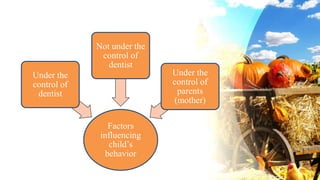


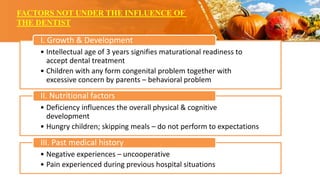

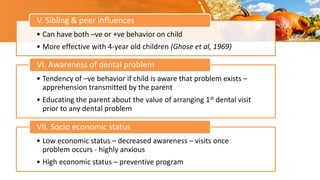










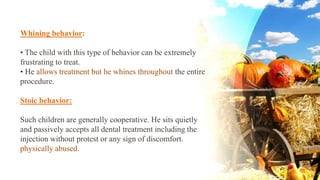
The document discusses non-pharmacological methods for managing children's behavior in dental settings, emphasizing the importance of effective communication between the dentist, child, and parents to foster cooperation and alleviate anxiety. Various classifications and evaluation scales are presented to help assess and modify children's behavior, alongside strategies like behavior shaping, modeling, and desensitization. Factors influencing a child's behavior include the dentist's approach, parental influence, and the child's background, highlighting the need for tailored behavior management techniques in pediatric dentistry.


