Behavioral
9/25/2016 1
ECOLOGY
zy
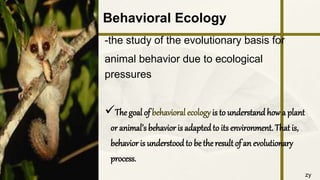
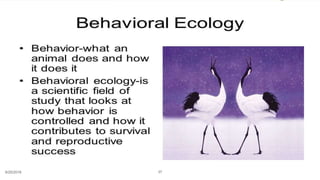
Behavioral Ecology
-the study of the evolutionary basis for
animal behavior due to ecological
pressures
The goal of behavioral ecology is to understand how a plant
or animal’s behavior is adaptedto its environment. That is,
behavioris understoodto be the result of an evolutionary
process.
zy
What is Behavior?
-encompasses a wide range of activities
- An action carried out by muscles or glands
under the control of the nervous system in
response to an environmental cue.
Why study behavior?
9/25/2016 3
zy
9/25/2016 4
zy
9/25/2016 5
zy
 Implies the monitoring of ecological resources, to
discover the current and changing conditions
 Are required components of most hazardous waste
site investigations
 Is a “qualitative or quantitative assessment of actual
or potential effects of a hazardous waste site on
plants and animals other than people and
domesticated species”
9/25/2016 6
Resource Assessment
zy
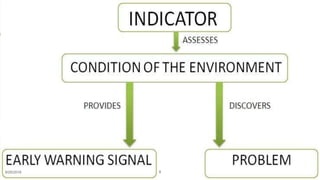
1. Assess the condition of the
environment
2. Provide an early warning signal of
changes in the environment, or
3. Diagnose the cause of an
environmental problem9/25/2016 7
Ecological indicators are able to:
zy
9/25/2016 8
zy
1. Strategic Ecological Assessment (SEcA)
- Is required to ensure that proposed new developments are
compatible with international obligations to conserve
protected habitats and their associated species
2. Rapid Ecological Assessment (REA)
- An integrated methodology to provide the multiple scale, up-
to-date information requited to guide conservation actions
9/25/2016 9
Types of Ecological Assessment:
zy
Communication
 comes from Latin word communicare “to share”
Animal Communication
- is the transfer of information from one or
a group of animals (sender or senders) to one
or more other animals (receiver or receivers)
which affects either the current or future
behavior of the receivers9/25/2016 10
Animal Communication
zy
1. Visual
a. Gestures
b. Facial Expression
c. Gaze Following
d. Color Change
e. Bioluminescent Communication
9/25/2016 11
Animal Communicate through:
zy
2. Auditory
3. Olfactory
4. Electro
Communication
5. Touch
6. Seismic
Communication
7. Auto Communication
8. Chemical
Communication
9. Tactile Communication9/25/2016 12
Animal Communicate through:
zy
 Electrocommunication is the communication method
used by weakly electric fishes. Weakly electric fishes are
a group of animals that utilize a communicating channel
that is "invisible" to most other animals: electric signaling.
 Seismic communication, sometimes called vibrational
communication, describes the conveying of information
through seismic vibrations of the substrate.
9/25/2016 13
zy
 Seismic energy transmits most efficiently between
the 10 and 40 Hz - in the same range as the
fundamental frequency and 2nd harmonic of an
elephant rumble. It turns out that when an elephant
rumbles a replica of the airborne sound is also
transmitted through the ground. Elephant sounds
have been measured as traveling at about 309 m
per second through air and at about 248-264 m/sec
through the ground.
9/25/2016 14
zy
9/25/2016 15
zy
 Most animals (including people) use “body language” as
well as sound and smell in order to communicate with one
another. Here are some of the ways animals express
themselves.
 Many animals communicate by smell: they
release pheromones (airborne chemicals) to send
messages to others. Pheromones play an important part
in reproduction and other social behavior. They are used
by many animals, including insects, wolves, deer, and
even humans!
9/25/2016 16
Animal Communication
zy
 Bees dance when they have found nectar. The scout bee will
dance in the hive, and the dance directs other bees to the
location of the nectar.
 Chimpanzees greet each other by touching hands.
 Male fiddler crabs wave their giant claw to attract female
fiddler crabs.
 White-tailed deer show alarm by flicking up their tails.
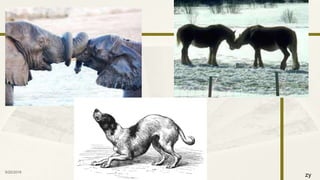
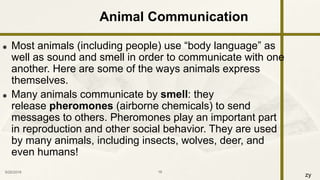
 Dogs stretch their front legs out in front of them and lower
their bodies when they want to play.
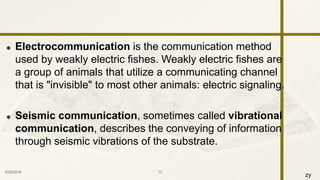
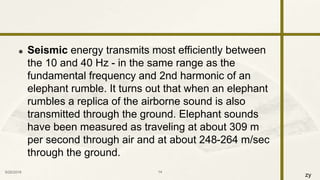
 Elephants show affection by entwining their trunks.
9/25/2016 17
zy
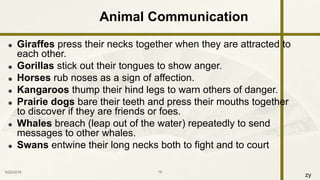
 Giraffes press their necks together when they are attracted to
each other.
 Gorillas stick out their tongues to show anger.
 Horses rub noses as a sign of affection.
 Kangaroos thump their hind legs to warn others of danger.
 Prairie dogs bare their teeth and press their mouths together
to discover if they are friends or foes.
 Whales breach (leap out of the water) repeatedly to send
messages to other whales.
 Swans entwine their long necks both to fight and to court
9/25/2016 18
Animal Communication
zy
1. Communication during contests
2. Mating rituals
3. Ownership/Territorial
4. Food-related signals
5. Alarm calls
6. Meta-communication
9/25/2016 19
Functions of Animal Communication
zy
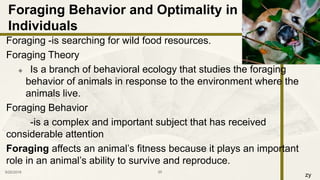
Foraging -is searching for wild food resources.
Foraging Theory
 Is a branch of behavioral ecology that studies the foraging
behavior of animals in response to the environment where the
animals live.
Foraging Behavior
-is a complex and important subject that has received
considerable attention
Foraging affects an animal’s fitness because it plays an important
role in an animal’s ability to survive and reproduce.
9/25/2016 20
Foraging Behavior and Optimality in
Individuals
zy
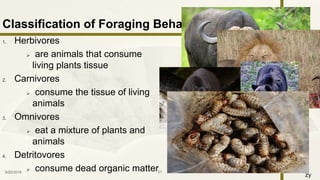
1. Herbivores
 are animals that consume
living plants tissue
2. Carnivores
 consume the tissue of living
animals
3. Omnivores
 eat a mixture of plants and
animals
4. Detritovores
 consume dead organic matter9/25/2016 21
Classification of Foraging Behavior:
zy
Optimal Foraging
- Feeding is not a single behavior but a
large collection of functionally related
behaviors
Optimal Food Types
- the type of food an animal chooses may
be governed by optimality principles
9/25/2016 22
zy
1. Learning
-defined as an adaptive change or modification of a
behavior based on a previous experience
2. Genetics
-influenced foraging behaviour
3. Predation
-refers to the presence of predators while an animal
is foraging
4. Parasitism
-can affect the way in which animals forage9/25/2016 23
Factors Influencing Foraging Behaviour
zy
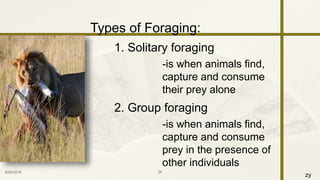
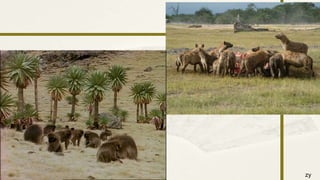
Types of Foraging:
1. Solitary foraging
-is when animals find,
capture and consume
their prey alone
2. Group foraging
-is when animals find,
capture and consume
prey in the presence of
other individuals
9/25/2016 24
zy
9/25/2016 25
zy
Sexual Polymorphism
-is maintained by frequency-dependent selection,
leading to predictable sex ratios at equilibrium
Polymorphism -the occurrence of different forms
among the members of a population or colony, or in the
life cycle of an individual organism
-greek “having multiple forms”
Sex ratio
-is the ratio of males to females in a population
-it is the relative number of males to females in a
population9/25/2016 26
Maintenance of Sex Ratio
zy
Types of Sex Ratio:
1. Primary sex ratio- ratio at fertilization
2. Secondary sex ratio- ratio at birth
3. Tertiary sex ratio- ratio in sexually active
organisms
- also called adult sex ratio (ASR), defined
as the proportion of adults in a population that
are male
4. Quaternary sex ratio- ratio in post-
reproductive organisms9/25/2016 27
zy
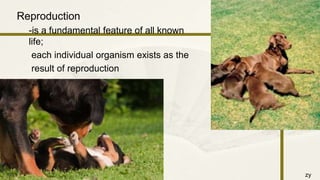
Reproduction
-is a fundamental feature of all known
life;
each individual organism exists as the
result of reproduction
9/25/2016 28
zy
- a special type of natural selection in which
the sexes acquire distinct forms either because
the members of one sex choose mates with
particular features or because in the
competition for mates among the members of
one sex only those with certain traits succeed.
9/25/2016 29
Sexual Selection
zy
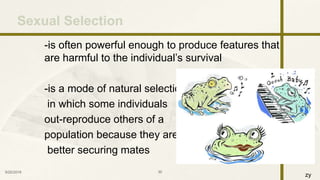
-is often powerful enough to produce features that
are harmful to the individual’s survival
-is a mode of natural selection
in which some individuals
out-reproduce others of a
population because they are
better securing mates
9/25/2016 30
Sexual Selection
zy
 Sexual selection is a mode of natural
selection where members of one biological
sex choose mates of the other sex to mate with
(intersexual selection), and compete with members
of the same sex for access to members of the
opposite sex (intrasexual selection). These two
forms of selection mean that some individuals have
better reproductive success than others within
apopulation, either from being more attractive or
preferring more attractive partners to
produce offspring.
9/25/2016 31
zy
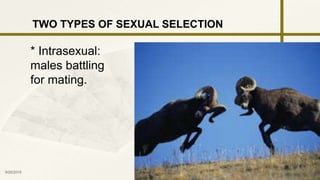
* Intrasexual:
males battling
for mating.
9/25/2016 32
TWO TYPES OF SEXUAL SELECTION
zy
9/25/2016 33
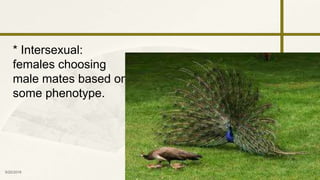
* Intersexual:
females choosing
male mates based on
some phenotype.
zy
9/25/2016 34
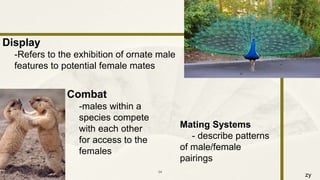
Display
-Refers to the exhibition of ornate male
features to potential female mates
Combat
-males within a
species compete
with each other
for access to the
females
Mating Systems
- describe patterns
of male/female
pairings
zy
9/25/2016 35
MATING
SYSTEM
- A mating system is a way in which a group
is structured in relation to sexual behaviour.
Monogamy
- This type of mating system often occurs in species in
which both the male and female are required to successfully
raise young or in which males have little chance of
monopolizing more than one female.
zy
9/25/2016 36
Polygamy
- In a polygamous mating system, individuals of one
or the other sex have more than one mate during the
breeding season. When males in the population mate
with more than one female, it is called polygyny (poly
means "many," and gyne means "female").
Polyandry
- In polyandry ( andros means "male"), some females
mate with more than one male during the breeding
season.
zy
9/25/2016 37
zy
God Bless!!!

9/25/2016 38

Behavioral Ecology

  • 1.
  • 2.
    zy Behavioral Ecology -the studyof the evolutionary basis for animal behavior due to ecological pressures The goal of behavioral ecology is to understand how a plant or animal’s behavior is adaptedto its environment. That is, behavioris understoodto be the result of an evolutionary process.
  • 3.
    zy What is Behavior? -encompassesa wide range of activities - An action carried out by muscles or glands under the control of the nervous system in response to an environmental cue. Why study behavior? 9/25/2016 3
  • 4.
  • 5.
  • 6.
    zy  Implies themonitoring of ecological resources, to discover the current and changing conditions  Are required components of most hazardous waste site investigations  Is a “qualitative or quantitative assessment of actual or potential effects of a hazardous waste site on plants and animals other than people and domesticated species” 9/25/2016 6 Resource Assessment
  • 7.
    zy 1. Assess thecondition of the environment 2. Provide an early warning signal of changes in the environment, or 3. Diagnose the cause of an environmental problem9/25/2016 7 Ecological indicators are able to:
  • 8.
  • 9.
    zy 1. Strategic EcologicalAssessment (SEcA) - Is required to ensure that proposed new developments are compatible with international obligations to conserve protected habitats and their associated species 2. Rapid Ecological Assessment (REA) - An integrated methodology to provide the multiple scale, up- to-date information requited to guide conservation actions 9/25/2016 9 Types of Ecological Assessment:
  • 10.
    zy Communication  comes fromLatin word communicare “to share” Animal Communication - is the transfer of information from one or a group of animals (sender or senders) to one or more other animals (receiver or receivers) which affects either the current or future behavior of the receivers9/25/2016 10 Animal Communication
  • 11.
    zy 1. Visual a. Gestures b.Facial Expression c. Gaze Following d. Color Change e. Bioluminescent Communication 9/25/2016 11 Animal Communicate through:
  • 12.
    zy 2. Auditory 3. Olfactory 4.Electro Communication 5. Touch 6. Seismic Communication 7. Auto Communication 8. Chemical Communication 9. Tactile Communication9/25/2016 12 Animal Communicate through:
  • 13.
    zy  Electrocommunication isthe communication method used by weakly electric fishes. Weakly electric fishes are a group of animals that utilize a communicating channel that is "invisible" to most other animals: electric signaling.  Seismic communication, sometimes called vibrational communication, describes the conveying of information through seismic vibrations of the substrate. 9/25/2016 13

  • 14.
    zy  Seismic energytransmits most efficiently between the 10 and 40 Hz - in the same range as the fundamental frequency and 2nd harmonic of an elephant rumble. It turns out that when an elephant rumbles a replica of the airborne sound is also transmitted through the ground. Elephant sounds have been measured as traveling at about 309 m per second through air and at about 248-264 m/sec through the ground. 9/25/2016 14
  • 15.
  • 16.
    zy  Most animals(including people) use “body language” as well as sound and smell in order to communicate with one another. Here are some of the ways animals express themselves.  Many animals communicate by smell: they release pheromones (airborne chemicals) to send messages to others. Pheromones play an important part in reproduction and other social behavior. They are used by many animals, including insects, wolves, deer, and even humans! 9/25/2016 16 Animal Communication
  • 17.
    zy  Bees dancewhen they have found nectar. The scout bee will dance in the hive, and the dance directs other bees to the location of the nectar.  Chimpanzees greet each other by touching hands.  Male fiddler crabs wave their giant claw to attract female fiddler crabs.  White-tailed deer show alarm by flicking up their tails.  Dogs stretch their front legs out in front of them and lower their bodies when they want to play.  Elephants show affection by entwining their trunks. 9/25/2016 17
  • 18.
    zy  Giraffes presstheir necks together when they are attracted to each other.  Gorillas stick out their tongues to show anger.  Horses rub noses as a sign of affection.  Kangaroos thump their hind legs to warn others of danger.  Prairie dogs bare their teeth and press their mouths together to discover if they are friends or foes.  Whales breach (leap out of the water) repeatedly to send messages to other whales.  Swans entwine their long necks both to fight and to court 9/25/2016 18 Animal Communication
  • 19.
    zy 1. Communication duringcontests 2. Mating rituals 3. Ownership/Territorial 4. Food-related signals 5. Alarm calls 6. Meta-communication 9/25/2016 19 Functions of Animal Communication
  • 20.
    zy Foraging -is searchingfor wild food resources. Foraging Theory  Is a branch of behavioral ecology that studies the foraging behavior of animals in response to the environment where the animals live. Foraging Behavior -is a complex and important subject that has received considerable attention Foraging affects an animal’s fitness because it plays an important role in an animal’s ability to survive and reproduce. 9/25/2016 20 Foraging Behavior and Optimality in Individuals
  • 21.
    zy 1. Herbivores  areanimals that consume living plants tissue 2. Carnivores  consume the tissue of living animals 3. Omnivores  eat a mixture of plants and animals 4. Detritovores  consume dead organic matter9/25/2016 21 Classification of Foraging Behavior:
  • 22.
    zy Optimal Foraging - Feedingis not a single behavior but a large collection of functionally related behaviors Optimal Food Types - the type of food an animal chooses may be governed by optimality principles 9/25/2016 22
  • 23.
    zy 1. Learning -defined asan adaptive change or modification of a behavior based on a previous experience 2. Genetics -influenced foraging behaviour 3. Predation -refers to the presence of predators while an animal is foraging 4. Parasitism -can affect the way in which animals forage9/25/2016 23 Factors Influencing Foraging Behaviour
  • 24.
    zy Types of Foraging: 1.Solitary foraging -is when animals find, capture and consume their prey alone 2. Group foraging -is when animals find, capture and consume prey in the presence of other individuals 9/25/2016 24
  • 25.
  • 26.
    zy Sexual Polymorphism -is maintainedby frequency-dependent selection, leading to predictable sex ratios at equilibrium Polymorphism -the occurrence of different forms among the members of a population or colony, or in the life cycle of an individual organism -greek “having multiple forms” Sex ratio -is the ratio of males to females in a population -it is the relative number of males to females in a population9/25/2016 26 Maintenance of Sex Ratio
  • 27.
    zy Types of SexRatio: 1. Primary sex ratio- ratio at fertilization 2. Secondary sex ratio- ratio at birth 3. Tertiary sex ratio- ratio in sexually active organisms - also called adult sex ratio (ASR), defined as the proportion of adults in a population that are male 4. Quaternary sex ratio- ratio in post- reproductive organisms9/25/2016 27
  • 28.
    zy Reproduction -is a fundamentalfeature of all known life; each individual organism exists as the result of reproduction 9/25/2016 28
  • 29.
    zy - a specialtype of natural selection in which the sexes acquire distinct forms either because the members of one sex choose mates with particular features or because in the competition for mates among the members of one sex only those with certain traits succeed. 9/25/2016 29 Sexual Selection
  • 30.
    zy -is often powerfulenough to produce features that are harmful to the individual’s survival -is a mode of natural selection in which some individuals out-reproduce others of a population because they are better securing mates 9/25/2016 30 Sexual Selection
  • 31.
    zy  Sexual selectionis a mode of natural selection where members of one biological sex choose mates of the other sex to mate with (intersexual selection), and compete with members of the same sex for access to members of the opposite sex (intrasexual selection). These two forms of selection mean that some individuals have better reproductive success than others within apopulation, either from being more attractive or preferring more attractive partners to produce offspring. 9/25/2016 31
  • 32.
    zy * Intrasexual: males battling formating. 9/25/2016 32 TWO TYPES OF SEXUAL SELECTION
  • 33.
    zy 9/25/2016 33 * Intersexual: femaleschoosing male mates based on some phenotype.
  • 34.
    zy 9/25/2016 34 Display -Refers tothe exhibition of ornate male features to potential female mates Combat -males within a species compete with each other for access to the females Mating Systems - describe patterns of male/female pairings
  • 35.
    zy 9/25/2016 35 MATING SYSTEM - Amating system is a way in which a group is structured in relation to sexual behaviour. Monogamy - This type of mating system often occurs in species in which both the male and female are required to successfully raise young or in which males have little chance of monopolizing more than one female.
  • 36.
    zy 9/25/2016 36 Polygamy - Ina polygamous mating system, individuals of one or the other sex have more than one mate during the breeding season. When males in the population mate with more than one female, it is called polygyny (poly means "many," and gyne means "female"). Polyandry - In polyandry ( andros means "male"), some females mate with more than one male during the breeding season.
  • 37.
  • 38.

Editor's Notes

  • #4 Some important details in introducing behavioral ecology. What is Behavior? Why study behavior?.
  • #7 The goal of EA is to understand the structure and function of ecosystems in order to develop improved management options.
  • #10 Strategic environmental assessment (SEA) is a systematic decision support process, aiming to ensure that environmental and possibly other sustainability aspects are considered effectively in policy, plan and programme making. REA relies on analysis of aerial photography, videogrsphy and satellite image data to identify conservation sites, and to direct field sampling and research for cost-effective biological and ecological data acquisitions.
  • #11 In the common, everyday human meaning of the term refers in its essence to share information between two or more individuals using code signals. When an animal communication involves multiple receivers, this may be referred to as an audience.
  • #38 Behavioral Ecology: SUMMARY ------ ADD this part.